How State Mandates Are Reshaping Lead Teacher Requirements Across the US
A quiet but powerful shift is unfolding in early childhood education across the United States, driven by a wave of state legislation that is fundamentally rewriting who is qualified to stand in front of a Pre-K classroom. For decades, an associate degree combined with a Child Development Associate (CDA) credential was considered the gold standard for many early learning programs. Today, that standard is rapidly giving way to a bachelor’s degree requirement, and states are aggressively rewriting the rules to meet workforce demands head-on.
The most closely watched example is Washington State, where House Bill 1112 was signed into law to elevate the educational baseline for early childhood educators serving state-funded programs. Beginning in the 2026–2027 school year, lead teachers in Washington State child care centers that accept state subsidies must hold a bachelor’s degree, with only narrow exceptions. The bill emerged from a sobering reality: roughly 44% of Washington children under age six are not meeting key developmental milestones, and research consistently shows that teacher educational attainment is one of the strongest predictors of child outcomes. Lawmakers recognized that without a qualified workforce, billions in expanded early learning investments would have nowhere to land.
Washington is far from alone. New York has accelerated its universal Pre-K expansion, which now serves more than 120,000 children across the state, and has tightened credentialing rules to ensure that lead teachers in publicly funded Pre-K classrooms hold a bachelor’s degree, often paired with early childhood or childhood education certification. Similar mandates have taken shape in Massachusetts, Connecticut, and Colorado, while states like Illinois and Maryland have introduced scholarship-for-service programs designed to help working educators upskill before compliance deadlines arrive.
The urgency behind these mandates is rooted in numbers that workforce analysts describe as a “crisis pipeline.” The US Bureau of Labor Statistics projects that the country needs more than 120,000 additional early childhood educators over the next decade just to keep pace with enrollment growth and replace workers leaving the field. The Center for the Study of Child Care Employment at the University of California, Berkeley estimates that fewer than 30% of current early educators nationwide hold a bachelor’s degree. When you overlay a degree requirement on a workforce where roughly 70% of practitioners are still operating with sub-baccalaureate credentials, the math simply does not work without a structural intervention.
This is precisely where the community college baccalaureate (CCB) pathway enters the conversation. State legislatures understood that simply requiring a bachelor’s degree without offering an accessible, affordable, and localized route to one would trigger mass resignations, program closures, and a child care shortage that would harm the very families the mandates were designed to serve. As a result, states fast-tracked authorization for community colleges to offer applied baccalaureate degrees in high-need workforce areas, and early childhood education consistently tops the list of approved programs.
By design, the CCB model allows a working preschool teacher who already holds an associate degree to seamlessly transfer into a bachelor’s program at the same institution, often at a tuition rate thousands of dollars lower than a four-year university. Programs like Highline College’s Bachelor of Applied Science in Early Childhood Education in Washington, SUNY’s Early Childhood Education and Care programs across New York, and similar offerings in Florida, Nevada, and California were either launched or expanded specifically in response to these mandates. Each program aligns directly with state-level competency frameworks and often integrates the practicum hours required for licensure.
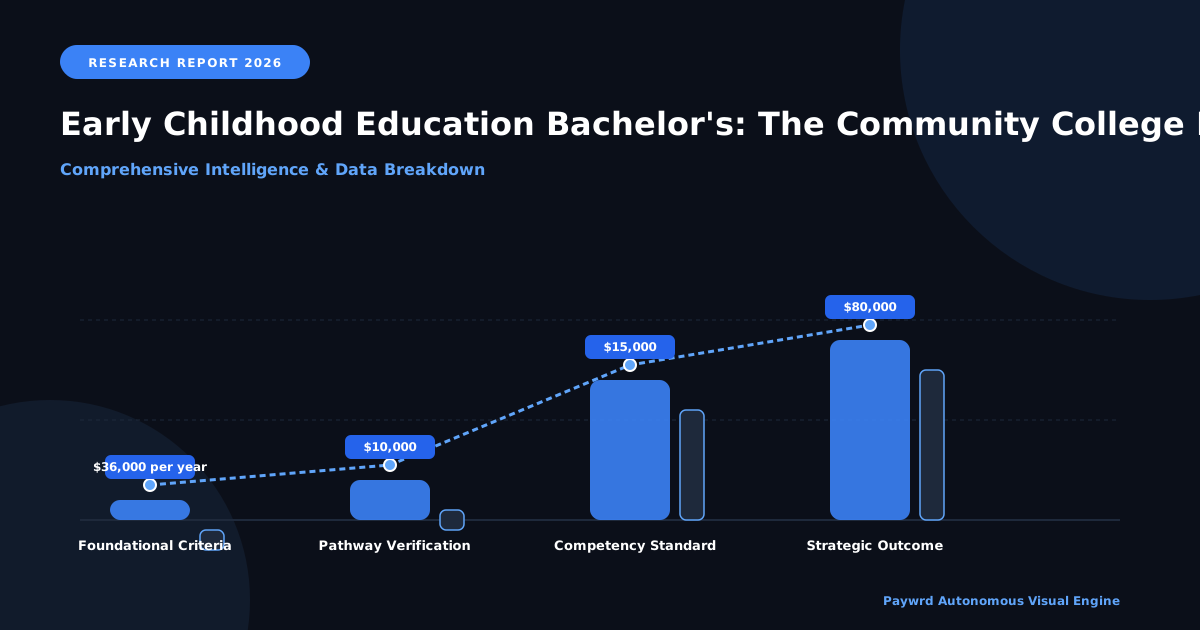
The deadline timelines are another critical pressure point. Washington State’s implementation window gives working educators roughly two academic years to come into compliance. New York’s universal Pre-K expansion has already been phased in across New York City and is now reaching suburban and rural districts with similar expectations. For a teacher earning the median early childhood wage of around $36,000 per year, the prospect of pausing work to enroll in a traditional residential bachelor’s program is financially untenable. The CCB pathway solves this by offering evening, weekend, hybrid, and fully online cohorts designed around the working learner’s calendar, frequently with employer tuition assistance braided into state scholarship funds.
There is also a notable fiscal incentive layered into the policy logic. States investing in Pre-K expansion expect a measurable return on educational quality. Higher-credentialed teachers produce stronger kindergarten readiness scores, narrowing achievement gaps and reducing remediation costs in K–3 systems. By elevating the workforce while simultaneously subsidizing the CCB pathway, states position themselves to capture both short-term labor supply and long-term educational ROI.
Ultimately, the legislative push across Washington, New York, and a growing list of other states signals a clear message: early childhood education is no longer being treated as informal caregiving but as a profession with the same academic rigor and compensation expectations as elementary education. For prospective students weighing their options, this regulatory shift means the bachelor’s degree is no longer optional career insurance; it is the entry ticket. The community college baccalaureate is emerging as the most practical bridge between where the early childhood workforce stands today and where state law demands it be tomorrow.
- Washington’s HB 1112 sets a 2026–2027 deadline for bachelor’s-level lead teachers in subsidized programs.
- New York’s universal Pre-K expansion is reinforcing bachelor’s-level credentialing across all publicly funded classrooms.
- The 120,000-worker shortage is the central workforce driver behind statewide degree mandates.
- Community college baccalaureate programs were fast-tracked because they offer the most affordable, accessible, and scalable upskilling route for incumbent workers.
- CCB programs are intentionally aligned with state competency frameworks to ensure graduates meet licensure and compliance requirements on day one.
Inside the CCB Accreditation Structure: What Makes a Degree Legitimate

When a community college in the United States awards a four-year bachelor’s degree, that credential has to clear a two-layer accreditation structure before it can be trusted by employers, state licensing boards, and graduate schools. The first layer is regional accreditation, the long-standing quality gatekeeper recognized by the Council for Higher Education Accreditation (CHEA) and the U.S. Department of Education. The second layer is programmatic alignment with the professional standards of the early childhood education field, typically tied to state early learning standards, the National Association for the Education of Young Children (NAEYC) professional standards, and content mapped to Praxis or state-specific educator examinations. Understanding both layers is essential for any student evaluating a Community College Baccalaureate, or CCB, pathway because the legitimacy of the degree depends on how cleanly these two systems interlock.
Regional accreditors such as the Northwest Commission on Colleges and Universities (NWCCU), the Higher Learning Commission (HLC), the Middle States Commission on Higher Education (MSCHE), the New England Commission of Higher Education (NECHE), the Southern Association of Colleges and Schools Commission on Colleges (SACSCOC), and the WASC Senior College and University Commission (WSCUC) evaluate an entire institution against criteria including governance, faculty credentials, student support services, assessment of learning outcomes, and financial stability. A community college that has held regional accreditation for decades, like many institutions now piloting CCB programs in Washington, Hawaii, Florida, and Texas, is not starting from zero. The regional accreditor simply extends the institution’s existing scope of accreditation to include the new baccalaureate level, a process that typically involves a substantive change review, a site visit, and an ongoing monitoring plan. For students, the practical benefit is straightforward: credits earned in regionally accredited coursework transfer more reliably across institutions than credits from nationally accredited or unaccredited providers, and federal Title IV financial aid, including Pell Grants and Federal Direct Loans, continues to flow to the program.
The second layer is where early childhood education gets its professional teeth. A legitimate CCB program aligns its coursework with state early learning standards, NAEYC’s standards for early childhood professional preparation, and the Council for the Accreditation of Educator Preparation (CAEP) or state-level educator preparation standards. Coursework typically covers child development from birth through age eight, curriculum design, observation and assessment, family and community engagement, inclusive practices for children with disabilities, and supervised fieldwork in early learning settings. Because many CCB programs are designed for working early educators, the practicum component is often embedded into existing employment, allowing candidates to complete field experiences at their own Head Start, private preschool, or public pre-K classroom under faculty supervision. Faculty teaching upper-division CCB courses are expected to hold graduate degrees in early childhood education or a closely related field, and many programs intentionally recruit practitioner-scholars who have spent years in classrooms themselves.
Articulation agreements are the connective tissue that makes the CCB pathway financially and academically viable. A well-designed CCB program will publish transfer guides showing how a Child Development Associate (CDA) credential, worth 9 to 12 college credits depending on the institution, maps into specific baccalaureate courses. The same guide typically converts an Associate of Applied Science (AAS) in Early Childhood Education into 60 to 72 credits of junior-year standing, sometimes referred to as a 2+2 structure. Prior coursework, including dual enrollment credits earned in high school, military training evaluated by the American Council on Education, and courses from other regionally accredited institutions, is reviewed under standard transfer credit policies, usually capped at around 60 lower-division credits and requiring a residency minimum of 30 upper-division credits earned at the community college itself. Programs that have signed formal baccalaureate articulation agreements with nearby four-year universities offer a second route: students can complete the first two years locally, then transfer seamlessly into a partner institution’s bachelor’s completion program with junior standing guaranteed.
- Regional accreditation ensures the degree is recognized by employers, state agencies, and graduate programs, and qualifies for federal financial aid.
- Programmatic alignment with NAEYC, CAEP, and state early learning standards ensures the degree prepares competent lead teachers and center directors.
- CDA credit articulation can translate an early childhood credential into 9 to 12 credits, reducing both time and tuition cost.
- AAS-to-bachelor’s 2+2 pathways typically grant 60 or more transfer credits, letting students enter the CCB program at junior standing.
- Residency requirements still apply, usually 30 upper-division credits earned at the community college, so the bachelor’s remains a legitimate four-year credential.
The bottom line for prospective students is simple: a CCB degree is legitimate when the community college is regionally accredited, the program is recognized by the state’s educator preparation office, the CDA and AAS credits you bring in are formally articulated, and the final transcript shows a bachelor’s degree earned at a Title IV-eligible institution. When all four conditions are met, the credential is indistinguishable from one earned at a state university, and it unlocks the same doors to graduate study, licensure, and career advancement. Before enrolling, always confirm the institution’s regional accreditor, review the published transfer credit guide, and verify that the program has been approved at the baccalaureate level by your state’s higher education board.
A Real Cost Breakdown: Tuition, FAFSA, and Hidden Savings of CCB Programs
When prospective educators first compare the price tags of a Community College Baccalaureate (CCB) program versus a traditional four-year private university, the difference can feel almost unbelievable. Most CCB pathways in Early Childhood Education (ECE) ring up between $10,000 and $15,000 in total tuition, according to benchmarks published by the American Association of Community Colleges and state higher-education finance boards. By contrast, a private, nonprofit university’s ECE bachelor’s program routinely tops $80,000 before factoring in housing, textbooks, transportation, or child care for the learner’s own family. For the average CCB enrollee, a working adult between 30 and 45 who is often supporting children while studying, that gap is not an abstract spreadsheet figure. It is the difference between graduating debt-free and taking on a decade of loan repayments.
The CCB tuition advantage starts with state-level funding formulas. Because CCB programs are housed at community colleges, they qualify for the same per-credit subsidies that keep associate degrees affordable. In states like Washington, California, Florida, and Virginia, tuition for a CCB cohort can be capped at roughly $110 to $160 per credit hour, even before financial aid is applied. A typical 120-credit ECE bachelor’s degree under this model lands near the $13,000 mark for an in-state student. Add modest fees, technology charges, and one or two textbooks per semester, and you arrive at the widely cited $15,000 ceiling.
Now layer in federal aid. Most CCB learners qualify for the Federal Pell Grant, which currently awards up to $7,395 per award year for students with the lowest expected family contribution. Because the typical CCB enrollee is an independent student, often supporting a household on a single income, the Simplified Needs Test inside the FAFSA often zeroes out their contribution calculation, unlocking the maximum award. A learner who enrolls full time for fall and spring semesters could see Pell cover well over half of their annual tuition, leaving only a few thousand dollars in out-of-pocket costs.
The FAFSA Simplification Act, fully implemented for the 2024–25 award year and tightened for 2025–26, has been especially favorable to the CCB demographic. Several legacy barriers have been removed. The Act eliminated the “man in the house” rule, restored Pell eligibility for incarcerated students, and, most importantly, expanded the definition of independent status, allowing more learners aged 24 and older to skip parental income questions entirely. For the average 30-to-45-year-old working parent, this means a faster, less intrusive application and a more reliable Pell award.
Beyond Pell, a network of state childcare workforce stipends and scholarships can dramatically reduce remaining costs. Programs like the Child Development Associates credential bonus in California, the T.E.A.C.H. Early Childhood Scholarship spanning more than 30 states, and state-funded apprenticeship wage supplements allow working educators to apply tuition reimbursement directly to their CCB bill. Many cohorts in Texas, Georgia, and Illinois have reported combined aid packages worth $4,000 to $8,000 per year, sometimes wiping out the entire remaining balance.
Then come the hidden savings, the line items that rarely make a marketing brochure but meaningfully shrink the real cost of a CCB degree. CCB learners save an estimated $15,000 to $25,000 in child-care expenses by choosing a community college close to home, since many programs offer evening, weekend, or hybrid courses that align with school-day hours. Textbook savings add another $1,200 across the degree, as CCB faculty increasingly adopt open educational resources. Even commuting costs shrink because most students drive fewer than 20 miles round-trip, avoiding the relocation and parking fees common at private universities.
For decision-makers modeling return on investment, the math is straightforward. A learner who chooses a CCB pathway at $13,000 total and finishes with zero debt can expect to recoup costs within the first two semesters of an upgraded lead-teacher salary, a wage bump averaging $3 to $7 per hour across many state QRIS systems. The same learner who borrows $80,000 at a private institution is looking at monthly loan payments that can swallow 10 percent or more of their take-home pay for a decade. The CCB route is not just cheaper at the sticker; it is engineered, by federal policy and state workforce incentives, to make a bachelor’s degree genuinely attainable for the adult learners who need it most.
The 2+2 Curriculum Model: Balancing Evening Cohorts With Practicum Hours
The Community College Baccalaureate, commonly called the CCB or 2+2 model, is engineered around one fundamental promise: every general education credit you complete in your first two years transfers cleanly into a four-year baccalaureate program, so you never repeat a single course. For working early childhood educators juggling shift schedules at licensed child care centers, this architecture is not merely convenient; it is financially transformative. Instead of paying university tuition for freshman composition, college algebra, and introductory psychology, you satisfy those requirements at the community college rate, often between $130 and $160 per credit in Washington State, before transitioning into upper-division ECE core coursework priced at roughly $250 to $415 per credit at participating institutions.
A typical eight-semester pathway unfolds like this. During the first year (Semesters 1 and 2), you concentrate on general education distribution requirements: English composition I and II, quantitative reasoning, natural science with lab, American diversity, and humanities electives. Semester 3 introduces your first ECE foundational courses, such as Child Development and Introduction to Early Childhood Education, while Semester 4 adds Curriculum Planning and Health, Safety, and Nutrition. The final 60 upper-division credits (Semesters 5 through 8) concentrate on advanced pedagogy, assessment, family engagement, language and literacy development, inclusive practices, and a capstone action-research project.
Threaded through this entire sequence is the supervised practicum, the clinical heartbeat of the degree. Washington State requires 480 documented practicum hours for the Early Childhood Education certificate that supports reciprocity across participating states, and these hours are intentionally distributed rather than crammed into a final semester. Beginning in Semester 3, you typically complete 60 to 80 hours per term in a licensed child care setting, working alongside a mentor teacher while a college supervisor conducts three on-site observations each term. By graduation, you have logged the equivalent of twelve full workweeks in real classrooms.
To accommodate working professionals, institutions have refined three delivery formats:
- Evening Cohort Tracks: Courses meet once weekly from 6:00 PM to 9:30 PM, allowing center staff to work daytime shifts without conflict. Cohort sizes are capped at 22 students to preserve seminar-style discussion.
- Hybrid Weekend Models: Face-to-face intensives run from 9:00 AM to 4:00 PM on two Saturdays per month, paired with asynchronous online modules that can be completed during evening breaks or nap-time windows.
- Competency-Based Assessments: Select programs allow experienced educators to demonstrate mastery through portfolio evidence, written defense panels, and skills demonstrations, accelerating progress and reducing redundant coursework.
What unites these designs is respect for the reality of the early childhood workforce. Lead teachers already earn modest salaries averaging $41,290 annually in Washington, so the 2+2 model preserves income while building credentials. This is not a stripped-down alternative degree; it is the same baccalaureate pathway, restructured around the lives of the adults who teach our youngest learners.
Career Outcomes and Salary Uplift for CCB-Educated Early Childhood Educators
Earning a Bachelor of Applied Science or Bachelor of Science in Early Childhood Education through a Community College Baccalaureate (CCB) pathway is more than an academic milestone—it is a direct lever for stronger career outcomes, higher compensation, and expanded leadership opportunities across the early learning workforce. National employment projections released by the U.S. Bureau of Labor Statistics (BLS) show that jobs for preschool teachers are expected to grow 3% through 2032, while kindergarten and elementary teacher positions are projected to grow 4% during the same period. These figures, drawn from the BLS Occupational Outlook Handbook, reflect steady, sustained demand driven by sustained enrollment in publicly funded pre-K programs, expanding Head Start coverage, and ongoing teacher attrition in K–3 classrooms. For CCB graduates, this translates into a labor market that actively rewards credentialed professionals who can step directly into licensed teaching roles.
The salary differential between associate-prepared and bachelor-prepared educators is one of the most compelling reasons to pursue the CCB route. According to the BLS May 2023 wage data, preschool teachers earn a median annual wage of around $35,000, with the lowest 10% earning approximately $27,000 and the highest 10% approaching $48,000. However, these aggregate figures mask a critical credential premium: educators who hold a bachelor’s degree and state licensure consistently enter the workforce at higher pay bands, particularly in public school settings. Across many districts, a bachelor-prepared early childhood educator starts near $48,000 annually, and in states that have aligned their public pre-K salary scales with K–12 schedules—such as Washington, New Jersey, and Connecticut—the starting figure climbs into the $55,000–$62,000 range.
The earnings gap becomes even more pronounced for educators who pursue leadership tracks. Head Start directors, who oversee federal grantee programs serving children from birth to age five, typically earn between $65,000 and $95,000 depending on program size and region. Likewise, public pre-K lead teachers in large urban districts command some of the strongest compensation packages in the early childhood field. In Seattle Public Schools, for instance, the entry-level salary for a credentialed pre-K lead teacher on the K–12 salary schedule begins near $68,000, with annual step increases and benefits that often exceed those available in private child care. Over a 25-year career, this credential-driven uplift can translate into more than $1 million in cumulative additional earnings compared with an associate-level peer.
Beyond raw wages, CCB graduates benefit from accelerated career ladders and portability across sectors. Because the CCB degree is awarded by an accredited institution—often holding regional accreditation from bodies such as the Northwest Commission on Colleges and Universities or the Higher Learning Commission—credits transfer cleanly to master’s programs in curriculum and instruction, educational leadership, or school counseling. This opens pathways to roles such as instructional coach, early learning coordinator, and eventually principal or district-level early childhood administrator. Actionable takeaways for prospective students include:
- Verify that the CCB program is housed at an institution accredited by a regional accreditor recognized by the U.S. Department of Education, ensuring Title IV financial aid eligibility and credit transfer.
- Confirm that the degree path satisfies state-specific lead teacher requirements under the relevant Department of Early Learning or State Office of Education rules—particularly in states like Washington, Florida, and Texas where bachelor’s-level credentials are now mandatory for publicly funded pre-K classrooms.
- Use the FAFSA (Free Application for Federal Student Aid) to access Pell Grants, state need-based aid, and TEACH Grant funding, which can offset tuition for students who commit to serving in high-need early childhood settings.
- Explore district-level salary schedules before enrolling; large public employers like Seattle Public Schools, Chicago Public Schools, and New York City Department of Education post transparent pay scales that demonstrate the long-term ROI of the bachelor’s credential.
- Plan for the Parapro to teacher bridge by leveraging existing Child Development Associate (CDA) or associate credits toward the CCB degree, shortening time-to-completion and accelerating the salary uplift.
In short, the BLS growth projections, combined with measurable salary premiums and leadership-track advancement, position the CCB-educated early childhood educator as one of the strongest workforce investments available in American education today. For students weighing cost against outcome, the data consistently favor the bachelor’s credential as the foundation for a stable, upwardly mobile, and socially impactful career.
Application Checklist: From CDA Credential to Commencement in Four Years
Transitioning from a Child Development Associate (CDA) credential to a Bachelor of Science in Early Childhood Education through a Community College Baccalaureate (CCB) pathway is one of the most financially strategic moves a working educator can make in 2025 and beyond, but it demands disciplined planning across four distinct phases: credential verification, financial aid packaging, academic record consolidation, and field-experience securing. This chronological roadmap is engineered for students who are actively employed in licensed early learning environments and want to earn a regionally accredited bachelor’s degree without sacrificing their paycheck or their classroom.
Phase 1 — Verify Your CDA Credential Portability (12 to 9 Months Before Enrollment). Begin by requesting an official CDA transcript through the Council for Professional Recognition’s online portal at cdacouncil.org. Confirm that your credential is current, that your 120 hours of formal early childhood education coursework are documented, and that your professional portfolio meets the standards required by the receiving four-year institution. Many CCB programs accept the CDA as satisfying up to 30 lower-division credits, but only when the credential is verified before the admissions file is reviewed. Email the registrar of your target CCB program to request a preliminary CDA transfer-credit evaluation, and save that written response in your admissions folder.
- Action Item: Order the CDA transcript (processing fee: $50; expedited: $100).
- Action Item: Confirm your CDA renewal cycle aligns with state lead-teacher credential requirements.
- Action Item: Request a written transfer-credit estimate from the CCB program director.
Phase 2 — File the FAFSA by Your State’s Priority Deadline (9 to 7 Months Before Enrollment). Because most CCB pathways qualify for both the Federal Pell Grant (maximum award of $7,395 for the 2025–2026 award year) and state-funded teacher scholarship programs, filing the FAFSA between October 1 and your state’s priority deadline is non-negotiable. States such as California (Cal Grant B deadline: March 3), New York (TAP: June 30), and Texas (TASFA/TEXAS Grant: priority March 15) use first-come, first-served funding pools that close long before the federal June 30 cutoff. Working educators often miss this window because they assume their income disqualifies them; in reality, the FAFSA’s Expected Family Contribution formula allows many adult learners to qualify for need-based aid even while earning a salary.
- Action Item: Create your FSA ID at studentaid.gov at least two weeks before filing.
- Action Item: Gather W-2s, tax returns, and verification of any employer tuition benefits.
- Action Item: Submit the FAFSA and the state aid application on the same day.
- Action Item: If your income exceeds Pell thresholds, complete the CSS Profile or institutional scholarship application by the CCB’s stated date.
Phase 3 — Request Official Transcripts From Every Accredited Community College Attended (7 to 5 Months Before Enrollment). Whether you completed a CDA-required practicum, a state-mandated 120-hour training, or general-education coursework at a community college, every credit must arrive in a sealed, registrar-stamped envelope or via a secure electronic service such as Parchment or the National Student Clearinghouse. Expect a $10 to $15 fee per transcript, and allow 7 to 14 business days for processing. Pay particular attention to whether your sending institution holds regional accreditation from agencies recognized by the Council for Higher Education Accreditation (CHEA); credits from non-regionally-accredited institutions are frequently rejected.
- Action Item: Compile a master list of every college, training provider, and exam vendor (CLEP, DSST) you have attended.
- Action Item: Order transcripts in a single batch to minimize duplicate fees.
- Action Item: Submit a Request for Evaluation form to the CCB’s transfer-credit office with each transcript arrival.
Phase 4 — Draft a Professional Portfolio and Secure a Practicum Partnership (5 to 1 Months Before Enrollment). Early childhood bachelor’s programs accredited by the National Council for Accreditation of Teacher Education (NCATE) or the Council for the Accreditation of Educator Preparation (CAEP) require documented evidence of competency across all eight NAEYC standards. Begin drafting your portfolio now, including lesson plans, family-engagement projects, child-assessment data, and reflective narratives tied to the NAEYC Professional Standards and Competencies for Early Childhood Educators. Simultaneously, contact the director of your current early learning site to formalize a practicum partnership. The site must be licensed, NAEYC-accredited or state-equivalent, and willing to host a practicum student for 200+ hours under the supervision of a mentor teacher holding a bachelor’s degree in early childhood education or a closely related field.
- Action Item: Request a Memorandum of Understanding (MOU) template from the CCB’s field-experience coordinator.
- Action Item: Verify the practicum site’s licensing status through your state’s Department of Children and Family Services database.
- Action Item: Compile two letters of recommendation: one from your program director and one from your site supervisor.
- Action Item: Submit the completed portfolio to the CCB’s admissions committee at least 30 days before the semester begins.
Completing these four phases in sequence converts a CDA credential into a powerful launching pad toward a bachelor’s degree, often shaving two full years off the traditional four-year timeline and saving between $15,000 and $25,000 in tuition — resources that can be redirected toward retirement contributions, emergency savings, or graduate study once the degree is conferred.
| Pathway Type | Avg. Total Tuition Cost | Admission Cut-offs | Timeline to Degree | Career ROI (Avg. Salary Lift) |
|---|---|---|---|---|
| Community College Baccalaureate (CCB) | $10,000 – $15,000 | 2.0+ GPA; Associate degree or 60 transferable credits; background clearance | 4 years (or 2 years upper-division if transferring) | +$8,000–$12,000/yr vs. associate-only |
| Traditional 4-Year Public University | $25,000 – $50,000 (in-state) | 2.5–3.0+ GPA; SAT/ACT optional at many; practicum prerequisites | 4 years full-time | +$10,000–$15,000/yr |
| Private University (Nonprofit) | $80,000 – $140,000 | 3.0+ GPA; letters of recommendation; essay; field experience | 4 years full-time | +$10,000–$15,000/yr (similar to public) |
| Associate + Transfer (2+2 Articulation) | $18,000 – $35,000 | Associate degree; minimum 2.0 GPA; state articulation agreement eligibility | 4 years total (2+2) | +$8,000–$12,000/yr |
| Online Bachelor’s (Competency-Based) | $12,000 – $22,000 | 2.0+ GPA; self-paced enrollment; technology requirements | 2.5–4 years (flexible) | +$8,000–$12,000/yr |
Strategic Final Takeaway
Success in evaluating Early Childhood Education Bachelor's: The Community College Baccalaureate Pathway relies on early preparation, adherence to verified accredited requirements, and cross-referencing official portals. Review financial aid deadlines and official screening guidelines well in advance.