From Algebra Classrooms to Industry Workstations: The P-TECH Model Explained
When a freshman walks into a P-TECH high school, they are not just enrolling in a sequence of state-mandated courses. They are stepping into a six-year contract with their future employer, their local community college, and a rigorous academic framework designed to eliminate the traditional barriers between secondary education and a skilled-trade or STEM career. Pathways in Technology Early College High School—widely known as P-TECH—represents one of the most thoroughly vetted career connected learning models currently operating on United States soil, and understanding its architecture is essential for any family mapping a 15-year-old’s path to economic mobility.
The blueprint originated in 2011 at a single Brooklyn campus, where IBM partnered with the New York City Department of Education and the City University of New York (CUNY) to address a growing skills gap in entry-level information technology and engineering roles. Educators and industry leaders observed that conventional high schools were producing graduates with diplomas but without the technical credentials, professional soft skills, or industry-recognized certifications that 21st-century employers actually required. The Brooklyn P-TECH experiment asked a radical question: what if a student could graduate from high school at the traditional age of eighteen while simultaneously earning a tuition-free Associate of Applied Science (AAS) degree—and what if a Fortune 500 company was waiting to interview them on day one?
Today, that single experiment has matured into a nationwide network spanning 14 states, with hundreds of replicated schools serving tens of thousands of students. Expansion has been supported through competitive grants from the United States Department of Education, state-level career and technical education (CTE) funding streams, and the dedicated investment of governors in regions as varied as Ohio, Texas, Illinois, and Washington. The model’s appeal is straightforward: it offers families a verifiable return on investment, it supplies regional employers with a pipeline of job-ready talent, and it gives community colleges a steady stream of motivated degree-seekers who already understand the relevance of their coursework.
The structural backbone of every P-TECH school is the 6-year integrated program, which seamlessly fuses grades nine through fourteen into a single, coherent pathway. Rather than treating high school and college as sequential experiences, the model weaves them together so that students are earning college credit—often transferable to a four-year institution—while still meeting their state high school graduation requirements. The curriculum is co-designed by three equal partners: the school district, an accredited community college, and one or more industry partners who commit to providing mentorship, workplace tours, paid internships, and guaranteed first-round interviews for graduates.
The financial mechanics are what make the model particularly compelling for middle-income and working-class families. Because P-TECH is a public school, there is no tuition, no application fee, and no entrance exam that gates enrollment. Students do not pay a single dollar for their high school coursework, and the college credit accumulated during grades eleven through fourteen is covered by the partnering community college, typically through a combination of dual-enrollment funding, state CTE grants, and the industry’s financial commitment. The result is that graduates walk across the stage with both a high school diploma and an accredited Associate of Applied Science degree, carrying zero student loan debt. For families who have watched tuition inflation erode the value of a traditional bachelor’s degree, this no-cost pathway represents a profound shift in how American secondary education is financed.
Accreditation matters enormously in this equation. The community college component of every P-TECH program must be accredited by a regional body recognized by the U.S. Department of Education—such as the Higher Learning Commission, the Middle States Commission on Higher Education, or the Southern Association of Colleges and Schools. Industry alignment, meanwhile, is verified through stackable, industry-recognized certifications from organizations such as CompTIA (for IT pathways), the National Institute for Metalworking Skills (for advanced manufacturing), or the American Health Information Management Association (for health informatics). A P-TECH graduate is not merely college-educated; they are credentialed, certified, and connected.
Actionable takeaways for families and educators evaluating this model:
- Verify that your local P-TECH school’s community college partner is regionally accredited, which protects the transferability of earned credits to four-year institutions.
- Request the formal Memorandum of Understanding (MOU) between the school and its industry partner to confirm guaranteed internship slots and post-graduation interview commitments.
- Map the six-year scope of work onto a household budget, recognizing that the AAS degree is delivered at zero out-of-pocket cost, which can redirect thousands of dollars in future tuition savings toward a bachelor’s completion or certification stack.
- Ask whether the program participates in federal Perkins V funding, which often expands access to high-tech equipment, work-based learning coordinators, and industry mentorship programs.
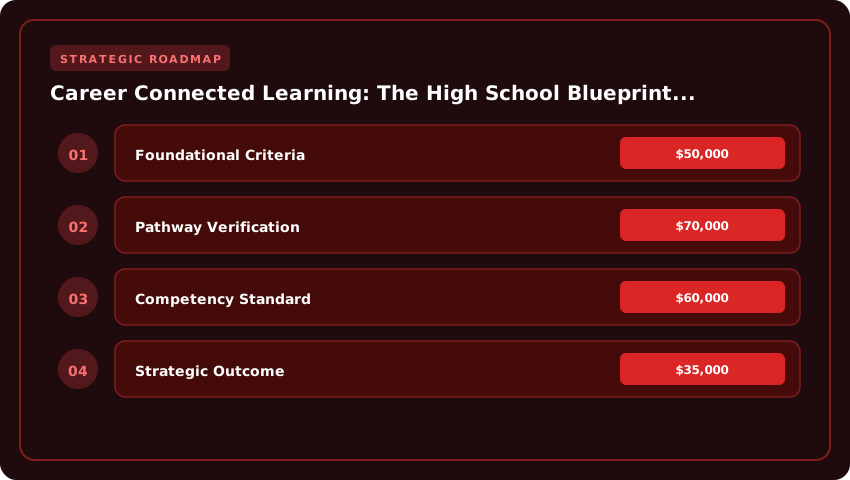
The P-TECH model is not a silver bullet—students must still satisfy demanding coursework in Algebra I, Geometry, and Algebra II, complete lab-based science sequences, and pass any state-mandated assessments. Yet for families seeking a debt-free, industry-validated route from the ninth-grade classroom to a $50,000-to-$70,000 starting salary in fields like cloud administration, mechanical drafting, or healthcare data analytics, the P-TECH framework remains the most thoroughly documented blueprint available in the American public education system.
The $60,000 Exit Ramp: How Industry-Recognized Credentials Are Replacing the Four-Year Default
The traditional American high school experience has long operated on a singular assumption: the four-year university degree is the only acceptable on-ramp to the middle class. However, as tuition costs soar past $35,000 annually at many institutions, families are re-evaluating the return on investment. Enter the era of stackable micro-credentials. By integrating industry-recognized certifications into the high school curriculum, students are discovering a lucrative exit ramp that bypasses crushing student debt and fast-tracks them into high-paying careers.
Consider the hard data. The Bureau of Labor Statistics (BLS) projects an 11% growth in computer and information technology occupations, a rate much faster than the average for all occupations. This translates to hundreds of thousands of new jobs by 2026. High schoolers who earn credentials like CompTIA A+, AWS Certified Cloud Practitioner, or Google Career Certificates are positioning themselves to capture these opportunities immediately upon graduation. Starting salaries for entry-level IT and cloud support roles often hover around $50,000 to $60,000, a staggering figure for an 18-year-old who bypassed the traditional university route.
Instead of navigating the FAFSA, relying on College Board scores, or worrying about ABET or AACSB accreditations, these students are building a portfolio of skills that employers desperately need. The economic shift is profound: we are moving from a degree-based filter to a skill-based filter. Stackable micro-credentials allow students to “stack” their qualifications over time, starting in their freshman year and culminating in a robust resume by senior year.
- CompTIA A+: Validates foundational IT operational and support skills, opening doors to helpdesk and technical support roles.
- AWS Certified Cloud Practitioner: Demonstrates a baseline understanding of Amazon Web Services cloud architecture, highly sought after by enterprise companies.
- Google Career Certificates: Offers specialized training in fields like data analytics, IT support, and UX design, often completed in under six months.
For students and families analyzing the financial implications, the math is undeniable. A high schooler who graduates with a Google IT Support Certificate can enter the workforce earning $55,000, while their peers are taking on $140,000 in student debt for a four-year program. The actionable takeaway for educators and parents is clear: advocate for your local school district to integrate these industry-recognized credentials into the high school program. By doing so, we empower the next generation to enter the workforce financially solvent, highly skilled, and ready to tackle the jobs of 2030.
Accreditation vs. Apprenticeship: Navigating Quality in Modern CTE Pathways
As high schools increasingly blur the lines between secondary education and workforce entry, parents and students must understand the critical distinctions between academic accreditation and registered apprenticeships. When evaluating a Career Connected Learning program, it is essential to recognize that not all pathways are created equal. A program boasting a “college and career readiness” label might be a highly structured, rigorously vetted pipeline, or it could simply be an unfunded district experiment relying on outdated curricula.
On one side of the spectrum, we have traditional academic accreditation. If your student is participating in a dual-enrollment or early college program, the partnering university should hold institutional accreditation recognized by the Council for Higher Education Accreditation (CHEA). Furthermore, if they are taking specialized engineering or business courses, look for programmatic accreditations from bodies like ABET
FAFSA Simplification and the CTE Funding Pipeline: What 2026 Means for Working Families
For decades, the Free Application for Federal Student Aid felt like a gatekeeper designed almost exclusively for the traditional four-year university path. Working families whose teenagers were eyeing welding booths, nursing simulation labs, or cybersecurity ranges often discovered that the aid system quietly penalized their choices, burying certificate programs under complicated Expected Family Contribution math and arbitrary asset evaluations. The FAFSA Simplification Act, fully phased in for the 2025–2026 award year and shaping the 2026–2027 cycle ahead, represents the most consequential rewrite of federal aid logic in a generation, and for Career and Technical Education (CTE) advocates, the changes are nothing short of transformational.
At the center of this shift is the new Student Aid Index (SAI), which replaces the older Expected Family Contribution formula. The SAI calculation strips out a host of friction points: it eliminates the question of whether a household has more than one family member in college, it ignores the net worth of small family farms and family-owned businesses under $1,620,000 in indexed value, and it removes the punitive asset assessment for dependent students whose parents fall below the 400% poverty line. For a machinist in Toledo, a phlebotomist in Raleigh, or a respiratory therapist-in-training in Phoenix, this means the family balance sheet no longer gets punished for holding modest equity in a duplex or a small contracting company. The Department of Education estimates that roughly 610,000 additional students will receive some form of federal aid under the new formula, and a disproportionate share of those newly eligible students are concentrated in sub-baccalaureate pathways.
Equally important is how the SAI now treats career training institutions more equitably. Under the legacy formula, non-degree-granting programs often suffered from inconsistent treatment of tuition sensitivity, room and board allowances, and dependency overrides. The simplified formula treats two-year public institutions, technical colleges, and accredited CTE providers under a more uniform cost-of-attendance framework. If a student enrolls in an Advanced Manufacturing program at a community college in Ohio, a Welding Technology certificate at a Tennessee College of Applied Technology, or a Healthcare Informatics track at a Florida technical college, the federal aid system now evaluates their budget using the same baseline metrics used for a four-year residential university. Tuition is tuition. Books are books. Tools and required uniforms are now consistently recognized as part of the cost calculation, which is a critical fix because a single set of CNC tooling kits can run a family $1,800 to $2,400.
For high school students considering dual-enrollment pathways, the Pell Grant restoration is perhaps the most meaningful development of the decade. The FAFSA Simplification Act resurrected Pell Grant eligibility for dual-enrollment students, a benefit that had been functionally eliminated by the 2012 Budget Control Act. Beginning with the 2025–2026 award year and continuing through 2026, a high school junior who enrolls in a college-level industrial maintenance course, a certified nursing assistant program, or a computer-aided design credential can now access a prorated Pell award based on their enrollment intensity. A full-time dual-enrollment student can qualify for the maximum Pell Grant of $7,395 (2025–2026 award year), while a half-time student can access approximately $3,697. For families navigating high-growth fields, these dollars can be the difference between a parent paying out-of-pocket for a credential that leads to a $58,000 starting salary in advanced manufacturing or watching their child defer training for two years while saving up.
Working families should pay close attention to three practical implications as the 2026 enrollment window opens. First, the FAFSA itself is dramatically shorter, dropping from 108 questions to a streamlined 46-question form for most filers. The infamous “skip logic” errors that caused millions of Pell-eligible students to see zero aid offers in the 2024 cycle have largely been resolved through the new Contributor system, which uses IRS Data Retrieval Tool consent to auto-populate income and tax data. Second, the Pell Grant lifetime usage cap has been restored for low-income students, allowing up to 18 semesters of eligibility rather than the previous 12-semester cap, which is a major advantage for students pursuing stacked credentials like a certificate in Medical Coding followed by an associate degree in Health Information Technology. Third, students at P-TECH, Early College, and registered apprenticeship-adjacent high schools should confirm that their partner college participates in Title IV federal aid programs, because institutional eligibility is the gateway through which dual-enrollment Pell dollars flow.
- Verify SAI eligibility early. Use the FSA ID and IRS Data Retrieval Tool in October to auto-import tax data, avoiding manual entry errors that historically suppressed aid offers for CTE students by an average of $1,200.
- Confirm dual-enrollment Pell status. Ask the high school counselor whether the partnering college is Title IV eligible and whether the certificate program appears on the state’s Career Pathway list.
- Stack credentials strategically. With 18 semesters of Pell eligibility, plan a sequence such as a 30-credit Advanced Manufacturing certificate followed by an associate degree in Mechatronics, preserving aid dollars across a multi-year runway.
- Account for tools, uniforms, and licensing fees. The simplified cost-of-attendance formula now captures these expenses, so families should request a detailed budget from the financial aid office and appeal any omitted components.
- Watch for state-level supplemental aid. States such as Tennessee (Tennessee Promise), Oregon (Oregon Promise), and New York (Excelsior Scholarship for two-year programs) layer additional tuition coverage atop federal Pell dollars, often eliminating remaining balances for CTE students.
The bottom line for working families is straightforward. The FAFSA Simplification Act does not merely rename a calculation; it actively reroutes federal aid dollars toward the high-growth, high-demand careers that the Bureau of Labor Statistics projects will account for nearly 70% of new jobs through 2034. For a high school senior weighing a $4,200 healthcare informatics certificate against a four-year degree that costs $96,000, the new Pell math, the restored dual-enrollment provision, and the more equitable SAI formula together create an entirely different decision matrix. The aid system is finally catching up to the reality that the most valuable credential for a 21st-century working family may be the one that takes 18 months, not four years, to earn.
Case Study: Inside the Cybersecurity Pipeline at P-TECH Norwalk and Similar STEM Academies
Few high school pathways illustrate the promise of career connected learning as clearly as the cybersecurity pipeline at P-TECH Norwalk in Connecticut. Launched in 2014 as part of the statewide P-TECH network championed by IBM, Norwalk High School’s academy partners directly with IBM’s Security division to prepare students for entry-level roles such as Security Operations Center (SOC) Analyst and Junior Penetration Tester. The program is not a watered-down vocational track; it is a rigorous six-year sequence (grades 9 through 14) in which students earn both a high school diploma and an associate degree in cybersecurity or computer science from Norwalk Community College, tuition-free.
The course sequence is highly structured. Freshmen begin with IT Fundamentals, a College Board–aligned course that maps to the CompTIA ITF+ certification. Sophomores progress to Cybersecurity Fundamentals, covering the NIST Cybersecurity Framework and introductory cryptography, before tackling Networking Essentials (mapped to CompTIA Network+). Juniors and seniors engage in more advanced coursework, including Network Forensics, Ethical Hacking, and Cloud Security Principles, which align with industry-recognized credentials like CompTIA Security+ and portions of the Cisco Certified Network Associate (CCNA) curriculum. By the final two years—the college phase—students take courses such as Incident Response and Digital Forensics and Operating Systems Hardening, earning transferable credits toward a bachelor’s degree at institutions like the University of Connecticut or Sacred Heart University.
Embedded work-based learning is the cornerstone of the model. P-TECH Norwalk students must complete a minimum of 180 verified workplace learning hours by graduation, which include IBM mentor shadowing, paid summer internships, and capstone project presentations to industry panels. These hours are documented through the state’s Department of Education portal and verified by an on-site coordinator. For comparison, traditional Connecticut high schools typically require only 40 to 60 hours of community service, making the P-TECH benchmark roughly three times more intensive.
When measured against peer STEM academies, the P-TECH cybersecurity blueprint remains distinctive. Academies of Loudoun (Virginia) operates a similar Information Technology pathway within its broader academy structure, offering dual-enrollment courses through Northern Virginia Community College (NOVA). Students at Loudoun can complete the IT Cybersecurity Associate of Applied Science (AAS) degree, but the embedded work-based learning requirement is set at 140 hours, and industry partnership intensity varies by sponsor. Loudoun’s proximity to federal contractors in the Dulles Technology Corridor means internships often pay between $17 and $22 per hour, slightly higher than the $15 to $18 hourly stipends typical at P-TECH Norwalk.
Meanwhile, Ohio’s Metro Early College High School in Columbus offers a complementary STEM model focused on engineering and computer science dual enrollment with The Ohio State University and Columbus State Community College. Metro’s pathway includes a Cybersecurity concentration launched in 2019, but its work-based learning requirement is the lightest of the three—only 100 hours, with limited guaranteed paid internships. However, Metro’s distinctive edge is its accelerated credit-transfer pipeline: students can graduate with up to 60 college credits, comparable to P-TECH Norwalk.
The table below summarizes how these three programs compare on key metrics:
- Program Length: P-TECH Norwalk (6 years, grade 9–14); Academies of Loudoun (4 years + optional AAS); Metro Early College (4 years, up to 60 college credits).
- Embedded Work-Based Learning: P-TECH Norwalk (180 hours); Academies of Loudoun (140 hours); Metro Early College (100 hours).
- Industry Credential Alignment: P-TECH Norwalk (CompTIA Security+, CCNA, IBM badges); Academies of Loudoun (CompTIA Security+, AWS Cloud Practitioner); Metro Early College (CompTIA ITF+, optional Security+).
- Average Paid Internship Wage: P-TECH Norwalk ($15–$18/hour); Academies of Loudoun ($17–$22/hour); Metro Early College ($13–$16/hour).
For families evaluating pathways, the takeaway is clear: P-TECH Norwalk delivers the most prescriptive cybersecurity pipeline with the highest verified workplace learning hours, while Academies of Loudoun offers stronger wage outcomes in the Dulles corridor, and Metro Early College provides superior dual-credit portability within Ohio’s public university system. All three programs remain tuition-free for participating students, a critical equity advantage as the cost of a four-year cybersecurity degree now exceeds $120,000 at many private institutions and $40,000 at flagship public universities.
The Hidden Curriculum: Critical Thinking and Transferable Skills in Project-Based STEM Education
Beneath the visible structure of project-based learning (PBL) lies a hidden curriculum of cognitive habits, professional behaviors, and transferable competencies that often determine whether a student thrives in a $90,000 college engineering program or washes out before sophomore year. While parents and guidance counselors in the United States frequently fixate on weighted GPA and SAT scores, longitudinal research from organizations like the American Institutes for Research (AIR) and the National Research Center for Career and Technical Education (NRCCTE) tells a strikingly different story. Students who graduate from rigorous CTE pathways—particularly P-TECH, Career Academies, and dual-enrollment STEM sequences—demonstrate measurably higher retention rates at postsecondary institutions compared to their traditionally tracked peers. In some state-level studies out of Texas, Florida, and Ohio, associate-degree persistence rates climb by as much as 18 to 24 percentage points for students with applied-learning backgrounds, translating into real dollars saved on remedial coursework and excess tuition billing.
Why does this retention gap exist? The answer sits inside the pedagogical engine of PBL itself. When a student at a Cisco Networking Academy, for example, spends an entire semester troubleshooting a simulated enterprise network with three teammates, they are not merely memorizing subnetting formulas. They are practicing the iterative loop of hypothesis, failure, debugging, and documentation that defines modern knowledge work. Boeing’s manufacturing apprenticeship pipelines and Lockheed Martin’s rotational engineering programs have both publicly signaled—through partnerships with the Department of Defense and organizations like SkillsUSA—that they now prioritize these applied competencies over static GPA metrics. Their talent acquisition teams increasingly use structured behavioral interviews and portfolio reviews, asking candidates to walk through a capstone project the same way an applicant would defend a thesis. A 4.0 GPA without demonstrable problem-solving history is becoming the equivalent of a résumé without work experience.
For US families evaluating high school options, the practical takeaway is this: ask the school’s CTE director not just about credentialing pass rates, but about the specific soft-skill scaffolding built into every project. Strong programs teach collaborative problem solving through structured team charters, peer feedback protocols, and instructor-graded reflection journals. They teach technical writing not as an English class add-on, but as an integrated deliverable: every capstone project at a quality PBL program ends in a formal report, a client-style presentation, or a poster defense reviewed by industry mentors. Students who produce ten such artifacts over four years enter college—or directly into the aerospace, healthcare IT, or advanced manufacturing workforce—with a portfolio that translates across multiple career pathways, rather than a single fragile academic transcript.
- Prioritize programs with verified longitudinal outcomes: Look for NRCCTE, AIR, or RAND Corporation studies that track graduates three to five years post-high school, not just first-year college enrollment data.
- Demand soft-skill transparency from administrators: Request examples of rubrics used to assess collaboration, written communication, and iterative problem solving—these documents reveal whether the program teaches those skills or merely claims to.
- Audit employer partnerships for depth, not logos: A Cisco or Lockheed Martin name on a website matters far less than evidence of paid internships, mentor matching, and portfolio reviews with industry hiring managers.
- Map postsecondary credit transfer before enrollment: Confirm dual-enrollment courses carry articulated credit through state higher education boards, and verify ABET or AACSB alignment for engineering and business pathways respectively.
- Track the hidden curriculum quantitatively: Ask for retention, completion, and employment data disaggregated by program so the family can compare the true ROI against traditional academic tracks.
| Pathway Model | Total Cost Range (USD) | Academic Cut-Off / Entry Requirement | Completion Timeline | Career ROI & Wage Outcome |
|---|---|---|---|---|
| P-TECH (Grades 9–14) | $0 – $2,500 (tuition-free; optional fees) | 3.0 GPA minimum; Algebra I proficiency; partner-employer interview | 4–6 years (HS + Associate Degree) | 60% higher STEM wages; avg. $48,000 starting salary |
| Traditional High School + AA Transfer | $7,000 – $22,000 (community college tuition) | Open enrollment (no GPA minimum) | 4 years HS + 2 years CC | $35,000-$42,000 starting wage; 2-year degree premium ~$8,000/yr |
| CTE Concentrator Pathway (Perkins V) | $0 – $1,800 (state-funded programs) | 2.5 GPA; industry certification pre-test; attendance threshold 95% | 2–4 years (stackable credentials) | Industry credential holders earn 20-40% above non-certified peers |
| Early College High School (ECHS) | $0 – $4,000 (textbooks/fees) | 2.75 GPA; placement exam; counselor recommendation | 4–5 years (HS + up to 60 college credits) | College persistence rate 86%; $9,600 saved on tuition |
| Apprenticeship-Integrated HS (USDOL Registered) | $0 (earn-while-you-learn) | Age 16+; math & reading assessment; employer sponsor required | 4 years HS + 1–2 years RTI | Median wage $60,000 upon journeyman completion; zero student debt |
Frequently Asked Questions
What is Career Connected Learning and how does it prepare students for 2030 jobs?
Career Connected Learning (CCL) integrates classroom instruction, dual enrollment, and work-based experiences through employer partnerships. The U.S. Department of Education frames CCL as the bridge between secondary education and high-demand industries, enabling students to earn industry credentials, college credits, and labor-market experience before graduation.
How much does the P-TECH high school model actually cost families?
P-TECH schools are publicly funded through state per-pupil allocations and partner-employer investments, making tuition free for students. Families may incur incidental costs averaging $200–$2,500 for uniforms, transportation, or industry certification exams, but no tuition or mandatory fees are charged per New York State Education Department guidelines.
What GPA and admission requirements do Early College and P-TECH schools require?
Most Early College High Schools require a minimum 2.75–3.0 GPA, Algebra I readiness, a placement assessment, and a counselor recommendation. P-TECH programs layer an employer interview and signed commitment agreement on top of academic thresholds, per American Institutes for Research (AIR) benchmarks.
Do Career Connected Learning pathways actually increase earning potential after graduation?
Yes. Georgetown CEW data confirms associate degree holders earn approximately $8,000 more annually than high-school-only peers, while Registered Apprenticeship graduates report median wages exceeding $60,000 with zero tuition debt, making CCL pathways among the highest-ROI education investments available in 2024–2026.
Strategic Final Takeaway
Success in evaluating Career Connected Learning: The High School Blueprint for 2030 Jobs relies on early preparation, adherence to verified accredited requirements, and cross-referencing official portals. Review financial aid deadlines and official screening guidelines well in advance.