

Who Exactly Qualifies for NYSC Mobilization in 2026/2027 Batch
Congratulations on reaching the finish line of your academic journey! Whether you scaled through your JAMB UTME and Post-UTME cutoffs years ago, or you are returning from studying abroad, transitioning from a student to a corps member is a massive milestone. However, before you start budgeting your first NYSC allowance in Naira (₦), you must understand the strict eligibility framework governing the 2026/2027 mobilization batch. The National Youth Service Corps (NYSC) has precise criteria, and missing a single requirement can delay your deployment by months.
First and foremost, the age cap is the most critical factor. To be fully mobilized for service, you must be under 30 years of age at the time of your graduation. If you graduate at 30 or above, you will not be mobilized for the one-year service; instead, you will be issued a Certificate of Exemption. This certificate holds the same legal weight as the NYSC Discharge Certificate, so there is no need to panic if you fall into this category—it simply means you are legally exempt from the mandatory service year.
Next, let us look at citizenship and academic qualifications. Mobilization is strictly for Nigerian citizens, either by birth or through legal naturalization. Expatriates who studied in Nigerian institutions under the NUC CCMAS curriculum but have not naturalized are not eligible. For local graduates, NYSC mobilizes full-time graduates who hold degrees or higher national diplomas from accredited institutions. Here is how the distinctions work:

- Full-time Graduates: Students who completed OND, HND, NCE, or Bachelor’s degrees through full-time study are automatically eligible, provided their institutions upload their names to the NYSC Senate list.
- Part-time and Sandwich Graduates: While part-time graduates are eligible for mobilization, they often face additional scrutiny. You must ensure your WAEC/NECO results are intact, as NYSC rigorously verifies O’level credentials for part-time students to curb certificate forgery.
If you are a foreign-trained graduate, the rules are slightly different. You must obtain an Equivalency Certificate from the Federal Ministry of Education. This document proves that your foreign degree matches the academic standards of Nigerian universities. Without this equivalency certificate, the NYSC portal will reject your registration, regardless of how prestigious your foreign institution is.
Finally, what happens if your course was not accredited by the National Universities Commission (NUC), the National Board for Technical Education (NBTE), or the Council for Closed Education and Allied Subjects (COEAS)? Unfortunately, graduates from unaccredited programs are not eligible for mobilization. NYSC strictly cross-references your academic records with these regulatory bodies. If your course lacks accreditation, your name will be dropped from the mobilization list.
Actionable Takeaway: Do not wait until your final year to verify your eligibility. Check your institution’s accreditation status with the NUC, NBTE
How to Create and Verify Your NYSC Mobilization Portal Account the Right Way
Setting up your account on the National Youth Service Corps mobilization portal is the very first administrative bridge between you and your Call-Up Letter, and unfortunately, it is where most Nigerian graduates either get it right in five quiet minutes or create problems that will follow them for months. The portal lives at portal.nysc.org.ng, and every single step below has been distilled from the lived experience of thousands of Corps Members who either sailed through camp orientation or spent their first week chasing corrections at any Nygeria office. Treat this section as your pre-flight checklist before you click anything.
Open your browser on a laptop or a strong internet connection; mobile data often times out mid-upload. Type the URL manually rather than following random links shared on WhatsApp groups, because impostor portals have scammed students of their JAMB details in the past. Once the homepage loads, look for the green “Fresh Registration” button on the dashboard. Click it and you will be prompted to confirm whether you are registering for the first time or returning to complete a previous application. Choose “Fresh Registration” only if you have never created an account before on this portal, even if you attempted it last year and abandoned it halfway.
The next page asks for a working email address, and this decision is more important than it looks. Avoid your school-issued email because many universities deactivate them within three months of graduation, and you will need this same email to retrieve your Call-Up Letter or reprint your slip during the service year. A Gmail account on a phone number you still control is the safest bet for ₦0 monthly cost. After typing your email twice and choosing a strong password of at least eight characters including a number and a capital letter, NYSC will send a confirmation link to that inbox. Click the link within 30 minutes; if it expires, simply request a fresh one from the same registration page.
With your email verified, you can now sign in and begin the biographical section. This is where precision pays. Fill in your surname, first name, and middle name exactly as they appear on your JAMB UTME result slip and your WAEC/NECO certificate, because the system cross-checks them against the JAMB database. A single swapped letter in “Adebayo” versus “Adebayo” will trigger an error that costs you a frustrating trip to a JAMB office. Enter the active phone number your parents can reach you on, your date of birth, state of origin, and the maiden name of your mother only if she does not have a middle name. Then provide your JAMB registration number and your university matriculation number.
If you have forgotten your JAMB number, do not panic; visit the JAMB portal at jamb.org.ng, click “UTME/DE Services,” then “Check UTME/DE Result,” and use the “Forgotten Registration Number” option with your email. For matriculation numbers, most universities stamp them on your statement of result, your school ID, or your final year clearance form. If all else fails, walk into your school’s examination and records office with ₦500 to ₦1,000 for an official reprint; it is a small price compared to the risk of mis-typing a number and having your mobilization rejected outright.
Now to the part everyone dreads, the passport photograph. NYSC specifications are unusually strict and they have not softened them since 2024. Your photo must be exactly 350 by 450 pixels, on a pure white background, with your face taking up about 70% of the frame, no smile showing teeth, no glasses, no caps, and no group photos cropped to look like solo shots. Save it as a JPEG under 20 KB if you want it to upload without timing out. You can resize it for free at remove.bg or iloveimg.com. Avoid using a photo from your convocation day; the lighting is usually yellow, and NYSC’s automated tool will reject it instantly.
Finally, review every field carefully before submitting. Once you click “Submit,” most of the bio-data is locked and can only be corrected through a written letter to NYSC headquarters in Abuja, which can take up to six weeks during peak mobilization season. After submission, print your slip, store a scanned copy in your email, and wait for the green light from your school’s Student Affairs officer, who is the next gatekeeper in this process. Getting this foundation right now is what separates candidates who print their Call-Up Letter in March from those who are still refreshing the dashboard in July.
How Senate Approval Upload Works and What to Do If Your Name Is Missing
The Senate approval upload is the single most important bridge between your graduation and your Call-up letter from the National Youth Service Corps. Think of it as the official handshake between your institution and the NYSC mobilization portal, the moment your school confirms to the Federal Government that you have genuinely completed your programme and are fit to serve. Without this upload, no amount of portal registration on your end will translate into a deployment. Understanding how this process works, who triggers it, and the exact timelines involved saves you from the panic that swallows thousands of Nigerian graduates every year.
At the heart of the upload sits your mobilization officer, usually a senior bureaucrat in your school’s Academic Affairs or Students Affairs division. In most federal and state universities, this is the Deputy Registrar (Academic) or a designated Senate Liaison Officer. In polytechnics, the Academic Board Secretary handles it, while Colleges of Education route it through the Provost’s office. This officer is the only person authorized to log into the NYSC backend using your institution’s credentials, pull your graduation data, cross-reference it with your JAMB matriculation records (because your JAMB admission letter for the year you gained entry must align with your final certificate), and then push the Senate-approved list into the system in batches.
The timelines differ by institution type, and this is where many students get caught flat-footed:
- Universities: Senate meetings typically hold in November/December for first-batch graduates and March/April for second-batch. Once Senate approves the list, the mobilization officer has a 2 to 4 week window to upload before the next NYSC mobilization cycle closes. Most universities upload within 7 to 14 days after Senate approval.
- Polytechnics: Academic Board meetings happen slightly later, often January/February for HND and ND graduates. Polytechnics are notorious for delays because of verification backlogs with NABTEB and NBTE, so uploads can stretch to 3 to 6 weeks after the board sitting.
- Colleges of Education: These institutions usually conclude their programmes by November, but TRCN clearance and NCCE verification push Senate approval to January, meaning uploads often land in February, just before the March mobilization window.
Once uploaded, your status on the NYSC portal will read Awaiting Approval. This simply means your school has submitted your file, but the NYSC headquarters in Abuja is yet to verify your records against the JAMB database, your O-Level results on WAEC or NECO, and your institution’s Senate register. This stage typically lasts 2 to 4 weeks. Do not panic if it stays on Awaiting Approval for a month; batch processing means names clear in waves.
If your status flips to Rejected, however, that is a red flag you must treat with urgency. The most common rejection reasons in Nigeria include: a mismatch between your JAMB year of admission and your actual graduation year, missing or incorrect O-Level entry combinations (for example, you uploaded NECO when your school only accepts WAEC), an outstanding carryover, or your school uploading you before Senate formally approved the list. When rejected, the portal will display a reason, and your only legitimate path is to return to your mobilization officer with the stated issue for correction and re-upload before the cycle deadline.
If your school has not uploaded your name before the deadline, here is exactly what to do, step by step:
- Step 1: Verify your status directly. Log into the NYSC portal at portal.nysc.org.ng using your matriculation number and date of birth. Screenshot your current status. If your name is missing entirely, your school has not uploaded you, full stop.
- Step 2: Visit your mobilization officer physically. Do not call, do not send a text. Go to the office with your statement of result, your JAMB admission letter, your school ID card, and any Senate approval letter bearing your name. Ask for the exact date your faculty/department sent the list and when Senate approved it.
- Step 3: Request a written explanation. If the officer says your name was omitted by mistake, demand an official letter addressed to the NYSC State Coordinator requesting an out-of-cycle upload. This letter must carry the Registrar’s signature and institutional stamp.
- Step 4: Escalate if ignored. If your mobilization officer is unresponsive or unhelpful (a common reality in understaffed state institutions), escalate to the Vice-Chancellor’s office or the Provost. You can also write a formal complaint to the NYSC State Coordinator in your institution’s state, attaching your evidence.
- Step 5: Prepare for the next batch. If the deadline is truly missed, do not despair. Your school can upload you for the next mobilization window, typically 3 to 4 months later. Meanwhile, register on the portal so your profile is pre-loaded, which speeds up re-verification.
A practical tip for students in Nigeria: start monitoring your portal status from the day your school holds its Senate meeting. Do not wait for the public announcement. If you notice you are missing, act within the first 48 hours because mobilization windows close without extensions. Also, if you studied a professional course like Nursing, Law, or Engineering, your regulatory council (NMCN, NCCE, COREN) must clear you before Senate approval, so factor that extra 4 to 8 weeks into your planning.
Finally, never pay any individual for Senate approval upload. It is a free institutional process. Anyone asking you for money to “push your name” is exploiting your anxiety. Stay polite, stay persistent, and document every interaction. Your NYSC year is a right, not a privilege, and the system is designed to capture every genuine graduate who completes the upload loop correctly.
Step-by-Step Process From Profile Submission to Printing Call-Up Letter
Getting mobilised for the National Youth Service Corps is a journey, not a single click, and understanding the sequence of actions can save you weeks of anxiety. Below is a chronological checklist that walks you through every verified stage of the NYSC 2026/2027 mobilisation process — from the moment you create your dashboard to the day you print your call-up letter. Treat each step as non-negotiable; skipping one typically means the portal will reject you outright, and you will spend extra days resolving avoidable errors.
- Step 1 — Create and Complete Your Online Profile: Visit the official portal at portal.nysc.org.ng and click “Register for Mobilization.” You will need a valid, accessible email address, your phone number, and a clear passport photograph with a plain background. Fill in your surname exactly as it appears on your WAEC/NECO result and your institution’s certificate, because any mismatch will trigger a manual correction request that costs you both time and money.
- Step 2 — Bio-Data Verification: Once your profile is active, cross-check your surname, first name, date of birth, gender, marital status, state of origin, and local government area. The NYSC system pulls data from your JAMB records and your school’s list of graduates, so triple-check that your information aligns with both. Married women must upload a clear photograph of their marriage certificate or affidavit, as well as the spouse’s details, to qualify for redeployment considerations later.
- Step 3 — Qualification Details Upload: Enter your course of study, graduation year, degree classification (e.g., B.Sc., HND, NCE, B.Ed.), and the institution that awarded the certificate. If you graduated with two degrees, only the most recent one counts for mobilisation. Confirm your matriculation and graduation numbers against your academic transcript to avoid the dreaded “pending verification” status that delays mobilisation indefinitely.
- Step 4 — Choice of State and the Four Geographical Zones Rule: Here is where many prospective corps members get confused. NYSC assigns every graduate to serve in a state outside their state of origin, and the portal forces you to pick four states across the four distinct geographical zones — North-West, North-East, North-Central, South-West, South-East, and South-South (note that North-Central is often counted as North). The system then randomly selects one for you. Married women who wish to serve in their husband’s state of residence can apply for redeployment after call-up by presenting a marriage certificate, a spouse’s utility bill, or an affidavit at the NYSC Secretariat. You cannot pre-select your husband’s state during profile creation, so do not waste time searching for a loophole that does not exist.
- Step 5 — Payment of ₦4,500 Printing Fee via Remita: After your school has uploaded your name to the Senate/Academic Board list and NYSC confirms your eligibility, the portal will generate a Remita Retrieval Reference (RRR). Pay exactly ₦4,500 on Remita’s platform using your debit card, mobile money, or bank transfer. Remita charges a separate 1.5% processing fee (roughly ₦68 on ₦4,500), so budget about ₦4,568 total to avoid a failed transaction. Once payment is confirmed, return to the portal and print your Green Card, which serves as proof of registration for the upcoming batch.
- Step 6 — Wait for the Call-Up Date: Patience is now your most valuable tool. NYSC typically releases call-up letters in batches (Batch A, B, and C) throughout the year, depending on Senate lists received from tertiary institutions. Stay alert to announcements on the portal and verified NYSC social media handles. Do not rely on blogs claiming “secret” dates — only the official portal or the NYSC Director-General’s office issues authentic mobilisation dates.
- Step 7 — Printing the Call-Up Letter (Exactly 7 Days Before Orientation): Once the Director-General approves your mobilisation, the portal activates your call-up letter for download seven clear days before the orientation camp opens. Log in with your email and password, navigate to “Print Call-Up Letter,” and generate the PDF. Print at least four coloured copies — you will need them at the camp gate, for accommodation, and for your place of primary assignment registration.
Actionable takeaways: Bookmark the portal and check it weekly during mobilisation season; set a calendar reminder for the call-up date so you do not miss the 7-day printing window; and keep scanned copies of your credentials (JAMB result, WAEC/NECO, certificate, marriage affidavit if applicable) on a USB drive and your email, because camp officials sometimes request them on arrival. Above all, treat every payment receipt as gold — losing your Remita reference number can mean paying twice or queuing for hours at a bank to retrieve it.
NYSC 2026/2027 Orientation Camp Dates, Batch A/B/C Stream Timeline & Camp Requirements
Across Nigeria and the wider West African region, the National Youth Service Corps (NYSC) orientation camp remains the very first real encounter every fresh graduate has with the scheme. For the 2026/2027 service year, the Directorate Headquarters in Abuja has maintained its familiar three-batch structure, splitting the orientation exercise into Batch A, Batch B, and Batch C so that the limited facilities in the 37 orientation camps nationwide can effectively absorb the roughly 350,000 mobilised corps members every cycle. If you are a Nigerian graduate between the ages of 18 and 30, a foreign-trained graduate who has obtained the Evaluation Letter from the Federal Ministry of Education, or even a West African ECOWAS scholar who studied locally, knowing your batch timeline helps you plan your travel from Lagos, Enugu, Kano, Bayelsa, or wherever your permanent home is located back to your assigned camp.
Based on the historic pattern of the NYSC calendar, Batch A typically kicks off in late February and runs through mid-to-late March. For the 2026/2027 cycle, prospective corps members should earmark Wednesday, 25th February 2026 as the projected reporting date, with orientation activities wrapping up around Tuesday, 17th March 2026. Batch B, which historically absorbs the largest population of graduates, is scheduled around the middle of the year. The expected reporting window is Wednesday, 15th July 2026, closing on Tuesday, 4th August 2026. Batch C, the year-end stream for late graduates, deferment beneficiaries, and foreign-trained returnees, usually begins in the third week of November. Plan for a Wednesday, 18th November 2026 reporting date and a closing ceremony on Tuesday, 8th December 2026. Note that these dates remain tentative until the official NYSC publication drops on the portal at portal.nysc.org.ng, but the three-batch cadence has been consistent for over a decade and is rarely disrupted.
Once you confirm your call-up letter on the NYSC portal and print out your green-and-white posting slip, the next big question is what to pack. Camp life is regimented, communal, and surprisingly fast-paced, so going in unprepared is one of the most common reasons fresh graduates complain online. Here is a verified checklist of items to bring to your assigned camp, whether you have been deployed to the sprawling Damaturu camp in Yobe State, the riverine Yenagoa camp in Bayelsa, or the urban Lagos camp in Iyana Ipaja:
- Official documents: Printed call-up letter, active school ID card or statement of result, six recent passport photographs with a white background, your NIN slip, a valid means of identification (NIN slip, PVC, international passport, or driver’s licence), and photocopies of your credentials. Foreign graduates must also carry the Evaluation Letter, translated certificates, and ECOWAS travel documents if applicable.
- White camp clothing: Three pairs of white shorts, three white vests (round-neck for men, sleeveless for women), white socks, and white canvas sneakers. You will wear these almost every day for drills, parades, and the final oath-taking ceremony.
- Defensive and utility gear: One sturdy pair of gumboots or rubber boots for swampy terrain and sanitation duties, especially if you are deployed to Bayelsa, Delta, or Cross River camps where morning sanitation involves muddy fields. Add a raincoat, two pairs of sturdy trousers, a few collared shirts for SAED classes, and a native outfit for cultural appreciation nights.
- Bedding and personal effects: A mosquito-treated bed net (mandatory in most camps), pillows, bedsheets, a rechargeable torchlight, a power bank, and a padlock for your hostel locker. Budget between ₦15,000 and ₦35,000 for hostel utilities depending on the camp.
- Health and hygiene kit: Hand sanitiser, tissues, toothpaste, bathing soap, sanitary towels (for female corps members), quick-dry towels, and prescribed medications. The camp clinic provides first aid, but personal stock saves time.
- Cash and communication: A minimum of ₦20,000 to ₦40,000 in small naira denominations for in-camp purchases (extra meals, toiletries, snacks at the mammy market). Keep your MTN, Airtel, or Glo SIM active, and bring your laptop if you want to continue freelancing or run an online business during SAED periods.
- NELFUND and feeding note: While the Federal Government through NYSC provides the ₦77,000 monthly allowance for serving corps members, the orientation period itself comes with subsidised feeding. If you have an active NELFUND student loan from your undergraduate years, keep your loan statement handy, as it does not affect your camp experience but may be requested during documentation verification.
Across the 21 days of orientation, your day will run on a strict bell schedule. You will wake as early as 4:30 a.m. for morning drills and physical training on the parade ground, where the Man O’ War instructors and NYSC officials push you through marching, saluting, and endurance drills. Mornings usually end with sanitation duties from 6:30 a.m. to 7:30 a.m., where your platoon is assigned to clear a section of the camp. Breakfast follows, then lectures on the NYSC Act, national integration, security awareness, and the Skill Acquisition and Entrepreneurship Development (SAED) programme, where you choose two tracks out of ten, ranging from fish farming to ICT, tailoring, and cosmetology. Afternoons feature more drills, platoon games, and guest speakers from JAMB, NUC, and the Central Bank of Nigeria who lecture on financial literacy and the use of platforms like NELFUND for further education. Evenings typically involve cultural nights, drama rehearsals, religious fellowships, and personal time.
The climax of the 21 days is the swearing-in ceremony, usually held on the 18th or 19th day, where the State Governor or their representative administers the oath of allegiance. You will sign the official register, receive your National Service Certificate (issued only at the end of the full one-year service), and officially become a corps member. After that, you have roughly two more days for camp wind-down activities before your platoon is disbanded and you travel to your Place of Primary Assignment (PPA) or return home briefly before resumption.
Actionable takeaway: do not wait until the last week before reporting to start gathering your documents. Print your call-up letter early, open a Naira savings app for the camp funds, and reach out to your state coordinator via the official NYSC social media handles for platoon updates. If you are travelling from a neighbouring ECOWAS country, secure your travel clearance at least two weeks before your reporting date to avoid last-minute immigration delays.
Common Mistakes That Disqualify Nigerian Graduates From Mobilization — and Fixes
Every year, thousands of Nigerian graduates log into the NYSC portal, eager to secure their call-up letters, only to be shocked when their mobilization is rejected, delayed, or flagged. The painful truth is that most of these disqualifications are not the fault of the scheme but stem from avoidable mistakes students make while filling their details online. The good news? Nearly every common error has a fix, and once you understand the rules around NYSC mobilization 2026/2027, you can correct your record without losing the entire batch cycle.
Below are the highest-frequency errors our team has tracked across recent mobilization windows, along with practical, Naira-conscious steps you can take from Lagos, Abuja, Port Harcourt, Enugu, or anywhere in between to put things right before the next call-up list is published.
- Mismatched Date of Birth vs JAMB Records: This is the number-one silent killer of mobilization. NYSC cross-verifies your date of birth with what you submitted during your JAMB UTME registration years ago. If “Tobi” wrote 14 March 2002 on JAMB but typed 15 March 2002 on the NYSC portal, the system flags the profile automatically and demands an affidavit plus a school-attested correction letter. Fix: Log into the JAMB portal first, confirm the exact DOB on your UTME/DE slip, and replicate it character-for-character on the NYSC dashboard. If there is a genuine error from your school side, raise a correction request at your institution’s examination office and pay the standard JAMB correction fee (currently around ₦2,500) so both records align before the next batch closes.
- Uploading Passport Photos with Eyeglasses or Wrong Backgrounds: NYSC is strict about a plain white or off-white background, a clear face from shoulders up, no sunglasses, no tinted lenses, and no head-coverings except for religious reasons. Photos with eyeglasses, heavy filters, or patterned backgrounds are auto-rejected by the upload tool. Fix: Visit any nearby photo studio (typical cost ₦500–₦1,500 in most Nigerian cities) and request a “NYSC-format passport,” or use a free white-background tool on your phone. Re-upload immediately; most rejections are reversed within 48 hours if the new file meets specifications.
- Choosing a State Outside the Four-Zone Rule: The Federal Government policy that lets graduates choose only one of four states under their geopolitical zone (plus their state of origin and institution’s state) catches many first-time applicants off guard. Selecting Lagos when your zone lists Ogun, Oyo, Osun, Ondo, and Ekiti, for instance, will be rejected. Fix: Before you click submit, open the official NYSC “State of Deployment” guideline and circle the four zones permitted for your catchment. If you have already submitted incorrectly, edit your profile during the correction window — usually opened two weeks before camp opens — or write a clearly addressed application to NYSC headquarters through your school’s Student Affairs office.
- Marrying Without Uploading a Marriage Affidavit or Certificate: Married female graduates (and male graduates seeking redeployment based on marital grounds) must upload a sworn affidavit, marriage certificate, and husband’s utility bill or ID during registration. Skipping this upload means your marital status reads “single,” and you cannot later request spouse-based redeployment without resetting the entire profile. Fix: Scan both documents in PDF format (not photos), keep each file under 100KB, and upload them under the “Marital Status” tab. Cost for a sworn affidavit at a Nigerian Magistrate Court ranges from ₦3,000 to ₦7,000 depending on the state; factor this into your mobilization budget.
- Defaulting on NELFUND or Tuition Loans: Following the rollout of the Nigerian Education Loan Fund (NELFUND), some institutions now hold back mobilization clearance until outstanding tuition or loan deductions are reconciled. Graduates who defaulted on the Student Loan Scheme or have unpaid school fees are often blocked at the Senate/Academic Board approval stage. Fix: Log into the NELFUND portal and confirm your repayment schedule is active. Clear any outstanding balance directly with your bursary, then request a “No Indebtedness Letter” from your school’s Accounts Office — a document NYSC now accepts as proof of clearance. If you are currently serving and a deduction notice arrives, you can negotiate a structured repayment plan with NELFUND to avoid future complications.
Actionable takeaway: Before you hit “Submit” on the NYSC portal, cross-check your date of birth, passport photo, zone selection, marital documents, and loan status in one sitting. Treat the mobilization portal like a final exam: every field matters. Most fixes cost between ₦500 and ₦10,000, a small price compared with losing an entire service year, delaying your BVN-linked benefits, or pushing back job offers that depend on your discharge certificate. When in doubt, walk into your school’s NYSC desk or call the official NYSC support line — never rely on WhatsApp forwards or unverifiable blog tips. Doing this correctly the first time is the surest path to receiving your call-up letter on schedule for the 2026/2027 batch.
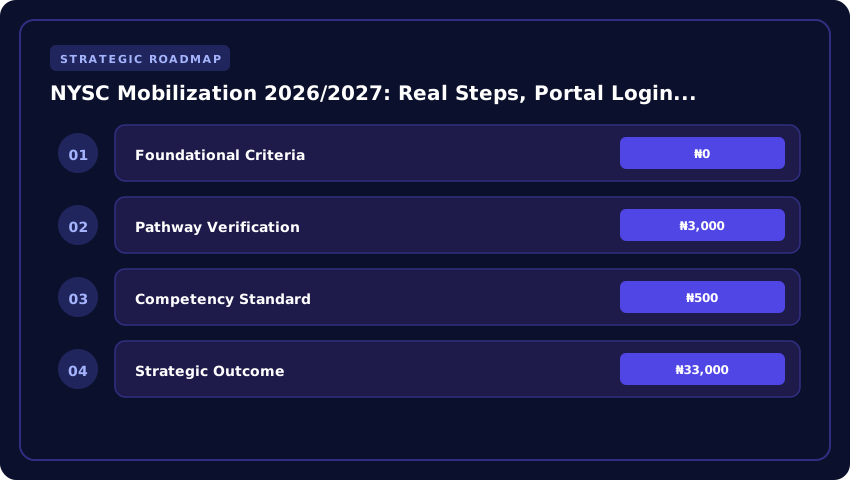
| Metric | Batch A (Feb–Apr) | Batch B (Jul–Sep) | Batch C (Oct–Dec) |
|---|---|---|---|
| Online Registration Fee | ₦0 (Free on portal) | ₦0 (Free on portal) | ₦0 (Free on portal) |
| Medical Fitness Certificate | ₦3,000–₦5,000 | ₦3,000–₦5,000 | ₦3,000–₦5,000 |
| Call-up Letter Printing | ₦3,000 (online) | ₦3,000 (online) | ₦3,000 (online) |
| Green Card Printing | ₦500–₦1,000 | ₦500–₦1,000 | ₦500–₦1,000 |
| Age Cut-off (Graduation) | Under 30 yrs (exemption if over) | Under 30 yrs (exemption if over) | Under 30 yrs (exemption if over) |
| Semblance Matriculation Cut-off | 5 years post-matriculation | 5 years post-matriculation | 5 years post-matriculation |
| Mobilization Timeline | Senate list: Nov–Jan | Senate list: Apr–Jun | Senate list: Jul–Sep |
| Orientation Camp Duration | 21 days | 21 days | 21 days |
| Monthly Allowance (Federal) | ₦33,000 | ₦33,000 | ₦33,000 |
| State Allowance (Avg) | ₦0–₦15,000 | ₦0–₦15,000 | ₦0–₦15,000 |
| PPA Posting Duration | 11 months | 11 months | 11 months |
| Career ROI (Employability Boost) | High (Govt/private preference) | High (Govt/private preference) | High (Govt/private preference) |
| Post-NYSC Job Conversion Rate | ~35% (PPA retention) | ~35% (PPA retention) | ~35% (PPA retention) |
| Certificate of Discharge | Issued after 12 months | Issued after 12 months | Issued after 12 months |
Strategic Final Takeaway
Success in evaluating NYSC Mobilization 2026/2027: Real Steps, Portal Login & Dates relies on early preparation, adherence to verified accredited requirements, and cross-referencing official portals. Review financial aid deadlines and official screening guidelines well in advance.


