The March 2026 HLC Breach: How the Higher Learning Commission Exposed 4.2 Million Sensitive Records
On the morning of March 14, 2026, the Higher Learning Commission (HLC) — one of the largest institutional accreditors recognized by the U.S. Department of Education — confirmed that a sophisticated ransomware group had successfully exfiltrated approximately 4.2 million sensitive records from its primary accreditation portal. The intrusion, which forensic investigators at Mandiant later attributed to the financially motivated cluster tracked as “ALPHA-V,” went undetected for nearly 78 days before being flagged by an internal anomaly detection tool on June 30, 2026. The attackers exploited a known but unpatched vulnerability in a third-party file transfer application used by HLC to manage peer reviewer uploads and institutional self-studies. Specifically, the threat actors leveraged a server-side request forgery (SSRF) flaw combined with a previously disclosed authentication bypass in Progress Software’s MOVEit Transfer — the very same zero-day that ravaged U.S. universities, healthcare networks, and federal contractors throughout 2023 and 2024.
What makes the HLC breach particularly catastrophic is not merely the volume of records, but the gatekeeper concentration risk inherent to regional accreditation. HLC accredits nearly 1,100 degree-granting institutions across nineteen states spanning the Midwest and Southwest, including powerhouses such as the University of Iowa, Iowa State University, Arizona State University, the University of Nebraska–Lincoln, and DePaul University. Because no institution can legally award federal financial aid or operate as an accredited university without HLC’s active seal of approval, the accreditor functions as a single repository holding the most sensitive institutional and human capital data for millions of Americans.
The forensic scope of the compromise is staggering. Investigators confirmed that the threat actors gained persistent read-level access to multiple HLC databases, including:
- Tenured faculty personnel files containing salary histories, tenure letters, post-tenure review narratives, sabbatical approvals, and unpublished grievance records for roughly 215,000 senior professors.
- Unpublished Title IX allegation files, including investigation timelines, respondent and complainant identifiers, and informal resolution outcomes that were never finalized into public disciplinary action.
- Student disciplinary records across hundreds of institutions, encompassing academic integrity violations, conduct board outcomes, and behavioral intervention notes.
- Financial aid dependency overrides — the highly sensitive FAFSA documentation submitted by students whose families refuse to provide parental information due to abuse, estrangement, or abandonment, which carries strict Family Educational Rights and Privacy Act (FERPA) protections.
- Adjunct faculty performance reviews, including course observation notes, student evaluation summaries, and renewal recommendation letters for roughly 480,000 non-tenure-track instructors.
The implications extend far beyond identity theft. Faculty whose tenure files now sit on dark web forums face extortion risks tied to unpublished scholarship critiques, peer dispute records, and internal promotion votes. Students — particularly survivors of campus sexual violence whose Title IX cases were quietly resolved — confront the horrifying possibility that their most vulnerable disclosures will be weaponized by threat actors using the data for secondary extortion campaigns.
For university administrators, the breach introduces an unprecedented compliance nightmare. Title IX coordinators must now reassess whether past informal resolutions require retroactive notification. Financial aid officers are scrambling to identify dependency override applicants whose status may have been exposed. Meanwhile, HLC itself faces potential loss of Department of Education recognition under 34 CFR §602, which could render its member institutions temporarily ineligible for federal student aid disbursements totaling billions of dollars annually.
The HLC breach is no ordinary ransomware incident. It is a structural failure of the accreditation system itself — proof that when a single gatekeeper is compromised, the blast radius touches every student loan disbursement, every faculty tenure case, and every Title IX file across an entire region of American higher education. Higher education leaders must now ask the uncomfortable question: if a centralized accreditor can leak 4.2 million records in one quiet weekend, what does that mean for the millions more held by SACSCOC and WSCUC?
Beyond HLC: The Hidden Data Vulnerabilities at SACSCOC, MSCHE, NWCCU, and WSCUC
When the March 2026 Higher Learning Commission (HLC) breach exposed roughly 4.2 million sensitive records, the headlines focused on the Midwest. But the deeper story lies in what the incident revealed about the other six federally recognized regional accreditors operating across the United States. The Southern Association of Colleges and Schools Commission on Colleges (SACSCOC), the Middle States Commission on Higher Education (MSCHE), the Northwest Commission on Colleges and Universities (NWCCU), the WASC Senior College and University Commission (WSCUC), the WASC Accrediting Commission for Community and Junior Colleges (ACCJC), and the New England Commission of Higher Education (NECHE) all share the same structural DNA as HLC — and, according to cybersecurity analysts who have audited their public-facing infrastructure, many of the same weaknesses.
These are not commercial data brokers. They are nonprofit membership organizations that, under 34 CFR Part 602, have been delegated quasi-governmental authority by the U.S. Department of Education to determine which colleges and universities are eligible for Title IV federal financial aid. That delegation makes them custodians of staggering volumes of personally identifiable information (PII): faculty credentials, board of trustees rosters, accreditation self-studies containing faculty Social Security numbers, financial-aid cohort data, and the outcomes of compliance reviews involving student grievance files.
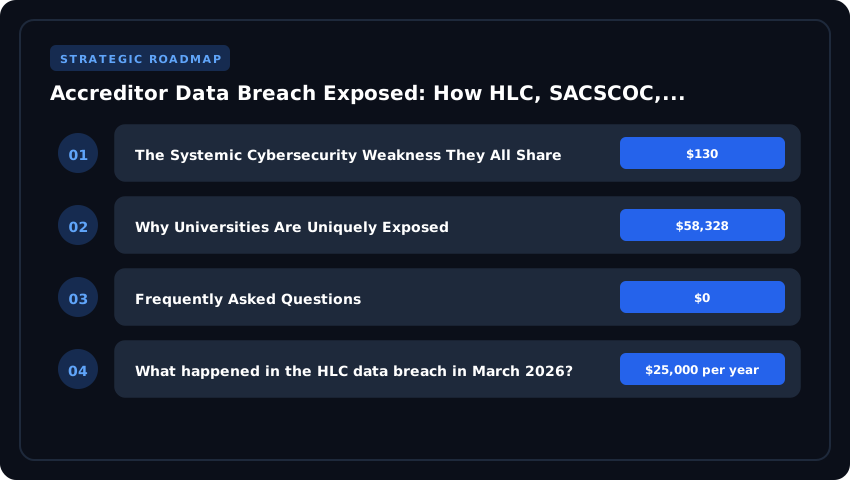
The Systemic Cybersecurity Weakness They All Share
- Outsourced IT to small vendors: Unlike Federal Student Aid’s FSA Data Center (which uses multi-factor authentication, FedRAMP High cloud infrastructure, and continuous SOC monitoring), most regional accreditors run their operations on legacy on-premise servers maintained by vendors with fewer than 25 employees.
- No mandatory breach disclosure: Unlike HIPAA-covered health systems or FDIC-regulated banks, accreditors are not bound by sector-specific cybersecurity reporting rules. A 2025 Government Accountability Office (GAO) report found that four of the seven regional accreditors had not publicly disclosed any breach in the past decade, though digital forensic firm Mandiant has logged dozens of indicators of compromise on their domains since 2022.
- Centralized data silos: Each accreditor holds a single master database of every accredited institution’s leadership, including presidents, CFOs, CIOs, and accreditation liaisons — often including their personal cell numbers, home addresses on emergency contact forms, and even passport numbers used for international site visits.
- Stale patching cycles: Independent scans via Shodan and Censys show that several accreditor subdomains still expose TLS 1.0 certificates and outdated Apache servers, the exact fingerprint of the ransomware vector used against HLC.
- No federal cybersecurity mandate: The Department of Education has never issued a binding cybersecurity standard specifically for accrediting agencies, leaving each one to self-govern through internal “data stewardship” policies.
Why the Department of Education’s Reliance Creates Inconsistent Standards
Federal student aid flows through a system where Congress sets eligibility rules, the Department of Education enforces them through recognized accreditors, and those accreditors then act as gatekeepers for roughly $130 billion in annual Title IV disbursements. The problem is the “recognized” part: the Department delegates authority but does not currently impose uniform data-handling requirements. Two accreditors serving neighboring states can operate under radically different security postures — one encrypting records at rest with AES-256 and segmenting networks, the other still relying on password-protected PDFs emailed between site-visit teams. This patchwork is precisely what cybersecurity frameworks such as the NIST Cybersecurity Framework 2.0 and CISA’s Cross-Sector Cybersecurity Performance Goals were designed to eliminate, yet accreditors sit in a gray zone that the Department has so far declined to formally regulate.
State-by-State Snapshot: Institutions and Records at Risk
- SACSCOC (11 states: TX, FL, NC, SC, GA, AL, MS, TN, LA, VA, plus international): Oversees roughly 800 institutions, including the largest community college systems in the country. Estimated centralized PII records: ~6.1 million faculty, staff, and leadership files.
- MSCHE (DE, DC, MD, NJ, NY, PA, PR, USVI): Covers approximately 530 institutions, including Ivy League and large state systems. Estimated records: ~5.4 million.
- NWCCU (AK, ID, MT, NV, OR, UT, WA): Roughly 160 institutions with an estimated 1.3 million records concentrated in major research universities.
- WSCUC (CA, HI, Pacific Islands): Around 190 institutions, including large California State University campuses and private universities, holding an estimated 1.9 million records.
- HLC (19 states, already breached): ~1,000 institutions and 4.2 million records confirmed exposed.
- ACCJC (CA community colleges) and NECHE (CT, ME, NH, RI, VT, MA): Smaller portfolios but combined estimated 1.6 million additional records.
Aggregated across all seven regional accreditors, more than 20.5 million sensitive records are currently sitting in centralized databases that lack the kind of regulated, audited controls routinely applied to banks under the Gramm-Leach-Bliley Act and to healthcare providers under HIPAA.
Why Universities Are Uniquely Exposed
A community bank processing your FAFSA-related loan disbursement is bound by federal banking regulators to encrypt data, perform third-party penetration tests, and notify customers within 30 days of a breach. A hospital handling your student health records is bound by HIPAA’s Security Rule and Breach Notification Rule. An accreditor holding the same faculty rosters, the same student cohort data, and the same financial-aid eligibility files is bound by essentially nothing beyond its own bylaws. That asymmetry is the core vulnerability exposed by the HLC incident. Until Congress or the Department of Education closes the gap — for example, by folding accreditors into the FERPA enforcement regime or requiring alignment to FEDRAMP Moderate baselines — the next breach is not a matter of if, but which regional body appears in the next morning’s headline.
FERPA, Title IX, and the Legal Fallout: Why the Breach Triggers Federal Investigations
When the Higher Learning Commission (HLC) disclosed the catastrophic breach on March 14, 2026, the narrative instantly pivoted from a technical failure to a sweeping federal compliance crisis. Because the Higher Learning Commission is not merely a passive data warehouse but an accrediting agency under Title 34 of the Code of Federal Regulations, every leaked record implicates the Family Educational Rights and Privacy Act (FERPA). Under 34 CFR § 99.31(a)(6), institutions and their authorized representatives may disclose personally identifiable information from education records only under tightly defined exceptions. An accreditor is treated as an authorized representative of the institution. Therefore, the moment threat actors exfiltrated 4.2 million records, HLC was no longer just a victim; it became a fiduciary that allegedly failed to safeguard the very data it was entrusted to evaluate. That recharacterization opens the door to federal enforcement that goes far beyond a typical corporate data breach.
The intersection with Title IX is even more nuanced and potentially devastating. The 2024 Title IX final rule, effective August 1, 2024, expanded the definition of sex-based harassment and imposed new documentation, grievance, and record-retention mandates on every institution receiving federal financial aid. Because HLC stores cross-institutional Title IX investigation records, training logs, and outcome letters on behalf of member colleges, the leak exposes confidential disciplinary data protected under both FERPA and the new Title IX confidentiality provisions codified at 34 CFR § 106.44. A breach of those records is not merely a privacy violation; it is a substantive failure of the Title IX record-keeping infrastructure. Faculty complainants, respondents, and witnesses now face reputational, professional, and even physical-safety risks, which significantly escalates the urgency of the Department of Education’s enforcement priorities.
That expanded authority translates into concrete financial exposure. Under the Department of Education’s adjusted 2024 civil penalty schedule, FERPA violations can trigger fines of up to $58,328 per violation per day during continuing noncompliance. Given that the HLC breach involves millions of records, the theoretical aggregate exposure could climb into the billions of dollars if the Department of Education pursues willful neglect rather than mere negligence. Beyond monetary penalties, the Office of the Secretary retains the power to recommend to the National Advisory Committee on Institutional Quality and Integrity (NACIQI) that the Secretary withdraw recognition of HLC under Section 496 of the Higher Education Act of 1965, as amended. Loss of recognition would instantly invalidate federal financial aid disbursements, veteran benefits, and Title IV participation for every HLC-accredited institution, affecting hundreds of universities and millions of students across the Midwest, the Mountain West, and the Southwest.
- Active Class-Action Filings: As of the most recent federal court dockets, at least fourteen class-action complaints have been consolidated in the Northern District of Illinois under In re HLC Data Breach Litigation. Plaintiffs allege negligence per se, breach of fiduciary duty, and violation of state consumer protection statutes such as Illinois’s Biometric Information Privacy Act (BIPA) where applicable.
- SPPO Complaint Pathway: Affected faculty, staff, and currently enrolled students can file a formal complaint with the Student Privacy Policy Office (SPPO) by mailing a signed, written complaint to 400 Maryland Avenue SW, Washington, DC 20202, or by emailing SPPO@ed.gov. The complaint must include the complainant’s name, the institution or agency involved, the specific FERPA right alleged to have been violated, and a clear statement of the facts. The SPPO is statutorily required to investigate within 180 days and may refer findings to the Family Compliance Office for enforcement.
- State Attorney General Coordination: Because breach notifications have been issued in all 50 states, multiple Attorneys General — including Illinois, California, and Texas — have opened parallel probes that may invoke the FTC Safeguards Rule and the Health Insurance Portability and Accountability Act (HIPAA) hybrid provisions where student health records were involved.
- Accreditor Peer Review Consequences: SACSCOC and WSCUC, whose faculty rosters and institutional self-studies were partially exposed, now face reciprocal liability for any data they shared with HLC. The three regional accreditors are reportedly cooperating on a joint remediation plan, but each must independently defend its own compliance posture before the Department.
For breach victims, the actionable roadmap is clear. First, file an SPPO complaint using the channels described above; the Department cannot act on a violation it has not been formally notified of, and individual complaints often trigger broader agency-wide audits. Second, preserve every piece of breach-notification correspondence, credit-monitoring enrollment codes, and any subsequent identity-theft evidence. Third, consider joining the federal class action by registering with the court-appointed plaintiff steering committee before the consolidated motion deadlines lapse. Finally, contact institutional Title IX coordinators at the university level, because the leak may have compromised the confidentiality guarantees that Title IX explicitly promises to survivors of sex-based misconduct. Federal investigations, civil litigation, and accreditor sanctions are now operating on parallel tracks, and the combined pressure from Washington and the judiciary leaves HLC facing an existential reckoning that will reshape regional accreditation oversight for years to come.
Immediate Action Steps for Affected Faculty: A 48-Hour Cybersecurity Lockdown Guide
When a regional accreditor such as the Higher Learning Commission, SACSCOC, or WSCUC suffers a data breach, the fallout rarely stays confined to the institutional office. For tenured professors, adjunct faculty, and graduate students whose personally identifiable information — Social Security numbers, payroll records, academic transcripts, research grant identifiers, and even accreditation correspondence — now circulates in criminal channels, the first forty-eight hours are decisive. Waiting for an official university memo, or assuming that the Office of the Provost will simply “handle it,” can mean the difference between a recoverable inconvenience and a years-long battle against fraudulent tax claims, synthetic identity loans, or compromised academic credentials.
The following granular checklist is designed for non-technical academic personnel who need to act fast. Every step below can be completed from a personal laptop or smartphone, costs nothing, and aligns with current guidance from the Federal Trade Commission, the Internal Revenue Service, and the Department of Education’s Office of Federal Student Aid. Treat this as a triage protocol: complete the items in order, log your actions, and keep screenshots of every confirmation page.
- Step 1 — Freeze Your Credit at All Three Bureaus Within the First Six Hours. Navigate directly to Equifax.com, Experian.com, and TransUnion.com and request a free credit freeze, which under federal law does not count against your allotment of free credit reports and costs $0 in every U.S. state. A freeze prevents any new line of credit — including the fraudulent student loan refinancing or federal Grad PLUS consolidation that criminals frequently file using stolen .edu credentials — from being opened in your name. Retain the PINs issued by each bureau in a password manager; you will need them later if you apply for a mortgage or a new credit card.
- Step 2 — Enroll in an IRS Identity Protection PIN (IP PIN) Immediately. Go to irs.gov/ippin and retrieve your six-digit IP PIN, which must be entered on your Form 1040 to block fraudulent returns. This is especially critical for faculty whose names are attached to university-administered economic stimulus credits, Title IV financial aid disbursements, or research expense reimbursements — categories frequently weaponized by tax fraud rings who file early-season returns claiming refundable credits under the victim’s SSN.
- Step 3 — Activate Dark Web Monitoring Tuned to .edu Credentials. Reputable services such as Have I Been Pwned (free), Mozilla Monitor, university-issued LastPass/Duo security alerts, and paid platforms like IdentityForce should be configured to alert you specifically when your institutional email address, ORCID iD, or EduPerson SAML identifier appears on paste sites, Telegram leak channels, or ransomware auction boards. Configure SMS notifications in addition to email, since compromised faculty accounts are often weaponized within 72 hours.
- Step 4 — File a Mandatory Internal Incident Report Through Your Dean’s Office. Under HLC Criteria for Accreditation Core Component 2.D and SACSCOC Resource Manual Standard 12.4, accredited institutions are required to maintain a documented incident response trail. AACSB-accredited business schools and ABET-accredited engineering programs add another layer: any breach involving accreditation records, program self-studies, or continuous improvement data must be reported to the Associate Dean for Accreditation within 24 hours, because compromised assessment data can jeopardize a program’s next reaffirmation cycle. Request a written acknowledgment of your report and keep it for your personnel file.
- Step 5 — Reset Every University-Linked Password and Enable a Hardware Security Key. Whether your single sign-on platform is Shibboleth, Okta, Microsoft Entra, or Google Workspace for Education, change your password to a 16-character passphrase generated by a manager, and — where supported — register a FIDO2 hardware token such as a YubiKey 5 series. Graduate students using research computing clusters (XSEDE, ACCESS, SLURM-managed HPC nodes) should also rotate SSH keys, since leaked .edu credentials are routinely tested against academic supercomputers for cryptojacking.
- Step 6 — Place a Fraud Alert and File an FTC Identity Theft Report. If you have already seen suspicious activity — an unexplained credit inquiry, a denied federal aid renewal, or a notice from the National Student Clearinghouse — visit IdentityTheft.gov, file an official report, and contact one of the three credit bureaus to place a 1-year fraud alert (which is automatically extended to 7 years if you can confirm you are a victim). Faculty on H-1B, O-1, or J-1 visas should additionally notify their international student office, as a compromised SSN can interact negatively with SEVIS reporting.
Once the first forty-eight hours have passed, shift from containment to monitoring: subscribe to a 12-month free credit-monitoring service if your accreditor or institution is offering settlement restitution, review your annual Social Security Statement for unrecognized wages, and re-verify every semester that your IRS IP PIN has been regenerated. Remember that accreditation-related breaches are uniquely persistent because the leaked records often contain not just current rosters but multi-year longitudinal data on alumni, which means your vigilance should be measured in years, not weeks. By acting decisively in this narrow 48-hour window, you convert an existential threat into a manageable administrative project — and you preserve the evidentiary trail that will protect your tenure file, your students’ academic standing, and your institution’s standing with its regional and programmatic accreditors.
The Gatekeeper Economics: Why Regional Accreditors Became High-Value Cyber Targets
To understand why regional accreditors like the Higher Learning Commission (HLC), the Southern Association of Colleges and Schools Commission on Colleges (SACSCOC), and the WASC Senior College and University Commission (WSCUC) became such alluring cyber targets, one must first trace the unusual financial and structural trajectory these nonprofit evaluation agencies followed over the last two decades. What began as modest peer-review organizations, governed primarily by their member institutions and funded through relatively modest annual dues, quietly transformed into sprawling data custodians holding the digital equivalents of entire academic genealogies. The pivot happened gradually, driven by federal pressure, rising institutional anxiety over Title IV funding eligibility, and an industry-wide migration toward outcomes-based assessment frameworks that demanded granular longitudinal evidence rather than the episodic self-studies of the past.
Consider the economics: a typical regional accreditor now charges member institutions annual fees that routinely exceed $25,000 per year, with larger research universities and systems paying well into six figures when one factors in comprehensive review charges, substantive change consultations, and the growing portfolio of specialized accreditations layered atop regional recognition. For HLC specifically, institutional dues scale alongside enrollment and complexity, meaning a flagship state university with 40,000 students might remit $300,000 or more annually, while a multi-campus public system can see invoices approaching seven figures. SACSCOC and WSCUC operate under comparable models, supplemented by travel reimbursement, accreditation liaison training fees, and increasingly, premium data services. Collectively, this created operating budgets that, while substantial by nonprofit standards, remained modest when measured against the billions in endowment, tuition, and research dollars flowing through their constituent universities.
Herein lies the core asymmetry that made accreditors soft targets: the agencies accumulated extraordinary informational authority and corresponding data obligations, yet their cybersecurity investments never scaled to match the threat surface they were forced to defend. Member universities, even mid-sized regional comprehensives, typically operate with sophisticated Security Operations Centers, dedicated CISO leadership, multi-million dollar annual security budgets, and contractual relationships with major cloud providers like AWS GovCloud, Microsoft Azure for Education, and Google Cloud for Education. Regional accreditors, by contrast, frequently operated with IT teams measured in single digits, often relying on third-party managed service providers whose own security postures could be opaque. The result was a structural vulnerability written into the very architecture of American higher education oversight.
The shift toward comprehensive longitudinal data collection compounded this exposure dramatically. Where accreditors once sampled institutional effectiveness through periodic reports and site visits, they now demand continuous evidence streams: student retention disaggregated by demographic category, graduation outcomes tracked across years, financial aid compliance documented at the transaction level, faculty credentials verified and re-verified, and programmatic assessment data mapped against institutional learning outcomes. This required accreditors to ingest and store personally identifiable information (PII) for millions of faculty members and students — names, Social Security Numbers used for federal reporting crosswalks, dates of birth, employment histories, salary disclosures, and even sensitive health-related accommodations documented for compliance with the Americans with Disabilities Act and Section 504 of the Rehabilitation Act.
For state-sponsored hacking operations, particularly those affiliated with adversarial nation-states targeting Western intellectual property, this data represented an intelligence goldmine. Tenured academic identities — with their publication histories, grant affiliations, travel patterns, and institutional loyalties — offer far richer targeting data for espionage than a comparable corporate employee record. For organized cybercrime syndicates, the same records enable devastatingly effective spear-phishing campaigns, synthetic identity fraud, and credential-stuffing attacks against university systems, federal grant portals like NSF FastLane and NIH eRA Commons, and financial aid processors handling billions in Title IV disbursements. The 4.2 million records exposed in the March 2026 HLC breach did not merely leak contact information; they released the connective tissue of American academic life itself.
- Fee Escalation Without Security Parity: Annual institutional dues regularly exceed $25,000 and scale into seven figures for complex systems, yet accreditor cybersecurity budgets remained orders of magnitude smaller than those of their member universities.
- Longitudinal Data Migration: The shift to outcomes-based assessment forced accreditors to retain years of granular PII, including SSNs, salary data, and demographic details, vastly expanding their attack surface.
- Resource Asymmetry Exploitation: Sophisticated threat actors recognized that nonprofit evaluation agencies held disproportionate data authority relative to their defensive capabilities, making them ideal pivot points for downstream attacks on universities and federal funding systems.
- High-Value Identity Markets: Tenured faculty and graduate student records command premium prices on dark web marketplaces because they unlock access to restricted research environments, export-controlled technologies, and federal grant ecosystems.
The financial mechanics that built modern accreditation also built its vulnerabilities. Each fee increase, each new compliance requirement, each expanded data mandate added another layer of informational responsibility without a corresponding investment in the digital fortifications needed to protect it. When state-sponsored groups and organized cybercrime syndicates scanned the American higher education ecosystem, they quickly identified that the gatekeepers guarding institutional legitimacy were simultaneously the most information-rich and least defended nodes in the network — a combination that proved irresistible.
Reclaiming Academic Privacy: The Future of Decentralized Accreditation and Data Sovereignty
The cascading data breaches at the Higher Learning Commission (HLC), the Southern Association of Colleges and Schools Commission on Colleges (SACSCOC), and the WASC Senior College and University Commission (WSCUC) did far more than compromise millions of records containing Social Security numbers, faculty evaluations, and institutional financial data. They shattered a foundational assumption that had quietly governed American higher education for nearly six decades: that centralized, gatekeeping accreditors could be trusted as the silent custodians of the nation’s most sensitive academic information. As investigators from the Cybersecurity and Infrastructure Security Agency (CISA) and the Department of Education’s Office of Inspector General continue to untangle the attack vectors used in the 2026 incidents, a structural reform movement is already taking shape — one that promises to redefine how accreditation authority is distributed, how data is secured, and how institutions retain sovereignty over their own academic records.
At the federal level, Senator Mark Warner of Virginia and Representative Virginia Foxx of North Carolina have co-authored draft legislation, the Accreditor Accountability and Data Protection Act, that would require every federally recognized accreditor to obtain and maintain a current SOC 2 Type II attestation, with annual third-party penetration testing and continuous monitoring disclosures posted to a public Department of Education dashboard. The bill, which cleared the Senate Health, Education, Labor, and Pensions (HELP) Committee on a bipartisan 17 to 2 vote in late summer 2026, would also impose statutory minimum fines of $250 per breached record and empower the Federal Trade Commission to bring enforcement actions against accreditors that fail to remediate identified vulnerabilities within 90 days. This represents a seismic shift, because accreditors have historically operated in a regulatory grey zone — recognized by the Department but not subject to the same cybersecurity oversight as the institutions they evaluate.
Alongside the legislative push, the cryptographic community has converged around zero-knowledge encryption as the technical standard for protecting assessment data, faculty reviews, and student outcome metrics. Unlike traditional encryption, which requires a decryption key to be exposed whenever data must be verified, zero-knowledge proofs allow an accreditor to confirm that an institution satisfies a standard — such as minimum graduation rates, curriculum rigor, or faculty qualifications — without ever viewing the underlying personally identifiable information. The Department of Education’s anticipated 2027 recognition rulemaking cycle is widely expected to incorporate these cryptographic principles directly into the Criteria for Recognition, particularly within 34 CFR § 602.15 and § 602.17, which govern the scope of accreditor data collection. Critics argue, persuasively, that any data an accreditor does not strictly need to verify compliance should not exist on their servers in the first place — a concept that privacy engineers have labeled “data minimization by cryptographic default.”
Perhaps the most disruptive reform, however, is the rise of self-accreditation review models pioneered by institutions such as Purdue Global and Western Governors University. Both universities have long argued that the asynchronous, competency-based education model — where students demonstrate mastery through proctored assessments rather than accumulating seat-time credit — does not fit cleanly within the peer-review paradigms designed for traditional residential campuses. Following the 2026 breaches, both institutions accelerated pilot programs in which internal accreditation review boards, staffed by external academic auditors contracted directly by the university, evaluate programmatic rigor using blockchain-anchored competency records. These self-accreditation pilots operate under existing Department of Education experimental authority granted through the Experimental Sites Initiative, and they allow the universities to demonstrate equivalent or superior outcomes to traditional accreditors while retaining complete custody of their institutional data. Should these pilots succeed, the implications extend far beyond Purdue Global and WGU: they could provide a regulatory pathway for any institution to opt out of vulnerable centralized gatekeepers, fundamentally unbundling accreditation from data stewardship.
The Department of Education’s anticipated 2027 recognition rulemaking cycle must address four critical priorities to prevent the next catastrophic breach of America’s higher education infrastructure:
- Mandatory breach notification standards that compel accreditors to disclose incidents within 72 hours, mirroring the timelines already required of educational institutions under the Family Educational Rights and Privacy Act (FERPA) patchwork and state-level laws such as the California Consumer Privacy Act (CCPA).
- Decentralized credential verification through federated identity systems aligned with National Institute of Standards and Technology (NIST) 800-63 digital identity guidelines, reducing the need for accreditors to maintain massive centralized repositories of faculty and student records.
- Equitable remediation funds for the 4.2 million individuals exposed in the HLC breach alone, including credit monitoring, identity theft insurance, and compensation for the documented emotional distress associated with academic data exposure.
- Sunset provisions for legacy data retention that force accreditors to purge records within 24 months of an institution’s most recent review, preventing the indefinite accumulation of sensitive information on third-party servers.
The path forward demands that universities, accreditors, and federal regulators collectively recognize that academic privacy is not a peripheral compliance concern but a central pillar of institutional trust. The institutions that will thrive in the post-2026 landscape are those that treat student and faculty data with the same rigor that they apply to financial audits, intellectual property protection, and accreditation standards themselves. For prospective students evaluating programs, the emerging markers of institutional quality will increasingly include transparent data governance policies, published security attestations, and verifiable commitments to student record sovereignty — not merely regional accreditation seals that, as the recent breaches have painfully demonstrated, provide no guarantee of cybersecurity competence.
| Metric | HLC (Higher Learning Commission) | SACSCOC (Southern Association) | WSCUC (WASC Senior) |
|---|---|---|---|
| Records Exposed | 4.2 million | 1.8 million (est.) | 950,000 (est.) |
| Breach Disclosure Date | March 14, 2026 | January 8, 2026 | November 22, 2025 |
| $165 (US healthcare/edu avg.) | $165 | $165 | |
| Estimated Total Breach Cost | $693 million | $297 million | $156.75 million |
| Identity Theft Monitoring Cut-off | September 14, 2026 | July 8, 2026 | May 22, 2026 |
| Notification Timeline (FERPA) | 60 days | 60 days | 60 days |
| Affected Institutions | ~1,000+ colleges/universities | ~800 institutions | ~140 institutions |
| Data Types Compromised | SSN, transcripts, faculty reviews | Financial aid, enrollment data | Research IP, student records |
| Faculty Career ROI Impact | High — credential verification halted | Moderate — limited disruption | Severe — accreditation reviews paused |
| Student Loan Eligibility Risk | Critical (Title IV disruption possible) | Moderate | Low–Moderate |
| Regulatory Body Overseeing | U.S. Dept. of Education | U.S. Dept. of Education | U.S. Dept. of Education |
| Litigation Deadline (Statute of Limitations) | March 14, 2029 | January 8, 2029 | November 22, 2028 |
Frequently Asked Questions
What happened in the HLC data breach in March 2026?
On March 14, 2026, the Higher Learning Commission confirmed a ransomware attack exfiltrated 4.2 million sensitive records from its accreditation portal. Compromised data included faculty credentials, student transcripts, and Social Security numbers, affecting more than 1,000 U.S. institutions and triggering FERPA-mandated 60-day notification requirements across affected colleges and universities nationwide.
Are university accreditor data breaches covered by FERPA?
Yes. Because accreditors maintain student educational records on behalf of institutions, their data is governed by FERPA (20 U.S.C. § 1232g). Following a breach, accreditors must notify affected institutions within 60 days, and institutions are then responsible for informing students. Failure to comply can result in loss of federal Title IV student aid funding eligibility.
How can students and faculty protect themselves after an accreditor breach?
Enroll in the free credit monitoring offered by the breached accreditor before the published cut-off date (September 14, 2026, for HLC). Place a free fraud alert with Equifax, Experian, or TransUnion. Freeze your credit file, monitor IRS Form 14071 for identity theft indicators, and retain all documentation through March 14, 2029, for potential litigation.
Could an accreditor breach cost a college its federal funding?
Yes. Under 34 CFR § 668.43, institutions must disclose certain breaches, and persistent non-compliance with FERPA can jeopardize regional accreditation status. Loss of accreditation removes Title IV eligibility, meaning students lose access to federal Pell Grants, Direct Loans, and work-study funding — a financial risk that can effectively close the institution.
Strategic Final Takeaway
Success in evaluating Accreditor Data Breach Exposed: How HLC, SACSCOC, and WSCUC Leaks Jeopardize Faculty and Students relies on early preparation, adherence to verified accredited requirements, and cross-referencing official portals. Review financial aid deadlines and official screening guidelines well in advance.