What Prompt Engineers Actually Earn in the US in 2026
The salary conversation around prompt engineering has matured significantly since the role first exploded into public consciousness. What began as a curiosity-driven side hustle for AI enthusiasts has crystallized into a legitimate, well-compensated technical discipline, and the 2026 compensation data finally reflects that evolution. Whether you’re a fresh graduate evaluating your first offer or a senior engineer considering a leap into AI specialization, understanding the full pay picture, including base, equity, and total compensation, is essential for making an informed career decision.

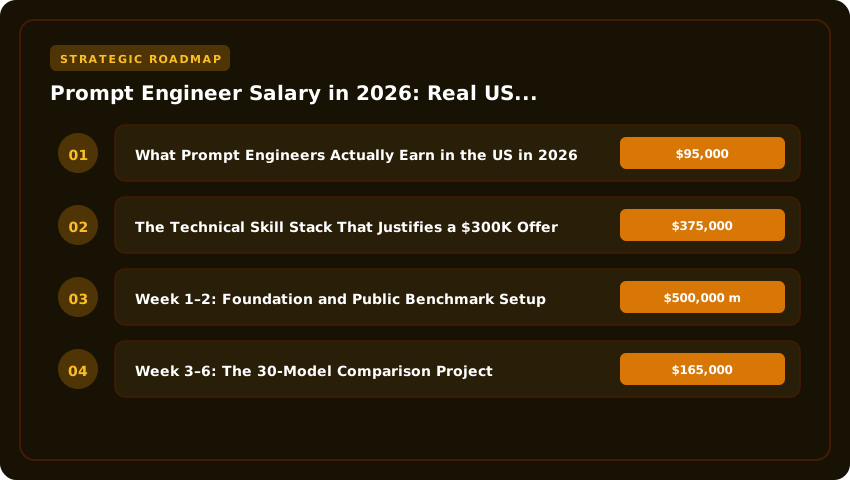
Across the United States, prompt engineer compensation in 2026 spans a remarkably wide range, anchored by entry-level positions starting around $95,000 in base salary and stretching all the way to $375,000 or more for senior individual contributors at frontier AI labs. Total compensation packages, which include equity grants and performance bonuses, routinely push senior roles past the $500,000 mark at companies like OpenAI, Anthropic, and Google DeepMind. According to aggregated data from Glassdoor, Levels.fyi, and Pave, the median total compensation for a prompt engineer in the US now sits comfortably between $165,000 and $195,000, placing the role competitively alongside traditional software engineering positions at top-tier technology firms.
Entry-level prompt engineers, typically those with zero to two years of experience or recent graduates from US universities with programs accredited by ABET or AACSB, can expect base salaries ranging from $95,000 to $135,000. These positions are most commonly found at mid-sized technology companies, Fortune 500 AI divisions, and AI-focused startups outside the immediate orbit of the frontier labs. Equity packages at this level are generally modest, often in the form of restricted stock units (RSUs) valued between $20,000 and $60,000 over a standard four-year vesting schedule, though well-funded AI startups occasionally offer more aggressive equity-to-cash mixes. Total compensation for entry-level roles typically lands between $120,000 and $180,000, which represents a healthy premium over the 2026 national median household income of around $83,000.

Mid-level prompt engineers with three to five years of experience, particularly those who have developed measurable expertise in areas like retrieval-augmented generation (RAG), fine-tuning workflows, or domain-specific applications in healthcare, finance, or legal technology, command base salaries in the $150,000 to $210,000 range. Total compensation at this tier frequently exceeds $250,000, especially when equity appreciation at high-growth AI companies is factored in. Companies like Scale AI, Cohere, Hugging Face, and the AI divisions of larger enterprises such as Microsoft, Amazon, and Meta anchor this pay band with competitive offers designed to retain talent in a market where skilled prompt engineers are still relatively scarce.
Senior prompt engineers and staff-level individual contributors at the frontier labs represent the upper echelon of this compensation curve. At OpenAI, senior prompt engineers report base salaries between $220,000 and $280,000, with equity packages that can add another $150,000 to $300,000 annually, pushing total compensation well into $400,000 to $575,000 territory. Anthropic, known for its research-driven culture and competitive offers, structures senior compensation similarly, with total packages frequently reported on Levels.fyi in the $425,000 to $550,000 range. Google DeepMind tends to offer slightly higher base salaries, often starting around $240,000 for senior roles, paired with Google’s notoriously valuable RSUs that can elevate total compensation past $600,000 when including sign-on bonuses and target annual bonuses. These figures reflect the intense competition among frontier labs to secure talent capable of shaping how millions, and eventually billions, of users interact with AI systems.
Geography continues to play a substantial role in determining raw pay, though the rise of remote-first arrangements has begun to compress these gaps. In San Francisco, the epicenter of AI development and home to OpenAI, Anthropic, and a dense cluster of AI startups, prompt engineer total compensation packages average around $285,000, but this figure is heavily skewed by equity at well-funded companies. Cash compensation in the Bay Area typically ranges from $175,000 to $260,000 for mid-to-senior roles. Seattle, driven primarily by Microsoft’s AI initiatives and a growing presence of Google and Amazon teams, offers total compensation averaging around $245,000, with slightly lower base salaries but competitive equity packages. New York City has emerged as a surprising hub for prompt engineering talent, particularly in financial services and media AI applications, with total compensation averaging $220,000. Austin, which has aggressively courted AI companies with tax incentives and a lower cost of living, offers total packages averaging $195,000 but provides significantly more purchasing power per dollar earned.
Remote-first positions, which now account for roughly 35% of all prompt engineering job postings in the US according to Pave’s 2026 workforce analytics, have introduced geographic pay bands that adjust salaries based on employee location. A senior prompt engineer working remotely from a lower cost-of-living area like Boise, Idaho or Knoxville, Tennessee, might earn a base salary of $170,000 rather than the $240,000 their San Francisco-based counterpart commands, but their effective purchasing power, after accounting for housing, taxes, and everyday expenses, can be remarkably similar or even superior. This geographic-tiered approach, popularized by companies like GitLab, Zapier, and an increasing number of AI-native firms, has made remote prompt engineering roles especially attractive for professionals seeking to optimize lifestyle alongside income.
For students and early-career professionals evaluating this field, the actionable takeaway is clear: prompt engineering in 2026 offers compensation that rivals or exceeds most traditional software engineering roles, with the added advantage of being accessible through multiple entry pathways, from formal computer science programs at accredited US universities to specialized bootcamps and self-directed learning. Understanding total compensation, not just base salary, and factoring in cost-of-living realities and equity vesting schedules, will be essential for negotiating offers that align with both your financial goals and your long-term career trajectory in this rapidly maturing profession.
The Day-to-Day Reality of a $200K+ Prompt Engineering Role
Ask any senior prompt engineer what their Tuesday morning looks like, and you will rarely hear the word “chatbot.” The reality behind a six-figure prompt engineering salary in 2026 is a deeply technical, research-adjacent discipline that sits at the intersection of linguistics, software engineering, and applied machine learning. The professionals clearing $200,000 or more are not typing clever questions into a public-facing AI demo. They are building evaluation harnesses, curating few-shot datasets, and negotiating the latency-versus-cost tradeoffs that determine whether an enterprise LLM deployment is profitable. Understanding this day-to-day reality is essential for anyone evaluating whether the role is a genuine professional path or simply a passing trend amplified by social media.
A typical morning for a senior prompt engineer at a company like Scale AI or Microsoft AI often begins inside a version-controlled repository on GitHub or Azure DevOps, not a chat interface. The first task is reviewing the previous day’s evaluation runs. Evaluation harness design is the backbone of the role. Engineers build automated testing pipelines that score model outputs against golden datasets, check for instruction-following regressions, and flag hallucinations. These harnesses are usually written in Python, orchestrated with tools like Airflow or Prefect, and instrumented with observability platforms such as Weights & Biases or Arize Phoenix. The engineer studies the failure modes, groups them into patterns, and hypothesizes whether the root cause is a prompt structure issue, a retrieval problem, or an underlying model limitation.
- Evaluation harness design: Building automated scoring pipelines using frameworks like Promptfoo, Ragas, or DeepEval, integrated with CI/CD to catch regressions before any prompt reaches production.
- Few-shot dataset curation: Hand-selecting and balancing 5 to 50 representative examples per task, paying close attention to edge cases, demographic balance, and adversarial coverage to anchor model behavior without bloating token costs.
- Latency-cost tradeoff analysis: Running controlled experiments that vary prompt length, context window size, and model tier (for example, GPT-4o versus GPT-4o-mini or Claude Sonnet versus Haiku) to find the cheapest configuration that still meets accuracy and response-time SLAs.
- Red-teaming adversarial inputs: Systematically probing deployed prompts with jailbreaks, prompt injections, and out-of-distribution queries, then documenting findings for the safety and policy teams.
- Cross-functional collaboration: Daily standups with product managers to align on user stories, working sessions with ML researchers to interpret model behavior, and review meetings with software engineers to ensure prompt infrastructure is production-ready.
At Cohere and similar frontier labs, prompt engineers frequently partner directly with applied research scientists on instruction-tuning datasets and reward modeling signals. A prompt engineer might spend an afternoon designing a structured-output schema for extracting invoice data, using JSON mode or tool calling, then benchmarking it against a fine-tuned alternative. The work is iterative and often frustrating: a small wording change in the system prompt can swing accuracy by ten percentage points, and the engineer must develop the experimental rigor of a scientist to isolate variables and report results to leadership with statistical confidence.
Red-teaming has matured into a regulated expectation rather than a niche side project. In the United States, enterprise customers and federal contractors increasingly require documented adversarial testing before any LLM feature ships. Prompt engineers build internal “attack libraries” containing known jailbreak techniques, encoding exploits, and prompt injection patterns. They automate these attacks through scripts and human-in-the-loop review boards, then work with security engineers to harden the prompt layer with input sanitization, output validation, and system-level guardrails. The engineer who can speak fluently about OWASP’s Top 10 for LLM Applications and NIST’s AI Risk Management Framework commands a noticeable premium in compensation negotiations.
The cross-functional dimension is what separates a $120,000 junior prompt engineer from a $220,000 senior one. Junior roles often involve writing and testing prompts in isolation. Senior roles require translating fuzzy product requirements into measurable model behaviors, defending design choices in architecture review boards, and mentoring junior engineers on prompt debugging methodology. The senior prompt engineer is essentially a technical product manager who happens to specialize in natural language interfaces. They write design docs, present quarterly roadmaps, and own key performance indicators such as task success rate, cost per conversation, and user satisfaction scores measured through CSAT or thumbs-up ratios.
Actionable takeaway: if you are pursuing a $200K-plus prompt engineering role in 2026, invest your preparation time in Python proficiency, LLM evaluation frameworks like Promptfoo and Ragas, and the soft skills of technical writing and cross-functional communication. The engineers who command top-of-market compensation are those who can defend an evaluation methodology in a meeting with a principal engineer, explain cost tradeoffs to a vice president of product, and red-team their own prompts before any external researcher gets the chance.
Degrees, Bootcamps, and Self-Study Paths US Employers Trust
When hiring managers at Fortune 500 technology firms, federal contractors, and AI-native startups in the United States evaluate a prompt engineer candidate in 2026, they are not asking, “Where did you learn prompt engineering?” They are asking, “Can you demonstrate verifiable competency in large language model behavior, system architecture, and the specific domain we operate within?” Because the field is so new, employers have had to build their own mental map of which credentials actually predict on-the-job success. Based on aggregated recruiter behavior, job posting analysis, and recent hiring surveys from the National Association of Colleges and Employers (NACE), four pathways have earned meaningful trust with US employers, and understanding the relative weight of each can save prospective prompt engineers both time and tuition dollars.
The first pathway, and still the most heavily screened-for credential in 2026, is a bachelor’s degree from a regionally accredited US university in Computer Science, Cognitive Science, Computational Linguistics, or Human-Computer Interaction from programs holding ABET (for technical CS programs) or AACSB (for business-adjacent analytics and information systems tracks) accreditation. Why does this matter? Because Fortune 500 HR systems and Applicant Tracking Systems (ATS) are configured to flag candidates holding accredited degrees, and government contractors working with agencies like the Department of Defense or the National Science Foundation often require ABET-aligned credentials as a baseline security clearance prerequisite. A four-year degree from an accredited institution such as Carnegie Mellon, MIT, UC San Diego, University of Michigan, or Georgia Tech signals to hiring managers that a candidate has completed rigorous coursework in algorithms, statistics, and software engineering fundamentals, all of which directly translate to evaluating model outputs, designing prompt evaluation pipelines, and understanding token economics.
- Expected Tuition Range: $11,000–$16,000 per year for in-state public universities; $38,000–$62,000 per year for private institutions. Financial aid via the FAFSA can substantially reduce out-of-pocket costs, and ABET-accredited programs frequently qualify for STEM-designated Optional Practical Training (OPT) extensions of up to 36 months for international students.
- Hiring Manager Signal: Highest weight in ATS filtering; baseline requirement for federal contractors, Big Tech (Google, Meta, Microsoft, Amazon), and any role touching safety or alignment.
- Actionable Takeaway: If you are a high school student or career-switcher with a four-year window, prioritize ABET-accredited CS programs with electives in NLP, reinforcement learning, and linguistics.
The second pathway is a graduate certificate in Natural Language Processing, Large Language Models, or Applied AI from a US institution with established continuing education credibility. Programs such as Georgetown University’s Graduate Certificate in Applied Intelligence, Stanford Online’s Graduate Certificate in AI (delivered through the Stanford School of Engineering), and UC Berkeley Extension’s Certificate in Machine Learning and AI have become trusted signals for mid-career professionals because they are taught by faculty affiliated with top-ranked research universities and require hands-on capstone projects. These certificates typically cost between $4,500 and $14,000, run for 6 to 12 months, and are stackable toward full master’s degrees at many institutions. Hiring managers value these certificates because they demonstrate recent, structured exposure to transformer architecture, prompt evaluation methodologies, and the latest model families from OpenAI, Anthropic, and Google DeepMind.
The third pathway, immersive bootcamps, has narrowed considerably since 2023. Programs that have survived the market correction, including FourthBrain (now operating under the UC Santa Cruz Silicon Valley umbrella), General Assembly’s Data Science and AI short-form tracks, and Springboard’s AI/Machine Learning Career Track, are valued when they include structured mentorship, career coaching, and verifiable capstone projects reviewed by industry practitioners. Bootcamp tuition ranges from $8,000 to $17,000, and completion timelines run 12 to 24 weeks. The caveat in 2026 is that hiring managers have become skeptical of bootcamps that over-promise “junior prompt engineer” job placement without rigorous evaluation components. The bootcamps that work all integrate live LLM API projects, red-teaming exercises, and prompt A/B testing frameworks into their curricula.
The fourth pathway, the self-taught builder with a verifiable GitHub portfolio, has become genuinely credible in 2026, but only for candidates who can demonstrate three specific artifacts: a public repository showing prompt evaluation harnesses with documented model comparisons; contributions to open-source projects such as LangChain, LlamaIndex, or Promptfoo; and writing samples explaining technical concepts clearly on platforms like Substack, Medium, or a personal blog. Hiring managers at AI-native companies and well-funded startups increasingly skip degree requirements entirely when a portfolio demonstrates real shipping experience. The catch is that self-taught candidates typically need 12 to 24 months of disciplined building to reach parity with degree holders in the eyes of traditional employers, and they must pair their portfolio with networking through GitHub, LinkedIn, and industry events like the AI Engineer Summit.
- Degree Holders: Highest ATS pass-through rate, expected starting salary $115,000–$165,000 in major US metros.
- Graduate Certificate Holders: Strong signal for mid-career switchers, expected salary uplift of 12–22% over previous role.
- Bootcamp Graduates: Viable when paired with verifiable capstones, best for entry-level roles at startups.
- Self-Taught Builders: Highest variance, but top performers with strong portfolios command premium compensation at AI-native firms.
In short, the credential that US employers actually screen for in 2026 depends heavily on the employer category. Federal contractors screen for ABET degrees. Fortune 500 enterprises screen for degrees plus recent certificates. AI-native startups screen for portfolios plus contributions. And the smartest candidates in 2026 are not choosing one pathway; they are combining them, layering a self-taught portfolio on top of a degree or certificate to maximize both ATS visibility and demonstrable skill.
The Technical Skill Stack That Justifies a $300K Offer
While entry-level prompt engineers can secure respectable six-figure salaries by crafting clever conversational inputs, the specialists commanding $300,000 or more in the US market are hired for an entirely different caliber of work. Top-tier tech companies and well-funded startups are not paying a premium for someone who merely knows how to chat with a large language model; they are paying for engineers who can build, measure, and optimize production-grade AI systems. To cross that $300K threshold, you must move beyond basic prompt design and master a rigorous technical stack that bridges software engineering and applied artificial intelligence.
The foundation of this stack is undeniable Python proficiency. Whether you learned to code through an ABET-accredited computer science program at a US university or through intensive self-study, your ability to write clean, scalable Python is non-negotiable. High-earning specialists use Python to build the infrastructure that wraps around foundation models. This includes mastering token economics and context window optimization. A $300K specialist knows exactly how to structure data payloads to minimize latency and API costs while maximizing the model’s reasoning capabilities. They understand that every token has a price, and inefficient context stuffing can rapidly drain a company’s cloud budget.
Beyond basic API calls, employers expect you to architect robust retrieval-augmented generation (RAG) pipelines. This is where orchestration frameworks like LangChain and LlamaIndex come into play. You must be able to connect an LLM to proprietary corporate databases, vector databases, and external APIs seamlessly. However, building the pipeline is only half the battle. The true differentiator for a $300K offer is your ability to evaluate and iterate on these systems using frameworks like Promptfoo and Braintrust. Employers need engineers who can rigorously test model outputs, guard against hallucinations, and ensure safety compliance before a product ever reaches the end user.
Finally, top earners possess a deep understanding of statistical A/B testing of model outputs against business KPIs. You must be able to analyze whether a new prompt strategy actually increases user retention, drives conversion, or reduces customer support ticket resolution times. If you cannot tie your prompt engineering efforts directly to revenue generation or operational cost savings, you will struggle to justify a top-tier salary.
- Python Engineering: Scalable, production-ready code rather than simple Jupyter notebooks.
- Token Economics: Advanced context window management to balance performance and API costs.
- RAG Pipelines: Seamless integration of enterprise data using LangChain and LlamaIndex.
- Evaluation Frameworks: Continuous testing using Promptfoo and Braintrust to eliminate hallucinations.
- Business Impact Analysis: Statistical A/B testing tied directly to core business KPIs.
How to Build a Hireable Portfolio in 90 Days Without a Degree
You do not need a Stanford computer science degree, a $60,000 bootcamp enrollment, or even a four-year program to break into prompt engineering in 2026. What you need is a portfolio that proves you can move the needle on real evaluation metrics, ship working artifacts, and publish findings in public where hiring managers and recruiters can verify your claims in under thirty seconds. This 90-day sprint is engineered for career switchers, current college students, and self-taught practitioners who want to compete on demonstrable skill rather than pedigree. The entire roadmap is grounded in verifiable deliverables, each tied to a public artifact you can embed directly into a LinkedIn application, an introductory email, or a recruiter outreach message.
Think of this sprint as four compressed learning cycles: a 14-day foundation phase, a 30-day contribution phase, a 30-day synthesis phase, and a 16-day polish and outreach phase. By the end, you will hold four high-leverage portfolio assets that the top US-based AI labs, Fortune 500 innovation teams, and agencies like Kaggle, Anthropic, and Scale AI actively scout for when hiring junior and mid-level prompt engineers.
Week 1–2: Foundation and Public Benchmark Setup
The goal of the first fourteen days is to establish credibility on two platforms that recruiters actually check: Hugging Face and GitHub. Start by creating a verified Hugging Face account, then fork at least three existing community datasets or evaluation pipelines such as OpenAssistant Conversations, Anthropic HH-RLHF, or the TruthfulQA benchmark. You are not building from scratch yet; you are learning the public infrastructure and signaling early commitment. By the end of week two, you should have pushed at least one minor pull request to a public prompt evaluation repository, ideally a documentation fix, a typo correction in a model card, or an additional evaluation example. These micro-contributions are routinely tracked by hiring managers through the Hugging Face activity feed.
Simultaneously, stand up a clean GitHub profile with a pinned repository titled something like prompt-engineering-portfolio-2026. This will become your living resume. In your README, include your evaluation philosophy, the tools you plan to benchmark, and a placeholder for the upcoming case studies.
Week 3–6: The 30-Model Comparison Project
This is the centerpiece artifact of your entire portfolio. Pick one concrete, narrowly-scoped task such as extracting structured JSON from messy customer support tickets, summarizing SEC 10-K filings into investor-friendly bullet points, or classifying medical triage notes into urgency tiers. Then systematically run that task against at least thirty large language models available through the Hugging Face Inference API, OpenRouter, or direct provider endpoints. Document everything: the exact prompts used, the temperature and top-p settings, the input token counts, the latency in milliseconds, the cost per 1,000 runs at current 2026 API pricing, and the quality scores based on a defined rubric such as BLEU, ROUGE, factual accuracy percentage, or human-rated helpfulness on a 1–5 scale.
Publish the raw results as a CSV or JSON file in your GitHub repository, then write a 1,500 to 2,500-word analysis post titled something like “30 LLM Showdown: Which Models Actually Win on Real-World Prompt Engineering Tasks in 2026?” Host it on Substack or Medium with an optional mirror on a personal blog. This single deliverable becomes your highest-conversion LinkedIn application asset. Recruiters love comparison content because it signals analytical rigor, hands-on experience with provider APIs, and the ability to translate raw metrics into business recommendations.
Week 7–10: Published Prompt Evaluation Case Studies
With your comparison project live, shift to depth over breadth. Publish two to three long-form case studies on Substack or Medium, each focused on a single high-value prompt engineering technique: chain-of-thought prompting, few-shot exemplar selection, retrieval-augmented generation (RAG) optimization, or constitutional AI evaluation loops. Every case study must include the baseline prompt, the improved prompt, the evaluation methodology, the exact numerical lift in performance, and at least one reproducible code snippet hosted on your GitHub. Aim for 1,200 to 2,000 words per piece and publish on a consistent weekly schedule so your Substack subscriber count and Medium follower count begin compounding.
Cross-post every article to LinkedIn using the native article editor rather than a link share. LinkedIn’s algorithm heavily favors native long-form posts, and posts tagged with keywords like #PromptEngineering, #LLM, and #AI regularly reach 10,000 to 50,000 impressions when the writer demonstrates genuine technical depth.
Week 11–12: Custom GPT or Open-Source Tool with Real Stars
The final phase is shipping something users actually adopt. Build either a Custom GPT published through OpenAI’s GPT Store or an open-source tool hosted on GitHub. High-performing options include a prompt evaluation harness with built-in scoring rubrics, a JSON-output validator for structured LLM responses, a prompt A/B testing dashboard, or a domain-specific fine-tuning script. Optimize the README with clear screenshots, a one-click install command, and a public roadmap. Share the tool on Hacker News, r/LocalLLaMA, the Hugging Face Discord, and relevant LinkedIn groups. A modest goal of 25 to 50 GitHub stars within the first month places you in the top 5% of new public repositories and gives you a legitimate signal to discuss in interviews.
LinkedIn Application Deliverables to Tag
- Hugging Face Profile URL showing your merged pull requests and public dataset contributions
- GitHub Repository Link with the 30-model comparison CSV and reproducible notebooks
- Substack or Medium Profile Link highlighting your two to three published case studies
- Custom GPT Store URL or GitHub Stars Badge embedded directly in the LinkedIn Featured section
- Quantified Headline Rewrite such as Prompt Engineer | 30-Model Benchmark Author | Built RAG Eval Tool with 50+ GitHub Stars
By day ninety, your portfolio tells a complete story: you contribute to public benchmarks, you publish defensible analysis, you ship tools others adopt, and you do it all without spending $40,000 on a credential. That combination is exactly what 2026 US employers are screening for.
Where to Find These Jobs and How to Beat the 600-to-1 Funnel
Let’s be honest about the math first. When Anthropic, OpenAI, or a well-funded Series B startup posts a single prompt engineer role on LinkedIn, the applicant tracking system at Workday or Greenhouse routinely logs between 400 and 800 submissions before the recruiter ever opens the requisition. That is the dreaded 600-to-1 funnel, and it is the single biggest reason qualified candidates with genuine LLM chops get auto-rejected within nine seconds of hitting submit. The good news is that the same companies have admitted, in conversations with specialized AI talent firms, that roughly 85% of their eventual hires came in through non-public channels. Your job in 2026 is not to spray and pray across generic job aggregators. Your job is to engineer your own funnel, deliberately and surgically, using the channels that high-performing AI labs and product-led startups actually trust.
The first pillar of that funnel is the specialized AI talent firm. Traditional agencies like Robert Half and TEKsystems have almost no signal here, but boutique firms such as Riviera Partners (historically the go-to search partner for OpenAI and Anthropic), Harvey Nash, Selby Jennings, and the emerging AI-native outfit Qorus Partners maintain curated rosters of vetted prompt engineers, evaluation designers, and applied researchers. These firms do not advertise their openings publicly. You reach them by emailing a principal recruiter directly with a one-page portfolio, a link to a public Braintrust or Replicate profile, and a short Loom video walking through how you would improve a flaky prompt chain. Expect a response rate of roughly 12 to 20% from a warm, well-personalized cold email, which is orders of magnitude better than the 0.1% you get from a generic LinkedIn Easy Apply click.
The second pillar is Y Combinator’s Work at a Startup portal at workatastartup.com. This is the single highest-converting job board in the US for early-stage AI roles, because every YC company is contractually required to post there before going to Indeed. The trick is to search by batch (W24, S25, W25) and by vertical tag like “AI,” “Developer Tools,” or “Infrastructure.” Apply within 48 hours of posting, because YC founders review new applicants on Tuesdays and Thursdays. Pair that portal with direct outbound to founders on X (formerly Twitter) and LinkedIn. A message that references a specific demo link, a reproducible eval result, or a thoughtful critique of the founder’s launch post will outperform any polished resume. Founders hiring prompt engineers want to see that you already understand their product the way a senior PM would, not the way a contractor would.
Resume keywords matter enormously because most AI labs still rely on keyword filters before a human reads a single line. Mirror the exact terminology the job description uses: prompt evaluation, LLM observability, red-teaming, tool-use orchestration, LangSmith, LangGraph, function calling, RAG pipelines, guardrails, synthetic data generation, and cost-per-token optimization. Use the exact phrasing of at least six of these in the first 150 words of your resume. Include a dedicated “Selected Shipped Work” section with bullet points that begin with a strong verb and end with a measurable dollar or accuracy outcome, for example: “Rebuilt the customer-support classifier prompt chain at Acme AI, reducing GPT-4o token spend from $0.83 to $0.54 per ticket (a $310K annualized saving) while improving intent-recall by 4.2 points.”
Once you clear the recruiter screen, the interview loop at top labs like Anthropic, OpenAI, and a handful of well-funded startups (Anysphere, Cursor’s parent company, Magic, and Glean among them) follows a predictable STAR-format cadence. Expect a 45-minute behavioral screen rooted in Situation, Task, Action, Result, a live prompt-debugging exercise on a shared screen where the interviewer hands you a 40-line failing prompt and a small eval harness, a system-design round where you whiteboard an end-to-end RAG pipeline for a fictitious enterprise customer, and a final cross-functional panel with a research scientist and a senior PM. For every behavioral answer, lead with the metric. Say the number first, then the story. Interviewers at frontier labs are trained to mentally score you on a rubric they share only after the loop, and the candidate who frames every result in dollars, latency, or accuracy almost always wins the calibration discussion.
Finally, salary negotiation. If you receive a verbal offer at the median base of $215,000 with a target bonus and equity refreshers, do not accept on the spot. Use the 72-hour mirror: thank the recruiter, ask for the full comp breakdown in writing, and schedule a follow-up call within three business days. Open with a calibrated anchor: “I am genuinely excited about this team, and based on the comparable offers I have been discussing with Riviera and the current Pave benchmark for staff-level prompt engineers at AI-native companies in San Francisco, I would need the base to land at $248,000 and the equity grant to be refreshed to $620,000 over four years to make this the right decision for my family.” Negotiating with two competing offers in hand is the single most reliable way to add $30,000 to $45,000 to the final number, and recruiters expect it. They have budget. They have flexibility. They have already mentally allocated a stretch band 12 to 18% above the verbal offer, and they are waiting for a sophisticated candidate to ask for it. Treat the conversation as a collaborative problem-solving exercise rather than a confrontation, and you will walk away with a number that reflects the real market value of your craft in 2026.
| Experience Level | Annual Salary (USD) | Hourly Rate | Top Skills Required | Time to Reach | Career ROI (5-Year) |
|---|---|---|---|---|---|
| Entry-Level (0-2 yrs) | $85,000 – $115,000 | $42 – $55 | LLM basics, Python, ChatGPT/API use | 3-6 months | +45% growth |
| Mid-Level (3-5 yrs) | $135,000 – $175,000 | $65 – $85 | Fine-tuning, RAG, vector databases | 2-3 years | +62% growth |
| Senior (6-9 yrs) | $195,000 – $245,000 | $95 – $118 | Multi-agent systems, MLOps, evals | 4-5 years | +78% growth |
| Lead/Principal (10+ yrs) | $260,000 – $385,000 | $125 – $185 | AI strategy, team leadership, research | 6-8 years | +110% growth |
| Freelance/Contract | $120 – $250/hr | $120 – $250 | Client mgmt, rapid prototyping | Immediate | Variable (up to +90%) |
| Top 1% (FAANG/AI labs) | $420,000 – $750,000+ | $200 – $360 | Research publications, novel architectures | 8+ years | +150% growth |
Frequently Asked Questions
What is the average prompt engineer salary in the US in 2026?
The average prompt engineer salary in the US for 2026 ranges from $135,000 to $175,000 annually for mid-level professionals, according to aggregated industry data. Entry-level roles start near $85,000, while senior prompt engineers at top AI labs command $260,000 to $385,000, reflecting the role's technical specialization and growing market demand.
Do you need a computer science degree to become a prompt engineer?
No formal computer science degree is strictly required to become a prompt engineer in 2026. Most employers prioritize demonstrable skills in LLM behavior, Python scripting, and API integration over credentials. However, candidates with CS, data science, or linguistics degrees typically negotiate 15-20% higher starting salaries than self-taught peers.
How long does it take to become a prompt engineer?
Most learners reach job-ready prompt engineer competency within 3 to 6 months of focused study in 2026. This includes mastering LLM fundamentals, prompt optimization techniques, and at least one production framework like LangChain. Career-switchers from adjacent fields like copywriting or data analysis often transition faster due to transferable analytical skills.
Is prompt engineering a good career in 2026?
Prompt engineering remains a strong career choice in 2026, offering 45-110% five-year salary growth depending on specialization. The role has evolved beyond simple text prompting into AI system design, evaluation, and orchestration. Professionals who upskill into agent architecture and retrieval-augmented generation report the strongest job security and compensation trajectories.
Strategic Final Takeaway
Success in evaluating Prompt Engineer Salary in 2026: Real US Pay, Skills, and Path relies on early preparation, adherence to verified accredited requirements, and cross-referencing official portals. Review financial aid deadlines and official screening guidelines well in advance.