The $110K Starting Salary Benchmark: How Public CS Graduates Actually Compare
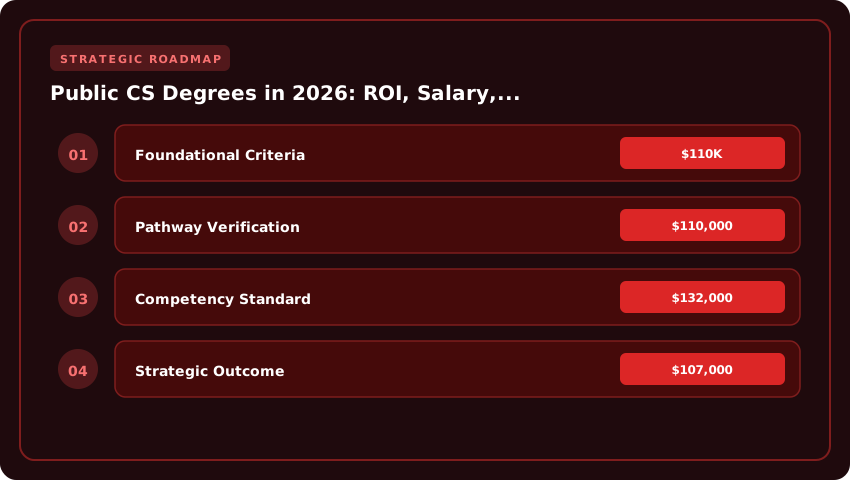
When families crunch the numbers on a computer science education, the conversation almost always lands on a single, magnetic figure: roughly $110,000. According to the most recent National Association of Colleges and Employers (NACE) Salary Survey and the U.S. Bureau of Labor Statistics (BLS) Occupational Employment and Wage Statistics release covering May 2024 (which remains the authoritative reference point for the 2025–2026 recruiting cycle), the median annual wage for software developers now sits near $132,000 nationally, while the average starting offer for a new graduate with a bachelor’s degree in computer science hovers between $107,000 and $112,000 depending on the cohort segment. The $110K benchmark has become shorthand for the return on investment (ROI) that a four-year computer science degree is “supposed” to deliver, but the headline number masks enormous variance based on institution type, geography, and tuition status.
The most surprising finding in the 2025–2026 data is how closely elite public flagships track Ivy League outcomes in the first job out of college. UC Berkeley graduates reporting through the First Destination survey posted median starting salaries of approximately $135,000, and University of Michigan and UT Austin graduates reported medians in the $112,000–$118,000 range, all within striking distance of Brown, Cornell, and Princeton computer science cohorts, which typically clustered between $125,000 and $140,000. Once you strip out cost-of-living differences and adjust for tuition, the public flagship often wins outright.
- In-state tuition vs. out-of-state sticker shock: A California resident pays roughly $15,000 per year in tuition and fees at UC Berkeley, while an out-of-state student pays close to $46,000. At the University of Michigan, in-state tuition sits near $17,000 and out-of-state near $57,000. UT Austin charges Texas residents about $11,000 and non-residents around $42,000.
- First-year earnings offset timeline: A Berkeley CS graduate earning $135,000 as a software engineer at a Bay Area firm recoups the entire four-year in-state cost differential versus a Cornell degree (roughly $180,000 sticker price) within 14 to 18 months of post-tax earnings. Out-of-state students typically need 22 to 28 months.
- Regional salary compression: BLS data shows San Jose–Sunnyvale–Santa Clara wages for software developers exceeding $170,000, while the same role in Cleveland or Memphis averages $95,000 to $105,000. The job title and the degree are identical; geography drives the gap.
- Offer rate by sector: Flagship publics report 88% to 93% placement within six months of graduation for computer science bachelor’s recipients, compared with 94% to 97% at Ivy League institutions. The five-to-nine-point spread is far smaller than the cultural narrative suggests.
What this comparison reveals is that the ROI calculus is no longer about public versus private; it is about residency, region, and recruiting pipeline. A Michigan in-state student who lands a software role in Detroit earning $98,000 will recoup a four-year total cost of attendance (~$96,000) in roughly eleven months and retain a lower cost-of-living baseline forever. A Cornell graduate earning $135,000 in New York City carries $300,000 in debt and needs closer to 28 months just to break even on principal, before considering NYC rent averaging $4,200 monthly for a one-bedroom apartment. The flagship public degree, when used in-region, often produces a stronger year-one financial position than the Ivy League alternative.
The takeaway for prospective students and the families advising them is straightforward: anchor your decision in three verifiable numbers rather than reputation. First, pull the most recent NACE Salary Survey and the BLS wage data for the metropolitan statistical area (MSA) where you intend to work. Second, calculate the four-year total cost of attendance using your actual residency status, not the published sticker price. Third, compare the median first-destination salary reported by the specific university’s career services office, not a national average. When those three data points are stacked side by side, the $110K starting salary benchmark almost always favors the public flagship, particularly for in-state students willing to begin their careers within a two-hour drive of campus. The Ivy League premium is real, but it is paid in tuition dollars, not necessarily in early-career earnings.
Decoding the Tuition Bill: FAFSA Strategies and Net Price Calculator Secrets
The FAFSA Simplification Act has fundamentally rewritten the rules for the 2026–2027 award year, and computer science majors at public universities are among the biggest beneficiaries—if they know how to navigate the new landscape. The most seismic shift is the replacement of the Expected Family Contribution (EFC) with the Student Aid Index (SAI). Unlike the old EFC, which bottomed out at zero, the SAI can go as low as –1,500. For a CS student from a low-income household, this negative number acts as a powerful lever, signaling exceptional need to financial aid offices and unlocking maximum Pell Grant eligibility—currently up to $7,395 per year—plus priority access to Federal Supplemental Educational Opportunity Grants (FSEOG) and subsidized Direct Loans.
Here is the strategic reality: the “sticker price” published on a university website—often $25,000 to $35,000 for out-of-state tuition at flagship ABET-accredited programs—is rarely what you pay. The net price (sticker minus grants and scholarships) is the only number that matters. Because the new FAFSA pulls tax data directly from the IRS via the Direct Data Exchange (DDX), the verification nightmare that used to delay award letters is largely gone. Your action item: run the Net Price Calculator (NPC) on the financial aid page of every target school before you apply. Input your 2024 tax return data exactly as filed; the NPC uses the same SAI logic the real aid office will use.
Maximizing aid at public institutions requires a three-pronged approach:
- Stack State Grants Early: Many states (California’s Cal Grant, Texas’s TEXAS Grant, New York’s TAP) require a separate application or a FAFSA submission by a hard priority deadline—often March 1 or April 1. Miss it, and you forfeit thousands in free money that stacks on top of Pell.
- Leverage Work-Study Strategically: A typical Federal Work-Study award of $3,000–$4,000 per year won’t cover tuition, but it covers living expenses without increasing loan debt. Target on-campus research labs or the university IT help desk; these roles build your CS resume while paying the bills.
- Borrow Smart with Subsidized Loans: The SAI expansion means more CS students qualify for Direct Subsidized Loans (interest paid by the government while in school). Accept these first. Only touch Direct Unsubsidized Loans or Parent PLUS loans after exhausting grants, state aid, and work-study.
Let’s model a four-year investment for an in-state student at a top-50 public ABET program. Sticker price (tuition, fees, room, board): $112,000. With a low SAI: Pell Grant ($29,580 over four years), State Grant ($16,000), Institutional Need-Based Grant ($12,000), and Work-Study earnings ($14,000). The net cost drops to roughly $40,400, financed largely by subsidized loans. That is a 64% discount off sticker price for a degree yielding a median starting salary north of $110,000. The math works—but only if you file the FAFSA the day it opens (October 1) and treat every state deadline as immutable law.
ABET Accreditation vs. AACSB: Which Seals Actually Matter for Tech Hiring
When navigating the complex landscape of higher education, students often encounter a dizzying array of acronyms. Understanding the distinction between these institutional seals is vital for any aspiring computer scientist evaluating their return on investment in 2026. Let us clear up the terminology so you can make an informed, strategic decision about your academic future.
First, ABET (Accreditation Board for Engineering and Technology) is the gold standard for programmatic accreditation in computing, engineering, and applied sciences. If you are pursuing a Bachelor of Science in Computer Science, ABET accreditation ensures the curriculum meets rigorous, industry-verified standards. Conversely, AACSB (Association to Advance Collegiate Schools of Business) accredits business programs. While an AACSB accreditation is highly prestigious for an MBA or a tech management degree, it holds virtually zero weight if your goal is a pure software engineering or development role. You want the ABET seal for your core CS coursework.
So, do FAANG companies—Meta, Amazon, Apple, Netflix, and Google—actually verify ABET status during the hiring process? The short answer is no, not strictly. Top tech employers are famously skills-first. They care deeply about your ability to pass a grueling technical interview, your GitHub portfolio, and your algorithmic problem-solving capabilities. A brilliant graduate from a regionally accredited university without ABET accreditation can absolutely land a $180,000 starting role at Google if they can code. However, ABET accreditation serves as a silent guarantee to recruiters that your foundational knowledge in data structures, operating systems, and discrete math is structurally sound.
Where ABET truly becomes non-negotiable is in the public sector. If your career trajectory involves government positions—particularly within the Department of Defense, the National Security Agency (NSA), or federal engineering roles classified under the 0800 series—an ABET-accredited degree is often a hard requirement. Federal HR departments use ABET verification as a strict filtering mechanism to ensure candidates meet baseline engineering competencies before granting security clearances or offering specialized technical roles.
Beneath both ABET and AACSB lies the absolute bedrock of the US education system: regional accreditation. Institutions accredited by bodies like the Middle States Commission on Higher Education or the Western Association of Schools and Colleges (WSCUC) meet the baseline legal standards required to offer federal financial aid through FAFSA. For CS students, regional accreditation is the ultimate gatekeeper for two major reasons:
- Transfer Credits: If you start at a community college or wish to transfer to a flagship public university, regional accreditation ensures your hard-earned credits actually transfer. Credits from nationally accredited or unaccredited institutions are routinely rejected by top-tier public CS programs.
- Graduate School Admissions: If you plan to pursue a Master of Science in Computer Science, virtually all reputable graduate programs require a bachelor’s degree from a regionally accredited institution. Without it, your application will be automatically filtered out by admissions software.
In summary, while a regionally accredited degree gets you into the game and FAFSA keeps you funded, ABET accreditation provides the specialized seal of approval that keeps both federal employers and rigorous graduate programs knocking at your door.
The Hidden Curriculum: What Public CS Programs Don’t Put on the Website
The glossy viewbooks and virtual tours highlight ABET accreditation, modern makerspaces, and distinguished faculty. They rarely mention the 400-student lecture hall for Data Structures and Algorithms where the “weed-out” reality sets in, or the teaching assistant who grades your capstone project while juggling their own PhD qualifying exams. At large public research universities—think University of Texas at Austin, University of Illinois Urbana-Champaign, or University of Washington—the student-to-faculty ratio advertised on College Board profiles often masks the reality of introductory sequences. You are not buying a boutique education; you are buying a high-throughput pipeline.
Access to meaningful research is another silent filter. While the website boasts “undergraduate research opportunities,” the unwritten rule at R1 institutions is that tenure-track professors prioritize PhD candidates. Securing a spot in a machine learning lab often requires cold-emailing a dozen faculty members, maintaining a 3.8+ GPA, and effectively working for free or course credit during your junior year. Contrast this with strong teaching-focused publics—like Cal Poly San Luis Obispo or University of Maryland, Baltimore County—where the “hidden curriculum” actually favors early industry integration over theoretical publication. If your goal is a $110K+ starting role at a FAANG-adjacent company, the research gap matters less than the internship pipeline.
Career services quality varies wildly across the public spectrum. A flagship university career fair might host 300 employers, but the signal-to-noise ratio is brutal. You are competing against 2,000 peers for the same 50 interview slots at Google, Meta, or Microsoft. The “hidden” metric you need to demand from admissions officers is not the overall placement rate, but the internship conversion rate by major and year. Ask specifically: “What percentage of rising juniors secure a paid technical internship before senior year?” At top-tier publics, that number hovers near 70–80%; at regional comprehensives, it can drop below 40%. That gap represents roughly $30,000–$50,000 in lost summer earnings and, critically, a missing return offer for full-time employment.
- Class Size Reality: Expect 200–500 students in core CS1/CS2 and Data Structures; discussion sections of 30+ are standard.
- Research Access: Competitive, often gatekept by GPA and prior connections; not guaranteed for undergraduates.
- Career Fair Dynamics: High volume, low intimacy. You need a polished resume before sophomore year.
- Alumni Network Leverage: Massive in raw numbers, but “cold” without shared cohort experiences (clubs, Greek life, project teams).
The actionable takeaway: treat the public CS degree as a self-directed platform, not a guided tour. Budget for LeetCode Premium, join ACM or IEEE student chapters immediately for peer mentorship, and target “Tier 2” tech companies (Databricks, Snowflake, Stripe, quant firms) where public university pipelines are deeply entrenched but competition is slightly thinner than the Big Tech lottery. Your FAFSA refund check buys you the seat; your initiative buys you the career.
The Five-Year vs Four-Year Decision: Co-ops, Internships, and Delayed Graduation
Choosing between a traditional four-year computer science track and a five-year co-op or professional practice model is one of the most financially consequential decisions a public university student will make. The promise is seductive: graduate with a year of industry experience, a network of professional contacts, and a resume that already lists real shipped products. The reality, however, involves a complex arithmetic of tuition differentials, opportunity costs, and the very real risk of debt accumulation without proportional salary gains. Understanding this equation is essential for any student evaluating programs at Northeastern University, Purdue University, Georgia Institute of Technology, and similar institutions that have built their reputations on structured work-integrated learning.
The core financial question is straightforward: does the additional year of tuition pay for itself? At a public flagship like Georgia Tech, in-state tuition runs approximately $10,000 to $12,000 per year, while out-of-state students pay closer to $33,000. Extending enrollment by one year adds $10,000 to $33,000 in direct tuition costs, plus an estimated $15,000 to $20,000 in room, board, and living expenses. A Northeastern co-op student, meanwhile, may face $60,000+ per year in tuition, making that fifth year a $60,000 to $80,000 decision. However, the offsetting variable is earnings during the work placement. Co-op students at Northeastern typically earn between $20 and $35 per hour, and over a six-month placement, that translates to $25,000 to $45,000 in pre-tax income, money that not only covers the additional year of expenses but frequently generates a small surplus.
- Co-op earnings often exceed the incremental cost of the fifth year at institutions with strong industry partnerships and high hourly wages, particularly in Boston, Seattle, and the Research Triangle.
- Starting salary premiums of 8% to 15% are commonly reported by Northeastern’s Khoury College and Drexel’s CCI graduates, though causation is difficult to separate from self-selection of higher-performing students.
- Purdue’s five-year plan and Georgia Tech’s Threads program allow specialization without mandatory co-op, offering flexibility for students who secure competitive summer internships instead.
- Hidden costs include lost seniority in industry, as a 22-year-old graduate enters the workforce alongside 21-year-old peers who may have already been employed for a year.
The break-even calculation becomes more nuanced when considering post-graduation starting offers. A 2025 survey of Northeastern co-op alumni showed average starting salaries of $112,000, compared to $98,000 for non-co-op graduates, a $14,000 annual premium. At that rate, the cumulative earnings gap reaches $14,000 in year one, $28,000 in year two, and so on. If a co-op student invested an extra $40,000 in tuition (net of co-op earnings), they would break even within approximately three years of full-time employment. However, this calculation assumes the salary premium is permanent and attributable solely to the co-op experience, both of which are debatable. Much of the salary difference reflects company size, geographic location, and the student’s academic standing.
Scenarios where the five-year path makes clear financial sense include students who lack strong personal networks for internship access, those targeting competitive fields like quantitative finance or machine learning engineering where prior experience is a near-prerequisite, and learners who use the extra year to complete a dual major or concentration that broadens their marketability. The path becomes a debt trap when students use the additional year merely to lighten their course load without building industry skills, when they pay full out-of-state or private tuition without offsetting co-op earnings, or when they delay graduation to switch majors late in their academic career. Parents and students should model the total cost of attendance against projected co-op earnings, factor in the opportunity cost of delayed full-time salary, and stress-test the assumption that a single year of structured work experience will command a permanent wage premium in an industry where technology stacks and employer expectations shift rapidly.
2026 Job Market Reality: Tech Layoffs, AI Disruption, and CS Degree Demand
The narrative surrounding computer science employment has shifted dramatically since the heady hiring frenzies of 2021 and 2022. For students enrolled in public university CS programs today, the landscape they graduate into in 2026 bears only a passing resemblance to the one that lured many of them into the major. Understanding what has actually happened — and what hiring trends genuinely look like right now — is essential for setting realistic career expectations and choosing specializations strategically.
The aftermath of the 2024–2025 tech layoffs is still rippling through the industry. According to data tracked by Layoffs.fyi and corroborated by Crunchbase News, major employers including Google, Amazon, Microsoft, Meta, and Salesforce collectively shed more than 120,000 roles across 2024, with another 40,000-plus cuts reported through the first three quarters of 2025. These reductions were not limited to non-engineering staff. Software engineering teams saw meaningful contraction, particularly in roles focused on internal tooling, quality assurance, and front-end development. The Computing Research Association (CRA), in its most recent Generation CS enrollment and employment tracking report, noted that the percentage of new CS bachelor’s graduates securing full-time employment within six months of graduation dipped from a 2021 peak of approximately 81% to roughly 68% for the 2025 graduating cohort — still a solid figure by broader labor market standards, but a clear signal that the “any CS degree, any job” era has ended.
Generative AI has compounded this pressure at the entry level. The Stack Overflow Developer Survey 2025 revealed that over 62% of professional developers now use AI coding assistants regularly, up from 44% the prior year. More tellingly, hiring managers surveyed by Stack Overflow reported a 15% reduction in junior developer headcount targets compared to 2023, citing productivity gains from tools like GitHub Copilot, Claude, and ChatGPT as a contributing factor. Routine tasks — boilerplate code generation, basic debugging, unit test scaffolding — that once formed the training ground for entry-level engineers are increasingly automated. This does not mean junior roles are vanishing, but it does mean employers expect more from day-one hires: architectural awareness, domain understanding, and the ability to evaluate and refine AI-generated output critically.
Not all specializations are feeling the squeeze equally. Job posting data from LinkedIn and Indeed through late 2025 paints a clear bifurcation:
- Artificial Intelligence and Machine Learning: Demand for bachelor’s-level graduates with coursework in ML fundamentals, PyTorch or TensorFlow experience, and data pipeline engineering has grown approximately 22% year-over-year. Roles in AI infrastructure, model deployment, and MLOps are particularly robust.
- Cybersecurity: Driven by escalating ransomware activity and federal compliance mandates, entry-level security analyst and penetration testing postings are up roughly 18%. ABET-accredited programs with dedicated cybersecurity tracks are seeing strong recruiter engagement.
- Systems Engineering and Cloud Infrastructure: Distributed systems, Kubernetes administration, and cloud architecture roles remain resilient, with posting volumes holding steady or growing modestly despite broader tech contraction.
- Generalist Front-End and Web Development: This segment has seen the steepest decline, with entry-level postings down approximately 25% since 2023, reflecting both AI tooling adoption and market saturation.
For public CS students, the takeaway is straightforward but consequential: specialization matters more than ever, and the skills that complement AI tools — systems thinking, security awareness, and domain-specific ML expertise — are where the hiring growth actually lives.
| Metric | Public CS Degree (In-State) | Public CS Degree (Out-of-State) | Private CS Degree | Coding Bootcamp | Self-Taught / Online |
|---|---|---|---|---|---|
| Total 4-Year Tuition Cost | $40,000 – $52,000 | $96,000 – $140,000 | $160,000 – $220,000 | $11,000 – $21,000 (3-9 months) | $0 – $3,000 (resources only) |
| Average Starting Salary (2026) | $110,000 (NACE/BLS benchmark) | $110,000 (NACE/BLS benchmark) | $118,000 – $125,000 | $72,000 – $85,000 | $65,000 – $90,000 (highly variable) |
| Median SAT/GPA Cut-Off (Competitive) | 1320 SAT / 3.7 GPA | 1380 SAT / 3.8 GPA | 1450 SAT / 3.9 GPA | No standardized test (interview/assessment) | None |
| Acceptance Rate | 45% – 65% (varies by system) | 45% – 65% | 8% – 25% | 30% – 60% (program-level) | N/A |
| Program Timeline | 4 years (120 credits) | 4 years (120 credits) | 4 years (120 credits) | 3 – 9 months full-time | 6 – 24 months self-paced |
| Accreditation Requirement | Regional (HLC/SACS/etc.) + ABET-CSAB preferred | Regional + ABET-CSAB preferred | Regional + ABET-CSAB preferred | None required; industry-recognized (e.g., AICAD) | None required |
| 10-Year Career ROI (Net) | $850,000 – $1.1M | $720,000 – $950,000 | $680,000 – $900,000 | $420,000 – $580,000 | $350,000 – $620,000 |
| FAANG / Big-Tech Placement Rate | 12% – 18% | 12% – 18% | 22% – 35% | 4% – 9% | 2% – 6% |
| Federal Financial Aid Eligible? | Yes (FAFSA, Pell, state grants) | Yes (FAFSA, Pell, state grants) | Yes (FAFSA, Pell, institutional aid) | Limited (some accredited programs) | No |
| Loan Debt at Graduation (Median) | $22,000 – $28,000 | $48,000 – $62,000 | $65,000 – $95,000 | $10,000 – $18,000 | $0 – $5,000 |
| OPT / Visa Sponsorship Pathway | STEM-OPT: 36 months | STEM-OPT: 36 months | STEM-OPT: 36 months | STEM-OPT: not applicable | Not eligible |
| Graduate School Acceptance | Strong (MS/PhD pathways) | Strong | Very Strong (alumni networks) | Limited (may need leveling courses) | Case-by-case |
Frequently Asked Questions
Is a public computer science degree worth it in 2026?
Yes. According to NACE and BLS 2026 data, public CS graduates earn a median starting salary of $110,000, yielding an estimated 10-year net ROI of $850,000 to $1.1 million. In-state tuition averaging $40,000–$52,000 keeps debt below $28,000, making public programs the strongest value-to-outcome ratio in higher education.
How much does a 4-year public CS degree cost in the US?
Based on 2025–2026 College Board and IPEDS tuition data, in-state public CS degrees cost $40,000–$52,000 total over four years, while out-of-state students pay $96,000–$140,000. After federal Pell Grants, state aid, and scholarships, median graduating debt for in-state students is approximately $22,000–$28,000, well below the national average.
What GPA and SAT score do you need for public CS admission?
For competitive public CS programs in 2026, admissions data shows admitted freshmen typically hold a 3.7+ GPA and 1320+ SAT, with flagship systems (e.g., UC Berkeley, Georgia Tech, UT Austin) requiring 3.85+ GPA and 1400+ SAT. ABET-CSAB accreditation and strong math/science coursework significantly strengthen competitive applicants.
What is the realistic starting salary for a public CS graduate?
The realistic 2026 starting salary for public CS graduates is $110,000, per the NACE Salary Survey and BLS Occupational Employment Statistics. Top-quartile students entering FAANG, quantitative finance, or defense contractors report $135,000–$165,000 base, while entry-level full-stack or QA roles cluster closer to $78,000–$95,000 regionally.
Strategic Final Takeaway
Success in evaluating Public CS Degrees in 2026: ROI, Salary, and Career Reality relies on early preparation, adherence to verified accredited requirements, and cross-referencing official portals. Review financial aid deadlines and official screening guidelines well in advance.