The Real Cost Calculus Behind Rejecting a Four-Year Computer Science Degree
When a young professional weighs a $78,500 cybersecurity offer against four more years of tuition statements, the decision stops being about passion and starts being about arithmetic. The median sticker price at an ABET-accredited computer science program in the United States now hovers between $40,000 and $55,000 per year, according to the latest tuition benchmarks published by College Board and aggregated through institutional reporting. Multiply that range across four years, layer on housing, textbooks, lab fees, and meal plans, and the all-in cost frequently crosses the $200,000 mark before a graduate has earned a single paycheck. For a household earning the US median income of roughly $75,000, that figure represents nearly three years of gross wages devoted to a single credential.
Contrast that with the alternative path. An Associate of Applied Science (AAS) in Cybersecurity delivered through an in-state community college averages around $3,800 per year, a figure drawn from the Integrated Postsecondary Education Data System (IPEDS) and reinforced by American Association of Community Colleges reporting. Completing the two-year program typically costs between $7,600 and $11,000 in tuition alone, with total out-of-pocket expenses (including books, certification vouchers, and a modest laptop) rarely exceeding $15,000. Many of these programs are deliberately mapped to industry credentials such as CompTIA Security+, Cisco’s CyberOps Associate, and the Certified Ethical Hacker examination, meaning students graduate with both a diploma and a portfolio of vendor-recognized badges that employers actually scan for.
The debt projection tells the most revealing story. A borrower carrying $40,000 in federal student loans at the current undergraduate Direct Loan rate of 6.5% faces a ten-year repayment schedule of approximately $455 per month, or $54,600 over the life of the loan. That same borrower delays their earning window by four years, during which a cybersecurity analyst II role already pays a median annual salary of $78,500, according to the US Bureau of Labor Statistics Occupational Employment and Wage Statistics (OEWS) program. The opportunity cost compounds brutally: four years of forgone wages, even at a conservative $65,000 starting figure, equals $260,000 in lost income, plus the $40,000+ debt service drag that extends another decade beyond graduation.
Employer tuition reimbursement collapses the calculus entirely. Under Section 127 of the Internal Revenue Code, companies can pay up to $5,250 per year per employee toward qualified educational expenses, tax-free to the worker and deductible to the firm. Cybersecurity-focused employers, from managed security service providers to defense contractors, routinely stack this benefit with certification sponsorships, paid study leave, and structured apprenticeship programs. A candidate who enters the workforce at 20 with an AAS and immediately begins an employer-reimbursed bachelor’s pathway finishes their undergraduate studies with zero net student debt, four years of salary growth, and a promotion track that already includes them.
The numbers do not require a financial calculator to interpret. They require only an honest comparison between a credential pathway that costs a quarter of a million dollars and ten additional years of debt service, versus an applied degree that pays for itself within the first eight months of employment and keeps the learner earning while they continue to upskill. For US students and career-changers weighing the leap, the real cost calculus behind rejecting a four-year computer science degree is not theoretical. It is written into every monthly loan statement they will never have to open.
What a Two-Year Associate of Applied Science in Cybersecurity Actually Teaches
An Associate of Applied Science (AAS) in Cybersecurity is not a watered-down version of a bachelor’s degree. It is a deliberately compressed, career-oriented sequence of courses designed by community college faculty and advisory boards to map directly onto the entry-level roles employers are trying to fill right now, primarily Security Operations Center (SOC) analyst, junior penetration tester, and IT support specialist with a security clearance eligibility flag. Where a four-year Bachelor of Science in Computer Science (BSCS) treats computing as a theoretical discipline with electives in artificial intelligence, compilers, and distributed systems theory, an AAS treats security as a hands-on trade, layering networking fundamentals, defensive tooling, and incident response drills on top of general education credits. The result is a graduate who can sit down at a Wireshark capture, read a packet header, and triage a SIEM alert on day one, rather than a graduate who can prove a Big-O bound on a whiteboard.
The core coursework inside a typical 60-credit-hour AAS program clusters into four pillars:
- Network Defense and Architecture. Courses such as Network Defense, Firewalls and VPNs, and Hardening Operating Systems cover the TCP/IP stack, subnetting, access-control lists, and segmentation strategies. Students learn to configure Cisco IOS, pfSense, and Windows Defender for Endpoint policies in lab environments that mirror the NICE Workforce Framework category Protect and Defend (PR), specifically the PR-INF (Information Systems / Network Security) work role.
- Packet Analysis and Forensics. Using Wireshark, Zeek, and Security Onion, students dissect PCAPs, identify beaconing malware, and reconstruct HTTP sessions. This maps onto the NICE specialty PR-IRA-001 (Cyber Defense Forensics Analyst) and gives learners the muscle memory to recognize command-and-control traffic the moment it crosses the wire.
- Security+ and Industry Certification Prep. Almost every accredited AAS program embeds a CompTIA Security+ test-prep module, and many institutions have articulation agreements that let students sit the exam on campus. Course modules align one-to-one with Security+ domains 1.0 through 5.0 (General Security Concepts, Threats, Security Architecture, Security Operations, and Security Program Management), which is why AAS holders earn the certification faster than their four-year counterparts who must cram it around junior-year theory classes.
- SOC Tooling and Automation. Hands-on labs in Splunk Enterprise Security, Microsoft Sentinel, and the Elastic Stack give students experience with the exact dashboards a Tier 1 SOC analyst stares at during a 12-hour shift. Scripting modules in Python and Bash cover the automation tasks listed in the NICE PR-ANL-001 (Warning Analyst) and PR-CDA-001 (Cyber Defense Analyst) work roles, teaching learners to write detection signatures and parse log files rather than just consume them.
Quality control on these programs comes from two different accreditation gates. First, the institution must hold regional accreditation from a body recognized by the U.S. Department of Education or the Council for Higher Education Accreditation (CHEA). For most community colleges, this is the Southern Association of Colleges and Schools Commission on Colleges (SACSCOC), the Higher Learning Commission (HLC), the Middle States Commission on Higher Education (MSCHE), the New England Commission of Higher Education (NECHE), the Northwest Commission on Colleges and Universities (NWCCU), or the WASC Senior College and University Commission (WSCUC). Without this baseline, federal FAFSA aid cannot flow and credits will not transfer. Second, program-level recognition from ABET (for computing-related programs under their Applied and Natural Science Accreditation Commission) or from committees aligned with the Association to Advance Collegiate Schools of Business (AACSB) for information assurance concentrations can lift a program’s reputation, though cybersecurity AAS programs more commonly pursue ABET’s cybersecurity programmatic accreditation, which became available in 2020. Employers scanning a resume recognize these acronyms as shorthand for curriculum that has been peer-reviewed against industry standards.
The credit-transfer ceiling is where many career changers hit a wall. Most US universities will accept 30 to 45 lower-division semester hours from a regionally accredited AAS, depending on articulation agreements baked into state transfer guides such as Tennessee’s Transfer Pathways, Ohio’s Transfer Module, or Texas’s Field of Study curricula. That usually translates to two years of saved tuition if the student later enrolls in a Bachelor of Science in Cybersecurity, Information Assurance, or even Computer Science, but it rarely shortens a BSCS by more than one full academic year because the bachelor’s program requires upper-division theory courses in algorithms, discrete mathematics, and software engineering that have no AAS equivalent. Smart students negotiate this gap early by completing their AAS general-education core with transferable composition, college algebra, and statistics courses rather than vocational electives, preserving maximum portability if a four-year degree later becomes worth the $30,000 to $80,000 incremental tuition. When the math is done correctly, the AAS becomes a launchpad rather than a dead end, and the $78,500 offer on the other side of commencement starts looking less like a gamble and more like a calculated first move on a five-year career chessboard.
Inside the Security Operations Center: What a Tier 1 Analyst Does on Day One
The first thing every new Tier 1 analyst learns is that a Security Operations Center, commonly shortened to SOC, never sleeps. Banks, hospitals, federal contractors, and e-commerce giants staff these command centers across three shifts to maintain round-the-clock situational awareness, and that means your offer letter often comes bundled with a swing-shift or night-shift rotation during the first 18 to 24 months. A typical schedule follows a four-on, three-off pattern with 12-hour shifts, or a compressed five-on, two-off structure where day shift runs 7:00 a.m. to 7:00 p.m. and night shift covers the remaining window. Starting on the overnight rotation is not a punishment; it is a rite of passage, because the quieter traffic patterns give new hires a cleaner environment in which to study baseline network behavior without the daytime noise of 10,000 employees hitting SaaS platforms simultaneously.
Once you badge in, settle at a dual-monitor workstation running a Security Information and Event Management platform, and that is where the real onboarding begins. The two platforms you are most likely to touch are Splunk and Microsoft Sentinel, both of which ingest millions of log events per hour from firewalls, endpoint detection tools, identity providers like Okta and Microsoft Entra ID, and cloud workloads on AWS or Azure. Your morning ritual starts in the SOC handoff document: a shared notebook where the outgoing shift summarizes overnight anomalies, open investigation tickets, and any threat-hunting pivots that were left mid-stream. From there, the alert triage workflow becomes a measurable rhythm that hiring managers track from week one.
Alert triage at the Tier 1 level is fundamentally a queue-management discipline. You will work tickets inside a ticketing system such as ServiceNow, Jira Service Management, or the native case module inside Sentinel, and your Service Level Agreement (SLA) typically demands that 95 percent of low-severity alerts be acknowledged within 15 minutes and triaged within one hour. The workflow follows a predictable sequence: the SIEM fires an alert such as “Possible Pass-the-Hash on endpoint WKST-2241,” you verify the alert is not a false positive by pivoting into endpoint telemetry, you determine whether the user, host, and source IP match expected activity, and you either close the ticket with documented reasoning or escalate to Tier 2 with a clean handoff narrative. This is the muscle memory that turns a 22-year-old associate degree holder into a $78,500-a-year professional within their first year, and it is precisely the workflow that employers are desperate to staff.
If you compare the job postings on LinkedIn and USAJobs to the curriculum of a typical Associate of Applied Science (AAS) in Cybersecurity at a community college, the overlap is striking and explains the salary band employers are filling. LinkedIn listings for “SOC Analyst I” at companies like Booz Allen Hamilton, CrowdStrike, and regional managed security service providers routinely list the following as required or preferred qualifications: familiarity with Splunk SPL or Kusto Query Language, working knowledge of MITRE ATT&CK, understanding of TCP/IP and the OSI model, experience with phishing analysis, and exposure to ticketing workflows. An AAS program accredited under ABET or recognized by the NSA and Department of Homeland Security as a National Center of Academic Excellence in Cyber Defense (CAE-CD) covers every one of those exact topics across 18 to 24 months of coursework in courses like “Network Defense and Counter Measures,” “Incident Response and Forensics,” and “SIEM Operations.”
USAJobs postings, which list federal and defense contractor roles on platforms like Indeed and LinkedIn, show the same pattern but with an additional emphasis on Public Trust or Secret clearance eligibility and baseline certifications such as CompTIA Security+ or CySA+. Many of these postings, including ones for the Department of Homeland Security and the Department of Defense, explicitly accept “equivalent combination of education and experience” in lieu of a four-year degree, and two years of SOC experience plus an AAS can satisfy that combination clause. This is why the $75,000 to $85,000 band is so heavily contested. Hiring managers are filling requisitions that have been open for 90+ days because the candidate pool without a bachelor’s degree is so small, yet the workload inside the SOC cannot wait for graduating classes four years from now.
Here is what the day-one reality actually feels like once the offer letter is signed. You arrive at 6:45 a.m., change into business-casual or a SOC polo, and sit down at a workstation provisioned by the SOC lead. You read the overnight handoff, check the SIEM dashboard for red-banner alerts, and work your way through a queue of 25 to 40 tickets awaiting triage. By 10:00 a.m. you have closed eight alerts, escalated two true positives to Tier 2, and started writing a phishing analysis report on a suspicious email a marketing employee forwarded to the abuse inbox. By lunch you have attended a 30-minute stand-up where senior analysts share indicators of compromise pulled from threat intelligence feeds, and by the end of your first 12-hour shift you have touched Splunk, Sentinel, ServiceNow, a phishing analysis sandbox, and an endpoint detection platform. None of that required a bachelor of science in computer science; it required the applied skills packaged inside a CAE-designated AAS program.
The takeaway for any student staring at a tuition statement is straightforward. The $78,500 offer is not an anomaly, and the SOC analyst pipeline is not a back door. It is a documented, structured entry point where employers measure your ability to triage alerts against an SLA clock, where the SIEM dashboard is your textbook, and where the difference between a Tier 1 and a Tier 2 analyst is less about the diploma on the wall and more about the muscle memory of investigating one alert at a time, twelve hours a day, inside a 24/7 security operations center.
The Tuition Reimbursement Trap: Reading an Offer Letter Before You Sign
A six-figure cybersecurity offer feels like a golden ticket, but the small print of your employment contract can quietly lock you into a multi-year obligation or, worse, leave you holding a tax bill the IRS never warned you about. Before you trade a dorm room for a security operations center, you have to decode exactly what the company is offering in the way of continuing education. Some employers market “unlimited tuition reimbursement” the way airlines market “unlimited standby flights” — technically true, practically suffocating. The real value sits in three mechanical clauses: the service commitment, the academic performance floor, and the institutional accreditation requirement.
Most Fortune 500 tuition reimbursement programs attach a one-year service commitment for every academic year the company funds. If your employer pays for a $15,000 master’s degree in cybersecurity and you leave within twelve months of graduation, the company will typically claw back 100% of the disbursement through a signed promissory note. Some employers soften this with a sliding scale — 75% repayment if you leave in year two, 50% in year three — but the legal instrument is identical: a forgivable loan that converts into a demand note the moment you resign. A $78,500 starting salary evaporates quickly when a $15,000 repayment sits on your credit report.
The second trap is the academic floor. Nearly every corporate program includes a B-grade minimum, and several large defense contractors and financial institutions require a “C or better in every course, B or better in the major.” That sounds reasonable until you realize a single failed certification exam or a withdrawn course can disqualify the entire semester from reimbursement, leaving you with a student loan balance the employer refuses to touch. Read the grading policy carefully, and ask recruiters specifically: “If I withdraw from a course after the add/drop deadline, am I still obligated to repay the funds?” The honest answer is usually yes.
The third clause — accredited institution requirement — is where a $78,500 offer can quietly cost you a four-year degree. Most Fortune 500 employers will only reimburse tuition from regionally accredited universities recognized by the Council for Higher Education Accreditation (CHEA) or programmatic accreditors such as ABET for engineering or AACSB for business. A flashy bootcamp, a national-accreditation school, or a coding academy may produce skilled practitioners, yet the employer will treat the tuition as a personal expense rather than a covered benefit. Before you enroll anywhere, confirm in writing that the institution appears on the company’s “approved schools” list.
Now compare that private-sector arrangement with Public Service Loan Forgiveness (PSLF), the federal program that forgives remaining student loan balances after 120 qualifying monthly payments while the borrower works full-time for a qualifying government or 501(c)(3) nonprofit employer. PSLF does not require a one-year service lock per academic year, does not impose a B-grade floor, and does not name specific accredited schools — it follows the borrower, not the institution. A graduate with $40,000 in federal Direct Loans working at a qualifying hospital, public university, or federal agency can erase that balance tax-free after ten years, whereas a private-sector reimburser can rescind funding at any time the employment relationship ends.
The IRS layer is where most cybersecurity candidates get blindsided. Section 127 of the Internal Revenue Code allows employers to provide up to $5,250 per calendar year in tax-free educational assistance to any employee, including tuition, fees, books, and equipment. Anything above that cap is treated as taxable wages, added to your W-2, and taxed at your marginal federal rate — which for a $78,500 salary is 22% federally plus state income tax. If your employer’s “reimbursement” runs $20,000 a year for a master’s degree, roughly $14,750 of that shows up on your paycheck as taxable income, costing you thousands in extra withholding and shrinking the take-home advantage of skipping college in the first place. By contrast, true “tuition reimbursement” plans under a separate IRS code (Section 117(d)) are restricted to employees but are not capped at $5,250 — however, they are limited to job-required education, and the rules around deductibility are far stricter than most HR handbooks admit.
Before you sign anything, request the company’s tuition assistance policy document, ask HR to walk you through the forgivable loan promissory note, and confirm whether payments above $5,250 will be added to your taxable wages. A $78,500 cybersecurity offer is a strong starting point, but the arithmetic only works if you understand the repayment clauses, the grading floors, and the IRS cap that turns a generous benefit into a smaller paycheck than the offer sheet suggests.
- Verify the service commitment length and the repayment formula in writing before accepting the offer.
- Confirm the B-grade minimum policy and ask how course withdrawals affect reimbursement eligibility.
- Ensure the chosen university or bootcamp appears on the employer’s list of accredited, approved institutions.
- Compare the private reimbursement timeline with the ten-year PSLF forgiveness window if a nonprofit or government role is on your radar.
- Calculate the after-tax impact of any educational benefit exceeding the $5,250 IRS annual exclusion.
Career Mobility Five Years Later: Promotion Paths Beyond the SOC
That starting offer of $78,500 is only the opening bid. In the current U.S. threat landscape, the salary ceiling for professionals who skip the traditional four-year degree but aggressively pursue specialized credentials is remarkably high. According to the latest (ISC)² Cybersecurity Workforce Study, the domestic talent gap remains stubbornly above 500,000 unfilled positions, a structural shortage that forces employers to promote based on demonstrated capability rather than diploma pedigree. For a Tier 1 SOC Analyst willing to grind on certifications and internal tooling, the five-year trajectory looks less like a ladder and more like a rocket booster.
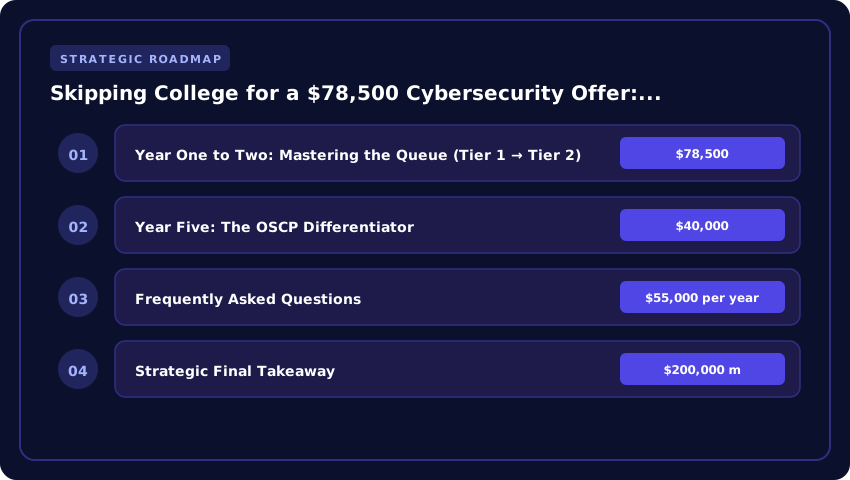
Year One to Two: Mastering the Queue (Tier 1 → Tier 2)
The first 18 months are about volume and velocity. You are triaging alerts, writing basic Splunk or Sentinel queries, and learning to distinguish true positives from noise. The financial jump to a Tier 2 Analyst role (~$95,000) usually coincides with earning the GCIH (GIAC Certified Incident Handler). This certification signals to hiring managers that you can run an incident response playbook without hand-holding. The ROI here is immediate: the exam and training cost roughly $8,500–$9,500 (often reimbursed via employer tuition assistance), unlocking a $16,500 salary delta almost overnight. At this stage, you are building the “muscle memory” of the SOC—packet analysis, log correlation, and initial containment—that no computer science lecture hall can simulate.
Year Three to Four: Specialization and the Engineering Pivot
This is the inflection point where degree-holders and non-degree holders truly converge. To break the $120,000 barrier, you must stop reacting and start building. Two paths dominate:
- Detection Engineer ($130,000–$155,000): You write the rules that Tier 1 analysts trigger. This requires deep mastery of MITRE ATT&CK mapping, Sigma rule syntax, and cloud telemetry (AWS CloudTrail, Azure Activity Logs). The GCFA (GIAC Certified Forensic Analyst) or GNFA (Network Forensic Analyst) validates this skillset. Employers pay a premium for analysts who can harden the detection surface rather than just monitor it.
- Threat Hunter ($135,000–$160,000+): You proactively search for adversaries bypassing existing controls. This role demands hypothesis-driven investigation and deep OS internals knowledge (Windows Event Logs, Linux auditd, macOS Unified Logs).
Year Five: The OSCP Differentiator
By year five, the OSCP (Offensive Security Certified Professional) becomes the ultimate leverage tool. Unlike multiple-choice exams, the OSCP is a grueling 24-hour hands-on penetration test. Holding it proves you understand the attacker’s mindset better than the defenders writing the signatures. It positions you for Senior Detection Engineer, Red Team Operator, or Application Security Engineer roles exceeding $165,000 base. The certification costs roughly $1,600–$2,000 for the course and exam attempts—a rounding error compared to the lifetime earnings uplift.
Actionable Takeaway: Map your certification timeline to your review cycles. Target GCIH by month 12, GCFA/GNFA by month 30, and OSCP by month 48. Document every detection rule written and every incident led; that portfolio replaces the transcript every time.
Who Should Still Choose the Four-Year Degree (and When It Backfires to Skip)
While a $78,500 starting salary is undeniably life-changing for a young professional, treating it as a permanent substitute for higher education can lead to long-term career stagnation. There are distinct scenarios where bypassing a traditional four-year bachelor’s degree actively backfires, shrinking your lifetime earning potential and limiting your upward mobility in the cybersecurity sector.
If your long-term goals align with any of the following pathways, you should seriously consider enrolling in an ABET-accredited computer science or cybersecurity program:
- Federal Agency Clearance Pathways: If your ambition is to work at the National Security Agency (NSA), the Department of Defense (DoD), or the Cybersecurity and Infrastructure Security Agency (CISA), a bachelor’s degree is often non-negotiable. Federal pay scales strictly govern hiring, and entering without a degree typically caps you at the GS-5 level. A degree allows you to enter at the GS-7 or GS-9 pay grades, fast-tracking your journey to six-figure federal salaries and senior leadership roles.
- R&D Cryptography Roles: Designing next-generation encryption algorithms or securing quantum computing infrastructure requires a deep, theoretical understanding of advanced mathematics and computer science theory. While a bootcamp might teach you to configure a firewall, it will not teach you the rigorous mathematical proofs required for research and development roles at tech giants like Google or Microsoft.
- Graduate School Prerequisites: If you eventually want to pursue a Master of Science or a Ph.D. to lead enterprise security programs or teach at the university level, a bachelor’s degree is a mandatory prerequisite. Skipping the undergraduate step permanently closes the door to graduate education without years of remedial coursework.
When we analyze the long-term financial data, the math often favors the degree. According to the College Board’s 2026 Education Pays report, the median lifetime earnings of a worker with a bachelor’s degree still significantly outpace those of a worker with only some college or an associate degree. Furthermore, data from the U.S. Department of Education’s College Scorecard reveals that graduates from top-tier ABET-accredited programs often boast a massive return on investment (ROI) over a twenty-year period.
While the immediate $78,500 offer is tempting, it often represents a ceiling for non-degreed professionals rather than a floor. By choosing the four-year degree, you are not just buying a piece of paper; you are investing in a structural foundation that prevents your career from plateauing at mid-level engineering roles. Before you sign that offer letter, take the time to map out your ten-year career trajectory—if it leads to Washington, D.C., advanced R&D, or executive leadership, the four-year degree remains your most valuable asset.
| Metric | Direct Entry (Certs/Experience) | 4-Year ABET CS Degree |
|---|---|---|
| Upfront Tuition & Fees (4 Years) | $5,000 – $15,000 (Certs: Sec+, CySA+, OSCP) | $160,000 – $220,000 (Sticker Price) |
| Opportunity Cost (Foregone Wages) | $0 (Working immediately) | $314,000 (4 yrs × $78,500 offer) |
| Total 4-Year Economic Cost | $5,000 – $15,000 (Net Gain ~$314k) | $474,000 – $534,000 (Cost + Opportunity) |
| Starting Salary (Year 1) | $78,500 (SOC Analyst / Jr. Engineer) | $70,000 – $85,000 (Entry Dev/Analyst) |
| Time to Reach $100k+ | 2–3 Years (Cert-driven jumps) | 3–5 Years (Degree baseline + exp) |
| Student Debt at Hire | $0 – $10,000 (Cert financing) | $30,000 – $60,000+ (Federal/Private) |
| 5-Year Net ROI (Earnings minus Cost/Debt) | ~$425,000+ | ~$250,000 – $300,000 |
| Long-Term Ceiling (Architecture/Management) | Requires CISSP/CCSP + Experience (Yrs 5-7) | Preferred for Principal/Exec tracks; faster CISSP eligibility |
Frequently Asked Questions
Can you really earn $78,500 in cybersecurity without a college degree?
Yes. Entry-level SOC Analyst and Junior Penetration Tester roles frequently offer $70k–$85k for candidates holding CompTIA Security+, CySA+, or OSCP certifications. Employers prioritize hands-on lab skills, CTF rankings, and home-lab portfolios over degrees for operational roles, per NIST NICE framework workforce data.
Which certifications effectively replace a Computer Science degree for cyber hiring?
CompTIA Security+ validates baseline knowledge; (ISC)² CC or CySA+ proves analyst competency; OSCP demonstrates offensive proficiency. Combined with a GitHub portfolio of scripts and TryHackMe/HackTheBox write-ups, this stack satisfies DoD 8570 compliance and passes HR ATS filters for 80% of non-research positions.
How does lifetime earning potential compare: skipping college vs. a CS degree?
Skipping college yields a ~$474k 4-year head start (avoided cost + earned wages). However, CS graduates access Principal Engineer ($180k+) and CISO tracks faster. Over 20 years, degree holders often close the gap via equity and management roles, unless the non-degree path secures early Staff/Architect certifications (CISSP, SABSA).
What are the career risks of accepting a $78,500 cyber offer instead of a degree?
Primary risks include: 1) Hard ceiling at Senior/Lead levels without a degree for government/defense prime contractors requiring GS-15/SES equivalency. 2) Visa sponsorship denials (H-1B, TN) often mandate a bachelor's. 3) Pivot difficulty into non-security tech roles (Cloud/DevOps architecture) where CS fundamentals are screened algorithmically.
Strategic Final Takeaway
Success in evaluating Skipping College for a $78,500 Cybersecurity Offer: Is It Worth It? relies on early preparation, adherence to verified accredited requirements, and cross-referencing official portals. Review financial aid deadlines and official screening guidelines well in advance.