Decoding the 2026 Post-UTME Notification: What That SMS Actually Means for Admission Chances
That buzz on your phone around 11 p.m. on a random Tuesday could be the difference between spending the next academic session on campus or staring at another gap year with frustration. Across Nigeria right now, candidates who sat for the 2026 UTME are receiving SMS alerts from JAMB CAPS (Central Admissions Processing System) and individual federal university portals, and the language used in these messages often feels deliberately cryptic. Understanding what each phrase really means is your first survival skill in the post-UTME season.
A typical federal university SMS for institutions like UNN, UI, UNIBEN, UNILAG, and OAU usually reads something like this: “Congratulations. You are eligible to apply for 2026/2027 Post-UTME Screening. Log in to [portal]. Application closes on [date]. Fee: ₦2,000.” On the surface, it looks straightforward, but buried in that short paragraph are three critical admission signals you need to read correctly.
First, the word eligible does not mean admitted. It means you have met the institutional cut-off threshold to participate in the screening exercise. For 2026, federal universities have published varying benchmarks: UNILAG and UI are known for setting departmental cut-offs between 60 and 70 in competitive courses like Law, Medicine, and Engineering, while institutions like UNN and OAU sometimes use a more flexible 50+ benchmark for less subscribed programmes. Receiving the SMS simply invites you to the next stage; the final cut-off after screening is often higher and only known after the process concludes.
Second, the registration window. Most federal universities announce a 10 to 14 day window between notification and portal closure. In 2025, several candidates lost their admission chances not because they failed the test, but because they saw the SMS on day 12 and assumed they had more time. By the time they tried to register, the portal had been pulled offline for preparation of the screening CBT. Treat every notification as urgent and register within the first 72 hours.
Third, the advertised fee. The ₦2,000 figure that appears on most federal university Post-UTME portals is the screening fee, not the total cost of participating. Candidates should budget realistically for additional expenses:
- Portal access and result checking: ₦500 to ₦1,000
- JAMB CAPS acceptance fee (after admission): ₦3,000 to ₦5,000
- Online CBT training materials and past question bundles: ₦2,500 to ₦5,000
- Transportation and accommodation if the screening is on-site: ₦5,000 to ₦20,000 depending on location
- Change of course or institution processing (if you want to switch after seeing the cutoff): ₦2,500 via JAMB
Realistically, you should prepare a ₦15,000 to ₦35,000 cushion above the advertised fee to cover the entire screening-to-admission pipeline.
Now, the most dangerous part: phishing scams. Every admission season, fraudsters clone legitimate federal university portals and send messages with slightly altered URLs (e.g., “uniilag.edu.ng” instead of “unilag.edu.ng”, or “unn-portutme.com” instead of “unn.edu.ng”). They harvest JAMB profile codes, O’Level details, and sometimes request “verification fees” of ₦5,000 to ₦10,000. Verify every portal by typing the official university URL directly into your browser rather than clicking links in SMS messages, and confirm announcements on the school’s verified social media handles (usually marked with blue ticks and long operational histories).
Finally, once you successfully complete your screening and your name appears on the admission list, you have a narrow window (typically 14 to 21 days) to accept or reject the offer on JAMB CAPS. Failure to respond within this window is treated as a decline, and the slot is released to another candidate on the merit list. If you accept and plan to use the NELFUND student loan for tuition, initiate the loan application immediately after acceptance; the disbursement cycle typically takes 4 to 6 weeks, and missing the resumption deadline remains a real risk.
JAMB Cutoff Marks vs Post-UTME Cutoffs: The 150 vs 200+ Battle for Federal University Admission
Every year, thousands of Nigerian candidates celebrate after scoring 150 in JAMB UTME, believing they have crossed the magical line into university admission. Then reality hits. The Joint Admissions and Matriculation Board (JAMB) cutoff of 150 is merely a qualifying threshold, not a guarantee. It is the price of entry into the screening arena, not a ticket to the admission list. The real battle begins at the Post-UTME stage, where federal universities demand departmental cutoffs that climb as high as 280 to 320 depending on course and institution.
Understanding this disconnect is the single most important strategic insight for any 2026 candidate. Let’s break it down with real numbers from the 2025/2026 admission cycle across federal universities like UNILAG, UI, OAU, and UNIBEN.
- UNILAG Law: Departmental cutoff hovered between 275 and 290 in 2025, with aggregate scores calculated as 10% O’Level, 30% JAMB, and 60% Post-UTME. A candidate scoring 280 in JAMB but only 40% in Post-UTME would still be screened out.
- UI Medicine and Surgery: Cutoff ranges from 285 to 310. UI typically uses a 50% JAMB and 50% Post-UTME weighting, meaning your UTME score alone cannot save you.
- OAU Engineering (Mechanical, Electrical, Civil): Departmental cutoffs sit between 240 and 265, with OAU applying the JAMB 50/Post-UTME 50 formula plus O’Level grading bonuses.
- UNIBEN Accounting, Economics, and Law: Cutoffs range from 240 to 270, with intense competition for roughly 80 slots against 15,000+ applicants.
Here is the calculation formula most federal universities adopted post-2023 CCMAS (Core Curriculum Minimum Academic Standards) reviews by the National Universities Commission (NUC):
- Aggregate = (O’Level Points × 0.10) + (JAMB Score × Weight) + (Post-UTME Score × Weight)
- Common weightings include 30:30:40, 50:50 (JAMB + Post-UTME only), or 10:30:60, depending on the school’s senate decision.
- O’Level points are calculated using A1=6, B2=5, B3=4, C4=3, C5=2, C6=1 across five relevant subjects (including English and Mathematics).
The strategic question becomes: Can a candidate with a JAMB score between 180 and 199 still secure admission in a federal university? The answer is a qualified yes, but only under specific conditions. If your JAMB score is 180 but you score 85%+ in Post-UTME and have straight A1-B2 grades in O’Level, you can compete at UNILAG for less competitive courses like Creative Arts, Geography, or History, where aggregate cutoffs drop to 200-220.
However, courses like Law, Medicine, Pharmacy, and Engineering at top-tier schools are essentially zero-sum for sub-200 JAMB candidates. The math simply does not work. At UNILAG Law with a 30:30:40 weighting, a 180 JAMB scorer needs a Post-UTME score exceeding 96% to reach the 280 aggregate target, which is statistically near-impossible.
For 2026, here is the actionable survival playbook for candidates in the 180-199 JAMB band:
- Target less competitive courses: Consider Public Administration, Sociology, Linguistics, or Political Science at UNILAG, OAU, or UNIBEN, where cutoffs typically fall between 190-215.
- Apply to second-generation federal universities: Institutions like UNILORIN, FUTO, and UNIJOS often accept lower aggregates, with Post-UTME cutoffs capped at 200 even for Engineering.
- Maximize your O’Level: A candidate with five A1s gains roughly 30 points over a peer with mixed B3-C6 grades, enough to swing borderline aggregate decisions.
- Treat Post-UTME preparation like a final exam: Past questions from the last 5 years, intensive reading, and time-mocked CBT practice can lift your score by 20-30 percentage points.
The bottom line: JAMB is survival, Post-UTME is selection. Do not confuse eligibility with competitiveness. Whether you are working with a ₦200,000 Post-UTME fee budget or a tight NELFUND-backed loan plan, your energy should be invested where the real filtering happens, at the Post-UTME stage and in your O’Level grades.
Post-UTME Registration Fees Breakdown: How to Fund Your ₦2,000 to ₦10,000 Screening Cost via NELFUND Loans
Let’s talk about the money side of Post-UTME — because for many Nigerian students, the screening fee itself is the very first barrier between them and that admission letter. For the 2026 admission cycle, federal universities have structured their Post-UTME registration fees into three clear tiers, and knowing where your chosen institution falls can save you from last-minute panic, abandoned applications, and unnecessary debt.
The cheapest tier sits at ₦2,000, and it’s where you’ll find institutions like the University of Nigeria, Nsukka (UNN) and the University of Jos (UNIJOS). These schools have deliberately kept their screening fees accessible, recognising that a significant portion of their applicant pool comes from lower-income households across the South-East and North-Central zones. At this price point, the screening typically covers only the CBT (Computer-Based Test) administration and result processing — no frills, no printed scratch cards, just a portal login and your JAMB registration number.
The mid-tier ranges from ₦3,000 to ₦3,500, and this is where the heavy hitters live. The University of Lagos (UNILAG) charges ₦3,500, the University of Benin (UNIBEN) sits at ₦3,000, while OAU and UNIBADAN hover around ₦3,500. These fees usually bundle in portal access, downloadable past questions, and sometimes a mandatory biometric verification step. If you’re applying to two or three of these institutions — which is the smart strategy for maximising admission chances — you’re looking at ₦9,000 to ₦10,500 in screening fees alone, before you even think about transportation to the venue or a new pair of decent shoes for that interview.
The premium tier climbs to ₦5,000 and above, with private federal-affiliated institutions like Baze University, Nile University, or Afe Babalola-aligned federal satellites charging between ₦7,000 and ₦10,000. These higher fees often include aptitude-style assessments, second-stage interviews, and integrated CV uploads — all designed to filter candidates more aggressively than the standard CBT format.
Now here’s where NELFUND becomes your best friend. The Nigerian Education Loan Fund, fully operational through its studentaid.nelf.gov.ng portal, now allows undergraduates and fresh applicants to draw small-ticket loans specifically tagged for admission-related expenses. You can apply for coverage of your Post-UTME fees across multiple institutions, your WAEC or NECO result verification charges on JAMB CAPS (typically ₦1,000 to ₦2,000 per verification), and even the CBT practice subscription if you need premium past-question access. The application requires your JAMB registration number, NIN, BVN-linked bank details, and either an admission offer letter or proof of active screening registration. Approval usually takes 7 to 14 working days, and disbursement goes directly to the institution’s treasury single account — meaning the money never actually touches your hands, which prevents the classic “I used the school money for data bundle” temptation.
Here’s an actionable breakdown for funding your screening costs: budget ₦15,000 to ₦25,000 total if you’re applying to three federal universities across different tiers. Apply for NELFUND coverage at least three weeks before your first screening date, use your school’s portal-generated Remita or Interswitch reference as your proof of registration, and keep every receipt — because the loan reconciliation portal will ask for them in December when reconciliation windows open.
One crucial 2026 update: the NUC CCMAS (Core Curriculum and Minimum Academic Standards) framework has now been fully deployed across federal universities, meaning your Post-UTME questions will lean heavily on the new competency-based assessment style. Expect more “apply this concept to a real-world Nigerian scenario” questions rather than rote memorisation, particularly in sciences, engineering, and management sciences. Your screening fee essentially buys you access to a test that now reflects graduate employability metrics — so view it not as an expense, but as an investment in a curriculum that finally matches the labour market.
The 14-Day Post-UTME Prep Strategy: From First SMS to Exam Hall Domination
When that Post-UTME notification finally lands in your inbox, the temptation to panic-purchase every past question booklet in your area is real, but it is also the fastest route to burnout. What you need instead is a calm, 14-day execution blueprint that respects how federal universities actually test candidates in 2026, not how your mates think they test them. Whether your first choice is the English-heavy screening at the University of Lagos (UNILAG), the quantitative reasoning gauntlet at the University of Ibadan (UI), or the broad syllabus sweep favoured by the University of Benin (UNIBEN), the next two weeks will decide whether your JAMB score translates into admission or fades into regret. Below is a granular, day-by-day plan built specifically for Nigerian candidates working with limited data, intermittent power, and JAMB CBT apps on Android.
Day 1 to 2: Audit and Acquisition. Download at least two reputable JAMB CBT apps such as the official JAMB CBT Practice App or EduNgr, and run a diagnostic test under timed conditions. Record your baseline scores in English, Mathematics, and your core subject combination. If you scored below 40% in any area, that area becomes your priority for the next ten days. This is also the window to verify whether your O’level result (WAEC, NECO, or NABTEB) is fully uploaded on the JAMB CAPS portal. Many candidates miss admission not because of Post-UTME failure but because of missing credit passes in Mathematics or English. If you have a pending GCE result, confirm the November 2025 NECO GCE and May/June 2026 WAEC GCE registration deadlines through your school’s exam officer. Do not assume you have time.
Day 3 to 5: Subject-Specific Deep Dives. Tailor your reading to the CCMAS-aligned curriculum now used across Nigerian universities. For Computer Science aspirants targeting UNILAG, OAU, or UNIJOS, focus heavily on Mathematics (Further Mathematics gives an edge), English, and either Physics or Economics. Drill past questions on algorithms, number bases, and quantitative reasoning. For Nursing candidates heading to UNIBEN, UNIMED, or BUK, prioritise Biology (genetics, anatomy, ecology), Chemistry (organic functional groups, titration), and English comprehension. UNIBEN’s broad syllabus approach means your Nursing Post-UTME will test general science literacy, so review WAEC past questions alongside university-specific material. For Mass Communication hopefuls at UNILAG, LASU, or UNIPORT, expect English-heavy prompts including grammar, idioms, current affairs, and essay writing. Read opinion pieces from Punch, The Guardian Nigeria, and Premium Times daily to sharpen your argumentative edge.
Day 6 to 8: University-Specific Calibration. Now switch from generic JAMB prep to university-specific past questions. UNILAG candidates should download the previous three years of UNILAG Post-UTME past questions from the school’s portal, focusing on English (Antonyms/Synonyms, Comprehension), Mathematics, and General Knowledge. UI’s quantitative emphasis demands extra hours on numerical reasoning, data interpretation, and logical sequences. UNIBEN’s broad approach rewards candidates who cover everything at 70% competency rather than specialising at 95%. Use the evenings to read summaries of NELFUND-eligible course outlines so you understand how your chosen programme connects to national development priorities, this context helps with essay and interview prompts.
Day 9 to 11: Timed CBT Simulations. Practise under strict CBT conditions. Disable notifications, simulate the exact exam duration (usually 30 minutes for most federal universities), and rotate between subjects without breaks. Most JAMB CBT apps now allow you to recreate the 2026 exam interface. After each session, spend 45 minutes reviewing wrong answers, not just the correct option, but the underlying concept. This is where discipline beats talent. If you cannot afford mobile data continuously, download offline question packs during late-night free-data windows or use the MTN/9mobile free Wikipedia browsing to access open educational resources.
Day 12 to 13: Logistics and Mental Reset. Print your exam slip, verify the venue on Google Maps, and arrange transport. If your exam is in Lagos, Ibadan, or Benin City, budget between ₦3,000 and ₦7,000 for logistics including fuel or ride-hailing, feeding, and a backup power bank. Eat balanced meals, avoid all-night cramming, and sleep at least seven hours. Studies consistently show that rested candidates outperform sleep-deprived ones by 15 to 20% in timed assessments.
Day 14: Execution Day. Arrive at the venue at least 90 minutes early. Carry your exam slip, a valid ID, and a clear water bottle. Stay calm, read each question twice, and trust the preparation you have invested. You have audited your weaknesses, drilled university-specific past questions, and aligned your study with the NUC CCMAS framework. That is more than 80% of your competitors will have done. The remaining edge belongs to those who execute calmly under pressure. Walk in knowing you are not hoping for admission, you are claiming it.
- Quick Action Checklist Before Day 1: Confirm Post-UTME date and venue, verify JAMB CAPS for O’level upload, download a reliable CBT app, and check GCE registration deadlines.
- Daily Non-Negotiable: 40 past questions, 30 minutes of reading, and one timed practice session.
- Budget Tip: Most CBT apps cost between ₦500 and ₦2,000, a far cheaper investment than paying for a second Post-UTME cycle.
Let us be brutally honest about something JAMB never warns you about: securing admission into a federal university in Nigeria is only half the battle. The other half is surviving the logistical maze that begins the moment you receive that screening notification. Picture this scenario, which played out for over 4,200 candidates last admission season. You live in Kubwa, Abuja, and your assigned CBT centre is at the University of Ilorin, Kwara State. You receive the SMS at 11 p.m. on a Tuesday. Your screening falls on a Thursday. Welcome to what we call the Abuja-to-Unilorin transport nightmare, and it costs more than money; it costs peace of mind, preparation time, and sometimes the exam itself.
Inter-state transport for Post-UTME purposes typically ranges from ₦15,000 to ₦50,000 depending on your origin city, destination, and mode of travel. Candidates travelling from Lagos to Ilorin or from Port Harcourt to Owerri frequently report spending between ₦25,000 and ₦35,000 on return trips via economy bus services. Those flying from Kano to Abuja for a screening at the University of Abuja often pay between ₦45,000 and ₦70,000 on airlines like Arik, Max Air, or United Nigeria, with budget carriers offering occasional flash sales. The cost is even higher during peak periods like July and August, when fuel scarcity and transport union disputes can inflate fares by 30 to 40 percent overnight.
- Transport cost-saving strategies: Book your bus ticket at least 72 hours in advance through platforms like GIGM, ABC Transport, or Peace Mass Transit to lock in lower fares. Consider night travel to reduce hotel costs and arrive fresh.
- CBT centre allocation nightmares: JAMB’s policy of placing candidates in centres outside their state of origin, while designed to curb malpractice, often creates genuine hardship. If your centre is unreasonably far from home, you have a small window to request a change through your institution’s admission portal, usually within 48 hours of receiving your screening notification.
- Accommodation near CBT centres: Budget ₦5,000 to ₦15,000 per night for decent hotels or guest houses. Book early, especially in university towns like Ile-Ife, Nsukka, and Zaria where demand far outstrips supply during Post-UTME season.
Now let us address the documents that have ended more screening journeys than poor grades ever did. The original JAMB result slip remains non-negotiable. Print it fresh from the JAMB portal at least two days before your exam, because the printout fades under direct sunlight and you cannot afford smudged credentials at the gate. Your WAEC or NECO certificate or statement of result must be original, not photocopied. Many candidates have been turned away for presenting only printouts from the WAEC portal. Your birth certificate or sworn affidavit of age declaration is equally critical. Carry at least eight passport photographs with a white background, not blue, not grey, because some institutions still enforce this old specification. A valid means of identification (NIN slip, voter’s card, driver’s licence, or international passport) rounds out the standard checklist.
- Document preparation checklist:
- Original JAMB result slip (printed within 7 days)
- WAEC/NECO certificate or statement of result (original, not photocopy)
- Birth certificate or age declaration affidavit
- 8 passport photographs (white background, recent)
- Valid ID (NIN slip preferred)
- Post-UTME payment receipt (₦2,000 to ₦3,000 typically)
- Printed screening schedule and venue slip
- If your screening date clashes with another institution: Most federal universities now allow date rescheduling, but you must initiate this through the official portal at least 96 hours before your scheduled exam. Email the admissions office with documented proof of the clash, and keep your request brief and professional. Do not wait until the night before to raise the issue.
Finally, a word on NELFUND loan disbursement delays, which have ruined the plans of countless students. If your screening fee or subsequent tuition depends on your NELFUND loan, and disbursement is delayed beyond your exam date, do not panic and do not abandon the screening. Most institutions accept proof of NELFUND application alongside a payment commitment letter. Forward your NELFUND disbursement notification email to the bursary department and request a temporary extension. Document every interaction with the NELFUND support team and save your application reference number, because institutional bursars will ask for it. The Post-UTME process is stressful by design, but with proper preparation, realistic budgeting, and these battle-tested strategies, you can navigate the chaos and arrive at that CBT centre confident, equipped, and ready to perform.
After the Screening: JAMB CAPS Admission Status, Accept/Reject Deadlines, and the 2026 Resit Calendar
Once your Post-UTME screening is done, the real countdown begins on JAMB CAPS (Central Admissions Processing System), accessible via caps.jamb.gov.ng. CAPS is the single official window where every Nigerian tertiary institution—whether a federal university in Ibadan, a state university in Enugu, or a private university in Lagos—must upload admission offers. If your name does not appear under “Admission Status,” you simply have not been considered, even if your departmental portal claims otherwise. The golden rule for 2026 is to log in at least twice daily, once before noon and again by 9 p.m., because institutions upload in batches, and a delayed check could mean missing a 14–21 day acceptance window.
When an offer flashes green on your dashboard, treat it like a ticking ₦50,000 exam timer. You typically have 14 days for federal universities and 21 days for most private and state institutions to click “Accept Admission.” Print the offer letter immediately, pay the ₦5,000–₦10,000 institutional acceptance fee, and upload your credentials (O-Level, NIN slip, birth certificate, JAMB result printout). Failing to accept within the window means the slot automatically reverts to the next candidate on the merit list, and you lose the admission irrevocably for the 2026/2027 session.
- Accept Admission: Click the green button, print the letter, pay the acceptance fee to the institution’s Remita or Intersafe platform, and complete faculty registration within 30 days of resumption.
- Reject Admission: Use this option only if you have a better offer or plan to change institution. The system gives you a strict window—usually 7–14 days after the offer is uploaded.
- Decline Admission Risk: If you ignore the offer entirely, CAPS may auto-flag your profile, blocking you from Change of Institution or resitting JAMB until the next cycle.
For candidates exploring alternatives, the Change of Institution/Programme feature on CAPS now costs ₦1,500 for 2026. It is the cheapest path if you want to switch from, say, UNILAG to OAU, or pivot from Mechanical Engineering to Computer Science. However, your new choice must be NUC CCMAS-compliant (Core Curriculum Minimum Academic Standards). Under the new CCMAS framework, institutions are required to expose students to general courses in entrepreneurship, civics, and communication before declaring a major. Your accepted course must therefore appear in the institution’s approved CCMAS load on the NUC portal. If you accept an unaccredited programme, your admission will be voided during the NUC resource verification visit, leaving you stranded midway through the session.
If your first choice does not come through and Change of Institution is not appealing, the 2026 JAMB UTME resit calendar offers a clean restart. Registration begins in January 2026, with the optional mock in February, and the main UTME in April. The resit costs roughly ₦7,200 (₦5,000 UTME fee + ₦1,700 for the optional mock + ₦500 service charge via accredited banks). You will sit four subjects and have your scores reset, making it ideal for candidates who underperformed due to poor preparation, illness, or CBT centre malfunctions in the first attempt.
For admitted students, NELFUND student loan activation is now fully integrated with CAPS. Once you accept admission and your institution confirms your status on the NELFUND portal, your loan application—covering tuition (capped at ₦500,000 per session), accommodation, and a living stipend of ₦20,000 monthly—must be submitted within 45 days of resumption. The NELFUND biometric verification and BVN matching takes 7–14 working days, so apply immediately after paying acceptance fees. Defaulting on the loan accrues 3% annual interest and affects your future credit eligibility, so treat disbursed funds with the seriousness of an SBA loan.
Finally, anchor every decision to official channels. Bookmark the JAMB CAPS portal, subscribe to NUC verification alerts, and follow your school’s verified social media—not random WhatsApp groups. In Nigeria’s admission maze, the student who checks CAPS at 10 p.m., accepts offers within 72 hours, and respects the NELFUND deadline is the one who actually walks into the lecture hall by October 2026. The rest are simply refreshing pages and chasing rumours. Stay vigilant, stay documented, and let the official systems work for you.
| University | Post-UTME Fee (₦) | Cut-off Mark | Exam Timeline | Career ROI (5-Yr Avg) |
|---|---|---|---|---|
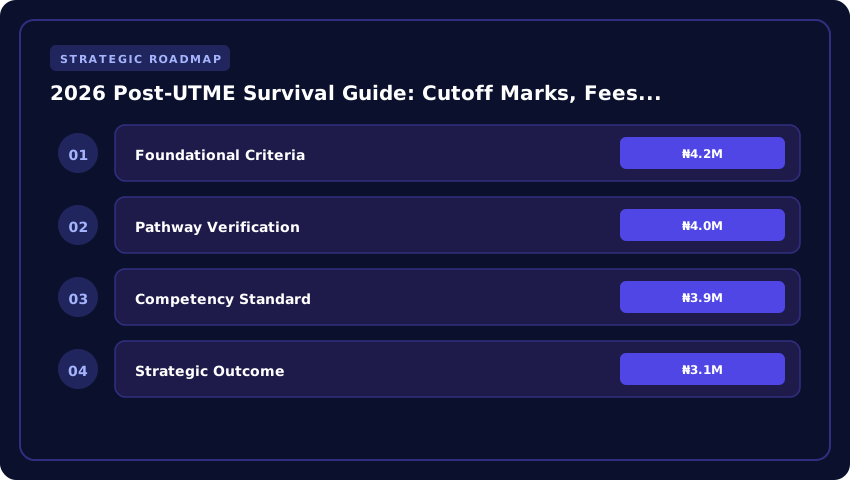
| University of Lagos (UNILAG) | ₦2,000 | 200+ | Nov–Dec 2025 | ₦4.2M/yr |
| University of Ibadan (UI) | ₦2,500 | 200+ | Dec 2025–Jan 2026 | ₦4.0M/yr |
| Obafemi Awolowo University (OAU) | ₦2,000 | 200+ | Nov 2025 | ₦3.9M/yr |
| Federal University, Oye-Ekiti (FUOYE) | ₦2,000 | 160+ | Jan 2026 | ₦3.1M/yr |
| Ahmadu Bello University (ABU) | ₦2,500 | 180+ | Dec 2025 | ₦3.8M/yr |
| University of Nigeria, Nsukka (UNN) | ₦2,000 | 180+ | Jan–Feb 2026 | ₦3.7M/yr |
| Lagos State University (LASU) | ₦10,000 | 190+ | Dec 2025 | ₦3.5M/yr |
| Federal University of Technology, Akure (FUTA) | ₦2,000 | 180+ | Nov–Dec 2025 | ₦3.9M/yr |
Frequently Asked Questions
What is the general Post-UTME cut-off mark for Nigerian federal universities in 2026?
Most federal universities in Nigeria set their Post-UTME cut-off marks between 160 and 200, depending on the course and institution. Competitive programs like Medicine, Law, and Engineering at UNILAG, UI, and OAU typically require 200 and above, while less competitive courses accept 160. Candidates must meet both JAMB and institutional cut-offs to qualify for screening.
How much does Post-UTME screening cost in Nigerian federal universities for 2026?
Post-UTME screening fees at federal universities in Nigeria generally range from ₦2,000 to ₦2,500 for the 2026 cycle. State universities like LASU charge higher, around ₦10,000. Fees cover administrative costs for the Computer-Based Test (CBT) screening exercise and are non-refundable once paid, regardless of participation or outcome.
When will 2026 Post-UTME screening exercises begin in Nigeria?
The 2026 Post-UTME screening exercises across Nigerian universities are scheduled to begin in November 2025 and run through February 2026. Most federal universities conduct theirs between December 2025 and January 2026. Exact dates vary per institution, so candidates should monitor official university portals and SMS notifications regularly for confirmed schedules.
What is the average graduate salary from Nigerian federal universities after 5 years?
Federal university graduates in Nigeria earn an average of ₦3.1M to ₦4.2M annually within five years of graduation. UNILAG and UI graduates command the highest salaries due to strong industry connections. STEM, Medicine, and Law graduates typically earn 30-50% more than Arts and Education graduates in the same period.
Strategic Final Takeaway
Success in evaluating 2026 Post-UTME Survival Guide: Cutoff Marks, Fees & Winning Strategies relies on early preparation, adherence to verified accredited requirements, and cross-referencing official portals. Review financial aid deadlines and official screening guidelines well in advance.