

Is City University Abuja Accredited for Your Postgraduate Programme? CCMAS & NUC Checklist
Before you commit a single Naira to an application portal, transport fare to the Nyanya-Karu expressway campus, or even download a PDF brochure, the single most important question on your mind should be a regulatory one: Is the postgraduate programme I want to pursue genuinely accredited, and will my certificate carry national weight in 2026, 2027, and beyond? For Nigerian applicants, prospective employers, and HR verification teams, accreditation is the difference between a Master’s degree that opens doors at the Federal Civil Service, the CBN, Shell, or the Nigerian Law School, and a piece of paper that gets politely pushed aside during document screening. City University Abuja, marketed widely as a private faith-based institution in the Federal Capital Territory, has steadily built out a postgraduate school that aligns with the National Universities Commission (NUC) framework, but verification is a personal responsibility you cannot outsource to a school ambassador on TikTok or a random WhatsApp broadcast group.
The NUC’s Core Curriculum and Minimum Academic Standards (CCMAS), which fully replaced the older BMAS framework beginning with the 2023/2024 academic session and now governs the 2026/2027 admissions cycle, requires every Nigerian university whether federal, state, or private to harmonize course content, credit units, and minimum academic benchmarks across degree levels. CCMAS is not a cosmetic rebranding; it mandates a minimum of 120 credit units for undergraduate programmes, structured learning outcomes, and direct alignment with industry needs under the Nigerian Graduate Pathways framework. For postgraduate studies, CCMAS enforces strict rules on thesis hours, dissertation weighting, supervised research methodology, and faculty-to-student ratios. If a programme is not in the NUC’s approved CCMAS gazette for City University Abuja, your PG Diploma, MBA, M.Sc., or Ph.D. will not pass NYSC mobilization for full-time programmes, will not be accepted by the Federal Scholarship Board, and may be flagged during background checks by global bodies like WES, UK NARIC, or the Council for the Regulation of Engineering in Nigeria (COREN).
So how do you actually verify? Step one is to visit the official NUC portal at nuc.gov.ng and navigate to the Accredited Programmes section. Search by institution name, filter by “Postgraduate,” and cross-reference each programme title letter by letter, paying close attention to department codes such as ACC for Accounting, BUA for Business Administration, CSC for Computer Science, ECO for Economics, EDU for Education, PUB for Public Administration, and LAW for Law. Step two is to request the NUC resource verification number or accreditation status letter directly from City University’s Postgraduate School, which is mandated to keep annual NUC approval letters on file for each programme. Step three is to confirm the specific accreditation window, as NUC typically grants approvals for three to five years, and a programme accredited only through 2024/2025 will require fresh re-accreditation before your admission letter can be honored.

For the 2026/2027 admissions cycle, City University Abuja’s postgraduate school is currently structured around the following faculties and departments offering PGD, Masters (M.A., M.Sc., MBA, MPA, M.Ed.), and doctoral (Ph.D.) pathways. Always confirm directly with the Postgraduate School Office before you pay your ₦25,000 application fee, because internal programme review sometimes shifts faster than public listings:
- Faculty of Management Sciences: Business Administration (
BUA), Accounting (ACC), Banking and Finance (BNF), Marketing (MKT), and Public Administration (PUB) full-time and part-time PGD, MBA, M.Sc., and Ph.D. - Faculty of Social Sciences: Economics (
ECO), Political Science and International Relations (POL), Sociology (SOC), Mass Communication (MAC) full-time and part-time M.A., M.Sc., and Ph.D. - Faculty of Sciences: Computer Science (
CSC), Mathematics (MTH), Physics (PHY), Chemistry (CHM), and Microbiology (MCB) PGD, M.Sc., and Ph.D. - Faculty of Education: Educational Management (
EDM), Guidance and Counselling (EDG), and Curriculum Studies (EDC) M.Ed., PGDE, and Ph.D. - Faculty of Arts and Humanities: English and Literary Studies (
ENG), Religious Studies (REL), History and International Diplomacy (HIS) M.A. and Ph.D. - Faculty of Law: Private Law, Public Law, Commercial Law (
LAW) LL.M and Ph.D. (subject to NBA and Council of Legal Education clearance).
Actionable takeaway: Treat accreditation as a hard filter, not a soft suggestion. Before you fall in love with a programme’s brochure, screenshot the NUC portal showing your exact course title and department code. If it does not appear, walk away regardless of how convincing the admissions officer sounds. A confirmed CCMAS-aligned programme protects your NYSC mobilization, your NELFUND student loan disbursement (which is disbursed only to NUC-accredited institutions), your future foreign equivalence evaluation, and ultimately, your career trajectory in Nigeria’s competitive ₦250 billion-plus postgraduate labour market.
City University Abuja Postgraduate Cut-Off Marks & Entry Requirements for 2026/2027
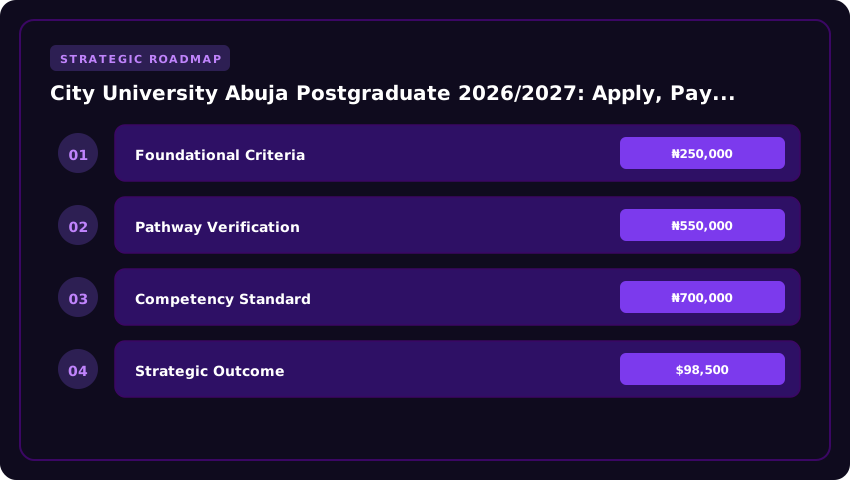
Securing a place in a postgraduate programme at City University Abuja begins with a clear understanding of the academic thresholds the institution sets for the 2026/2027 session. The university follows the National Universities Commission (NUC) Core Curriculum Minimum Academic Standards (CCMAS) while also applying its own departmental benchmarks to guarantee that admitted candidates can thrive in rigorous research and professional environments.
Minimum undergraduate CGPA for direct entry into a Master’s degree is a Second Class Lower division, which translates to a Cumulative Grade Point Average (CGPA) of 3.00 on a 5.00 scale (or 2.50 on a 4.00 scale). Candidates who meet this benchmark and possess the required O’level credits can apply straight to M.Sc., M.A., M.Ed., or professional Master’s programmes such as the MBA and LLM.
For holders of a Higher National Diploma (HND), the pathway is slightly different. An HND with a minimum of Lower Credit (CGPA 2.50–2.99 on a 4.00 scale) qualifies you for a Postgraduate Diploma (PGD) in a related discipline. Successful completion of the PGD with a minimum CGPA of 3.50 (on a 5.00 scale) then opens the door to a Master’s programme. This two‑step route ensures that HND graduates acquire the research methodology and academic writing skills expected at the Master’s level.
All applicants, irrespective of entry route, must present five (5) O’level credits obtained in not more than two sittings in WAEC, NECO, or NABTEB. The compulsory subjects are English Language and Mathematics; the remaining three credits should be relevant to the intended programme (e.g., Economics, Accounting, and Commerce for MBA; Literature in English and Government for LLM).
- MBA (Master of Business Administration): Departmental cut‑off is typically a CGPA of 3.20 or higher, plus a minimum of two years post‑graduation work experience. Candidates with a CGPA between 3.00–3.19 may be considered if they present a strong professional portfolio and pass the departmental interview.
- LLM (Master of Laws): Requires a Second Class Upper (CGPA ≥ 3.50) in LL.B. or a Second Class Lower with a minimum of 3.00 plus a pass in the Nigerian Law School Bar Part I. A written legal essay and oral interview form part of the selection.
- M.Sc. (Sciences, Engineering, Computing, etc.): General cut‑off aligns with the university minimum of 3.00 CGPA. Competitive departments such as Computer Science, Biotechnology, and Petroleum Engineering often raise the bar to 3.30–3.50 and may require a relevant research proposal at the application stage.
- PGD programmes: Open to HND Lower Credit holders and university graduates with a Third Class degree (CGPA 2.00–2.49). A minimum of 3.50 CGPA in the PGD is mandatory for progression to a Master’s.
Actionable takeaway: Before you pay the non‑refundable application fee (₦15,000 for 2026/2027), verify your CGPA against the specific departmental cut‑off on the university’s portal. Prepare certified copies of your O’level results, degree/HND transcript, NYSC discharge/exemption certificate, and, where required, a concise research concept note (max 500 words). Early preparation of these documents reduces last‑minute delays and positions you favorably for competitive programmes like the MBA and LLM.
Breaking Down City University Abuja Postgraduate School Fees (₦) and Acceptance Charges
Understanding the full cost of postgraduate study at City University Abuja requires more than glancing at a tuition brochure. Between acceptance charges, faculty levies, ICT fees, and accommodation estimates along the Nyanya–Karu expressway, your total commitment for the 2026/2027 academic session will depend heavily on your chosen programme, mode of study, and whether you are a fresh graduate or a returning professional. Below is a transparent, Nigerian-context breakdown designed to help you budget realistically before paying a single Naira into any portal.
For the 2026/2027 session, fresh postgraduate students should expect to budget between ₦385,000 and ₦720,000 for tuition alone, depending on the qualification. A Postgraduate Diploma (PGD) typically falls at the lower end, ranging from ₦385,000 to ₦450,000, while a Master of Science (M.Sc) programme ranges between ₦520,000 and ₦620,000. Professional master’s degrees such as the MBA sit slightly higher, generally between ₦580,000 and ₦720,000, reflecting the cost of intensive business modules and external facilitators. Doctoral (PhD) programmes represent the most significant academic investment, with tuition typically ranging from ₦850,000 to ₦1.1 million per session, inclusive of supervised research support but excluding dissertation binding and external viva logistics.
- Acceptance Fee (Mandatory, Non-Refundable): ₦50,000 – ₦75,000 for Nigerian students; West African ECOWAS applicants should budget a 15–20% surcharge to cover verification and credential evaluation costs.
- ICT & E-Learning Levy: ₦25,000 – ₦40,000 per session, covering access to the university’s Learning Management System, digital library subscriptions, and remote defence platforms for thesis students.
- Faculty Charges (Programme-Specific): Sciences and Health-Related disciplines carry laboratory and fieldwork levies of ₦30,000 – ₦60,000, while Management and Social Sciences typically add ₦15,000 – ₦25,000 for professional seminars and guest lectures.
- Accommodation (On-Campus Hostel): Limited hostel spaces range from ₦120,000 to ₦180,000 per session for standard rooms; premium ensuite options may reach ₦220,000.
- Off-Campus Rentals in Abuja (Nyanya–Karu Axis): Self-contained one-bedroom apartments typically rent for ₦350,000 – ₦550,000 annually, with shared flats starting around ₦180,000.
When comparing across faculties, Management Sciences generally present the highest tuition baseline, particularly for the MBA and M.Sc in Finance or Project Management, where structured professional certification components are embedded. Natural and Applied Sciences programmes add a measurable premium for laboratory access and field-based research support, while Social Sciences and Humanities tend to sit at the more accessible end of the spectrum. Education and Public Administration PGDs remain the most affordable entry routes, making them attractive for working-class professionals seeking upward mobility without immediate financial strain.
- Estimated First-Year Cost Summary (Nigerian Students):
- PGD: ₦510,000 – ₦620,000 total (tuition + acceptance + levies)
- M.Sc: ₦645,000 – ₦760,000 total
- MBA: ₦705,000 – ₦860,000 total
- PhD: ₦1.0 million – ₦1.3 million total
- West African (Non-Nigerian) Premium: Add 10–20% to cover international processing, credential authentication, and slightly higher accommodation surcharges for international residents.
Actionable takeaway: Before initiating payment, request the official 2026/2027 fee schedule directly from the Postgraduate School and cross-check it against the breakdown above. If you are an indigene of any Nigerian state or a beneficiary of the NELFUND student loan scheme, confirm whether postgraduate students qualify under current federal guidelines, as this can offset 30–50% of tuition for eligible applicants. Additionally, factor in ₦15,000 – ₦25,000 for medicals, ₦10,000 for student ID, and ₦8,000 for verification of credentials via the Bursary portal. Planning with these figures ensures you avoid mid-session financial interruptions and stay fully focused on your academic outcome.
How to Secure a NELFUND Student Loan for Your City University Abuja 2026/2027 Session
Financing a postgraduate degree can feel like a heavy financial burden, but the Nigerian Education Loan Fund (NELFUND) has emerged as a lifeline for ambitious scholars. If you are targeting the City University Abuja Postgraduate 2026/2027 session, securing a NELFUND loan can bridge the gap between your academic aspirations and your current financial reality. Unlike undergraduate applications where your JAMB UTME and Post-UTME scores are heavily scrutinized, postgraduate funding shifts the focus entirely to your academic history and professional readiness.
To qualify for a NELFUND loan as a postgraduate student, you must be a Nigerian citizen admitted into an approved NUC-compliant program at City University Abuja. The good news is that the eligibility criteria are straightforward and designed to support working professionals. You must demonstrate a genuine need for financial assistance and maintain satisfactory academic progress once enrolled. Crucially, you do not need to dust off your WAEC/NECO results or JAMB history; instead, the focus is strictly on your tertiary education credentials.
When preparing your application on the official NELFUND portal, having your documents organized will save you hours of frustration. Ensure you have the following ready for upload:
- Admission Letter: Your official offer letter from City University Abuja for the 2026/2027 academic session.
- Degree Transcripts: A verified copy of your first-degree transcript, proving you meet the academic baseline for postgraduate study.
- NYSC Discharge Certificate: Your NYSC completion certificate or a valid exemption letter, which is mandatory for PG applicants.
- Identification: A valid National Identification Number (NIN) and Bank Verification Number (BVN).
- Student Status Verification: Details confirming your active enrollment status, which City University Abuja will verify directly through the NELFUND institutional portal.
The application process itself is entirely digital. Simply visit the NELFUND student portal, create an account using your NIN and email address, and complete the student verification phase. Once City University Abuja confirms your admission status, you can proceed to fill out the loan application form, upload your documents, and submit. The funds are disbursed directly to the institution’s account, covering your tuition fees seamlessly.
Understanding the repayment terms is vital for your financial peace of mind. NELFUND offers a generous grace period; repayment begins two years after you complete your National Youth Service Corps (NYSC) program. For postgraduate students who might already be working, repayments are structured as a manageable percentage of your monthly income, ensuring you are not overwhelmed.
What if the NELFUND loan does not cover the entire tuition for your specialized MBA or MSc program? City University Abuja offers flexible, partial tuition payment plans that work harmoniously with your loan. You can negotiate a structured installment plan with the Bursary Department for the remaining balance. For instance, if your program costs ₦1,500,000 and NELFUND approves ₦1,000,000, you can spread the remaining ₦500,000 across the two semesters. This strategic combination ensures you never have to put your postgraduate dreams on hold while maintaining full compliance with the university’s financial regulations.
Step-by-Step Application: Filling the City University Abuja Postgraduate Portal Without Errors
Filling the City University Abuja postgraduate portal can feel intimidating the first time you open the dashboard, especially when you are juggling NYSC mobilisation, a current job, or family responsibilities across cities like Lagos, Port Harcourt, or Kano. The good news is that the school deliberately keeps the workflow linear, mirroring the National Universities Commission (NUC) CCMAS reporting style and the Post-UTME templates familiar to anyone who recently sat JAMB. Once you understand the rhythm of the portal — create account, pay, upload documents, submit referees, and track — the entire process from registration to admission letter typically takes seven to fourteen working days if your inputs are clean.
Begin by visiting the official admissions portal through the university’s verified website rather than searching for shortcuts on social media. Cybercafé operators in Nyanya and Wuse often advertise “fast-track” portals that harvest data; stick to the canonical domain ending in .edu.ng. Click “Postgraduate Admissions 2026/2027,” then select “Create New Account.” You will be asked for a valid email, active phone number, NIN (for identity triangulation), and your JAMB registration number if you previously ran a UTME cycle. Choose a password you can retrieve offline; password resets rely on OTP sent to your registered line, and Nigerian network downtime during peak hours can lock you out for hours.
After email verification, the system opens your applicant dashboard. This is where most candidates make costly errors. Read every dropdown carefully, especially the programme mode: Full-Time, Part-Time, or Sandwich. Sandwich programmes at City University Abuja are typically compressed into long vacation windows — useful for teachers on holiday break — while full-time demands residence near Karu for the duration of lectures. Picking the wrong mode means forfeiting your fee and starting over, so confirm with your employer or HOD before clicking submit.
- Personal Bio-data: Match every entry — surname, middle name, date of birth, state of origin — exactly with what is on your WAEC/NECO certificate and NIN record. Discrepancies trigger manual verification that can stretch three weeks.
- O-Level Upload: Scan your WAEC or NECO result at 200–300 DPI in PDF or JPEG. File size must usually fall below 2MB; oversized files silently fail upload, leaving the form looking complete when it is not.
- Transcript Upload: For HND and first-degree holders, request your transcript from your awarding institution at least four weeks before the portal closes. City University accepts official e-transcripts forwarded directly by institutions; a sealed envelope mailed via EMS is the alternative. Avoid uploading a “result slip” as a substitute.
- Referees’ Reports: The portal requires two referees — typically one academic and one professional. Input their official email addresses; the system auto-generates a confidential link for them to upload. Chase referees politely on WhatsApp; busy professors often forget, and an unsubmitted referee form equals an incomplete file.
- Programme Selection: Confirm that your chosen department aligns with the NUC-approved CCMAS curriculum. MBA, MSc, MPhil, and PhD tracks each carry distinct entry benchmarks, and selecting a non-accredited specialisation can invalidate your application.
When documents are clean, proceed to fee payment. The application fee for the 2026/2027 cycle is payable via Remita, the federal government-integrated gateway also used by JAMB and most universities. Generate your Remita Retrieval Reference (RRR) from the portal, pay with any Nigerian bank, USSD, debit card, or the Remita app, then return to the portal to “verify payment.” The portal usually reflects the debit within ten minutes, though Interswitch and some bank channels occasionally delay confirmation. Retain your transaction receipt; you will need it during Post-UTME screening and physical verification at the Nyanya campus.
Once payment is confirmed, the “Submit Application” button activates. Before you click it, preview every page. Nigerian applicants often discover after paying that their state of origin defaulted to “FCT Abuja” because they typed “Abuja” in the address field — a small detail that screening officers flag. Use the preview mode to confirm your referees received their upload prompts, that your transcripts attached correctly, and that your programme title is spelt right. After submission, the portal generates a unique Application ID. Print the acknowledgement slip; it is your login reference for tracking.
Tracking admission status is the final and most overlooked step. Return to your dashboard weekly. Status updates move through three stages: “Under Review,” “Recommended for Admission,” and “Offer Letter Released.” If your file stalls at “Under Review” for more than thirty days, escalate politely through the admissions email or visit the postgraduate school at the Karu expressway campus during working hours. Carrying your printed slip, payment receipt, and original credentials speeds up any manual reconciliation.
- Tip for NELFUND applicants: If you plan to apply for a student loan under the Nigerian Education Loan Fund, begin the NELFUND registration simultaneously with your portal submission. Approval timelines run parallel to admission offers, and a confirmed admission letter is required before disbursement.
- Tip for working professionals: Choose Part-Time if your organisation cannot release you for full residency. Sandwich is ideal for those tied to academic calendars.
- Tip for international applicants: West African sub-regional students (Ghana, Cameroon, Chad) should ensure their transcripts carry ECOWAS-standard evaluation; otherwise expect a two-week delay.
By following this sequence — verified portal, clean bio-data, mode-aware programme selection, properly scanned documents, prompt referee follow-up, Remita payment, and weekly status tracking — you transition from applicant to admitted candidate without the panic that derails most first attempts. Treat the portal as a structured exam: read instructions, double-check inputs, and keep offline copies of every receipt and slip. That discipline alone separates the candidates who celebrate admission within the first batch from those who spend months chasing clerical errors.
Post-UTME Screening, Interview Dates & Documents to Prepare Before Resuming in Abuja
While City University Abuja technically runs a “Postgraduate” rather than a UTME screening exercise, the institution mirrors the JAMB-style rigor expected across Nigerian tertiary institutions. Every applicant for the 2026/2027 academic session — whether pursuing a Postgraduate Diploma (PGD), Master of Science (M.Sc), Master of Business Administration (MBA), Master of Public Administration (MPA), or a Doctor of Philosophy (Ph.D.) — must pass through a multi-stage screening gauntlet before any admission letter is processed. Think of it as the academic equivalent of clearing customs at Abuja’s Nnamdi Azikiwe International Airport: arrive unprepared, and you’ll be turned back at the gate.
For the 2026/2027 intake, the Postgraduate School has historically rolled out administrative timelines between late April and early July for first-batch admissions, with a second window opening in October for late applicants. The Post-UTME screening itself is a hybrid affair: a Computer-Based Test (CBT) covering Quantitative Reasoning, English Proficiency, and Subject-Specific Pedagogy, followed by an oral interview conducted either physically on the Nyanya-Karu expressway campus or virtually via Zoom for diaspora candidates. Expect your CBT invitation slip — downloadable from the student portal at a typical portal-access fee of ₦2,500 — to arrive within 72 hours of successful payment.
- CBT Screening Date: Expected Saturday, 30th May 2026 (first batch) and Saturday, 7th November 2026 (second batch), 9:00 AM prompt.
- Oral Interview Window: 7 to 14 working days after CBT results are released; Ph.D. candidates should add an additional 30 minutes for the oral defence.
- Mandatory Orientation Week: Scheduled for Monday, 1st September 2026 through Friday, 5th September 2026, running from 8:30 AM to 4:00 PM daily at the Senate Building Auditorium.
- Late Registration Penalty: ₦10,000 surcharge applies to candidates who fail to complete physical clearance within the first two weeks of resumption.
Now, let’s talk about the Ph.D. oral defence — the moment where your proposal either soars or sinks. City University Abuja has adopted a panel format similar to the NUC CCMAS standard: five to seven faculty members, an external assessor drawn from another NUC-accredited institution, and a viva voce chair. You’ll typically be given 10 to 15 minutes to present your research synopsis using PowerPoint, followed by a 30-minute grilling session where panel members probe your methodology, theoretical framework, and contribution to knowledge. Bring a printed copy of your proposal (three spiral-bound copies), your Curriculum Vitae, and a soft copy on a 32GB flash drive — the panel secretary will format it onto the departmental laptop to avoid compatibility issues.
For Master’s and PGD candidates, the interview is lighter but no less important. Expect questions on your statement of purpose, why you chose City University specifically (have a credible answer; the panel can smell generic replies), and how your research interest aligns with the supervising professor’s niche. A common trap is assuming the interview is a formality — it isn’t. Past cohorts report rejection rates of roughly 15 to 20 percent at the interview stage, even among candidates who scored above 65 percent in the CBT.
Before you even board a bus to Abuja, your document portfolio should be airtight. Below is your printable clearance checklist — tick every box before stepping into the Postgraduate School:
- O’Level Result: WAEC, NECO, or NABTEB certificate (not just result slip; the certificate is mandatory for verification).
- Bachelor’s Degree Certificate: Original plus two photocopies; for HND holders seeking PGD admission, include the HND transcript.
- NYSC Discharge Certificate OR Exemption Letter: Mandatory for all Nigerian graduates below 30 years at the time of admission; foreign graduates must present a sworn affidavit of non-NYSC participation.
- Birth Certificate or Sworn Age Declaration: A Lagos State High Court affidavit is acceptable, but a hospital-issued birth certificate carries more weight during verification.
- Local Government of Origin Certificate: Required for indigene verification and access to certain state scholarship windows.
- Passport Photographs: 12 copies, white background, taken within the last six months.
- Referee Reports: Three sealed envelopes from academic referees sent directly to the Postgraduate School.
- Transcript Request: Forwarded from your previous institution to pgtranscripts@cityuniabuja.edu.ng at least four weeks before resumption.
- NELFUND Loan Approval Code: If you intend to apply for the Federal Government student loan, your NELFUND-issued Application ID must be presented at the bursary.
- Evidence of Tuition Payment: Bank teller or e-receipt showing remittal to the school’s TSA collection account.
One practical tip that seasoned Abuja residents swear by: arrive in the Federal Capital Territory at least 48 hours before your screening date. Nyanya traffic along the expressway is unpredictable, and a missed CBT slot cannot be rescheduled within the same cycle — you’ll have to wait for the next batch. Book accommodation around Garki or Wuse for proximity, and keep a scanned backup of every document on your Gmail cloud. The Postgraduate School’s verification unit is notoriously strict, and a single missing signature on your transcript can derail weeks of preparation. Walk in prepared, and you’ll be signing your matriculation register before the orientation week ends.
| Programme | Tuition (₦) | Duration | Entry Cut-off | Career ROI |
|---|---|---|---|---|
| PGD | ₦250,000 – ₦350,000/session | 2 Semesters | 2.50 CGPA + NYSC | Mid-level promotion eligibility |
| Masters (M.Sc / M.A) | ₦450,000 – ₦650,000/session | 3–4 Semesters | 2.50 CGPA + PGD or 2nd Class | Senior management / lecturing |
| MBA | ₦550,000 – ₦750,000/session | 4 Semesters | 2.50 CGPA + 2yr work exp. | Executive roles, ₦5M+ salary uplift |
| PhD | ₦700,000 – ₦950,000/session | 6–8 Semesters | Masters with 3.50 CGPA | Academic / research leadership |
Strategic Final Takeaway
Success in evaluating City University Abuja Postgraduate 2026/2027: Apply, Pay & Qualify relies on early preparation, adherence to verified accredited requirements, and cross-referencing official portals. Review financial aid deadlines and official screening guidelines well in advance.


