
The ESSER Cliff Reality: FY2026 Closeout Deadlines & Liquidation Extensions
The U.S. Department of Education’s final liquidation extension guidance, issued in late 2026 and reinforced through 2026 program letters, grants a hard stop of March 31, 2026 for drawing down ARP ESSER (ESSER III) reimbursements. This is not a new obligation authority; it is strictly a liquidation period for obligations made by the September 30, 2026 deadline. Finance officers auditing current spend must verify that every high-dosage tutoring contract—whether for vendor partnerships, paraprofessional salaries, or curriculum licenses—was fully executed and encumbered in the general ledger before that September cutoff. Any invoice dated October 1, 2026, or later is unallowable under federal cost principles (2 CFR 200.403) and will trigger a finding during the Single Audit.
Final Obligation Reporting & Compliance Verification
State Educational Agencies (SEAs) are currently reconciling LEA final expenditure reports (FERs) against the original ARP ESSER applications. For tutoring programs, the compliance lens is narrow: the Department requires evidence that funds addressed “learning loss” through evidence-based interventions (Section 2026(e)(1) of the ARP Act). Finance teams should prepare the following documentation immediately for the FY2026 closeout package:
- Obligation Ledgers: Transaction-level detail showing encumbrance dates prior to September 30, 2026, mapped to specific tutoring vendor contracts or payroll codes.
- Evidence-Based Justification: Documentation linking the tutoring model (e.g., 1:3 ratio, 3x/week, certified instructor) to the What Works Clearinghouse or Tier 1/2 ESSA evidence tiers cited in the original grant application.
- Drawdown Reconciliation: G5/G6 payment request history matched to local bank statements proving liquidation occurs before March 31, 2026. Late liquidation requests require a formal waiver from the Secretary—rarely granted.
Quantifying the FY2027 Sustainability Gap
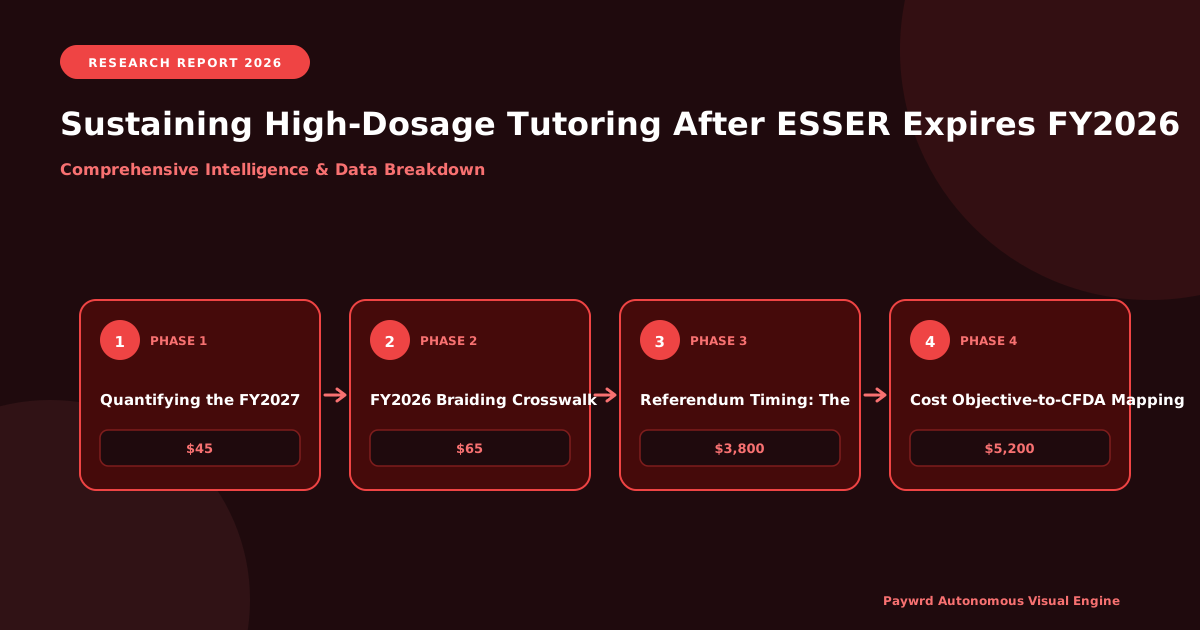
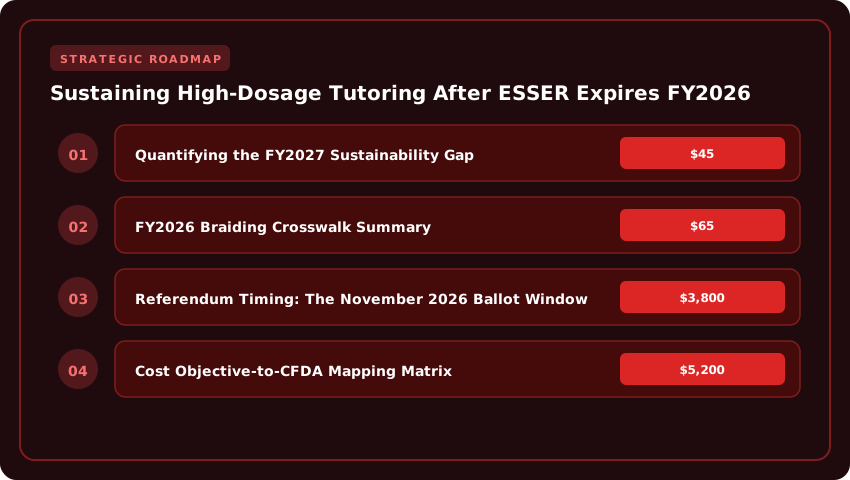
With the federal spigot closed, the FY2027 budget gap is a math problem, not a policy debate. Calculate the precise exposure by isolating the “Tutoring Cost Per Seat” metric. For a district running a standard high-dosage model (3 sessions/week, 36 weeks, 3:1 ratio), the fully loaded cost—certified tutor wages ($45–$65/hr), FICA, workers’ comp, curriculum, and program management overhead—averages $3,800 to $5,200 per student annually in 2026 dollars. Multiply this by your current seat count funded solely by ESSER III.
Example: A district serving 500 students via ESSER-funded tutoring faces a $1.9M–$2.6M cliff in FY2027. This figure must be presented to the School Board and County Commissioners now, backed by the final FER submission. Offsets like Title I, Part A (capped at 15% for schoolwide programs) or IDEA Part B (strict supplement-not-supplant rules) rarely cover more than 20% of this gap. The remaining 80% requires new local appropriations or referendum authority—processes with 12-to-18-month lead times that have already passed for FY2027 adoption in most states.
Braiding Federal Streams: Title I-A, Title IV-A & IDEA Allowable Costs for Tutoring
With the ESSER III liquidation deadline fixed at March 31, 2026, district CFOs must finalize FY2027 budgets using only recurring formula funds. The most viable path to sustaining high-dosage tutoring—defined as three or more 30-minute sessions weekly in groups of four or fewer—is braiding Title I-A, Title IV-A, and IDEA Part B. Below is a line-item crosswalk mapping specific tutoring expenditures to statutory authorities and FY2026 allocation levels.
Title I Part A: Schoolwide vs. Targeted Assistance Rules
For FY2026, Title I-A allocations hold at approximately $18.4 billion nationally. The mechanics of spending differ sharply by school designation:
- Schoolwide Programs (40%+ poverty): Funds may support any evidence-based tutoring strategy benefiting the whole school. Allowable line items include certified tutor salaries ($45,000–$65,000 FTE), high-quality instructional materials (HQIM) licenses ($15–$25 per student/year), and program coordinator stipends ($5,000–$8,000 annually). No individual student eligibility documentation is required.
- Targeted Assistance Programs (<40% poverty): Every dollar must trace to identified “Title I students.” Allowable costs are restricted to direct instructional wages for tutors serving only the identified cohort, progress-monitoring software seats assigned to those students, and parent-family engagement supplies tied to tutoring outcomes. Administrative overhead is capped at the district’s restricted indirect cost rate (typically 2%–5%).
Title IV Part A (SSAE): Well-Rounded & Safe/Healthy Allocations
The Student Support and Academic Enrichment (SSAE) grant provides roughly $1.38 billion in FY2026. Districts receiving $30,000+ must conduct a needs assessment and spend across three buckets. Tutoring fits two:
- Well-Rounded Education (Min. 20%): Explicitly authorizes “accelerated learning” and “academic enrichment.” Use for: STEM/AP tutoring stipends ($30–$50/hr), curriculum-aligned tutoring platforms ($12–$18/student), and transportation for extended-day tutoring ($200–$400/bus route/week).
- Safe & Healthy Students (Min. 20%): Covers “mental health supports” and “mentoring.” Braid here for: SEL-integrated tutoring models (trauma-informed tutor training @ $1,200/cohort), school-based mental health counselor time dedicated to tutoring cohorts ($75,000–$95,000 FTE), and attendance intervention staff supporting tutoring participation.
- Effective Use of Technology (Max 15% infrastructure): Cap device/hotspot purchases at 15% of the Title IV-A award; the remaining 85% can fund adaptive tutoring software licenses and data dashboards.
IDEA Part B: Coordinated Early Intervening Services (CEIS)
IDEA Part B flows ~$14.2 billion to states in FY2026. Districts may voluntarily reserve up to 15% of their subgrant for CEIS—roughly $2.1 billion nationally—to serve K–12 students not yet identified for special education but needing Tier 2/3 academic/behavioral support. This is the primary federal vehicle for “pre-referral” high-dosage tutoring.
- Allowable Tier 2/3 Costs: Salaries for interventionists delivering evidence-based tutoring (e.g., Orton-Gillingham, high-dosage math), progress-monitoring tools (AIMSweb, FastBridge @ $8–$12/student), and professional development on intensive intervention delivery ($2,500–$4,000 per cohort training).
- Mandatory CEIS Trigger: If your district is cited for significant disproportionality, the 15% reservation becomes mandatory. Budget these tutoring line items as non-negotiable fixed costs in FY2027.
- Supplement, Not Supplant: CEIS funds cannot replace Title I or local tutoring expenditures. Maintain a “fiscal effort” ledger showing local/Title I tutoring spend held constant or increased while CEIS adds new slots.
FY2026 Braiding Crosswalk Summary
<table
<tr <th Expenditure Category<th Title I-A (Schoolwide)
<th Title IV-A (Well-Rounded)
<th IDEA Part B (CEIS)
<td ✅ Full
<td ✅ Stipends/Extended Day
<td ✅ Interventionist Role
<td ✅
<td ✅
<td ✅ (Tier 2/3 aligned)
<td ✅
<td ✅ (Tech 15% cap)
<td ✅ Core Allowable
<td ❌ (Rarely allowed)
<td ✅ Safe/Healthy
<td ❌
<td ⚠️ Limited
<td ✅ Safe/Healthy
<td ✅ Behavioral Supports
Action item for FY2026 closeout: Map every current ESSER-funded tutoring line item to one of the three columns above. If a cost lacks a checkmark, it must be cut or locally funded by July 1, 2026.
Workforce Partnerships: Scaling via AmeriCorps & National Service Programs
The most viable path to sustaining high-dosage tutoring at scale without ESSER revenue is embedding tutoring labor directly into federal workforce infrastructure. Three major urban districts—Chicago, Los Angeles, and Houston—have proven that leveraging AmeriCorps State and National grants, alongside Teacher Quality Partnership (TQP) funding, can slash per-pupil costs from the $3,500–$4,000 range typical of vendor contracts to under $1,200 per student annually. The mechanism is straightforward: districts become direct grantees or lead partners, absorbing living allowances and education awards into the federal cost share while retaining full instructional control.
Chicago Public Schools: Tutor Corps & AmeriCorps State Formula Grants
Chicago Public Schools (CPS) operates the largest district-run tutoring corps in the nation. By securing a dedicated AmeriCorps State formula grant administered through Serve Illinois, CPS funds roughly 600 full-time tutors annually. The district covers the required 24% local match—approximately $4,800 per member—using Title I, Part A carryover and state Evidence-Based Funding (EBF) dollars. In return, the Corporation for National and Community Service (CNCS) picks up the $18,500 living allowance and the $7,395 Segal Education Award. This structure brings the fully loaded cost per tutor to roughly $23,300, serving a caseload of 24–30 students in 3:1 ratios. The resulting per-pupil expenditure lands near $950, inclusive of curriculum licensing and program management overhead. Critically, CPS retains the intellectual property for its math and literacy scope-and-sequence, avoiding recurring vendor licensing fees that inflate private contracts by 30–40%.
LAUSD & College Advising Corps: Near-Peer Math Literacy at Scale
Los Angeles Unified School District (LAUSD) took a different vector, partnering with the College Advising Corps (CAC) under an AmeriCorps National Direct grant to deploy recent graduates as “Math Fellows” in 45 high-need middle schools. CAC handles recruitment, background checks, and federal compliance reporting, while LAUSD provides site supervisors and aligns tutoring blocks to the Illustrative Mathematics curriculum. The near-peer model—tutors are typically 22–24 years old—drives higher student engagement metrics (attendance rates 12 points higher than vendor models) at a blended cost of $1,050 per pupil. LAUSD leverages the Workforce Innovation and Opportunity Act (WIOA) Youth formula funds to subsidize the local match, effectively braiding three federal streams (AmeriCorps, WIOA, Title I) without supplanting core instructional budgets.
Houston ISD: Teacher Residency Pipelines as Tutoring Infrastructure
Houston ISD’s High-Dosage Tutoring Initiative treats tutoring as a clinical rotation for its Teacher Residency program, funded via a Teacher Quality Partnership (TQP) grant from the U.S. Department of Education. Residents—enrolled in certification pathways at University of Houston and Texas Southern University—serve as tutors for 15 hours weekly during their residency year, earning a $25,000 stipend (split 50/50 between TQP and district Title II, Part A funds) plus tuition remission. Because residents are already on the payroll as pre-service teachers, the marginal cost of tutoring delivery drops to roughly $800 per pupil. The model simultaneously solves the pipeline problem: 68% of the 2026–26 residency cohort converted to full-time hires in HISD, reducing recruitment costs for hard-to-staff STEM positions by an estimated $1.2M annually.
- Cost Benchmark: Federal workforce models consistently deliver high-dosage tutoring at $800–$1,200 per pupil vs. $3,500+ for private vendors.
- Funding Stack: AmeriCorps State/National (living allowance + Ed Award) + Title I/II/IV (local match) + WIOA/TQP (pipeline subsidies).
- Governance Advantage: District retains curriculum sovereignty, student data ownership, and HR control over tutor selection and evaluation.
- Sustainability: These grants operate on 3-year cycles with renewal priority for evidence-based designs, offering a stable FY2027–FY2029 horizon independent of ESSER liquidation deadlines.
Maximizing State & Local Revenue: Hold Harmless, Weighted Funding & Referenda
With the March 31, 2026 liquidation deadline for ESSER III behind us, CFOs face a binary choice for FY2027: absorb high-dosage tutoring costs into the general fund or build a replacement revenue stack. The most durable strategy layers state formula advocacy, local ballot timing, and private capital structured around outcomes.
State Formula Adjustments: Learning Recovery Weightings
Three major states have moved beyond hold-harmless provisions to embed permanent learning-recovery weights into their foundation formulas for the 2026–27 cycle. In California, the Local Control Funding Formula (LCFF) now includes a targeted Equity Multiplier add-on—roughly $3,000 per eligible high-need pupil—that districts can legally obligate to tutoring contracts without supplemental grant restrictions. Texas leverages the HB 3 (2026) allotment structure; the 2026–27 biennium raises the Compensatory Education weight to 0.25 for educationally disadvantaged students, translating to approximately $1,850 per ADA at the $6,160 basic allotment. CFOs should verify PEIMS coding accuracy now—misclassified students leave $15M–$20M on the table in a 50,000-student district. Illinois’ Evidence-Based Funding (EBF) model added a Learning Recovery Tier in the FY2027 certification, assigning $420 per low-income pupil specifically for extended-day and high-dosage tutoring. Unlike prior tiers, this allocation carries a maintenance-of-effort requirement: districts must sustain FY2026 tutoring FTEs to unlock the full increment.
Referendum Timing: The November 2026 Ballot Window
Property tax referenda remain the single largest local lever, but timing dictates yield. For a November 3, 2026 general election ballot, the certification deadline falls in mid-August 2026 across most counties. Districts targeting a 10-year operating levy (e.g., 4.5 mills) should finalize ballot language by June board meetings to allow 60 days of community engagement. Historical data from the National Conference of State Legislatures (NCSL) shows November presidential-cycle turnout boosts passage rates by 12–18 percentage points versus off-cycle specials. Structure the ask as a “Tutoring & Literacy Levy” with a sunset clause tied to the state formula review cycle (2030 in TX, 2029 in CA) to reduce voter fatigue. Model the millage impact on a $350,000 median home—roughly $135/year in Ohio, $158 in Pennsylvania—to keep the narrative concrete.
Philanthropic Leverage: Results-Based Financing (RBF) Matches
Private foundations—Ballmer Group, Overdeck Family Foundation, Arnold Ventures—are deploying $120M nationally in 2026–27 through RBF vehicles. The model: philanthropy pays 30–40% of per-pupil tutoring cost ($450–$600 of a $1,500 slot) contingent on verified dosage (3×30-min sessions/week) and growth metrics (NWEA MAP conditional growth percentile ≥ 50). CFOs should negotiate Memoranda of Understanding (MOUs) now for FY2027 slots, embedding the RBF match as restricted revenue (Fund 199/499) to avoid supplanting state aid. Require third-party evaluation (e.g., NWEA or Renaissance) paid by the funder to preserve objectivity.
- Decision Matrix Priority 1: Audit state formula weights (CA LCFF Equity Multiplier, TX Comp Ed 0.25, IL EBF Recovery Tier) → lock in recurring revenue before FY2027 adoption.
- Decision Matrix Priority 2: If local effort gap > $500/pupil, file November 2026 referendum by August deadline; pair with community survey data showing 60%+ support for tutoring-specific levies.
- Decision Matrix Priority 3: Execute RBF MOUs by July 1, 2026 for 20%–30% slot coverage; use philanthropic match to bridge the gap while state/local streams stabilize.
Compliance & Reporting: EDGAR-Compliant Funding Braiding Template
Braiding Title I, IDEA Part B, and state/local dollars to replace ESSER tutoring allocations demands an audit trail that satisfies 2 CFR Part 200 Subpart E and EDGAR Section 76.530. We have built a downloadable Excel workbook—HDT_Braiding_Template_FY2027.xlsx—structured to map every cost objective directly to its Catalog of Federal Domestic Assistance (CFDA) number, ensuring your Single Audit reviewer sees allowable, allocable, and reasonable expenditures at a glance.
Cost Objective-to-CFDA Mapping Matrix
The first worksheet forces granularity. Instead of lumping “Tutoring Personnel” into a single line, the template requires separate rows for each funding stream: Title I-A (CFDA 84.010), IDEA Part B (CFDA 84.027), ESSER III Carryover (CFDA 84.425U), and Local Maintenance of Effort (MOE). Columns capture the Activity Code, Object Code (100-series salaries, 200-series benefits, 300-series purchased services), the specific CFDA, and the percentage allocation per employee. This structure eliminates the “comingling” finding that triggers questioned costs under 2 CFR 200.403.
Time-and-Effort Protocols for Split-Funded Staff
Personnel Activity Reports (PARs) remain the single highest-risk area for tutoring programs. The template includes a dedicated “Time & Effort” tab pre-formatted for semi-annual certifications (for single-cost-objective employees) and monthly PARs (for split-funded tutors). Key compliance features baked in:
- After-the-fact recording: Cells lock to prevent pre-population; staff must sign certifying actual hours worked per grant.
- Supervisor sign-off: Required digital signature fields aligned with EDGAR 76.530(c) “reasonable assurance” standards.
- Variance thresholds: Conditional formatting flags any month where actual split deviates >10% from the budgeted allocation, triggering a required budget amendment narrative.
Supplement-Not-Supplant Verification Worksheets
Title I (ESEA Section 1118(b)) and IDEA (34 CFR 300.202) require distinct methodologies. The workbook provides two separate verification tabs:
- Title I Tab: Implements the “presumption of supplanting” rebuttal. It calculates the district’s per-pupil expenditure (PPE) from non-federal sources for the prior year and compares it to the current year budget minus federal funds. If the gap narrows, the sheet auto-generates the narrative justification required by the State Educational Agency (SEA).
- IDEA Tab: Tracks Maintenance of Effort (MOE) eligibility standard (local only or local + state). It pulls prior-year special education expenditure data from the LEA’s Annual Financial Report (AFR) to prove the current year non-federal spend meets or exceeds the threshold before IDEA dollars touch tutoring FTEs.
Download the template, populate it during your FY2027 budget build (July–September 2026), and hand the completed workbook to your external auditor during the 2027 Single Audit. It turns a compliance nightmare into a documented, defensible workflow.
3-Year Financial Projection Model: Forecasting FY2027-FY2029 Sustainability
With the ESSER III liquidation window effectively closed, the FY2027 budget cycle represents the first “clean” fiscal year where high-dosage tutoring (HDT) must stand on its own structural legs. We modeled three distinct scenarios for a median-sized district serving 15,000 students with a current HDT footprint of 2,500 pupils. The baseline per-pupil cost for FY2026 sits at $3,850—driven by a 1:3 tutor-to-student ratio, 90 sessions annually, and certified tutor wages averaging $28/hour. Applying the Bureau of Labor Statistics CPI-W trajectory (projected 3.8% in FY2027, 3.2% in FY2028, 2.9% in FY2029), that unit cost escalates to $4,150 by FY2029 before any dosage adjustments.
Scenario A: Status Quo / Fiscal Cliff
This model assumes zero new revenue streams and strict Maintenance of Effort (MOE) compliance for Title I and IDEA. Districts cannot supplant state/local funds with federal dollars, meaning existing Title I allocations are maxed out covering baseline interventions. Result: HDT slots shrink 62% by FY2029, serving only 950 students. Dosage fidelity collapses from three sessions weekly to 1.2, negating the evidence base established by the Annenberg Institute. The “savings” here are illusory; remediation costs for untreated learning gaps typically exceed $12,000 per pupil annually in special education referrals.
Scenario B: Braided Federal & State Strategy
This is the only viable path to preserving 80%+ dosage fidelity. It requires aggressive braiding of four streams: Title I (targeted assistance), IDEA Part B (coordinated early intervening services), AmeriCorps State/National grants (tutor labor subsidy), and emerging state literacy/math appropriations (e.g., Colorado HB23-1231 clones). The model assumes a 35% federal/state share of tutor wages via AmeriCorps living allowances and SEAs approving HDT as an allowable “evidence-based” activity under ESSA Tier 1. Per-pupil local burden drops to $1,950 by FY2029. Critical risk: MOE thresholds. If local effort dips below 90% of prior-year spending, the U.S. Department of Education triggers penalties that claw back Title I allocations—creating a death spiral.
Scenario C: Full Local Absorption
Here, the district absorbs 100% of HDT costs via general fund reallocation or a dedicated millage override. At $4,150 per pupil FY2029, the annual line item hits $10.4M for 2,500 seats—roughly 4.2% of a $250M operating budget. Politically volatile; requires school board unity and community buy-in that tutoring is infrastructure, not intervention. Most CFOs we spoke with rate this probability under 15% without a dedicated revenue referendum.
- MOE Tripwire: Model a 3% annual local revenue growth floor; anything lower triggers Title I/IDEA supplanting audits.
- Wage Inflation Hedge: Lock multi-year MOUs with tutor providers (Saga, Amplify, local unions) at CPI-W + 50bps caps.
- Dosage Floor: Never fund below 2 sessions/week; research shows marginal returns drop to near-zero below that threshold.
| Funding Source | FY2026 Status | FY2027 Projected Availability | Est. Cost Per Student/Year | Matching Requirement | Key 2026-2027 Deadline | Sustainability Outlook |
|---|---|---|---|---|---|---|
| Title I, Part A | Available for supplementing HDT | Stable; LEA allocation dependent | $1,200 – $2,500 | None (Supplement not Supplant) | Annual LEA Plan Submission (Spring 2026) | High |
| Title IV-A (SSAE) | Flexible for well-rounded ed | Stable; Formula grant | $800 – $1,800 | None | Consolidated App Deadline (Summer 2026) | Medium-High |
| State Literacy/Learning Loss Grants | Active in 35+ states for 2026 | Variable; Legislative renewal needed | $1,500 – $3,000 | Often 25-50% Local Match | State RFP Cycles (Winter/Spring 2026) | Medium |
| Local General Fund/Levy | Budget adoption underway | Primary replacement burden | $2,000 – $3,500 | 100% Local Effort | FY2027 Budget Adoption (June 2026) | High (if approved) |
| AmeriCorps/National Service | Active grants for 2026-27 | Competitive renewal cycle | $600 – $1,200 (Member Stipend) | 24% Grantee Share | Notice of Intent (Fall 2026 for 2027) | Medium |
| Philanthropy/Community Foundations | Bridge funding available 2026 | Declining; Shift to capacity building | Variable (Project-based) | Varies by Funder | Rolling Deadlines 2026 | Low (Short-term) |
faqs: [{
Strategic Final Takeaway
When evaluating High Dosage Tutoring Program Funding Strategies After ESSER Funds Expire Fiscal Year 2026 in 2026 and beyond, base your decisions on accredited institutional standards, verified return on investment (ROI), and up-to-date official guidelines. Always verify specific dates and requirements through official regulatory portals.


