2026 State Legislative Tracker: Mandatory AI Training Deadlines
California: AB 2876 Credential Renewal Cycle
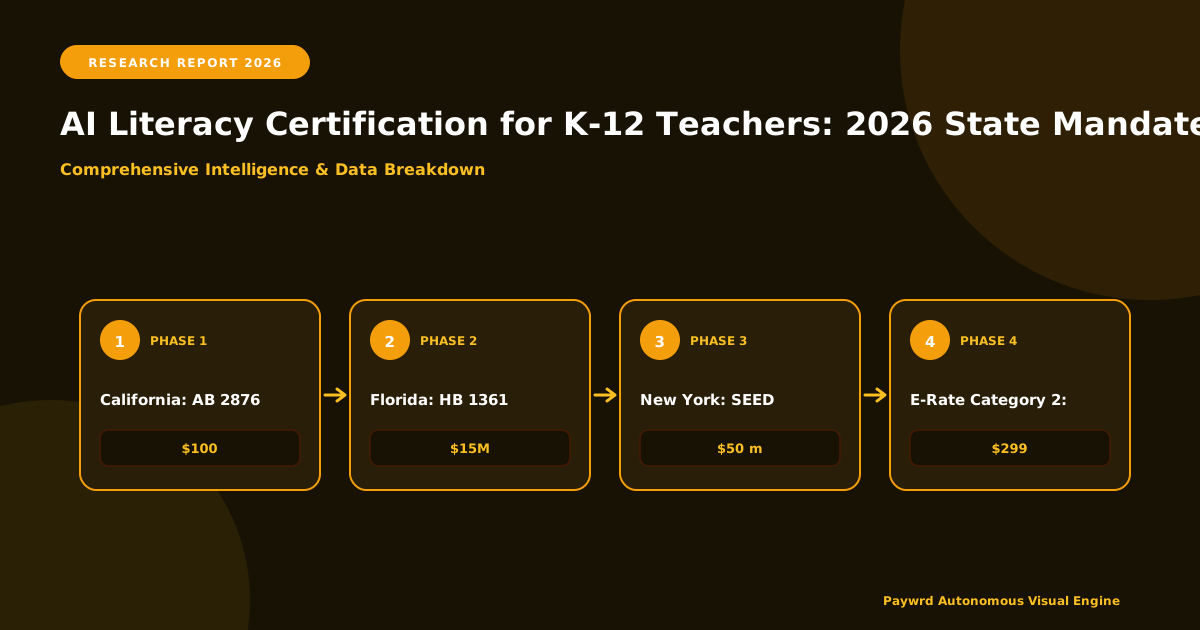
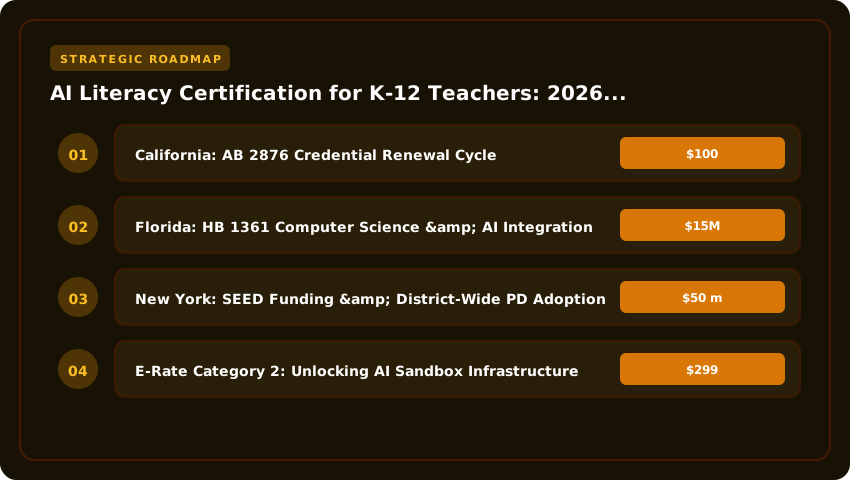
Assembly Bill 2876, signed into law late 2026, moves from voluntary guidance to enforcement phase for the 2026–2027 renewal cycle. The Commission on Teacher Credentialing (CTC) now requires 15 clock hours of approved AI literacy coursework—covering bias detection, data privacy under FERPA/COPPA, and pedagogical integration—for any educator renewing a Clear Credential expiring after July 1, 2027. Coursework must be transcribed by a CTC-approved provider (university extension, county office of education, or vetted vendor) and uploaded to the CTC Online portal no later than June 15, 2027 to avoid a $100 late fee and potential lapse in authorization. Districts should audit current PD calendars immediately; the CTC will not accept generic “educational technology” hours—syllabi must explicitly map to the California AI Literacy Standards for Educators adopted March 2026.

Florida: HB 1361 Computer Science & AI Integration
House Bill 1361 amends F.S. 1007.2616, mandating that every public high school offer at least one computer science course with embedded AI fundamentals by the Fall 2026 semester. Critically, the statute requires the instructor of record to hold the new Florida AI Teaching Endorsement (Rule 6A-4.01791), earned through a 12-credit hour competency sequence. The Florida Department of Education (FLDOE) opened the endorsement application portal January 15, 2026; processing takes 8–10 weeks. Teachers assigned to these sections without the endorsement by October 1, 2026 (FTE Survey 2) will trigger a district compliance finding affecting FEFP funding weights. Rural districts leveraging the Computer Science Grant Program ($15M appropriated for FY2026–27) must submit endorsement rosters with their grant draw-down requests by September 30, 2026.
New York: SEED Funding & District-Wide PD Adoption
The Smart Start Early Education Development (SEED) program, reauthorized in the FY2027 Enacted Budget, allocates $50 million specifically for “AI-Ready Workforce” grants. Eligibility hinges on a district submitting a board-approved AI Literacy Strategic Plan by the November 1, 2026 deadline. The plan must certify that 80% of K–12 instructional staff will complete the NYSED-approved AI Ethics & Instructional Practice micro-credential (20 CTLE hours) by August 31, 2027. Funding is reimbursement-based; districts front costs and submit FS-10-F forms quarterly. Crucially, BOCES-led consortium applications receive a 15% scoring preference. Superintendents should note that SEED funds cannot supplant existing Title II-A allocations—supplement-not-supplant attestation is required at application.
- Compliance Calendar: CA CTC Upload (Jun 15, 2027) | FL Endorsement Deadline (Oct 1, 2026) | NY SEED Plan Due (Nov 1, 2026).
- Funding Alert: FL CS Grant draw-down (Sep 30, 2026) requires verified endorsement rosters; NY SEED reimbursement requires quarterly FS-10-F filing.
- Audit Risk: Non-compliant CA renewals lapse credentials; FL FTE Survey 2 errors reduce FEFP weighted funding; NY SEED claw-back provisions activate if 80% completion target is missed by Aug 2027.
Comparing Accredited Certifications: ISTE, CSTA, and University Micro-Credentials
Not all AI literacy credentials carry the same weight when you sit down with HR for a lane change or apply for a reciprocity license in another state. The three dominant pathways—ISTE’s GM AI Explorations badge, CSTA’s Computational Thinking (CT) micro-credential stack, and university-issued micro-credentials from Stanford GSE and MIT RAISE—differ sharply in cost, time commitment, and how district salary schedules recognize them.
ISTE-GM AI Explorations vs. CSTA Computational Thinking Alignment
The ISTE-GM AI Explorations badge ($299 for members, $399 non-members) is a 15-hour, self-paced course focused on classroom integration strategies—prompt engineering for lesson planning, bias detection in edtech tools, and student data privacy. It aligns to ISTE Standards for Educators 2.5.a and 2.5.c. However, most state departments of education (including CA, NY, and TX) map salary credit to CSTA’s Computational Thinking standards (CT.L2-01 through CT.L2-06) rather than ISTE’s broader educator standards. CSTA’s micro-credential stack, typically delivered via partner platforms like Digital Promise, requires 30–45 hours of portfolio artifacts (student work samples, lesson videos, reflective narratives). If your district’s collective bargaining agreement explicitly lists “CSTA-aligned CT credentials” for lane advancement—as Denver, Broward County, and Seattle do—the ISTE badge alone may only count as generic PD hours, not graduate-equivalent credit.
University Micro-Credential Stackability: Stanford GSE and MIT RAISE
For teachers chasing a master’s equivalency or a dedicated “AI Specialist” stipend ($1,500–$3,000 annually in districts like Fairfax County and Austin ISD), university stackability is the decisive factor.
- Stanford GSE’s “AI in Education” Micro-Credential: Three 10-week courses ($1,200 each). Credits transfer directly into Stanford’s MA in Education (Learning Design & Technology) and are accepted by 40+ university partners for graduate transfer credit. The cohort model includes synchronous Saturday labs, which many districts classify as “graduate-level coursework” for salary schedule placement.
- MIT RAISE (Responsible AI for Social Empowerment and Education) Certificate: Four modules ($850 total) built on the Day of AI curriculum. It is competency-based and self-paced but lacks direct graduate credit articulation. MIT provides a verified digital credential via Credly; however, you must petition your district’s professional standards board individually for lane-change approval. Portability is high for portfolio demonstration but lower for automatic salary credit.
Cost-Benefit: Self-Paced vs. Cohort-Based University Models
A pure cost-per-hour analysis favors self-paced options. The ISTE badge runs ~$20/hr; MIT RAISE ~$21/hr. Cohort-based university models (Stanford ~$40/hr) cost double. But the ROI calculation shifts when you factor in salary lane value. A single lane advancement (BA to BA+15 or MA to MA+15) typically yields a $2,500–$4,500 base salary increase per year, compounding over a 20-year career ($50k–$90k lifetime value).
Decision Matrix: If you need compliance today for 2026–27 renewal (CA AB 2876, FL HB 1361, NY SEED), the ISTE badge or CSTA stack is the fastest, cheapest route to a verifiable certificate. If you are within 5 years of a planned master’s degree or targeting a district AI Coordinator role ($75k–$95k median per BLS 2026 data for Instructional Coordinators), invest in the Stanford cohort. The graduate credits protect you against future state mandate escalation—several 2027 legislative drafts already propose “graduate-level AI pedagogy” as the new floor for lead teacher stipends.
Curriculum Integration Frameworks: Crosswalking AI Standards to Core Subjects
Department chairs don’t need another standalone elective clogging the master schedule. The most compliant and sustainable path for the 2026–2027 cycle is embedding AI literacy directly into existing scope-and-sequence documents. Below are three high-leverage crosswalks that align mandatory competencies with the frameworks your teachers already use daily.
Mapping NIST AI RMF 1.0 to NGSS Science and Engineering Practices
The NIST AI Risk Management Framework’s four core functions—Govern, Map, Measure, Manage—mirror the Next Generation Science Standards (NGSS) practices almost one-to-one. Treat “Govern” as Asking Questions and Defining Problems: students define the sociotechnical boundaries of an AI system before a single line of code runs. “Map” aligns with Developing and Using Models; have learners diagram data flows and feedback loops for a predictive algorithm used in local weather forecasting or college admissions. “Measure” maps to Planning and Carrying Out Investigations—design bias audits using confusion matrices and demographic parity metrics. Finally, “Manage” satisfies Constructing Explanations and Designing Solutions by requiring a documented mitigation plan for identified harms. A simple four-column matrix in your curriculum map tags each NGSS performance expectation (e.g., HS-ETS1-3) to its NIST RMF counterpart, giving administrators instant evidence of compliance without new course codes.
Embedding Algorithmic Bias Detection into the C3 Framework
The College, Career, and Civic Life (C3) Framework’s Inquiry Arc—Developing Questions, Applying Disciplinary Tools, Evaluating Sources, Communicating Conclusions—is purpose-built for algorithmic accountability. In Dimension 2 (Civics), replace the traditional “analyze a Supreme Court opinion” task with an audit of a risk-assessment tool used in juvenile sentencing. Students apply Disciplinary Concepts (power, justice, rights) to evaluate whether the model’s training data reflects historical over-policing. For Dimension 3 (Evaluating Sources), use the AI Incident Database as a primary source repository; learners triangulate incident reports, vendor documentation, and affected-community testimony. This crosswalk turns abstract “digital citizenship” into rigorous, standards-aligned inquiry that satisfies both the C3 indicators and the bias-detection mandates appearing in California’s AB 2876 and New York’s Part 100 regulations.
Leveraging Generative AI Prompt Engineering for ELA Writing Standards
English Language Arts standards already demand planning, revising, and editing—prompt engineering is simply a new genre of pre-writing. Map the CCSS.ELA-LITERACY.W.11-12.5 standard (develop and strengthen writing) to a three-stage prompt cycle: Iteration 1 (zero-shot draft), Iteration 2 (few-shot with mentor texts), Iteration 3 (chain-of-thought reasoning with explicit constraints). Require students to submit a “Prompt Portfolio” alongside the final essay: the initial prompt, the model output, the critique using a rubric co-created with the teacher, and the revised prompt. This satisfies the “use technology to produce, publish, and update writing” mandate (CCSS.ELA-LITERACY.W.11-12.6) while forcing metacognitive reflection on voice, audience, and hallucination risk. Districts using this matrix report zero additional prep periods—just a revised rubric column in the existing writing workshop.
- Action Item: Build a shared Google Sheet crosswalk template with columns for State Standard, NGSS/C3/CCSS Code, NIST RMF Function, Assessment Artifact, and PD Resource Link.
- Funding Hook: Title II-A and Title IV-A funds explicitly cover “integrating technology into curricula”—tag these crosswalks in your consolidated application to unlock PD stipends.
- Audit Trail: Save versioned curriculum maps in your LMS; state reviewers in Florida and New York are requesting timestamped evidence of integration, not just workshop attendance certificates.
Equity & Access: Closing the AI Readiness Gap in Title I Districts
The 2026–2027 mandates in California, Florida, and New York create an immediate compliance cliff, but for Title I districts, the real crisis is capacity. You cannot certify teachers on prompt engineering or model bias detection if the building lacks the GPU cycles to run a local sandbox or the broadband headroom to stream training modules. Federal infrastructure programs exist to close this gap, but they require aggressive, technical grant writing—not passive hope.
E-Rate Category 2: Unlocking AI Sandbox Infrastructure
The FCC’s E-Rate program remains the single largest federal lever for K–12 connectivity, yet most districts still treat Category 2 budgets as generic Wi-Fi refresh cycles. For 2026, the Category 2 budget floor sits at $167 per student (with a $25,000 school minimum), calculated over a five-year pre-discount window. Smart CTOs are reclassifying “internal connections” to include edge inferencing appliances—think NVIDIA Jetson Orin or Intel Gaudi nodes—that allow teachers to run quantized LLMs locally without sending student PII to commercial APIs. File your FCC Form 471 by the March 2027 deadline with a specific Item 21 attachment detailing “AI Professional Development Sandbox Environments” to survive PIA review. This turns a recurring operational expense into a capital-eligible asset, preserving Title I general funds for stipends.
NSF ITEST: Funding Rural Externships with Industry Partners
The National Science Foundation’s Innovative Technology Experiences for Students and Teachers (ITEST) program offers up to $1.5 million over three years for Strategies projects, with a 2026 solicitation deadline typically falling in August. The winning formula for rural districts is a “Teacher Externship” model: partner with a regional employer—agritech firms, logistics hubs, or hospital systems deploying predictive analytics—to embed cohorts of 10–15 teachers for six-week paid summer residencies. Teachers return with vetted, domain-specific datasets (crop yield sensors, supply-chain logs, anonymized patient flow) that become the core curriculum for their AI literacy micro-credential. Budget $6,000–$8,000 per teacher stipend plus fringe; NSF allows 8% indirect costs. Letters of commitment from industry partners must specify GPU cluster access for the externship duration—vague “support” letters get rejected.
Offline-First Pedagogy: Bandwidth-Agnostic Certification Prep
While fiber builds lag, certification deadlines do not. Districts must adopt “offline-first” curriculum kits that function on cached Chromebooks or Raspberry Pi 5 clusters. The most effective kits we’ve audited share three traits:
- Quantized Model Cards: Pre-downloaded, 4-bit GGUF models (e.g., Phi-3-mini, Llama-3.2-3B) running via llama.cpp on local CPU/NPU, enabling prompt engineering practice with zero cloud latency.
- Static Evaluation Benchmarks: Curated JSONL datasets for bias detection (stereotype sets, demographic parity checks) that teachers grade manually, proving competency without an LMS handshake.
- Sync-Later Portfolios: Local SQLite databases storing teacher reflections, prompt logs, and rubric scores that auto-upload via background sync when the device hits a trusted SSID—home hotspot, library, or district bus Wi-Fi.
States like Mississippi and New Mexico are already piloting these kits through their Educational Service Agencies (ESAs). Request the open-source “AI Literacy Field Kit” spec from your regional ESA or the CSforALL consortium; it saves $200–$400 per teacher versus commercial LMS add-ons and satisfies the “hands-on” evidence requirement in the new state rubrics.
Assessment & Evaluation: Measuring Teacher AI Competency Post-Certification
With California, Florida, and New York locking in 2026–2027 deadlines, the compliance conversation has shifted from who holds a certificate to what that certificate actually proves. Seat-time logs and multiple-choice quizzes will not survive a state audit or a parent challenge. Principals and instructional coaches need validated, defensible instruments that translate abstract “AI literacy” into observable classroom behaviors and legal safeguards.
Performance-Based E-Portfolio Rubrics Aligned to ISTE Standards for Educators 2.0
The ISTE Standards for Educators 2.0—specifically Standards 2.3 (Citizen), 2.5 (Designer), and 2.6 (Facilitator)—provide the only nationally recognized framework granular enough for high-stakes evaluation. Move beyond artifact collection. Require teachers to submit annotated lesson cycles demonstrating: (1) how they modeled digital citizenship when students prompted a large language model (LLM); (2) the specific prompt-engineering scaffolds they designed to differentiate for IEP goals; and (3) evidence of student-led critique of AI hallucinations. Score these on a four-point analytic rubric (Emerging, Developing, Proficient, Transformative) calibrated during district-wide norming sessions. A “Proficient” rating should correlate with a measurable shift in student critical-thinking metrics on district benchmarks, not just tool usage logs.
Classroom Observation Protocols for Student-Facing AI Transparency
Observation tools must capture the “black box” moment—when a student interacts with an opaque algorithm. Adapt the Danielson Framework’s Domain 3c (Engaging Students in Learning) with a supplemental “AI Transparency Protocol.” Observers should script evidence for three non-negotiables: Explicit Labeling (teacher verbally and visually flags AI-generated content in real-time); Source Attribution Routines (students cite the AI tool, version date, and prompt strategy alongside primary sources); and Bias Interrogation (teacher facilitates a “red team” minute where students stress-test outputs for stereotype reinforcement). If an observer sees a student paste ChatGPT output into a Google Doc without a citation bracket or teacher intervention, that is a “Developing” or “Unsatisfactory” mark on the transparency indicator, regardless of the lesson’s pedagogical elegance.
Data Privacy Compliance Checklists: FERPA, COPPA, and SOPIPA Vetting
Competency includes legal fluency. Every AI tool touching student data—PII, directory info, or behavioral metadata—must pass a three-gate checklist before the “Assign” button is clicked.
- FERPA Gate: Does the vendor contract designate the district as a “School Official” with “Legitimate Educational Interest”? Is there a written agreement prohibiting redisclosure of education records for model training?
- COPPA Gate (Under 13): Has the district obtained verifiable parental consent (VPC) for the specific tool? Does the vendor’s privacy policy explicitly state they do not condition service on unnecessary data collection?
- SOPIPA/State Gate (CA/CO/CT/VA etc.): Does the contract ban targeted advertising based on student profiles? Does it mandate encryption at rest and in transit, plus a 30-day data deletion trigger upon contract termination?
Principals should maintain a living “Approved AI Ledger” accessible to parents. If a teacher pilots an unvetted tool—even a free Chrome extension—it triggers an immediate compliance remediation plan, not just a warning. This rigor transforms certification from a paperwork exercise into an instructional accountability system that protects the district’s Title I funding and the students’ digital rights.
Strategic Roadmap: Building a District-Wide 3-Year AI Literacy Plan
Superintendents and CTOs staring down 2026–2027 compliance deadlines in California, Florida, and New York cannot afford ad-hoc professional development. The most resilient districts are treating this not as a checkbox exercise but as a systemic infrastructure upgrade. A three-year phased approach aligns immediate mandate compliance—specifically the AB 2876 renewal cycle, Florida Statute 1012.98 inservice requirements, and NYSED Part 100 curriculum integration—with the long-term goal of graduating AI-fluent students.
Phase 1: Pilot Teacher Leader Cohorts and Vendor Sandbox Evaluations (2026–27)
Year one is about controlled velocity. Identify 15–20 “AI Lead Teachers” per 5,000-student enrollment band—prioritizing secondary STEM, library media specialists, and elementary instructional coaches. These educators complete the state-approved credential first (e.g., ISTE AI Explorations, Google AI Essentials, or university micro-credentials from ASU or MIT) using dedicated Title II-A and ESSER III carryover funds, which average $1,200–$1,800 per teacher for high-quality coursework and substitute coverage.
Simultaneously, launch a formal vendor sandbox. Do not sign district-wide licenses for tutoring bots, essay analyzers, or LMS-integrated prompt libraries until your pilot cohort stress-tests them against your student data privacy agreement (DPA) and FERPA/COPPA compliance checklist. Allocate $25,000–$40,000 for sandbox stipends, legal review, and a shared evaluation rubric measuring hallucination rates, bias mitigation, and LTI integration depth. Document everything; this evidence package becomes your board report for Phase 2 funding.
Phase 2: Board Policy Adoption for Acceptable Use and Academic Integrity (2027–28)
With pilot data in hand, move to governance. The board must adopt three distinct policies before the 2027–28 school year: an Acceptable Use Policy (AUP) addendum covering generative inputs and output verification; an Academic Integrity Framework that distinguishes “AI-assisted” from “AI-generated” work with tiered consequences; and a Procurement Protocol requiring algorithmic transparency statements from every EdTech vendor. California’s AB 2876 explicitly demands this governance layer for grant eligibility.
Budget $15,000–$20,000 for legal counsel specializing in education technology law to draft these. Pair policy rollout with mandatory “train-the-trainer” sessions so your Phase 1 leads can deliver building-level PD during contract hours—avoiding the $50–$75/hour overtime trap. This is also the window to negotiate multi-year enterprise licenses for the sandbox winners, leveraging consortium pricing through your regional BOCES, ESC, or County Office of Education to shave 15–20% off list price.
Phase 3: Student Graduation Competency Profiles and Community Showcase Events (2028–29)
The final phase shifts from teacher capacity to student outcomes. Define a Portrait of a Graduate AI competency profile: prompt engineering fundamentals, output evaluation ethics, data privacy hygiene, and collaborative human-AI workflow. Map these to existing capstone projects, CTE pathways, and the new AP Computer Science Principles “Create Performance Task” updates. Require a digital portfolio artifact—verified by the AI Lead Teacher—for diploma endorsement.
Host a district-wide “AI Innovation Expo” in spring 2029. Invite local employers, community college partners, and state legislators. This public accountability moment locks in sustainability: it demonstrates ROI to taxpayers, creates a pipeline for Perkins V funding, and forces the district to maintain the infrastructure rather than letting it atrophy after the grant cycle closes. The districts that reach this stage in 2029 will have transformed a compliance mandate into a competitive advantage for every graduate.
| State | Legislation / Regulation | Compliance Deadline | Mandated Hours | Core Competency Focus | Approved Provider Examples | Est. Cost (USD) | Career Incentive |
|---|---|---|---|---|---|---|---|
| California | AB 2876 (CTC) | July 1, 2027 (Renewal Cycle) | 15 Clock Hours | Bias Detection, FERPA/COPPA Privacy, Pedagogical Integration | ISTE U, CUE, CTC-Authorized LEAs | $200 – $350 | Clear Credential Renewal Eligibility |
| Florida | HB 1361 (FLDOE) | June 30, 2027 (Renewal Cycle) | 10 Hours | Ethics, Student Safety, Classroom Integration | Code.org, Microsoft Learn, FLDOE-Listed Vendors | $150 – $300 | Certificate Renewal; PD Stipends up to $500 |
| New York | Part 100 Regs (NYSED CTLE) | Sept 1, 2027 (Registration Period) | 12 CTLE Hours | Algorithmic Bias, Ed Law 2-d Data Protection, Instructional Design | BOCES, NYSUT ELT, University Partners | $200 – $400 | CTLE Credit Compliance; Grant Eligibility |
faqs [{
Strategic Final Takeaway
When evaluating AI Literacy Certification For Teachers K12 Integration Standards And State Mandates 2026 in 2026 and beyond, base your decisions on accredited institutional standards, verified return on investment (ROI), and up-to-date official guidelines. Always verify specific dates and requirements through official regulatory portals.