
Choosing the Right CAC Structure for Digital Creators in 2026
Most Nigerian creators start as sole proprietors because a Business Name registration costs roughly ₦12,000–₦15,000 on the CAC Company Registration Portal (CRP). It is fast, requires only a CAC 1.1 form (Application for Registration of Business Name), and gets you a Certificate of Registration and a Tax Identification Number (TIN) automatically. However, this structure offers zero liability separation. If a client sues over a contract dispute or a copyright claim escalates, your personal assets—your laptop, car, or savings—are on the line. Furthermore, major brands and government grants (like the Creative Industry Fund) increasingly demand a Limited Liability entity before signing MOUs worth seven figures.

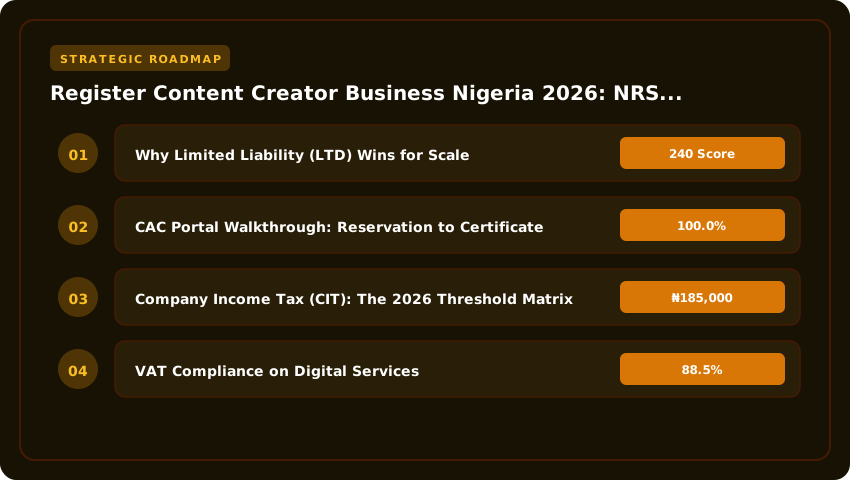
Why Limited Liability (LTD) Wins for Scale
Incorporating a Private Company Limited by Shares (LTD) shifts the risk profile entirely. The company becomes a distinct legal person; debts and lawsuits stop at the corporate veil. For 2026, the minimum share capital remains ₦100,000, but the real cost driver is the filing fees and stamp duties—budget approximately ₦60,000–₦80,000 total if you DIY via the portal, or ₦120,000+ if you engage an accredited agent. The perception payoff is immediate: you can open a corporate bank account in the company name, issue proper invoices with VAT (7.5%), and apply for the NELFUND Student Loan scheme or NYSC exemption certificates under a corporate structure. Crucially, an LTD allows you to bring on co-founders or investors later by issuing shares, something a Business Name legally cannot do.
CAC Portal Walkthrough: Reservation to Certificate
The CRP workflow is identical for both structures, but the forms differ. Here is the 2026 execution path:

- Name Reservation (₦500–₦700): Log into CRP, click “New Name Reservation.” Submit two proposed names (e.g., “CreatorHub Digital Ltd” & “CreatorHub Media Ltd”). Approval typically takes 2–24 hours. The reservation lasts 60 days—do not let it lapse.
- Pre-Incorporation Forms:
- Business Name: Complete CAC 1.1 (Statutory Declaration of Compliance is not required). Upload proprietor’s NIN/International Passport, passport photo, and signature specimen.
- LTD: Complete CAC 1.1 (Application for Registration of Company) + MEMART (Memorandum and Articles of Association). You need at least one Director and one Shareholder (can be the same person). A Company Secretary is optional for small companies under CAMA 2026 but recommended for governance.
- Payment & Submission: The portal calculates fees automatically (Filing fee + Stamp Duty + Certified True Copy charges). Pay via Remita/RRR. Upon successful payment, the system queues for approval. The Registrar typically approves within 48–72 hours if queries are absent.
- Post-Incorporation: Download your e-Certificate (PDF with QR code), Certified True Copy (CTC) of MEMART (for LTD), and Status Report. Your TIN is generated instantly by FIRS integration—verify it on the FIRS TIN Verification Portal immediately.
Pro Tip: If you registered a Business Name pre-2026, you can convert to an LTD via “Change of Particulars” on the portal, preserving your registration history and brand equity while unlocking liability protection.
Navigating the FIRS-to-NRS Transition: Securing Your Tax Identification Number
The 2026 Nigeria Revenue Service (Establishment) Act didn’t just rename the Federal Inland Revenue Service (FIRS); it fundamentally rewired how digital creators obtain and manage their Tax Identification Numbers (TIN). In 2026, the operational reality is clear: the NRS is the single authority, and the legacy FIRS TIN you might have generated years ago is effectively dormant until migrated or re-validated on the new NRS e-Services portal. For a creator structuring as an LTD, this isn’t administrative housekeeping—it is the gateway to corporate bank accounts, WHT credit notes, and NELFUND eligibility.
Automatic TIN Generation vs. Manual NRS Portal Activation
If you incorporated your Limited Liability Company via the CAC Company Registration Portal (CRP) in late 2026 or 2026, the CAC-NRS integration pipeline should have auto-generated a TIN upon issuance of your Certificate of Incorporation. Check your CAC dashboard or the email linked to your CRP account; the TIN often arrives there before the physical certificate. However, “generated” does not equal “activated.” The NRS system treats auto-generated TINs as pending activation until a designated director or authorized officer logs into the NRS e-Services portal and completes the biometric/credential verification.
If you registered a Business Name (BN) or incorporated before the integration went live, you have no automatic TIN. You must manually register on the NRS portal using your CAC Registration Number (RC/BN), provide the principal officer’s NIN/BVN, and submit the required incorporation documents (MemArt, CAC 1.1, Status Report). Do not rely on third-party agents charging ₦15,000–₦25,000 for this; the self-service portal is free and processes activation within 24–48 hours if documents are clear.
Verifying TIN Status and Linking to Business Bank Accounts
Once activated, verification is non-negotiable. Log into the NRS e-Services portal, navigate to TIN Verification, and input your TIN. The status must read “Active” with your correct legal entity name and registered address. A status of “Inactive,” “Suspended,” or “Pending” will trigger immediate rejection by bank compliance teams when you attempt to open a corporate account or upgrade a KYC tier.
Nigerian banks (GTBank, Access, Zenith, Opay Business, Moniepoint Business) now query the NRS API in real-time during onboarding. You cannot simply present a printed TIN certificate; the system must return a “Valid” response. If your TIN verification fails, the common culprits are:
- Name Mismatch: The name on the NRS portal differs slightly from the CAC certificate (e.g., “Ltd” vs “Limited”).
- Unfiled Returns: Even zero-returns (NIL returns) for VAT and CIT must be filed annually. A single missed filing year flags the TIN as non-compliant.
- Unlinked BVN/NIN: The principal officer’s BVN must be successfully mapped to the TIN profile on the portal.
Fix these before walking into a bank branch. In 2026, a verified, active NRS TIN is your creator business’s credit score—it proves you exist legally and fiscally. Without it, brand deals requiring WHT remittance, grant applications, and payment gateway onboarding (Flutterwave, Paystack corporate) hit a hard wall.
Mapping 2026 Tax Obligations: CIT, VAT & WHT for Content Revenue Streams
Now that your Limited Liability Company (LTD) is incorporated on the CAC CRP portal, the Federal Inland Revenue Service (FIRS) expects compliance. For 2026, the tax architecture under the Finance Act amendments remains the baseline for every digital creator earning in Naira or foreign currency. Ignoring this isn’t an option—FIRS now cross-references CAC data with bank BVN records and platform 1099-K equivalents from Meta, Google, and TikTok.
Company Income Tax (CIT): The 2026 Threshold Matrix
Your CIT rate hinges entirely on gross turnover (total revenue before expenses), not profit. This distinction catches many creators off guard when a viral month pushes them into a higher bracket.
- Small Company (0% CIT): Gross turnover ₦25 million or below. You file returns (due 6 months after financial year-end), but pay zero Company Income Tax. You still pay Tertiary Education Tax (TET) at 2.5% of assessable profit.
- Medium Company (20% CIT): Gross turnover between ₦25 million and ₦100 million. The 20% rate applies to taxable profit. TET remains 2.5%.
- Large Company (30% CIT): Gross turnover above ₦100 million. Full 30% CIT on taxable profit plus 2.5% TET.
Pro Tip: If you hit ₦25.1 million in turnover, the entire profit pool is taxed at 20%, not just the excess. Plan your expense recognition (equipment, software subscriptions, studio rent) strategically within the financial year to manage taxable profit.
VAT Compliance on Digital Services
Since the 2026 Finance Act, non-resident digital platforms (Google/YouTube AdSense, Meta Ads, Patreon, Stripe) are mandated to charge 7.5% VAT on services consumed in Nigeria. However, the compliance burden sits differently depending on the revenue stream:
- AdSense / YouTube Partner Program: Google Ireland typically invoices you net of VAT (reverse charge mechanism). You must self-account for 7.5% Output VAT on the gross value in your monthly VAT returns (Form 002) via TaxPro Max, even if you didn’t collect it from a “customer.” This is a cash-flow cost you must budget for.
- Local Brand Sponsorships: You must charge 7.5% VAT on invoices to Nigerian brands. If you invoice ₦1,000,000, the invoice total is ₦1,075,000. You remit the ₦75,000 to FIRS by the 21st of the following month.
- Foreign Subscriptions (Patreon, Substack, OnlyFans): Treat as export of services—zero-rated for VAT (0%), but you must declare the revenue in your VAT returns with supporting bank advice (Form A/e-Form M) to prove foreign exchange inflow.
Withholding Tax (WHT): Reclaiming Your Credit Notes
This is where creators leave money on the table. When a Nigerian corporate brand pays your invoice, they deduct 10% WHT (5% for individuals, but your LTD suffers 10%) and remit it to FIRS. That ₦100,000 deducted from your ₦1,000,000 fee is not a cost—it is an advance payment of your CIT.
- Action Item: Demand the FIRS WHT Credit Note (generated automatically on TaxPro Max once the payer files their WHT schedule).
- Filing: Aggregate all Credit Notes for the Year of Assessment. When filing your CIT return (Form CIT 01), schedule these credits against your assessed tax liability. If WHT credits exceed CIT due, you carry the balance forward—FIRS rarely issues cash refunds, but the credit offsets future years.
- AdSense/Platforms: Foreign platforms generally do not deduct Nigerian WHT. Your CIT liability on this income is settled purely via the annual self-assessment.
Deadline Summary: VAT Returns — 21st of following month. CIT Returns — 6 months after financial year-end (typically June 30 for Dec 31 year-end). WHT Remittance (if you hire contractors) — 21st of following month. Set calendar alerts; FIRS penalties (₦25,000 first month, ₦5,000 subsequent) compound fast.
Claiming Tax Reliefs & Incentives: Pioneer Status & Creative Industry Waivers
Registering your Limited Liability Company (LTD) unlocks the single biggest financial lever for Nigerian digital creators in 2026: the ability to legally drive your effective tax rate to zero during your critical growth years. Most creators ignore these statutory incentives because they assume they are reserved for heavy manufacturing. That assumption costs you millions in unnecessary tax outflows. The Federal Inland Revenue Service (FIRS) and the Nigerian Investment Promotion Commission (NIPC) have explicit frameworks covering innovative digital services, and your content business qualifies if structured correctly.
Pioneer Status Incentive (PSI): The 3–5 Year Tax Holiday
Under the Industrial Development (Income Tax Relief) Act, the Pioneer Status Incentive grants a corporate income tax holiday for up to three years, renewable for an additional two years (totaling five years). For 2026, the NIPC explicitly lists “Software Development,” “Data Processing,” and “Digital Content Creation” under eligible pioneer industries. If your LTD is certified, you pay zero Companies Income Tax (CIT) on profits during the holiday period. You also enjoy withholding tax (WHT) exemption on dividends paid from pioneer profits and capital allowance deferral.
Eligibility hinges on proving “innovation” and “economic contribution.” For a creator business, this means demonstrating proprietary content formats, proprietary technology stacks (e.g., a custom CMS or distribution app), or significant employment of Nigerian digital talent. The application runs through the NIPC One-Stop Investment Centre (OSIC). You need your Certificate of Incorporation, Memart, CAC Status Report, a detailed feasibility study, and projected employment figures. The processing fee is ₦200,000 (non-refundable), and the approval timeline averages 3–6 months. Start this application immediately after incorporation; you cannot claim it retrospectively for years already assessed.
Small Company Relief: Automatic Zero CIT Under ₦50m Turnover
While you wait for Pioneer Status approval—or if your model doesn’t fit the “innovation” threshold—the Finance Act 2026 (effective 2026/2027 assessment years) gives you an immediate shield. Any company with gross turnover of ₦50 million or less is classified as a “Small Company” and is exempt from Companies Income Tax (CIT) entirely. You still file returns (zero-tax computation), but you keep 100% of your profit after allowable expenses. This is not a waiver you apply for; it is a statutory right triggered by your audited financial statements.
- Threshold: ₦50 million annual gross turnover.
- Benefit: 0% CIT rate (vs. 20% for medium, 30% for large).
- Compliance: Must file audited accounts and tax computations via TaxPro Max.
- VAT Note: VAT registration threshold remains ₦25m turnover; PSI does not exempt VAT collection/remittance, only CIT.
Creative Industry Development Bill & Export Incentives
The Creative Industry Development Bill, currently advancing through the National Assembly in 2026, proposes a dedicated Creative Economy Development Fund and enhanced tax credits for export earnings. While awaiting assent, existing provisions under the Companies Income Tax Act (CITA) Section (c) already exempt profits of companies engaged in “export trade” provided proceeds are repatriated through the CBN I&E window and used for raw materials, plant, or machinery. For creators earning dollar revenue from YouTube AdSense, Patreon, or international brand deals via domiciliary accounts, this is actionable now. Ensure your bank issues Certificates of Capital Importation (CCI) for every inflow; this documentation is your evidence for the export profit exemption claim during FIRS audit.
Strategic Takeaway: In Year 1, operate under Small Company Relief (₦0 CIT). In Year 2, activate Pioneer Status application for the 3+2 year holiday. Simultaneously, document all foreign earnings for the Export Expansion Grant (EEG) and CITA export exemption. This layered approach keeps your effective tax rate at zero well past the ₦50m turnover mark, preserving capital for equipment, talent, and studio infrastructure.
Setting Up Compliant Invoicing, Bookkeeping & Remittance Workflows
Registering your company with CAC and obtaining a Tax Identification Number (TIN) is only the gateway. The real compliance burden—and where most creators stumble—is the daily financial operations stack. Since the Federal Inland Revenue Service (FIRS) tightened enforcement of the National Revenue Service (NRS) e-invoicing mandate, you cannot afford to operate on WhatsApp receipts or informal spreadsheets. From Day 1, your workflow must distinguish clearly between a VAT Invoice and a Sales Receipt, because the tax treatment and audit trail requirements are fundamentally different.
NRS-Compliant e-Invoicing: VAT Invoice vs. Sales Receipt
Under the 2026 Finance Act amendments and the updated VAT Modification Order, any transaction where you charge 7.5% VAT requires a valid VAT Invoice. This document must carry your FIRS-issued TIN, the buyer’s TIN (for B2B deals), a unique sequential invoice number, the date of supply, a clear description of services (e.g., “Brand Integration – YouTube Dedicated Video”), the net amount, VAT charged, and the total. Crucially, it must be generated from an FIRS-accredited e-invoicing solution or a compliant ERP that transmits data to the NRS platform in real-time or near-real-time.
A Sales Receipt, conversely, applies strictly to VAT-exempt transactions or cash sales below the mandatory invoicing threshold (currently ₦25,000 for non-VATable supplies, though best practice dictates invoicing everything). It acknowledges payment received but does not serve as input VAT evidence for your corporate clients. If you issue a receipt where a VAT invoice was legally required, your client cannot claim input credit, and you expose yourself to penalties for non-remittance and improper documentation during an NRS audit.
Cloud Accounting Stack: Tool-Agnostic Selection Criteria
You do not need enterprise-grade SAP or Oracle. You need a cloud tool that handles multi-currency (USD brand deals vs. NGN local gigs), auto-calculates WHT/VAT, and pushes remittance files directly to Remita—the Federal Government’s mandatory payment gateway. Three platforms dominate the Nigerian creator economy in 2026 for a reason:
- QuickBooks Online (QBO): The global standard. Its Nigerian localization handles VAT returns (Form VAT 002) and WHT schedules natively. The Remita integration allows you to generate a payment reference (RRR) and pay FIRS liabilities without leaving the dashboard. Best for creators scaling toward agency structures.
- Zoho Books: Superior automation for recurring invoices (retainer clients) and client portals. The Nigerian edition is fully NRS-compliant with built-in e-invoicing middleware. It wins on price-to-feature ratio for solo creators managing 10–20 monthly invoices.
- Kippa / Bumpa: Homegrown, mobile-first, and built specifically for Nigerian SMEs. They offer seamless Remita integration and simplified “VAT Invoice” templates that pass FIRS validation. Ideal if your bookkeeping happens primarily on a smartphone between shoots.
The Remittance Workflow: Automate or Accumulate Penalties
Do not wait until the 21st of the following month to scramble. Set up a “Tax Sweep” automation: every Friday, your accounting tool tags collected VAT and withheld WHT (from client payments) to a designated “Tax Liability” bank sub-account or a dedicated virtual account. On the 14th of the new month, run the VAT Return (VAT 002) and WHT Schedule reports, generate the RRR codes via Remita integration, and authorize payment. This rhythm—categorize, segregate, file, pay—turns compliance from a quarterly fire drill into a boring, automated background process, exactly where it belongs.
Annual Compliance Calendar: Key 2026/2027 Filing Deadlines & Penalties
Missing a filing deadline with the Federal Inland Revenue Service (FIRS) isn’t just a slap on the wrist—it is the fastest way to lose your Tax Clearance Certificate (TCC), and without a valid TCC, you are automatically disqualified from NELFUND student loans, Creative Industry grants, and most corporate brand deals requiring vendor compliance. For the 2026/2027 fiscal cycle, treat these dates as hard stops in your project management tool, not suggestions.
Monthly VAT Returns: The 21st Rule
If your annual turnover exceeds ₦25 million (the mandatory VAT registration threshold), you must file VAT returns monthly. The deadline is strictly the 21st day of the month following the transaction month. For example, VAT collected in January 2026 is due by February 21, 2026. December 2026 VAT is due January 21, 2027. File via the FIRS e-Services portal or approved third-party software. Even if you collected zero VAT in a month, you must file a “Nil Return”—silence is treated as default.
Annual Companies Income Tax (CIT) Returns: Six-Month Window
Your CIT return is due six months after your accounting year-end. Most creators align their year-end with the calendar year (December 31). If that is you, the deadline for the 2026 financial year is June 30, 2027. If your year-end is March 31, 2026, the deadline is September 30, 2026. This filing includes your audited financial statements, tax computation, and capital allowances schedule. Engage a FIRS-accredited tax practitioner early; the portal rejects submissions with computation errors.
Penalty Structure: The Cost of Procrastination
FIRS penalties compound aggressively. For 2026/2027, the regime is:
- CIT Late Filing: ₦25,000 for the first month of default, plus ₦5,000 for each subsequent month the return remains outstanding.
- VAT Late Filing: ₦50,000 for the first month, plus ₦25,000 for each subsequent month.
- Late Payment Interest: Beyond filing penalties, unpaid tax attracts interest at the Central Bank of Nigeria (CBN) Monetary Policy Rate (MPR) plus a spread, calculated daily until settled.
A single missed VAT filing spiraling into three months costs you ₦100,000 in penalties alone—before you pay the actual tax. That is budget for a new lens or a month of ad spend.
Actionable Compliance Workflow
- Automate Reminders: Set recurring calendar alerts for the 15th of every month (VAT prep) and 5 months post-year-end (CIT prep).
- Reconcile Weekly: Match your Flutterwave/Paystack/Stripe payouts against issued invoices weekly. Do not wait for month-end.
- Retain a Filing Agent: Budget ₦50,000–₦150,000 annually for a chartered accountant to file. The ROI is a clean TCC on demand.
Compliance is not bureaucracy; it is your business license to operate at the top tier of the creator economy. Protect your TCC like you protect your content library.
Leveraging Tax Compliance for Growth: NELFUND, Grants & International Deals
Many creators treat tax compliance as a bureaucratic nuisance, but in 2026, your Tax Clearance Certificate (TCC) is arguably the most powerful business development asset you own. It is the master key unlocking institutional capital and tier-one commercial partnerships. Without a valid TCC issued by the Federal Inland Revenue Service (FIRS) or relevant State Internal Revenue Service, you are structurally locked out of the funding pipelines that scale a creator business into a media company.
The TCC Gateway: NELFUND, BOI & Brand Contracts
The Nigerian Education Loan Fund (NELFUND) has expanded its mandate to support vocational and enterprise development for young Nigerians. For a registered Limited Liability Company (LTD) in the creative sector, accessing the Creative Industry Loan or the Skill-Up Artisans (SUPA) facility requires a current TCC as a non-negotiable eligibility criterion. The same applies to the Bank of Industry (BOI) Creative Industry Fund and the Youth Entrepreneurship Support (YES) programme. These facilities offer single-digit interest rates (often 5–9% per annum) and moratorium periods that commercial banks simply cannot match.
On the commercial side, multinational brands (Diageo, MTN, Airtel, Nigerian Breweries) and their procurement departments mandate a valid TCC during vendor onboarding. If you are pitching a ₦15 million annual retainer for brand ambassador duties or UGC production, the finance team will request your TCC before the first invoice is paid. Operating without it forces you into informal, lower-value “cash-in-hand” deals that stunt revenue growth and expose you to audit risk.
- Action Item: File your Companies Income Tax (CIT) returns annually via the TaxPro Max portal even if you made a loss. A “Nil Return” generates a TCC just as effectively as a profitable filing.
- Timeline: Apply for your TCC at least 30 days before a grant deadline or contract negotiation; FIRS processing can lag during peak quarters (Q1 and Q4).
- State vs Federal: If your LTD is registered in Lagos but you operate physically in Abuja, ensure you hold both FIRS (CIT) and FCT-IRS (PAYE/Withholding Tax) clearance to avoid jurisdictional disputes during due diligence.
Mastering Double Taxation Treaties (DTT) for Foreign Revenue
If your revenue stack includes YouTube AdSense (US/Ireland), TikTok Creator Fund (UK/US), Patreon (US), or direct brand deals invoiced in USD/GBP, you are earning foreign-sourced income. Nigeria has Double Taxation Treaties (DTT) with the United Kingdom, Ireland, and several European nations, but notably not with the United States. This distinction dictates your effective tax rate.
For revenue routed through Ireland (Google/YouTube EMEA) or the UK (TikTok UK), the DTT typically caps Withholding Tax (WHT) on royalties at 7.5% in the source country. You must submit a Certificate of Residence (CoR) obtained from FIRS to the paying platform (via their tax interview/forms like W-8BEN-E for US entities or UK equivalent) to claim this reduced rate. Without the CoR, platforms default to statutory rates—often 30% for US payors and 20% for UK/Ireland—bleeding your margins unnecessarily.
For US-sourced revenue (Patreon, direct US sponsors), no treaty relief exists. You will suffer 30% US WHT (or 15% if you validly claim treaty benefits under the US-Nigeria absence of treaty via domestic law provisions, though this is complex). However, under Nigerian law (CITA Section 33), you can claim Foreign Tax Credit (FTC) for taxes suffered abroad against your Nigerian CIT liability (30% for large companies, 0% for small companies under ₦25m turnover, 20% for medium). This prevents true double taxation but requires meticulous record-keeping: bank credit advices, WHT deduction certificates, and platform tax statements.
- Get the CoR: Apply via TaxPro Max under “Certificate of Residence” once your CIT returns are up to date. It is valid for one year.
- Entity Classification: Ensure your LTD is classified correctly on W-8BEN-E (usually “Corporation” or “Disregarded Entity” depending on US tax election) to avoid FATCA reporting errors.
- Transfer Pricing: If you invoice a related foreign entity (e.g., a UK holdco), ensure pricing is at arm’s length and file the annual Country-by-Country Report (CbCR) and Transfer Pricing Disclosure Form if group revenue exceeds ₦10 billion.
Tax compliance in 2026 is not about avoidance; it is about arbitrage. The creators who secure the CoR, maintain a spotless TCC, and file correctly on TaxPro Max are the ones signing the seven-figure contracts and drawing down the single-digit loans. The rest are leaving money on the table for the taxman—or the competition.
Strategic Final Takeaway
When evaluating How To Register Content Creator Business NRS Tax Identification Number TIN Relief Guide in 2026 and beyond, base your decisions on accredited institutional standards, verified return on investment (ROI), and up-to-date official guidelines. Always verify specific dates and requirements through official regulatory portals.