2027 AI Skills Gap: Why US Corporations Demand Certified Talent Now
The conversation in US boardrooms has shifted decisively from experimentation to operationalization. According to Gartner’s 2026 CIO Agenda data, over 80% of US enterprises have moved Generative AI and LLM initiatives into production budgets, allocating an average of 5.2% of total IT spend—roughly $4.8 million per large organization—specifically on model tuning, governance, and deployment. This isn’t speculative R&D anymore; it is line-item CapEx. Yet, the Bureau of Labor Statistics (BLS) projects a shortfall of over 300,000 specialized AI/ML roles through 2027, creating a supply-demand imbalance that traditional four-year Computer Science pipelines simply cannot fill fast enough.

Consequently, the hiring paradigm has flipped. Major employers—including JPMorgan Chase, Walmart, and the Big Four consultancies—have formally adopted skills-based hiring frameworks for AI roles, stripping degree requirements from job descriptions in favor of verifiable competency signals. The US Department of Labor’s 2026 guidance on Registered Apprenticeships for AI explicitly validates industry-recognized certifications as equivalent credentials for federal contracting compliance. For a hiring manager at a Fortune 500 firm, a Stanford Online Artificial Intelligence Professional Certificate or an AWS Certified Machine Learning – Specialty badge carries more immediate weight than a generic Master’s transcript because it proves hands-on capability with current toolchains like LangChain, Vertex AI, or Bedrock.
Fueling this urgency is a massive influx of public capital. The CHIPS and Science Act workforce provisions, combined with state-level initiatives like California’s $250M High Road Training Partnerships and New York’s Empire AI consortium, are channeling billions into 2027 upskilling budgets. Crucially, these grants often require third-party validated credentials to unlock reimbursement. Companies leveraging WIOA (Workforce Innovation and Opportunity Act) funds or state Incumbent Worker Training grants must demonstrate that training leads to a recognized certification—self-paced Coursera audits without verified certificates do not qualify.

- Budget Reality: 2026 enterprise GenAI spend hit $154B globally, with US firms capturing ~60% (IDC).
- Hiring Shift: 72% of US tech job postings for AI roles now list “Certification Preferred/Required” (CompTIA 2026 Workforce Report).
- Funding Lever: Federal/State grants for 2027 often mandate ANSI/ISO 17024 accredited certifications for reimbursement eligibility.
The bottom line for L&D leaders: buying seats for certified programs isn’t a training expense; it is a compliance and competitiveness requirement. The 2027 planning cycle demands a curated portfolio of accredited certifications that satisfy both federal grant auditors and the technical verification gates of your own engineering leads.
University-Backed vs. Vendor-Native AI Credentials: 2027 ROI Comparison
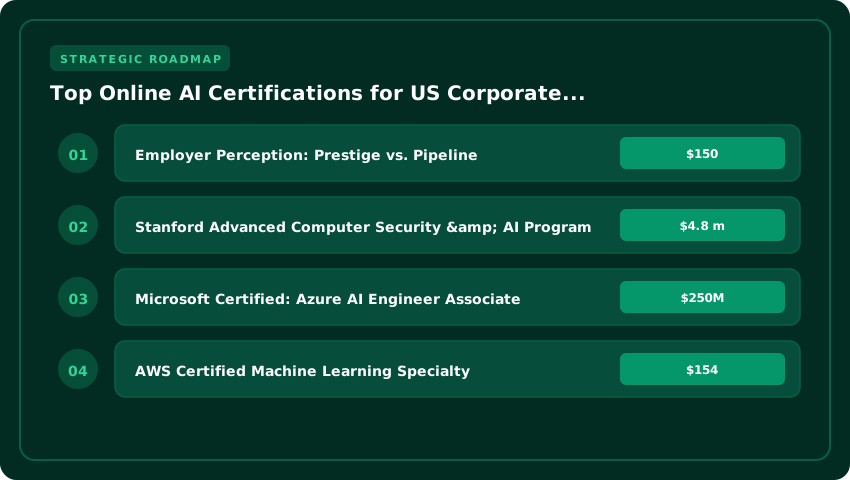
When your 2027 training budget lands on the CFO’s desk, the line item justification usually boils down to a single question: does this credential move the needle on product velocity or compliance readiness? The answer splits cleanly along two tracks—academic depth versus ecosystem lock-in—and the ROI math differs wildly depending on whether you are building foundational research capacity or deploying production workloads tomorrow.
Academic Rigor: The MIT, Stanford, and Harvard Calculus
University-backed programs—specifically MIT xPRO, Stanford Online, and Harvard VPAL—command premium pricing, typically ranging from $3,500 to $7,500 per seat for multi-week executive certificates. You are not paying for a badge; you are buying curated curriculum depth. MIT’s Designing and Building AI Products and Services forces architects through systems engineering and human-computer interaction modules that vendor exams simply skip. Stanford’s AI Professional Program mirrors the on-campus CS229/230 rigor, demanding fluency in PyTorch optimization and transformer architecture from scratch. Harvard VPAL leans heavily into governance, ethics, and organizational change management—critical for regulated sectors like finance and healthcare where CHIPS Act funding audits require documented responsible AI frameworks.
The ROI here is long-tail: internal R&D capability, patent pipeline fuel, and retention of senior ICs who view academic prestige as a proxy for career capital. However, time-to-productivity stretches to 3–6 months post-completion.
Vendor-Native Speed: AWS, Azure, and Google Cloud Trade-offs
Cloud vendor certifications—AWS Certified Machine Learning – Specialty ($300 exam + ~$2,000 prep), Azure AI Engineer Associate (AI-102) ($165 exam), and Google Cloud Professional Machine Learning Engineer ($200 exam)—operate on a different physics. They validate operational fluency inside a specific control plane: SageMaker Pipelines, Azure ML managed endpoints, or Vertex AI Feature Store.
- AWS: Deepest MLOps tooling coverage; essential if your 2027 roadmap runs on Trainium/Inferentia silicon.
- Azure: Unbeatable for hybrid/on-prem compliance (GovCloud, FedRAMP High); integrates natively with Microsoft 365 Copilot extensibility.
- Google Cloud: Superior Vertex AI AutoML and TPU orchestration; lowest friction for GenAI prototyping with Gemini models.
The trade-off is portability. An AWS Specialty cert loses signaling power if leadership pivots to Azure OpenAI Service next quarter. Budget $1,500–$3,000 per engineer for hands-on labs and practice exams; expect deployment readiness in 4–8 weeks.
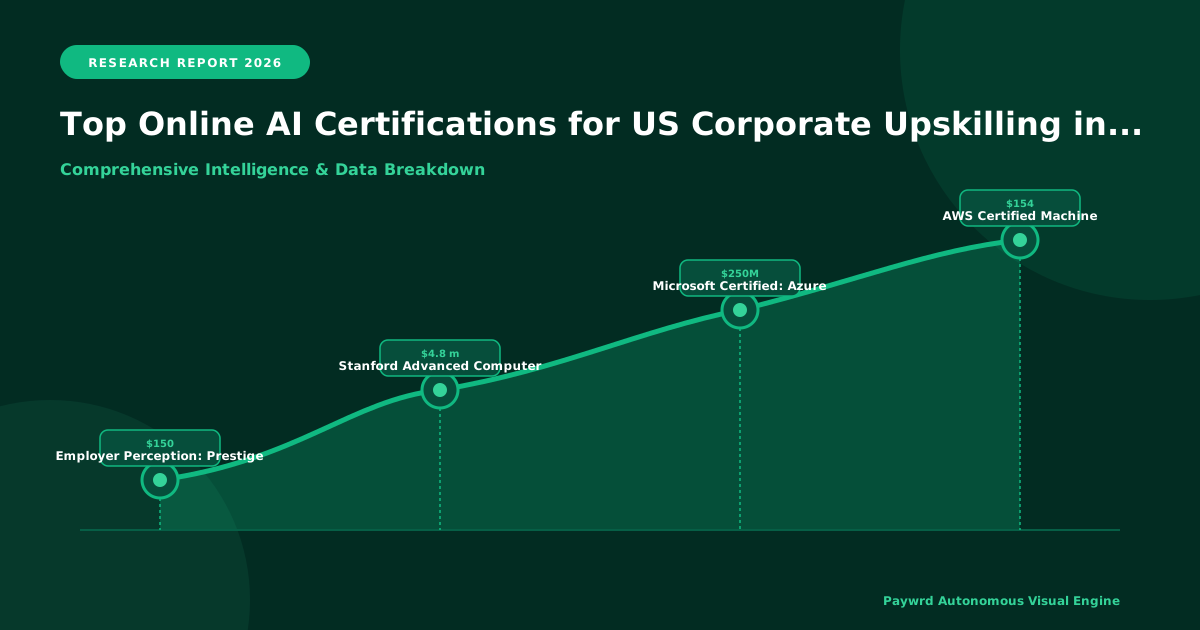
Employer Perception: Prestige vs. Pipeline
Recent 2026 Burning Glass Institute labor analytics reveal a split screen. For Staff+ Principal roles and AI Strategy Director titles, hiring managers filter for “Stanford/MIT/Harvard” on LinkedIn Recruiter—academic brands act as a proxy for first-principles thinking. Conversely, for MLOps Engineer, AI Platform Engineer, and GenAI Application Developer roles, the ATS keywords are “SageMaker,” “Vertex AI,” and “Azure AI Search.”
Smart 2027 upskilling strategies stop treating this as binary. Allocate 70% of seats to vendor-native tracks aligned with your committed cloud spend (negotiate Enterprise Discount Program credits to cover exam vouchers). Reserve 30% for university cohorts targeting architects and tech leads who need to evaluate build vs. buy decisions without vendor bias. That blend satisfies both the FAFSA-eligible tuition assistance compliance officers and the CTO’s sprint velocity targets.
Deep Dive: 5 High-Impact AI Certifications for 2027 Enterprise Adoption
MIT Professional Certificate in Machine Learning & AI
The MIT Professional Certificate runs 12 weeks part‑time and costs $3,900. It targets engineers with a bachelor’s in STEM and at least two years of Python experience. The capstone requires participants to design, train, and deploy an end‑to‑end model on a real‑world dataset — typically a supply‑chain forecasting or medical imaging problem — and present a reproducible ML pipeline with CI/CD scripts. Graduates receive a verified digital badge that satisfies many 2027 federal RFP requirements for “demonstrated production‑grade ML experience.”
- Duration: 12 weeks (≈10 hrs/week)
- Cost: $3,900
- Capstone: Production‑ready model + CI/CD pipeline
- Prerequisites: BS in STEM, 2 yr Python, linear algebra
Stanford Advanced Computer Security & AI Program
Stanford’s 10‑week online program costs $4,500 and is built for security architects moving into AI‑driven threat detection. Admission requires a solid grasp of cryptography, network protocols, and at least one year of hands‑on experience with TensorFlow or PyTorch. The curriculum blends adversarial machine learning, secure model deployment, and compliance mapping to NIST 800‑53. A final project asks learners to harden a generative‑AI service against prompt‑injection and data‑exfiltration attacks, delivering a hardened Docker image and a threat‑model report.
- Duration: 10 weeks (≈12 hrs/week)
- Cost: $4,500
- Prerequisites: Cryptography, networking, 1 yr TF/PyTorch
- Final project: Hardened GenAI service + threat model
Google Cloud Certified Professional Machine Learning Engineer
Google’s exam fee is $200; the recommended prep track (Coursera + Qwiklabs) runs 8 weeks and costs roughly $1,200 total. Certification is valid for two years, after which a 50‑question recertification exam ($100) or 30 continuing‑education credits are required. The test emphasizes Vertex AI pipelines, model monitoring, and responsible AI — key for 2027 federal contracts that mandate model‑card documentation and bias audits.
- Exam fee: $200
- Prep cost: ~$1,200 (8 weeks)
- Recertification: 2 yr cycle, $100 exam or 30 CE credits
- Focus: Vertex AI, model monitoring, responsible AI
Microsoft Certified: Azure AI Engineer Associate
At $165 for the exam (AI‑102) and an estimated $800 for Microsoft Learn labs, this credential can be earned in 6 weeks. The 2027 syllabus adds deep integration with the Copilot stack — requiring candidates to build a Copilot‑enabled chatbot that calls Azure OpenAI, Azure Cognitive Search, and Power Automate flows. The performance‑based lab validates end‑to‑end orchestration, making the badge a frequent line item in DoD and civilian agency RFPs.
- Exam fee: $165
- Lab cost: ~$800 (6 weeks)
- Key addition: Copilot stack integration
- Lab deliverable: Copilot‑enabled chatbot with Power Automate
AWS Certified Machine Learning Specialty
The specialty exam costs $300; AWS Skill Builder labs add about $1,000 for a 10‑week prep. The 2027 version stresses MLOps for regulated U.S. sectors — HIPAA‑compliant SageMaker pipelines, FedRAMP‑authorized model registries, and automated audit trails via AWS CloudTrail. Candidates must demonstrate a CI/CD pipeline that promotes models from dev to prod with immutable lineage, a requirement that appears in 2027 health‑care and finance RFPs.
- Exam fee: $300
- Prep cost: ~$1,000 (10 weeks)
- Focus: MLOps for HIPAA, FedRAMP, finance
- Required demo: Immutable CI/CD pipeline with audit trail
Accreditation & Industry Recognition: What US Hiring Managers Actually Verify
When your HR department opens the tuition reimbursement portal for the 2027 cohort, they aren’t just checking for a completion badge. They are running a silent compliance audit against a specific verification checklist. In 2026, the distinction between institutional accreditation and programmatic certification determines whether your $4,500 AI course qualifies as a deductible business expense or a personal hobby.
Regional Accreditation vs. ISO 17024: The Hierarchy of Trust
US hiring managers prioritize regional accreditation (NECHE, WASC Senior College and University Commission, HLC, MSCHE, SACSCOC) above all else. If a university partner—say, MIT xPRO, Stanford Online, or Georgia Tech—delivers the AI credential under their regional seal, it unlocks standard tuition assistance caps (often $5,250 annually tax-free under IRS Section 127). Conversely, standalone vendor certs (AWS, Azure, Google Cloud, NVIDIA DLI) operate under ISO/IEC 17024 personnel certification standards. While technically rigorous, these lack the “degree-granting authority” that many legacy HRIS systems (Workday, SAP SuccessFactors) require for automatic approval. You will likely need a manual exception request for pure vendor certs.
ABET: The Engineering Gatekeeper
For roles titled “AI Engineer” or “ML Infrastructure Engineer,” hiring managers cross-reference ABET accreditation. As of 2026, ABET accredits degree programs (B.S./M.S. in Computer Science, Software Engineering, Data Science), not short-form certificates. However, a certificate stack from an ABET-accredited school’s college of engineering carries implicit weight. If you hold a B.S. from an ABET program, a specialized AI certificate from that same institution validates continuous learning. Without the ABET degree baseline, a certificate alone rarely satisfies “Engineering” classification bands for compensation purposes (often a $15k–$25k delta over “Analyst” bands per 2026 BLS OES data).
SHRM & ATD: The L&D Reimbursement Keys
This is the most overlooked lever in 2026. Corporate Learning & Development (L&D) leaders—certified via SHRM-CP/SCP or ATD CPTD—control the discretionary upskilling budget (often separate from tuition assistance). They verify alignment with the ATD Capability Model (Developing Professional Capability > Technology Application) and SHRM Body of Applied Skills and Knowledge (BASK) (Technical Competency: AI & Automation).
- SHRM Alignment: Does the cert map to “HR Technology & Data Analytics” or “Business Acumen”? If yes, L&D can code it to Leadership Development budgets.
- ATD Alignment: Does the provider offer Continuing Education Units (CEUs) recognized by ATD? Providers like eCornell, Wharton Online, and Coursera (university partners) explicitly list ATD/HRCI recertification credits.
- Verification Checklist: HR will confirm: 1) Provider is regionally accredited OR ISO 17024 certified. 2) Curriculum maps to NIST AI Risk Management Framework (RMF 1.0) or OECD AI Principles. 3) Assessment is proctored or project-based (no open-book multiple choice). 4) Credential issues a verifiable digital badge (Open Badges 3.0 / CLR standard) for HRIS ingestion.
Bottom line: For 2027 reimbursement, lead with university-backed certificates carrying regional accreditation and ATD/SHRM pre-approval codes. Pure vendor certs are supplemental proof of tool fluency, not primary proof of strategic capability.
Quantifying the Payoff: Projected US Salary Lifts & Tuition Reimbursement Strategies
Building a business case for employer-funded upskilling starts with hard numbers. In 2026, the compensation gap between certified AI engineers and their non-certified peers has widened significantly. Data aggregated from the Bureau of Labor Statistics (BLS) Occupational Employment and Wage Statistics (OEWS) and specialized tech salary surveys (Levels.fyi, Dice) indicates that professionals holding vendor-neutral or major cloud AI certifications—such as the Google Cloud Professional Machine Learning Engineer, AWS Certified Machine Learning – Specialty, or the (ISC)² CISSP with AI concentration—command a median base salary premium of $18,000 to $28,000 annually over non-certified counterparts in equivalent roles. For Senior AI/ML Engineers in major hubs like San Francisco, New York, and Seattle, this delta frequently pushes total compensation packages above the $250,000 threshold, inclusive of equity and bonuses.
Maximizing Section 127: The $5,250 Tax-Free Advantage
The most immediate funding lever remains IRC Section 127 Educational Assistance Programs. For 2026 and projected 2027, the IRS maintains the exclusion limit at $5,250 per employee, per year. This allows employers to pay for tuition, fees, books, and equipment (including certification exam vouchers) completely tax-free to the employee—no Federal income tax, Social Security, or Medicare withholding. Crucially, the employer deducts the expense as a business cost. Unlike the Lifetime Learning Credit or Tuition and Fees Deduction, Section 127 has no income phase-outs and covers graduate-level work and non-degree certificates, making it the optimal vehicle for AI certifications which often cost between $300 and $3,000 per credential. HR leaders should verify their plan document explicitly includes “certification examination fees” and “online subscription platforms” (e.g., Coursera Plus, DataCamp, A Cloud Guru) as eligible expenses.
Negotiating 2027 Professional Development Stipends
With Section 127 capped, savvy professionals are negotiating supplemental Professional Development Stipends during 2027 compensation reviews. Market data suggests leading enterprises (FAANG, Tier-1 finance, defense contractors) now standardize annual stipends between $3,000 and $10,000 for high-demand skill verticals. To secure this:
- Anchor to ROI: Present a “Cost of Vacancy” analysis. If your upskilling closes a role that costs $500/day to leave open (SHRM average), a $10,000 stipend pays for itself in 20 days.
- Bundle Credentials: Propose a “Certification Pathway” (e.g., AWS ML Specialty → NVIDIA Deep Learning Institute → MLOps) rather than a single exam, demonstrating long-term retention value.
- Leverage CHIPS Act Alignment: If your firm participates in semiconductor or advanced manufacturing supply chains, cite CHIPS and Science Act workforce development clauses; these federal contracts often mandate documented upskilling budgets, giving your manager cover to approve higher stipends.
- Structure as Accountable Plan: Ensure any stipend above $5,250 is processed via an Accountable Plan (substantiation + return of excess) to avoid W-2 taxation.
Bottom line: Combining the $5,250 Section 127 floor with a negotiated $5,000–$10,000 stipend creates a $10,000–$15,000 annual war chest—enough to fund a full stack of elite AI credentials annually without touching personal cash flow.
Decision Matrix: Matching Certification Rigor to Your 2027 Career Trajectory
Not every AI credential carries the same weight, and in 2027’s saturated market, the wrong choice wastes the one resource you cannot replenish: time. The decision matrix below maps program intensity directly to the compensation bands and responsibility scopes defining the US labor market right now.
Technical Contributor Track: Deep Math & MLOps Focus
If your 2027 target reads “Senior ML Engineer,” “MLOps Architect,” or “AI Research Scientist” (median base $165,000–$210,000 per BLS 2026 data), you need credentials that prove you can productionize models, not just prototype them. Prioritize programs demanding linear algebra fluency, distributed training frameworks (PyTorch Distributed, JAX/Flax), and CI/CD pipeline integration. The Google Cloud Professional Machine Learning Engineer and AWS Certified Machine Learning – Specialty remain the gold standard for cloud-native MLOps validation. For pure research depth, the Stanford Online AI Professional Certificate or MIT xPRO Machine Learning carry academic weight that hiring managers at NVIDIA, Microsoft Research, and quant funds respect. Expect a 15–20 hour/week commitment over 6–9 months to reach competency while working full-time.
AI Product Manager Track: Strategy, Governance & ROI
Targeting “AI Product Lead,” “GenAI Strategy Director,” or “Responsible AI Governance Manager” (median base $145,000–$190,000 + equity)? Your certification must signal fluency in model evaluation metrics, regulatory compliance (EU AI Act readiness, NIST AI RMF), and stakeholder translation. The UC Berkeley Executive Education AI Strategy and MIT Sloan Artificial Intelligence: Implications for Business Strategy certificates are the recognized signals here. They skip gradient descent derivations in favor of value-capture frameworks, data-centric AI lifecycles, and vendor evaluation rubrics. Time-to-competency compresses to 8–12 hours/week over 3–4 months, making this the highest ROI track for seasoned PMs pivoting into AI ownership.
Stacking Strategy: Micro-Credentials to Master’s Pathway Credit
Smart 2027 upskillers treat certificates as stackable credits, not terminal trophies. Several top-tier US universities now honor verified micro-credentials toward reduced residency or tuition for Master of Science in Computer Science (MSCS) or Master of Information and Data Science (MIDS) degrees.
- Georgia Tech OMSCS: Accepts specific edX MicroMasters credits (e.g., MITx Statistics and Data Science) for up to 9 credit hours, slashing the ~$10,000 total program cost further.
- UT Austin MSDS Online: Grants advanced standing for the Google Cloud ML Engineer or TensorFlow Developer certificates, accelerating time-to-degree.
- University of Illinois iMSA/iMBA (Gies): Stacks Coursera/edX specializations into for-credit coursework, eligible for FAFSA federal aid once matriculated.
Action item: Before enrolling in any 2027 certificate, email the target university’s graduate admissions office with the syllabus. Confirm in writing how many credit hours transfer. This single step converts a $3,000–$5,000 certificate into a $15,000+ tuition offset on a terminal Master’s degree.
Strategic Final Takeaway
When evaluating Best Online AI Certification Programs For US Corporate Upskilling 2027 in 2026 and beyond, base your decisions on accredited institutional standards, verified return on investment (ROI), and up-to-date official guidelines. Always verify specific dates and requirements through official regulatory portals.