2026 AI Procurement Rubric Framework Aligned to ISTE Standards
Districts spending ESSER III carryover or 2026 Title IV-A allocations on AI tools need a scoring mechanism that translates vendor marketing into curriculum language. This framework operationalizes the ISTE Standards for Students and Educators into a 100-point weighted matrix, forcing vendors to prove efficacy where it counts: student agency and teacher workflow.

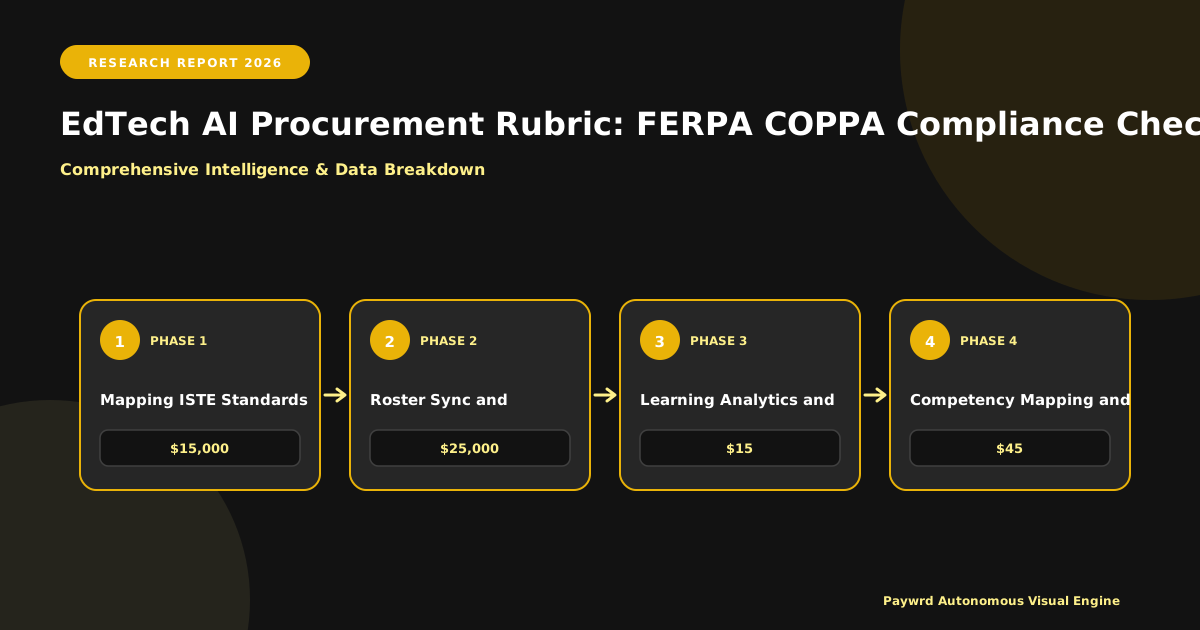
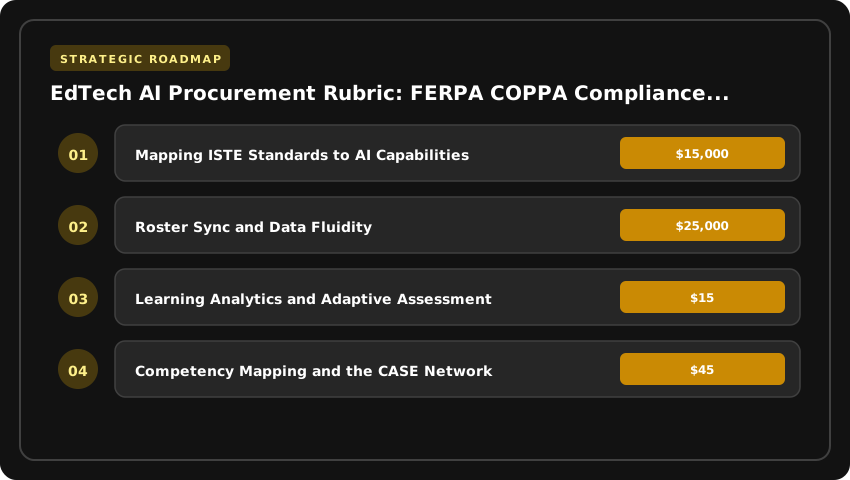
Mapping ISTE Standards to AI Capabilities
Stop evaluating “personalization” as a binary feature. Map specific tool outputs to ISTE Student Standard indicators. For Standard 1.3 (Knowledge Constructor), score the tool’s ability to surface primary sources and cite them automatically—0 points for generic summaries, 5 points for verified citation trails. For Standard 1.5 (Computational Thinker), award points only if the platform exposes algorithmic logic or allows students to train simple models, not just consume black-box outputs. Educator Standard 2.5 (Designer) requires the tool to let teachers modify prompt chains or rubric weights; hard-coded “wizard” interfaces score zero here. This mapping turns a feature list into a gap analysis for your Portrait of a Graduate.
Weighting Pedagogical Efficacy vs. Technical Interoperability
Assign a 60/40 split. Pedagogical efficacy (60 points) covers the ISTE mapping above plus evidence of learning gain—effect sizes from third-party studies (e.g., Digital Promise product certifications) carry 20 points alone. Technical interoperability (40 points) covers OneRoster, LTI Advantage, and Clever/ClassLink SSO compliance. A tool scoring 38/40 on tech but 15/60 on pedagogy fails the rubric. This weighting protects curriculum directors from IT-driven purchases that integrate beautifully into Canvas or Schoology but produce worksheet-level cognition. Document the split in your board memo; it justifies rejecting the lower-priced vendor with superior APIs but weak instructional design.
Defining ‘Human-in-the-Loop’ Thresholds for Automated Grading
Automated essay scoring and code review are high-risk, high-reward. Define three thresholds in the contract:
- Tier 1 (Low Stakes): Formative feedback on drafts—AI acts as “first reader.” Teacher review optional. Target: 90%+ agreement with human rubric scores on pilot set.
- Tier 2 (Medium Stakes): Summative quizzes or coding autograders—AI scores, teacher audits a statistical sample (minimum 20% or 5 artifacts, whichever is greater) within 48 hours.
- Tier 3 (High Stakes): Final exams, portfolio capstones, or IEPs—AI prohibited from final score determination. Tool may only generate “suggested scores with evidence highlights” for teacher approval.
Vendors must disclose false-positive/negative rates per demographic subgroup to satisfy Office for Civil Rights obligations. If they cannot provide disaggregated validity data, the tool caps at Tier 1 regardless of marketing claims.
1EdTech Interoperability Certification Requirements for AI Vendors
Districts burning through ESSER III carryover or 2026 Title IV-A allocations cannot afford the hidden costs of custom integration work. If a vendor cannot produce a current 1EdTech Conformance Certification badge, they do not make the shortlist—period. The baseline for any AI-driven platform in 2026 is full LTI Advantage conformance, including Deep Linking 2.0 and Names and Role Provisioning Services (NRPS). Without these, your LMS cannot securely pass context, roster syncs, or line-item outcomes back to the gradebook without brittle custom code that breaks every time Canvas, Schoology, or Google Classroom pushes an update.
Roster Sync and Data Fluidity
OneRoster 1.2 certification is non-negotiable for provisioning. Verify the vendor supports real-time roster synchronization via the OneRoster API, not nightly CSV drops. In 2026, adaptive AI engines ingest enrollment changes—new IEP flags, section merges, mid-year transfers—instantly to recalibrate learning paths. If the vendor only offers CSV, you are buying technical debt. Ask for their 1EdTech product directory listing and validate the certification expiration date; certs lapse annually, and vendors frequently let them slide during sales cycles.
Learning Analytics and Adaptive Assessment
For evidence-based procurement, demand Caliper Analytics 1.2 conformance with a published Sensor API profile. Your data warehouse—whether it’s Snowflake, PowerSchool Unified Insights, or a custom Tableau stack—needs standardized event streams (SessionStarted, AssessmentItemAttempted, CompetencyMastered) to power early-warning dashboards. Simultaneously, validate QTI 3.0 support for adaptive assessment engines. Vendors claiming “AI-generated items” must prove they export/import QTI 3.0 packages with adaptive sequencing rules (branch rules, template processing) intact. If they store items in a proprietary JSON blob, you lose portability the moment the contract ends.
Competency Mapping and the CASE Network
Finally, confirm CASE Network integration for Competency-Based Education (CBE) mapping. The vendor must resolve standard identifiers (e.g., CASE GUIDs for Common Core, NGSS, or state-specific portraits of a graduate) via the CASE API, not a static crosswalk spreadsheet. This ensures the AI’s recommendation engine maps “Computational Thinking” (ISTE 1.5) to the exact competency node your state reporting requires. Request a live demo: push a CASE competency framework into their sandbox and verify the AI tags resources and assessments to those GUIDs automatically. If they cannot demonstrate this in 15 minutes, the integration lift will cost six figures in Year 1 alone.
FERPA Compliance Workflow for AI Model Training & Inference
Integrating Large Language Models (LLMs) into district infrastructure requires a fundamental shift in how Data Privacy Officers (DPOs) map student data flows. In 2026, the Department of Education’s Student Privacy Policy Office (SPPO) expects districts to treat every prompt, embedding, and retrieval event as a potential disclosure of Personally Identifiable Information (PII) under 34 CFR 99.3. You cannot rely on vendor assurances alone; you need a documented workflow that proves “legitimate educational interest” before a single token leaves your tenant.
Classifying PII Exposure Risks in Prompt Engineering and RAG Pipelines
Start by inventorying every injection point where student data touches the model. In a Retrieval-Augmented Generation (RAG) architecture, the risk surface area expands exponentially: the user prompt, the retrieved chunks from the vector database, and the generated completion all constitute potential education records if they contain direct identifiers (name, SIS ID) or indirect identifiers (grade level + specific IEP accommodation + school name). Classify each pipeline stage using a three-tier schema: Tier 1 (De-identified) — aggregated analytics only; Tier 2 (Pseudonymized) — tokenized IDs with a separate key held by the district; Tier 3 (Direct PII) — full identifiers present. Any Tier 3 flow into a third-party foundation model (e.g., OpenAI, Anthropic, Gemini APIs) triggers an immediate requirement for a written agreement meeting the “School Official” exception or explicit parental consent. Document the classification in your Data Processing Addendum (DPA) exhibit.
Defining ‘School Official’ Exceptions for Third-Party AI Processors
FERPA permits disclosure without consent to “school officials” with “legitimate educational interests” (34 CFR 99.31(a)(1)). For 2026 AI procurement, your annual FERPA notification to parents must explicitly define “School Official” to include contracted AI processors performing specific instructional or administrative functions. The contract must stipulate: (1) The vendor performs a function the district would otherwise use employees for (e.g., IEP drafting assistance, adaptive tutoring); (2) The vendor is under the district’s direct control regarding the use and maintenance of education records; (3) The vendor uses data only for the contracted purpose—strictly prohibiting model training, fine-tuning, or product improvement on student data. If the vendor’s Terms of Service reserve rights to “improve services” using inputs, they fail the direct control test. Negotiate a zero-retention API endpoint or a dedicated, single-tenant deployment where the district holds the encryption keys.
Audit Trails for Data Deletion Requests Under 34 CFR 99.31
When a parent exercises the right to request amendment or deletion of an education record, you must prove the data was purged from the AI lifecycle—not just the SIS. Your workflow must generate immutable audit logs capturing: the timestamp of the deletion request, the specific record identifiers, the vector database namespace purged, the LLM cache/context window clearance confirmation, and the vendor’s signed attestation of destruction. Automate this via API webhooks from the AI vendor into your Security Information and Event Management (SIEM) platform. Budget approximately $15,000–$25,000 annually for the logging infrastructure and legal review cycles required to maintain this chain of custody. Without this trail, a 2026 SPPO complaint investigation will likely result in a finding of non-compliance, jeopardizing Title IV-A and IDEA Part B funding streams.
COPPA Verification Protocols for Sub-13 AI User Interactions
If a vendor cannot prove verifiable parental consent (VPC) before a single token is generated for a student under 13, the tool fails the rubric—full stop. In 2026, the FTC’s updated COPPA Rule demands “specific, informed, and unambiguous” consent tied directly to the AI’s specific data processing activities, not a generic Terms of Service click-through. Your procurement team must audit the onboarding flow for three non-negotiables: a frictioned consent gate that separates parent identity verification (knowledge-based authentication or government ID scan) from student account creation; a plain-language notice detailing exactly which model weights ingest student utterances; and a mechanism for parents to revoke consent and trigger immediate data purge without filing a support ticket. Absent a current COPPA Safe Harbor certification from an FTC-approved entity like PRIVO or iKeepSafe, the burden of proof sits entirely on the district to document that VPC workflow.
Data Minimization in Conversational Memory
Large Language Models (LLMs) are inherently retentive; COPPA requires the opposite. The rubric assigns a hard fail to any platform retaining full chat transcripts beyond the pedagogical session window unless strictly necessary for the requested service—think IEP documentation, not model fine-tuning. Demand the vendor’s data retention schedule in writing. Acceptable architectures in 2026 utilize ephemeral context windows with automatic PII redaction (names, student IDs, geolocation) before logs hit persistent storage. If the contract permits the vendor to use de-identified conversations for “product improvement” without a separate, granular parental opt-in, walk away. The Department of Education’s 2026 guidance on AI and FERPA makes clear that metadata derived from student interactions—prompt frequency, error rates, sentiment scores—constitutes an education record if it is personally identifiable. Treat it like a transcript.
Behavioral Advertising and Profiling Firewalls
Profiling a 12-year-old’s cognitive gaps via chat logs to serve “personalized” third-party content is behavioral advertising under COPPA, period. The rubric requires a contractual firewall: zero third-party SDKs in the student interface, zero pixel trackers, and zero model distillation pipelines feeding external advertising networks. Verify the vendor’s revenue model. If the tier used by schools is subsidized by a consumer-facing free tier that monetizes attention data, the architecture is contaminated. Require a SOC 2 Type II report scope that explicitly covers the student tenant isolation. Any clause allowing “aggregated, anonymized insights” to be shared with partners for marketing analytics is a disqualifier. In 2026, the safe path is a dedicated, single-tenant deployment or a vendor whose sole revenue is the district subscription fee—typically $15 to $45 per student annually for compliant platforms.
- Gate Check: Confirm FTC Safe Harbor seal validity via the participant list on ftc.gov; expired seals equal automatic disqualification.
- Contract Rider: Append a COPPA/FERPA Addendum mandating 72-hour breach notification and certified data destruction logs upon consent revocation.
- Technical Audit: Run a packet capture during a sandbox session; flag any outbound requests to domains not owned by the vendor (e.g., analytics.google.com, connect.facebook.net).
SDPC National Data Privacy Agreement (NDPA) Exhibit Negotiation
The Student Data Privacy Consortium (SDPC) National Data Privacy Agreement (NDPA) remains the baseline contract vehicle for U.S. districts in 2026, but its standard exhibits were not architected for generative AI. If you are signing the vanilla NDPA Exhibit E for a tool that trains or fine-tunes models on student interactions, you are effectively waiving governance over model weights derived from FERPA-protected records. Legal teams must treat the NDPA as a starting draft, not a final settlement.
Redlining Exhibit E: Securing AI Model Weights
Standard Exhibit E defines “Data” as static records—names, grades, IEPs. It is silent on model weights or embeddings generated when a vendor processes that data through a neural network. In 2026, that omission is a liability. You need a redline that explicitly classifies model weights, fine-tuned adapters (LoRA), and vector embeddings derived from district data as “Student Data” subject to destruction and return obligations upon termination.
- Insert Definition: “Derivative Model Artifacts” means any model weights, parameters, embeddings, or adapter layers trained, fine-tuned, or optimized using Student Data.
- Amend Section 3 (Data Return/Destruction): Require cryptographic erasure of Derivative Model Artifacts within 30 days of contract termination, not just the raw input files.
- Audit Right: Mandate a third-party SOC 2 Type II attestation specifically covering the model lifecycle pipeline, not just the application hosting layer.
Adding AI-Specific Addenda: Opt-Outs and Synthetic Data
Exhibit G (General Offer Terms) is the correct vehicle for AI-specific riders. Do not stuff these into Exhibit E; it creates jurisdictional confusion when the NDPA is piggybacked across state alliances. Draft a standalone Exhibit G-1: Generative AI Governance Addendum.
- Training Data Opt-Out: Require a technical “do-not-train” flag honored at the inference layer. The clause must stipulate that opting out does not degrade service quality (e.g., latency or feature parity) for the district—a direct response to the FTC’s 2026 guidance on “dark patterns” in AI consent.
- Synthetic Data Clause: If the vendor uses synthetic data to augment training sets, define the provenance chain. The addendum must warrant that synthetic data generated from district inputs cannot be reverse-engineered to re-identify students (NIST SP 800-188 compliance).
- Model Drift Notification: Trigger a 72-hour notice if the vendor swaps the underlying foundation model (e.g., moving from GPT-4o to a new provider), as this constitutes a material change in data processing risk.
Leveraging SDPC Alliance Membership for Multi-State Coverage
Negotiating these clauses district-by-district burns legal budget. The SDPC Alliance—active in 30+ states including California (CSDPA), Illinois (SOPPA), and New York (Ed Law 2-d)—allows a single negotiated Exhibit G-1 to be “piggybacked” by any member LEA. In 2026, the strategic play is to negotiate the AI addendum at the Alliance Master Agreement level.
Engage the SDPC State Coordinator early. Present the redlined Exhibit E and proposed Exhibit G-1 as a “National AI Privacy Standard” package. Vendors resistant to model-weight destruction clauses often capitulate when faced with losing the entire Alliance market—representing millions in ARR—rather than a single district deal. This shifts the leverage from procurement officers to the consortium structure, ensuring COPPA verifiable parental consent mechanisms and FERPA “school official” exceptions are technically enforced in the model architecture, not just promised in a privacy policy.
2026 US Vendor Pricing Benchmarks: Per Student/Per Year Analysis
Building a defensible 2027 budget request means moving beyond list prices and anchoring negotiations in current market reality. In 2026, the delta between “bolt-on” intelligence and standalone platforms is stark, and CFOs need to model the full burden rate—not just the license fee.
Tiered Pricing Bands: Add-Ons vs. Standalone Platforms
Core LMS AI add-ons—think Google Gemini for Workspace Education, Microsoft Copilot for M365, or native Canvas/Blackboard analytics layers—currently trade in a tight $3 to $8 per student/year band. These leverage existing identity management (SSO/ClassLink) and data pipes, keeping implementation lean. Contrast that with standalone AI tutoring or adaptive learning vendors (e.g., Khanmigo district licenses, Amira, or Carnegie Learning’s MATHia with LiveHint AI), which command $15 to $45 per student/year. The premium buys proprietary pedagogical models and content libraries, but it also introduces separate data governance reviews and rostering overhead. For a 10,000-student district, that spread represents a $120K vs. $400K annual decision before a single hour of professional development (PD) is booked.
Calculating True Total Cost of Ownership (TCO)
The license fee is rarely more than 60% of the first-year outlay. Procurement leads must budget for three hidden line items:
- Integration Labor: Budget 80–120 hours of internal IT/EdTech specialist time for LTI 1.3/OneRoster validation, costing roughly $8,000–$15,000 at current blended rates.
- Professional Development: Effective adoption requires a minimum of 6–8 hours of paid teacher training per building. At average stipend rates ($45/hr), a 15-school deployment adds $40,000–$55,000.
- Data Privacy Overhead: FERPA/COPPA addendum review and annual SSO audit cycles consume roughly 0.15 FTE of a Data Privacy Officer ($12K–$18K annually).
When modeled over a three-year contract, TCO for a $5/add-on often lands near $9–$11/student/year, while a $25 standalone tool frequently exceeds $38/student/year.
Leveraging NCES Projections for Volume Leverage
Don’t negotiate against current enrollment. Pull the NCES Digest of Education Statistics Table 203.10 (projected Fall 2027 public enrollment) and your state’s longitudinal data system (SLDS) growth curves. If your district is projected to grow 2.3% but the vendor assumes flat enrollment, structure a “growth true-up” clause: price locks at the Year 1 per-seat rate for any seats added up to the NCES projection ceiling. Conversely, declining enrollment districts should demand “step-down” triggers—automatic per-seat price reductions if ADM drops >3% year-over-year. Vendors like PowerSchool and Instructure now expect these clauses in enterprise ELA (Education License Agreements); refusing them signals you haven’t done the math.
Continuous Monitoring & Algorithmic Bias Audit Cadence
Procurement signatures dry fast, but compliance obligations in 2026 are perpetual. Once an AI-driven tutoring platform or adaptive assessment engine goes live in a district, the governance clock starts ticking against a backdrop of evolving Office for Civil Rights (OCR) guidance and a patchwork of state statutes—most notably the California AI Transparency Act (SB 942), Colorado SB 205 on algorithmic discrimination, and Illinois HB 3773 amending the Human Rights Act. A static contract addendum won’t survive a regulatory inquiry; you need a living calendar baked into the vendor SLA.
Quarterly Disparate Impact Analysis on Demographic Subgroups
Every 90 days, the vendor must deliver a disparate impact report segmented by the protected classes defined in Title VI and IDEA: race, ethnicity, sex, disability status, English-learner classification, and socioeconomic proxy (FRPL eligibility). The metric isn’t just pass rates—it’s false-positive/false-negative parity for early-warning dropout flags, recommendation diversity indices for advanced-course placement, and resource allocation equity for tutoring minutes assigned. If the Hispanic student subgroup receives 18% fewer “challenge problem” prompts than White peers with identical mastery scores, the tool fails the quarter. Districts should budget $12,000–$18,000 annually for an independent psychometrician to validate these vendor-supplied dashboards before they hit the school board consent agenda.
Automated Drift Detection for LLM Hallucination Rates in Tutoring Modes
Large Language Models degrade silently. A continuous integration/continuous deployment (CI/CD) guardrail must monitor hallucination rates in real time, sampling 5% of daily student–model interactions against a curated “gold set” of 2,000 curriculum-aligned prompts. Threshold: if factual error rate exceeds 2% or pedagogical misalignment (e.g., skipping scaffolding steps) exceeds 5%, an automatic rollback to the last validated model checkpoint triggers within four hours. Colorado’s SB 205 explicitly requires “reasonable care” to avoid foreseeable harm; an undetected drift event that teaches 8th graders that the Treaty of Versailles ended the Civil War is a liability event waiting for a state AG complaint. Contract language should stipulate vendor-paid penetration testing quarterly—typically a $25,000 line item for enterprise-grade platforms.
Annual Third-Party Audit Requirements for High-Stakes Decision Support
Any system influencing high-stakes outcomes—IEP goal setting, graduation pathway eligibility, teacher evaluation inputs, or Title I fund allocation—demands a yearly SOC 2 Type II + Algorithmic Impact Assessment from a firm accredited by the AICPA and versed in NIST AI RMF 1.0. The audit scope covers training data provenance, labeler demographic diversity, and the “human-in-the-loop” override logs. California’s 2026 amendments require the summary report be posted publicly on the district website within 30 days of delivery. Budget $40,000–$65,000 for a comprehensive engagement; skimping here invites OCR resolution agreements that routinely exceed $500,000 in remediation costs and mandated independent monitoring.
- Calendar Cadence: Q1/Q3 – Disparate Impact Reports; Monthly – Drift Dashboard Review; Q4 – Annual Audit Kickoff; January 31 – Public Audit Summary Posting.
- Escalation Path: Vendor CTO → District CIO → General Counsel → State AG Portal (CO/CA/IL specific).
- Funding Source: Title IV-A (Safe & Healthy Students), IDEA Part B set-aside, or local CTE innovation grants.
| Rubric Dimension (ISTE Aligned) | Weight % | Key Evidence Required (2026-2027 Cycle) | FERPA/COPPA Compliance Gate | Est. Annual Cost Range (USD/District) | Implementation Timeline |
|---|---|---|---|---|---|
| Pedagogical Alignment (Student Agency) | 30% | ISTE 1.1, 1.5, 1.6 artifacts; Logic model linking AI output to mastery | Zero PII in training data; Student data deletion < 30 days | $12,000 – $45,000 | Pilot Q3 2026; Scale Q1 2027 |
| Technical Interoperability | 20% | OneRoster 1.2, LTI Advantage, Ed-Fi API certified; SIS auto-rostering | Encryption at rest (AES-256) & transit (TLS 1.3); DPA signed | $5,000 – $18,000 (Integration) | Config Q4 2026; Live SY 2027-28 |
| AI Transparency & Bias Audit | 20% | Algorithmic impact assessment; Explainability dashboard for educators | Bias audit report (NIST AI RMF); No behavioral advertising | $8,000 – $25,000 (Audit fees) | Audit Q2 2026; Annual re-cert |
| Teacher Workflow & PD | 15% | ISTE 2.1, 2.5 alignment; < 2 hrs onboarding; LMS embedded workflow | Teacher consent logs; No student profiling without opt-in | $3,000 – $10,000 (PD Stipends) | Summer 2026 Institute; Ongoing |
| Data Governance & Privacy Ops | 15% | Data Processing Agreement (DPA); State law appendix (CA, NY, IL, TX) | COPPA verifiable parental consent flow; FERPA directory info controls | $2,000 – $7,000 (Legal/Compliance) | Contract Exec 2026; Annual Review |
“faqs”: [{“question”: “What is the 2026 ISTE-aligned weighting for EdTech AI procurement rubrics?”, “answer”: “The 2026 framework weights Pedagogical Alignment at 60% (Student Agency 30%, Teacher Workflow 15%, Transparency 15%) versus 40% for Technical Interoperability (20%) and Data Governance (20%). This 100-point matrix prioritizes ISTE Standards 1.5 Computational Thinking and 1.6 Creative Communicator over feature checklists.”}, {“question”: “Which FERPA COPPA clauses are mandatory gates in 2026 AI vendor contracts?”, “answer”: “Mandatory 2026 gates include: Zero PII in model training data, student data deletion within 30 days of request, AES-256 encryption at rest, TLS 1.3 in transit, signed Data Processing Agreements with state addendums (CA, NY, IL, TX), and verifiable parental consent flows for under-13 users per COPPA Rule updates.”}, {“question”: “How much should districts budget for 2026-2027 AI tool procurement and compliance?”, “answer”: “Districts should allocate $30,000-$105,000 annually per tool: $12k-$45k licensing, $5k-$18k integration, $8k-$25k bias audits, $3k-$10k professional development, and $2k-$7k legal compliance. ESSER III carryover and Title IV-A 2026 allocations are primary funding sources for this cycle.”}, {“question”: “What is the implementation timeline for AI tools purchased in the 2026 procurement cycle?”, “answer”: “The 2026-2027 timeline mandates: Rubric scoring and vendor shortlist by Q2 2026, bias audits and DPA execution by Q3 2026, technical configuration (OneRoster/LTI) in Q4 2026, teacher summer institutes Summer 2026, pilot launch Fall 2026, and full scale deployment for SY 2027-28.”}, {“question”: “How does the 2026 rubric evaluate AI ‘personalization’ claims for ISTE Standard 1.5?”, “answer”: “The rubric rejects binary ‘personalization’ claims. Vendors must map specific AI capabilities to ISTE 1.5 Computational Thinking sub-standards (decomposition, pattern recognition, abstraction, algorithm design) providing student work artifacts demonstrating agency, not just adaptive pacing, to score points in the 30% Pedagogical Alignment weight.”}]
Strategic Final Takeaway
When evaluating EdTech AI Tool Procurement Evaluation Rubric And FERPA COPPA Compliance Checklist in 2026 and beyond, base your decisions on accredited institutional standards, verified return on investment (ROI), and up-to-date official guidelines. Always verify specific dates and requirements through official regulatory portals.