Official 2026/2027 Session Fee Schedule: Tuition & Levies
Bar Part I: Stream 1 (Nigerian University Graduates)
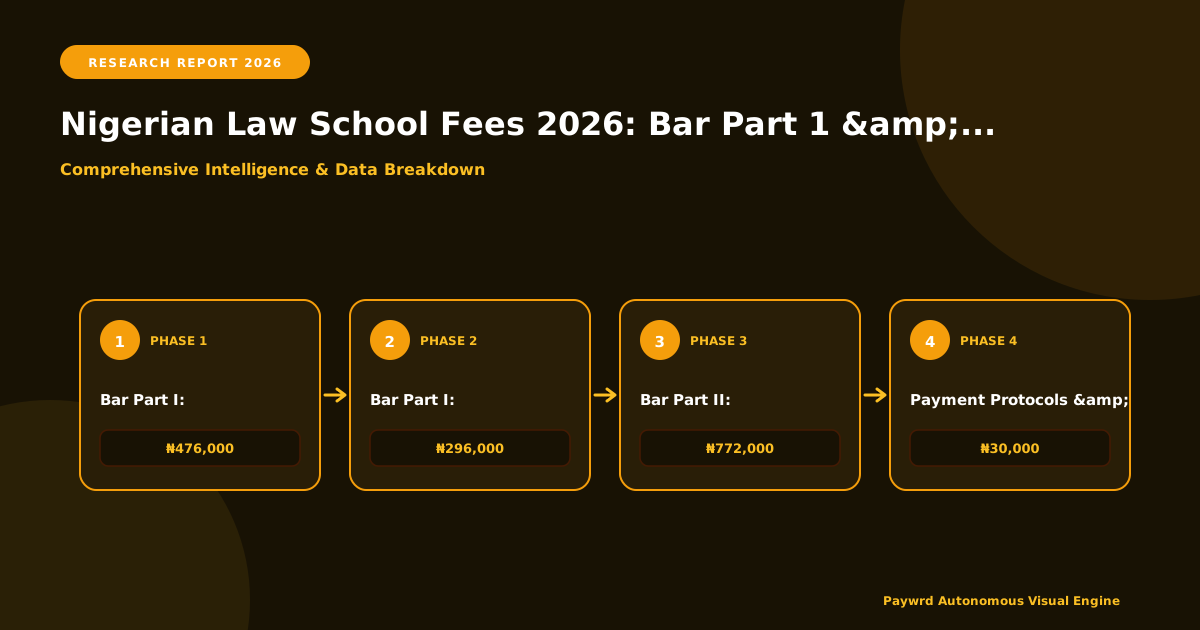
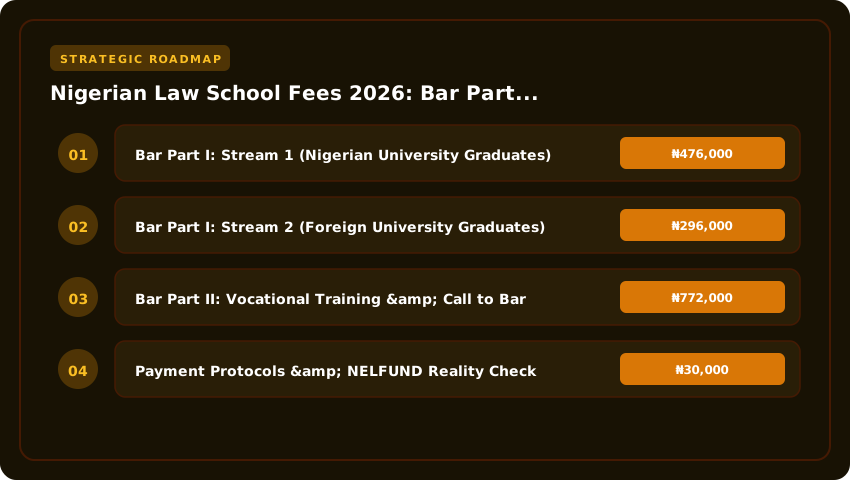
The Council of Legal Education has maintained the 2026 fee structure for the 2026/2027 academic year for domestic graduates. Stream 1 candidates—holders of LL.B degrees from NUC-accredited Nigerian universities—face a consolidated tuition charge of ₦476,000. This is non-negotiable and payable in full via the Council’s Remita portal before the matriculation deadline. On top of tuition, mandatory levies apply: a ₦30,000 Development Levy for infrastructure upkeep across the seven campuses (Abuja, Lagos, Enugu, Kano, Bayelsa, Yola, Bwari) and a ₦20,000 ICT/Computer-Based Testing (CBT) Charge covering the mandatory digital literacy module and examination logistics. An additional ₦10,000 covers identity card, library registration, and sports levy. Stream 1 Total Out-of-Pocket: ₦536,000.

- Tuition: ₦476,000
- Development Levy: ₦30,000
- ICT/CBT Charge: ₦20,000
- Admin/ID/Library/Sports: ₦10,000
Bar Part I: Stream 2 (Foreign University Graduates)
Graduates from foreign universities—including those from the UK, US, Ghana, and other jurisdictions—bear a significantly higher burden under Stream 2. Tuition is pegged at ₦850,000, reflecting the differential funding policy. The Development Levy (₦30,000), ICT Charge (₦20,000), and Admin bundle (₦10,000) remain identical to Stream 1. Crucially, Stream 2 students must also budget for the mandatory Bar Part I Prerequisite Examination (Bar Pre) prep materials, often sourced privately. Stream 2 Total Out-of-Pocket: ₦910,000.
- Tuition: ₦850,000
- Development Levy: ₦30,000
- ICT/CBT Charge: ₦20,000
- Admin/ID/Library/Sports: ₦10,000
Bar Part II: Vocational Training & Call to Bar
Successful Bar Part I candidates proceeding to the vocational stage (Bar Part II) pay a tuition of ₦476,000—mirroring the Stream 1 rate—plus the standard Development Levy (₦30,000) and ICT Charge (₦20,000). However, Part II introduces two unique, non-avoidable costs: the Call-to-Bar Fee (₦30,000) processed through the Body of Benchers, and the Regalia Rental Fee (₦50,000) for the wig, gown, and bib used during the Call ceremony. Note: Regalia purchase is optional (≈₦350,000+), but rental is mandatory for the ceremony. Bar Part II Total Out-of-Pocket: ₦606,000.

- Tuition: ₦476,000
- Development Levy: ₦30,000
- ICT/CBT Charge: ₦20,000
- Call-to-Bar Fee: ₦30,000
- Regalia Rental: ₦50,000
Payment Protocols & NELFUND Reality Check
All payments are processed exclusively via the Council of Legal Education Remita gateway; campus cashiers accept zero cash. Generate your RRR (Remita Retrieval Reference) from the student portal (nigerianlawschool.edu.ng), pay at any commercial bank or via USSD, and upload the receipt for clearance. Critical: As of
Accommodation & Hostel Balloting Costs for 2026 Intake
Securing a bed space is the first real logistical battle after fee payment. For the 2026/2027 session, the Council of Legal Education has retained the subsidised on-campus hostel fee at ₦30,000 per session across all six campuses—Abuja (Bwari), Lagos (Yaba), Enugu (Agbani), Kano, Yenagoa, and Yola. This covers bed space and basic maintenance only; it does not include feeding, laundry, or generator fuel levies which are managed by the Hostel Executives and typically add another ₦15,000–₦25,000 per semester depending on the campus.
Balloting Timeline & Eligibility Mechanics
The balloting portal usually opens two weeks after the physical verification exercise concludes (typically late October to early November for Stream 1). Access is strictly limited to students who have completed 100% tuition payment and cleared all verification holds on the nigerianlawschool.edu.ng portal. You cannot ballot for a friend; the system ties the bed space to your JAMB registration number and biometric capture. If you miss the 72-hour payment window after a successful ballot, the slot reverts to the pool immediately—no appeals, no extensions.
Campus-Specific Private Hostel Ranges (2026 Market Rates)
On-campus supply meets roughly 35–45% of demand. Most students end up off-campus. Below are current monthly ranges for a standard self-contained room or shared 2-bedroom flat (per bed space), excluding service charges and caution fees (usually 2–3 months’ rent upfront):
- Abuja (Bwari/Kubwa axis): ₦180,000 – ₦350,000/month. Bwari town is cheaper; Kubwa/Abuja Municipal offers better roads but commands a premium.
- Lagos (Yaba/Sabo/Onike): ₦250,000 – ₦500,000/month. The most expensive market. “Self-contained” often means a partitioned boys’ quarters; verify toilet facilities physically.
- Enugu (Agbani/Emene): ₦100,000 – ₦220,000/month. Agbani hostels near the campus gate fill up fastest; Emene offers better infrastructure but requires daily keke/tricycle commute.
- Kano (Bagauda/Dawakin Tofa): ₦60,000 – ₦130,000/month. Most affordable campus. Many students negotiate “per session” lump sums (₦500k–₦800k) for 10-month leases.
- Yenagoa (Ama/Otuokpoti): ₦120,000 – ₦250,000/month. Flood risk is real; prioritize elevated ground floors and verify drainage before paying.
- Yola (Karewa/Doubeli): ₦70,000 – ₦150,000/month. Quietest market. Power supply is erratic; factor generator/solar costs into your budget.
Strategic Advice for 2026 Intake
Do not wait for the ballot result to start scouting. Join the verified WhatsApp/Telegram groups for your campus (usually administered by the SUG or Law School Liaison Officers) by mid-September. Inspect physically or mandate a trusted senior colleague to video-call you through the property—check water pressure, security gates, and proximity to the campus shuttle route. If you secure off-campus housing, pay your caution fee and first rent only after signing a tenancy agreement witnessed by a lawyer or the campus Student Affairs Officer. Budget a minimum of ₦600,000 – ₦1.2 million for the full 10-month session off-campus, inclusive of agency fees (10%), legal fees (5–10%), and initial fuel/feeding stock.
Hidden & Variable Costs: Materials, Feeding & Transport
The published tuition schedule is only the entry ticket. The real financial weight of the Bar programme sits in the daily operational costs that the Council of Legal Education does not line-item on the remita invoice. For the 2026/2027 session, a realistic budget must account for three major variable buckets: professional materials, daily sustenance, and the logistics of the Stream 2 campus swap.
Casebooks, Statutes & Legal Report Budget
While the Law School provides core lecture manuals, they are rarely sufficient for the “externals” or the rigorous weekly tests. Every student needs updated copies of the Evidence Act 2026 (as amended), Administration of Criminal Justice Act (ACJA), Civil Procedure Rules of the relevant High Courts, and the Nigerian Law Reports (NLR) or All Nigeria Law Reports (ALLR) digests for the last five years. In 2026, a comprehensive “chamber library” purchased from major legal bookshops in Abuja (Garki/Area 10), Lagos (Ikeja/Law School Road), or Enugu (Okpara Avenue) will cost between ₦75,000 and ₦120,000. Budget an extra ₦15,000–₦25,000 for printing endless drafts, pleadings, and past questions during the revision weeks. Digital subscriptions to LawPavilion Prime or Nigerian Legal Information Institute (NigerLII) premium tiers are viable supplements at roughly ₦30,000/year, but hard copies remain mandatory for the closed-book Bar Finals.
Daily Feeding Allowances: 2026 Campus City Rates
Feeding is the single largest recurrent expense after rent. The Council’s cafeteria meals (where functional) average ₦1,500–₦2,500 per plate, but most students rely on off-campus “bukas” or meal-prep. For 2026, budget conservatively per day:
- Abuja (Bwari) & Lagos (Yaba): ₦4,000 – ₦6,000/day (High cost of living; transport to cheap joints eats savings). Monthly: ~₦130,000.
- Enugu (Agbani) & Bayelsa (Yenagoa): ₦3,000 – ₦4,500/day. Monthly: ~₦100,000.
- Kano (Bagauda) & Yola: ₦2,500 – ₦3,500/day. Monthly: ~₦80,000.
Over the ~9-month Part II residential period, feeding alone demands ₦720,000 – ₦1.17 million depending on campus posting. Part I (4–5 months) adds another ₦400,000–₦600,000.
Inter-Campus Relocation: The Stream 2 “Swap” Tax
This is a unique cost centre for Stream 2 (Foreign Graduates). You complete Bar Part I at your assigned campus (often Abuja, Lagos, or Enugu) but are frequently redeployed to a different campus for Bar Part II. In 2026, a one-way flight (e.g., Lagos ↔ Abuja, Abuja ↔ Yola, Enugu ↔ Kano) booked 2 weeks out costs ₦90,000–₦180,000. Add excess luggage fees for law books and regalia boxes (₦15,000–₦30,000) and local haulage (₦10,000–₦20,000). Budget a minimum ₦150,000 – ₦250,000 for this mandatory relocation. Stream 1 (Nigerian graduates) typically remain on the same campus for both parts, avoiding this hit entirely.
Payment Protocol: Remita, NELFUND Loan & Installment Options
Paying your Nigerian Law School fees in 2026 is a strictly digital affair anchored on the Remita platform. There are no cash payments at campus bursaries, and bank tellers are obsolete. Every applicant—whether Bar Part I or Part II—must generate a unique Remita Retrieval Reference (RRR) via the official Council of Legal Education portal before a single kobo leaves their account. Miss this step, and your payment will not reflect on your student profile, jeopardizing your clearance for lectures or the Bar Finals.
Step-by-Step: Generating Your RRR on the NLS Portal
- Log in to your applicant dashboard at
nigerianlawschool.edu.ngusing your application credentials. - Navigate to the “Fees Payment” or “Financials” tab for the 2026/2027 session.
- Select the specific fee item (e.g., “Tuition – Bar Part I Stream 1” or “Call to Bar Fees”).
- Click “Generate RRR”. The system communicates with Remita in real-time to produce a 12-digit code tied to your name and registration number.
- Copy the RRR immediately. You can pay instantly via the portal’s card/bank transfer gateway (attracting a ~1.5% + ₦100 gateway fee) or take the RRR to any commercial bank branch, POS agent, or mobile banking app (USSD/Internet Banking) for zero-gateway-fee settlement.
- After payment, return to the portal and click “Verify Payment”. The system auto-updates your status to “Paid” within minutes. Download the PDF receipt for your physical clearance file.
Accessing the Federal Government Student Loan (NELFUND) for Law School
The 2026/2027 session marks the first full cycle where Nigerian Law School students can access the NELFUND interest-free loan under the Student Loans (Access to Higher Education) Act. Since the Law School is a federal tertiary institution under the Council of Legal Education, it is an approved beneficiary institution. However, the loan covers tuition only—it does not cover feeding, accommodation, regalia, or the Call-to-Bar levy.
To apply: Register on the nelf.gov.ng portal using your NIN and BVN. Select “Nigerian Law School” as your institution and input your matriculation/registration number. You must provide your JAMB admission letter (for Part I) or Law School admission letter (for Part II) and a letter of identification from your Campus Director. Disbursement is paid directly to the Law School’s Remita account upon approval; you will receive a notification to verify the credit on your portal. Processing typically takes 4–6 weeks, so apply the moment you accept admission—do not wait for the payment deadline.
Official Stance on Installment Payments & Late Penalties
The Council of Legal Education maintains a zero-tolerance policy on installment payments for the 2026/2027 session. The fee schedule explicitly states: “All fees must be paid in full before the commencement of lectures.” There is no official two-installment or three-installment plan sanctioned by the Director-General. Any campus-level arrangement allowing staggered payment is informal, unauthorized, and will not shield you from portal restrictions.
Late payment attracts a penalty of ₦20,000 per session after the published deadline (usually two weeks post-resumption). More critically, non-payment results in an automatic lockout from the Learning Management System (LMS), exclusion from continuous assessment, and inability to sit for the Bar Part I or Part II examinations. If you are awaiting NELFUND disbursement, generate your RRR immediately and select “Pay Later” to lock in the amount, but you must clear the balance before the deadline to avoid the penalty and academic sanctions.
Fee Waivers, Scholarships & Employer Sponsorship Routes
The ₦1.15 million baseline for the 2026/2027 Bar journey is a steep climb for many fresh graduates, but the Council of Legal Education and external stakeholders maintain structured lifelines. Knowing exactly where to apply—and beating the deadlines—is often the difference between deferring a year and walking into the campus in January.
NLS Council Indigent Student Waiver (2026/2027 Cycle)
The Council of Legal Education runs a needs-based tuition waiver strictly for Bar Part I (Stream 1) candidates. For the 2026/2027 session, the application portal typically opens within two weeks of the admission list release—usually late October to mid-November 2026. You must submit a sworn affidavit of means, your parents’ or guardians’ tax clearance certificates (or a sworn declaration of unemployment), and a letter of identification from your Local Government Area Chairman or a traditional ruler. The Council’s Bursary Committee prioritizes candidates with verifiable zero-income backgrounds; partial waivers (50% tuition) are more common than full rides. Decisions are communicated via the candidate’s NLS dashboard before the first semester payment deadline. Keep scanned copies of your JAMB admission letter and LL.B transcript ready; missing documents auto-disqualify the application.
NBA Branch & Law Firm Sponsorship Windows
Most Nigerian Bar Association branches—Lagos, Abuja, Port Harcourt, Kano, and Enugu being the most active—run annual “Call to Bar Sponsorship Schemes” targeting indigenes or resident students. The NBA Lagos Branch typically opens its portal in Q1 2026 (January–March) for the subsequent academic year, requiring an essay on a topical legal issue and proof of branch membership (or parent’s membership). Top-tier commercial firms (e.g., Udo Udoma & Belo-Osagie, Aluko & Oyebode, Banwo & Ighodalo) and mid-tier litigation chambers often sponsor future associates conditional on a training contract offer. Applications for these firm-sponsored routes usually close by June 2026 for the 2026/2027 session. Candidates should monitor the “Careers” or “Graduate Recruitment” pages of target firms and the NBA National Young Lawyers Forum WhatsApp/Telegram channels for real-time alerts.
State Government Scholarship Portals for Indigenes
State scholarship boards remain the most reliable high-volume funders for Law School. The workflow is standard across states but deadlines vary wildly:
- Lagos State Scholarship Board (LASSB): Portal opens April 2026 for the 2026/2027 session. Requires LASRRA card, LGA identification, and NYSC call-up letter (or exemption certificate) for Part II applicants. Awards cover full tuition plus a ₦150,000–₦200,000 maintenance stipend.
- Rivers, Delta, Bayelsa, Akwa Ibom (Niger Delta States): Often run “Special Law School Schemes” separate from general undergraduate boards. Applications typically open May–July 2026. They require a “Letter of Identification” signed by the Community Development Committee (CDC) Chairman.
- Northern States (Kano, Kaduna, Katsina, Borno): Usually managed by State Scholarship Boards under the Ministry of Education. Portals open March–May 2026. They prioritize candidates with First Class/Second Class Upper degrees.
- PTDF & NELFUND: While PTDF focuses on STEM, their “Local Scholarship” scheme occasionally admits Law candidates for specialized Oil & Gas Law modules. NELFUND (Student Loan Act) currently covers tuition only for undergraduate studies; Law School (post-graduate vocational) is not yet eligible for the 2026/2027 cycle per the current guidelines.
Action Plan: Create a spreadsheet today tracking: Portal URL, Opening Date, Closing Date, Required Documents, and Contact Officer. Set calendar reminders for 30 days, 7 days, and 24 hours before each deadline. The money exists; the organized candidate claims it.
Comparative ROI: 2026 Law School Cost vs Junior Associate Salaries
Let’s talk brass tacks. You are looking at a minimum outlay of ₦1.15 million to clear the Nigerian Law School hurdle in the 2026/2027 session. That is not pocket change. The real question isn’t whether you can scrape the fees together—it is how fast that capital earns its keep once you wear the wig and gown.
Tier-1 Firms: The Fast Track to Break-Even
If you land a pupilage slot at a “Big Seven” or top-tier commercial outfit—think Udo Udoma & Belo-Osagie, Aluko & Oyebode, or Banwo & Ighodalo—your first-year total package (salary + housing + transport allowances) typically lands between ₦4.5 million and ₦6 million per annum in 2026. At that rate, your entire Law School investment is recovered within the first 3 to 4 months of net earnings. The math is brutal but beautiful: the ROI is effectively infinite after month four. However, these slots are brutally competitive; they demand a First Class or strong Second Class Upper, stellar Bar finals grades (often 65%+), and connections that get your CV past the HR filter.
Mid-Tier & Boutique Firms: The 8-to-12 Month Horizon
For the vast majority of 2026 Call-to-Bar candidates, the destination is a reputable mid-tier firm or a specialized boutique. Here, annual packages range from ₦1.8 million to ₦3 million. Assuming a ₦2.4 million package (₦200k/month gross), and factoring in Lagos rent, transport, and black tax, your net recovery timeline stretches to 8–12 months. It is a solid professional wage, but it demands strict budgeting during that first year. You are not “balling”; you are building a foundation.
The NYSC Allowance Offset: A Psychological Buffer, Not a Financial Plan
Do not sleep on the NYSC factor. During your pupilage year (which runs concurrently with service for most), the Federal Government pays ₦77,000 monthly (current 2026 rate). Add a typical state allowance (Lagos pays ₦15,000–₦20,000; FCT pays ₦10,000) and a firm stipend (often ₦50k–₦100k for corp members), and you clear roughly ₦140k–₦200k/month. Crucial insight: This covers your feeding and transport. It prevents you from touching your associate salary for survival, allowing you to aggressively attack the ₦1.15m debt or build your emergency fund. Treat NYSC money as operational expenditure (OpEx), not capital expenditure (CapEx).
Long-Term Trajectory: The Compounding Effect
The first-year salary is the floor, not the ceiling. The Nigerian legal market rewards tenure and portable skills aggressively.
- Year 1–2 (Associate): ₦2.5m – ₦6m. Focus: Technical competence, billable hours, mentorship.
- Year 3–5 (Senior Associate): ₦7m – ₦15m+. Focus: Business development, team management, niche expertise (FinTech, Energy, Dispute Resolution).
- Year 6–8 (Counsel/Partner Track): ₦20m – ₦50m+. Equity participation kicks in.
Viewed over a 10-year horizon, that ₦1.15 million fee yields an internal rate of return (IRR) that blows any treasury bill or real estate play out of the water—if you stay the course and upskill relentlessly. The Bar fee is the cheapest equity stake you will ever buy in your own human capital.
| Cost Component | Bar Part I (Stream 1: Nigerian LL.B) | Bar Part II (All Streams) | Full Journey Total (2026/2027) |
|---|---|---|---|
| Tuition Fee | ₦476,000 | ₦296,000 | ₦772,000 |
| Development Levy | ₦30,000 | ₦30,000 | ₦60,000 |
| Library & ICT Levies | ₦20,000 | ₦20,000 | ₦40,000 |
| Sports & Medical Levies | ₦15,000 | ₦15,000 | ₦30,000 |
| Examination & Verification | ₦15,000 | ₦25,000 | ₦40,000 |
| Call-to-Bar Formalities | N/A | ₦85,000 | ₦85,000 |
| Regalia (Wig & Gown) | N/A | ₦120,000 | ₦120,000 |
| Estimated Sub-Total | ₦556,000 | ₦591,000 | ₦1,147,000 |
| Accommodation & Feeding | Excluded (Variable) | Excluded (Variable) | Budget ₦400k–₦800k+ |
“faqs”: [{“question”: “What is the total cost for Nigerian Law School Bar Part 1 and Part 2 in 2026?”, “answer”: “For the 2026/2027 session, a Nigerian graduate (Stream 1) requires a minimum of ₦1.15 million to cover both Bar Part I (₦556,000) and Bar Part II (₦591,000). This sum covers tuition, mandatory levies, call-to-bar formalities, and regalia, but excludes accommodation and feeding costs.”}, {“question”: “How much is Bar Part 1 tuition for Nigerian university graduates in 2026?”, “answer”: “The Council of Legal Education fixed Bar Part I tuition for Stream 1 candidates (Nigerian LL.B holders) at ₦476,000 for the 2026/2027 academic year. Including mandatory development, library, ICT, and medical levies totalling ₦80,000, the total payable via Remita before matriculation is ₦556,000.”}, {“question”: “What are the Bar Part 2 fees for the 2026/2027 session including Call to Bar?”, “answer”: “Bar Part II tuition is ₦296,000 plus ₦90,000 in levies. Candidates must budget an additional ₦85,000 for Call-to-Bar formalities and approximately ₦120,000 for wig and gown regalia, bringing the Part II total to roughly ₦591,000 payable before the 2027 Call ceremony.”}, {“question”: “What is the difference between Stream 1 and Stream 2 Law School fees in 2026?”, “answer”: “Stream 1 (Nigerian LL.B) pays ₦476,000 tuition for Part I. Stream 2 (Foreign LL.B) pays significantly higher tuition, historically set at $2,500 (approx. ₦3.8m at 2026 rates), plus similar levies. Both streams converge at Part II with identical ₦296,000 tuition and Call-to-Bar costs.”}, {“question”: “When is the payment deadline for 2026 Nigerian Law School fees?”, “answer”: “All fees for the 2026/2027 session must be paid in full via the Council’s Remita portal before the matriculation deadline, typically scheduled for early January 2027 for Stream 1. Late payment attracts penalties and bars participation in the orientation and first semester examinations.”}]}
Strategic Final Takeaway
When evaluating Nigerian Law School Fees Breakdown 2026 Bar Part 1 And Part 2 in 2026 and beyond, base your decisions on accredited institutional standards, verified return on investment (ROI), and up-to-date official guidelines. Always verify specific dates and requirements through official regulatory portals.