Key Takeaway: In 2026, merely holding a degree isn’t enough to lead indigenous machine building projects in Nigeria. You need the Corporate Member (MIMechE) grade with a relevant Divisional Specialist registration to legally sign off on designs, fabrications, and commercialization under COREN and NIMechE bylaws.
NIMechE 2026 Membership Grades & Machine Building Designations
The Nigerian Institution of Mechanical Engineers (NIMechE) operates a strict competency ladder aligned with the Council for the Regulation of Engineering in Nigeria (COREN). For engineers targeting the indigenous machine building space—think agro-processing equipment, modular refineries, or CNC fabrication lines—your membership grade determines your legal authority to practice, lead teams, and certify prototypes.

Graduate Member (GMIMechE) vs. Corporate Member (MIMechE): The Competency Gap
Fresh graduates enter as Graduate Members (GMIMechE). This grade confirms academic qualification but does not confer the legal right to independently practice, stamp drawings, or lead commercial fabrication projects. You are restricted to supervised training under a Corporate Member.
To lead indigenous machine building, you must upgrade to Corporate Member (MIMechE). The 2026 pathway requires:
- A minimum of 4 years post-graduation supervised experience (reduced to 3 years with a Master’s/PhD).
- Demonstrable competency in Design & Fabrication via the NIMechE Professional Interview (PI), specifically referencing indigenous project portfolios (e.g., a functional cassava peeler prototype or a locally fabricated hydraulic press).
- Current COREN registration as a Registered Engineer (REng)—mandatory since the 2026 Engineering Regulation amendments.
Without the MIMechE stamp, you cannot legally certify a machine for commercial deployment or bid for Federal Government intervention contracts (like those from NASENI or the Bank of Industry).
Specialist Registration Pathways: Divisional Alignment for 2026
NIMechE’s Technical Divisions are not just networking groups; they define your scope of practice. For machine building, you must align with one of three Specialist Registers during your Corporate application or via a subsequent Specialist Assessment:
- Plant Engineering Division: Essential for engineers building process machinery, pressure vessels, and piping systems for the oil & gas or food processing sectors. Requires proven track record in ASME/API code compliance adapted for local fabrication realities.
- Manufacturing Engineering Division: The home for CNC machining, welding fabrication management, additive manufacturing, and production line automation. This is the primary designation for “Factory Floor” leadership.
- Mechatronics & Robotics Division: Critical for 2026 projects involving smart sensors, PLC-controlled fabrication, and autonomous agricultural machinery. Requires a portfolio showing hardware-software integration on indigenous prototypes.
You apply for Specialist Registration via the NIMechE portal, submitting a Competency Report mapped to the specific Divisional Competency Framework (updated 2026).
Fellowship (FNIMechE): The Commercialization & Deployment Benchmark
Fellowship is not a retirement badge; it is the highest practice license for leading large-scale indigenous industrialization. The 2026 criteria are rigid:
- 10+ years post-Corporate experience with at least 5 years in strategic leadership.
- Indigenous Prototype Deployment: Documented evidence of at least two (2) distinct machines/systems designed, fabricated locally, and currently operating commercially in Nigeria (not just lab prototypes).
- Commercialization Track Record: Proof of technology transfer, licensing agreements, or spin-off companies generating revenue (verifiable via CAC filings and tax clearance).
- Mentorship: Structured mentorship of at least two engineers through to Corporate Membership.
Fellows sit on the NIMechE Council and the COREN Engineering Regulation Monitoring (ERM) teams, effectively setting the standards for what qualifies as “Nigerian-made” machinery in 2026 and beyond.
Academic Alignment: NUC CCMAS Curriculum & University Fabrication Labs
The 2026 Core Curriculum Minimum Academic Standards (CCMAS) for Mechanical Engineering, mandated by the National Universities Commission (NUC), finally bridges the decade-long gap between classroom theory and the hard reality of indigenous machine building. Unlike the old BMAS, the CCMAS allocates a minimum of 30% credit units to practical competency. For NIMechE aspirants targeting the Corporate Member (MIMechE) grade and the Design Divisional Specialist registration, your transcript must explicitly reflect mastery in CNC Programming (G/M-code & Conversational), Advanced CAD/CAM (SolidWorks CAM, Mastercam, Fusion 360), and Foundry Technology & Metal Casting. Electives are no longer optional fillers; they are the evidence COREN assessors scrutinize during your Professional Competence Examination (PCE). Select 400/500-level electives like “Computer Integrated Manufacturing,” “Rapid Prototyping & Tooling,” and “Non-Traditional Machining” to populate your NIMechE Design Competency Log with verifiable project artifacts.
Top 5 Federal Universities with Functional Rapid Prototyping & Machine Tool Parks (2026)
Not every “Federal University of Technology” delivers on the CCMAS promise. Based on 2026/2027 NUC resource verification visits and NIMechE student chapter output, these five institutions currently operate functional Industrial Machine Tool Parks and Rapid Prototyping Centers accessible to undergraduates for capstone projects:
- Federal University of Technology, Minna (FUT Minna): Hosts the NASENI-supported Advanced Manufacturing Centre (AMC) with 5-axis CNC mills, Wire EDM, and a dedicated Foundry Lab for sand/resin casting—critical for the “Foundry Technology” CCMAS module.
- University of Nigeria, Nsukka (UNN): The Engineering Workshop Complex houses a fully automated Flexible Manufacturing System (FMS) cell and a Metal Additive Manufacturing (DMLS) lab donated via TETFund High Impact Intervention.
- Ahmadu Bello University, Zaria (ABU): The Mechanical Engineering Workshop boasts one of the largest inventories of conventional and CNC lathes/mills in the North, plus a Functional Prototype Development Centre linked to the National Metallurgical Development Centre (NMDC), Jos.
- Federal University of Technology, Owerri (FUTO): The Centre for Advanced Engineering Innovation (CAEI) features industrial-grade FDM/SLA 3D printers and a CNC programming lab running Mastercam 2026 seats for 50 concurrent users.
- Obafemi Awolowo University, Ile-Ife (OAU): The Central Technological Laboratory (CTL) and Departmental Workshop maintain a functional Foundry (green sand & CO2 process) and a CNC suite calibrated to ISO 230 standards, essential for dimensional accuracy logs.
Strategic SIWES/IT Placements: Indigenous OEMs & NASENI Ecosystem
Your 6-month SIWES (Students Industrial Work Experience Scheme) or 12-month Industrial Training (IT) is the single highest-weighted entry in your NIMechE Training Summary Report (TSR). Avoid generic maintenance roles in oil servicing firms. Target placements where you build or program machines. In 2026, the highest-value hosts are:
- Innoson Vehicle Manufacturing (IVM), Nnewi: Request attachment to the Body-in-White (BIW) Jig/Fixture Design unit or the Powertrain Machining line. Document your involvement in CNC toolpath optimization for engine block machining.
- NASENI Affiliated Workshops (e.g., NASENI Machine Tools, Kaduna; Advanced Manufacturing Technology Programme, Abuja): These are the only sites where you gain exposure to indigenous CNC controller development (NASENI Lathe/Controller) and Reverse Engineering workflows for spare part localization—directly satisfying the “Indigenous Technology Development” competency pillar.
- National Agency for Science and Engineering Infrastructure (NASENI) Skill Acquisition Centres: Specifically the centres in Kano, Enugu, and Lagos running the “Machine Tool Building” vocational track.
- NACETEM (National Centre for Technology Management), Ile-Ife: Ideal for the R&D/Design track; contribute to technology audit reports on Nigerian machine tool capacity.
Pro Tip: Before reporting for IT, download the NIMechE Logbook Template (Revised 2026) from the NIMechE portal. Have your Industry-Based Supervisor (IBS) sign off weekly on specific CCMAS-mapped tasks: “Programmed 5-axis impeller toolpath,” “Designed sand mold gating system via MagmaSoft,” “Operated Wire EDM for die fabrication.” This granularity turns a routine IT into a portfolio piece for your Corporate Membership interview.
Mandatory Certifications: COREN Registration & NIMechE Specialist Exams
In 2026, the regulatory gatekeeping for indigenous machine building in Nigeria has tightened. You cannot legally supervise the fabrication of a cassava peeler in Owerri, sign off on a CNC milling project in Aba, or stamp structural drawings for a modular refinery skid in Port Harcourt without the Council for the Regulation of Engineering in Nigeria (COREN) stamp and the corresponding NIMechE Divisional Specialist badge. The era of “graduate engineer” as a terminal title is over; the market now demands Registered Engineer (REng) status backed by documented competence in local material science.
COREN Engineering Training Scheme (ETS): The Machine Design Logbook Reality
The COREN ETS logbook is not a diary—it is a legal evidence portfolio. For the 2026/2027 cycle, assessors at the COREN portal are rejecting generic “site supervision” entries. If your trajectory is Machine Design & Manufacturing, your logbook must demonstrate supervised competency in three non-negotiable areas:
- Indigenous Material Characterization: Documented supervision of tensile, hardness, and wear testing on locally sourced A36 steel substitutes, aluminum alloys from Nigerian foundries, or polymer composites reinforced with agricultural waste (e.g., coconut shell, rice husk).
- Reverse Engineering Workflows: Signed-off reports showing dimensional recovery of obsolete imported parts (gearboxes, hydraulic cylinders) using 3D scanning or coordinate measuring machines (CMM), followed by local CAD reconstruction and tolerance stack-up analysis.
- Fabrication Process Control: Evidence of supervising welding procedure specifications (WPS) qualification per ISO 15614-1, heat treatment cycle validation, and non-destructive testing (NDT) interpretation for pressure vessels or lifting equipment.
Your Supervising Engineer (a COREN-registered REng) must countersign these specific entries monthly. Uploads to the COREN ETS portal are now audited quarterly; incomplete logs delay your Professional Interview (PI) by a minimum of six months.
NIMechE Professional Competence Examination (PCE): Syllabus Pivot 2026
The NIMechE PCE, administered via the NIMechE national secretariat, has shifted from generic thermodynamics to Indigenous Material Selection & Reverse Engineering. The 2026 syllabus weighs 40% on case studies requiring you to:
- Select optimal local material grades for a specified machine component (e.g., tractor tine, pump impeller) balancing cost (₦/kg), availability in Onitsha/Nnewi markets, and mechanical property degradation factors.
- Execute a full reverse engineering protocol: from as-built measurement uncertainty budgeting to generating a manufacturable CAD pack with Geometric Dimensioning & Tolerancing (GD&T) callouts compliant with ASME Y14.5-2026 (adopted 2026 standard).
- Defend a “Design for Local Manufacturability” (DFLM) report proving the part can be produced on a 3-axis CNC or conventional lathe/mill found in a typical Nigerian SME workshop.
Passing the PCE is the prerequisite for upgrading to Corporate Member (MIMechE) and applying for the Divisional Specialist Registration (DSR) in Manufacturing or Plant Engineering—grades that legally empower you to certify indigenous machines for commercial sale.
Differentiators: ISO 9001:2026 Lead Auditor & ASME GD&T
For engineers targeting leadership in fabrication SMEs or Original Equipment Manufacturer (OEM) startups, two certifications separate “employable” from “bankable” in 2026:
- ISO 9001:2026 Lead Auditor (IRCA Certified): The 2026 revision emphasizes risk-based thinking and supply chain resilience. Holding this cert allows you to implement a Quality Management System (QMS) that satisfies NASENI and SON (Standards Organisation of Nigeria) requirements for government procurement contracts (e.g., NASENI’s tractor assembly mandate). It signals to investors (Bank of Industry, NELFUND-backed VCs) that your fabrication shop operates at export-grade consistency.
- ASME GD&T Professional (Senior Level): With the adoption of ASME Y14.5-2026 in Nigerian polytechnic curricula (CCMAS 2026 update), fluent GD&T is the lingua franca of precision. It reduces scrap rates in local CNC shops by 30–50% by eliminating ambiguous drawings. For a Machine Design engineer, this is not optional upskilling—it is the technical currency for signing off on interchangeable parts for the African Continental Free Trade Area (AfCFTA) market.
Budget ₦1.2M–₦1.8M for these combined certifications (training + exam fees) in 2026. Treat it as CAPEX on your personal license to operate.
2026 Salary Benchmarks: Indigenous Manufacturing vs. Oil & Gas Service Sector
Let’s talk numbers without the fluff. In 2026, the compensation gap between building machines in a Lagos/Ogun industrial cluster and servicing an IOC asset in Port Harcourt or Warri remains stark, but the trajectory lines are crossing in interesting ways. If you are calibrating your next career pivot or walking into a salary review, these are the market realities you need anchored in your negotiation strategy.
Entry-Level (0–3 Years): The Survival vs. Structure Trade-off
Fresh graduates and early-career engineers in indigenous machine shops—think agro-processor fabricators in Otta, solid mineral crusher builders in Ibadan, or CNC job shops in Aba—typically command ₦180,000 to ₦350,000 monthly. The variance depends heavily on the shop’s order book and whether they pay 13th-month bonuses. You trade higher base pay for chaotic workflows, “wearing multiple hats,” and often delayed salaries when clients default.
Contrast this with International Oil Company (IOC) service vendors (Schlumberger, Baker Hughes, Halliburton, or top-tier indigenous vendors like Nestoil/SAIPEM sub-contractors). Here, the band is ₦400,000 to ₦700,000 monthly, often structured with housing allowances, HMO covering dependents, offshore rotation allowances, and defined career ladders. The catch? You are a cog in a massive machine—specialized, siloed, and rarely touching the full design-to-commissioning lifecycle of a complete indigenous plant.
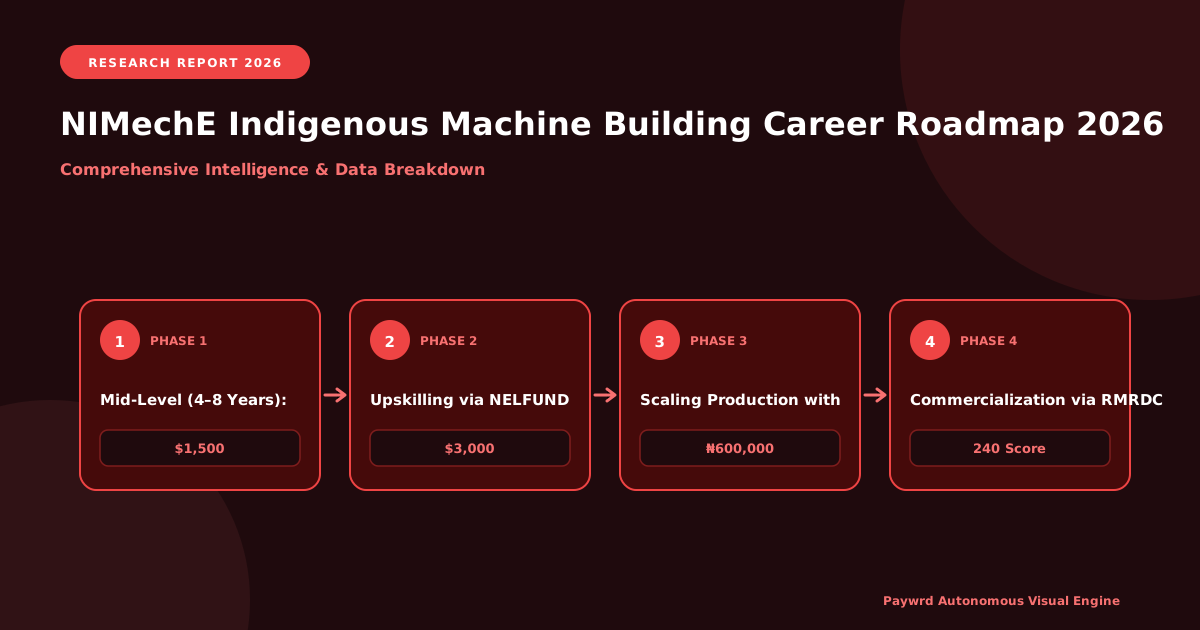
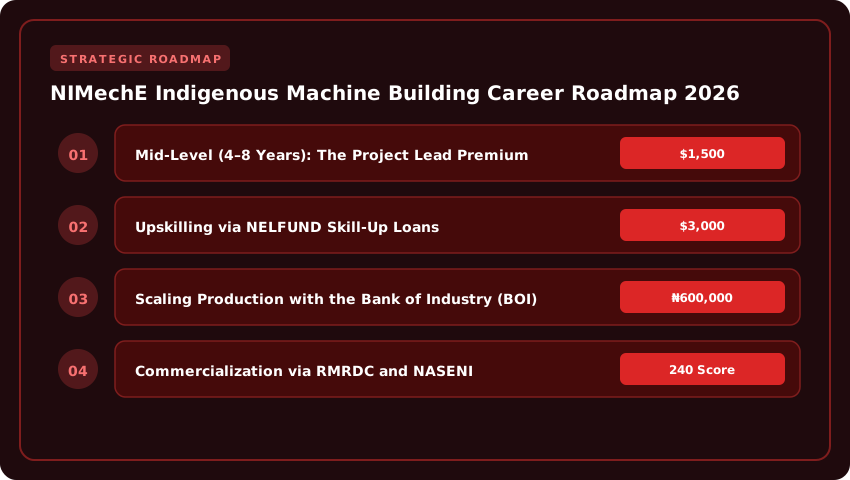
Mid-Level (4–8 Years): The Project Lead Premium
This is where the indigenous sector gets competitive. A Project Lead designing a 5-ton/hr cassava processing line or a modular gold ore crusher for a Zamfara cooperative earns ₦600,000 to ₦1.2 million monthly. The premium here is scope ownership. You own the mechanical design, vendor management for bought-out parts, fabrication supervision, and site commissioning. You are the “Chief Engineer” on a ₦150M–₦500M CAPEX project.
In the Oil & Gas service sector, a similar experience band (Senior Engineer/Team Lead) sits around ₦800,000 to ₦1.5 million, but the upside is capped by rigid grading systems. You hit the “Principal Engineer” ceiling fast unless you pivot to commercial management. The indigenous route offers equity-style upside—profit-sharing on successful plant replication is becoming a standard retention tool in 2026.
Senior Principal & Consultant Fees: The Asset Owner Economics
At the top end, the comparison shifts from salary to contract value. A Senior Principal/Consultant engaged for the full lifecycle—conceptual design, detailed engineering, fabrication oversight, and commissioning—of an indigenous plant (e.g., a modular refinery skid, a fertilizer blending plant, or a mineral processing hub) commands ₦2.5 million to ₦5 million+ per contract.
This isn’t a monthly retainer; it’s a milestone-based fee structure:
- Design Freeze (30%): ₦750k–₦1.5M
- Fabrication Supervision (40%): ₦1M–₦2M
- Commissioning & SAT Sign-off (30%): ₦750k–₦1.5M
Oil & Gas consultants at this level bill daily rates of $1,500–$3,000 (₦2.3M–₦4.6M/month at current rates), but engagement is sporadic and subject to IOC budget cycles. The indigenous machine building consultant builds a recurring revenue pipeline—design one successful maize mill, replicate it across 10 states. That scalability is the 2026 wealth vector.
Bottom line: Oil & Gas pays better cash flow early. Indigenous manufacturing builds better asset equity and professional autonomy mid-to-late career. Choose based on your risk appetite and whether you want to manage interfaces or own outcomes.
High-Growth Sectors: NADDC Automotive, Agro-Processing & Solid Minerals Machinery
If you are positioning for the 2026–2027 project pipeline, stop chasing generic “oil and gas” maintenance roles. The federal budget votes and policy directives are screaming three specific sectors where indigenous machine building capacity is not just preferred—it is a statutory requirement. Understanding the technical specs behind these policies is how you move from job seeker to project lead.
NADDC Automotive: Beyond Assembly to Component Machining
The National Automotive Industry Development Plan (NAIDP) enforcement under the National Automotive Design and Development Council (NADDC) has shifted gears. The 2026 focus isn’t just Semi-Knocked Down (SKD) assembly; the local content quotas now demand verified Nigerian fabrication of chassis components, body panel stamping dies, and precision-machined engine ancillaries (brackets, housings, transmission shafts). Companies like Innoson, Nord, and the new OEM partners in the Lagos and Kano automotive clusters are actively hunting Mechanical Engineers with Divisional Specialist registration in Production/Manufacturing to sign off on Process Failure Mode Effects Analysis (PFMEA) for these lines. If your portfolio lacks CNC programming for automotive-grade steel (AHSS/DP600) or fixture design for robotic welding cells, you are invisible to this ₦500B+ annual procurement window.
Agro-Processing: Designing for the Staple Crop Value Chain
Federal and State agro-allied programs—driven by the Bank of Agriculture (BoA) and CBN Anchor Borrowers’ off-taker guarantees—are capitalizing Cassava, Yam, Palm Oil, and Rice value chains. This translates directly into demand for complete processing lines designed for Nigerian feedstock variability. We are talking:
- Cassava/Yam: Automated peeling/washing lines (5–10 TPH), continuous hydrocyclone starch extraction units, and flash dryers with energy recovery loops.
- Palm Oil: Sterilizer design optimization for smallholder clusters (FFB throughput 1–5 TPH), screw press efficiency upgrades, and kernel recovery clarification systems.
- Rice Milling: Parboiling vessels with uniform steam distribution, rubber roll huskers, and optical sorter integration for Grade 1 export specs.
Engineers who can produce the P&IDs, structural calculations for seismic Zone 2 compliance, and HAZOP studies for these plants are writing their own tickets. The “local fabrication” clause in most 2026 intervention funds (like the Agro-Processing Productivity Enhancement and Livelihood Improvement Support – APPEALS) mandates 60% local machine content.
Solid Minerals: Crushing & Beneficiation for the Downstream Policy
The 2026 Solid Minerals Downstream Policy is the sleeper hit. The Ministry of Solid Minerals Development is enforcing the “mine-to-market” ban on raw ore export. This creates an immediate, massive demand for fabricated comminution and beneficiation equipment: Jaw/Cone crushers (handling lateritic/oxide ores), Ball/Rod mills with variable frequency drives (VFDs), Spiral classifiers, Magnetic separators, and Flotation cells. Critically, the policy incentivizes modular, skid-mounted plants for artisanal cluster formalization. Mechanical Engineers with Mineral Processing Machinery specialization who can design for high abrasion indices (using Hardox/AR500 wear liners) and dust suppression (NFPA 652 compliance) are currently naming their fees. COREN registration is non-negotiable here—insurers and the Mines Inspectorate Department (MID) require a stamped Mechanical Completion Certificate before plant commissioning.
Funding Prototypes & SMEs: NELFUND, BOI & Raw Materials Research Grants
Transitioning from a theoretical design to a functional, industrial-grade machine requires significant capital. In 2026, the Nigerian funding landscape for indigenous machine building has shifted toward targeted interventions that reward technical viability over mere business plans. For the NIMechE-certified engineer, the path to financing involves a strategic mix of educational loans, industrial credit, and research grants.
Upskilling via NELFUND Skill-Up Loans
Before scaling a prototype, your technical competency must be current. The Nigerian Education Loan Fund (NELFUND) has expanded its 2026 mandate beyond basic tuition to include “Skill-Up” loans. These are specifically designed for postgraduate specializations and high-end certifications. Engineers can now access low-interest funding for:
- Advanced CNC/CAD Certifications: Financing for professional mastery in SolidWorks, Autodesk Fusion 360, and Mastercam to reduce fabrication errors.
- M.Eng in Manufacturing Engineering: Full or partial tuition coverage for Master’s degrees at accredited Nigerian universities, provided the research focuses on indigenous machine development.
- Requirement: Applicants must provide a valid NIMechE membership ID and a letter of admission or certification enrollment from a NUC-approved institution.
Scaling Production with the Bank of Industry (BOI)
For those moving from a prototype to a Small or Medium Enterprise (SME), the Bank of Industry’s ₦100bn Intervention Fund for Indigenous Capital Equipment Fabrication is the primary vehicle for growth. Unlike commercial bank loans, this fund targets the “Import Substitution” goal of the 2026 national economic agenda.
To qualify, your SME must demonstrate the ability to fabricate machinery that replaces imported equivalents. Eligibility hinges on providing a detailed Technical Design Document signed off by a COREN-registered engineer and a clear market analysis showing the cost-advantage of your indigenous machine over foreign imports.
Commercialization via RMRDC and NASENI
The bridge between a laboratory prototype and a commercial product is often funded through the Raw Materials Research and Development Council (RMRDC) and the National Agency for Science and Engineering Infrastructure (NASENI). In 2026, the most effective route is the RMRDC Techno-Expo grant, which provides seed funding for prototypes that utilize local raw materials.
Furthermore, the NASENI collaboration framework allows engineers to utilize government-owned fabrication hubs. By partnering with NASENI, you can access high-precision tooling and testing facilities that would be prohibitively expensive for a startup, effectively lowering your CAPEX while accelerating the commercialization of reverse-engineered prototypes.
Building a 2026 Portfolio: Reverse Engineering, Competitions & Technical Publications
In the 2026 industrial landscape, a degree and a COREN license are your entry tickets, but a technical portfolio is your closing argument. For the indigenous machine builder, a portfolio must move beyond theoretical projects to “Proof of Fabrication.” Employers and private investors in Nigeria’s growing manufacturing hubs—from Agbara to Aba—now demand tangible evidence that you can translate a CAD model into a functional, locally sourced machine.
Documenting ‘As-Built’ Assets and FEA Reports
The gold standard for a 2026 portfolio is the “As-Built” documentation package. Rather than showing idealized renders, you must document the actual fabrication process of indigenous hardware, such as centrifugal pumps, industrial gearboxes, or agricultural dryers. Your portfolio should include:
- Detailed As-Built Drawings: Final technical drawings that reflect the actual dimensions and modifications made during the fabrication phase, not just the initial design.
- FEA Simulation Reports: Finite Element Analysis (FEA) reports that prove the structural integrity of your design. Showing a side-by-side comparison of simulated stress points versus actual wear-and-tear patterns on a fabricated prototype demonstrates a high level of engineering maturity.
- Bill of Materials (BOM): A comprehensive list of locally sourced components, proving your ability to navigate the Nigerian supply chain without relying on expensive imports.
Winning the NIMechE Innovation Circuit
Visibility in the Nigerian engineering ecosystem is accelerated by competitive validation. The NIMechE National Engineering Competition remains the premier stage for talent discovery. Specifically, targeting the Indigenous Machine Design & Innovation Challenge provides more than just a trophy; it offers a stamp of approval from the industry’s most senior Fellows. Winning or placing in this category signals to the market that your designs meet national safety and efficiency standards, making you a prime candidate for lead design roles in indigenous firms.
Technical Publications and Material Substitution
To transition from a technician to a thought leader, you must contribute to the body of Nigerian engineering knowledge. Publishing case studies in the NIMechE Journal or the Nigerian Journal of Technology (NJT) is critical. In 2026, the most valuable research focuses on Local Material Substitution. Documenting how you replaced a costly imported alloy with a locally available Nigerian steel grade—while maintaining the machine’s performance—proves you can reduce production costs, which is the primary pain point for Nigerian manufacturers. These publications serve as peer-reviewed evidence of your expertise, transforming your portfolio from a collection of projects into a professional body of work.
| Criteria | Graduate Member (GMIMechE) | Corporate Member (MIMechE) |
|---|---|---|
| Legal Authority | Entry-level / Trainee | Certified Design Sign-off |
| COREN Alignment | Registration in Progress | Fully Registered Engineer |
| Machine Building Role | Assistant Designer / Technician | Lead Project Engineer / Consultant |
| 2026/2027 Timeline | Immediate upon Graduation | Post-Professional Experience |
| Certification Power | Cannot certify prototypes | Authorized to certify fabrications |
| Salary Potential (NGN) | ₦150,000 – ₦350,000 / month | ₦600,000 – ₦1,500,000+ / month |
Frequently Asked Questions
What is the difference between GMIMechE and MIMechE for machine building in 2026?
In 2026, GMIMechE is an entry-level grade for graduates providing foundational training. Conversely, MIMechE (Corporate Member) status grants the legal authority to sign off on indigenous machine designs and fabrications. Only MIMechE members, aligned with COREN regulations, can lead commercialization projects for agro-processing or CNC fabrication lines in Nigeria.
How do I become a certified indigenous machine builder in Nigeria for 2027?
To certify machine building projects by 2027, you must transition from Graduate Member to Corporate Member (MIMechE). This requires documented professional experience, passing the COREN registration examinations, and obtaining a Divisional Specialist registration. This pathway ensures you meet the legal bylaws required to certify industrial prototypes and modular refineries.
Can a Graduate Member (GMIMechE) legally sign off on engineering designs in 2026?
No, a Graduate Member (GMIMechE) cannot legally sign off on engineering designs or fabrications in 2026. Under NIMechE and COREN bylaws, only Corporate Members (MIMechE) possess the professional standing to certify technical drawings and commercialize indigenous machinery. GMIMechE members must work under the supervision of a registered Corporate Member.
What are the salary expectations for MIMechE certified machine builders in 2026?
Certified MIMechE professionals specializing in indigenous machine building command premium salaries in 2026, typically ranging from ₦600,000 to over ₦1,500,000 monthly. This higher bracket reflects their legal authority to lead high-value projects, such as modular refinery construction and industrial CNC line implementation, which require certified professional sign-offs.
Which NIMechE designation is required for agro-processing equipment fabrication in 2026?
For the fabrication and commercialization of agro-processing equipment in 2026, the Corporate Member (MIMechE) grade is mandatory. This designation, paired with a relevant Divisional Specialist registration, allows the engineer to legally validate the safety, efficiency, and regulatory compliance of the machinery under current Nigerian engineering standards.
Strategic Final Takeaway
When evaluating NIMechE Indigenous Machine Building Engineering Career Roadmap Nigeria in 2026 and beyond, base your decisions on accredited institutional standards, verified return on investment (ROI), and up-to-date official guidelines. Always verify specific dates and requirements through official regulatory portals.