
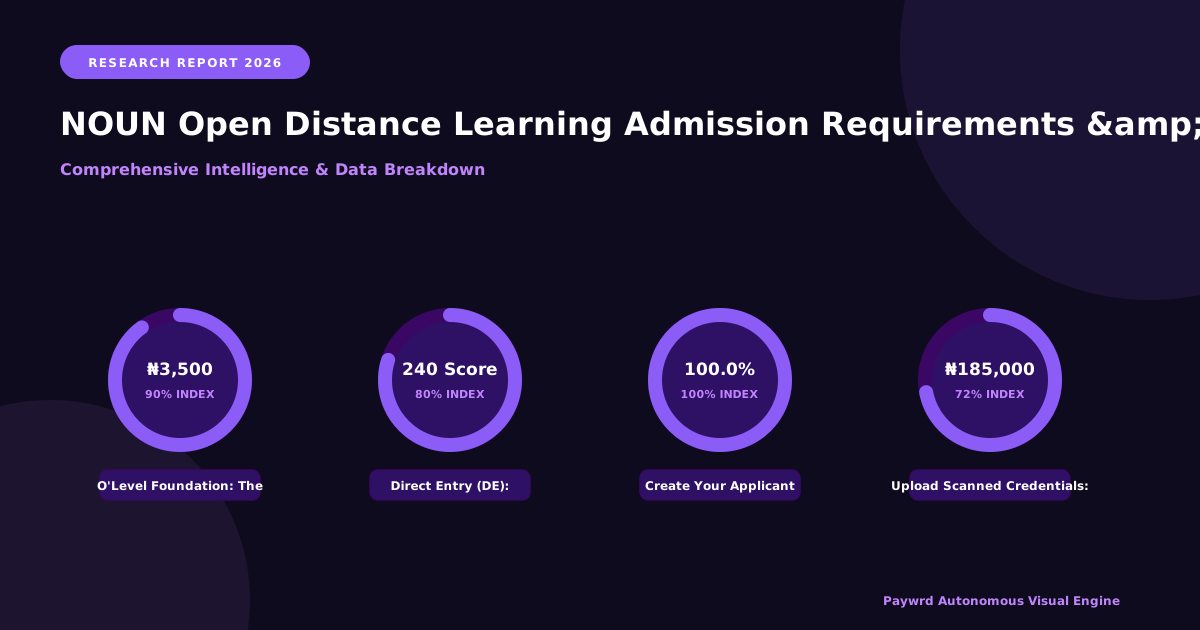
2026 NOUN ODL Entry Requirements: O’Level, JAMB & Direct Entry Breakdown
O’Level Foundation: The Non-Negotiable Baseline
Every programme under the National Open University of Nigeria (NOUN) demands a minimum of five (5) credit passes at not more than two sittings in WAEC, NECO, or NABTEB. English Language and Mathematics are compulsory across all faculties—no exceptions. Under the current NUC CCMAS framework, “Awaiting Results” candidates can register but must upload verified certificates before the matriculation deadline, typically March 2027. Combining WAEC and NECO is accepted; combining WAEC/NECO with NABTEB is accepted only for relevant vocational programmes. Verify your specific subject combinations (e.g., Physics/Chemistry/Biology for Sciences; Government/Literature for Arts) on the NOUN admission portal before purchasing the application form.

JAMB UTME: The 2026/2027 Threshold & Profile Protocol
For 100-Level entry, you must sit the 2026 UTME. The general institutional cut-off mark remains 140, but competitive programmes—Law, Nursing, and Mass Communication—often require 180–200+ to clear departmental screening. Crucially, you must create a JAMB Profile Code (send NIN [Your 11-digit NIN] to 55019 or 66019) and purchase the ₦3,500 e-PIN before starting the NOUN application. NOUN does not conduct a separate Post-UTME exam; admission is processed via JAMB CAPS. Ensure you accept the admission offer on CAPS within 72 hours of notification, or the slot reverts to the next candidate.
Direct Entry (DE): NCE, OND, HND & Degree Holders
DE candidates bypass UTME but must still register on JAMB CAPS (₦3,500 DE e-PIN) to regularize admission. Acceptable qualifications for 200/300 Level entry include:

- NCE: Minimum Merit pass (Credit preferred for Education programmes).
- OND/ND: Minimum Lower Credit (CGPA 2.50/4.00) from NBTE-accredited institutions.
- HND: Minimum Lower Credit for 300 Level entry; Upper Credit may attract advanced standing.
- Bachelor’s Degree: Third Class minimum for unrelated disciplines; Second Class Lower for related fields.
All DE transcripts must be forwarded directly to the NOUN Registrar from the awarding institution.
Programme-Specific Prerequisites (Law, Nursing, Education, Management)
- Law (LL.B): Requires 5 Credits including English, Literature-in-English, and Mathematics at one sitting. UTME subjects: English, Literature, Government/History, CRS/IRS. JAMB score realistically needs 220+ for merit consideration.
- Nursing Science (B.NSc): Requires 5 Credits at one sitting (English, Maths, Physics, Chemistry, Biology). Must hold a valid Registered Nurse (RN) certificate from NMCN for the Top-Up programme; Generic B.NSc requires 200+ UTME.
- Education Programmes: NCE holders get 200 Level entry. UTME candidates need credits in English, Maths, and two relevant teaching subjects.
- Management Sciences (Admin, Accounting, Public Admin): Requires Economics credit at O’Level. DE candidates with ICAN/ACCA/ACIB partial qualifications receive course exemptions upon verification.
Cross-check every requirement against the NUC CCMAS Benchmark Minimum Academic Standards PDF for your specific programme code before paying the ₦18,000 application processing fee.
Step-by-Step NOUN Admission Portal Registration Walkthrough (2026 Cycle)
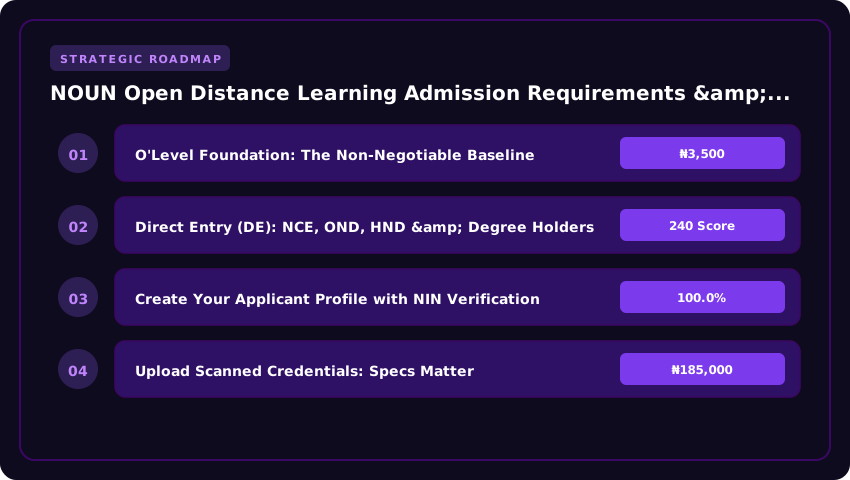
The NOUN admission portal at admissions.nou.edu.ng is the single gateway for the 2026/2027 academic session. There are no paper forms and no third-party agents. If you miss a step here, your application does not exist. Follow this exact click-path to avoid the common “RRR mismatch” and “NIN verification failed” errors that stall thousands of applicants every cycle.
1. Create Your Applicant Profile with NIN Verification
Land on the homepage and click “Apply for Admission” followed by “Undergraduate” (or PG/PhD if applicable). The system immediately demands your National Identification Number (NIN). Enter the 11-digit number exactly as it appears on your NIMC slip or digital ID app. The portal queries the NIMC database in real-time; if your name, date of birth, or phone number on the NIN record differs from what you intend to use, the verification fails. Fix discrepancies at an NIMC enrollment centre before you start. Once verified, the system auto-populates your biodata. Set a secure password and a functional email address—this becomes your login for the entire cycle.
2. Generate and Pay the ₦18,000 Application Fee via Remita
After saving your profile, navigate to the “Payment” tab on your dashboard. Select “Remita” as the payment gateway. The portal generates a unique Remita Retrieval Reference (RRR) code—copy this code; do not close the tab. You have three payment channels:
- Bank Branch: Walk into any commercial bank (Access, Zenith, UBA, First Bank, etc.), present the RRR, and pay ₦18,000 cash or transfer. Collect the bank receipt with the RRR printed on it.
- Card/USSD/Internet Banking: Click “Pay with Card” or “Pay via USSD” on the Remita popup. Use a card enabled for international/online transactions or dial the USSD code displayed (usually 737 or 901 depending on bank) to authorize the debit.
- Remita Mobile App: Log in, select “Pay FGN/State TSA,” paste the RRR, and confirm.
Critical: The portal does not auto-refresh payment status instantly. Wait 10–15 minutes after a successful bank alert, then click “Verify Payment” on your NOUN dashboard. If it stays “Pending” after 24 hours, do not pay again. Raise a ticket via the “Support” link with your RRR and bank teller screenshot.
3. Upload Scanned Credentials: Specs Matter
With payment verified, the “Upload Documents” tab unlocks. NOUN rejects files that exceed size limits or use wrong formats. Prepare these before you start:
- O’Level Result(s): WAEC/NECO/NABTEB scratch card printout or PDF (Max 500KB, JPEG/PDF). If using two sittings, merge into one PDF.
- JAMB Admission Letter/Result Slip: The 2026 UTME/DE slip showing your profile code and score (Max 500KB).
- Birth Certificate / Age Declaration: NPC certificate or sworn affidavit (Max 300KB).
- Passport Photograph: White background, recent, 35x45mm (Max 50KB, JPEG only).
- Local Government Identification: Indigene letter (Max 300KB).
Upload each file to its specific slot. Do not upload a JAMB slip into the O’Level slot—the validator checks metadata. Click “Save & Continue” after each successful upload.
4. Submit Application and Print Acknowledgement Slip
Review the “Preview” page meticulously. Check spelling of names, programme choice (e.g., B.Sc. Computer Science vs B.Sc. Information Technology), and study centre selection. Once submitted, the application locks—edits require a support ticket. Click “Submit Application”. The final screen generates your Acknowledgement Slip containing your Application ID, RRR, Programme, and Study Centre. Print two copies immediately (Colour or B/W). One copy is mandatory for the physical screening exercise at your study centre; the other is your personal record. Without this slip, you are not a candidate for the 2026 cycle.
Understanding NOUN Matriculation Numbers & Student Portal Activation
Securing an admission offer is only the first milestone; the transition to an active student begins with the issuance of your matriculation number. For the 2026/2027 academic session, NOUN typically releases matriculation lists in batches via the official university website and through direct SMS notifications to the phone number provided during your application. If you have completed your payment and documentation but haven’t seen your number, check the “Admission Status” tab on the portal regularly, as lists are updated dynamically.
Activating Your Digital Campus: The iLearn LMS
Your matriculation number serves as your primary identity across all university systems. To access your course materials, you must activate the iLearn (Learning Management System) portal. The process is straightforward but requires precision:
- Login Credentials: Your default username is your matriculation number.
- Password Reset: For security, NOUN requires a mandatory password reset upon first login. Use the “Forgot Password” or “Reset Password” link to sync your account with your registered email address.
- Course Enrollment: Once inside iLearn, ensure your registered courses for the current semester are visible. If the dashboard is empty, it usually indicates a pending synchronization between the registry and the LMS.
NELFUND Integration & Financial Aid
With the 2026 expansion of the Nigerian Education Loan Fund (NELFUND), your matriculation number is now the critical link for funding. To successfully apply for a student loan, your matriculation status must be “Active” and verified on the NOUN database. NELFUND’s API cross-references your details with the university’s registry; if your matriculation number is not yet synced, your loan application will be flagged as “Unable to Verify Student Status.” Ensure your portal profile is 100% complete before initiating the loan request.
Troubleshooting ‘Invalid Matric Number’ Errors
A common frustration during course registration is the “Invalid Matric Number” error. This typically occurs for three reasons:
- Payment Lag: Your acceptance fee or tuition payment has not yet reflected in the bursary system.
- Data Mismatch: A typo in your name or date of birth during the initial application is causing a verification failure.
- Session Update: The portal is undergoing a session rollover for the 2026/2027 calendar.
If this persists for more than 48 hours after payment, you must lodge a ticket via the NOUN support desk or visit your nearest Study Centre with your payment receipts to manually trigger a profile synchronization.
NOUN Study Centre Selection: 2026 Accredited Locations & Facilitation Schedules
Choosing the right Study Centre is the most critical logistical decision a NOUN student makes. While the National Open University of Nigeria operates on an Open Distance Learning (ODL) model, your Study Centre serves as your administrative hub, your primary examination venue, and your point of contact for physical facilitation. For the 2026/2027 academic session, NOUN has expanded its footprint to over 100 accredited Study Centres spanning all 36 states and the FCT, ensuring that no learner is too far from a designated academic support point.
Understanding Centre Types: Community vs. Special Centres
Not all centres operate under the same administrative framework. Depending on your status, you will be assigned to one of two categories:
- Community Study Centres: These are the standard hubs open to the general public. They are strategically located in urban and semi-urban areas to provide library access, ICT support, and physical classrooms for facilitation.
- Special Study Centres: These are specialized hubs tailored for specific populations, including Nigerian Correctional Service facilities (Prisons) and Military barracks. These centres have modified schedules and security protocols to accommodate the unique needs of their learners.
2026 Facilitation Schedules: Physical vs. Virtual
In 2026, NOUN has fully integrated a hybrid facilitation model to reduce the cost of commuting for students. Your facilitation timetable is accessible via the student portal under the “Course Material/Facilitation” tab. You can expect two primary modes of interaction:
- Physical Sessions: These are face-to-face tutorials held at your chosen centre. These are highly recommended for complex courses requiring practical demonstrations or intensive group discussions.
- Virtual Sessions: Utilizing Zoom and Google Meet, these live webinars allow you to interact with facilitators in real-time from any location. Ensure you have a stable data connection and a registered NOUN student email to join these sessions.
How to Request a Study Centre Transfer
Life happens—you may relocate for work or marriage, or find a centre closer to your home. To avoid the stress of traveling long distances for exams, you can request a transfer via the official NOUN portal. Follow these steps:
- Log into your student portal using your matriculation number and password.
- Navigate to the “Student Services” menu and select “Study Centre Transfer.”
- Select your desired new centre from the 2026 accredited list.
- Upload a formal application letter and pay the prescribed transfer fee (refer to the current 2026 fee schedule on the portal).
- Wait for administrative approval before attempting to register for courses at the new location.
Cost Breakdown: NOUN Tuition, Exam Fees & Hidden Charges for 2026/2027
Budgeting for a degree at the National Open University of Nigeria (NOUN) requires a shift in mindset from traditional universities. Instead of a flat annual tuition fee, NOUN operates on a course-unit system. This means your total expenditure per semester depends directly on the number of credits you register for, allowing you to scale your education based on your financial capacity.
Tuition and Course Unit Costs
For the 2026/2027 academic session, the cost per unit remains tiered based on the level of study. It is critical to calculate your total units before attempting payment on the portal to avoid underpayment, which can lead to course registration errors.
- Undergraduate Programmes: ₦4,000 per course unit.
- Postgraduate Programmes: ₦6,000 per course unit.
- Exam Registration Fee: A mandatory ₦1,000 per course is charged during the examination registration window.
Compulsory Administrative & Hidden Charges
Beyond the base tuition, new and returning students must account for administrative overheads. These are often the “hidden” costs that catch students off guard during their first year.
- ID Card & Orientation: A one-time fee for new students to secure their official university identification and orientation materials.
- Project Supervision: Final year students (both UG and PG) must pay a dedicated supervision fee for their research projects; this is separate from regular course units.
- TMA & Exam Logistics: While Tutor-Marked Assignments (TMAs) are integrated, ensure your portal data is current to avoid lockout during the submission window.
Payment Schedule and Portal Verification
NOUN adheres to a strict semesterly registration deadline. Once the portal closes for the 2026/2027 session, late registration is typically penalized with a surcharge or, in extreme cases, the forfeiture of the semester’s credits.
To ensure your funds are correctly allocated, follow these verification steps:
- Payment Gateway: Use only the official NOUN portal integrated with Remita for all transactions.
- Verification: After payment, navigate to the “Payment History” tab on your student dashboard to confirm the status is marked as “Successful.”
- E-Receipts: Always download and save your e-receipts as PDFs. These documents are your only legal proof of payment during course registration disputes or when applying for NELFUND student loans.
Common 2026 Admission Pitfalls: Rejection Reasons & Appeal Process
Navigating the National Open University of Nigeria (NOUN) admission cycle in 2026 requires more than just meeting the cut-off marks; it requires technical precision. Many qualified candidates face rejection not due to academic failure, but because of “system-level” errors that trigger automatic disqualification during the screening process.
Top 5 Reasons for Disqualification in 2026
- Invalid JAMB Profile: Failing to link your JAMB registration number to the NOUN portal or using an outdated profile code. Even Direct Entry (DE) candidates must have a valid 2026 JAMB profile to be processed.
- O’Level Subject Mismatch: Uploading results that do not align with the NUC Core Curriculum and Minimum Academic Standards (CCMAS). For instance, applying for Computer Science without a credit in Mathematics is an instant trigger for rejection.
- Awaiting Results (AR) Limbo: While NOUN allows initial applications with “Awaiting Result,” failure to upload the final verified WAEC/NECO certificate before the 2026 deadline leads to automatic withdrawal of admission.
- Incorrect Combination: Selecting a course combination on the JAMB CAPS portal that differs from the choice made on the NOUN admission portal.
- Payment Discrepancies: Failure to complete the ₦3,500 JAMB e-PIN or the NOUN application fee, leaving the application in “Pending” status until the window closes.
JAMB CAPS vs. NOUN Portal: Resolving Discrepancies
A common source of anxiety in 2026 is the “Status Gap.” You may see “Admitted” on the NOUN portal but “Not Admitted” on the JAMB Central Admissions Processing System (CAPS). Remember: JAMB CAPS is the final authority. If the NOUN portal shows admission, you must log into your JAMB CAPS profile and manually “Accept” the offer. Until you click accept, your admission is not legally binding, and you cannot generate a registration number.
Appeal Process for Direct Entry (DE) Conversions
If your Direct Entry conversion was rejected due to a transcript error or a misinterpreted diploma grade, you must file a formal appeal. Submit a digital petition via the NOUN support ticket system and a physical copy to the nearest Study Centre. Attach your verified transcript and a screenshot of the rejection notification. Appeals for the 2026 session must be lodged within 14 working days of the rejection notice.
Re-application Strategy for 2027
If the 2026 window closes and your appeal is unsuccessful, do not panic. To secure a spot in 2027, focus on correcting your O’Level deficiencies now. Ensure your JAMB profile is updated and consider taking a remedial exam if your subject combination was the cause of rejection. Early registration for the 2027 cycle usually opens in late 2026; staying ahead of the portal rush is the best way to avoid technical glitches.
NOUN ODL vs Conventional Universities: 2026 Employability & NYSC Mobilization
A recurring concern for prospective students in 2026 is whether a degree from the National Open University of Nigeria (NOUN) carries the same weight as one from a conventional university. With the full implementation of the NUC’s Core Curriculum and Minimum Academic Standards (CCMAS), the gap has effectively closed. For the 2026 academic session, the vast majority of NOUN undergraduate programmes hold full NUC accreditation, ensuring that your certificate is recognized globally and locally.
NYSC Mobilization and the Age Factor
One of the biggest myths is that NOUN graduates are ineligible for the National Youth Service Corps (NYSC). In 2026, NOUN graduates remain fully eligible for mobilization, provided they meet the standard age requirements. However, because ODL attracts many mature students, those who graduate above the age of 30 are not mobilized for service. Instead, they must apply through the NYSC portal for an official Exclusion Letter. This document is critical, as it serves as the legal equivalent of a discharge certificate when applying for federal civil service roles or promotions within the Nigerian public sector.
Employer Perception: Public vs. Private Sector
The employability landscape in 2026 shows a distinct shift toward skill-based hiring. Our current data indicates:
- Private Sector: Tech firms, FinTechs, and multinational corporations in Lagos and Abuja now prioritize “competency over classroom.” They view NOUN graduates as self-disciplined and tech-savvy due to the rigors of the ODL model.
- Public Sector: Federal and State ministries fully accept NOUN degrees for entry-level roles and grade-level promotions, provided the programme is NUC-accredited.
Academic Progression: The Path to Masters and PhD
A NOUN degree is a valid passport to advanced studies. Alumni are eligible for admission into Postgraduate (PG) programmes both within NOUN and at other conventional universities. To secure admission into a Masters or PhD programme in 2026, NOUN graduates must provide:
- A verified degree certificate or statement of result.
- A minimum of a Second Class Lower (2:2) for most Masters programmes.
- Official transcripts sent directly from the NOUN Registrar to the receiving institution.
Ultimately, the ROI of a NOUN degree in 2026 lies in its flexibility. While conventional students are often delayed by industrial strikes, NOUN students adhere to a strict academic calendar, entering the job market or pursuing advanced degrees faster than their peers.
| Admission Category | O’Level Requirement | JAMB/Entry Mandate | Estimated Application Fee | 2026/2027 Timeline |
|---|---|---|---|---|
| UTME Candidates | 5 Credits (Max 2 Sittings) | Valid JAMB Profile Code | ₦3,500 (e-PIN) + Portal Fee | Open Q1 – Q3 2026 |
| Direct Entry (DE) | 5 Credits (Max 2 Sittings) | Mandatory JAMB Profile Code | ₦3,500 (e-PIN) + Portal Fee | Open Q1 – Q3 2026 |
| Post-Graduate | Relevant Degree/HND | Institutional Approval | Variable by Programme | Rolling Admissions 2026 |
Frequently Asked Questions
What are the NOUN admission requirements for the 2026/2027 session?
For the 2026/2027 session, NOUN requires a minimum of five credit passes in O'Level (WAEC, NECO, or NABTEB) obtained in no more than two sittings. English Language and Mathematics are compulsory for all programmes. Additionally, all applicants must possess a valid JAMB profile code to complete their portal registration.
Do Direct Entry candidates need a JAMB profile code for NOUN 2026 admission?
Yes, for the 2026 admission cycle, a JAMB profile code is a mandatory requirement for all applicants, including Direct Entry candidates. You must create a JAMB e-PIN (costing approximately ₦3,500) to generate the profile code required for successful registration on the NOUN ODL portal.
Can I apply for NOUN 2026 admission with awaiting results?
Under the current NUC CCMAS framework for 2026, candidates with awaiting results are permitted to begin the registration process on the NOUN portal. However, final admission is strictly contingent upon the submission and verification of the required five credit passes in not more than two sittings.
How many sittings are allowed for O'Level results at NOUN in 2026?
The National Open University of Nigeria (NOUN) maintains a strict policy for the 2026/2027 academic session allowing a maximum of two sittings to achieve the required five credit passes. Applications with three or more sittings are generally not accepted for undergraduate admission under current guidelines.
Strategic Final Takeaway
When evaluating NOUN Open Distance Learning Admission Requirements And Portal Registration Guide in 2026 and beyond, base your decisions on accredited institutional standards, verified return on investment (ROI), and up-to-date official guidelines. Always verify specific dates and requirements through official regulatory portals.

