Academic Pathways: Top Nigerian Universities for Renewable Energy
Entering the solar sector in 2026 requires more than just a passion for “green energy”; it requires a qualification recognized by the Council for the Regulation of Engineering in Nigeria (COREN). With the full implementation of the National Universities Commission (NUC) Core Curriculum and Minimum Academic Standards (CCMAS), degrees in Electrical and Electronics Engineering (EEE) have been restructured to integrate smart grid technology and photovoltaic (PV) systems directly into the undergraduate syllabus.

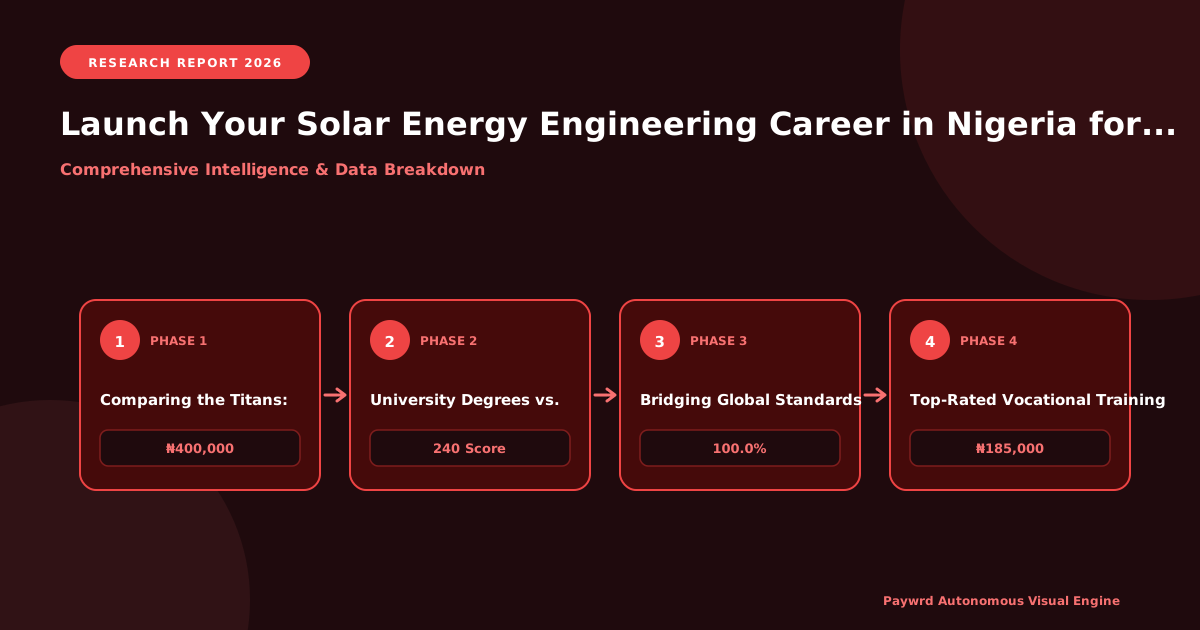
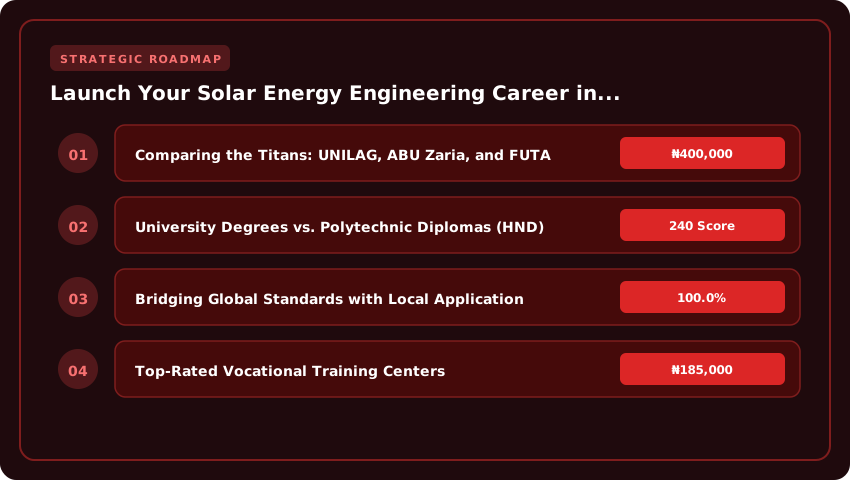
Comparing the Titans: UNILAG, ABU Zaria, and FUTA
Depending on your career goals—whether you aim for research, project management, or technical design—different institutions offer distinct advantages:
- Federal University of Technology Akure (FUTA): Widely regarded as the gold standard for technical depth. FUTA’s energy programs are heavily focused on hardware implementation and solar thermal systems, making graduates favorites for field engineering roles.
- University of Lagos (UNILAG): The ideal choice for those eyeing the corporate and financial side of energy. Given its proximity to Nigeria’s commercial hub, UNILAG offers superior networking opportunities with international energy firms and startups.
- Ahmadu Bello University (ABU) Zaria: A powerhouse for large-scale grid integration and rural electrification projects. ABU is particularly strong in adapting renewable energy solutions for the unique climatic conditions of Northern Nigeria.
University Degrees vs. Polytechnic Diplomas (HND)
A common dilemma for 2026 aspirants is choosing between a B.Eng and a National Diploma (ND/HND). The decision should be based on your intended role in the solar value chain:
- University Degree (B.Eng): Essential for those pursuing “Design Engineer” or “Consultant” roles. These paths focus on the physics of energy, system modeling, and high-level project architecture.
- Polytechnic Diploma (ND/HND): The fastest route to becoming a “Field Engineer” or “Installation Specialist.” Polytechnics prioritize the practical application of solar panel mounting, inverter wiring, and battery maintenance.
Regardless of the path, students should leverage the 2026 NELFUND portal to secure student loans, as the cost of specialized engineering equipment and software licenses has risen. Ensure your chosen institution is listed on the JAMB CAPS portal under the updated CCMAS guidelines to avoid pursuing an obsolete curriculum.
Professional Certifications and Vocational Mastery for 2026
A degree from an NUC CCMAS-compliant institution provides the theoretical foundation, but the 2026 Nigerian energy market demands proven technical competence. Employers are no longer hiring based on certificates alone; they are looking for “plug-and-play” engineers who can design, install, and troubleshoot complex solar PV systems without extensive on-the-job retraining.
Bridging Global Standards with Local Application
To command a premium salary in the current market, you must align your skills with the North American Board of Certified Energy Practitioners (NABCEP) standards. While NABCEP is a global benchmark, the 2026 Nigerian landscape requires a hybrid approach. You must integrate these international safety and design protocols with local realities, such as managing high-ambient temperature degradation and optimizing systems for the specific irradiance patterns of the Sahel and Coastal regions.
- NABCEP PV Installation Professional: The gold standard for verifying that your installation methods meet global safety and efficiency codes.
- Local Grid Integration: Mastery of Nigerian Electricity Regulatory Commission (NERC) guidelines for grid-tied and hybrid systems.
- Battery Storage Specialization: Advanced certification in Lithium-Iron Phosphate (LiFePO4) management, which has replaced lead-acid as the industry standard in 2026.
Top-Rated Vocational Training Centers
Theoretical knowledge fails the moment you step onto a roof. For hands-on mastery, focus on centers that offer simulated site environments and real-world project experience. Leading vocational hubs in Lagos, Abuja, and Port Harcourt now offer intensive “Bootcamp” certifications that focus on inverter configuration, cable sizing, and structural mounting. Look for centers that partner with tier-1 equipment manufacturers (like Victron, Huawei, or Sungrow) to ensure you are training on the hardware actually being deployed in Nigerian commercial projects.
The Mandate of COREN Registration
In 2026, practicing as a Solar Engineer without Council for the Regulation of Engineering in Nigeria (COREN) registration is a significant professional risk. COREN registration is not merely a formality; it is a legal requirement for signing off on large-scale industrial solar projects and securing government contracts. For graduates, the path involves completing the mandatory internship period and passing the professional interview. Without this license, you are limited to technician roles; with it, you transition into a Professional Engineer (Engr.) capable of leading consultancy firms and overseeing multi-million Naira energy transitions.
Rural Electrification: Turning UN-Backed Initiatives into Jobs
The narrative around solar energy in Nigeria has shifted decisively from “potential” to “procurement.” In 2026, the most tangible entry points for engineers aren’t in Lagos boardrooms but in the dusty transformer yards of underserved communities where the Rural Electrification Agency (REA) and development partners are deploying capital at scale. The United Nations Development Programme (UNDP) and the World Bank have consistently praised Nigeria’s Nigeria Electrification Project (NEP) and the Solar Power Naija initiative as continental benchmarks. For a graduate engineer, this international validation translates directly into structured project pipelines, standardized procurement processes, and—critically—paid roles managing Mini-Grid deployments across the North-Central, South-South, and North-East geopolitical zones.
Mini-Grid Development: Where the Engineering Jobs Live
Forget rooftop installations for high-net-worth individuals; the volume hiring in 2026 is happening in Mini-Grid development. The REA’s Performance-Based Grant (PBG) mechanism under NEP has unlocked over ₦45 billion in private sector investment since inception, with a fresh tranche targeting 250 new sites approved for the 2026/2027 fiscal cycle. Each site requires a resident Site Engineer, a Commissioning Lead, and an O&M (Operations & Maintenance) Supervisor. Companies like Havenhill Synergy, Rensource, and A4&T Power are actively recruiting COREN-registered engineers who understand IEC 60364-7-712 standards for PV systems and can navigate the Nigerian Electricity Regulatory Commission (NERC) Mini-Grid Regulations 2026. These aren’t volunteer gigs; entry-level Site Engineers command ₦250,000 – ₦350,000 monthly plus hardship allowances, while Project Leads earn upwards of ₦700,000.
Off-Grid Community Power: The Productive Use Angle
The UN’s Sustainable Energy for All (SEforALL) framework emphasizes “Productive Use of Energy” (PUE)—powering agro-processing, cold storage, and welding shops, not just light bulbs. This creates a niche for Energy-Agriculture Integration Specialists. In 2026, the Energizing Agriculture Programme (EAP), backed by the Global Energy Alliance for People and Planet (GEAPP), is piloting 50 sites where solar engineers design systems sized for three-phase motor loads. If you can size a 50kWp hybrid system to run a cassava grater and a cold room simultaneously while optimizing battery Depth of Discharge (DoD) for lithium-ion banks, you are immediately employable by the implementing partners managing these grants.
Pitching to NGOs and Government Agencies: A Practical Playbook
You don’t wait for a LinkedIn notification. In the Nigerian development sector, access comes through Expression of Interest (EOI) portals and accredited vendor lists. Here is how to position yourself or your firm in 2026:
- Register on the REA Vendor Portal: The REA maintains a pre-qualified list for EPC contractors. Ensure your company (or the firm you work for) has a valid Bureau of Public Procurement (BPP) Certificate and COREN Engineering Practice License. Without these, your bid is disqualified at the technical evaluation stage.
- Track UNDP/UNOPS Procurement Notices: Monitor ungm.org and the UN Nigeria procurement page for “Individual Contractor (IC)” and “Institutional Contract” notices. Keywords: “Solar PV Technical Specialist,” “Mini-Grid Tariff Modelling,” “Environmental and Social Safeguards (ESS) Compliance.”
- Leverage the NELFUND/GEEP Nexus: The Nigeria Education Loan Fund (NELFUND) now supports skills acquisition loans. Pitch a “Solar Mini-Grid Technician” upskilling proposal to your state’s Government Enterprise and Empowerment Programme (GEEP) desk; they often fund toolkits (multimeters, clamp meters, insulation testers) for youth cooperatives bidding on community O&M contracts.
- Master the “Bankable” Feasibility Study: NGOs like GIZ (NESP) and USAID (Power Africa) fund the studies before the steel. Learn HOMER Pro or PV*SOL to a professional certification level. Submitting a bankable load profile and financial model (LCOE, IRR, DSCR) for a specific community makes you indispensable to the Project Development Unit.
The UN backing isn’t just prestige; it de-risks the revenue stream. When the World Bank provides a Partial Risk Guarantee for a Mini-Grid, the developer gets paid. That certainty is why serious engineers are moving to Makurdi, Gombe, and Ogoja in 2026. The grid won’t reach these places for a decade. Your career starts where the grid ends.
2026 Salary Guide: Earning Potential for Solar Professionals
Let’s talk numbers. In Nigeria’s 2026 energy market, a solar qualification is not just a certificate—it is a revenue-generating asset. Whether you are negotiating a corporate role or quoting a residential installation in Lekki or Garki, knowing the current benchmarks prevents you from leaving money on the table. The figures below reflect real-time market data from major recruitment platforms (LinkedIn Nigeria, Jobberman, MyJobMag) and industry surveys conducted by the Renewable Energy Association of Nigeria (REAN) in Q1 2026.
Corporate Engineering Roles: Monthly Gross Salaries (₦)
Structured employment offers stability, HMO, and pension contributions, but the ceiling is defined by your grade level and the company’s capitalization. International EPC contractors and major Discos/GenCos pay a premium over local integrators.
- Entry-Level (Graduate Engineer / NYSC / 0–2 Years Exp): ₦180,000 – ₦350,000. NYSC corps members in top EPC firms (e.g., Sterling & Wilson, SkipperSeil) typically earn ₦150k–₦250k plus allowance. Confirmed juniors with COREN registration in view start at ₦250k.
- Mid-Level (Project Engineer / Design Engineer / 3–5 Years Exp): ₦450,000 – ₦850,000. This bracket requires proven proficiency in PVsyst, AutoCAD, and ETAP, plus site commissioning experience.
- Senior / Lead Engineer (6+ Years Exp / COREN Registered): ₦1,000,000 – ₦2,200,000+. Roles involving bankable feasibility studies for mini-grids (World Bank/AfDB funded) or managing utility-scale portfolios command the upper tier.
Independent Certified Installers: Project-Based Income
For the entrepreneur, income scales with reputation and certification tier (NABCEP equivalent or REAN/SESN certification). You are not paid a salary; you are paid per kilowatt-peak (kWp) installed or per contract margin.
- Residential Retrofits (3kVA – 10kVA Systems): Net margin typically ₦150,000 – ₦400,000 per project after hardware costs. A certified team closing 4–6 jobs monthly clears ₦600k–₦2.4M gross revenue.
- Commercial & Industrial (C&I) Rooftop (50kWp – 500kWp): Margins range ₦1.5M – ₦15M+ per contract. These require COREN sign-off and bankable performance guarantees.
- Recurring Revenue (O&M Contracts): Smart installers lock in ₦50k–₦200k/month per client for preventive maintenance and remote monitoring via VRM/Growatt/ShinePhone portals.
Key Pay Multipliers: Location & Certification
Your postcode and your paperwork dictate your rate card.
- Lagos / Abuja / Port Harcourt Premium: Expect a 25–40% salary uplift over Ibadan, Kaduna, or Enugu for identical roles. Cost of living and density of C&I demand drive this. Remote site allowances for Northern mini-grid projects (e.g., NEP/RES projects) add ₦100k–₦300k/month hazard/remote posting allowances.
- COREN Registration vs. Graduate Member: A registered Engineer (R.Eng) legally signs off designs for NERC permits and bank loans. This single credential adds ₦150k–₦400k/month to a corporate offer and is mandatory for bidding on Federal Government/REA contracts.
- Specialized Software & Storage Certs: Certified PVsyst Expert, Tesla Powerwall Certified Installer, or Victron Energy Certified Professional badges justify 15–20% premium quotes in the private residential market.
Bottom line: In 2026, an uncertified installer is a technician; a COREN-registered engineer with storage expertise is a partner. Negotiate accordingly.
Strategic Entry Points: From Internships to Entrepreneurship
The classroom gets you the certificate, but the site gets you the contract. In Nigeria’s 2026 solar market, employers—from EPC contractors to Discos diversifying into distributed generation—are scanning for verified field hours, not just CGPA scores. Your transition strategy must be deliberate: target the right firms, fund the right upskilling, and document every kilowatt you commission.
Top 10 Solar Firms Actively Recruiting in West Africa (2026)
These companies have active graduate trainee programs, NYSC slots, or direct entry-level engineering roles listed on their career portals or LinkedIn as of Q2 2026. Tailor your CV to their specific tech stack (e.g., Victron, SMA, Huawei, Growatt).
- Arnergy Solar: Heavy on commercial & industrial (C&I) hybrid systems; look for “Junior Design Engineer” roles.
- Rensource Energy: Scaling “Power-as-a-Service” for markets and clusters; high demand for O&M technicians.
- Daystar Power (Shell Group): Enterprise-scale projects; prioritize candidates with PV*SOL or Helioscope proficiency.
- Starsight Energy: C&I focus across Nigeria and Ghana; strong graduate analyst program.
- Green Village Electric (GVE) Projects: Mini-grid developers; need site engineers willing to deploy to rural clusters.
- Salpha Energy: Pay-as-you-go (PAYG) home systems; sales-engineering hybrid roles are common entry points.
- Auxano Solar: Indigenous manufacturing + EPC; values hands-on assembly line experience.
- Blue Camel Energy: Strong in solar irrigation and cold storage; agricultural energy niche.
- Wattcore Energy: Fast-growing EPC arm; looks for NYSC members with COREN provisional registration.
- Kensington Power: Utility-scale and metro-grid tie-ins; requires strong AutoCAD ETAP skills.
Leveraging NELFUND for Specialized Renewable Energy Training
Many graduates miss this: the Nigerian Education Loan Fund (NELFUND) isn’t just for tuition anymore. Under the 2026 Act amendments operationalized in 2026, the fund covers “skill-up” certifications at accredited institutions. If your university degree is theoretical, use a NELFUND loan (up to ₦500,000 per session for skills programs) to finance a 3-month intensive at places like the National Power Training Institute of Nigeria (NAPTIN) Regional Centres (Abuja, Lagos, Kaduna) or the Renewable Energy Academy (REA) in Ibadan. Target courses like “Advanced PV System Design (PV*SOL/PVsyst),” “Battery Energy Storage Systems (BESS) Commissioning,” or “Mini-Grid Project Finance.” Keep your admission letter and fee schedule ready for the NELFUND portal application.
Building a Bankable Portfolio: From Rooftops to Solar Farms
Don’t wait for a job to start engineering. In 2026, a GitHub repo of simulation files beats a generic cover letter. Start small, document rigorously:
- Tier 1 – Residential (3–5 kWp): Volunteer to design/install for a family member or NYSC host community. Capture: Single-line diagrams (SLD), shading analysis reports (SunEye or SketchUp), COC (Certificate of Compliance) photos, and client testimonial videos. Cost: ~₦1.5M–₦2.5M (self-funded or crowdfunded).
- Tier 2 – Commercial (20–50 kWp): Pitch a “Zero-Capex” PPA model to a local bakery, pharmacy, or petrol station. Use your NAPTIN certification to sign off the design. Document the Performance Ratio (PR) over 90 days—this is gold for EPC interviews.
- Tier 3 – Industrial/Mini-Grid (100 kWp+): Partner with a licensed mini-grid developer (like GVE or Havenhill) as a Junior Site Engineer. Your portfolio entry here is a commissioning report signed off by a COREN-registered engineer, showing SCADA integration and grid-forming inverter settings.
Final tip: Register your portfolio as a Business Name (BN) with CAC (₦10,000–₦15,000 via agents) before you hit Tier 2. It signals to employers—and future clients—that you treat engineering as a business, not a hobby. That mindset shift is what separates a ₦150k/month technician from a ₦5M/project contractor in 2026.
| Decision Criteria | University B.Eng (EEE – Renewable Energy Option) | Polytechnic HND (Electrical/Electronic – Solar/PV Specialization) | Professional Certification Route (COREN + REAN) |
|---|---|---|---|
| Program Duration (2026 Entry) | 5 Years (10 Semesters) | 4 Years (ND 2yrs + HND 2yrs + 1yr IT) | 18–24 Months post-NYSC |
| Estimated Total Tuition (2026–2030) | ₦2,500,000 – ₦6,000,000 (Public vs Private) | ₦600,000 – ₦1,500,000 | ₦400,000 – ₦900,000 (Exams + Workshops) |
| JAMB UTME Cutoff (2026 Cycle) | 220–260 (Federal); 180–200 (State/Private) | 150–180 (ND Entry) | N/A (Requires B.Eng/HND + NYSC) |
| CCMAS / NBTE Curriculum Focus | Smart Grid, PV System Design, Energy Storage, AI in Energy | PV Installation, Inverter Tech, Maintenance, Site Survey | Grid Code Compliance, Mini-Grid Design, Project Finance |
| COREN Registration Eligibility | Direct (Graduate Engineer) | Technologist Grade (Upgradeable to Engineer via PGD) | Engineer/Technologist (Based on Base Qualification) |
| Mandatory Industrial Training (SIWES/IT) | 6 Months (300/400 Level) | 1 Year (Post-ND) + 6 Months (HND) | Logbook Verification (4 Years Post-Grad) |
| Average Entry Salary (2026 Market) | ₦250,000 – ₦450,000/month (Graduate Trainee) | ₦150,000 – ₦280,000/month (Technologist) | ₦400,000 – ₦700,000/month (Certified Project Eng.) |
| 2027+ Career Ceiling | Project Manager, Design Engineer, Policy Analyst | Site Supervisor, O&M Lead, Technical Trainer | Independent Consultant, EPC Contractor, REAN Executive |
Frequently Asked Questions
Which Nigerian universities offer NUC CCMAS-accredited Renewable Energy Engineering degrees for 2026 admission?
For 2026 admission, Federal University of Technology Akure (FUTA), University of Nigeria Nsukka (UNN), and Federal University of Petroleum Resources Effurun (FUPRE) offer NUC CCMAS-compliant B.Eng programmes with dedicated Renewable Energy/Solar options. Verify 2026 JAMB brochure for updated accreditation status before applying.
What is the minimum JAMB score required for Solar Energy Engineering in Nigerian universities for the 2026/2027 session?
The 2026/2027 JAMB cutoff for Electrical/Electronics Engineering with Renewable Energy bias ranges from 220 at competitive federal universities (FUTA, UNN) to 180 at state universities. Private institutions like Afe Babalola or Covenant may accept 190–200 with strong O’Level results.
How much does a complete Solar PV installation certification cost in Nigeria for 2026?
A full REAN/COREN-recognized Solar PV certification pathway (NABCEP-aligned training + COREN exam fees + logbook processing) costs ₦450,000–₦850,000 in 2026. This covers 3-month intensive training, practical assessments, and the mandatory professional practice examination for licensure.
Can a Polytechnic HND holder register as a Professional Engineer with COREN in 2026?
No. In 2026, HND holders register as Engineering Technologists with COREN. To upgrade to Professional Engineer (PEng), you must complete a Postgraduate Diploma (PGD) in Engineering (18 months) or a Master’s degree (M.Eng), followed by 4 years supervised practice and the Professional Competence Examination.
What are the 2026 salary benchmarks for entry-level Solar Engineers in Nigeria’s private sector?
In 2026, entry-level Solar Design Engineers earn ₦250,000–₦400,000 monthly at EPC firms (Daystar, Arnergy, Rensource). Field Installation Engineers start at ₦180,000–₦280,000. COREN-licensed engineers with 2+ years experience command ₦500,000–₦800,000 in project lead roles.
Strategic Final Takeaway
When evaluating How To Start A Career In Solar Energy Engineering In Nigeria in 2026 and beyond, base your decisions on accredited institutional standards, verified return on investment (ROI), and up-to-date official guidelines. Always verify specific dates and requirements through official regulatory portals.