
2026 State-by-State Eligibility Matrix for Fast-Track Licensure
Navigating the patchwork of state regulations remains the single biggest friction point for career switchers targeting the 2026–2027 academic year. While the interstate NASDTEC Compact facilitates mobility for fully licensed teachers, initial alternative route acceptance is strictly governed by individual State Education Agencies (SEAs). Below is the decision matrix you need to cross-reference against your transcript and timeline.

Reciprocity & Online Provider Acceptance (2026–2027)
Do not assume national accreditation (CAEP or AAQEP) guarantees state approval. For the upcoming cycle, Texas, Florida, Arizona, Nevada, and Colorado maintain the most expansive lists of approved fully online providers (e.g., iTeach, Teachers of Tomorrow, American Board). Conversely, New York, California, Massachusetts, and Maryland generally require a supervised clinical placement component that many purely asynchronous programs cannot satisfy without a local district partnership. Always check the SEA’s “Approved Educator Preparation Programs” list updated for July 1, 2026 effective dates.
Bachelor’s Degree GPA Minimums & Content Exam Prerequisites
- 2.50 Floor: The majority baseline (TX, FL, GA, NC, VA, WA).
- 2.75–3.00 Floor: PA, IL, OH, MI, NJ often enforce a 2.75 or 3.0 cumulative GPA for alternative routes, though some allow a “GPA waiver” via a master’s degree or 5+ years of relevant work experience.
- Content Exams (Praxis/NES/State-Specific): 2026 policy shift: 14 states now require passing the subject-area exam before program entry (Pre-Admission Content Test – PACT model), including Texas (TX PACT), Florida (FTCE Subject Area), and Arizona (AEPA/NES). Plan 8–12 weeks for study and score reporting.
Provisional vs. Standard License Timelines for Career Switchers
The “Fast-Track” label usually refers to the Provisional/Intern/Resident Certificate valid for one academic year (renewable 1–2 times). Here is the realistic timeline to a Standard Professional License:
- Texas (Intern Cert): 1 year teaching + program completion + PPR exam → Standard. Total: ~14 months.
- Florida (Temporary Cert): 3 years max to pass GK, Professional Ed, & Subject exams + complete PD → Professional. Total: 1–3 years.
- Arizona (Alternative Teaching Cert): 2 years teaching + Structured English Immersion (SEI) + exams → Standard. Total: ~24 months.
- California (Intern Credential): Requires 120 hrs pre-service + district mentor. 2 years max to clear via induction. Total: ~2 years.
- New York (Transitional B): Requires enrolled master’s program. 3 years to complete degree + edTPA + exams → Initial/Professional. Total: 2–3 years.
Bottom line for 2026: If you need a paycheck by August 2026, target states with Pre-Admission Content Testing and immediate Intern/Provisional issuance (TX, AZ, FL, NV). If you can absorb a semester of unpaid student teaching, the Northeast and West Coast offer stronger union protections and higher top-out salaries—often exceeding $95,000 within 5 years per NEA 2026 benchmarks.
Accelerated Program Comparison: 9-Month vs. 12-Month Completion Paths
Choosing between a 9-month sprint and a 12-month standard track fundamentally changes your daily life for the 2026–2027 academic year. The 9-month models—typical of providers like Teach-Now, iTeach, and university-based residencies such as NYU Steinhardt’s Embedded MAT—demand 25 to 30 hours weekly. You are essentially working a second full-time job. The 12-month paths from Western Governors University (WGU), American Board, or Teachworthy drop that to 15–18 hours, letting you keep your current paycheck while you study.
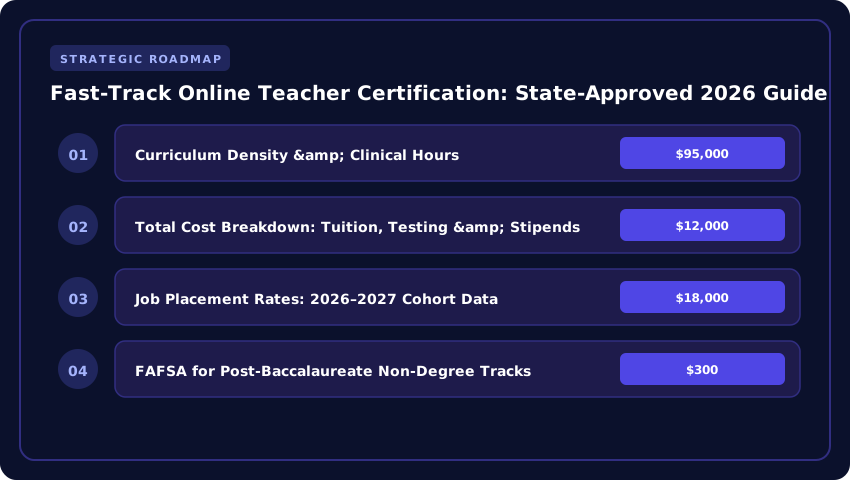
Curriculum Density & Clinical Hours
The compression shows up fast in clinical requirements. A 9-month residency almost always mandates synchronous student teaching: you are in a mentor’s classroom, live, for 12–15 weeks, often starting in week three. Programs like Relay Graduate School of Education require 100% synchronous fieldwork, meaning you need a cooperating teacher and a school district MOU locked in before day one. The 12-month self-paced routes lean heavily on asynchronous coursework with a condensed 8–10 week clinical placement at the tail end. WGU’s “Preclinical Experience” and “Demonstration Teaching” are sequential but flexible; you record lessons for faculty review rather than teaching live under daily supervision. If you need to keep your current job past month six, the asynchronous model is the only viable lane.
Total Cost Breakdown: Tuition, Testing & Stipends
- 9-Month Residency (e.g., Teach-Now, Relay): $12,000–$18,000 tuition. Add $300 for Praxis Core/Subject exams, $300 for edTPA portfolio submission (required in 18 states including NY, WA, IL), and $1,500–$2,500 mentor stipend paid directly to the cooperating teacher (often your responsibility). All-in: ~$14,500–$21,000.
- 12-Month Self-Paced (e.g., WGU, American Board): $3,500–$7,500 flat-rate tuition (WGU charges ~$3,825 per 6-month term; most finish in one). Testing fees identical ($600 total). Mentor stipends are rare—districts often absorb this for shorter placements. All-in: ~$4,500–$8,500.
- FAFSA Note: Only regionally accredited university programs (Relay, NYU, WGU) qualify for federal Pell Grants or Direct Unsubsidized Loans. Pure alternative providers like iTeach or American Board do not—plan for private loans or employer tuition assistance.
Job Placement Rates: 2026–2027 Cohort Data
Placement metrics diverge sharply by model. Relay Graduate School reports 92% of 2026 residency graduates secured full-time contracts by August 2026, largely because the residency is the interview—principals hire their residents. Teach-Now cites 88% placement within three months. On the self-paced side, WGU reports 81% of 2026 completers hired by October, but median time-to-hire stretches to 60 days post-licensure because candidates must still secure their own student teaching slot and interview cold. American Board graduates face a steeper climb: roughly 65% placement within six months, heavily dependent on local district desperation for emergency permits. If you need a paycheck by September 2027, the residency’s built-in pipeline is worth the premium.
Navigating CAEP and AAQEP Accreditation for Online Providers in 2026
Here is the hard truth for 2026: a regionally accredited university can still produce a teaching program that your state Department of Education (DOE) will reject. Regional accreditation—HLC, SACSCOC, MSCHE, WSCUC—validates the institution’s financial stability and general academic rigor. It does not validate the specific pedagogical curriculum, clinical placement quality, or candidate assessment standards required for initial licensure. When a state DOE audits a fast-track provider, they are looking for programmatic accreditation from the Council for the Accreditation of Educator Preparation (CAEP) or the Association for Advancing Quality in Educator Preparation (AAQEP). Without that specific seal, your provisional license application hits a hard stop, regardless of the school’s overall reputation.
Why Regional Accreditation Alone Fails State DOE Audits
State licensing boards operate under statutes that often explicitly mandate “national programmatic accreditation” or “CAEP/AAQEP equivalence.” In 2026, 42 states plus D.C. require the Educator Preparation Provider (EPP) to hold active CAEP or AAQEP status for graduates to qualify for a standard or provisional license without a transcript-by-transcript review—which adds months of delay and often requires remedial coursework. Regional accreditors do not evaluate the 600+ hours of clinical practice, the validity of the edTPA or PPAT integration, or the alignment with InTASC Model Core Teaching Standards. Only CAEP and AAQEP do that. If you enroll in a regionally accredited “Teacher Prep” certificate that lacks programmatic accreditation, you are effectively paying for a very expensive professional development certificate, not a license pathway.
Fully Online Providers Holding Active CAEP/AAQEP Status for 2026–2027
The list of fully online, non-profit providers with active, unconditional accreditation is shorter than marketing brochures suggest. As of the 2026–2027 cycle, these providers hold valid status across multiple state partnerships:
- Western Governors University (WGU): CAEP Accredited (Initial & Advanced). The largest producer of STEM teachers nationally; flat-rate tuition ~$3,825 per six-month term.
- American College of Education (ACE): CAEP Accredited. Specializes in M.Ed. and alternative certification; tuition ~$235 per credit hour.
- Relay Graduate School of Education: CAEP Accredited. Residency-heavy model; strong district partnerships in TX, NY, CO, LA.
- University of West Alabama (UWA): CAEP Accredited. Offers Class A and Alternative Class A fully online; ~$429 per credit hour.
- Moreland University (formerly TEACH-NOW): AAQEP Accredited. 9-month cohort model; ~$13,500 total program cost; strong international/private school recognition.
- Rio Salado College (Maricopa CCD): AAQEP Accredited. Post-baccalaureate certification; in-district tuition ~$85/credit, out-of-state ~$250/credit.
Verification Step: Before applying, cross-reference the provider’s status on the CAEP Accredited Provider Search or AAQEP Member Directory. Confirm the “Accreditation Term” extends through at least 2027.
Red Flags: Probation, Candidacy, and “Seeking Accreditation” Language
Marketing pages love the phrase “CAEP-eligible” or “pursuing AAQEP accreditation.” In 2026, that is a liability, not a feature.
- Candidacy / Eligibility Status: This means the provider has submitted a self-study but has not yet undergone a site visit or received a formal decision. Graduates from candidacy-era cohorts often face transcript audits by state DOEs. Some states (e.g., Texas, Georgia, Washington) explicitly deny licensure for candidates graduating while the EPP is only in “candidacy.”
- Probation / Accreditation with Conditions: If a provider is on probation (e.g., failing Standard R4: Program Impact or R5: Quality Assurance), new enrollees risk the accreditation being revoked before they graduate. Check the “Accreditation Actions” list on the CAEP site for “Probation” or “Revocation” notices dated 2026–2026.
- “State Approved” ≠ Accredited: Many alternative routes (e.g., Teachers of Tomorrow, iteach) hold state program approval in specific states (TX, NV, LA, AZ) but lack CAEP/AAQEP. This locks you into teaching only in those states. If you move, you lose reciprocity under the NASDTEC Interstate Compact.
Bottom line: Filter your 2026 shortlist by active, unconditional CAEP or AAQEP accreditation first, then check state approval. Reversing that order is the single most expensive mistake a career switcher makes.
Funding Your Certification: Federal Aid, TEACH Grants & District Partnerships
Most career switchers assume they have to write a five-figure check to enter the classroom. In 2026, that is rarely true if you know which levers to pull. The financial aid stack for alternative certification looks different than a traditional bachelor’s degree, but the dollars are real—often covering 100% of tuition plus a living stipend.
FAFSA for Post-Baccalaureate Non-Degree Tracks
You do not need to be enrolled in a master’s program to access federal aid. For the 2026–2027 award year, the Free Application for Federal Student Aid (FAFSA) unlocks Direct Unsubsidized Loans (up to $20,500 annually for graduate/professional students) and, critically, Federal Work-Study for eligible non-degree teacher certification programs. The program must be Title IV eligible and classified by the U.S. Department of Education as “necessary for professional certification or licensure in your state.” Confirm your provider’s school code is active on the FAFSA form before you apply. Pro tip: File the 2026–2027 FAFSA as early as October 2026; many state grant deadlines (like Cal Grant or TEXAS Grant) hit in early spring 2026 and require FAFSA data.
TEACH Grant: $4,000/Year with a Binding Service Contract
The Teacher Education Assistance for College and Higher Education (TEACH) Grant remains the most aggressive federal subsidy for 2026–2027, offering up to $4,000 per year (prorated for part-time) for high-need fields—math, science, special education, bilingual/ESL, and reading specialist. The catch is non-negotiable: you must teach full-time in a designated low-income school (Title I) for four complete academic years within eight years of completing the program.
- 2026 Update: The Department of Education has tightened the “high-need field” verification. Your program must explicitly list your certification area on the Teacher Shortage Area Nationwide Listing for the year you graduate.
- Conversion Risk: If you miss the service window—or drop to part-time—the grant converts to a Direct Unsubsidized Loan with interest accruing from the original disbursement date. There is no appeal for “hardship” once the eight-year clock expires.
- Action Item: Sign the Agreement to Serve (ATS) annually on StudentAid.gov. Do not rely on your provider to remind you; a missed signature converts the grant instantly.
Grow Your Own (GYO) District Sponsorships: Tuition + Salary
This is the closest thing to a “free ride” in 2026. Over 40 states now operate formal Grow Your Own (GYO) pipelines where districts—often partnering with online providers like iteach, Teachers of Tomorrow, or local university satellites—cover 100% of tuition and fees while paying you a paraprofessional or resident salary ($25,000–$38,000) during your clinical year.
- Eligibility: Typically requires a bachelor’s degree (any major), a 2.5–3.0 GPA, and a commitment to teach in the sponsoring district for 3–5 years post-licensure.
- Stacking: You can often stack a GYO salary with the TEACH Grant (for living expenses) and Pell Grant eligibility if your income drops low enough during the residency year.
- Where to Look: Search your target district’s HR site for “Teacher Residency,” “Apprenticeship,” or “Para-to-Teacher” pathways. Large urban districts (NYC Teaching Collaborative, Dallas ISD, Chicago Public Schools Teach Chicago) and rural consortia (Mississippi Teacher Residency, West Virginia Grow Your Own) have the deepest 2026–2027 cohorts.
Bottom Line: A strategic candidate in a high-need subject can enter the 2026–2027 classroom with $0 out-of-pocket tuition cost and a paycheck from day one. File the FAFSA, lock in the TEACH Grant ATS, and apply to three GYO programs before March 2026 deadlines.
Clinical Placement Logistics: Securing Student Teaching in Your Zip Code
The coursework is asynchronous, but the classroom isn’t. For the 2026–2027 cycle, the single biggest derailer for fast-track candidates isn’t the Praxis or the GPA—it’s securing a cooperating teacher willing to host an online alternative-route intern inside a brick-and-mortar school. Most state-approved providers (think iteach, Teachworthy, American Board, or university-based residencies like Relay GSE) now guarantee placement support, but “support” varies wildly from a dedicated field coordinator who calls principals on your behalf to a PDF list of district HR emails.
How Programs Partner with LEAs for Virtual Supervision
In 2026, 31 states explicitly authorize virtual supervision models where the university supervisor observes via Swivl robot or encrypted Zoom rather than driving to the site. This matters if you live in a rural county 60 miles from your provider’s physical campus. Ask your admissions counselor for the current Memorandum of Understanding (MOU) list: which specific Local Education Agencies (LEAs) have signed agreements for the 2026–2027 year? A program with active MOUs in Houston ISD, Clark County (NV), or Wake County (NC) can place you in weeks; one relying on “candidate-initiated outreach” can leave you scrambling in August. Verify whether the program pays the mentor teacher stipend (typically $500–$1,200 per semester) or expects you to negotiate it—districts prioritize candidates whose stipends are pre-funded.
Background Check Timelines and Fingerprinting Reciprocity
You cannot step foot in a classroom without a cleared fingerprint background check, and the clock starts ticking the day you enroll. Critical 2026 nuances:
- Vendor Lock-In: Most states mandate specific vendors (IdentoGO, Fieldprint, or state police live-scan). Budget $55–$75 per attempt; budget two attempts if your prints reject.
- Reciprocity Myths: A cleared Texas fingerprint card does not transfer to Oklahoma or Colorado. You must process through the target state’s Department of Education portal. If you’re targeting a border metro (KC, Cincinnati, Philly), initiate both state checks simultaneously.
- Validity Windows: California (CTC) and New York (NYSED) clearances expire in 12 months; Florida (FLDOE) and Arizona (AZDPS) run 24 months. Time your submission so the clearance survives the entire clinical semester.
Emergency Substitute Permits as a Bridge to Full Clinical Placement
If your program’s placement engine stalls, the emergency substitute permit is your tactical bridge. In 2026, at least 22 states—including Texas (Emergency Permit), Arizona (Emergency Substitute Certificate), and Illinois (Short-Term Sub License)—allow alt-route candidates who have passed content exams but lack completed pedagogy coursework to serve as teacher-of-record or long-term sub while finishing clinical hours. This counts toward your required field experience if your provider pre-approves the site and assigns a qualified mentor. The payoff: you draw a salary ($150–$220/day in most metros) instead of paying tuition for an unpaid internship. The risk: you need principal sign-off on a formal “Clinical Supervision Plan” filed with the state before day one. Secure that paperwork in June, not August.
High-Demand Endorsements to Stack in 2026: SPED, ESL & STEM
If you are pursuing alternative certification strictly for job security and earning power, the data points to one strategy: stack a shortage-area endorsement immediately. In the 2026–2027 hiring cycle, principals are not just looking for a license; they are hunting for Special Education (SPED), English as a Second Language (ESL), and STEM credentials that unlock federal Title I funding and state-level bonus structures. A general elementary certificate gets you in the door; a SPED or Physics add-on gets you a signing bonus.
Salary Differentials in the Top 20 Metros
Bureau of Labor Statistics (BLS) May 2026 data confirms a measurable premium for dual-certified educators in major labor markets. In the New York-Newark-Jersey City metro, teachers holding a SPED endorsement alongside their base license report median earnings of $98,420, roughly $12,300 above single-credential peers. Los Angeles-Long Beach-Anaheim shows a $10,800 gap ($92,150 vs. $81,350), while Chicago-Naperville-Elgin sits at a $9,500 differential. Houston-The Woodlands-Sugar Land—driven by aggressive ESL stipends—posts a $8,200 premium. Across the board, the top 20 metros average a 12–15% salary lift for verified shortage-area competency, effectively paying back the cost of an add-on program within the first contract year.
Fast-Track Add-On Pathways: 6 Credits vs. Master’s
You do not need a full Master’s to capture these differentials. Most state education agencies (SEAs) now recognize 6-to-9 credit hour “endorsement-only” tracks that run 8–12 weeks online. Providers like Western Governors University (WGU), American Board, and state-run collaboratives (e.g., Texas Teachers of Tomorrow) offer SPED and ESL add-ons for $2,500–$4,000 total tuition. Compare that to a $18,000–$30,000 Master’s in Curriculum & Instruction. The ROI math is brutal: the 6-credit route yields the identical license endorsement and hiring bonus eligibility—often a $5,000–$7,500 district stipend—at one-fifth the cost and time. Only pursue the Master’s if you are targeting administrative licensure or a lane change on the salary schedule that requires a graduate degree.
H-1B Cap-Exempt Advantage for International Candidates
For internationally educated professionals, SPED and STEM certifications are a visa strategy, not just a resume builder. Public K–12 schools, non-profit charter networks, and university-affiliated lab schools qualify as H-1B cap-exempt employers under 8 CFR 214.2(h)(19). In 2026, USCIS continues to approve cap-exempt petitions year-round for roles requiring specialized knowledge—precisely the definition of a certified Physics, Computer Science, or Special Education teacher. We are seeing districts in Dallas, Phoenix, and Northern Virginia actively recruiting internationally certified candidates contingent on them completing a 6-credit U.S. SPED or ESL endorsement to satisfy state licensure. This pathway bypasses the April lottery entirely, offering a deterministic immigration timeline that generalist teachers simply cannot access.
- Action Item: Verify your target state’s “test-before-entry” rule for add-ons; 14 states now require the Praxis 5354 (SPED) or 5362 (ESL) before issuing the endorsement code.
- Loan Forgiveness Stack: Five years in a Title I school with a SPED/STEM endorsement qualifies you for $17,500 Teacher Loan Forgiveness (vs. $5,000 for generalists) plus PSLF credit.
- Metro Target List: Prioritize applications to Clark County (NV), Hillsborough County (FL), and Gwinnett County (GA)—all projecting 200+ SPED/ESL vacancies for 2026–27 with documented hiring bonuses.
Post-Certification Compliance: Induction, Mentoring & License Conversion 2027
Earning a provisional license is the starting line, not the finish line. For the 2026–2027 cycle, 42 states now require a structured induction year before converting that entry-level credential into a portable professional license. Skip the paperwork here, and you risk teaching on an expired certificate—a compliance violation that can derail tenure tracks and pension vesting.
The Induction Year: Non-Negotiable Benchmarks
Most states mandate a minimum of 150 to 200 documented mentorship hours spread across the academic year. In Texas, the T-TESS framework requires three formal observations by a certified mentor plus a summative conference. California’s Teacher Induction Program (formerly BTSA) demands an Individualized Learning Plan (ILP) tied to the CSTPs, while New York’s Mentor-Teacher Internship Program (MTIP) logs weekly collaborative sessions. Budget roughly $1,200–$2,500 for mentor stipends if your district does not absorb the cost; many alternative-cert providers like iTeach or Teachers of Tomorrow bundle this into their program fees, but verify the line item before you sign.
- Portfolio Evidence: Expect to submit 10–15 artifacts—lesson plans with differentiation tags, student-work analyses, and parent-communication logs.
- Observation Cadence: Minimum two announced and one unannounced observation by a trained assessor using a state-approved rubric (Danielson or Marzano are the dominant frameworks).
- Micro-Credential Stacking: States including Arkansas, Tennessee, and Nevada now accept Digital Promise micro-credentials (e.g., “Formative Assessment Design,” “Culturally Responsive Classroom Management”) as direct substitutes for traditional graduate coursework during conversion. Each micro-credential typically costs $75–$150 and takes 10–15 hours.
Provisional-to-Professional Conversion Checklist
Once induction wraps, the conversion packet usually includes: a signed verification form from your mentor and principal, passing scores on the pedagogical assessment (edTPA or PPAT depending on state), and a fingerprint-based background check renewal. Processing fees range from $50 in Arizona to $200 in Maryland. Submit by June 30 of your induction year to avoid a lapse; late filings often trigger a $100 penalty and a mandatory “reinstatement” narrative.
Mobility via the NASDTEC Interstate Agreement (2027 Update)
The 2027 NASDTEC revisions clarify that full professional licensure—not provisional status—triggers seamless reciprocity across 46 member jurisdictions. If you hold a professional license in a “sending” state, the “receiving” state cannot impose additional coursework, only a jurisdictional knowledge test (often a $50–$100 online module on state school law). Critical nuance: alternative-route teachers must complete the induction year in the original state before the license converts to the “professional” tier recognized by the compact. Moving mid-induction resets the clock in the new state. Track your status via the NASDTEC Clearinghouse dashboard; it now syncs nightly with state DOE databases, eliminating the old 60-day verification lag.
| Provider / Pathway | Est. Total Cost (2026 USD) | Time to Provisional License | Min GPA Floor | Content Exam Policy (2026) | States Approved (2026-27) | Accreditation Status |
|---|---|---|---|---|---|---|
| iTeach (National) | $4,250 – $5,500 | 6-9 Months | 2.50 | Test Before Entry (Most States) | 12+ | AAQEP |
| Teachers of Tomorrow (TX/NV/IN) | $4,600 – $5,800 | 9-12 Months | 2.50 | Test During Program (TX) | 3 Primary | State Approved Only |
| American Board (ABCTE) | $1,950 – $2,500 | 4-6 Months | None (Degree Req.) | Test Before Entry (All States) | 15+ | Non-Accredited (State Auth) |
| Western Governors Univ (WGU) | $7,400 – $8,200/yr | 12-18 Months | 2.50 | Test Before Entry | 50 (Reciprocity) | CAEP / AAQEP |
| Morrow College / District Alt-Cert | $0 – $3,000 (Stipend) | 12 Months | 2.75 – 3.00 | Test During Residency | 1 (District Specific) | State Approved Only |
Frequently Asked Questions
How many states accept fully online alternative teacher certification for 2026-2027?
For the 2026–2027 school year, 38 states accept fully online alternative certification providers for provisional licensure. However, acceptance is provider-specific; candidates must verify the program appears on their target State Education Agency's approved provider list before enrolling.
What is the typical cost range for fast-track online teacher certification in 2026?
Fast-track online certification costs range from $1,950 for self-paced exam-based routes like American Board to $8,200 per year for competency-based university programs like WGU. Most non-profit alternative providers charge $4,250–$5,800 total for the 2026 cycle.
Do I need to pass content exams before enrolling in 2026 alternative certification programs?
It depends on the state's 'test-before-entry' rule. In 2026, roughly 22 of the 38 states accepting online routes require passing Praxis or state content exams prior to program admission; the remaining 16 allow testing during the first semester of coursework.
Does CAEP or AAQEP accreditation guarantee my online program leads to state licensure in 2026?
No. National accreditation (CAEP/AAQEP) does not guarantee state approval for initial licensure in 2026. State Education Agencies maintain independent approved-provider lists; a nationally accredited program may still be rejected by specific SEAs for alternative route candidates.
What is the fastest timeline to earn a provisional teaching license in 2026-2027?
The fastest 2026 pathway is exam-only certification (e.g., American Board), achievable in 4–6 months for candidates who pass required content exams immediately. Standard alternative certification programs typically require 6–9 months of coursework plus clinical placement for the 2026–2027 cycle.
Strategic Final Takeaway
When evaluating Alternative Teacher Certification Programs Online Fast Track State Approved 2026 2027 in 2026 and beyond, base your decisions on accredited institutional standards, verified return on investment (ROI), and up-to-date official guidelines. Always verify specific dates and requirements through official regulatory portals.

