
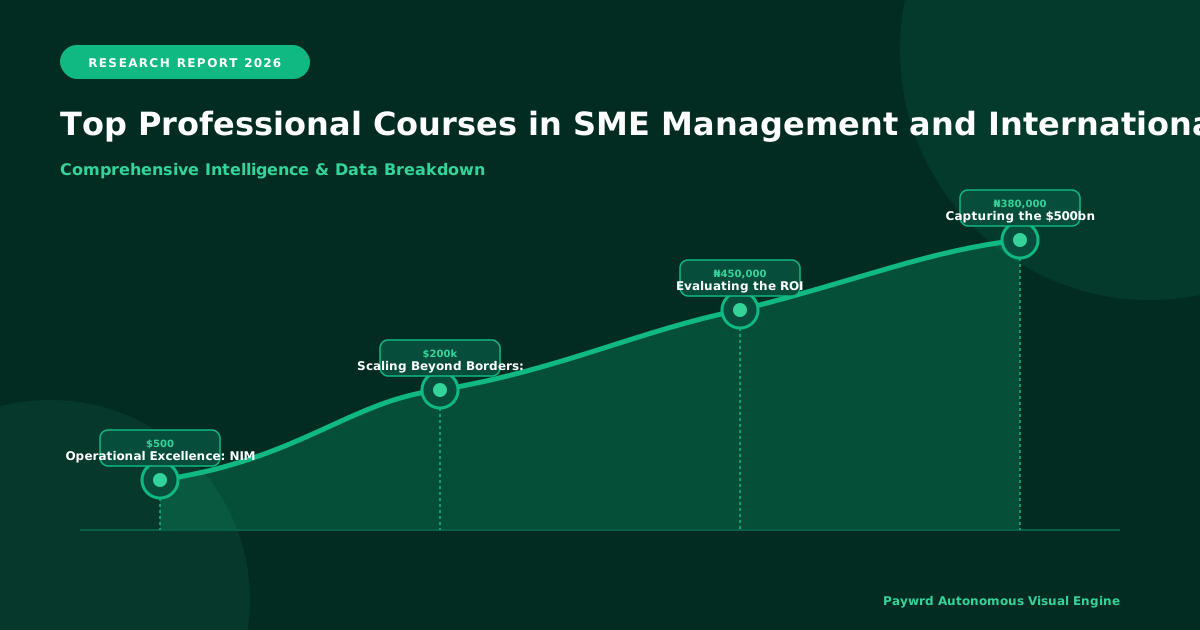
Strategic Certifications for Nigerian SME Growth in 2026
For the Nigerian SME owner, the transition from survival mode to sustainable growth requires more than just capital; it requires institutional credibility. In today’s volatile economic climate, certifications act as a signal to investors, banks, and international partners that your business operates on global standards rather than guesswork.
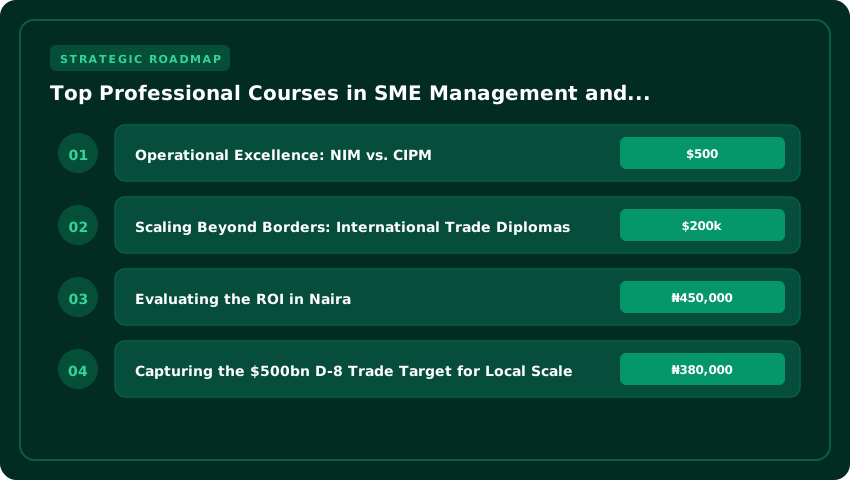
Operational Excellence: NIM vs. CIPM
When choosing between the Nigerian Institute of Management (NIM) and the Chartered Institute of Personnel Management (CIPM), the decision depends on your current bottleneck. NIM is the gold standard for generalist operational excellence. It provides a holistic framework for strategic planning and organizational leadership, making it ideal for CEOs looking to structure their entire business model.
Conversely, CIPM is indispensable for SMEs that have scaled past 15 employees. As labor laws evolve and the competition for tech-savvy talent intensifies in 2026, CIPM certification ensures your HR processes—from recruitment to payroll compliance—are legally sound and optimized for productivity. While NIM builds the machine, CIPM optimizes the people running it.

Scaling Beyond Borders: International Trade Diplomas
With the full integration of the African Continental Free Trade Area (AfCFTA), West African exporters can no longer rely on informal shipping agents. Specialized diplomas in International Trade, particularly those aligned with the Nigerian Export Promotion Council (NEPC) guidelines, are now critical. These programs provide essential knowledge on:
- Navigating the ETLS (Export Trade Liberalization Scheme) for duty-free imports of raw materials.
- Mastering Incoterms 2026/2027 to mitigate risk during transit.
- Compliance with EU and US FDA standards for Nigerian agro-allied exports.
Evaluating the ROI in Naira
The financial commitment for these certifications ranges from ₦150,000 to ₦450,000 depending on the level of membership and examination fees. However, the Return on Investment (ROI) is realized through three primary channels:
- Credit Access: Certified managers often find it easier to secure SME loans from BOI (Bank of Industry) due to demonstrated professional competence.
- Waste Reduction: Implementing NIM-certified lean management can reduce operational leakages by 15-20% annually.
- Premium Pricing: International trade certification allows SMEs to shift from local “commodity” pricing to “premium export” pricing, significantly increasing profit margins in USD or Euros.
Leveraging the Abuja SME Centre for D-8 Trade Expansion
For the Nigerian entrepreneur in 2026, scaling beyond domestic borders is no longer a luxury but a survival strategy against local currency volatility. The Abuja SME Centre serves as the primary institutional bridge for businesses aiming to penetrate the Developing-8 (D-8) markets—comprising Bangladesh, Egypt, Indonesia, Malaysia, Nigeria, Pakistan, Turkey, and Vietnam. By utilizing this hub, SMEs can transition from local vendors to international exporters by leveraging structured trade facilitation resources.
Navigating Trade Facilitation and D-8 Market Intelligence
The Abuja SME Centre provides more than just office space; it offers a sophisticated ecosystem of market intelligence specifically tailored for the D-8 corridor. Nigerian entrepreneurs can access real-time data on tariff structures, import-export regulations, and consumer behavior patterns within member nations. This intelligence is critical for avoiding costly logistical errors and ensuring that products meet the specific regulatory standards of the destination country.
- Export Readiness Assessments: Access specialized audits to determine if your production capacity and quality control meet D-8 international standards.
- B2B Matchmaking: Utilize the centre’s database to connect with verified distributors and wholesalers in Turkey and Malaysia.
- Regulatory Guidance: Get direct support on navigating the Nigerian Export Promotion Council (NEPC) requirements and D-8 customs protocols.
Step-by-Step Guide to Utilizing Government Trade Hubs for Export
To effectively move your goods from a Nigerian warehouse to a D-8 market, follow this streamlined operational path through the Abuja SME Centre:
- Registration and Profiling: Register your business at the centre and create a detailed company profile. Ensure your CAC documentation is current and your Tax Identification Number (TIN) is verified.
- Intelligence Gathering: Request a “Market Entry Report” for your specific product category. This identifies which D-8 nation has the highest demand and the lowest entry barriers for your goods.
- Certification Alignment: Work with the centre’s consultants to acquire necessary certifications (such as ISO or Halal certifications for Southeast Asian markets) which are often mandatory for D-8 trade.
- Trade Mission Participation: Apply for government-sponsored trade delegations. These missions provide face-to-face networking opportunities that are far more effective than cold-emailing foreign buyers.
- Logistics Integration: Leverage the centre’s partnerships with freight forwarders to optimize shipping costs and reduce transit times.
By integrating these government resources with professional SME management certifications, Nigerian business owners can reduce the risk of international expansion and secure a sustainable foothold in the global economy.
Capturing the $500bn D-8 Trade Target for Local Scale
The Developing Eight (D-8) bloc’s ambition to hit $500 billion in intra-member trade by 2030 isn’t just a diplomatic talking point—it is a concrete revenue ladder for Nigerian SMEs prepared to move beyond the Lagos-Ibadan corridor. With a combined population exceeding 1.2 billion across Nigeria, Indonesia, Turkey, Egypt, Iran, Pakistan, Bangladesh, and Malaysia, the addressable market dwarfs ECOWAS. But access requires more than an export license; it demands product-market fit, standards compliance, and trade finance structures that most local “hustles” currently lack.
Identifying High-Demand Nigerian Products in D-8 Markets
Nigeria’s comparative advantage sits heavily in agro-processing and solid minerals, but the D-8 demand map is specific. Indonesia and Malaysia are structural deficits in cassava derivatives (starch, ethanol) and cocoa butter equivalents for their massive confectionery sectors. Egypt and Turkey absorb significant volumes of sesame seeds, ginger, and hibiscus—provided aflatoxin levels meet EU-adjacent standards these nations enforce. Meanwhile, Pakistan and Bangladesh offer growing appetite for lead zinc concentrates and tantalite for their electronics assembly lines. The actionable insight? Stop shipping raw cashews to Vietnam for re-export. Target the Turkish confectionery factories directly with peeled, graded kernels certified by the Nigerian Export Promotion Council (NEPC).
Scaling Production to Meet International Quality Standards
“Export quality” is not a suggestion; it is a binary gatekeeper. In 2026, the Standard Organisation of Nigeria (SON) MANCAP certification is the baseline, but D-8 buyers—especially Turkish and Indonesian procurement officers—demand ISO 22000 (Food Safety) or ISO 9001 (Quality Management) as a prerequisite for Letters of Credit. SMEs must invest in Hazard Analysis and Critical Control Points (HACCP) plans for agro-exports. A practical step: leverage the Nigeria-Africa Trade and Investment Promotion Programme grants to upgrade drying floors from bare cement to raised, stainless-steel mesh systems. This single capex item reduces aflatoxin rejection rates by over 60%, instantly qualifying your ginger or sesame for the Istanbul Spice Bourse.
Financial Strategies to Capitalize on Cross-Border Trade Volumes
Working capital kills more export deals than quality. The 90-to-120-day cash conversion cycle of international trade requires bridging finance that commercial banks price at 28–32% per annum—unviable for thin margins. The strategic pivot in 2026 is accessing the African Export-Import Bank (Afreximbank) trade finance facilities or the NEXIM Bank Export Credit Guarantee Scheme, which de-risks the transaction for local banks, dropping rates to single digits. Structure your contracts using Incoterms 2026 CIP (Carriage and Insurance Paid To) rather than FOB; it shifts logistics risk to the buyer’s freight forwarder but gives you control over insurance claims. Finally, hedge FX exposure via the CBN’s Investors’ & Exporters’ (I&E) Window forwards—locking your Naira realization rate the day the Bill of Lading drops, not the day the MT103 hits your domiciliary account.
- Action Item: Register on the D-8 Trade Information Network Portal to track live tenders from Tehran to Jakarta.
- Compliance: Budget ₦2.5M–₦5M annually for SON/ISO surveillance audits; treat it as COGS, not overhead.
- Finance: Apply for the NELFUND-backed “Export Ready” facility if annual turnover exceeds ₦100M.
Government-Backed Training Programs for Global Scaling
You don’t need deep pockets to access world-class trade intelligence; you need to know which federal doors are open in 2026. The Nigerian government has quietly ramped up non-oil export capacity building, moving beyond rhetoric into structured, often tuition-free programs that directly address the compliance and documentation gaps killing SME margins at the ports. If you are still paying private consultants ₦500,000 for export documentation training you can get for free at a NEPC zonal office, you are leaking working capital.
BOI and SMEDAN: The Twin Engines of Capacity Building
The Bank of Industry (BOI) and SMEDAN have aligned their 2026 intervention strategies under the Federal Government’s MSME Survival Fund legacy framework. BOI’s Enterprise Development Programme (EDP) now mandates a 40-hour certification module on financial modeling and export readiness as a pre-condition for accessing their single-digit interest facilities (currently 9% per annum for agro-processing and creative sectors). SMEDAN, meanwhile, has digitized its National Business Skills Development Initiative (NBSDI). The curriculum now includes a dedicated “Export Cluster” track covering HS Code classification, Rules of Origin under AfCFTA, and digital marketing for cross-border e-commerce. Registration is free via the SMEDAN portal, but slots are capped per state—apply the moment the quarterly window opens.
NEPC: Your Gateway to Verified Exporter Status
The Nigerian Export Promotion Council (NEPC) remains the single most critical touchpoint for new exporters. Their Export Development Programme (EDP) and the Zero Oil Plan workshops are not generic seminars; they are operational bootcamps. In 2026, NEPC zonal offices in Lagos, Kano, Port Harcourt, and Aba run monthly “New Exporter Clinics” where you walk in with your product samples and walk out with a vetted Export Plan and a list of verified freight forwarders. Crucially, completing the NEPC Export Licence Acquisition Workshop fast-tracks your NXP (Nigerian Export Proceeds) form processing on the Nigeria Single Window Trade Portal. Miss this, and your goods sit at Apapa or Tin Can for weeks awaiting documentation clearance.
Unlocking State-Level Grants and AfCFTA Workshops
Don’t sleep on sub-national funding. States like Lagos (through LSETF), Kaduna (KADIPA), and Cross River have dedicated Export Expansion Grants (EEG) ranging from ₦2 million to ₦10 million for SMEs with verified export orders. However, the grant agreement almost always requires proof of attendance at a state-sponsored AfCFTA Readiness Workshop. These sessions, often facilitated by the Nigerian Office for Trade Negotiations (NOTN) in partnership with GIZ or UNIDO, cover tariff liberalization schedules and non-tariff barrier reporting mechanisms. Pro tip: Monitor the Federal Ministry of Industry, Trade and Investment website and your state’s Ministry of Commerce social handles for the 2027 calendar—applications typically open Q1 and Q3.
- Action Item: Register on the SMEDAN MSME Portal and NEPC Exporters Database this week to receive SMS alerts for 2026/2027 training cycles.
- Document Prep: Have your CAC Certificate, Tax Clearance Certificate (TCC), and Bank Verification Number (BVN) ready; these are non-negotiable for grant applications.
- Cluster Strategy: Join a recognized Export Cluster Group (ECG) via NEPC; collective bargaining power reduces freight costs by up to 30% on consolidated containers.
Integrating Digital Trade Tools into SME Management
Certification gets you a seat at the table; digital fluency keeps you there. In 2026, the Nigerian SME that treats technology as a support function rather than a core competitive lever is already losing market share to competitors in Ghana, Kenya, and Côte d’Ivoire who have automated their trade compliance. The African Continental Free Trade Area (AfCFTA) is no longer a policy document gathering dust in Abuja—it is a live, digital ecosystem. If your documentation, market intelligence, and logistics visibility aren’t digitized, you are effectively invisible to regional buyers.
Adopting AfCFTA-Compliant Digital Documentation Tools
Manual paperwork is the single biggest friction point at Nigerian borders—Apapa, Seme, and Mfum included. The AfCFTA Rules of Origin (RoO) regime demands precise, verifiable data on value addition and tariff classification. Leading SMEs are now integrating Electronic Certificate of Origin (e-CoO) platforms directly into their ERP systems, bypassing the physical stamp-and-sign merry-go-round at chambers of commerce. Tools like the AfCFTA Non-Tariff Barriers (NTB) online reporting mechanism and the Pan-African Payment and Settlement System (PAPSS) APIs allow you to settle invoices in Naira while your buyer in Abidjan pays in CFA Franc, instantly. If your finance team is still manually keying Form M data into the Nigeria Customs Service (NCS) NICIS II portal without API middleware, you are burning 15–20% of your margin on demurrage and human error.
Using AI-Driven Market Analysis for West African Trade Corridors
Gut feeling doesn’t scale across the Lagos-Abidjan corridor. In 2026, affordable AI tools—many built on open-source LLMs fine-tuned for Afrocentric trade data—are democratizing intelligence previously reserved for multinationals. Platforms ingesting real-time data from the ECOWAS Trade Liberalisation Scheme (ETLS) databases, port community systems in Lomé and Tema, and even satellite imagery of border queue lengths can forecast demand spikes for your specific HS codes three months out. This allows a Lagos-based agro-processor to pivot cassava flour shipments from a saturated Accra market to a deficit in Ouagadougou before the price arbitrage disappears. Look for solutions that plug into the African Trade Observatory (ATO) dashboards; they turn raw tariff schedules into actionable “landed cost” simulations per corridor.
Managing Remote International Supply Chains from Nigeria
You cannot manage a supply chain stretching from Onne Port to a warehouse in Douala via WhatsApp voice notes. The 2026 standard is a Control Tower dashboard—a single pane of glass showing container GPS location, warehouse IoT sensor data (temperature/humidity for perishables), and customs clearance status across jurisdictions. Nigerian SMEs are adopting lightweight SaaS platforms (often priced in Naira via local cloud partners like Layer3Cloud or Galaxy Backbone) that aggregate carrier EDI feeds, NCS release notifications, and last-mile delivery proof-of-delivery (POD) scans. This visibility transforms you from a passive shipper into a logistics orchestrator, enabling you to offer DDP (Delivered Duty Paid) terms to buyers in Bamako or Yaoundé—a massive trust signal that justifies premium pricing.
- Action Item: Audit your current trade stack. If you lack API connectivity to NICIS II and PAPSS, budget ₦2.5M–₦5M for middleware integration in Q3 2026.
- Skill Gap: Upskill your logistics lead on Incoterms 2026 digital execution and HS Code classification using the WCO HS Tracker.
- Compliance: Register on the AfCFTA NTB Portal (tradebarriers.africa) to log and resolve border delays in real-time; it creates an audit trail for dispute resolution.
Financial Planning for International Trade Education
Let’s be honest: in the 2026 Nigerian economy, “budgeting” isn’t a spreadsheet exercise—it is a survival strategy. With the Naira fluctuating between ₦1,500 and ₦1,700 to the dollar, the sticker price of a globally recognized certification like the CITP (Certified International Trade Professional) or ICC Academy credentials has effectively doubled in local currency terms over the last 18 months. A program that cost ₦1.2 million in early 2026 now commands ₦2.5 million to ₦3 million. If you are an SME owner in Aba, Onitsha, or Lagos, you cannot simply “save up” fast enough to beat inflation. You need a financial architecture that treats upskilling as a capital expenditure (CapEx) with a defined Return on Investment (ROI), not an operating expense.
Structuring Your Education CapEx in a High-Inflation Environment
Stop looking at the lump sum. Break the cost down into modular milestones. Most reputable bodies—like the Nigerian Institute of Management (NIM) or the Chartered Institute of Shipping (CIS)—now offer installment plans spread over 3 to 6 months. Negotiate directly with the training provider; many have discretionary “early bird” or “alumni” discounts of 10–15% that aren’t advertised on their websites. Factor in the “hidden costs”: data subscriptions for virtual modules (budget ₦15,000–₦25,000 monthly for reliable 4G/5G), examination resit fees (often ₦30,000–₦50,000 per paper), and the opportunity cost of time away from the shop floor. Build a 20% contingency buffer on top of the quoted tuition to absorb mid-cycle FX spikes.
Unlocking NELFUND and Institutional Credit Lines
Here is where most business owners leave money on the table. The Nigeria Education Loan Fund (NELFUND), fully operational under the 2026 Act and funded in the 2026/2027 appropriation, is not just for undergraduates. The portal (nelf.gov.ng) explicitly covers “vocational, technical, and professional education” at accredited institutions. If your chosen certification provider is accredited by the National Board for Technical Education (NBTE) or the National Universities Commission (NUC) via CCMAS alignment, you qualify.
- Loan Ceiling: Up to ₦5 million per applicant for professional programs, interest-free, with a two-year moratorium post-completion.
- Repayment: 10% direct deduction from source (business revenue or salary) only when turnover hits the ₦500k monthly threshold.
- Application Hack: Apply via your BVN-linked profile; ensure your tax clearance (TCC) and CAC documents are current. Rejection rates are high for incomplete KYC, not lack of funds.
Beyond NELFUND, check the Bank of Industry (BoI) “Bottom of the Pyramid” scheme and Development Bank of Nigeria (DBN) on-lending facilities through commercial banks like Access, Zenith, or FCMB. These often have specific “Capacity Building” windows with single-digit interest rates (9–11%) if you can demonstrate the certification unlocks an export contract or AGOA eligibility.
Calculating Your Break-Even Point: The Hard Math
Don’t guess—model it. Let’s assume a ₦2.8 million total cost (tuition + exams + logistics) for an Export Management Certification.
- Scenario A (Cost Savings): You learn correct HS Code classification and Incoterms 2026 rules, eliminating ₦400k/month in demurrage, penalties, and freight overcharges. Break-even: 7 months.
- Scenario B (Revenue Uplift): Certification qualifies you for the Nigerian Export Promotion Council (NEPC) Export Expansion Facility Programme (EEFP) grants (up to ₦50 million) and reduces your letter of credit confirmation fees by 1.5% on a $200k annual turnover. Break-even: 4 months.
Run your specific numbers. If the certification doesn’t pay for itself within 12 months via reduced leakages or unlocked contracts, it’s a hobby, not an investment. In 2026, Nigerian SMEs cannot afford hobbies.
| Certification / Course | Focus Area | Est. Cost (₦) 2026 | Timeline (2026/2027) | Key Prerequisite | Primary ROI for SMEs |
|---|---|---|---|---|---|
| NIM Chartered Manager | General Management & Strategy | ₦450,000 – ₦650,000 | 6-12 Months (Flexible) | HND/B.Sc + 3yrs Exp | Bank Loan Eligibility & Board Governance |
| CIPM Chartered HR | HR Compliance & Labour Law | ₦380,000 – ₦550,000 | 6-18 Months (Diet Exams) | HND/B.Sc (Any Discipline) | Regulatory Compliance & Talent Retention |
| CIBN / ACIB Banking | Trade Finance & Credit Risk | ₦300,000 – ₦500,000 | 12-18 Months | Degree + NYSC Cert | Access to FX Windows & Trade Facilities |
| NEPC Export Certification (ECCP) | International Trade & Export Docs | ₦150,000 – ₦250,000 | 3-6 Months (Modular) | Registered Business (CAC) | Export Expansion Grant (EEG) Access |
| CITP / FIBP (International) | Global Supply Chain & Logistics | $1,200 – $2,500 (USD) | 6-12 Months (Online) | 2yrs Trade Experience | AfCFTA Market Entry & Investor Credibility |
Frequently Asked Questions
Which professional certification is best for SME management in Nigeria 2026?
For 2026, the NIM Chartered Manager certification remains the gold standard for general SME leadership, signaling governance maturity to banks and investors. However, CIPM is superior if your scaling bottleneck is HR compliance and labour law adherence. Choose NIM for strategy/finance access; choose CIPM for operational/people scaling.
How much does it cost to get NEPC export certification in Nigeria 2026?
As of 2026, the Nigerian Export Promotion Council (NEPC) Export Certification Programme (ECCP) costs between ₦150,000 and ₦250,000 depending on the module track. This fee covers training, documentation workshops, and the issuance of the Exporter's Certificate required to access the Export Expansion Grant (EEG) and AfCFTA preferential tariffs.
Can I do professional courses online in Nigeria for 2026 admission?
Yes, major bodies like NIM, CIPM, and CIBN offer hybrid or fully online diet examinations for the 2026/2027 sessions. International options like CITP/FIBP are 100% virtual. Registration portals typically open Q1 2026; ensure your NYSC discharge certificate and CAC documents are digitized for upload during application.
What certification unlocks Export Expansion Grant (EEG) in Nigeria 2026?
The NEPC Exporter's Certificate (obtained via the ECCP course) is the mandatory prerequisite to apply for the Export Expansion Grant (EEG) in 2026. Without this certification, SMEs cannot process the NXP form or claim the 10-30% export incentive rebates on non-oil export proceeds repatriated through the CBN I&E window.
Difference between NIM and CIPM certification for Nigerian business owners 2026?
NIM (Nigerian Institute of Management) certifies general management competence—strategy, finance, and governance—ideal for CEO/Founder credibility with lenders. CIPM (Chartered Institute of Personnel Management) certifies HR expertise—labour law, industrial relations, payroll compliance—critical once headcount exceeds 20 staff to avoid regulatory penalties from the Ministry of Labour.
Strategic Final Takeaway
When evaluating Best Professional Courses In SME Management And International Trade For Nigerian Entrepreneurs in 2026 and beyond, base your decisions on accredited institutional standards, verified return on investment (ROI), and up-to-date official guidelines. Always verify specific dates and requirements through official regulatory portals.


