2026 ACCA Exemption Fee Structure for Non-Accounting Degrees
ACCA operates a global fee structure denominated in GBP, but Nigerian students pay the USD equivalent via the MyACCA portal. For 2026, the global exemption fees have seen a marginal uptick. Crucially, non-accounting degrees (B.Sc. Economics, Engineering, Sciences, Arts) typically only map to the Applied Knowledge module—Business and Technology (BT), Management Accounting (MA), and Financial Accounting (FA). Applied Skills exemptions (LW through FM) are reserved for accounting-specific curriculums accredited under the ACCA Accelerate or Approved Learning Partner programmes.

Applied Knowledge Exemption Costs (Standard for Non-Accounting Grads)
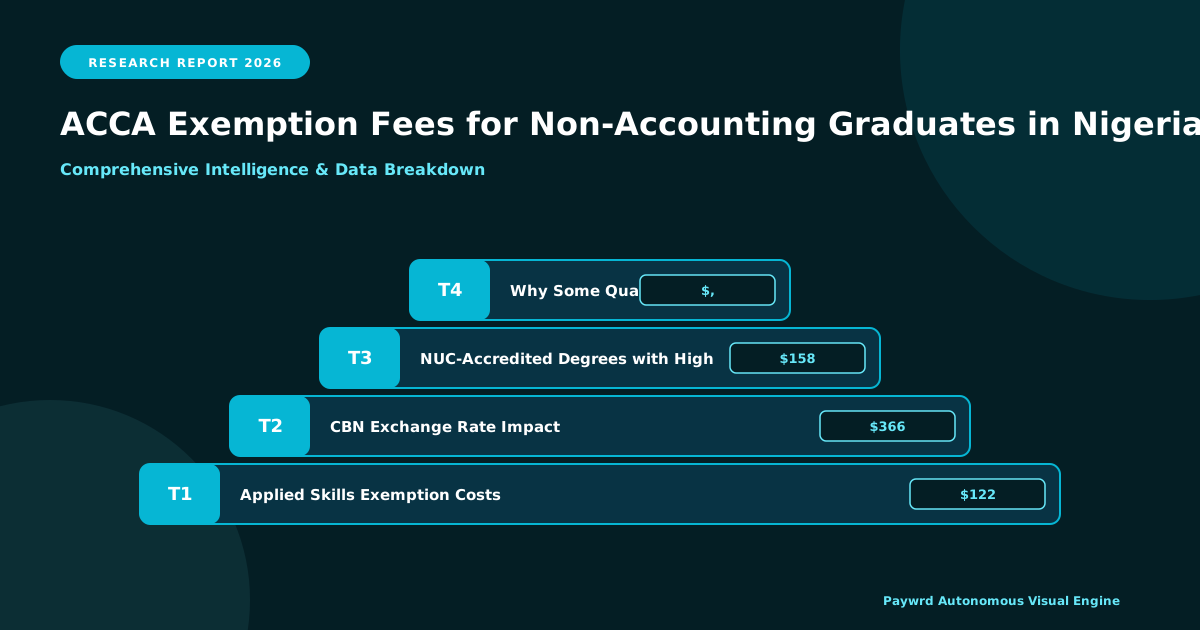
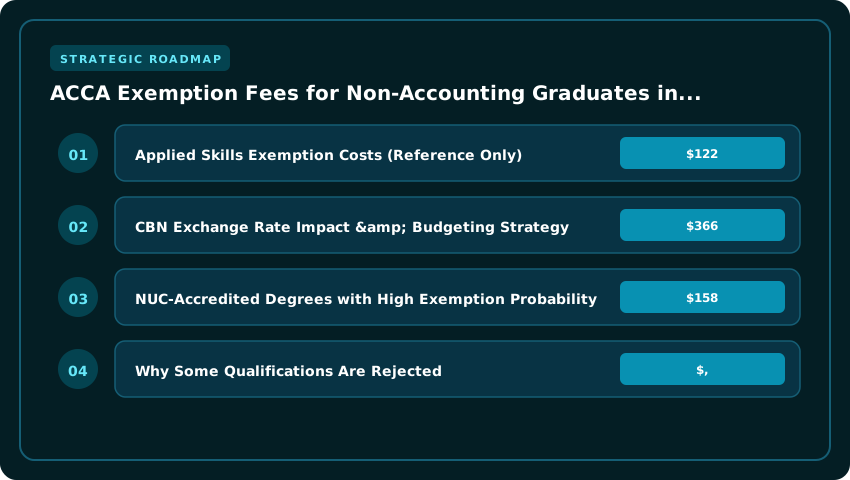
Each Applied Knowledge exemption carries a 2026 fee of $122 USD per paper. With three papers typically available (BT, MA, FA), the gross USD liability is $366. Using the prevailing CBN Investors & Exporters (I&E) window rate averaging ₦1,650/$ for Q1 2026 transactions, the Naira outflow looks like this:
- Per Paper: $122 × ₦1,650 = ₦201,300
- Three Papers (BT, MA, FA): $366 × ₦1,650 = ₦603,900
- Buffer for Card Fees/Rate Spike (5%): Add ~₦30,000 → Total Budget: ~₦635,000
Payment is processed via international-enabled Naira debit cards (Visa/Mastercard) on the MyACCA dashboard. Ensure your bank’s daily POS/WEB limit exceeds ₦210,000 per transaction to avoid split payments incurring multiple bank charges.

Applied Skills Exemption Costs (Reference Only)
If your transcript reveals specific module equivalencies (rare for non-accounting degrees), Applied Skills exemptions cost $158 USD per paper in 2026. At ₦1,650/$, that is ₦260,700 per paper. Six papers would exceed ₦1.56M. Always run the ACCA Exemption Calculator before paying; do not assume eligibility.
CBN Exchange Rate Impact & Budgeting Strategy
The CBN’s floating regime means the rate on your payment date determines the final debit. In 2026, we saw swings of ₦50–₦80 within a week. To mitigate risk:
- Fund Domiciliary Account First: Buy USD at a competitive bureau de change (BDC) rate (often ₦20–₦30 cheaper than bank I&E rate) and pay via a USD-denominated virtual card (e.g., Grey, Geegpay, or bank Dom card).
- Pay Early in the Cycle: ACCA exemption fees are fixed in USD for the calendar year. Paying in January/Q1 locks in the rate before potential election-cycle or oil-price volatility in H2 2026.
- Check Bank Limits: GTBank, Access, and Zenith often cap web transactions at $200–$500 daily. Request a temporary limit increase via your app or branch 24 hours before payment.
Remember: Exemption fees are non-refundable. Confirm your eligibility on the ACCA Exemption Enquiry Database using your exact institution name and graduation year before initiating any transfer.
Eligibility Criteria: Which Non-Accounting Degrees Qualify for Exemptions?
Not every university degree grants you a shortcut into the ACCA qualification. To avoid wasting your application fees or facing a rejection from the ACCA global registration team, you must understand that exemptions are granted based on the alignment of your university curriculum with the ACCA syllabus. In Nigeria, the primary benchmark for this alignment is the National Universities Commission (NUC) Core Curriculum and Minimum Academic Standards (CCMAS).
NUC-Accredited Degrees with High Exemption Probability
While a pure Accounting degree offers the maximum number of exemptions, several “Accounting-adjacent” degrees are recognized. If you graduated from an NUC-accredited institution in 2026 or earlier, the following degrees typically qualify for exemptions, primarily at the Applied Knowledge level (Business and Technology, Management Accounting, and Financial Accounting):
- Banking and Finance: High alignment with financial reporting and management accounting modules.
- Economics: Strong eligibility for exemptions in Business and Technology (BT) and Management Accounting (MA) due to the quantitative nature of the degree.
- Business Administration: Generally qualifies for the Business and Technology (BT) paper, though exemptions for financial papers depend on the specific concentration of the degree.
- Mathematics and Statistics: Often granted exemptions in Management Accounting (MA) due to advanced numerical proficiency.
Why Some Qualifications Are Rejected
A common point of frustration for Nigerian applicants is the rejection of Higher National Diplomas (HNDs) or foreign degrees. Here is why this happens in 2026:
Unaccredited Polytechnic HNDs: ACCA requires that the awarding institution be recognized by the National Board for Technical Education (NBTE) and the NUC. If your polytechnic’s program has lost its accreditation or is not listed on the official NUC/NBTE portals, ACCA will treat you as a “non-degree holder,” requiring you to sit for all papers from the start.
Foreign Degrees without NARIC/ENIC Evaluation: If you obtained your degree from a university outside Nigeria (e.g., India, UK, or USA), ACCA may not automatically recognize the institution. You are often required to provide a NARIC (now UK ENIC) evaluation to prove that your degree is equivalent to a UK Bachelor’s degree. Without this verification, your request for exemptions will likely be denied, regardless of your GPA.
To ensure a seamless process, always upload clear, scanned copies of your official degree certificate and a detailed academic transcript via the MyACCA portal. Partial transcripts or “statements of result” are frequently flagged, leading to delays in your 2026 registration.
Step-by-Step: Applying for Exemptions via myACCA Portal in 2026
Navigating the myACCA portal in 2026 requires precision, as any error in document submission can lead to a rejection of your exemption claim, forcing you to sit for exams you might already be qualified to skip. For non-accounting graduates in Nigeria, the process is streamlined but strict regarding certification.
Document Upload and Verification
Once you log into your myACCA account, navigate to the ‘Exemptions’ tab. You will be required to upload digital copies of your academic credentials. To avoid delays, ensure your documents meet these specific Nigerian requirements:
- Certified Degree Certificate: Upload a high-resolution scan of your original degree. Ensure it is stamped and signed by the Registrar of your university.
- Official Academic Transcripts: ACCA requires a detailed breakdown of every course taken. Your transcript must be sent directly from your institution to ACCA or uploaded as a certified true copy.
- NYSC Discharge Certificate: While not a prerequisite for the academic exemption itself, providing your NYSC discharge certificate is highly recommended for Nigerian students to validate their graduation status and professional standing within the national framework.
The Payment Workflow: Settling Fees in 2026
The most challenging part of the process for Nigerian candidates is the payment phase. Since ACCA bills in GBP/USD, the 2026 foreign exchange volatility makes your payment method critical to avoid transaction failures.
You have two primary routes for settling your exemption fees:
- Naira Debit Cards: Most standard Naira cards have strict monthly limits on international spend. If your exemption fees exceed these limits (which they likely will, given the 2026 exchange rates), your transaction will be declined. This method is only viable for very small, single-paper exemptions.
- USD Domiciliary Accounts: This is the gold standard for 2026. By using a virtual or physical USD card linked to a domiciliary account, you bypass the CBN’s retail limit on Naira cards. This ensures a seamless one-click payment and prevents the “Transaction Declined” error that plagues many Nigerian applicants.
After payment, your application enters the review queue. In 2026, the average processing time for Nigerian universities is 10 to 21 business days. Once approved, your exemptions will reflect automatically in your myACCA dashboard, and you can proceed to book your remaining Applied Skills papers.
Hidden Costs: Re-registration, Annual Subscription & Late Payment Penalties
Many Nigerian students make the mistake of budgeting only for the initial exemption fees, assuming that once the papers are cleared, the financial road to membership is smooth. However, the ACCA qualification carries a “total cost of ownership” that extends far beyond the initial grant of exemptions. To avoid sudden financial shocks in 2026, you must account for recurring operational costs.
The 2026 Annual Subscription Fee
The moment your exemptions are granted and your student status is activated, you are liable for the Annual Subscription fee. This is not a one-time payment but a recurring charge required to maintain your active status on the global register. For the 2026 cycle, this fee is mandatory for all students to access the MyACCA portal, book exams, and receive official results.
- Immediate Liability: This fee is typically due upon registration or at the start of the calendar year.
- Currency Volatility: Because this is billed in GBP/USD, the Naira equivalent fluctuates. Budget approximately ₦120,000 to ₦180,000 annually depending on the prevailing 2026 exchange rates.
- Consequence of Non-payment: Failure to pay the subscription locks your portal, meaning you cannot register for the next set of Applied Skills papers.
Re-activation Fees and Lapsed Status
Life happens—whether it is a career shift or financial constraints. If you stop paying your annual subscriptions or fail to sit for an exam for a prolonged period, your student status may lapse. If this happens before you reach the Strategic Professional level, you cannot simply “resume” where you left off.
To return to the program, you will be required to pay a Re-activation Fee. This is a penalty charge designed to bring your account back into good standing. In 2026, this fee is often higher than the standard annual subscription and must be cleared before any pending exemptions are recognized or new exams are booked.
Late Payment Penalties and Exam Deadlines
ACCA operates on a strict “Standard Entry” and “Late Entry” deadline system. If you miss the standard window for your Applied Skills exams, you will be hit with a late entry surcharge. This penalty can increase the cost of a single paper by 20% to 50%.
- Standard Entry: Lowest cost; requires planning 2 months in advance.
- Late Entry: Significant price hike; often occurs when students rush to finish papers before the end of the quarter.
Exemptions vs. Foundations in Accountancy (FIA): Cost-Benefit Analysis for 2026
For a non-accounting graduate in Nigeria, the crossroads between claiming exemptions and enrolling in the Foundations in Accountancy (FIA) route is a strategic financial decision. While exemptions offer a shortcut, the FIA route provides a pedagogical safety net. In 2026, the decision hinges on whether you prioritize speed of certification or the depth of your technical foundation.
Financial Breakdown: Direct Costs vs. Long-term Value
Choosing exemptions is essentially “buying time.” If you qualify for the three Applied Knowledge papers (BT, MA, FA), you pay a lump sum—roughly ₦600,000 to ₦650,000 depending on the current CBN exchange rate—to skip these exams. This is a significant upfront cost but eliminates the need for tuition fees and exam registration for those specific modules.
Conversely, the FIA route allows you to pay as you go. You pay for individual papers and registration fees over a longer period. While the cumulative cost of FIA registration, tuition from a tuition provider, and exam fees may eventually equal or exceed the cost of exemptions, the cash flow burden is spread out. For students leveraging NELFUND loans or corporate sponsorships in 2026, the FIA route is often more manageable than a massive one-time USD payment via the MyACCA portal.
Time-to-Membership: Fast-Tracking vs. Knowledge Building
The strategic trade-off is most evident in your career timeline:
- The Exemption Route (Fast-Track): This is the optimal path for graduates with a strong quantitative background (e.g., Engineering, Mathematics, or Economics) who need to enter the job market as “ACCA Part-Qualified” as quickly as possible. It shaves approximately 6 to 12 months off your journey to membership.
- The FIA Route (Foundation): This is highly recommended for those from purely arts or social science backgrounds. Jumping straight into Applied Skills (the next level) without the foundational knowledge of Financial Accounting (FA) or Management Accounting (MA) often leads to high failure rates in professional papers, which costs more in retake fees than the original FIA route would have.
Ultimately, if your 2027 goal is to secure a role in a Big 4 firm or a top-tier Nigerian bank, the speed of exemptions is an advantage. However, if you find the concept of a balance sheet alien, investing the time in FIA ensures you don’t crash and burn during the more rigorous Strategic Professional level.
Employer Sponsorship & NELFUND: Funding Your ACCA Exemptions in Nigeria
Paying for ACCA exemptions out-of-pocket in 2026 is a significant financial burden, especially with the volatility of the Naira against the Pound Sterling. For non-accounting graduates entering the workforce in Lagos or Abuja, the most sustainable path to certification is leveraging corporate sponsorship or government-backed credit facilities.
Structuring a Reimbursement Proposal for Corporate Giants
Top-tier employers in Nigeria—specifically the Big 4 (PwC, Deloitte, KPMG, EY), commercial banks, and FMCGs like Unilever or Nestlé—have established budgets for professional development. However, they rarely hand over funds without a structured business case. To secure sponsorship for your exemption fees, your proposal must shift from “personal growth” to “organizational value.”
When drafting your request to HR or your Line Manager, include these three critical pillars:
- The Competency Gap: Explicitly state how the ACCA Applied Skills modules will improve your current output in financial reporting or audit efficiency.
- The ROI Timeline: Propose a “claw-back” agreement. For example, suggest that the firm pays 100% of the exemption fees, but you agree to remain with the company for 12 to 24 months post-certification or refund a prorated amount.
- The Certification Roadmap: Provide a clear schedule of when you intend to sit for the remaining papers, proving that the exemptions are a springboard, not a destination.
NELFUND 2026: Can the Skill-Up Loan Cover ACCA?
The Nigerian Education Loan Fund (NELFUND) has expanded its mandate for 2026 to include the “Skill-Up” loan category, moving beyond traditional university tuition. For non-accounting graduates, this presents a strategic opportunity to fund professional certifications.
Under the 2026 guidelines, professional certification fees are eligible for funding provided the certification is recognized by the National Universities Commission (NUC) or relevant professional regulatory bodies in Nigeria. To apply for ACCA funding via the NELFUND portal, you must meet the following criteria:
- Verification: You must upload a valid admission letter or registration confirmation from the ACCA MyACCA portal.
- BVN & NIN Linkage: Your profile must be fully synchronized with the National Identity Management Commission (NIMC) to prevent fraud.
- Repayment Terms: Be aware that NELFUND loans are typically tied to employment status; repayments commence only after you secure a job above the minimum wage threshold or complete your certification.
By combining a NELFUND loan for initial exemptions with a corporate sponsorship plan for the Strategic Professional level, you can effectively eliminate the upfront financial barrier to becoming a Chartered Certified Accountant in Nigeria.
| Exemption Category | Eligible Degrees (Non-Accounting) | Estimated Cost (2026 Naira ₦) | Timeline for 2026/2027 Intake | Prerequisites |
|---|---|---|---|---|
| Applied Knowledge (BT, MA, FA) | Economics, Engineering, Sciences, Arts | ₦600,000 – ₦650,000 | January – December 2026 | B.Sc. or HND from recognized university |
| Applied Skills (LW, PM, TX, FR, AA, FM) | Not typically applicable for non-accounting degrees | N/A (Full Exam Required) | Quarterly Exam Windows 2026/2027 | Accredited Accounting Degree |
| Strategic Professional Level | Not applicable for entry-level graduates | N/A (Full Exam Required) | Ongoing 2026/2027 | Completion of Applied Skills |
Frequently Asked Questions
How much are ACCA exemption fees for non-accounting graduates in Nigeria for 2026?
For 2026, non-accounting graduates in Nigeria typically qualify for exemptions in the Applied Knowledge module (BT, MA, FA). The estimated total cost ranges between ₦600,000 and ₦650,000, depending on the current CBN exchange rate, as fees are paid in USD via the MyACCA portal to the global body.
Which ACCA papers can a non-accounting graduate get exemptions for in 2026?
In 2026, non-accounting graduates (such as those with degrees in Economics, Engineering, or Sciences) generally only receive exemptions for the Applied Knowledge level, specifically Business and Technology (BT), Management Accounting (MA), and Financial Accounting (FA). Applied Skills exemptions are strictly reserved for accredited accounting-specific degree holders.
How do I pay ACCA exemption fees from Nigeria in 2026?
Nigerian students must pay their 2026 ACCA exemption fees directly through the MyACCA portal. While the global fee structure is denominated in GBP, payments from Nigeria are processed in USD. It is recommended to use a domiciliary account or a USD-enabled corporate card to avoid transaction failures.
Can an Economics graduate get Applied Skills exemptions in ACCA for 2027?
Generally, Economics graduates are only eligible for Applied Knowledge exemptions. For the 2027 cycle, Applied Skills exemptions (LW through FM) remain reserved for degrees specifically accredited by ACCA. Economics graduates should plan to sit for the Applied Skills exams to progress toward full membership.
What is the process for claiming ACCA exemptions for Nigerian graduates in 2026?
To claim exemptions in 2026, Nigerian graduates must upload their official degree certificate and academic transcripts to the MyACCA portal. ACCA will then review the curriculum against their global standards and notify the student of the eligible exemptions and the corresponding USD fees required for credit.
Strategic Final Takeaway
When evaluating What Are ACCA Exemption Fees For Non Accounting Graduates in 2026 and beyond, base your decisions on accredited institutional standards, verified return on investment (ROI), and up-to-date official guidelines. Always verify specific dates and requirements through official regulatory portals.