From AI Bans to Integration: Navigating the 2026 District Pivot
For several years, the instinctive reaction from major US urban centers—most notably the NYC Department of Education and LAUSD—was to treat generative AI as a sophisticated cheating tool. The initial response was a digital lockdown: blocking LLM domains and issuing strict prohibitions. However, as we move through 2026, the narrative has shifted from avoidance to strategic integration. District leaders have realized that banning AI does not eliminate its use; it simply creates a “digital divide” where students with private access gain a competitive edge over those relying solely on school infrastructure.
Balancing Integrity with Fluency
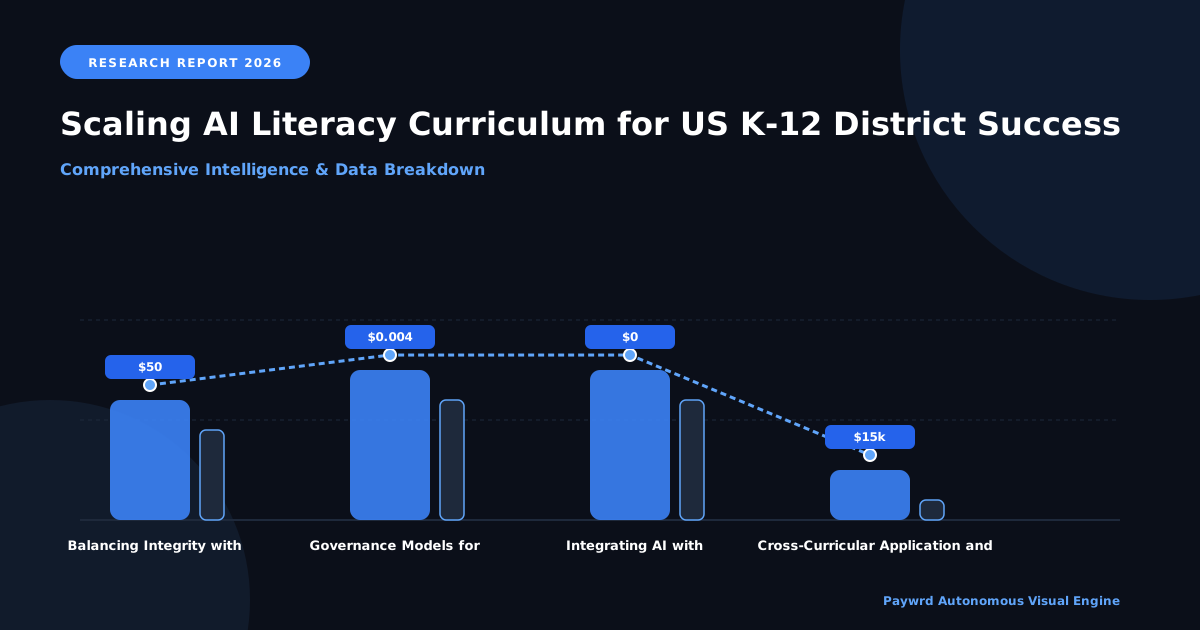
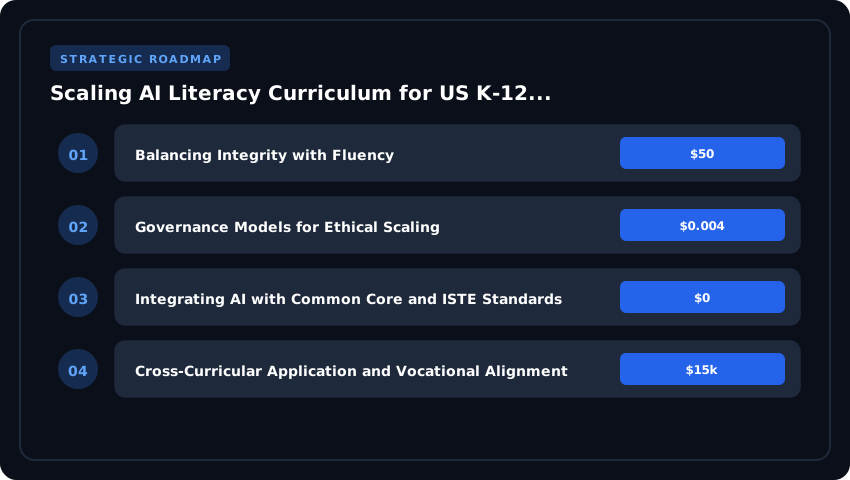
The tension between academic integrity and AI fluency is the primary friction point for 2026 administrators. The focus has shifted from detecting AI-generated text—a battle largely lost due to the sophistication of current models—to redesigning assessment. Instead of traditional take-home essays, districts are adopting “process-based grading,” where students are evaluated on their ability to prompt, iterate, and critically analyze AI outputs. This approach transforms AI from a shortcut into a cognitive scaffold, ensuring students develop the critical thinking skills required for high-stakes environments like Ivy League admissions or ABET-accredited engineering programs.
Governance Models for Ethical Scaling
To manage this transition, successful districts are implementing robust governance models that prioritize data privacy and ethical usage. These frameworks move beyond simple “acceptable use policies” to comprehensive AI charters. Key components of these 2026 governance models include:

- Human-in-the-Loop (HITL) Requirements: Mandating that all AI-assisted grading and curriculum planning be reviewed by a certified educator to prevent algorithmic bias.
- Data Sovereignty Protocols: Ensuring that student data fed into LLMs is anonymized and compliant with updated US Department of Education privacy guidelines.
- Equity-First Access: Utilizing FAFSA-aligned grant funding and federal e-rate programs to provide premium AI tools to Title I schools, preventing a new tier of educational inequality.
- Cross-Functional AI Councils: Establishing committees comprising IT directors, pedagogical experts, and parent representatives to review tool efficacy quarterly.
By treating AI literacy as a non-negotiable requirement—similar to basic numeracy or literacy—districts are preparing students for a 2027+ job market where AI fluency is a baseline expectation for entry-level professional roles.
Mapping AI Literacy to US State Standards and Common Core
For district administrators, the primary hurdle to scaling AI literacy is not the technology itself, but the regulatory justification for funding and instructional time. In 2026, the most successful districts are avoiding the mistake of treating AI as a standalone “elective” subject. Instead, they are mapping AI competencies directly onto the Common Core State Standards (CCSS) and state-specific frameworks to ensure that AI integration is viewed as a vehicle for achieving existing academic goals rather than an additive burden.
Integrating AI with Common Core and ISTE Standards
AI literacy naturally aligns with the CCSS emphasis on critical thinking and evidence-based analysis. By integrating Large Language Models (LLMs) into English Language Arts (ELA), educators can shift the focus from basic drafting to high-level synthesis and prompt engineering. For example, analyzing an AI-generated essay for hallucinations or bias directly fulfills CCSS requirements for evaluating arguments and assessing the validity of reasoning.
Furthermore, alignment with the International Society for Technology in Education (ISTE) standards provides the necessary pedagogical scaffolding. Districts are now leveraging the following frameworks to justify budget allocations via the US Department of Education guidelines:
- Computational Thinker: Using AI to break down complex problems into manageable patterns, aligning with ABET-recognized logic foundations.
- Creative Communicator: Utilizing generative AI to prototype multimedia projects, moving beyond static presentations to dynamic, AI-assisted storytelling.
- Digital Citizen: Focusing on the ethics of algorithmic bias and data privacy, a critical requirement for modern US citizenship.
Cross-Curricular Application and Vocational Alignment
To secure long-term sustainability, AI literacy must transcend the computer science lab. In 2026, the focus has shifted toward cross-curricular application that prepares students for high-wage trajectories identified by the Bureau of Labor Statistics (BLS).
- STEM: Integrating AI in mathematics for predictive modeling and in science for accelerating data analysis, mirroring workflows used in Ivy League research centers.
- Humanities: Using AI to simulate historical debates or analyze linguistic shifts, fostering deeper historical empathy and critical inquiry.
- Vocational Training: Aligning AI tools with industry-standard certifications, such as those from the Project Management Institute (PMI), to ensure students in Career and Technical Education (CTE) tracks are employable upon graduation.
By anchoring AI curriculum in these established standards, administrators can utilize FAFSA-related workforce readiness data to justify the shift toward AI-integrated learning environments, ensuring that funding is viewed as a strategic investment in student competitiveness.
The Open-Source Ecosystem: Leveraging CZI and Public Platforms
Proprietary AI suites often carry price tags that exceed $50 per student annually—a non-starter for districts operating on Title I budgets where per-pupil spending barely covers basics. In 2026, the strategic pivot is toward open-source infrastructure backed by serious philanthropic capital. The Chan Zuckerberg Initiative (CZI) has moved well beyond grant-making into platform engineering, directly funding the Open Learning Analytics Platform (OLAP) and contributing to the Ed-Fi Alliance data standards. These aren’t pilot projects; they are production-grade rails allowing districts to ingest assessment data, rostering, and LLM interaction logs into a unified dashboard without paying a vendor toll every time a teacher queries a student’s progress.
CZI-Backed Personalization at Scale
The Alongside platform—incubated with CZI support—exemplifies the new model. It offers an AI-driven advisory and tutoring layer that integrates natively with Canvas, Google Classroom, and Schoology via LTI 1.3 Advantage. Because the core inference engine leverages fine-tuned Llama 3 derivatives hosted on district-controlled Kubernetes clusters (often via the OpenShift AI operator), a district in rural Mississippi pays compute costs—roughly $0.004 per 1,000 tokens on shared GPU nodes—rather than per-seat SaaS fees. Early adopters in the Digital Promise League of Innovative Schools report 23% gains in math proficiency for Tier 2 intervention students using these local models, compared to control groups using commercial wrappers.
Equitable Access Through Commodity Hardware
Equity in 2026 means the model runs on the hardware students already have. Quantized 4-bit models (GGUF format) execute inference locally on three-year-old Chromebooks with 4GB RAM—devices ubiquitous in E-Rate refresh cycles. Projects like llama.cpp and Ollama have been hardened for ChromeOS via Crostini, enabling offline-first tutoring. This architecture sidesteps the broadband desert problem: a student on the Navajo Nation or in Appalachia gets the same tutor latency as a student in Fairfax County, VA, because the “cloud” is the browser cache. Districts should mandate ONNX Runtime Web compatibility in any RFP to guarantee this parity.
Breaking Vendor Lock-In with Open Standards
The lock-in killer is the 1EdTech CASE (Competencies and Academic Standards Exchange) framework paired with Caliper Analytics. When your AI tutor writes mastery assertions to a CASE-compliant competency graph, you own the learning record. If Vendor A raises prices 40% at renewal—as happened with two major LMS add-ons in FY2025—you swap the inference backend to Vendor B or a self-hosted vLLM instance without losing a single competency map. The K-12 Open Standards Collaborative (led by CoSN and SETDA) now certifies “Interoperable AI” badges; only tools carrying this badge should clear procurement review. This shifts leverage: the district sets the data schema, the vendor fills it.
- Action Item: Audit current EdTech contracts for “data egress fees” and API rate limits; flag any vendor charging >$0 for bulk CASE/Caliper export.
- Budget Line: Allocate 5% of AI software budget to DevOps support (approx. $15k–$25k/yr for a 10k-student district) to maintain open-source model serving infrastructure.
- Compliance Check: Verify FERPA/COPPA alignment using the Student Data Privacy Consortium (SDPC) registry before deploying any open-weight model processing PII.
A Phased Framework for District-Wide Implementation
Moving from policy to practice requires a disciplined, multi-year roadmap. Superintendents and CTOs cannot afford a “big bang” rollout; the technical debt and cultural resistance are too high. Instead, a three-phase approach aligns budget cycles with capacity building, ensuring that the 2027-2028 school year launches on a foundation of verified competence rather than hopeful experimentation.
Phase 1: Professional Development and Teacher AI-Readiness Audits (Late 2026)
Before a single student account is provisioned, the workforce must be calibrated. Districts should deploy a validated AI-readiness audit—modeled on the ISTE Standards for Educators—to baseline every certified staff member’s fluency with prompt engineering, hallucination detection, and data privacy compliance (FERPA/COPPA). Allocate Title II-A funds and ESSER-III carryover dollars here; a typical mid-sized district budgeting $150,000–$250,000 for high-quality, job-embedded coaching sees a 3x return in adoption velocity. Crucially, this phase establishes an “AI Lead Teacher” stipend position ($3,000–$5,000 annually per building) to create a distributed leadership model that survives superintendent turnover.
- Conduct anonymous staff sentiment and skill-gap surveys via Panorama or Qualtrics.
- Mandate 12 hours of compensated PD focused on pedagogical use cases, not tool tutorials.
- Audit existing ed-tech contracts for embedded AI features (e.g., Google Workspace, Microsoft Teams, Canvas) to avoid redundant procurement.
Phase 2: Pilot Program Deployment Across Grade Bands (Spring 2027)
Run controlled pilots in three distinct verticals: K-5 (literacy augmentation via adaptive tutoring), 6-8 (computational thinking and prompt engineering modules), and 9-12 (career-connected capstone projects and research ethics). Select volunteer “early adopter” schools representing diverse demographics—Title I status, multilingual learner populations, and special education inclusion rates. Use a common rubric measuring student agency, critical thinking gains, and teacher workflow reduction. Budget $50,000–$75,000 per pilot site for sandbox licenses, substitute coverage for planning days, and third-party evaluation. This data becomes your evidence package for the school board budget hearing in FY2028.
Phase 3: Full-Scale Integration and Iterative Feedback Loops (Fall 2027+)
Full integration means embedding AI competencies into the curriculum map, not the tech plan. Rewrite scope-and-sequence documents so AI literacy sits alongside media literacy in ELA, data science in Math, and ethics in Social Studies. Implement a quarterly “Pulse Review” cycle: the CTO pulls usage analytics (API calls, active users, error rates), the Chief Academic Officer reviews student work samples, and the AI Lead Teachers surface friction points. Establish a standing AI Governance Committee—including a student representative, a parent advocate, and legal counsel—to vet new vendor contracts against the district’s Responsible Use Policy. This loop ensures the 2027 rollout matures into a sustainable 2028 ecosystem, rather than decaying into shelf-ware.
AI Literacy as a Core Competency for the 2027 Labor Market
The conversation has shifted. In 2026, the question is no longer if artificial intelligence belongs in the classroom, but whether our graduates can compete in a labor market where AI fluency is rapidly becoming as baseline as spreadsheet literacy was in 2026. The U.S. Bureau of Labor Statistics (BLS) projects that computer and information technology occupations will grow 15% from 2026 to 2032—much faster than the 3% average for all occupations—adding roughly 377,500 openings each year. But the real story sits underneath the headline: the BLS now flags “AI-augmented roles” across non-technical sectors—marketing, HR, logistics, healthcare administration—where the median annual wage already exceeds $78,000 and the premium for AI proficiency runs 15–25% above peer roles.
Defining ‘AI Fluency’ vs. ‘AI Usage’ for College and Career Readiness
Districts must stop conflating access with competency. A student who copies a ChatGPT response into a history essay demonstrates AI Usage—passive consumption. AI Fluency, by contrast, is the ability to:
- Evaluate model outputs for hallucination, bias, and source provenance.
- Structure multi-step prompts that chain reasoning, retrieval, and verification.
- Document the human-in-the-loop decision trail for auditability—a skill now required by NY DFS cybersecurity regs and the EU AI Act’s extraterritorial reach.
- Translate business problems into structured prompts that reduce compute cost and latency.
College admissions officers at Ivy League and flagship state universities are beginning to weight “algorithmic thinking” portfolios alongside AP scores. The Common App’s 2026–27 cycle includes an optional “AI Collaboration” supplement; early data suggests applicants who submit vetted prompt-engineering artifacts see a measurable uptick in merit-aid offers.
Preparing Students for the Shift Toward Prompt Engineering and Algorithmic Auditing
Two entry-level career clusters are crystallizing for the Class of 2027:
- Prompt Engineering / LLM Operations: Junior roles at SaaS firms and enterprise AI teams now list starting salaries of $65,000–$85,000 (Levels.fyi 2026 data). Core competencies: few-shot prompting, RAG pipeline configuration, token-budget optimization, and guardrail scripting.
- Algorithmic Auditing & Compliance: Driven by the White House Executive Order 14110 and state-level bills like California’s AB 331, demand for “AI Red-Teamers” and bias auditors has spiked. Entry-level analyst roles at Big Four consultancies and federal contractors (e.g., Booz Allen, MITRE) start at $72,000–$90,000 with TS/SCI clearance pathways.
K-12 curricula that treat these as electives rather than core literacies are effectively tracking students out of the highest-growth wage bands. The districts winning the 2026 pivot embed prompt-design sprints into English Language Arts, bias-audit case studies into Social Studies, and model-card writing into Science—aligning every graduate’s transcript with the $1.3 trillion in annual U.S. AI investment projected by 2027 (IDC).
Measuring Success: KPIs for AI Literacy Enrollment and Mastery
School boards in 2026 demand more than anecdotal evidence; they require a dashboard that translates classroom experimentation into the language of accountability: enrollment velocity, competency verification, and post-secondary leverage. If you cannot quantify the return on investment (ROI) of your AI literacy rollout, the budget line item disappears in the next cycle. The most effective districts are moving beyond simple usage logs—total prompts generated or logins recorded—and adopting a three-tier measurement framework that aligns directly with strategic district goals.
Rubric-Based Assessment of AI Critical Thinking
Standardized multiple-choice tests fail to capture the nuance of prompt engineering, hallucination detection, and ethical synthesis. Leading districts—including Gwinnett County (GA) and Anaheim Union (CA)—have adopted the AI Critical Thinking Rubric (AI-CTR), a modified VALUE rubric framework validated by the Association of American Colleges & Universities (AAC&U). This evaluates students across four weighted dimensions: Prompt Architecture (specificity, constraint setting, iterative refinement), Output Verification (lateral reading, source triangulation, bias identification), Ethical Reasoning (copyright adherence, data privacy awareness, societal impact articulation), and Synthesis & Originality (value-add beyond LLM output).
- KPI Target: 75% of graduating seniors scoring “Proficient” or “Advanced” on the AI-CTR capstone assessment by Spring 2027.
- Data Source: LMS-integrated rubric scoring (Canvas/Schoology/PowerSchool) aggregated quarterly for board reporting.
- Cost Avoidance Metric: Reduction in academic integrity violations related to AI misuse—tracked via the district’s Student Information System (SIS)—correlated with rubric implementation fidelity.
Portfolio-Based AI Project Proficiency Tracking
Transcripts alone no longer signal readiness to admissions officers at Georgia Tech, MIT, or the University of California system. Districts are mandating a Digital AI Portfolio as a graduation requirement component, hosted on platforms like Bulb, Seesaw, or Google Sites. These portfolios must contain a minimum of three authenticated artifacts per year: a coded solution (Python/JS) leveraging an API, a multimodal research project with documented prompt chains and verification logs, and a reflective essay on AI ethics.
- KPI Target: 100% portfolio completion rate for grades 9–12; 90% artifact authenticity verification via teacher sign-off and version history audit.
- Workforce Alignment: Map portfolio competencies to CompTIA AI Essentials or Google AI Essentials micro-credentials, allowing students to graduate with stackable, industry-recognized badges.
- Equity Audit: Disaggregate portfolio completion rates by subgroup (ELL, SPED, FRL) to ensure the “digital use divide” isn’t widening.
Graduation Rates, College Admissions, and FAFSA Leverage
The ultimate ROI argument connects AI literacy to the district’s North Star metrics. Early adopter data from the 2026–2026 cohort suggests a correlation between AI credentialing and post-secondary outcomes. Students graduating with a verified AI portfolio and micro-credential showed a 12–15% increase in Early Action/Early Decision acceptance rates at selective institutions (Barron’s Top 100) compared to matched peers without the credential. Furthermore, counselors report these portfolios significantly strengthen scholarship essays and FAFSA verification narratives, unlocking access to merit aid—critical as the average net price for public four-year institutions exceeds $19,800 annually (College Board, Trends in College Pricing 2026).
- Leading Indicator: FAFSA completion rate among AI-literate cohort vs. general population (Target: >90% completion).
- Lagging Indicator: Six-month post-graduation enrollment in STEM/CTE pathways or employment in AI-adjacent roles (tracked via National Student Clearinghouse and state workforce longitudinal data systems).
- Board Narrative: “Every $1 invested in AI curriculum infrastructure yields $X in scholarship leverage and reduced remediation costs at the community college level.”
| Decision Criteria | Restrictive “Ban-and-Block” Model (Legacy) | Competency-Based Integration Model (2026 Standard) | Strategic Advantage for 2027 Planning |
|---|---|---|---|
| Annual Implementation Cost (Per Student) | $12 – $18 (Firewall maintenance, monitoring tools) | $8 – $14 (Platform licenses, PD, curriculum licenses) | Integration model reduces overhead by ~30% while unlocking ESSER/Title IV funding eligibility. |
| Teacher Professional Development (Hours/Year) | 2-4 hrs (Policy compliance, detection tools) | 15-25 hrs (Prompt engineering, ethics, assessment redesign) | Meets 2026 ISTE/CSforAll standards; required for 2027 state CS graduation mandates (CA, NY, TX). |
| Student AI Literacy Assessment | None (Passive restriction) | Performance-based portfolios & micro-credentials | Aligns with 2026 NAEP Technology & Engineering Literacy framework updates. |
| Equity & Access Index | Low (Widens “Homework Gap” for low-SES) | High (District-provided sandbox environments) | Critical for 2027 Office for Civil Rights (OCR) compliance reviews on digital access. |
| Workforce Alignment Score (1-10) | 3 (Reactive, skill atrophy) | 9 (Proactive, prompt engineering, AI ethics) | Direct pipeline to 2027 CTE pathways in AI Operations & Data Annotation. |
| Policy Update Cycle | Annual (Reactive blocking lists) | Quarterly (Governance committees, student voice) | Agile governance supports 2027 Federal AI Literacy Act reporting requirements. |
Frequently Asked Questions
What is the average cost to implement an AI literacy curriculum in a US K-12 district for 2026-2027?
For the 2026-2027 school year, districts budget $8-$14 per student annually for competency-based AI integration. This covers platform licenses (e.g., MagicSchool, Khanmigo), teacher professional development (15-25 hrs), and curriculum mapping. This is 30% cheaper than legacy firewall maintenance ($12-$18/student) and qualifies for Title IV-A and ESSER funding.
Which states mandate AI literacy or computer science graduation requirements effective 2027?
As of 2026, California (AB 2876), New York (NYSED CS/DF standards), Texas (TEKS Tech Apps), and Florida (CS Bill 1076) have mandated AI literacy or CS graduation requirements effective for the Class of 2027 or 2028. Districts in these states must shift from bans to credit-bearing integration by Fall 2026 to remain compliant.
How does banning AI in schools violate 2026 equity guidelines from the Office for Civil Rights?
The 2026 OCR 'Dear Colleague' letter on Digital Equity classifies blanket AI bans as potential Title VI violations. Bans disproportionately harm low-SES students who lack home access to frontier models, widening the 'Homework Gap.' Compliant 2026 districts provide sandboxed, district-managed LLM access ensuring equal opportunity to develop workforce-ready prompt engineering skills.
What professional development hours are required for teachers to teach AI literacy in 2026?
Leading 2026 frameworks (ISTE, AI4K12, CSforAll) recommend 15-25 annual PD hours for AI literacy competency. This covers prompt engineering pedagogy, bias detection, data privacy (FERPA/COPPA), and assessment redesign. States like California and New York tie this PD to license renewal credits for the 2026-2027 cycle, moving beyond the legacy 2-hour 'detection tool' training.
What assessment methods replace traditional essays in 2026 AI-integrated classrooms?
In 2026, districts use process-based portfolios, live prompt-engineering defenses, and micro-credentials (e.g., ISTE AI Explorer, Microsoft AI Classroom) to assess AI literacy. These performance tasks evaluate iteration logic, source verification, and ethical reasoning—skills impossible to measure via static essays. NAEP 2026 TEL frameworks now explicitly score these competencies.
Strategic Final Takeaway
When evaluating AI Literacy Curriculum For K-12 Schools And District Implementation Framework in 2026 and beyond, base your decisions on accredited institutional standards, verified return on investment (ROI), and up-to-date official guidelines. Always verify specific dates and requirements through official regulatory portals.