
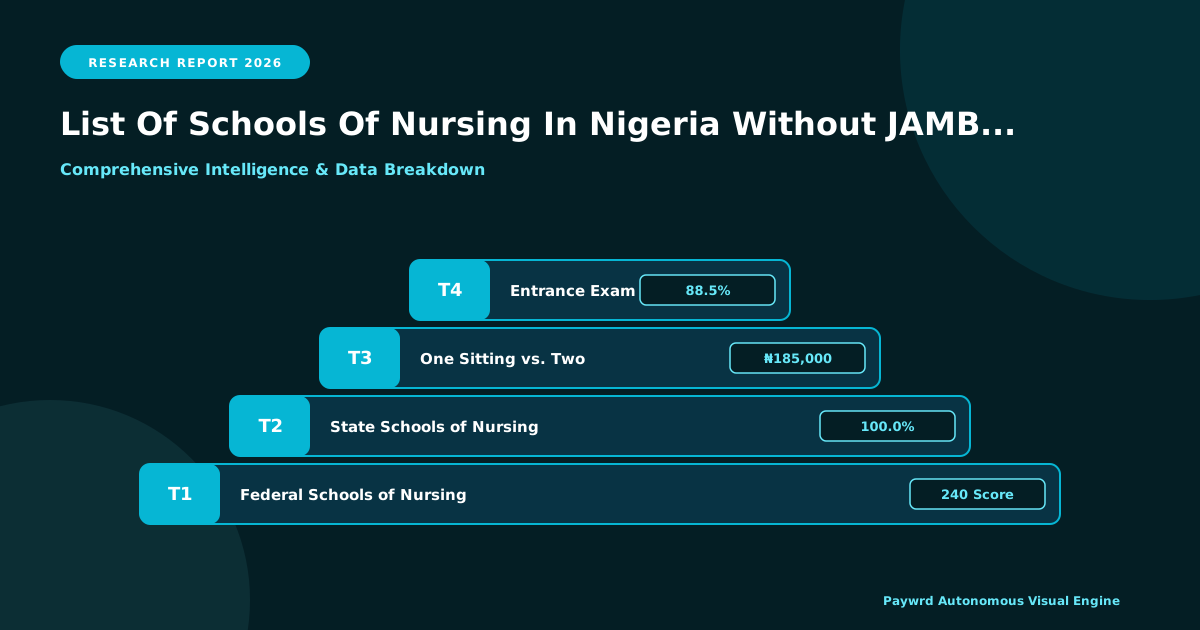
2026/2027 Accredited Schools of Nursing Admitting Without JAMB
The Nursing and Midwifery Council of Nigeria (NMCN) maintains a strict distinction: Schools of Nursing (Basic Nursing/Basic Midwifery) run three-year diploma programmes regulated solely by the Council, while University Departments of Nursing Science run five-year BNSc degrees requiring JAMB. For the 2026/2027 academic session, over 150 accredited Schools of Nursing across the federation are selling direct-entry forms. Admission hinges on your WAEC/NECO/NABTEB results and performance on the school’s Computer-Based Test (CBT), usually conducted between June and September 2026.

Federal Schools of Nursing (Highly Subsidised Fees)
Federal institutions remain the gold standard for affordability (tuition often ₦50,000–₦150,000 per session) and clinical exposure at Federal Medical Centres. Forms for the 2026 intake typically open in April.
- North: FMC Azare (Bauchi), FMC Birnin Kebbi, FMC Gusau, FMC Jalingo, FMC Keffi, FMC Nguru (Yobe), FMC Owerri (Imo – though geographically South-East, federally administered).
- South-West: FMC Abeokuta, FMC Owo (Ondo), FMC Ebute-Metta (Lagos – Post-Basic mostly, check Basic Nursing status for 2026), LUTH Idi-Araba (School of Nursing), UCH Ibadan (School of Nursing).
- South-South/South-East: FMC Asaba, FMC Owerri, FMC Umuahia, FMC Yenagoa, UPTH Port Harcourt (School of Nursing).
- North-Central/FCT: National Hospital Abuja (School of Nursing), FMC Bida, FMC Lokoja, FMC Makurdi.
State Schools of Nursing (Regional Accessibility)
State-owned schools prioritize indigenes via catchment quotas but admit non-indigenes at slightly higher fees (₦150,000–₦300,000/session). Verify 2026 accreditation status on the NMCN portal before paying.
- North-West: School of Nursing Katsina, Sokoto, Gusau, Dutse (Jigawa), Birnin Kebbi, Kano (Murtala Muhammad Specialist Hospital), Kaduna (Barau Dikko).
- North-East: School of Nursing Maiduguri (Borno), Yola (Adamawa), Gombe, Bauchi, Damaturu (Yobe).
- South-West: School of Nursing LASUTH Ikeja (Lagos – highly competitive), OOUTH Sagamu (Ogun), LAUTECH Osogbo (Osun), UCH Ibadan (Oyo State managed), EKSUTH Ado-Ekiti, UNIMED Ondo.
- South-East: School of Nursing Nnewi (Anambra), Enugu (ESUTH/UNTH), Abakaliki (FETHA/EBSUTH), Owerri (FMC/Imo State), Umuahia (ABSUTH).
- South-South: School of Nursing Uyo (Akwa Ibom), Calabar (CRS), Port Harcourt (Rivers – BMH/RSUTH), Benin (UBTH/EDOSUTH), Asaba (Delta), Yenagoa (Bayelsa).
Private & Mission Schools of Nursing (NMCN Approved for 2026)
Private colleges charge premium fees (₦600,000–₦1,500,000 per session) but offer guaranteed admission slots, modern hostels, and faster academic calendars. Confirm the 2026/2027 NMCN accreditation letter on the school’s notice board.
- Lagos/Ogun Axis: Babcock University Teaching Hospital (Ilishan), Lead City University Teaching Hospital (Ibadan – though BNSc, check Diploma wing), Sacred Heart Catholic Hospital (Lantoro, Abeokuta), St. Nicholas Hospital (Lagos).
- South-East/South-South: Madonna University Teaching Hospital (Elele), Gregory University (Uturu – check Nursing Dept), St. Charles Borromeo (Onitsha), Mater Misericordiae (Afijio/Oyo), Methodist Hospital (Ituk Mbang, Akwa Ibom).
- North: ECWA School of Nursing (Egbe, Kogi), ECWA School of Nursing (Jos), Bingham University Teaching Hospital (Jos), Nile University (Abuja – verify diploma vs degree).
Action Step: Shortlist 3–5 schools by geography and budget. Download the 2026 application form PDF from the school’s official website (avoid third-party agents), pay the application fee via Remita/TSA, and prepare rigorously for the CBT—past questions are your best currency.
2026 Admission Requirements: WAEC/NECO Grades & Age Limits
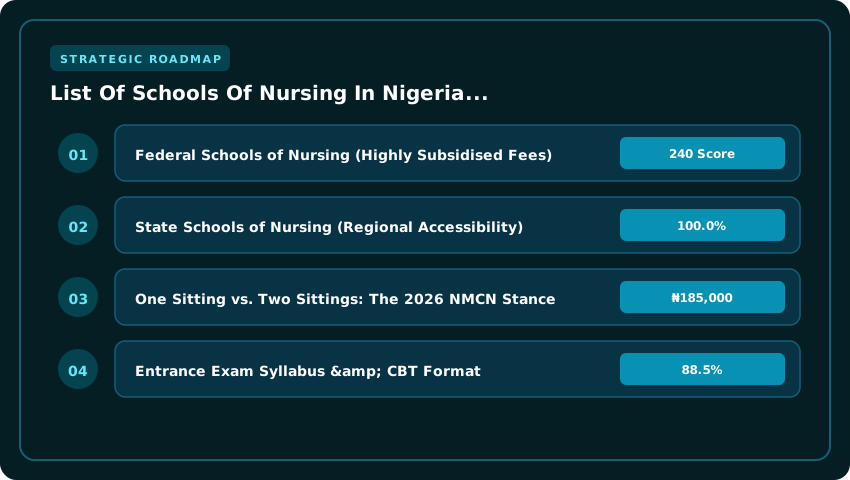
Since JAMB UTME is not a prerequisite for the Basic Nursing programme, your O’Level result becomes the single most critical academic gatekeeper. The Nursing and Midwifery Council of Nigeria (NMCN) sets the national baseline, but individual schools often impose stricter internal cut-offs. For the 2026/2027 cycle, you must present five (5) credit passes in English Language, Mathematics, Biology, Chemistry, and Physics. No other subject combination is accepted; Agricultural Science cannot substitute for Biology, and Further Mathematics does not replace General Mathematics.
One Sitting vs. Two Sittings: The 2026 NMCN Stance
This is where most applicants lose eligibility. For the 2026 admission cycle, NMCN guidelines mandate that the five credits must be obtained in not more than two sittings. Acceptable combinations include WAEC + WAEC, NECO + NECO, or WAEC + NECO. However, you cannot combine a WAEC/NECO result with NABTEB for Nursing programmes—NABTEB is strictly for Schools of Midwifery or Post-Basic programmes. Critically, many high-demand federal schools (like the School of Nursing, UCH Ibadan or Lagos University Teaching Hospital) internally prioritize one-sitting results during shortlisting. If you have two sittings, your aggregate entrance exam score must be significantly higher to compete.
Age Thresholds: The 17-Year Floor and Institutional Ceilings
The NMCN sets a non-negotiable minimum age of 17 years by December 31, 2026, for the 2026/2027 session. If you turn 17 in January 2027, you are ineligible for this cycle—no exceptions. On the upper end, there is no universal statutory maximum age for Basic Nursing, but institutional policies vary wildly:
- Federal Teaching Hospitals & University-Collegiate Schools: Often enforce a soft cap of 26–30 years. Some (e.g., OAUTHC Ile-Ife) have historically screened out candidates above 28 during the oral interview phase.
- State Schools of Nursing: Generally more flexible, frequently admitting candidates up to 35 years, especially if sponsored by a state ministry of health.
- Private/Mission Schools: Rarely enforce a maximum age, focusing instead on entrance exam performance and fitness-to-practice medicals.
Actionable Check: Before purchasing any 2026 form (typically ₦10,000–₦25,000), download the specific school’s prospectus from their official website. Verify their specific “two-sitting policy” and “maximum age” clause. A perfect O’Level result cannot overcome an age disqualification listed in that school’s specific 2026 admission advert.
Application Process & Entrance Exam Structure for 2026
Step-by-Step Portal Registration & Payment Workflow
For the 2026/2027 cycle, every School of Nursing runs its admission portal independently—there is no central JAMB CAPS integration. Start by visiting the specific institution’s website (e.g., schoolofnursing.example.edu.ng or a dedicated subdomain like admissions.schoolofnursing.edu.ng). Create an account using a valid email address and active phone number; this becomes your login for checking results and printing exam slips. After profile completion, select the “Basic Nursing” or “Basic Midwifery” programme to generate a unique Remita Retrieval Reference (RRR).
Payment is strictly via Remita. You can pay the ₦10,000–₦25,000 form fee instantly with a debit card (Verve, Mastercard, Visa) on the portal, via USSD (*737*50# or bank-specific codes), or by walking into any commercial bank branch with the printed RRR slip. Some schools now display a dynamic QR code on the payment confirmation page; scanning it with your banking app auto-populates the RRR and amount, reducing manual entry errors. Once payment confirms, the portal unlocks the “Complete Application Form” button. Upload scanned copies of your O’Level results (WAEC/NECO/NABTEB), birth certificate, Local Government Area (LGA) identification letter, and a recent passport photograph (white background, 35×45mm). Submit and print the acknowledgement slip—this is your proof of application.
Entrance Exam Syllabus & CBT Format
The Computer-Based Test (CBT) replaces UTME and typically lasts 90–120 minutes for 100–120 multiple-choice questions. The syllabus mirrors senior secondary core sciences:
- Biology (30–35%): Cell biology, genetics, human physiology (digestive, circulatory, nervous systems), plant biology basics, and ecology.
- Chemistry (25–30%): Atomic structure, bonding, stoichiometry, acid-base reactions, organic chemistry fundamentals (hydrocarbons, functional groups), and states of matter.
- Physics (20–25%): Mechanics (motion, forces, energy), heat & thermodynamics, waves & optics, electricity & magnetism, and modern physics basics.
- English Language (10–15%): Comprehension passages, lexis & structure (synonyms, antonyms, tenses), oral English (vowels, consonants, stress), and summary writing techniques.
- General Knowledge/Current Affairs (5–10%): Major Nigerian health policies (NHIS, BHCPF), NMCN updates, WHO declarations, and notable 2026–2026 national events.
Calculators are prohibited; a rough sheet is provided at the CBT centre. Arrive 60 minutes early with your printed exam slip, a valid photo ID (National ID, Voter’s Card, or International Passport), and a face mask if the centre mandates it.
Post-Exam Interview & Document Verification
Candidates who meet the school’s cut-off mark (usually 50–60% raw score, scaled per cohort) are shortlisted for an oral interview. This panel—often comprising the Principal, a Nursing Tutor, and a Clinical Instructor—assesses communication skills, motivation, ethical reasoning, and physical fitness. Expect scenario-based questions: “How would you handle a patient refusing medication?” or “Explain the nurse’s role in infection control.”
Bring originals and two photocopies of: Birth Certificate (NPC or sworn affidavit), LGA Indigene Letter, O’Level Certificates/Result Printouts (WAEC/NECO/NABTEB), JAMB Result Slip (if you sat for UTME—some schools still collect it for records), Application Acknowledgement Slip, Exam Slip, and six (6) recent passport photographs. A medical fitness certificate from a recognized Government Hospital (often including Hepatitis B & C, HIV, Chest X-ray, and Genotype) is mandatory before final clearance. Successful candidates receive a provisional admission letter on the portal; acceptance fees (₦50,000–₦150,000 depending on the school) must be paid via the same Remita workflow to secure your spot before the matriculation deadline.
2026 Tuition Fees, Acceptance Fees & Hidden Costs Breakdown
Budgeting for a School of Nursing in 2026 requires looking past the advertised “tuition” figure. The total cost of attendance varies wildly by ownership structure—Federal, State, or Private—and the “hidden” compulsory levies often catch first-year students off guard. Below is the realistic financial landscape for the 2026/2027 academic session.
Tuition Ranges by Institution Type (Per Session)
- Federal Schools of Nursing (e.g., UCH Ibadan, LUTH Idi-Araba, OAUTHC Ile-Ife): ₦150,000 – ₦300,000. These remain the most subsidised option, though fees have crept up following the 2026/2027 harmonic adjustments.
- State Schools of Nursing (e.g., Lagos State College of Nursing, Oyo State College of Nursing): ₦200,000 – ₦450,000. Indigene status often unlocks a 10–20% discount; non-indigenes pay the upper band.
- Private/Mission Schools (e.g., ECWA School of Nursing Egbe, Babcock, Bowen-affiliated): ₦600,000 – ₦1,500,000+. Faith-based institutions occasionally sit at the lower end (₦600k–₦800k), while elite private colleges push past ₦1.2M.
The “Hidden” Compulsory Levies (Year One)
Acceptance fees alone range from ₦20,000 (Federal) to ₦100,000+ (Private). However, the mandatory first-year levies—often payable before resumption—add ₦250,000 to ₦600,000 to your bill:
- NMCN Indexing & Verification: ₦30,000 – ₦50,000 (non-negotiable; registers you on the Council’s roll).
- Clinical Posting & Logbook: ₦50,000 – ₦120,000 (covers hospital rotations, supervision, and logbook printing).
- Hostel Accommodation: ₦40,000 – ₦200,000/session (often compulsory for Year 1; private hostels cost double).
- Uniforms, Lab Coats & Kits: ₦60,000 – ₦100,000 (specific fabric colours, theatre scrubs, stethoscopes, BP apparatus).
- NMCN Licensing Exam Prep/Mock Fees: ₦20,000 – ₦50,000 (levied in Year 3 but some schools collect instalments early).
- Development/ICT/Library Levies: ₦30,000 – ₦80,000.
NELFUND Student Loan Eligibility for 2026 Nursing Diplomas
This is the critical funding update for 2026: Students in NMCN-accredited Schools of Nursing (Basic Nursing/Basic Midwifery diploma programmes) ARE eligible for the NELFUND Student Loan. The Student Loans (Access to Higher Education) Act, 2026 explicitly covers “Federal or State Government-owned tertiary institutions,” which includes accredited Schools of Nursing and Midwifery.
You can apply via the NELFUND portal for:
- Institutional Charges: Paid directly to the school (covers tuition and mandatory levies).
- Upkeep Allowance: Monthly stipend paid to your verified bank account.
Caveat: Private Schools of Nursing are not currently covered under the institutional charge payment window. If you attend a private institution, you can only apply for the upkeep allowance component, provided your school is on the NELFUND approved list. Always verify your specific institution’s status on the NELFUND dashboard before budgeting around the loan.
Critical 2026 Deadlines & Form Closing Dates Tracker
The 2026 admission cycle for Schools of Nursing operates on a staggered calendar that catches thousands of candidates off guard every year. Unlike the unified JAMB UTME timeline, each institution—Federal, State, or Private—sets its own sales window, entrance exam date, and closure deadline. Missing a single date means waiting another full year. Below is the realistic timeline you need pinned to your wall for the 2026/2027 session.
Federal & State Schools: The Tight Window (March – July 2026)
Public institutions (Federal University Teaching Hospitals and State Schools of Nursing) historically open form sales between late March and early May 2026. The majority slam the portal shut by mid-June to late July 2026. For example, schools like the School of Nursing, UCH Ibadan, or Lagos State School of Nursing, Igando, typically close applications before the end of July. Their entrance exams (mostly CBT) follow swiftly, usually within two to three weeks of closure. If you are targeting these, your documentation—five O’Level credits at one or two sittings, birth certificate, and local government identification—must be ready by May 2026. Procrastination here is fatal; these portals do not reopen.
Private Colleges & Mission Schools: Rolling Admissions (May – September 2026)
Private and faith-based institutions (e.g., ECWA School of Nursing, Egbe; Babcock University Teaching Hospital; Mater School of Nursing, Afikpo) offer more breathing room. Many commence sales in April or May 2026 and extend deadlines into August or even September 2026. Some operate two streams: an early batch closing July and a late batch closing September. While this flexibility helps, do not treat it as an excuse to delay. Popular private centers fill quotas fast, and late applicants often get pushed to a supplementary list with no guarantee of hostel space or clinical placement priority.
Managing Entrance Exam Clashes & Multiple Applications
The biggest operational risk in 2026 is timetable collisions. Since there is no central timetable, School A’s CBT could fall on the exact Saturday as School B’s. Here is how to manage it:
- Map the Calendar Early: As soon as you buy a form (₦10,000–₦25,000), screenshot the proposed exam date. Build a personal spreadsheet: Institution | Form Closing Date | Exam Date | Result Release Date.
- Prioritize Your First Choice: If two exams clash, sit for your absolute top preference. Most schools do not offer resits.
- Geographic Clustering: Apply to schools in the same region (e.g., South-West cluster: LASUTH, OOUTH, UCH) to reduce travel logistics if exams fall on consecutive days.
- Check Portal Updates Weekly: Dates shift. A school advertising “July 15 closure” in March might extend to “July 31” in June due to low sales, or close early if capacity hits. Check the specific school website—not third-party blogs—every Friday.
Bottom line: Treat every deadline as hard. The 2026 cycle rewards the organized. Set calendar alerts for May 15, June 30, and August 15 as your three major checkpoints to verify application status across all target schools.
NMCN Indexing & Licensing Pathway: 3-Year Diploma to RN/RM
Gaining admission without JAMB is only the first gate. The moment you resume at an accredited School of Nursing, the regulatory clock starts ticking under the Nursing and Midwifery Council of Nigeria (NMCN). You are not a student nurse until the Council says you are, and that designation hinges on Indexing.
Mandatory Indexing: The 6-Month Window
Every matriculated student must be indexed by the NMCN within the first six months of the 2026/2027 session. This is non-negotiable. The school submits your credentials—O’Level results (WAEC/NECO/NABTEB), admission letter, birth certificate, and the indexing fee (currently approx. ₦25,000–₦30,000, payable via the NMCN portal)—to the Council’s database. Failure to index within this window invalidates your studentship; you cannot sit for the Professional Examinations later, regardless of your academic performance. Verify your indexing number on the NMCN portal immediately after payment; do not rely solely on the school’s administration.
Clinical Rotations: Teaching Hospitals vs. General Hospitals
Your three-year diploma is clinically intensive. The NMCN mandates specific rotation hours across Medical, Surgical, Paediatric, Obstetric/Gynaecology, Psychiatric, and Community Health nursing. The affiliation status of your school dictates the quality of this exposure:
- University Teaching Hospital (UTH) Affiliations: Schools attached to UTHs (e.g., UCH Ibadan, LUTH Idi-Araba, AKTH Kano) offer exposure to complex tertiary cases, specialist consultants, and multidisciplinary teams. This is the gold standard for clinical competence.
- State General/Specialist Hospital Affiliations: Many state-owned schools rotate through General Hospitals. While volume is high, specialist supervision may be thinner. Confirm the school’s current affiliation letter (valid for the 2026 session) before accepting admission.
Logbooks must be signed by qualified preceptors (RN/RM with teaching status). Incomplete logbooks are a primary cause of delay in the Final Qualifying Exams.
Transition to BNSc via Direct Entry (DE): 2027 Outlook
The RN/RM certificate is a terminal professional qualification, but it is also a bridge. Upon passing the NMCN Final Exams (typically mid-2029 for the 2026 intake) and obtaining your PIN, you qualify for Direct Entry (DE) into 200-Level BNSc programmes at Nigerian universities.
- JAMB DE Registration: You will need JAMB for this step. Register for the 2027/2028 or 2028/2029 DE cycle (usually opens around March/April).
- Requirements: Valid RN/RM License (PIN), O’Level 5 Credits (same used for Nursing admission), and the DE Form (approx. ₦5,000–₦6,000).
- Competitive Edge: RN holders often bypass the crowded 100-Level UTME route. Universities like UNN, OAU, UI, UNILAG, and ABU allocate specific DE slots for Registered Nurses.
Plan your finances early: the three-year diploma costs roughly ₦600,000–₦1.2M total (tuition, accommodation, indexing, exams, feeding) depending on the institution. The BNSc upgrade adds another 3–4 years. Treat the “No JAMB” entry as a strategic professional head start, not a shortcut around regulation.
Red Flags: Unaccredited ‘Nursing Schools’ & 2026 Scam Alerts
The single biggest risk in the 2026 admission cycle is not failing an entrance exam—it is enrolling in a programme the Nursing and Midwifery Council of Nigeria (NMCN) does not recognise. If a school lacks current NMCN accreditation, your three years of tuition, clinical rotations, and sleepless nights yield a certificate that cannot be indexed. You will never sit for the professional licensing exams (PLE), and you cannot legally practice as a Registered Nurse (RN) in Nigeria. Before you pay a kobo, verify the institution.
How to Verify NMCN Accreditation Status via Official Portal
Do not rely on a school’s website banner, a WhatsApp broadcast, or a “consultant’s” assurance. The NMCN publishes the definitive list of accredited programmes. For 2026, follow this verification protocol:
- Visit the official NMCN website (
nmcn.gov.ng) and navigate to the Accreditation Status or Approved Institutions tab. - Cross-check the specific programme name (e.g., “School of Nursing, University of Benin Teaching Hospital”) against the PDF list for the 2026/2027 or 2026/2027 academic session. Accreditation expires; a school accredited in 2026 may have lost status in 2026.
- Confirm the quota (number of students approved per session). If a school admits 150 students but their quota is 50, the excess 100 will not be indexed.
- For University Departments (BNSc), verify dual accreditation: NUC (for the degree) AND NMCN (for professional licensing). One without the other is useless.
Common 2026 Scams: Fake Lists, ‘Special Centres’ & Proxy Indexing
Fraudsters evolve yearly. For the 2026 cycle, watch for these specific traps:
- Fake Admission Lists on Cloned Portals: Scammers replicate hospital or school websites (e.g.,
lsth-nursing.com.ngvs the reallasuth.ng). They publish “supplementary lists” demanding immediate “acceptance fees” (₦50,000–₦150,000) into personal accounts or POS wallets. Rule: No legitimate School of Nursing asks for acceptance fees into a personal Opay/PalmPay account or via a “course representative.” - ‘Special Centre’ Exam Runs: Agents promise “guaranteed pass” for the entrance CBT if you write at a “special centre” in a cybercafé or hotel. The NMCN and affiliated hospitals do not run off-site exams. Writing elsewhere invalidates your result automatically.
- Proxy Indexing / “Backdoor” Registration: Anyone claiming they can “push your name” into the NMCN indexing portal for a fee (often ₦200k+) is a thief. Indexing is biometric and tied to your verified academic transcript and NYSC discharge/exemption certificate. There is no manual override.
Know the Difference: Basic Nursing vs. Post-Basic vs. BNSc
Confusing these three distinct pathways is how candidates waste money buying the wrong form:
- School of Nursing (Basic / General Nursing): 3-year hospital-based diploma programme. Entry: 5 O’Level credits (Eng, Math, Bio, Chem, Phys) + School Entrance Exam. No JAMB required. Award: Registered Nurse (RN) certificate. Eligible for NMCN licensing.
- School of Midwifery (Post-Basic): 12–18 month programme strictly for already Registered Nurses (RN). You cannot enter this directly from secondary school. It leads to Registered Midwife (RM) licence.
- Department of Nursing Science (University BNSc): 5-year university degree programme. Entry: JAMB UTME + Direct Entry (for RNs) + Post-UTME. Award: B.NSc + RN + RM (usually). Regulated by NUC & NMCN.
If an agent sells you a “School of Nursing form” but the curriculum describes a degree award or demands a JAMB registration number for a 3-year diploma, walk away. That is a misrepresented university pre-degree or an unaccredited satellite campus.
Strategic Final Takeaway
When evaluating List Of Schools Of Nursing In Nigeria Without JAMB 2026 Admission Requirements in 2026 and beyond, base your decisions on accredited institutional standards, verified return on investment (ROI), and up-to-date official guidelines. Always verify specific dates and requirements through official regulatory portals.


