Foundational Credentials for the 2026 Entry-Level Market
The 2026 hiring landscape for entry-level cybersecurity talent has crystallized around two distinct validation models: broad, vendor-agnostic literacy and specific, infrastructure-deep fluency. Employers—ranging from federal contractors in Northern Virginia to fintech startups in Austin—are filtering resumes for proof that a candidate can speak the language of risk and* configure the gear that enforces policy. For students bypassing the traditional four-year computer science track, two credentials dominate the conversation.
CompTIA Security+ (SY0-701): The Universal Baseline
If you earn one certification before your high school graduation ceremony, make it Security+. Updated in late 2026 and firmly entrenched as the 2026 standard, the SY0-701 exam validates the exact vocabulary hiring managers expect: zero-trust architecture, threat intelligence feeds, and incident response playbooks aligned with NIST 800-61r2. It is DoD 8570/8140 compliant, meaning it satisfies federal contract requirements immediately—a massive advantage for teens targeting clearance-required roles in the DC metro area or San Antonio.
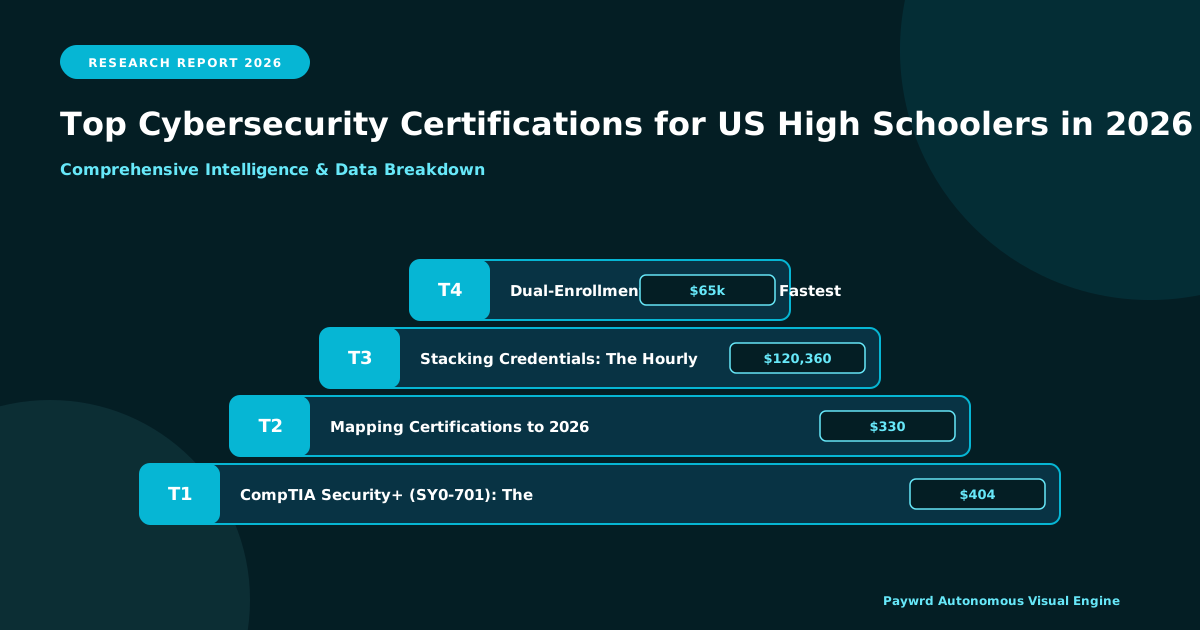
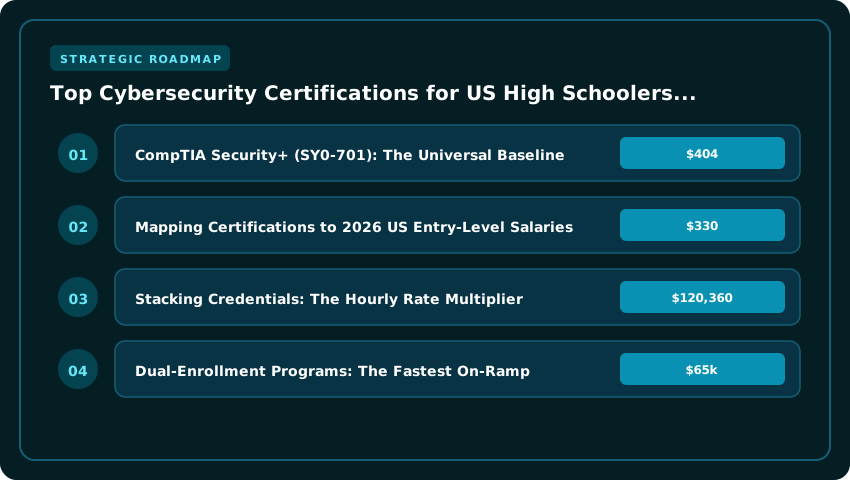
- Cost: $404 exam voucher (academic discounts often drop this to ~$330 via CompTIA Academic Partner schools).
- Prereqs: None officially, though CompTIA recommends Network+ and two years of IT admin experience; motivated 17-year-olds with a home lab routinely pass.
- Salary Signal: BLS data places median infosec analyst pay at $120,360 (2026 data, trending higher in 2026); Security+ holders typically enter at $65k–$80k in tier-2 markets.
Cisco Certified Support Technician (CCST) Cybersecurity: The Packet-Level Differentiator
Launched in 2026 and refined for the 2026–2026 cycle, the CCST Cybersecurity certification is Cisco’s answer to the “paper tiger” problem. It moves beyond theory, demanding candidates demonstrate competence in configuring ASA/FTD firewalls, securing Cisco IOS routers, and analyzing NetFlow telemetry in SecureX. For a high schooler, this is the credential that says “I can touch the CLI and not break the network.” It stacks directly into the CCNA Security track, giving a clear ladder to associate-level roles without a bachelor’s degree.

- Cost: $125 exam fee—significantly lower barrier than Security+.
- Format: 50 minutes, ~35-45 questions; heavy on simulation labs (Packet Tracer / CML).
- Strategic Value: Pairing CCST with Security+ covers the “Governance/Risk/Compliance” side and the “Network Defense” side—a combination that maps directly to NICE Framework work roles PR-CDA-001 and OM-ADM-001.
Vendor-Neutral vs. Vendor-Specific: The 2026 Decision Matrix
Choosing between them isn’t binary; it’s sequential. Vendor-neutral (Security+) proves you understand the why—risk frameworks, cryptography primitives, compliance mandates (HIPAA, CMMC, FERPA). Vendor-specific (CCST) proves the how on the gear running 60% of enterprise backbones. The optimal 2026 playbook for a high school senior: study Security+ objectives first to build the mental model, sit for the exam in Q2, then pivot to CCST labs over the summer. This sequence costs under $600 total, requires zero student loans (FAFSA doesn’t cover certs, but many Perkins-funded CTE programs do), and delivers a resume that clears automated ATS filters at Lockheed Martin, CrowdStrike, and managed security service providers (MSSPs) nationwide.
Mapping Certifications to 2026 US Entry-Level Salaries
Projected Annual Earnings for Certified High School Graduates
Walking across the graduation stage in 2026 with a CompTIA Security+ or Cisco CCST Cybersecurity badge immediately shifts your negotiating baseline. According to the latest Bureau of Labor Statistics (BLS) Occupational Employment and Wage Statistics (OEWS) data released in early 2026, the national median pay for Information Security Analysts sits at roughly $120,360 annually. However, entry-level percentiles (10th–25th) for candidates with zero professional experience but holding validated credentials typically land between $58,000 and $72,000 in lower-cost metros (Midwest, South) and $75,000 to $90,000 in high-cost hubs like the DC–Northern Virginia corridor, NYC, or San Francisco Bay Area. A high school graduate holding Security+ clears the HR algorithmic filter for GS-5/GS-7 federal contractor roles, where starting salaries are rigidly defined by the General Schedule—currently $47,448 to $58,662 base before locality pay adjustments.
Salary Variance: SOC Analyst vs. Junior Penetration Tester
The role you target dictates the certification ROI more than the cert itself. A Tier 1 SOC Analyst position—monitoring SIEM alerts, triaging phishing, running basic vulnerability scans—remains the highest-volume entry point. 2026 data from CompTIA’s State of the Tech Workforce and Dice’s Tech Salary Report places the national average starting salary for SOC Analyst I roles at $71,500. Contrast that with a Junior Penetration Tester role, which demands demonstrable offensive chops (often OSCP or eJPT). Because the talent pool is thinner, junior pentest roles command a premium: average starting offers hover around $88,000–$95,000, but they almost universally require a portfolio or CTF rankings alongside the cert. If you only have Security+, you are qualified for the SOC queue; you are not yet competitive for the pentest queue without the offensive validation stack.
Stacking Credentials: The Hourly Rate Multiplier
Hourly contract work—common for students funding college via FAFSA work-study or gap-year gigs—reveals the clearest math on stacking. A 2026 graduate with Security+ only typically bills $28–$35/hr for managed security service provider (MSSP) shift work. Add the Cisco CCST Networking or CCST Cybersecurity badge to prove packet-level fluency, and that rate jumps to $38–$45/hr for NOC/SOC hybrid contracts. The real inflection point arrives with the Security+ + CySA+ (or Splunk Core Certified User) combo: threat-hunting and log-analysis fluency pushes billable rates to $50–$62/hr for remote shift coverage. For context, that annualizes to $104,000–$129,000 at 40 hours/week—rivaling mid-career medians—without a bachelor’s degree. The stack signals “ready to produce on day one,” which is the only currency hiring managers in 2026 actually pay for.
Leveraging US Community Colleges and Vocational Centers
Community colleges and regional vocational centers are the single most underutilized force multipliers for high schoolers targeting cybersecurity certifications in 2026. These institutions have spent the last three years aggressively aligning curriculum with CompTIA, Cisco, and (ISC)² objectives, often baking the exam voucher cost directly into tuition. For a student in Ohio, Texas, or Virginia, this means walking out of a dual-enrollment class with both high school credit and a Security+ or CCST badge—without paying the $404 or $125 retail exam fees out of pocket.
Dual-Enrollment Programs: The Fastest On-Ramp
Nearly every state now operates a structured dual-enrollment (or concurrent enrollment) framework allowing juniors and seniors to take college-level IT courses tuition-free or at a steep discount. In 2026, the National Alliance of Concurrent Enrollment Partnerships (NACEP) accredits over 1,200 programs where courses like “Network Defense” or “Ethical Hacking Fundamentals” map 1:1 to certification blueprints. A student at Northern Virginia Community College (NOVA), for instance, can complete the Cybersecurity Career Studies Certificate (18 credits) while still enrolled in Fairfax County Public Schools. The district covers the $185/credit tuition rate via state formula funding, and the program includes a CompTIA Security+ voucher. That is roughly $3,300 in training and testing value absorbed by the K–12 system.
State-Funded Vocational Grants and Workforce Initiatives
Beyond standard dual-enrollment, 2026 sees a surge in targeted workforce grants. The Workforce Innovation and Opportunity Act (WIOA) Youth Program and state-level equivalents—like Texas Workforce Commission’s Skills Development Fund or California’s Strong Workforce Program—routinely allocate millions to community college cyber ranges. These grants often cover “wrap-around” costs that FAFSA misses: certification exam retakes, practice lab subscriptions (like Practice-Labs or Cyberbit), and even transportation to testing centers. In Michigan, the Going PRO Talent Fund reimburses employers who hire high school apprentices directly from vocational centers like the Oakland Schools Technical Campuses, creating a direct pipeline from a Cisco CCST Networking class to a paid SOC apprenticeship.
- Perkins V Funding: Federal Carl D. Perkins Career and Technical Education Act dollars flow to high schools and colleges specifically for industry-recognized credentials (IRCs). Ask your CTE director if “CompTIA Security+” or “EC-Council Certified Ethical Hacker” are on the approved IRC list for 2026–2027.
- Last-Dollar Scholarships: States like Tennessee (TN Promise) and New York (Excelsior Scholarship) cover remaining tuition gaps for CTE pathways at community colleges, effectively making the certification track free.
- CyberCorps Scholarship for Service (SFS): While traditionally for bachelor’s degrees, several partner community colleges (e.g., Whatcom Community College in WA) now offer “2+2” SFS pathways starting at the associate level.
Bridging the Diploma-to-Cert Gap
The structural gap between a high school diploma and a hireable certification is usually lab access and structured mentorship. Vocational centers solve this. Centers like Francis Tuttle Technology Center (OK) or Center for Advanced Technical Studies (SC) maintain dedicated cyber ranges—air-gapped networks with Splunk, Palo Alto firewalls, and Kali Linux attack boxes—that a home lab cannot replicate. Instructors are often active-duty Guard/Reserve cyber operators or retired federal contractors holding active CISSP or GPEN certs. They don’t just teach the book; they run the NIST NICE Framework work roles into daily lesson plans. By graduation, a student isn’t just “certified”; they have a portfolio of packet captures, incident response reports, and a letter of recommendation from a cleared professional. That is the currency that gets a 19-year-old past the HR filter at a defense contractor or MSP.
Strategic Pathways to ABET-Accredited STEM Degrees
Earning a CompTIA Security+ or Cisco CCST badge in 2026 does more than pad a résumé—it builds a bridge into ABET-accredited Computer Science and Cybersecurity bachelor’s programs where the real earning power lives. ABET accreditation remains the gold standard for STEM degrees because it signals to employers and licensing boards that a curriculum meets rigorous quality thresholds for engineering and computing. For a high schooler, the strategic play is treating these certifications not as terminal goals, but as articulated credit assets that lower both the time-to-degree and the total cost of attendance.
Aligning Certifications with ABET Program Outcomes
ABET Criterion 3 requires programs to demonstrate specific student outcomes—like the ability to apply security principles to system design or analyze computing problems. Admissions committees at schools like Georgia Tech, Purdue, and Virginia Tech increasingly map industry credentials to these outcomes. A Security+ certification (SY0-701) often maps directly to introductory information assurance coursework, potentially satisfying three to four credit hours of lower-division electives. Similarly, the Cisco CCST Cybersecurity badge aligns with network security fundamentals modules. Before enrolling, request the institution’s Credit for Prior Learning (CPL) matrix; top-tier ABET programs publish these equivalency tables publicly, allowing you to calculate exactly how many semesters you can shave off a standard 120-credit curriculum.
Leveraging Credentials for Merit Scholarships
Certifications function as high-leverage differentiators in the merit-aid arms race. Many public flagships and private tech institutes—including Rochester Institute of Technology and Stevens Institute of Technology—offer stackable scholarships specifically for students entering with validated technical competencies. In the 2026–2026 award cycle, RIT’s Computing Medal Scholarship provided up to $28,000 over four years for incoming freshmen holding CompTIA or Cisco credentials combined with a 3.5+ GPA. When filing the FAFSA, these merit awards reduce your Student Aid Index (SAI) without triggering the asset penalties associated with 529 plan withdrawals. Document every certification with official transcripts from CertMetrics or Credly; financial aid offices treat verified digital badges as rigorously as AP scores.
Transferring Vocational Credits to Four-Year Requirements
The mechanics of credit transfer hinge on articulation agreements between community colleges, technical high schools, and four-year ABET institutions. If your high school partners with a local community college for dual enrollment, your Security+ prep course might already carry a course code (e.g., CIS 150: Network Security Fundamentals) that transfers seamlessly into a Bachelor of Science in Cyber Operations. Verify transferability using tools like Transferology or the destination university’s transfer credit database. Key checkpoints:
- Grade Thresholds: Most ABET programs require a “C” or better (often “B” for core security classes) on the transcribed college course backing the cert.
- Recency Windows: Certifications older than three years—pre-2026 versions—may be rejected for core major credit, though they often still count as general electives.
- Capstone Protection: ABET rules generally prevent transferred credits from satisfying senior capstone or design project requirements; plan to take those in residence.
By treating 2026 certifications as academic currency, you convert a $400 exam fee into roughly $15,000–$25,000 in saved tuition and accelerated entry into a workforce where the median entry-level salary for ABET grads in cybersecurity now exceeds $85,000 annually, per BLS Occupational Employment Statistics.
Navigating the 2027 Cybersecurity Talent Pipeline
The class of 2026 is stepping into a labor market that is rewriting its own rulebook in real time. By 2027, the Bureau of Labor Statistics projects information security analyst roles will grow another 32 percent from the 2026 baseline, pushing median pay well past the $120,000 mark. But the volume of openings masks a sharper filter: hiring managers at federal contractors in the DC corridor and cloud-native shops in Austin are no longer impressed by a badge alone. They want evidence that a candidate can operate inside an AI-augmented security operations center (SOC) on day one.
Emerging Skill Requirements for the 2027 Labor Market
Static knowledge of port numbers and the OSI model is now table stakes. The 2027 job description emphasizes cloud-native telemetry, automated response playbooks, and large language model (LLM) prompt hygiene. Employers are scanning resumes for exposure to infrastructure-as-code scanning (Terraform, CloudFormation), container runtime security (Falco, Sysdig), and the MITRE ATT&CK framework mapped to cloud kill chains. High schoolers targeting the 2027 internship cycle should prioritize the CompTIA Cloud+ or the CCSP Associate track over legacy server-hardening modules. Additionally, familiarity with Zero Trust Architecture (ZTA) implementation—specifically NIST SP 800-207—is becoming a hard requirement for Department of Defense (DoD) 8570 compliance pathways.
The Role of AI-Driven Security Tools in Modern Certification Exams
Certification bodies are embedding AI fluency directly into the testing engine. CompTIA’s 2026 Security+ (SY0-701) update introduced performance-based questions (PBQs) requiring candidates to interpret output from an AI-powered XDR dashboard. (ISC)² has signaled that the 2027 CISSP refresh will weight “AI Governance and Risk Management” as a distinct domain. For a high schooler, this means study labs must move beyond virtual machines. You need hands-on time with Microsoft Copilot for Security, Google Chronicle, or Splunk Observability Cloud free tiers. The exam isn’t asking “what is a SIEM?” anymore; it asks “triage this AI-generated alert cluster and write the KQL query to validate the false positive.”
Building a Professional Portfolio Alongside Certification Badges
A badge proves you passed a test; a portfolio proves you can do the work. In 2027, the differentiator for a $65,000–$80,000 starting SOC Tier 1 role is a public GitHub repository containing:
- Detection Engineering Artifacts: Sigma rules or Splunk SPL queries mapped to MITRE ATT&CK techniques (T1059, T1486) with unit tests.
- Automation Scripts: Python or PowerShell playbooks that enrich alerts via VirusTotal or AbuseIPDB APIs and auto-ticket in ServiceNow or Jira.
- Cloud Misconfiguration Remediation: Terraform modules that enforce S3 bucket encryption, Security Group least-privilege, and IAM policy boundaries.
- CTF Write-ups: Structured post-mortems from platforms like Hack The Box, TryHackMe, or the National Cyber League (NCL) demonstrating methodology, not just flags.
Pair this with a LinkedIn profile that lists your FAFSA status, CompTIA Security+ number, and a link to that repo. When a recruiter at a Managed Security Service Provider (MSSP) filters for “Security+ AND Python,” your profile surfaces with proof, not just keywords. That is how you convert a 2026 certification into a 2027 offer letter.
| Certification | Target Role (2026) | Exam Cost (USD) | Prerequisites | Renewal Cycle | Avg. Entry Salary (US 2026) | Best For |
|---|---|---|---|---|---|---|
| CompTIA Security+ (SY0-701) | SOC Analyst Tier 1, Jr. Security Admin | $404 | None (Network+ & 2 yrs IT admin exp recommended) | 3 Years (CE Program) | $72,000 – $85,000 | Broad baseline validation; DoD 8570 compliance |
| Cisco CCST Cybersecurity | Network Security Support, Jr. NetSec Engineer | $125 | None | 3 Years | $65,000 – $78,000 | Hands-on packet analysis & Cisco infrastructure fluency |
| (ISC)² Certified in Cybersecurity (CC) | Security Analyst, GRC Assistant | Free Exam / $50 Annual Maint. | None | 3 Years (CPEs) | $60,000 – $72,000 | Zero-cost entry; Theory & policy focus |
| CompTIA CySA+ (CS0-003) | Threat Hunter, SOC Analyst Tier 2 | $404 | Security+ equiv. + 4 yrs exp recommended | 3 Years (CE Program) | $80,000 – $95,000 | Behavioral analytics & SIEM specialization |
| OffSec Certified Professional (OSCP) | Jr. Penetration Tester, Red Teamer | $1,649 (Course + Exam) | Strong Linux/Scripting/Networking | 3 Years (CPEs) | $90,000 – $110,000 | Proving practical exploit dev & AD compromise skills |
Frequently Asked Questions
Which cybersecurity certification is best for a US high school graduate in 2026 with no experience?
For 2026 US high school graduates with zero experience, CompTIA Security+ (SY0-701) is the industry standard baseline. It satisfies DoD 8570 requirements for federal contractors and validates vendor-agnostic risk management skills. Cisco CCST Cybersecurity is the superior alternative for students targeting network security operations roles requiring hands-on packet-level configuration proof.
How much does it cost to get CompTIA Security+ certified in 2026?
The CompTIA Security+ (SY0-701) exam voucher costs $404 USD in 2026. Budget an additional $300-$600 for official CertMaster Learn/Practice bundles or third-party video courses (e.g., Professor Messer, Jason Dion). No mandatory training enrollment is required, keeping total investment under $1,000 for self-study candidates.
Can a high schooler get a SOC analyst job in 2026 with only a Cisco CCST Cybersecurity badge?
Yes, the Cisco CCST Cybersecurity badge qualifies 2026 high schoolers for entry-level Network Security Support or Jr. SOC Analyst roles, particularly at Cisco-partner MSPs and enterprise NetOps teams. It proves practical CLI configuration and packet capture analysis. Pairing it with Security+ significantly expands eligibility to broader SOC Tier 1 positions requiring DoD 8570 compliance.
What is the salary difference between Security+ and OSCP for 2026 entry-level roles?
In 2026, Security+ holders average $72k-$85k for SOC Tier 1 roles. OSCP holders command $90k-$110k for Junior Penetration Tester positions—a $15k-$25k premium. However, OSCP requires ~$1,650 training cost and 300+ hours lab time, whereas Security+ costs ~$400 and requires 100-150 hours study. ROI favors Security+ for immediate employment.
Do cybersecurity certifications expire in 2026 and how do you renew them?
Yes, all major 2026 certifications expire in 3 years. CompTIA (Security+, CySA+) requires 50 CEUs or passing the latest exam. Cisco CCST requires passing any current associate/expert exam or 30 CE credits. (ISC)² CC requires 45 CPEs and $50 annual maintenance fee. OSCP requires 120 CPEs or retaking the exam. Plan 10-20 hours yearly for maintenance.
Strategic Final Takeaway
When evaluating Best Cybersecurity Certifications For High School Students In The United States in 2026 and beyond, base your decisions on accredited institutional standards, verified return on investment (ROI), and up-to-date official guidelines. Always verify specific dates and requirements through official regulatory portals.