Key Takeaway: JAMB 2026/2027 registration is a self-service process that begins online but finishes in person. Your NIN, a valid E-PIN, and biometric capture at an accredited CBT centre are the three non-negotiable pillars. Skip any one of these, and your registration is dead on arrival.
Official JAMB 2026/2027 Portal Access & Registration Walkthrough
The Joint Admissions and Matriculation Board has streamlined the 2026/2027 UTME registration into a structured sequence that candidates must follow to the letter. The official entry point remains jamb.gov.ng, and every transaction you complete outside that domain or through unverified intermediaries risks your data and your application. Here is how to move through each stage cleanly.

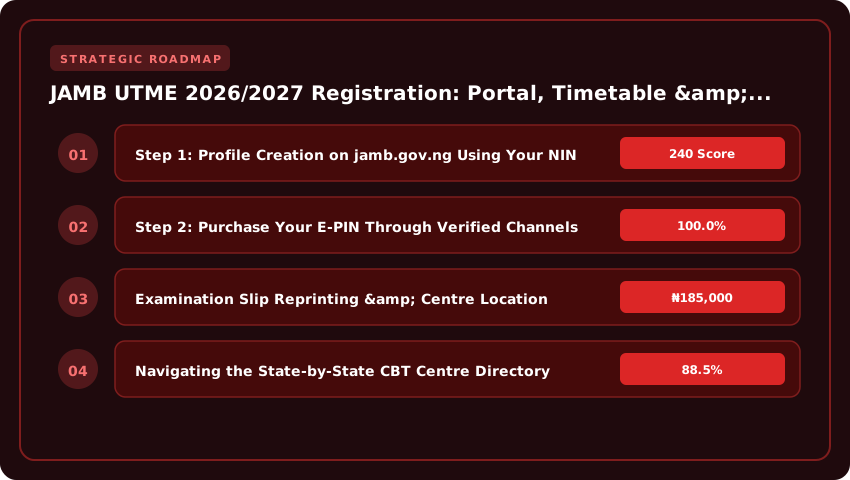
Step 1: Profile Creation on jamb.gov.ng Using Your NIN
Visit the official JAMB website and click the registration link. You will be prompted to enter your 11-digit National Identification Number. This NIN links your academic application directly to your national identity record, so ensure you are entering it correctly — one misplaced digit sends you back to the payment stage. After NIN verification, fill in your surname, first name, and other names exactly as they appear on your NIN certificate. Mismatches between your profile and your biometric data will cause complications during screening at your chosen institution.
Step 2: Purchase Your E-PIN Through Verified Channels
The 2026/2027 E-PIN costs ₦5,000 for UTME candidates. You can purchase it through any of these approved channels:
- Banks: Visit any commercial bank teller window or ATM with a voucher option. Pay the exact amount and receive your E-PIN voucher directly from the bank.
- USSD: Dial the designated JAMB short code from your registered mobile number to generate a PIN via your bank’s mobile banking service.
- POS Agents: Only use agents affiliated with verified banks. Confirm the transaction alert on your bank notification before accepting the PIN.
- NELFUND Wallet: Candidates with active NELFUND education wallet balances can pay directly from their portal, removing the need for a separate bank transaction entirely.
After purchasing, log back into jamb.gov.ng, enter the E-PIN, and confirm your profile details. The system will then generate your registration summary for the next stage.
Step 3: Biometric Verification at Accredited CBT Centres
This is where most candidates stumble. JAMB requires physical biometric capture — fingerprint and passport photograph — at an accredited Computer-Based Test centre. Carry your NIN, the printed or digital E-PIN confirmation, and present yourself with a clean, well-lit appearance for the photograph. The centre’s accredited agent will verify your data against the national database. Without this step, your profile remains incomplete and you cannot sit for the 2026 UTME.
Stick to the official pipeline. No third party can complete your registration faster or more securely than you doing it yourself through these verified channels.
2026 UTME Examination Timetable & CBT Centre Logistics
Mark your calendars: the 2026 Unified Tertiary Matriculation Examination (UTME) is scheduled to run from Friday, April 24 to Monday, May 5, 2026. This two-week window accommodates the massive candidate pool across morning and afternoon sessions. Before the main event, the optional but highly recommended Mock Examination holds on Saturday, April 4, 2026. Treat the mock as a full dress rehearsal—it is your only chance to test the CBT interface, keyboard responsiveness, and time management under real exam conditions without the stakes.
Examination Slip Reprinting & Centre Location
You cannot walk into a centre guessing your venue. The Examination Slip Reprinting portal opens Monday, April 13, 2026, exactly two weeks before the main exam. Log into your JAMB profile on the official ibass.jamb.gov.ng portal, click “Print Examination Slip,” and verify three critical data points: your centre name, full address, and your scheduled session (Morning: 7:00 AM accreditation / 8:00 AM start; Afternoon: 12:00 PM accreditation / 1:00 PM start). Do not rely on the centre assigned during registration; JAMB frequently reassigns candidates to balance capacity across the 36 states and the FCT.
Navigating the State-by-State CBT Centre Directory
JAMB accredits over 700 centres nationwide. While a static list here would be obsolete by exam week, the live directory is always accessible via the JAMB IBASS portal under “Accredited CBT Centres.” Filter by your state of residence—whether Lagos, Kano, Rivers, or the FCT—to see real-time capacity and address details. Pro tip: physically visit your assigned centre before exam day if it is in an unfamiliar neighbourhood. Lagos candidates in Ikorodu or Badagry, for instance, need to factor in unpredictable traffic; Northern candidates in Borno or Yobe should confirm security clearance routes. Arriving 90 minutes early is not paranoia; it is standard protocol.
Exam Day Kit: Mandatory Items & Prohibited List
Security at the gate is tight. You will be turned away for missing items or possessing contraband. Pack only the following in a transparent nylon bag:
- Printed Examination Slip (colour or black-and-white, must show your passport photo and QR code).
- Valid Photo ID: National ID Card (NIN slip accepted), International Passport, Driver’s License, or Voter’s Card. School ID cards are not accepted.
- One HB Pencil & Eraser (for rough work on the provided sheet; calculators are embedded in the CBT software).
Leave these at home or in the car: Mobile phones (even switched off), smartwatches, calculators, wristwatches, bags, wallets, earphones, biros, correction fluid, and any electronic device. JAMB’s 2026 guidelines mandate automatic disqualification and potential prosecution for candidates caught with prohibited items. Your biometrics (fingerprint and facial capture) at the centre gate are your final ticket into the hall—ensure your fingers are clean and uninjured.
Verified Subject Combinations for Top 2026 Competitive Courses
Getting your JAMB subject combination wrong is the single fastest way to lose admission in 2026/2027. Universities now cross-check your UTME subjects against your WAEC or NECO results through NUC CCMAS before they even schedule your post-UTME screening. If there is a mismatch, your application gets flagged and often rejected outright. Here is the exact mapping you need for the most competitive faculties.
Medicine, Nursing & Health Sciences
Medicine and Surgery demands English Language, Biology, Chemistry, and Physics at UTME level. On the O’Level side, you need credit passes in those same four subjects plus Mathematics, all obtained in not more than two sittings at WAEC, NECO, or NABTEB. Nursing Science follows a similar structure but replaces Physics with Mathematics as a core O’Level requirement in most institutions. For Health Sciences and Pharmaceutical Technology, the combination remains Biology, Chemistry, and Physics, though some schools accept a Mathematics substitution at UTME. Do not assume flexibility here—the University of Lagos, University of Ibadan, and Ahmadu Bello University all enforce strict subject alignment through the JAMB CAPS portal.
Engineering & Technology
Engineering programs universally require English Language, Mathematics, Chemistry, and Physics at UTME. The variation comes at the O’Level stage. Most federal universities insist on five credit passes including English, Mathematics, Chemistry, Physics, and a science or technical subject. Some institutions like the Federal University of Technology, Minna, accept Technical Drawing or Further Mathematics as the fifth subject. A common mistake candidates make is sitting for Mathematics at O’Level and arriving at the screening without it—that is an automatic disqualification in virtually every accredited engineering faculty across Nigeria.
Law
Law candidates must register English Language, Literature in English, Government or History, and any other Arts or Social Science subject at UTME. The O’Level requirement is notably rigid: you need credit passes in English Language and Literature in English, plus Government or History, all in not more than two sittings. The Nigerian Law Council accreditation means universities cannot bend these rules regardless of your UTME score. Literature in English is non-negotiable at both stages, and substituting it with CRS or Islamic Studies will flag your application on the JAMB CAPS verification layer.
Accounting & Social Sciences
Accounting typically requires English Language, Mathematics, Economics, and any other relevant subject at UTME. O’Level demands credit in English, Mathematics, Economics, and one additional commercial or science subject. For Social Sciences courses like Sociology and Political Science, Government or History is essential at both UTME and O’Level. Literature in English often serves as a strong complementary subject, though some institutions accept Economics in its place. Always verify the specific faculty bulletin on the institutional portal before finalizing your combination, as requirements shift slightly between federal, state, and private universities.
Your subject choices are not suggestions—they are admission gatekeepers. Confirm every requirement against the latest JAMB brochure and your target institution’s posted criteria before you pay for the E-PIN.
2026 Institutional Cut-Off Marks: UNILAG, UI, UNN, FUTA & Others
If you are targeting a top-tier Nigerian university for the 2026/2027 academic session, knowing where the cut-off marks land is not optional, it is your strategic blueprint. The Joint Admissions and Matriculation Board sets a national minimum, but individual institutions and departments raise the bar significantly. Your JAMB score alone does not seal admission; it simply opens the door to the next phase of competition.
Projected Departmental Cut-Offs vs 2026 Benchmarks
For the 2026 UTME cycle, the general JAMB cut-off for federal and state universities sits at 140, and polytechnics and colleges of education accept 100 and above. However, the real battle begins at the institutional level. At the University of Lagos (UNILAG), competitive departments like Law, Medicine, and Pharmacy demand scores between 250 and 300+. The University of Ibadan (UI) follows a similar pattern, with Medicine and Surgery candidates needing upwards of 260, while less competitive arts departments may accept candidates in the 160 to 180 range. At the University of Nigeria Nsukka (UNN), Engineering and Medical programmes typically require 220+, and FUTA candidates should aim for 180+ for engineering-related courses and 200+ for competitive sciences. Federal universities like ABU, KSU, and UNILORIN generally set departmental marks between 160 and 240 depending on course demand. Always cross-reference these projections with the latest JAMB CAPS data and official university admissions pages closer to the post-UTME registration window.
Post-UTME Screening Formats: CBT, Oral & Credential-Based
Universities run different post-UTME screening models, and understanding yours matters for preparation. Some institutions conduct Computer-Based Testing (CBT) screenings, which mirror the JAMB format but focus on English, Mathematics, and subject-specific questions. Others adopt oral interviews or viva voce sessions, particularly for courses in the arts and social sciences. A growing number of institutions now use credential-based screening, where candidates upload O-Level results, A-Level certificates, or ND diplomas, and admissions are assessed on academic documentation rather than a written exam. Check your target university’s admissions office or official portal to confirm the exact format for 2026/2027 before you begin preparation.
Merit, Catchment & ELDS Admission Quota Breakdown
Nigerian universities allocate admission slots across three main quotas, and understanding this distribution directly affects your chances:
- Merit Admission (typically 40 to 50 percent): Reserved for candidates with the highest combined JAMB and post-UTME scores, regardless of state or origin. This is where top scoreers compete on pure academic merit.
- Catchment Admission (roughly 30 to 40 percent): Allocated to candidates from the state or geo-political zone where the institution is located. If you are from Lagos State and applying to UNILAG, this quota works in your favour.
- ELDS (Educationally Disadvantaged States) Admission (approximately 10 to 20 percent): Designed to promote access for candidates from historically under-represented states. Eligibility is determined by JAMB and the university based on official ELDS classifications.
Your combined score across JAMB and post-UTME determines where you fall within these quotas. Aim high on both stages, because a strong JAMB score alone does not guarantee a merit slot if the post-UTME carries significant weight at your chosen institution. Monitor the NUC CCMAS portal and your university’s official admissions announcements throughout the 2026/2027 cycle to stay ahead of every deadline and policy change.
Registration Fees & Payment Breakdown in Naira (₦)
For the 2026/2027 session, the Joint Admissions and Matriculation Board (JAMB) has maintained the official registration fee at ₦7,700 for both UTME and Direct Entry (DE) candidates. This figure is non-negotiable and payable directly to JAMB via the Central Admissions Processing System (CAPS) wallet or approved banking channels (Remita, NIBSS, USSD) during the profile creation and E-PIN purchase phase. It covers the cost of the examination, the syllabus brochure (now digital), and the mandatory mock examination for candidates who opt in. Any request for payment above this amount to a “JAMB official” or agent for the core registration is fraudulent.
CBT Centre Service Charges & Hidden Costs to Avoid
While the ₦7,700 goes to JAMB, candidates must physically visit an accredited Computer-Based Test (CBT) centre to complete biometric capture and final submission. Here is where hidden costs often inflate the budget. JAMB officially caps the CBT centre service charge at ₦700. This fee covers the use of the centre’s infrastructure, biometric verification, and the printing of your examination slip. However, many centres illegally demand “processing fees,” “facilitation fees,” or “network charges” ranging from ₦1,000 to ₦3,000. Refuse to pay these. Accredited centres are paid a per-candidate stipend by JAMB; the ₦700 is your only legal obligation to them.
- Mock Examination (Optional): An additional ₦1,000 paid directly to the CBT centre if you choose to sit for the pre-UTME mock. This is highly recommended for first-timers to familiarize themselves with the interface.
- Profile Creation/USSD Charges: The initial NIN-to-Profile code generation via USSD (550191NIN#) attracts a standard network charge of ₦50 per attempt. Ensure you have airtime before dialing.
- Correction of Data: Post-submission corrections (e.g., name spelling, course/institution changes) attract a separate fee of ₦2,500 per correction, payable via the candidate’s profile on the JAMB portal.
Refund Policy for Missed Exams or Double Registration Errors
JAMB operates a strict no-refund policy for the ₦7,700 registration fee once the E-PIN has been used to complete registration on the portal. If you miss your scheduled exam date due to illness, travel issues, or lateness, the fee is forfeited. There is no carryover to the next year. For double registration errors—where a candidate accidentally purchases two E-PINs or registers twice—JAMB does not automatically reverse funds. You must file a formal complaint through the JAMB Support Portal with transaction evidence (RRR numbers, bank tellers). Resolution is discretionary and often results in a credit note for future JAMB services rather than a cash refund to your bank account. The CBT centre’s ₦700 service charge is also non-refundable once biometrics are captured. Budget wisely: treat the ₦7,700 + ₦700 (+ ₦1,000 for mock) as a sunk cost the moment you hit “Submit.”
Common 2026 Registration Errors & Real-Time Fixes
JAMB’s 2026/2027 registration portal is robust, but candidates still stumble on predictable traps. Based on the top five technical failures reported this cycle, here is your corrective playbook. Address these now, not after the deadline.
NIN Mismatch: Dashboard Correction vs Support Ticket
A mismatched National Identification Number is the single fastest route to application rejection. If your NIN on the JAMB dashboard does not match the one linked to your NIMC database, do not panic, but act fast. For minor digit errors visible on your profile, navigate to the JAMB 2026/2027 dashboard, locate your personal details section, and attempt a self-service correction directly. The system allows one dashboard edit before your data locks. If the mismatch persists or the portal rejects your correction, escalate immediately through the official JAMB support ticket system at jamb.gov.ng. Include your correct NIN, registered email, and a screenshot of the error. Do not wait. NIN-related rejections spike in the final 72 hours of registration, and support response times stretch beyond 48 hours during peak periods.
O’Level Upload Issues: Awaiting Results vs Verified Certificates
This is the second most common failure. Candidates with pending O’Level results often upload placeholder documents or skip the upload entirely, assuming JAMB will accept an “awaiting results” declaration. It will not. If your results are still awaiting publication, upload a scanned copy of your entry confirmation or result slip from WAEC/NECO/NABTEB showing your examination sitting date. Once verified results are released, log back into the portal and replace the placeholder with the official certificate or result download. JAMB cross-references uploads against the West African Examinations Council e-Registration database, so any discrepancy triggers an automatic flag. Use only the verified certificate; do not submit photocopies or screenshots.
Course or Institution Change Window: Deadline and ₦2,500 Processing Fee
Changing your chosen course or institution after initial registration is possible but time-sensitive. JAMB opens a dedicated correction window during the registration period, and you must complete the change before the published cutoff date, typically two weeks before the examination begins. Each correction costs ₦2,500, processed through the JAMB portal via your registered E-PIN. This fee is non-refundable regardless of whether the change is approved. Do not attempt to make multiple corrections in a single session, as the system may lock your profile. Make one change, confirm the receipt, and verify the update on your dashboard before attempting another.
E-PIN Activation Failure
Some candidates pay but never receive their E-PIN activation. If your payment reflects in your bank statement but the portal still shows “unpaid,” generate a new payment confirmation directly on the JAMB portal using your transaction reference number. Contact your bank first to confirm the debit, then re-initiate within the portal.
Biometric Capture Rejection at CBT Centres
Even with a valid E-PIN, failed fingerprint or facial capture at your accredited CBT centre invalidates the entire registration. Visit a different accredited centre if your first attempt fails, and carry your NIN slip and printed payment receipt. Centres are accredited through the NUC CCMAS portal, so verify your centre’s status before travelling.
Treat every step as non-negotiable. Your registration is only complete when your dashboard shows a verified, biometric-captured profile with correct O’Level documentation and a locked course choice.
Post-Registration Roadmap: Syllabus, Mock & Result Checking
Registration is only the starting line. What separates candidates who land admission offers from those who fade out is what happens after you click submit on the JAMB portal. This roadmap walks you through the three critical post-registration moves you cannot afford to miss in 2026.
Downloadable 2026 JAMB Syllabus & Recommended Textbooks
The JAMB 2026/2027 syllabus is available as a free downloadable PDF on the official JAMB website. Every subject combination has a dedicated syllabus document outlining specific topics, sub-topics, and learning objectives. Do not walk into the examination hall guessing what to study. Download your syllabus the same week you complete registration and bookmark it on your phone.
Alongside the syllabus, JAMB publishes recommended textbooks per subject. These are not arbitrary suggestions; they are vetted resources whose content aligns directly with exam questions. For English Language, the recommended novel and grammar textbooks are non-negotiable. For sciences, the JAMB-approved Physics, Chemistry, and Biology texts cover the exact experimental scenarios tested in past questions. Use the syllabus as your table of contents and match each topic to a chapter in the recommended text.
- Download the syllabus PDF from the official JAMB website
- Cross-reference each subject’s recommended textbook list
- Build a weekly study schedule mapped to syllabus topics
Mock Exam Participation: Opt-In Process & Performance Analytics
The JAMB Mock Examination is an opt-in exercise, which means you must actively register for it through the JAMB portal after your primary registration is confirmed. The mock typically runs a few weeks before the main UTME. It is one of the most underutilised tools in the candidate toolkit.
After sitting for the mock, JAMB releases performance analytics broken down by subject. These analytics show your score distribution, time management per section, and a comparative ranking against other mock candidates. Use this data to identify weak subjects and recalibrate your study priorities. Candidates who treat the mock as a dress rehearsal consistently outperform those who skip it entirely.
Result Checker Portal: Accessing Scores & Admission Status on CAPS
Once the 2026 UTME concludes, results are published on the JAMB Result Checker portal. You will need your registration number and the unique PIN sent to your registered email or phone number. Enter both, and your subject-by-subject breakdown appears instantly.
However, checking your score is only half the equation. The real action happens on JAMB CAPS (Central Admission Processing System). After JAMB releases cut-off marks and individual institutions publish their admission lists, CAPS becomes where you accept or reject admission offers. Log into CAPS regularly, because admission offers expire if you do not accept them within the stipulated window. Your CAPS dashboard will display your admission status in real time, showing whether you have been offered a slot, placed on a waiting list, or need to change your institution or course preference.
- Check JAMB Result Checker using registration number and PIN
- Monitor CAPS daily for admission offers and status updates
- Accept or reject offers within the stated deadline
| Requirement | 2026/2027 Specification | Status/Cost |
|---|---|---|
| Official Portal | jamb.gov.ng | Mandatory |
| Identity Verification | National Identification Number (NIN) | Required |
| Registration Fee | Standard UTME Fee (₦) | Payable via E-PIN |
| Biometric Capture | Accredited CBT Centre Visit | Mandatory |
| Registration Window | 2026 – 2027 Cycle | Active/Upcoming |
Frequently Asked Questions
How do I register for JAMB UTME 2026/2027?
To register for JAMB UTME 2026/2027, visit the official portal at jamb.gov.ng to create your profile using your NIN. After completing the online form and paying the required fees via an E-PIN, you must visit an accredited CBT centre for biometric capture to finalize your application.
Is NIN mandatory for JAMB 2026/2027 registration?
Yes, the National Identification Number (NIN) is a non-negotiable requirement for the 2026/2027 JAMB registration. It serves as the primary identity verification tool. Candidates without a valid NIN will be unable to create a profile on the official portal or proceed with biometric capture.
What are the essential requirements for JAMB 2026/2027 registration?
The three essential pillars for a successful 2026/2027 JAMB registration are a valid National Identification Number (NIN), a verified E-PIN for payment of registration fees, and the completion of biometric data capture at a JAMB-accredited CBT centre. Missing any of these steps renders the application invalid.
Where can I access the official JAMB 2026/2027 registration portal?
The only official and secure entry point for the 2026/2027 UTME registration is jamb.gov.ng. Candidates are strongly advised to avoid third-party websites or unverified intermediaries to protect their personal data and ensure their application is processed correctly by the Joint Admissions and Matriculation Board.
Strategic Final Takeaway
When evaluating JAMB UTME Registration 2026/2027 Portal Timetable And Subject Combinations in 2026 and beyond, base your decisions on accredited institutional standards, verified return on investment (ROI), and up-to-date official guidelines. Always verify specific dates and requirements through official regulatory portals.