2026 FRSC Eligibility Criteria and Updated Academic Requirements
Applying for a position with the Federal Road Safety Corps (FRSC) is not merely about submitting a CV; it is about meeting a stringent set of paramilitary standards. For the 2026 intake, the Corps has emphasized a “fitness-first” approach, meaning that academic qualifications are only the first gate. If you do not meet the physical and age benchmarks, your application will be flagged during the initial screening phase.

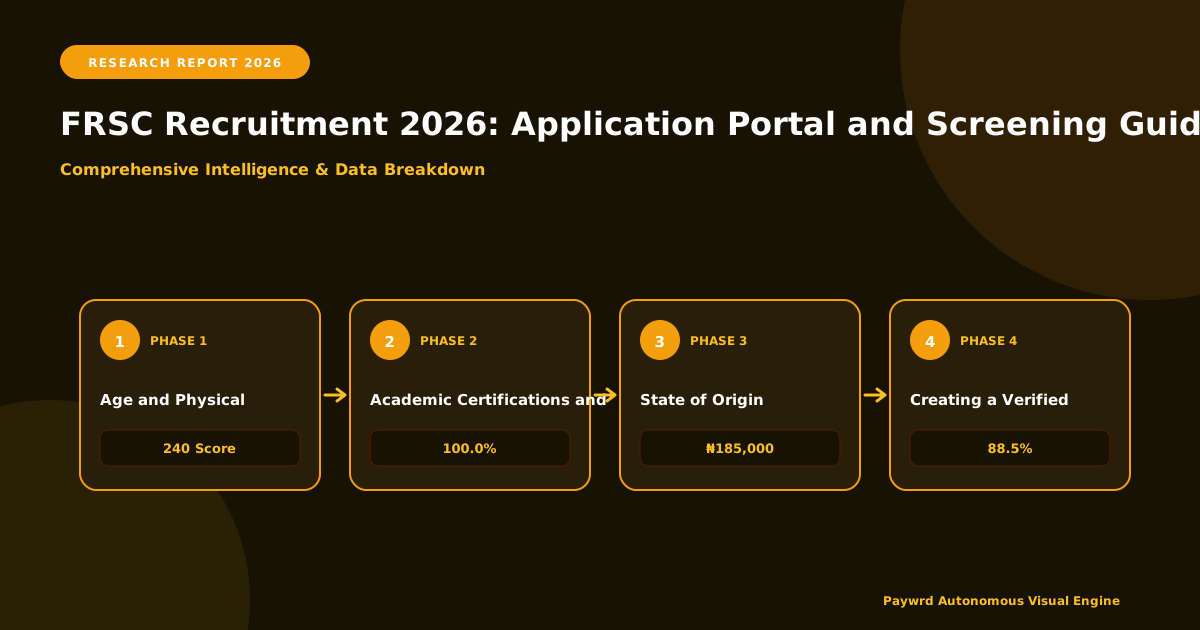
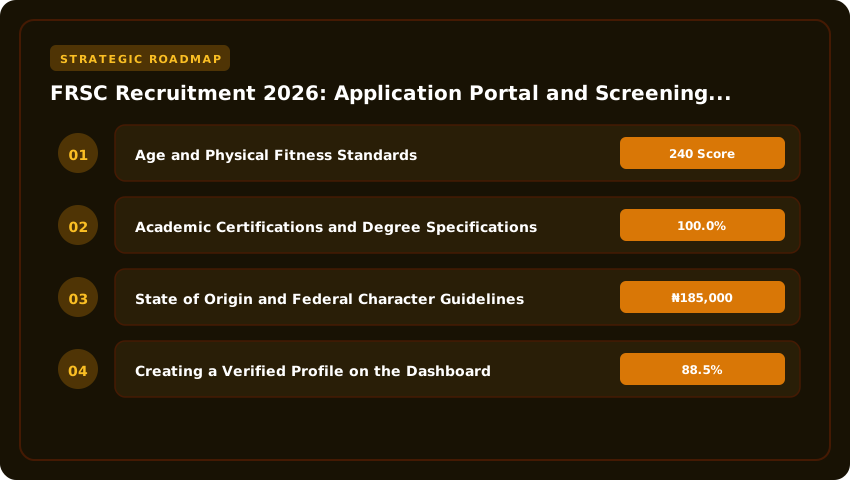
Age and Physical Fitness Standards
For the 2026 recruitment cycle, the minimum age for applicants is 18 years, with a strict upper limit that varies based on the cadre (typically 30 years for entry-level officers). Beyond age, the FRSC has updated its physical fitness requirements to ensure recruits can handle the rigors of highway patrol and emergency response. Key requirements include:
- Height: Minimum height requirements remain mandatory for both male and female candidates to ensure operational efficiency.
- Vision: Applicants must possess good eyesight (correctable with lenses) and be free from color blindness.
- General Health: Candidates must be free from chronic ailments or physical deformities that could hinder field duties.
Academic Certifications and Degree Specifications
The FRSC maintains a merit-based academic filter. To be eligible for the 2026 portal, you must possess valid certifications from recognized Nigerian examination bodies. The requirements are broken down as follows:
- O’Level Requirements: A minimum of five (5) credits in WAEC, NECO, or NABTEB, including English Language and Mathematics. These must be obtained in one sitting or two sittings, depending on the specific cadre guidelines for 2026.
- Tertiary Education: For Officer cadres, a minimum of a Bachelor’s degree, HND, or NCE from a recognized institution is required. Degrees must be verified via the NUC or NBTE portals.
- Professional Certifications: Additional certifications in safety management, logistics, or emergency medical services provide a competitive edge during the screening process.
State of Origin and Federal Character Guidelines
In alignment with the Federal Character Commission (FCC) mandates, the 2026 recruitment is designed to ensure equitable representation across all 36 states and the FCT. This means that slots are allocated based on state-of-origin quotas.
Applicants must provide a valid Certificate of State of Origin. Be aware that if a particular state has already filled its quota for the 2026 cycle, the portal may restrict further applications from that region. This system prevents regional imbalance and ensures that the FRSC maintains a truly national workforce.
Step-by-Step Navigation of the 2026 FRSC Application Portal
Navigating the 2026 FRSC recruitment portal requires precision. Because the Corps now employs an automated filtering system, a single clerical error or an oversized file can lead to an immediate system-generated rejection. To ensure your application reaches the screening officers, follow this technical walkthrough.
Creating a Verified Profile on the Dashboard
The first phase is the creation of your digital identity on the official FRSC recruitment dashboard. Start by registering with a valid email address and a functional Nigerian phone number. You will be required to create a secure password and verify your account via an OTP (One-Time Password) sent to your mobile device.
- NIN Integration: You must input your National Identification Number (NIN). The portal syncs in real-time with the NIMC database to verify your age and state of origin.
- FCC Compliance: Select your Local Government Area (LGA) carefully. The 2026 cycle strictly enforces Federal Character Commission quotas; selecting the wrong LGA will result in automatic disqualification during the shortlisting phase.
Uploading Compliant Digital Documents
The 2026 portal has strict specifications for document uploads. Files that exceed the size limit or are in the wrong format will trigger an “Upload Failed” error, which often freezes the application page.
- Passport Photographs: Upload a recent digital photograph with a plain white background. The image must be in JPEG format, typically under 200KB, and your face must be clearly visible without glasses or headgear (unless for religious reasons).
- Academic Credentials: Scan your WAEC/NECO certificates and degree/HND certificates into a single PDF file. Ensure the scan is legible; blurred documents are flagged by the system as “unverifiable.”
- Digital Signature: Use a clean white sheet of paper to sign, scan it, and upload it as a PNG or JPEG.
Avoiding Portal Errors and Submission Timeouts
High traffic on the FRSC portal often leads to session timeouts, which can result in loss of unsaved data. To avoid this, avoid applying during peak hours (10:00 AM to 4:00 PM). Use a stable browser like Google Chrome or Mozilla Firefox updated to the latest version.
Before clicking the final “Submit” button, review your entries. Once submitted, the 2026 portal does not allow for post-submission edits. If you encounter a “Server Busy” message, do not refresh the page repeatedly; instead, clear your browser cache and log back in after fifteen minutes to prevent your IP address from being temporarily flagged as a bot.
The 2026 Screening Process: From CBT to Physical Assessment
Securing a spot in the 2026 Federal Road Safety Corps (FRSC) intake requires more than just meeting the academic criteria; you must survive a rigorous, multi-stage elimination process. The Corps has transitioned to a more data-driven evaluation system this year, meaning your performance in the initial Computer Based Test (CBT) heavily dictates your progression to the physical stages.
Mastering the 2026 CBT Syllabus
The CBT is the first major hurdle. In 2026, the FRSC has shifted focus toward situational judgment and cognitive agility. To score high, prioritize these high-yield topics:
- Nigerian Highway Code: Comprehensive knowledge of road signs, traffic regulations, and the 2026 updated safety protocols.
- Current Affairs: Focus on the current administration’s transport policies, Nigerian geography, and recent Federal Government initiatives.
- Quantitative Reasoning: Basic mathematics, data interpretation, and logical sequence problems.
- English Proficiency: Reading comprehension, grammar, and official correspondence styles.
Physical Endurance and Medical Protocols
Once you clear the CBT, you will be invited for the physical screening. The FRSC maintains a paramilitary standard, and the 2026 benchmarks are non-negotiable. Candidates are evaluated on strength, stamina, and overall health.
- Endurance Tests: Expect timed runs, push-ups, and sit-ups. Ensure you begin a fitness regimen at least four weeks before your scheduled date to avoid fainting or failure.
- Medical Screening: This involves rigorous checks for eyesight (color blindness is often a disqualifier), hearing, and general cardiovascular health.
- Height and Weight: Strict adherence to the minimum height requirements for both male and female candidates is mandatory to ensure operational efficiency.
Interview Etiquette for the Selection Board
The final stage is the oral interview before the FRSC selection board. This is where your personality and discipline are scrutinized. The board isn’t just looking for intelligence; they are looking for “command presence.”
Dress in formal, corporate attire—strictly professional. When addressing the board, maintain a posture of alertness and respect. Be prepared to answer questions on why you want to join the Corps and how you handle high-pressure environments. Avoid rambling; provide concise, confident answers that demonstrate your loyalty to national service and your ability to follow a chain of command.
Required Documentation for the 2026 Verification Stage
Passing the online assessment is only the first hurdle. The physical verification stage is where the majority of candidates are disqualified, often due to trivial clerical errors or missing paperwork. For the 2026 recruitment cycle, the Federal Road Safety Corps (FRSC) has implemented a zero-tolerance policy regarding document authenticity. If a required paper is missing or unverifiable, you will be sent home immediately without a second chance.
Originals vs. Photocopies: The 2026 Checklist
You must arrive at the screening center with a well-organized file. The FRSC verification officers require both the original documents for sighting and two sets of clear, legible photocopies for their archives. Ensure your documents are arranged in the following order:
- Educational Certificates: Original FSLC, WAEC/NECO certificates, and your Degree/HND certificate.
- Institutional Transcripts: A certified copy of your academic transcript if requested for specific professional cadres.
- Identity Verification: A valid National Identity Number (NIN) slip and a government-issued ID (International Passport or Voter’s Card).
- Birth Certification: An original birth certificate or a statutory declaration of age sworn in a High Court.
Validating NYSC and Indigene Status
In line with 2026 Federal Character Commission (FCC) guidelines, your state of origin must be indisputable. You are required to present a valid Local Government Area (LGA) Indigene Letter signed by your local government chairman. Any discrepancy between the state selected on the application portal and the letter provided will lead to instant disqualification.
For graduates, the NYSC Discharge Certificate is non-negotiable. If you are currently serving, a formal letter of mobilization or an official letter from the NYSC State Coordinator confirming your service status is acceptable, provided you can produce the final certificate before the final enlistment date in 2027.
Handling Discrepancies in Name and Date of Birth
One of the fastest ways to fail the 2026 screening is having mismatched data across your credentials. If your name is spelled differently on your WAEC certificate compared to your Degree, or if your date of birth varies by even one day, you must provide legal cushioning.
To prevent disqualification, you must present a Court Affidavit of Correction of Name/Date of Birth and a Newspaper Publication from a recognized national daily. These legal documents must be original and dated prior to the screening date. Do not attempt to “explain” these differences verbally to the officers; only legal documentation is recognized as proof of identity.
FRSC Career Path: 2026 Salary Scales and Benefit Packages
Joining the Federal Road Safety Corps (FRSC) in 2026 is more than a commitment to public safety; it is a strategic career move into a stable, well-compensated paramilitary structure. The Corps has updated its remuneration packages to align with current economic realities, ensuring that officers are motivated to maintain the highest standards of discipline and professionalism on Nigerian roads.
2026 Entry-Level Salary Breakdown
For the 2026 recruitment cycle, entry-level officers are placed on the Consolidated Paramilitary Salary Structure (CONPSS). While specific figures vary slightly based on the cadre (Inspectorate vs. Officer cadre), the baseline monthly take-home for a fresh recruit typically ranges between ₦145,000 and ₦185,000. This base pay is supplemented by various monthly allowances, including utility and transport subsidies, ensuring a competitive starting package compared to other federal agencies.
Comprehensive Welfare and Benefit Packages
Beyond the monthly salary, the FRSC provides a robust safety net designed to protect the officer and their family. The 2026 benefit package includes:
- Health Insurance: Full coverage under the National Health Insurance Authority (NHIA), granting officers and their immediate dependents access to quality healthcare at accredited hospitals nationwide.
- Housing Allowances: New recruits are eligible for housing subsidies or placement in FRSC barracks, significantly reducing the cost of living in expensive urban hubs.
- Pension Schemes: A mandatory contributory pension scheme managed through approved Pension Fund Administrators (PFAs), ensuring financial security after retirement.
- Duty Allowances: Additional stipends for officers deployed to high-risk zones or special operational assignments during festive periods.
Promotion Cycles and Professional Growth
The FRSC is renowned for its meritocratic approach to career progression. Promotion cycles typically occur every three years, provided the officer meets the required performance benchmarks and passes the mandatory promotion examinations. Professional growth is not limited to rank; the Corps invests heavily in human capital through:
- Specialized Training: Opportunities for certification in Accident Reconstruction, Traffic Management, and Emergency Medical Services.
- Academic Support: Encouragement and partial sponsorship for officers pursuing advanced degrees in Law, Public Administration, or Logistics.
- Leadership Tracks: A clear trajectory from Assistant Superintendent to higher command levels, allowing ambitious officers to influence national road safety policy.
Avoiding 2026 Recruitment Scams and Fake Portals
As the 2026 FRSC recruitment window opens, there is a predictable surge in fraudulent websites and “agent” scams designed to prey on hopeful applicants. These bad actors often create polished, professional-looking landing pages that mimic the official Federal Road Safety Corps branding to steal your personal data or extort money from you. Protecting your identity and your finances is as critical as the application itself.
Identifying Official .gov.ng Domains
The most vital rule for any Nigerian government application is the domain extension. Every legitimate FRSC recruitment portal will end with the .gov.ng suffix. If you are directed to a site ending in .com, .net, .org, or .xyz, you are on a phishing site. Scammers often use deceptive URLs like “frsc-recruitment-portal-2026.com” to trick users. Always verify the URL in your browser’s address bar before entering your NIN, phone number, or academic credentials.
The FRSC ‘Zero-Payment’ Policy
It is important to be categorically clear: The FRSC recruitment process is 100% free. The Corps does not charge a “processing fee,” “screening fee,” or “administrative levy” at any stage of the application. Be wary of the following red flags:
- Individuals claiming to be “insiders” or “officers” who can guarantee your employment for a fee.
- Requests for payments via bank transfers or gift cards to “fast-track” your screening.
- Emails or WhatsApp messages claiming you have been shortlisted but must pay for a “security clearance certificate.”
Any request for money is a definitive sign of a scam. The FRSC operates a merit-based system governed by Federal Character Commission (FCC) guidelines; no amount of money can bypass the official screening benchmarks.
How to Verify Your Application Status
Avoid relying on third-party SMS alerts or unofficial emails to track your progress. To ensure your application is legitimate and active, use only these official channels:
- The Official Portal: Log in to your dashboard on the verified .gov.ng recruitment site using your unique application ID and password.
- Official Social Media: Follow the verified FRSC handles (marked with the blue checkmark) on X (formerly Twitter) and Facebook for general announcements.
- Physical Zonal Offices: If in doubt, visit the nearest FRSC Zonal Command office to verify the authenticity of any communication you have received.
| Criteria | General Cadet (2026) | Specialist Officer (2026) | Screening Requirement |
|---|---|---|---|
| Minimum Qualification | B.Sc / HND / Degree | Professional Certification | Digitized Certificates |
| Age Limit (2026/2027) | 18 – 30 Years | 18 – 35 Years | Valid Govt ID |
| Physical Benchmark | Strict Fitness Test | Moderate Fitness Test | Medical Clearance |
| Application Fee | Free (₦0) | Free (₦0) | Online Portal Only |
| Selection Basis | FCC Guidelines | Merit & Specialization | State Quota System |
Frequently Asked Questions
What are the FRSC recruitment requirements for 2026?
To qualify for the 2026 FRSC recruitment, applicants must possess a minimum of a B.Sc or HND, fall within the 18-30 age bracket for cadets, and meet strict physical fitness benchmarks. All candidates must adhere to Federal Character Commission (FCC) guidelines and provide digitized academic certificates for portal verification.
How do I apply for the 2026 FRSC recruitment portal?
Applicants must access the official FRSC recruitment portal during the 2026 window. Ensure all academic credentials are scanned in PDF format. Create a profile, fill in personal details according to your state of origin for FCC compliance, and submit the application before the 2026 deadline to avoid disqualification.
What is the physical screening process for FRSC 2026?
The 2026 screening process employs a 'fitness-first' approach. Shortlisted candidates will undergo rigorous physical endurance tests, height and chest measurements, and a comprehensive medical examination. Failure to meet these paramilitary physical standards results in automatic disqualification, regardless of the applicant's academic qualifications or degree class.
When is the FRSC recruitment screening date for 2026/2027?
The 2026/2027 screening timeline is released shortly after the portal closes. Candidates should monitor their registered email and the official FRSC dashboard for their specific state's screening date. Ensure all original documents are ready for physical verification to prevent delays during the 2026 intake process.
Does FRSC recruitment 2026 charge an application fee?
No, the official FRSC recruitment process for 2026 is entirely free. Applicants should be wary of fraudulent websites or individuals requesting payment for placement. All legitimate applications are processed exclusively through the official government portal without any financial charges for registration or screening invitations.
Strategic Final Takeaway
When evaluating FRSC Recruitment 2026 Requirements Screening And Application Portal Guide in 2026 and beyond, base your decisions on accredited institutional standards, verified return on investment (ROI), and up-to-date official guidelines. Always verify specific dates and requirements through official regulatory portals.