Navigating the 2026 AI Skill Landscape in Nigeria
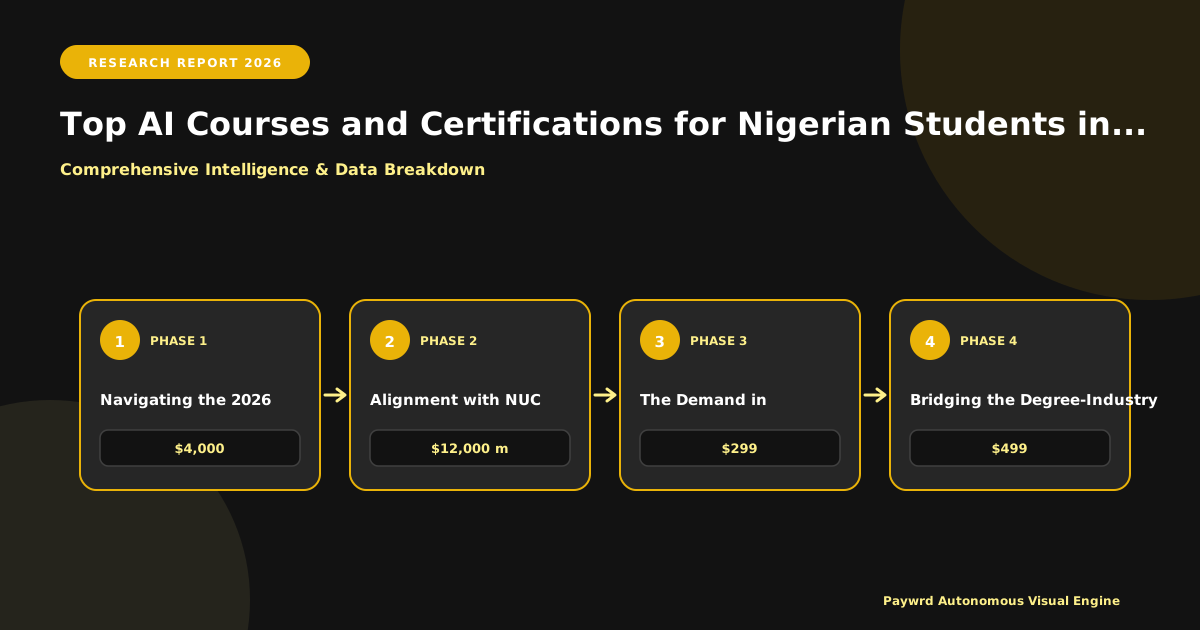
The Nigerian educational landscape has undergone a seismic shift. As we move through 2026, the integration of Artificial Intelligence is no longer an elective luxury but a core requirement for survival in the professional market. For students in Nigerian universities, the roadmap to employability now requires a strategic hybrid approach: combining the theoretical rigor of formal degrees with the agile, high-impact skills demanded by the private sector.
Alignment with NUC CCMAS Guidelines
The National Universities Commission (NUC) has fully embedded AI competencies into the Core Curriculum and Minimum Academic Standards (CCMAS) for Computer Science and Engineering. This means that 2026 graduates are expected to have a foundational grasp of machine learning and data ethics. However, while the CCMAS provides the necessary academic scaffolding, the pace of AI evolution often outstrips university syllabus updates. Students must recognize that the NUC guidelines are the floor, not the ceiling, of their technical proficiency.
The Demand in Lagos and Abuja Tech Hubs
In the high-pressure tech ecosystems of Yaba (Lagos) and the emerging innovation clusters in Abuja, the demand has shifted from general software engineering to specialized AI implementation. Companies are aggressively hiring for roles focused on:
- Generative AI Integration: Building custom AI agents for fintech and agritech solutions.
- LLM Fine-Tuning: Adapting Large Language Models to understand Nigerian linguistic nuances and local dialects.
- AI Governance: Ensuring compliance with emerging Nigerian data protection laws and ethical AI frameworks.
Bridging the Degree-Industry Gap
There remains a persistent “readiness gap” between graduating with a B.Sc. and delivering value on day one of a job. To bridge this, Nigerian students are increasingly turning to industry-recognized certifications. While a degree proves you can learn, a certification in PyTorch, TensorFlow, or a specialized LLM course proves you can execute.
For those facing financial constraints, leveraging the 2026 NELFUND student loan options to fund professional certifications is becoming a common strategy. By pairing a university degree with a portfolio of real-world AI projects, students can command starting salaries that far exceed traditional entry-level bands, positioning themselves as elite assets in both the local and global remote-work markets.
Top-Rated Global AI Certifications with Naira-Friendly Pricing
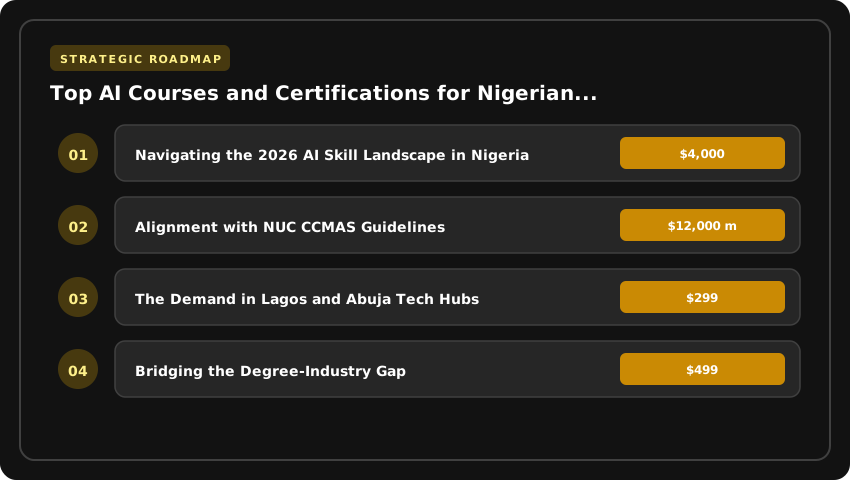
For the Nigerian student in 2026, the challenge isn’t finding AI courses—it’s identifying which certifications carry actual weight with employers while remaining affordable amidst currency volatility. While the prestige of global certificates is undeniable, the cost in Naira can be prohibitive without a strategic approach to funding and platform selection.
Comparing the Big Three: Google, Microsoft, and NVIDIA
In the current 2026 landscape, three providers dominate the professional AI space, each serving a different career trajectory:
- Google AI Professional Certificates: Best for beginners. These are hosted on Coursera and focus on practical application. They are highly accessible, with pricing typically ranging from ₦25,000 to ₦60,000 per month via subscription.
- Microsoft Certified: Azure AI Engineer Associate: The gold standard for corporate integration. This is essential for students targeting roles in Nigerian banks or fintech firms using the Azure stack. Exam vouchers can be costly, but Microsoft often provides “Cloud Skills Challenges” that offer free certification paths.
- NVIDIA Deep Learning Institute (DLI): The choice for high-end technical mastery. These certifications focus on GPU acceleration and LLM fine-tuning. While more expensive, they are the most respected for roles in AI research and heavy-duty engineering.
Scholarships and Financial Aid for West African Students
You should never pay full price for a global certification if you are a student in Nigeria. In 2026, several pathways exist to bypass the high cost of USD-denominated courses. Coursera’s Financial Aid remains the most reliable route; by submitting a detailed application explaining your financial status, you can often get 100% of the course fee waived.
Additionally, keep a close eye on the NELFUND (Nigerian Education Loan Fund) updates. While primarily for tuition, there are emerging partnerships in 2026 aimed at subsidizing professional certifications for STEM students to bridge the gap between NUC-accredited degrees and industry needs.
Cost-Benefit Analysis: Paid Certs vs. Free Audited Courses
A common dilemma for Nigerian students is whether to pay for the certificate or simply “audit” the course for free. Here is the 2026 breakdown:
- Free Audited Courses: Excellent for skill acquisition. You get the knowledge, but no verifiable credential. This is ideal for building a personal portfolio on GitHub to prove your competence.
- Paid Certifications: These act as a “trust signal” for HR filters. In a competitive job market, a verified badge from Google or Microsoft can be the difference between your CV being read or ignored by an Automated Tracking System (ATS).
The verdict? Audit the course first to ensure it fits your goals, then apply for financial aid or use a scholarship to secure the official certification once you’ve mastered the material.
Funding Your AI Education: NELFUND and Local Grants
The primary barrier to mastering AI in Nigeria remains the cost of high-end certifications and the hardware required to run local LLMs. However, in 2026, the financial landscape for students has evolved. You no longer have to rely solely on out-of-pocket payments to access world-class AI training.
Leveraging NELFUND for Professional AI Certifications
The Nigerian Education Loan Fund (NELFUND) has expanded its scope beyond basic tuition. For the 2026 academic session, students can now leverage NELFUND loans to cover “supplementary professional development,” which includes globally recognized AI certifications from providers like NVIDIA, Google, and Microsoft. To qualify, ensure your institution is registered on the NELFUND portal and that your course of study aligns with the NUC’s Core Curriculum and Minimum Academic Standards (CCMAS) for computing or related fields.
- Application Tip: When applying via the NELFUND portal, clearly categorize your AI certification as a “Professional Skill Enhancement” to increase approval odds.
- Repayment: Remember that these loans are designed for long-term repayment, typically commencing after you secure employment in the tech sector.
Nigerian Tech Grants and Fellowships for 2026/2027
Beyond loans, several local grants and fellowships are actively funding AI talent to drive Nigeria’s digital economy. For the 2026/2027 cycle, keep a close watch on the following opportunities:
- NITDA AI Fellowships: The National Information Technology Development Agency frequently offers grants for students building AI solutions for agriculture and healthcare.
- Local Venture Hubs: Ecosystem players like CcHub and various state-led tech hubs provide stipends for students specializing in Generative AI and Machine Learning.
- Corporate Scholarships: Many Nigerian banks and fintechs now offer “AI Talent Pipelines,” paying for your certifications in exchange for a commitment to work with them post-graduation.
Managing Costs Amidst Naira Volatility
With the Naira’s volatility affecting subscription costs for platforms like Coursera, OpenAI, or AWS, strategic financial planning is essential. To avoid the “exchange rate shock,” consider these strategies:
First, prioritize Local Currency Billing where available, or utilize virtual dollar cards that offer competitive mid-market rates. Second, lean heavily into Open-Source Learning; utilize Hugging Face and Kaggle for free datasets and compute power before committing to paid tiers. Finally, form Study Cooperatives with classmates to share the cost of “Team” or “Enterprise” subscriptions, effectively slashing your individual monthly spend by up to 60%.
Specialized AI Paths for Nigerian Degree Holders
For Nigerian graduates in 2026, the goal is no longer just “learning AI,” but applying it to solve systemic local challenges. With the NUC’s Core Curriculum and Minimum Academic Standards (CCMAS) now fully integrated across universities, degree holders possess the theoretical foundation. However, the real market value lies in vertical specialization—merging a degree in Computer Science, Economics, or Medicine with AI certifications tailored to Nigeria’s high-growth sectors.
AI for FinTech: Optimizing Nigerian Banking
Nigeria remains the FinTech hub of Africa, but the 2026 market demands more than basic payment gateways. Degree holders in Accounting, Finance, or Software Engineering should pivot toward AI certifications focusing on fraud detection and credit scoring for the unbanked. By implementing Machine Learning (ML) models that analyze non-traditional data—such as mobile airtime top-up patterns—AI specialists can help Nigerian banks reduce NPL (Non-Performing Loan) ratios and automate KYC processes, significantly lowering the cost of customer acquisition in rural areas.
AgriTech AI: Precision Farming for West African Soil
Agriculture is the backbone of the Nigerian economy, yet it remains plagued by inefficiency. For graduates of Agricultural Science or Environmental Engineering, the path forward is AI-driven precision farming. Specializing in Computer Vision and IoT integration allows professionals to build systems that detect crop pests specific to the Nigerian climate or analyze soil nutrient levels in real-time. Implementing these AI solutions helps smallholder farmers in the North and Middle Belt optimize fertilizer use, directly increasing yield and ensuring food security for the 2027 harvest cycle.
HealthTech AI: Solving Rural Diagnostic Gaps
The disparity in healthcare access between urban centers like Lagos and rural clinics in the Niger Delta is a critical pain point. Medical degree holders and Biomedical Engineers can bridge this gap by specializing in AI-powered diagnostics. By leveraging certifications in Medical Imaging AI and Natural Language Processing (NLP), practitioners can deploy lightweight diagnostic tools that operate on low-bandwidth networks. These tools can screen for malaria, tuberculosis, or maternal health complications in remote clinics where specialist doctors are unavailable, effectively democratizing healthcare delivery across the federation.
- FinTech Focus: Focus on Predictive Analytics and AML (Anti-Money Laundering) AI certifications.
- AgriTech Focus: Prioritize Remote Sensing and Satellite Imagery AI courses.
- HealthTech Focus: Specialize in HIPAA-compliant AI frameworks and Diagnostic ML.
Project-Based Learning: Building a 2026 AI Portfolio
In the 2026 job market, a digital certificate from Coursera or a degree from a Nigerian university serves as a ticket to the interview, but your portfolio is what secures the job. Global recruiters and local tech hubs in Yaba and Maitama are no longer impressed by “completed courses”; they demand proof of deployment. To stand out, you must transition from a passive learner to an active builder by solving problems that are uniquely Nigerian.
Developing Local-Language LLMs
One of the highest-value projects you can undertake in 2026 is bridging the linguistic gap in Artificial Intelligence. While global models are proficient in English, there is a massive demand for high-quality Large Language Models (LLMs) tailored for Yoruba, Hausa, and Igbo. By focusing on Low-Resource Language (LRL) datasets, you can build specialized chatbots or translation tools that serve rural populations.
- Action Plan: Use frameworks like Hugging Face to fine-tune open-source models (such as Llama 4 or Mistral) using curated Nigerian linguistic datasets.
- Impact: Demonstrating that you can handle tokenization for tonal languages proves a level of technical sophistication that generic AI certifications cannot.
Contributing to Open-Source AI via GitHub
Your GitHub profile is your real-time resume. In 2026, contributing to open-source AI projects is the fastest way to gain visibility with international recruiters from Silicon Valley to Berlin. Instead of building isolated projects, find existing AI libraries and submit pull requests that optimize performance or fix bugs.
- Strategy: Focus on “AI Orchestration” tools or agents that automate workflow. Document your commits clearly and engage with the global developer community.
- Goal: Aim for consistent contributions that show you can collaborate within a professional software development lifecycle (SDLC).
Documenting Nigerian Infrastructure Case Studies
The most impressive portfolios solve “street-level” problems. Use AI to tackle specific Nigerian infrastructure deficits—such as predicting power grid failures in Lagos, optimizing logistics for farmers in the North, or creating AI-driven diagnostic tools for understaffed rural clinics.
Don’t just write code; document the process. Create detailed case studies that outline the problem, the dataset used, the model architecture, and the measurable impact. When you can show a recruiter how your AI model reduced waste in a local supply chain by 15%, you move from being a “student” to a “solution provider.”
AI Career Outlook: 2026 Salary Benchmarks in Nigeria
For the Nigerian student, the primary motivation for pursuing AI certifications is the Return on Investment (ROI). In 2026, the gap between a general Computer Science graduate and a certified AI Specialist is reflected starkly in the payroll. As Nigerian enterprises aggressively migrate to AI-driven operations to cut costs, the demand for local talent capable of deploying Large Language Models (LLMs) and autonomous agents has skyrocketed.
Local Salary Benchmarks (2026)
While salary scales vary between Lagos-based fintechs and Abuja-based government contractors, the current 2026 market rates for AI-certified professionals are as follows:
- Entry-Level AI Engineer: Fresh graduates with a degree and a recognized certification (e.g., NVIDIA or Google AI) typically earn between ₦450,000 and ₦850,000 monthly.
- Mid-Level AI Specialist: Professionals with 2-4 years of experience in model tuning and RAG (Retrieval-Augmented Generation) architectures command ₦1.2 million to ₦2.5 million monthly.
- Senior AI Architect/Lead: Experts overseeing enterprise AI integration in Nigeria now see monthly packages ranging from ₦3.5 million to ₦6 million, often including equity or performance bonuses.
The Global Arbitrage: Remote Work in US/EU Markets
The most lucrative path for Nigerian AI specialists in 2026 remains the “Global Arbitrage” model. By leveraging remote-first platforms, Nigerian engineers are bypassing local currency fluctuations. Specialists proficient in PyTorch, TensorFlow, and LLM orchestration are securing remote contracts with US and EU firms paying between $4,000 and $12,000 monthly. With the 2026 emphasis on decentralized AI development, Nigerian talent is increasingly viewed as a high-value, cost-effective alternative to Silicon Valley hires, provided they hold globally recognized certifications.
Top Hiring Hubs in Nigeria
If you are looking for local stability and rapid career growth, several sectors are currently dominating AI recruitment in 2026:
- Fintech Giants: Companies like Flutterwave, OPay, and Moniepoint are hiring AI engineers to build advanced fraud detection and automated credit scoring systems.
- AgriTech Innovators: Startups focusing on AI-driven crop yield prediction and precision farming are scaling rapidly.
- Government & Public Sector: Following the 2026-2027 digitalization mandates, various federal agencies are recruiting AI consultants to optimize public service delivery and data management.
- HealthTech Firms: AI specialists are being integrated into diagnostic centers to implement AI-assisted radiology and patient triage systems.
| Certification/Path | Estimated Cost (2026/27) | Prerequisites | Avg. Entry Salary (NGN/mo) | Duration |
|---|---|---|---|---|
| Google AI Professional Cert | $299 – $499 | Basic Python Knowledge | ₦350,000 – ₦600,000 | 6 Months |
| NUC-Accredited AI Degree | ₦1.2M – ₦3.5M | JAMB/Post-UTME 2026 | ₦250,000 – ₦450,000 | 4 Years |
| DeepLearning.AI Specialization | $49/month | Linear Algebra & Calculus | ₦400,000 – ₦750,000 | 4 Months |
| Microsoft Azure AI Engineer | $165 (Exam Fee) | Cloud Fundamentals | ₦300,000 – ₦550,000 | 3 Months |
Frequently Asked Questions
What are the best AI certifications for Nigerian students in 2026?
For 2026, the most valuable certifications for Nigerian students are the Google AI Professional Certificate and DeepLearning.AI's LLM specializations. These provide the practical Generative AI and orchestration skills required by Lagos and Abuja tech hubs, complementing NUC-accredited degrees to maximize employability in the local and global remote markets.
How much does an AI certification cost in Nigeria for 2026/2027?
Costs vary by provider; professional certificates from Google or Coursera typically range from $299 to $499, while specialized exam-based certifications like Microsoft Azure AI cost approximately $165. Many Nigerian students utilize scholarship programs or Naira-denominated local bootcamps to offset these costs during the 2026/2027 academic sessions.
Do I need a university degree to work in AI in Nigeria in 2026?
While a degree is beneficial, the 2026 market prioritizes a hybrid approach. Combining an NUC-accredited degree with specialized certifications in LLM orchestration and Generative AI is the gold standard. However, a strong portfolio of AI projects can secure entry-level roles in Nigeria's agile private tech sector.
What is the average salary for AI specialists in Nigeria in 2026?
In 2026, entry-level AI specialists in Nigeria earn between ₦250,000 and ₦750,000 monthly, depending on their certification level and portfolio. Those specializing in LLM fine-tuning and AI integration for fintech often command the higher end of this spectrum, especially when working for international firms remotely.
Which AI skills are most in demand for Nigerian graduates in 2027?
Heading into 2027, the most demanded skills include LLM orchestration, AI agent development, and ethical AI governance. Nigerian firms are specifically seeking graduates who can integrate AI into existing business workflows, making proficiency in Python, PyTorch, and cloud-based AI deployment essential for competitive candidates.
Strategic Final Takeaway
When evaluating Best AI Courses And Certifications For Nigerian Students 2026 in 2026 and beyond, base your decisions on accredited institutional standards, verified return on investment (ROI), and up-to-date official guidelines. Always verify specific dates and requirements through official regulatory portals.