The 2026 Cybersecurity Landscape for US High Schoolers
Entering the cybersecurity field in 2026 is fundamentally different than it was just a few years ago. We have moved past the era of simple firewall management into a period of hyper-automated warfare. For US high school students, this means the “entry-level” bar has been raised. The industry is no longer just looking for people who can code; they are looking for analysts who can manage AI agents that do the coding for them.

The Demand for SOC Analysts
The Security Operations Center (SOC) remains the primary gateway for new talent. There is currently a critical shortage of Tier 1 SOC Analysts capable of triaging alerts in real-time. According to recent labor trends, firms are aggressively recruiting from community colleges and four-year universities to fill these roles. For a student starting today, the goal is to move from a “monitor” to a “hunter.” Companies are prioritizing candidates who possess foundational certifications and a demonstrated ability to handle high-pressure environments.
AI-Driven Threats and New Requirements
The proliferation of generative AI has weaponized phishing and malware creation, making threats more sophisticated and harder to detect. Consequently, the US Department of Education and industry leaders are pushing for a curriculum shift. To be competitive in 2026, students must understand:
- AI Prompt Engineering: Using LLMs to analyze logs and automate threat hunting.
- Adversarial ML: Understanding how attackers “poison” data to trick security AI.
- Zero Trust Architecture: Moving beyond perimeter security to a “never trust, always verify” model.
Market Growth and Financial Outlook (2027+)
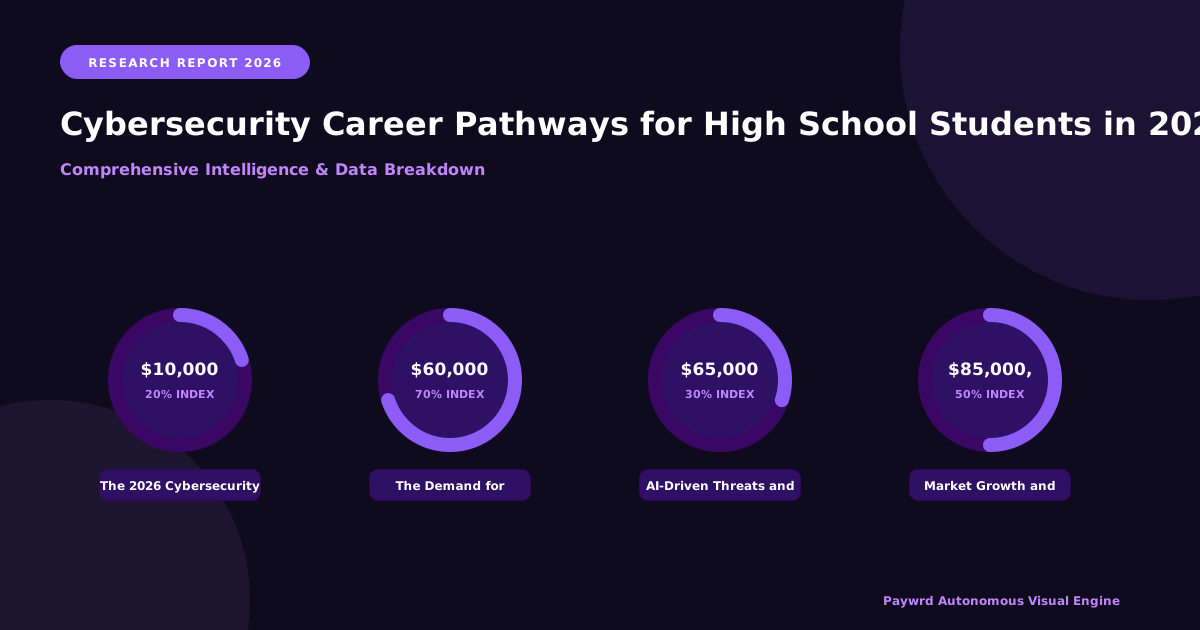
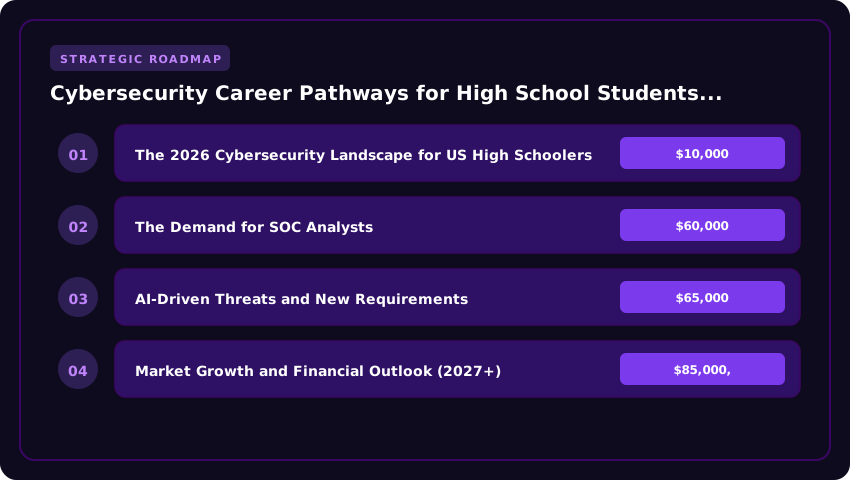
The financial incentive to enter this field remains staggering. Looking toward 2027 and beyond, the US Bureau of Labor Statistics (BLS) projects growth for information security analysts to far outpace the average for all occupations. While tuition for a degree from an ABET-accredited program can range from $10,000 at public institutions to over $60,000 at Ivy League universities, the ROI is rapid.
Entry-level salaries for cybersecurity roles in 2026 typically start between $65,000 and $85,000, depending on the region and certification level. With the federal government increasing FAFSA allocations for STEM-critical pathways, there has never been a more accessible or lucrative time for a high school student to commit to this trajectory.
Comparing Degree Paths: ABET-Accredited Programs vs. Certifications
For high school students entering the pipeline in 2026, the central dilemma is no longer whether to get a degree, but which credential yields the highest return on investment (ROI). The landscape is split between the prestige of ABET-accredited Computer Science (CS) programs and the agility of industry-recognized certifications.
The Academic Route: ABET and Specialized Degrees
A traditional four-year degree from an Ivy League institution or a top-tier state university remains the gold standard for leadership and research roles. ABET accreditation is non-negotiable here; it ensures the curriculum meets rigorous global standards for technical education. While a general CS degree provides a broad theoretical foundation, we are seeing a massive surge in specialized Cybersecurity degrees. These programs integrate AI-driven threat hunting and quantum-resistant cryptography directly into the core curriculum.
- Financial Commitment: Average tuition at private non-profit four-year institutions now ranges from $40,000 to $65,000 per year. Students should prioritize FAFSA applications early to secure federal grants and loans.
- Earning Potential: According to recent BLS data, entry-level cybersecurity analysts with a bachelor’s degree command starting salaries between $75,000 and $95,000, depending on the region.
The Fast-Track: Certifications and Bootcamps
For students who prefer a hands-on approach, certifications offer a streamlined entry point. In 2026, the “certification stack” is the primary currency for technical roles. CompTIA Security+ remains the baseline for DoD compliance, while Cisco’s specialized tracks provide the networking depth required for infrastructure security. Accelerated bootcamps have evolved into hybrid models, often partnering with AACSB-accredited business schools to blend technical skill with project management (PMI) principles.
- Key Credentials: Focus on CompTIA Security+, Cisco Certified Support Technician (CCST), and cloud-specific certs from AWS or Azure.
- ROI Analysis: Bootcamps typically cost between $10,000 and $20,000 and take 3 to 9 months. While the initial salary may be slightly lower ($60,000 to $80,000), the lack of student debt and faster market entry often result in a higher short-term ROI.
Ultimately, the most competitive candidates in 2027 and beyond will be those who “stack” their credentials. The ideal trajectory involves pursuing an ABET-accredited degree while simultaneously earning industry certifications to prove immediate technical competency to employers.
Strategic High School Coursework and STEM Alignment
Building a competitive profile for 2027 college admissions or direct-to-industry certifications requires more than just a high GPA. In 2026, the academic roadmap for aspiring cybersecurity professionals centers on a rigorous blend of Advanced Placement (AP) rigor and hands-on technical fluency. Students should prioritize AP Computer Science Principles to understand the conceptual breadth of the internet and data, followed by AP Computer Science A to master Java and object-oriented programming. These courses provide the theoretical foundation necessary to navigate the complex algorithms used in modern threat detection.
Technical Electives and Systems Literacy
While AP courses satisfy university requirements, the actual “work” of cybersecurity happens in the command line. Students must strategically integrate the following into their elective schedules to avoid a skills gap upon graduation:
- Python Proficiency: As the primary language for automation and AI-driven security tools, Python is non-negotiable. Focus on scripting for network analysis and automating repetitive security tasks.
- Linux Fundamentals: Since the vast majority of servers and security tools run on Linux, students should seek courses or self-study modules covering the Bash shell, file permissions, and kernel basics.
- Discrete Mathematics: Understanding logic and number theory is essential for grasping the encryption and cryptography standards used by the US Department of Education and federal agencies.
Accelerating the Timeline: Dual Enrollment
To reduce the long-term financial burden of a degree—where average annual tuition at private institutions can exceed $55,000—students should leverage dual-enrollment programs. By taking courses at local community colleges, students can earn college credits while gaining exposure to ABET-accredited curriculum. This path allows students to complete foundational prerequisites before ever stepping foot on a university campus, significantly accelerating their path toward high-paying roles that the BLS projects will continue to see aggressive growth through 2032.
Competitive Extracurriculars and Validation
Academic transcripts tell a story, but competitive achievements prove competence. To stand out to Ivy League recruiters or industry scouts, students should engage in high-stakes simulations:
- CyberPatriot: The National Youth Cyber Education Program provides a structured environment to secure virtual networks, mirroring real-world administrative challenges.
- Capture The Flag (CTF) Events: Participating in CTFs forces students to apply “adversarial thinking,” solving puzzles related to reverse engineering and web exploitation.
- Certification Alignment: Aiming for entry-level certifications (like CompTIA Security+) during senior year provides a tangible credential that complements a high school diploma.
Funding Your Education: FAFSA and Cybersecurity Scholarships
Pursuing a degree in cybersecurity in 2026 requires a strategic financial plan. With average annual tuition for public four-year institutions now hovering between $11,000 and $28,000—and Ivy League or private costs often exceeding $65,000—relying solely on out-of-pocket payments is rarely viable. The first step for any high school senior is the 2026-2027 FAFSA (Free Application for Federal Student Aid). This application is the gateway to federal Pell Grants, subsidized loans, and work-study programs managed by the US Department of Education.
Leveraging STEM Grants and Corporate Funding
Beyond federal aid, the 2026 landscape offers robust, specialized funding for STEM students. There is a concentrated effort to diversify the cybersecurity workforce, leading to an increase in grants specifically for underrepresented students in tech. These grants are often “gift aid,” meaning they do not require repayment and are designed to bridge the gap between FAFSA allocations and the actual cost of attendance.
Furthermore, US tech giants have shifted their philanthropic focus toward early-pipeline talent. Students should aggressively target corporate scholarships from the following entities:
- Google: Focuses on scholarships for students pursuing computer science and cybersecurity who demonstrate a commitment to diversity and inclusion.
- Microsoft: Offers various grants and scholarships centered on AI-integrated security and cloud infrastructure.
- Amazon: Provides funding and apprenticeship pathways that often blend tuition assistance with guaranteed internship placements.
Earn While You Learn: Work-Study and IT Centers
One of the most overlooked funding strategies is the university work-study program. Rather than taking a generic campus job, cybersecurity students should apply for positions within their university’s IT security centers or Security Operations Centers (SOCs). These roles provide a dual benefit: they offer a steady paycheck to cover living expenses and provide hands-on experience with enterprise-grade tools.
Working in a campus security center allows students to apply theoretical knowledge from ABET-accredited programs in real-time. In 2026, these roles are increasingly focused on monitoring AI-driven threat detection systems, giving students a competitive edge. By combining FAFSA grants, corporate scholarships, and strategic work-study placements, students can enter the workforce with minimal debt, positioning themselves to capture the high starting salaries—often exceeding $75,000 for entry-level analysts—reported by the Bureau of Labor Statistics (BLS).
Mapping Specialized Roles to Personal Strengths
Cybersecurity is not a monolithic career; it is a collection of distinct disciplines. For a high school student in 2026, the goal is to align your natural cognitive strengths with a specific niche to avoid burnout and accelerate your path toward high-earning certifications. Whether you are aiming for an Ivy League computer science program or an ABET-accredited technical degree, understanding where you fit is the first step.
Offensive Security: The “Puzzle Solver”
If you possess a rebellious streak and a passion for dismantling things to see how they work, Offensive Security—specifically Penetration Testing and Red Teaming—is your calling. These professionals are paid to think like adversaries. You will spend your days identifying vulnerabilities before hackers do, using AI-driven fuzzing tools to probe network perimeters.
- Best for: Students who enjoy gaming, competitive coding, and complex logic puzzles.
- Key Focus: Exploitation frameworks, social engineering, and adversarial simulation.
Defensive Security: The “Guardian”
Defensive Security, or Blue Teaming, is for those who thrive under pressure and enjoy the thrill of the chase. Incident Response specialists are the first responders of the digital world. In 2026, this role relies heavily on analyzing telemetry from AI-powered Security Operations Centers (SOCs) to neutralize threats in real-time.
- Best for: Students with high attention to detail, a protective instinct, and a love for investigative work.
- Key Focus: Threat hunting, digital forensics, and rapid containment.
Governance, Risk, and Compliance (GRC): The “Strategist”
Not every high-paying cyber role requires writing code. GRC is the intersection of law, business, and technology. These professionals ensure that organizations meet strict US Dept of Education or HIPAA standards. It is a critical role for students who are organized, articulate, and interested in the “why” behind the rules.
- Best for: Students who excel in debate, writing, and organizational management.
- Key Focus: Policy drafting, auditing, and risk assessment frameworks.
Cloud Security: The “Architect”
As US enterprises migrate fully to hybrid environments, securing AWS and Azure has become a specialized science. Cloud Security Architects design the blueprints that keep data safe across distributed servers. This is a high-growth area where certifications from major cloud providers often command salaries exceeding $110,000 for entry-level specialists in 2026.
- Best for: Students who enjoy systems thinking and building scalable structures.
- Key Focus: Identity and Access Management (IAM), container security, and serverless architecture.
Projecting 2027 Entry-Level Salaries and Growth Trajectories
For high school students planning their transition into the workforce or higher education in 2027, the financial outlook for cybersecurity remains exceptionally strong. According to the latest Bureau of Labor Statistics (BLS) projections and industry data, entry-level cybersecurity analysts are entering the market with competitive starting packages. In 2027, the average starting salary for a graduate with a bachelor’s degree from an ABET-accredited program typically ranges between $72,000 and $95,000, depending on their specialization in AI-driven threat detection or cloud security.
Regional Pay Disparities and Market Hubs
While the national average is high, geography plays a critical role in initial compensation. The US market is currently defined by three primary hubs:
- Silicon Valley & Seattle: These remain the highest-paying regions, with entry-level roles often exceeding $105,000. However, the cost of living necessitates a careful analysis of “real” income.
- Texas (Austin/Dallas): A surging hub for cybersecurity, Texas offers a strategic balance. Starting salaries range from $68,000 to $82,000, but the lack of state income tax significantly increases take-home pay.
- East Coast (DC/NYC): The corridor between Washington D.C. and New York City offers stable, high-floor salaries averaging $75,000 to $90,000, driven heavily by financial services and federal agencies.
The Long-Term Climb: From Junior Analyst to CISO
Cybersecurity is not a stagnant role; it is a high-velocity career ladder. A typical trajectory begins as a Junior Security Analyst or SOC (Security Operations Center) Tier 1 Analyst. With 3 to 5 years of experience and certifications from bodies like PMI or specialized vendor credentials, professionals move into Senior Security Engineering or Architecture roles, where salaries often leap to the $130,000–$160,000 range.
The ultimate ceiling is the Chief Information Security Officer (CISO). This executive role requires a blend of technical mastery and business acumen, often supplemented by an MBA from an AACSB-accredited school. CISOs in the US now command total compensation packages (including equity and bonuses) that frequently exceed $250,000 per year.
The “Clearance Premium” in Defense Contracting
For students targeting government roles or defense contractors (such as Lockheed Martin or Raytheon), obtaining a US government security clearance is a massive financial catalyst. A Top Secret (TS/SCI) clearance acts as a “force multiplier” for salary, often adding a 15% to 25% premium to base pay. Because the vetting process is rigorous and time-consuming, candidates who possess active clearances are in extremely high demand, providing them with immense job security and leverage during salary negotiations.
| Pathway Option | Primary Prerequisite (2026) | Estimated Cost (USD) | 2026/2027 Timeline | Starting Salary Potential |
|---|---|---|---|---|
| AI-Driven Certification | AI Prompt Engineering Basics | $500 – $2,000 | 3-6 Months | $65,000 – $85,000 |
| Cybersecurity Degree | STEM High School Diploma | $20,000 – $50,000/yr | 4 Years | $80,000 – $110,000 |
| Vocational Apprenticeship | Basic Python & AI Fluency | $0 (Paid Training) | 12-24 Months | $55,000 – $75,000 |
| Bootcamp (Specialized) | Foundational Logic/Math | $10,000 – $18,000 | 6 Months | $70,000 – $90,000 |
Frequently Asked Questions
What are the best cybersecurity certifications for high school students in 2026?
In 2026, students should prioritize AI-integrated security certifications. While CompTIA Security+ remains a baseline, certifications focusing on AI-driven threat detection and automated response orchestration are now essential. High schoolers should target credentials that validate their ability to manage AI security agents and oversee hyper-automated defense systems.
Is a college degree required for cybersecurity jobs in 2027?
While a degree provides a strong theoretical foundation, the 2027 market heavily favors skill-based hiring. Proficiency in AI-fluency and hands-on experience with automated warfare tools often outweigh traditional degrees. Many US firms now accept a combination of specialized bootcamps and AI-security certifications for entry-level analyst roles.
What skills do high schoolers need for cybersecurity in 2026?
The 2026 entry bar requires more than basic coding. Students must possess AI-fluency, specifically the ability to prompt and manage AI agents that handle routine coding and firewall tasks. Critical thinking, AI-driven forensic analysis, and an understanding of hyper-automated threat landscapes are now mandatory prerequisites for US students.
How much can a beginner in cybersecurity earn in the US in 2026?
Entry-level cybersecurity professionals in the US can expect starting salaries between $65,000 and $85,000 in 2026. Those specializing in AI-security orchestration or automated threat hunting often command higher premiums, with some specialized junior roles reaching $90,000 depending on their technical certifications and AI-fluency levels.
How do I start a cybersecurity career in high school for 2027?
Start by mastering AI prompt engineering and basic Python. Engage in AI-focused Capture The Flag (CTF) competitions and seek apprenticeships that emphasize automated defense. By 2027, the most successful students will be those who can demonstrate a portfolio of managed AI security agents and automated scripts.
Strategic Final Takeaway
When evaluating Cybersecurity Career Pathways For High School Students In The US in 2026 and beyond, base your decisions on accredited institutional standards, verified return on investment (ROI), and up-to-date official guidelines. Always verify specific dates and requirements through official regulatory portals.