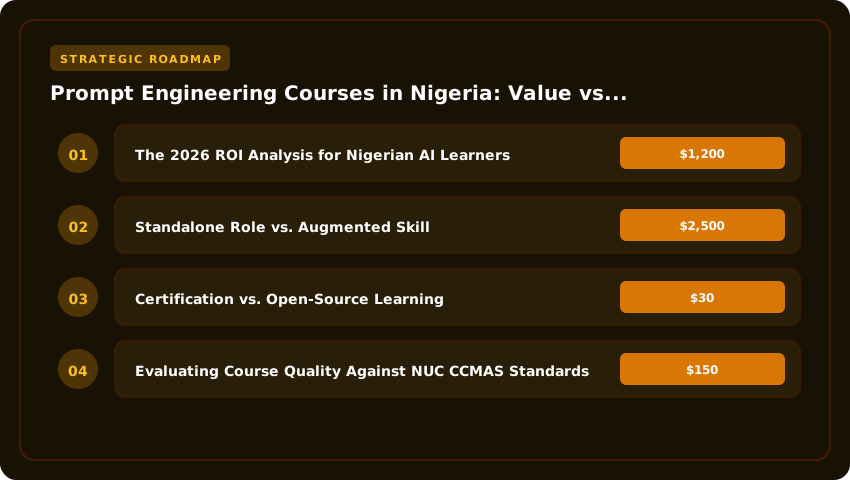
The 2026 ROI Analysis for Nigerian AI Learners
Investing in AI education in 2026 requires a cold, hard look at the numbers. With the Naira fluctuating against the Dollar, the financial goal for most Nigerian learners is “Geo-Arbitrage”—earning in USD while spending in NGN. Currently, high-end local Prompt Engineering bootcamps range from ₦150,000 to ₦450,000. While this seems steep, the ROI is realized the moment you secure a remote junior AI Specialist role, which currently averages between $1,200 and $2,500 per month for West African talent.

Standalone Role vs. Augmented Skill
The market has shifted. In 2026, “Prompt Engineer” was a trendy job title; by 2026, it has evolved into a foundational requirement. Very few Nigerian firms are hiring “Prompt Engineers” as a standalone role. Instead, they are hiring “AI-Augmented Software Engineers” or “AI-Driven Content Strategists.” The real value lies in augmentation. A marketer who can use advanced chain-of-thought prompting to automate a full campaign lifecycle is 3x more valuable than a generalist, often commanding a 40% premium in local salary bands.
Certification vs. Open-Source Learning
The opportunity cost of a paid certification is significant. With the proliferation of high-quality open-source frameworks and NUC-aligned AI modules in tertiary institutions, you must ask: is the certificate worth the tuition?
- Paid Certifications: Best for networking, structured mentorship, and “social proof” for LinkedIn profiles. Ideal for those transitioning from non-tech backgrounds who need a guided roadmap.
- Self-Taught/Open-Source: Best for those with strong technical foundations. Utilizing free documentation and community-led projects allows you to build a portfolio (GitHub/Kaggle) that carries more weight with international recruiters than a PDF certificate.
For students leveraging NELFUND loans for tech education, the focus should be on programs that offer guaranteed internship placements. If a course costs ₦300,000 but doesn’t provide a direct pipeline to a project or a portfolio-building exercise, the ROI is negative. In the 2026 economy, a proven portfolio of AI-automated workflows beats a certificate every single time.
Evaluating Course Quality Against NUC CCMAS Standards
In 2026, the Nigerian educational landscape has shifted. With the National Universities Commission (NUC) fully implementing the Core Curriculum and Minimum Academic Standards (CCMAS), the line between “informal tech bootcamps” and “academic rigor” has blurred. For a Prompt Engineering course to hold genuine value, it must align with the CCMAS framework, which emphasizes multidisciplinary integration. If a course teaches prompts in a vacuum without referencing data ethics, algorithmic bias, or domain-specific application—as mandated by the NUC’s updated guidelines for Computer Science and AI—it is likely obsolete.
Spotting ‘Certificate Mills’ vs. Industry Credentials
The 2026 market is flooded with “certificate mills”—low-cost, automated programs that grant a PDF certificate after watching a few pre-recorded videos. These hold zero weight with top-tier Nigerian firms or international recruiters. To avoid wasting your tuition, evaluate courses based on these red flags and green flags:
- Red Flag: Promises of “Mastery” in 48 hours or certificates that aren’t verifiable via a blockchain link or a recognized institutional portal.
- Red Flag: Curricula that focus solely on “magic prompts” rather than the underlying architecture of Large Language Models (LLMs).
- Green Flag: Partnerships with recognized bodies (e.g., NITDA, Google, or NUC-accredited universities) and a focus on AI orchestration.
- Green Flag: Assessment models that require live coding or real-time prompt optimization tests.
The Supremacy of Project-Based Portfolios
By 2026, the “Certificate Era” has effectively ended. Nigerian employers in the Fintech and Agritech sectors no longer ask “Where did you study?” but rather “What have you built?” A high-value course must culminate in a tangible project-based portfolio. This means moving beyond simple chat logs to demonstrating complex AI workflows, such as building a custom RAG (Retrieval-Augmented Generation) system for Nigerian legal documents or an automated customer support agent for a local e-commerce brand.
Your portfolio is your real currency. In a competitive 2026 job market, a GitHub repository showcasing your ability to reduce token costs or improve model accuracy for a specific Nigerian business use case is worth more than any diploma. Ensure your chosen program prioritizes “Proof of Work” over “Proof of Attendance.”
Time Commitment vs. Rapid AI Evolution
In the current 2026 landscape, the greatest risk for a Nigerian learner isn’t the cost of a course, but the “knowledge half-life.” Large Language Models (LLMs) are evolving so rapidly that a comprehensive six-month diploma designed in early 2026 may be functionally obsolete by the time you graduate in 2027. When the underlying architecture of models shifts from simple prompting to autonomous agentic workflows, long-term, rigid curricula become liabilities rather than assets.
Micro-credentialing vs. Comprehensive Diplomas
For those eyeing 2027 readiness, the strategy has shifted from “degree hunting” to “skill stacking.” Comprehensive diplomas often suffer from academic lag—the time it takes to approve a curriculum often exceeds the release cycle of a new frontier model. Instead, the most successful Nigerian tech talents are opting for micro-credentialing. These are short, intensive bursts of learning (2 to 4 weeks) focused on specific capabilities, such as RAG (Retrieval-Augmented Generation) or AI-driven API orchestration.
- Micro-credentials: High agility, immediate application to freelance gigs on Upwork or Toptal, and lower financial risk.
- Comprehensive Diplomas: Better for institutional prestige but often lack the “bleeding-edge” updates required for high-paying USD contracts.
Balancing University Studies with AI Specialization
For students currently navigating the NUC’s Core Curriculum and Minimum Academic Standards (CCMAS) in Nigerian universities, the challenge is balancing a rigid degree with the fluid nature of AI. Attempting a full-time AI specialization alongside a heavy engineering or law load often leads to burnout. The optimal approach in 2026 is “Parallel Integration.”
Rather than treating Prompt Engineering as a separate subject, students should apply AI tools to their core academic requirements. For instance, a Law student at UNILAG or a Computer Science student at ABU Zaria should focus on how AI automates legal discovery or code refactoring. This transforms the time commitment from “extra study hours” into “efficiency gains,” allowing the student to maintain their GPA while building a portfolio of AI-augmented projects.
Ultimately, the goal for 2027 is not to be a “Prompt Engineer”—a title that is rapidly disappearing—but to be a domain expert who can orchestrate AI. The time you spend learning should be weighted toward 20% theory and 80% active deployment in real-world Nigerian use cases.
Local Market Demand: Where Prompting Skills Pay Off
In 2026, prompt engineering has evolved from a “trendy trick” into a core operational requirement across Nigeria’s primary economic hubs. The demand is no longer about knowing how to chat with an AI, but about AI Orchestration—the ability to build complex, multi-step prompt chains that automate entire business departments. This shift has created a massive talent gap in Lagos and Abuja, where companies are desperate for professionals who can bridge the gap between raw LLM capabilities and actual business KPIs.
The Power Hubs: FinTech and GovTech
In Lagos, the FinTech ecosystem has moved beyond basic chatbots. Top-tier firms are now hiring prompt engineers to refine automated credit scoring models and personalize customer onboarding journeys. Similarly, in Abuja, the GovTech push is in full swing. Government agencies are integrating AI to streamline civil service workflows and automate the processing of public petitions, creating a surge in demand for specialists who can ensure these prompts remain unbiased, secure, and compliant with Nigerian data privacy laws.
Unlocking Global Geo-Arbitrage
For the savvy Nigerian professional, the real financial windfall lies in freelance platforms like Upwork and Toptal. In 2026, “Prompt Engineer” is a standalone category, but the highest-paying gigs are for Domain-Specific Prompting. Whether it is automating legal discovery for US-based law firms or generating high-conversion ad copy for UK e-commerce brands, the ability to engineer precise outputs allows Nigerians to command rates between $30 and $150 per hour. This creates a powerful hedge against Naira volatility, turning a local skill into a global USD revenue stream.
2026 Real-World Applications
We are seeing a new breed of “Hyper-Productive” Nigerian professionals who have fundamentally changed their workflow:
- The Digital Marketer: Instead of spending days on a campaign, a Lagos-based strategist now uses a proprietary prompt library to conduct market research, generate 50 variations of ad copy, and build a full content calendar in under two hours.
- The Software Developer: Engineers are leveraging advanced prompting to automate the writing of boilerplate code and unit tests, reducing development cycles by nearly 40% and allowing them to take on three times as many international contracts.
- The Administrative Lead: In Abuja’s corporate sector, execs are using AI orchestration to summarize 100-page policy documents into actionable briefs, cutting down meeting preparation time from days to minutes.
Funding Your AI Education in Nigeria
The biggest barrier to learning AI in Nigeria in 2026 is not talent—it is cash flow. Between unstable internet, expensive hardware, and course fees priced in dollars, the financial math can feel brutal. But there are real paths through this. Let us break them down.
Tapping Into NELFUND and Private Scholarships
The NELFUND portal (administered under the Tertiary Education Fund Act of 2026) now provides interest-free loans for accredited Nigerian tertiary students pursuing technology-related certifications and degrees. In 2026, eligible learners can access up to ₦500,000 per academic cycle, repayable after graduation. The key requirement is admission into a participating institution verified through NUC CCMAS. Do not confuse this with the old HEFUND structure—NELFUND is a completely overhauled system with stricter verification and disbursement through approved bank partners.
Beyond government loans, private scholarships are actively targeting AI learners:
- The Google Developer Scholarship program regularly covers full certification costs for African applicants—watch the Google for Africa portal for 2026 cohort announcements.
- MTN Foundation offers technology grants up to ₦2,000,000 for Nigerian students in emerging tech fields, with applications typically opening mid-year.
- Andela’s learning pathways sometimes include sponsored access to advanced AI curricula for developers already in their talent pipeline.
Budgeting for Data and Hardware
AI training is resource-hungry. You need a reliable laptop with at least 16GB RAM and a functional GPU—budget ₦350,000 to ₦700,000 for a solid entry-level setup in 2026. For internet, Nigerian broadband plans from providers like Smile or MTN average ₦10,000 to ₦25,000 monthly for stable speeds suitable for cloud-based AI labs. Do not underestimate this line item. Many learners fail not because they lack intelligence but because their connection crashes mid-assessment. Build a monthly connectivity budget of at least ₦15,000 into your plan from day one.
Subscription vs. One-Time Payment: What Wins?
Most platforms selling AI courses operate on two models. Subscription services like Coursera Plus (approximately ₦45,000 per month or ₦380,000 per year via Nigerian billing) give you access to rotating course libraries. One-time purchases on platforms like Udemy (often ₦3,000 to ₦15,000 during flash sales) lock specific content to your account permanently.
For Nigerian learners in 2026, the one-time model wins if you have clear goals. You want a specific skill—prompt engineering for fintech, say—buy it once, master it, and move to earn. Subscriptions suit explorers, but monthly costs compound fast when the Naira is weak. If you must subscribe, use student discounts and cancel immediately after certification.
The smart move is to combine NELFUND support for hardware purchases with targeted one-time course investments, then pursue USD-denominated freelance work to recoup every naira spent.
Final Verdict: The 2026 Decision Matrix
The noise around “Prompt Engineering” as a standalone career peaked in late 2026. By 2026, the market has corrected sharply. If you are a Nigerian learner staring at a ₦150,000–₦300,000 course invoice, the decision framework is binary: Are you buying a syntax tutorial, or are you buying a workflow integration? The former is a depreciating asset; the latter is your ticket to geo-arbitrage.
Checklist: Pay for a Course vs. Use Free Tools
- PAY (₦50k–₦200k): Only if the curriculum forces you to build production-grade pipelines—RAG implementation with LangChain/LlamaIndex, agent orchestration via CrewAI or AutoGen, eval frameworks (DeepEval/Ragas), and CI/CD deployment on AWS/GCP/Azure. The certificate is irrelevant; the GitHub repo link is the credential.
- PAY (Corporate Sponsorship/₦500k+): If your employer (e.g., a Tier-1 Nigerian bank, Flutterwave, or Andela partner) funds a specialized “LLM Ops” or “AI Safety/Red Teaming” bootcamp tied to an internal promotion band.
- FREE (YouTube/GitHub/Docs): Prompt patterns (Chain-of-Thought, Few-Shot, ReAct), basic API calling, and model switching. Anthropic’s Cookbook, OpenAI’s Prompt Engineering Guide, and DAIR.AI’s Prompt Engineering Guide remain the gold standard—cost: ₦0, just data bundles.
- FREE (Community): Join AI Saturdays Lagos, Data Science Nigeria (DSN) Slack, or GenAI Nigeria Telegram groups. Peer review of your prompts beats a static video module every time.
Predicting Value into 2027: The “Orchestration” Pivot
By 2027, “Prompt Engineer” will vanish from LinkedIn job titles, replaced by AI Engineer, LLM Application Developer, or Domain-Specific AI Specialist. The models (GPT-5, Claude 4, Gemini Ultra) will handle prompt optimization natively via “System 2” reasoning and automatic prompt rewriting. Value shifts entirely to context engineering: how you chunk legal documents for a LawTech RAG, how you guardrail a Fintech credit-scoring agent against CBN compliance hallucinations, or how you optimize token costs for an Agritech advisory bot serving 50,000 farmers via WhatsApp. The premium pays for domain context + engineering rigor, not prompt syntax.
Recommended Learning Paths by Career Stage (2026)
- Undergraduate / NYSC (₦0 Budget): Skip paid courses. Master Python → FastAPI → LangChain/LlamaIndex tutorials → Build 3 portfolio projects (e.g., “JAMB CBT Tutor Bot,” “NYSC Posting Predictor,” “NAFDAC Drug Verification Agent”). Deploy on Hugging Face Spaces or Railway.app. Target: Junior AI Engineer roles (₦300k–₦600k/month) or Upwork $500–$1k/mo gigs.
- Mid-Level Professional (Banking, Law, Agric, DevOps) — Pivot Strategy: Do not start from zero. Spend ₦50k–₦100k on a cohort-based “LLM App Dev” course (e.g., Decagon, AltSchool Africa advanced track, or reputable global cohort like AI Makerspace) only if it includes a capstone project in your specific domain. Leverage 5+ years domain knowledge + new AI stack = Senior AI Product Manager / Lead AI Engineer (₦1.5M–₦3M/month or $3k–$6k/month remote).
- Senior Expert / Founder: Hire a tutor for 1-on-1 sessions (₦20k–₦50k/hr) to architect your specific RAG/Agent architecture. Time is your constraint, not curriculum.
Bottom Line: In 2026 Nigeria, the Naira cost of a generic prompt course is almost never justified. The Dollar value lies in applying LLMs to a hard problem you already understand. Buy the tool, don’t rent the syntax.
| Learning Pathway | Estimated Cost (2026) | Duration | Primary Credential | Target 2026 Outcome | Geo-Arbitrage ROI Potential |
|---|---|---|---|---|---|
| Local Intensive Bootcamps (Lagos/Abuja) | ₦150,000 – ₦450,000 | 4–8 Weeks | Certificate of Completion | Portfolio projects for local SMEs | Moderate (Local NGN contracts) |
| Global Vendor Certs (DeepLearning.AI, Google, Microsoft) | $49 – $299 (₦75k – ₦450k) | 1–3 Months (Self-paced) | Verified Digital Badge | Remote Jr. AI Specialist ($1,200–$2,500/mo) | High (USD Income / NGN Spend) |
| Nigerian University Postgrad (AI/Data Science) | ₦500,000 – ₦1,500,000/yr | 12–24 Months | M.Sc / PGD | Academic Research / Lecturing / Corporate | Long-term (Visa/Immigration leverage) |
| Domain-Specialized Tracks (Fintech/Agritech/Law + AI) | ₦200,000 – ₦600,000 | 8–12 Weeks | Capstone Project + Domain Cert | Niche Consultant / Product Role ($2,000–$4,000/mo) | Highest (Premium USD Rates) |
| Self-Guided / Community (ALX, Zindi, Kaggle, YouTube) | ₦0 – ₦50,000 (Data/Compute) | Variable (6mo+) | Public GitHub / Kaggle Profile | Freelance / Open Source Contributor | Variable (High effort, zero barrier) |
Frequently Asked Questions
What is the average cost of a Prompt Engineering bootcamp in Nigeria for 2026?
In 2026, Nigerian Prompt Engineering bootcamps range from ₦150,000 to ₦450,000 for 4-to-8-week intensive programs. Premium domain-specialized tracks combining AI with Fintech or Law can reach ₦600,000, while global vendor certifications (DeepLearning.AI, Google) cost $49–$299 (approx. ₦75k–₦450k) offering stronger USD remote job signals.
How much can a Nigerian Prompt Engineer earn remotely in 2026?
As of 2026, West African talent in junior AI Specialist roles averages $1,200 to $2,500 monthly. Professionals integrating prompt engineering into high-value domains like Fintech, Agritech, or Legal Tech command $2,000 to $4,000 monthly, enabling geo-arbitrage by earning USD while spending Naira.
Which Prompt Engineering certification has the highest ROI in Nigeria for 2027?
For 2027, the highest ROI comes from domain-specialized tracks (Fintech, Agritech, Law) priced ₦200k–₦600k, not standalone prompt certificates. These unlock niche remote contracts at $2k–$4k/mo. Global vendor badges (DeepLearning.AI, Microsoft) offer the best cost-to-signal ratio at under ₦450k for general remote entry.
Is a university degree in AI better than a bootcamp for Nigerian remote work in 2026?
No. In 2026, Nigerian university AI degrees (₦500k–₦1.5M/yr, 12–24 months) optimize for academic migration visas, not immediate remote income. Bootcamps and global certs (₦75k–₦450k, 1–3 months) deliver faster portfolio velocity for $1,200+/mo remote roles. Degrees suit long-term immigration; certs suit immediate geo-arbitrage.
Can I learn Prompt Engineering for free in Nigeria and get a remote job in 2026?
Yes. In 2026, self-guided paths using ALX, Zindi, Kaggle, and YouTube (cost: ₦0–₦50k for data) can yield remote work. Success requires a public GitHub portfolio and verified Kaggle rankings replacing formal credentials. It demands 6+ months discipline but offers zero financial barrier to $1,200+/mo USD roles.
Strategic Final Takeaway
When evaluating Is An Online Prompt Engineering Courses Program Worth The Cost And Time in 2026 and beyond, base your decisions on accredited institutional standards, verified return on investment (ROI), and up-to-date official guidelines. Always verify specific dates and requirements through official regulatory portals.