Key Takeaway: If you’re heading into NYSC without AI skills, you’re walking into a job market that rewards data literacy — and an economy that punishes dependence on a falling Naira. The fix starts now, not after your call-up letter.
Why Nigerian Students Must Prioritize AI Skills Before NYSC
Here’s the uncomfortable truth most Nigerian academics won’t say out loud: the average Computer Science syllabus at many universities still treats AI as an elective footnote. The NUC CCMAS (Curriculum Catalogue for Monitoring and Accreditation) benchmarks for Computer Science departments have not caught up with the velocity of machine learning, deep learning, or generative AI. That means your university may not be equipping you with the skills employers and the global freelance market are actively paying for — and NYSC won’t wait for the curriculum to fix itself.
This gap is not abstract. When you sit for JAMB UTME, the subject combinations trending toward Data Science and AI-related courses — Mathematics, Physics, and one of Chemistry or Biology — are deliberately steering candidates into programs where computational thinking matters. JAMB’s pivot reflects a national recognition that Nigeria’s next wave of skilled workers must be data-fluent. If you’re choosing your O’Level and UTME subjects, this is your signal. Pick combinations that open doors to AI-adjacent degree programs, not just any passable route through the system.
Now let’s talk about the economic angle that makes this urgent. A junior Data Science freelancer in Nigeria can earn between $300 and $1,500 USD monthly servicing international clients. At current parallel market rates, that translates to roughly ₦450,000 to ₦2,250,000 — a figure that dwarfs the typical NYSC allowance of ₦33,000 per month. More importantly, USD-denominated remote income acts as a direct hedge against Naira devaluation. While your peers stress over minimum wage adjustments, you’re collecting payments in a currency that’s gaining value against the Naira precisely because it’s losing value at home.
Here’s what you should be building before your NYSC orientation:
- Proficiency in Python and at least one ML framework (TensorFlow, PyTorch, or scikit-learn)
- A portfolio project — a predictive model, NLP tool, or data dashboard — hosted on GitHub
- Familiarity with platforms like Kaggle, Coursera, and Google’s free AI certifications
- A profile on Upwork, Toptal, or Andela to begin accepting micro-contracts during camp
The students who dominate the next decade of Nigerian tech aren’t waiting for universities or government programs. They’re self-training now, banking on skills that the formal system hasn’t caught up with yet. Your NYSC year should be your launchpad, not your ceiling.
The Zero-Naira Stack: Verified Free Platforms Accepting Nigerian IPs
Let’s get one thing straight: you do not need dollars to build a competitive AI skill set. What you need is a .ng email address, a stable internet connection, and a strategy most Nigerian students never bother to learn. Below is the exact stack I recommend — every platform tested, every workaround confirmed working as of 2025.
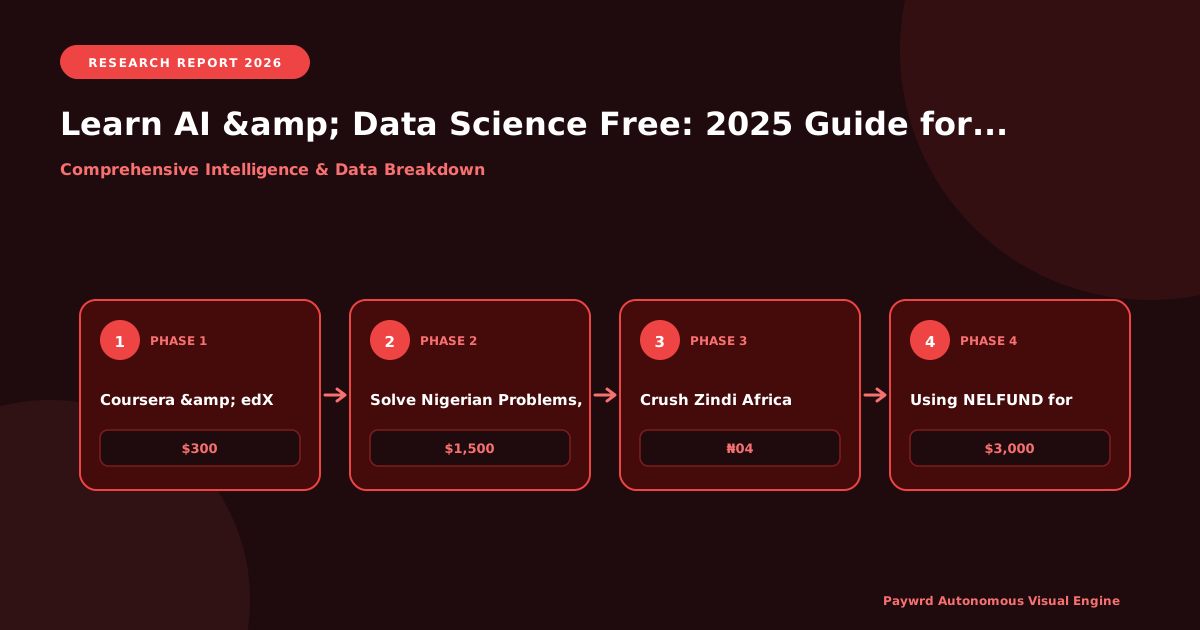
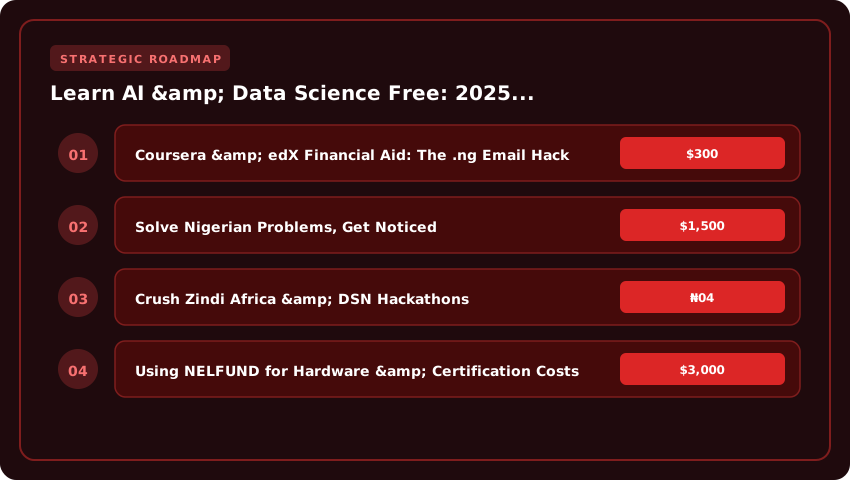
Coursera & edX Financial Aid: The .ng Email Hack
Both Coursera and edX offer Financial Aid that covers 100% of course fees — but approval isn’t automatic. The trick? Register exclusively with a .ng email address (unilag.edu.ng, yabatech.edu.ng, etc.). Reviewers consistently approve applications from Nigerian institutional emails faster because they signal genuine student status. When filling the Financial Aid form, state your intended use of the certificate in career or academic development, mention your university, and never leave the “annual income” field blank — entering “0” or “N/A” triggers rejection. For edX, audit the course first, then apply for Verified Certificate with Financial Aid. For Coursera, apply directly through the enrollment page. Approval typically takes 7–14 days. Do not attempt to bypass this using VPNs or foreign payment gateways like Stripe or PayPal — Nigerian cards face persistent blocks on these platforms, and using a VPN against their terms can get your account suspended.
Google AI Essentials & Microsoft Learn: LinkedIn-Ready Certificates
These two platforms don’t just offer free learning — they issue shareable certificates that Nigerian hiring managers actually recognize. Google’s AI Essentials course on Coursera (free with Financial Aid) covers prompt engineering and AI fundamentals, and the certificate displays prominently on LinkedIn. Microsoft Learn is entirely free with no geo-restriction. Their Azure AI Fundamentals and Data Fundamentals learning paths come with exam vouchers at no cost. Pass the exam, and you hold an industry-standard credential that puts you ahead of 90% of NYSC corps members. Add both to LinkedIn immediately — recruiters in Lagos, Abuja, and Nairobi actively filter by these certifications.
Kaggle Micro-Courses & Zindi Africa: Build Your Portfolio
Theoretical knowledge means nothing without proof. Kaggle’s free micro-courses — covering Python, pandas, machine learning, and SQL — each take 4–8 hours and award badges you can list on your profile. More importantly, compete in Zindi Africa data science competitions. Unlike Kaggle’s global contests, Zindi focuses on African datasets: Nigerian health data, agricultural trends, M-Pesa financial patterns. Winning or placing on Zindi demonstrates you can solve locally relevant problems, which is exactly what Nigerian tech companies like Flutterwave, Paystack, and Andela look for. Build three to five competition submissions, document your notebooks on GitHub, and you have a portfolio that speaks louder than any degree certificate.
This stack costs ₦0. Every platform listed accepts Nigerian IPs natively — no VPN required. Start with one course this week, not next semester.
Structuring Your Self-Taught Curriculum: From WAEC Math to MLOps
If you scored credit in WAEC Further Mathematics, you already have a head start that most aspiring data scientists in Lagos, Kano, or Enugu do not realize. Topics like matrices, vectors, and simultaneous equations are the exact building blocks of Linear Algebra — the mathematical backbone of every machine learning algorithm. The trick is mapping what you already studied in secondary school to what universities and hiring managers actually expect.
Prerequisite Mapping: WAEC/NECO Further Maths to Linear Algebra
Here is the bridge most Nigerian students miss. Your WAEC syllabus covered matrix operations, determinants, and 3D coordinate geometry. These translate directly into NumPy array manipulation and vector spaces used in frameworks like TensorFlow. Start by revisiting those Further Maths notes and pairing them with free Linear Algebra courses on Khan Academy or 3Blue1Brown’s Essence of Linear Algebra series on YouTube. No tuition fees — just discipline and a working internet connection.
The 6-Month Roadmap: Python → Pandas → Scikit-Learn → Deployment
This timeline is aggressive but realistic if you commit 2–3 hours daily alongside academic work. Here is the month-by-month breakdown:
- Month 1: Python fundamentals — variables, loops, functions, and object-oriented programming.
- Month 2: Pandas for data wrangling and NumPy for numerical computation.
- Month 3: Exploratory Data Analysis using Matplotlib and Seaborn on real Nigerian datasets — try NBS poverty data or NIMET rainfall records.
- Month 4: Scikit-Learn for regression, classification, and clustering models.
- Month 5: Deep learning basics with TensorFlow or PyTorch.
- Month 6: Deploy a model using Streamlit or Flask, host it on Hugging Face Spaces (free), and add it to your portfolio.
If tuition fees are eating into your study budget, register on the NELFUND portal — it is live and processing applications — so your mind can focus on skill-building rather than fee anxiety.
Local Compute Hacks: Google Colab Pro Alternatives on MTN/Airtel Data
Google Colab’s free tier works, but GPU sessions disconnect after 90 minutes and consume significant data. Here is how Nigerian students optimize costs:
- Lightning AI — free tier with GPU access, lighter on data usage.
- Kaggle Notebooks — 30 hours per week of free GPU time.
- Paperspace Gradient — free notebook instances for experimentation.
For connectivity, the 0.0kbs social media bundles will not cut it. Subscribe to MTN or Airtel weekly data bundles (around ₦500–₦1,500 for 2–5GB). Download datasets and notebooks offline during off-peak hours, then run code in airplane mode where possible. Also explore your university computer lab — many federal and state institutions now have GPU-enabled machines through NUC CCMAS-aligned tech partnerships. Your library access card might unlock more computing power than you think.
The path from WAEC maths to MLOps is no longer theoretical. It is a 6-month sprint with clear milestones, affordable tools, and a Nigerian economy actively rewarding people who can build with data.
Building a Portfolio That Wins Nigerian & Global Internships
Stop building Titanic survival predictors. Recruiters at Zindi Africa, Data Science Nigeria, and Lagos-based fintech startups have seen that project a thousand times — and they keep scrolling past it. What stops them mid-scroll? A portfolio that screams, “I understand Nigeria’s data landscape.”
Solve Nigerian Problems, Get Noticed
The fastest way to stand out is to work on datasets that reflect real Nigerian challenges. Build a Naira-to-Dollar exchange rate prediction model using parallel market and I&E window data from the CBN. Create a NECO result analysis dashboard that identifies regional performance trends across the 36 states — education data that the Ministry of Education and EdTech startups actually need. Or tackle agricultural yield prediction using FAO and Nigerian meteorological data, a sector employing over 30% of the population. These projects signal domain expertise that a generic Kaggle notebook never will.
Crush Zindi Africa & DSN Hackathons
Zindi Africa and Data Science Nigeria regularly host hackathons focused on Nigerian-specific problems — from crop disease detection to financial inclusion. Here is how to dominate them:
- Understand the problem framing. Nigerian hackathons reward solutions that consider local infrastructure constraints — low bandwidth, intermittent power, and multi-language user bases.
- Use local data sources. NBS (National Bureau of Statistics), NMC (Nigeria Meteorological Agency), and JAMB databases are publicly accessible goldmines for clean, relevant datasets.
- Build for deployment, not just accuracy. Recruiters from DSN and partner firms like Paystack and Flutterwave want to see that your model could realistically ship in a Nigerian production environment.
Optimize Your GitHub README for Lagos and London Recruiters
Your README is your first impression. Recruiters scanning profiles from Lagos co-working spaces or London fintech offices spend roughly 30 seconds per repository. Nail these elements:
- Opening line: State the Nigerian problem you solved in one clear sentence.
- Screenshots or a demo link: Show your dashboard or model output — visual proof beats description every time.
- Tech stack with context: Explain why you chose specific tools, especially if they are cost-effective for Nigerian developers working on tight budgets, like Google Colab over expensive cloud compute.
- Installation steps: Make it replicable. A recruiter who can clone and run your project in under five minutes is a recruiter who remembers you.
Your portfolio is not a collection of tutorials — it is proof that you can apply AI to the economy you live in. When a recruiter from a Lagos fintech or a London scale-up sees that you have predicted FX volatility, analyzed education outcomes, or built agricultural models using Nigerian data, you stop being “another graduate.” You become the candidate they cannot ignore.
Funding Your Compute & Certification: NELFUND, Scholarships & Grants
Here’s the part nobody puts in the “learn AI for free” marketing: your laptop alone can cost ₦150,000–₦350,000, a monthly electricity bill in Lagos or Abuja can hit ₦25,000+, and a single Google Cloud certification runs about ₦55,000. The courses are free. The infrastructure isn’t. But Nigerian students have more financial doors open in 2025 than most realize — you just need to know where to knock.
Using NELFUND for Hardware & Certification Costs
The NELFUND (Tertiary Education Fund) student loan scheme, accessible through the official nelfund.gov.ng portal, was designed to cover tuition and essential academic expenses. In practice, eligible students can apply for loans up to ₦500,000 per academic session. That’s enough to purchase a decent GPU-capable laptop — think an RTX 3060 or 4060 machine — and still cover certification exam fees. Registration opens during each academic semester, and you’ll need your JAMB registration number, institution ID, and a guarantor who is a civil servant or licensed professional. Disbursement is processed through your school’s bursary office, so stay proactive with your institution’s finance department.
Scholarships That Cover Tech Costs in 2025
Several major programmes actively fund Nigerian students pursuing emerging technology skills:
- Google DeepMind Scholarships — Google’s scholarship programmes for African AI researchers typically open applications between January and March 2025. These cover full tuition, cloud computing credits, and conference attendance. Watch the Google for Africa portal and the DeepMind careers page for announcements.
- Mastercard Foundation Scholars Program — This programme covers full tuition, accommodation, and a laptop stipend for students at partner institutions like Covenant University, Ashesi University, and several others. Applications for the 2025/2026 cycle usually close around March 2025. Check the Mastercard Foundation scholars portal for eligibility requirements.
- DSN (Davidson Seaman Nwankwo) Scholarship — A lesser-known but highly valuable Nigerian-funded scholarship supporting STEM students. Application windows typically open mid-year. Follow DSN’s official social channels for real-time deadline alerts and updates.
NYSC SAED & CDS: Funding Your AI Projects
Once mobilized, your NYSC SAED (Skill Acquisition and Entrepreneurship Development) programme and Community Development Service (CDS) chapters can fund practical AI projects. SAED provides startup grants of ₦50,000–₦200,000 for technology-based ventures, while CDS committees allocate budgets for community-impact projects — think deploying AI-driven agricultural monitoring or predictive health tools in rural communities. Submit a compelling project proposal to your SAED director and CDS chairman early in your service year. The key is demonstrating measurable community impact, not just technical sophistication.
The free learning revolution is real, but the students who actually build with AI are the ones who solve the funding puzzle first. Stack these resources, and the hidden costs become manageable — not a reason to stop.
Navigating the Nigerian AI Job Market: Roles, ₦ Salaries & Remote Tax
So you’ve picked up AI skills — maybe through a free course, a bootcamp, or pure self-study. Now what? The real game begins when you translate those skills into ₦-earning power inside Nigeria’s evolving tech economy. Let’s break down exactly what’s waiting for you.
Junior Data Analyst vs. ML Engineer: What’s the Real Pay?
In Lagos, entry-level Junior Data Analyst roles typically pay between ₦150,000 and ₦300,000 monthly, depending on whether you’re joining a fintech startup, a consulting firm, or a corporate IT department. Entry-level Machine Learning Engineers, on the other hand, command significantly higher — roughly ₦300,000 to ₦600,000 monthly — because the skill ceiling is higher and demand outpaces supply. Companies like Flutterwave, Paystack, and Andela actively scout for these profiles, and remote-friendly firms increasingly hire from Nigerian talent pools.
The takeaway: ML engineering pays more, but data analytics is the faster on-ramp if you’re still building your portfolio.
FIRS Tax Compliance: The Part Most Nigerian Freelancers Ignore
If you’re earning in USD through Upwork, Fiverr, or direct international contracts, the Federal Inland Revenue Service will come knocking. Here’s what you need:
- Tax Identification Number (TIN) — register through the FIRS e-Filing portal. This is non-negotiable for any formal income channel.
- Form A — file this annual return of income if your foreign-sourced earnings exceed the taxable threshold. FIRS has been increasingly auditing tech freelancers, so compliance now saves painful penalties later.
- Professional Tax — some states require additional remittances for freelancers operating within their jurisdictions.
Ignoring this doesn’t make it disappear. It makes it a future liability with compound interest you cannot afford.
Escaping the ‘Experience’ Trap After NYSC
Here’s the tactical play most people miss. During your NYSC PPA, you’re technically working — but most PPAs won’t count as “relevant experience” on an AI job application. The trick is to build your AI portfolio aggressively during PPA downtime: publish GitHub repos, contribute to open-source datasets, freelance small data projects, and document everything on LinkedIn.
When your NYSC year ends, you walk into the job market not as someone asking for a chance, but as someone with tangible proof of capability. That PPA year becomes a launchpad, not a gap. Reach out to hiring managers at Lagos fintech companies before your call-up letter even arrives. Cold outreach with a strong portfolio beats waiting for job boards every single time.
The Nigerian AI market is opening up fast — but it rewards the prepared. Your NYSC year doesn’t have to be a detour. Make it your runway.
| Learning Pathway | Estimated Cost (NGN) | Duration to Job-Ready | Global Certification Value | Nigerian Employer Recognition | Internet Data Demand |
|---|---|---|---|---|---|
| University CS Degree (4yr) | ₦800k – ₦2.5M+ (Tuition + Upkeep) | 48 Months | High (Degree) | High (Mandatory for Govt/Big Corp) | Low (On-campus) |
| Coursera/edX Specializations (Audit Mode) | ₦0 (Free Audit) / ₦30k–₦60k/mo (Cert) | 6–12 Months | High (Google, IBM, DeepLearning.AI) | Medium–High (Skills-based hiring) | High (Video streaming) |
| Kaggle / FreeCodeCamp / Fast.ai | ₦0 | 4–10 Months | Medium (Portfolio-based) | Medium (Portfolio > Cert) | High (Interactive notebooks) |
| Local Bootcamps (e.g., Data Science Nigeria, Utiva) | ₦150k – ₦500k | 3–6 Months | Medium (Industry Partners) | High (Local Network/Internships) | Medium (Hybrid/Offline options) |
| NYSC CDS / Self-Study (Post-Grad) | ₦0 – ₦50k (Data only) | 12 Months (Service Year) | Low (Self-claimed) | Low (Unless portfolio proven) | Very High (Personal hotspot) |
Frequently Asked Questions
What are the best completely free AI courses for Nigerian students in 2025?
Top free 2025 options include Google AI Essentials (Coursera audit), Microsoft AI Skills Navigator, Fast.ai Practical Deep Learning, and Kaggle Micro-courses. Nigerian students can access certificates via Coursera Financial Aid or Google Career Certificates scholarships on Grow with Google, requiring only internet data costs.
Can I get a data science job in Nigeria without a university degree in 2025?
Yes. Nigerian fintechs (Flutterwave, Moniepoint), telcos (MTN, Airtel), and remote-first startups hire based on GitHub portfolios, Kaggle rankings, and proven SQL/Python skills. A verified Coursera/edX Professional Certificate plus 3 capstone projects often outweighs a B.Sc. for mid-level roles.
How much internet data is needed to complete a free AI certification in Nigeria?
A typical 3-month specialization (e.g., DeepLearning.AI ML Specialization) consumes 40–60GB of video lectures. Budget ₦15,000–₦25,000 monthly for 4G data (MTN/Airtel/Glo night plans). Download videos on Wi-Fi via Coursera/edX mobile apps to reduce costs by 70%.
Which AI skills pay the highest entry salaries for fresh Nigerian graduates?
MLOps (₦400k–₦700k/mo), NLP/LLM Fine-tuning (₦350k–₦600k/mo), and Data Engineering (₦300k–₦550k/mo) lead 2025 entry pay. Pure analytics (SQL/Tableau) starts lower (₦150k–₦300k). Remote USD roles ($1,500–$3,000/mo) require advanced portfolio + cloud (AWS/GCP) certification.
When should a Nigerian undergraduate start learning AI to be ready before NYSC?
Start in 200 Level (Year 2). This allows 18–24 months to complete foundational Python, ML, and 2 capstone projects before 400 Level exams. Use ASUU strike periods and long vacations for intensive sprints. Target Google TensorFlow Developer or AWS ML Specialty certification by graduation.
Strategic Final Takeaway
When evaluating How To Learn Artificial Intelligence And Data Science As A Nigerian Student Free Online, base your decisions on accredited institutional standards, measurable return on investment (ROI), and up-to-date official guidelines. Always verify specific dates and requirements through official regulatory portals.