
Key Takeaway: You cannot “test into” the AP Capstone Diploma. It is earned exclusively through a two-year, sequential course enrollment—AP Seminar followed by AP Research—offered only at College Board–authorized schools.
The Two-Course Mandatory Sequence: Seminar & Research
The AP Capstone Diploma isn’t a single exam you cram for; it is a structured, two-year academic journey. Think of it less like a standard AP class and more like a miniature thesis program embedded inside your high school schedule. The College Board designed this as a non-negotiable sequence: you must complete AP Seminar (typically taken in 10th or 11th grade) before you are even allowed to enroll in AP Research (usually 11th or 12th grade). There are no waivers, no summer shortcuts, and no portfolio substitutions that let you skip the first year.

Year One: AP Seminar – The Skill-Building Foundation
AP Seminar is the gateway. This course shifts the focus from content memorization to competency mastery. You aren’t studying a specific subject like Biology or European History; instead, you are learning how to investigate. The curriculum centers on the “QUEST” framework—Question, Understand, Evaluate, Synthesize, and Transform. You will analyze arguments, evaluate source credibility, collaborate on team projects, and defend individual research presentations. Your final AP score (1–5) comes from three components: a Team Project and Presentation, an Individual Research-Based Essay and Presentation, and the end-of-course written exam. Crucially, you generally need a score of 3 or higher here to move forward, though school policies on progression can vary.
Year Two: AP Research – The Deep Dive
If Seminar teaches you the tools, AP Research hands you the blueprints and says, “Build something.” This course requires you to design, plan, and execute a year-long, mentored investigation into a topic of your choosing. The output is an academic paper (4,000–5,000 words) and a presentation with an oral defense. There is no traditional multiple-choice exam. The prerequisite logic is strict: the methodological discipline, citation rigor, and argumentative structure demanded in Research are directly scaffolded by the Seminar year. Students who attempt to enter Research without the Seminar foundation typically struggle with the autonomy and academic writing standards required to pass.
School Authorization: The Hidden Gatekeeper
Even if you have the schedule space and the motivation, you cannot self-study AP Capstone. Your high school must be an authorized AP Capstone Diploma Program participant. This requires the school to apply through the College Board, commit to specific teacher professional development (summer institutes for both Seminar and Research instructors), and agree to implement the required assessment administration protocols. If your school doesn’t offer the program, you cannot earn the diploma—period. Always verify with your counseling office before planning your four-year trajectory; transferring schools mid-sequence to find an authorized provider is a common but disruptive workaround.
The 3+3+3 Scoring Rule: Decoding the Performance Threshold
Once you have navigated the two-year course sequence, the diploma hinges on a single, unforgiving numeric formula: 3 + 3 + 3. It sounds simple, but every digit represents a distinct performance gate you must clear. Missing the mark on just one exam—even by a single point—downgrades the credential from a Diploma to the AP Seminar and Research Certificate. There is no averaging, no superscoring, and no rounding up.
The Core Duo: Seminar and Research (The First Two “3s”)
The first two pillars are non-negotiable and sequential. You must earn a score of 3 or higher on the AP Seminar Exam (typically taken in Year 1) and a 3 or higher on the AP Research Exam (Year 2). These are not standard multiple-choice tests. Your Seminar score blends a team project, an individual research-based essay, and an end-of-course exam. Research is even heavier on throughput: it weighs your academic paper (4,000–5,000 words), a presentation, and an oral defense. A “3” here signals to colleges that you can formulate a research question, execute a methodology, and defend your findings under scrutiny—skills that translate directly to undergraduate thesis work.
The Breadth Requirement: Three Additional AP Exams (The Final “3”)
This is where many high-achieving students stumble. Beyond the Capstone courses, you need scores of 3 or higher on three additional AP Exams of your choosing. These cannot be Seminar or Research retakes; they must be distinct subjects—think AP Biology, AP Calculus BC, AP World History, or AP English Language. The College Board designed this to prove you possess both the depth of a researcher and the breadth of a well-rounded scholar. Strategically, students often align these three exams with their intended college major to maximize credit transfer potential.
Timeline Flexibility: Concurrent vs. Sequential Completion
Here is the strategic nuance the rulebooks don’t always highlight: the three additional AP exams do not need to be taken during your Capstone years. You have a rolling window. You can bank qualifying scores from freshman or sophomore year (e.g., AP Human Geography or AP Computer Science Principles) long before you enroll in Seminar. Conversely, you can take them senior year alongside Research, or even the summer after graduation, provided scores are reported before the College Board finalizes your diploma status. This flexibility allows you to “build” the diploma over a four-year high school arc rather than cramming everything into junior and senior year.
- Bank Early: Take “gateway” APs (Psychology, Environmental Science, CSP) in 9th/10th grade to secure two of the three breadth scores early.
- Align with Major: Use the three elective slots to satisfy freshman-year college prerequisites (e.g., Calc AB/BC + Physics 1 + Chem for Engineering).
- Score Reporting: Ensure all five qualifying scores (2 Capstone + 3 Electives) are sent to the College Board by the July deadline of your graduation year.
Bottom line: The 3+3+3 rule is a binary switch. You either clear all six scores at 3+, or you don’t. Map your four-year testing calendar backward from that reality.
Validating the ‘Additional 3’: Eligible AP Exam Categories
Earning the AP Capstone Diploma requires more than just surviving the Seminar and Research sequence. You need a supporting cast: scores of 3 or higher on four additional AP Exams of your choosing. But before you load up your schedule, you need to know exactly which exams count toward that “Additional 4” requirement (often referred to as the “additional 3” plus the two Capstone courses, totaling six distinct exams). The College Board draws a hard line here, and misunderstanding it costs students diplomas every single year.
The Hard Exclusion: Capstone Exams Don’t Double-Dip
This is the most common trap. You cannot use your AP Seminar or AP Research exam scores to satisfy the “additional four” requirement. It sounds obvious, but in the stress of junior and senior year, students assume six passing scores equals the diploma. It doesn’t. The two Capstone courses are the prerequisite structure; the other four exams are the breadth requirement. You need four distinct, non-Capstone AP exams with scores of 3 or higher. Period. If you pass Seminar, Research, and only three other AP exams, you earn the AP Seminar and Research Certificate—a valuable credential—but not the full Capstone Diploma.
The Wide-Open Playing Field: Accepted Disciplines
Aside from that single exclusion, the menu is vast. The College Board accepts passing scores from virtually every other AP subject across the curriculum. This flexibility is intentional; they want the diploma to signal interdisciplinary breadth. Eligible categories include:
- STEM: Calculus AB/BC, Statistics, Biology, Chemistry, Physics 1/2/C, Computer Science A/Principles, Environmental Science, Precalculus.
- History & Social Sciences: World History, US History, European History, Human Geography, Psychology, Macroeconomics, Microeconomics, Government & Politics (US/Comparative).
- English: English Language and Composition, English Literature and Composition.
- World Languages & Cultures: Spanish, French, German, Chinese, Japanese, Latin, Italian, Spanish Literature.
- Arts: Art History, Music Theory, 2-D/3-D Art and Design, Drawing.
- Interdisciplinary/Electives: African American Studies (new), Computer Science Principles (often categorized here or STEM).
If it has an AP exam code and isn’t named “Seminar” or “Research,” it counts.
Strategic Selection: Align with Your Major, Not Just the Checklist
Since you have the freedom to choose, don’t just pick the “easiest” exams to game the system. Admissions officers at competitive universities look at which four you chose. An aspiring Engineering major presenting AP Art History, Psychology, Human Geography, and Environmental Science alongside their Capstone work raises eyebrows—it suggests avoidance of rigorous STEM validation. Conversely, a Humanities applicant skipping AP Lang or History looks like a gap in preparation.
Use the “Additional 4” to build a coherent academic narrative. If you are targeting a BS/MD program, prioritize Biology, Chemistry, Calculus, and Physics. If you are heading toward International Relations, grab World History, Comparative Government, a Language, and Economics. The diploma proves you can do sustained research; your four elective scores prove you have the foundational content knowledge for your intended field. Choose exams that make your transcript tell a consistent, ambitious story.
AP Seminar and Research Certificate: The Alternative Credential
Life happens. Maybe your schedule clashed with AP Biology, or your school only offers a handful of AP subjects. Perhaps you transferred mid-program and simply ran out of time to rack up four additional qualifying scores. The College Board built the AP Seminar and Research Certificate precisely for this scenario. It is not a consolation prize; it is a legitimate, transcript-verified credential that signals to admissions officers you have mastered the hardest part of the Capstone framework: the research cycle itself.
Eligibility When the “Additional 3” Are Missing
The Diploma demands a 3 or higher on AP Seminar, AP Research, and four other AP Exams of your choosing. The Certificate strips away that external requirement entirely. If you earn scores of 3 or higher on both AP Seminar and AP Research—but fall short on the supplementary exams—you automatically qualify for the Certificate. There is no separate application, no portfolio resubmission, and no appeal process. The College Board’s scoring system detects the combination at score release and flags the credential accordingly.
This means a student who aces the two Capstone courses but only manages two other AP Exams (or zero) still walks away with official recognition. It protects the investment of the two-year sequence. You keep the weighted GPA boost, the teacher recommendations built on sustained inquiry, and now a formal line on your College Board score report.
Scoring Requirements: The Core Threshold
The bar does not lower for the Certificate. You still need a 3 or higher on AP Seminar (combining the Team Project, Individual Essay, and End-of-Course Exam) and a 3 or higher on AP Research (the Academic Paper plus Presentation and Oral Defense). A 2 on either course breaks the chain. There is no averaging; both must clear the threshold independently. This rigidity ensures the Certificate retains currency—it proves you can design, execute, and defend a year-long research project at a college-ready level.
Transcript Designation: Diploma vs. Certificate
On your official AP Score Report sent to colleges, the distinction is explicit:
- AP Capstone Diploma: “AP Capstone Diploma awarded” appears alongside the list of all qualifying exam scores (6+ total).
- AP Seminar and Research Certificate: “AP Seminar and Research Certificate awarded” appears, listing only the two Capstone scores (or any other APs you took).
Admissions readers know the difference. The Diploma signals breadth and depth; the Certificate signals depth in scholarly methodology. Both are valuable. If you are targeting research-heavy programs, honors colleges, or scholarship committees that prize evidence of independent inquiry, the Certificate carries serious weight. It tells them: This student has already written a 5,000-word paper, defended it orally, and passed external evaluation. That narrative often matters more than a fourth AP History score.
Homeschooled & Independent Study Eligibility Protocols
The short answer is sobering: you cannot pursue the AP Capstone Diploma as a purely independent candidate. Unlike standard AP exams—where a homeschooled student can register at a local test center and self-study—AP Seminar and AP Research require daily, authenticated classroom participation at a College Board–authorized school. There is no “audit only” or “exam only” pathway. If your transcript does not reflect enrollment in the official course codes at an approved institution, your performance tasks will never reach the digital portfolio, and no diploma will be issued.
The Authorized School Mandate
Every student must be rostered in the AP Course Audit system under a teacher who has completed the mandatory summer professional development for that specific course. For homeschooled families, this means securing a formal partnership with a brick-and-mortar public school, private academy, or accredited online provider that holds active Capstone authorization. Some districts allow “dual enrollment” solely for Capstone; others require full-time enrollment. Start these conversations in January of the year before you intend to begin AP Seminar—waitlists and administrative approvals move slowly.
Digital Portfolio Deadlines Are Non-Negotiable
The College Board’s digital portfolio platform (accessed via AP Classroom) locks submission windows months before the May exam window. For non-traditional students, the critical dates are:
- AP Seminar: Individual Research Report (IRR) and Team Multimedia Presentation (TMP) components typically due late April; Individual Written Argument (IWA) due early May.
- AP Research: Academic Paper (4,000–5,000 words) and Presentation with Oral Defense (POD) due late April.
Miss these by even an hour and the portfolio locks—no extensions, no exceptions. Your supervising teacher must click “Submit” on your behalf; you cannot self-upload. Confirm time-zone settings and institutional firewalls weeks ahead.
Teacher Certification: The Hidden Gatekeeper
Scoring integrity rests on the Endorsed Teacher model. Only teachers who have attended the official AP Summer Institute (APSI) for Seminar or Research—and received their endorsement code—can access the scoring rubrics, calibrate student work, and submit final scores. A well-meaning parent-tutor or unendorsed online instructor cannot legally score the performance tasks. If your chosen provider uses rotating adjuncts, verify each instructor’s current endorsement status annually; certifications expire and must be renewed.
Practical workaround: Several accredited virtual schools (e.g., Stanford Online High School, Laurel Springs, Dwight Global) maintain standing Capstone authorizations and endorsed faculty. They charge tuition, but they handle the audit, the portfolio logistics, and the teacher certification—removing the administrative burden from your kitchen table.
College Credit & Admissions Weight: The ROI of the Diploma
Let’s be blunt: the AP Capstone Diploma is a heavy lift. Two years, thousands of words, oral defenses, and the mental bandwidth to synthesize disparate disciplines. The inevitable question—usually asked around 11 PM during a literature review—is simple: Is it worth it? The answer depends entirely on where you apply and how you frame the work. Universities do not treat this credential monolithically; they slot it into three distinct buckets, and knowing the difference changes your college list strategy.
Placement vs. Credit vs. The “Admissions Boost”
First, the hard currency: college credit. Policies vary wildly. A handful of elite institutions (think Yale, Brown, or Dartmouth) generally do not award elective credit for AP Seminar or Research scores, viewing the courses as excellent preparation rather than college-equivalent replacements. However, many flagship public universities and selective private colleges—University of Michigan, NYU, Boston University, and the entire University of California system—grant 3 to 6 semester hours for qualifying scores (typically 4 or 5). That is a semester’s worth of gen-ed requirements cleared before you step foot on campus.
Then there is advanced placement (skipping intro courses). Even if a school denies credit, they often grant placement. A 5 on AP Research might exempt you from a first-year writing seminar or an introductory research methods course in your major. This is “hidden ROI”—it frees up schedule space for a double major, a minor, or early access to upper-level seminars where the real networking happens.
But the highest ROI for most applicants? The admissions signal. Admissions officers at top-tier schools have told me explicitly: the Diploma signals intellectual stamina. It proves you can manage a long-form, self-directed project without hand-holding. In a pile of 4.0 GPAs and 1500 SATs, the Capstone student is the one who has already written a 5,000-word academic paper and defended it orally. That is a “yes” signal in holistic review.
The “Interdisciplinary” Distinction: Why AdComs Lean In
Universities are obsessed with interdisciplinary thinking—CS + Ethics, Biology + Policy, Economics + Data Science. Standard APs are siloed (Chem, Calc, Lit). AP Capstone is structurally interdisciplinary by design. When an admissions reader sees “AP Capstone Diploma,” they see a student who has been forced to connect dots across the curriculum for two years.
This is particularly potent for applicants to programs like USC’s Academy, UPenn’s M&T, or Stanford’s Symbolic Systems. The Diploma serves as empirical evidence that you don’t just say you think across boundaries; you have a 4,000-word academic paper and a presentation score proving you can execute it.
Aligning Your Research with Your Major Declaration
This is where savvy students turn the Diploma into a strategic weapon. Your AP Research topic must converse with your intended major.
- STEM Applicants: A Research paper on “Algorithmic Bias in Medical Diagnostics” carries infinitely more weight for a CS/Bio major than a paper on “Shakespearean Tragedy.” It demonstrates domain-specific literacy.
- Humanities/Social Science Applicants: Use the paper to showcase methodological rigor. A History applicant using primary source archives or a Psych applicant running a small-scale IRB-approved study signals graduate-level readiness.
- Undecided/Interdisciplinary Applicants: Lean into the synthesis. A paper analyzing “Urban Food Deserts through Geographic Information Systems and Public Policy” screams “admit me to your interdisciplinary core.”
Pro tip: Reference your AP Research topic in your Common App “Additional Information” section or a supplemental essay. Attach the abstract. Admissions officers rarely read the full paper, but seeing the title, methodology, and score (if reported) validates your intellectual narrative instantly. The Diploma isn’t just a line on a transcript; it’s a portfolio piece. Treat it like one.
Critical Administrative Deadlines: Ordering & Submission
Here is the brutal truth about the AP Capstone Diploma: you can ace every exam, write a publishable research paper, and still walk away empty-handed if your school misses a single administrative cutoff. The College Board does not grade “intent”—they grade verified submission. For counselors and coordinators, the operational calendar is not a suggestion; it is the structural steel holding the diploma together. Miss a bolt, and the building collapses.
The “Intent to Participate” Lock-In (October–November)
Long before students upload a single artifact, the AP Coordinator must formally flag them in the AP Registration and Ordering system. This usually happens in the fall—typically by the November 15 preferred ordering deadline (though some districts enforce earlier internal cutoffs). If a student is enrolled in AP Research but the coordinator fails to check the “Capstone Diploma” indicator during exam ordering, the system treats the course as a standalone AP Research credit. There is no retroactive “oops” button in March. I have seen valedictorians lose the diploma because a checkbox was missed during a hectic registration week. Counselors: audit your roster against the coordinator’s order confirmation before the Thanksgiving break.
Digital Portfolio: The Hard Stop (Late April)
This is the most unforgiving date on the calendar. The final submission deadline for both the AP Seminar and AP Research performance tasks—Individual Research Report, Team Multimedia Presentation, Academic Paper, and Presentation with Oral Defense—typically falls in late April (often April 30 or the last business day prior) at 11:59 PM ET. Note the time zone: Eastern Time. A student in California or Hawaii submitting at 11:58 PM their time is already late.
- No Grace Period: Unlike standard AP exams with late-testing windows, the digital portfolio locks automatically. Server congestion on deadline day is real; advise students to hit “Submit Final” 48 hours early.
- Component Completeness: A “submitted” portfolio missing the Oral Defense video or the signed Academic Honor Code is scored as incomplete. Incomplete equals no score. No score equals no diploma.
- Teacher Attestation: The teacher must attest to the work in the AP Digital Portfolio before the student deadline. If the teacher is out sick or overwhelmed, the student pays the price. Build in a departmental “attestation week” two weeks prior.
Late-Testing Policies: The Diploma Killer
Standard AP exams offer a late-testing window (usually mid-to-late May) for conflicts or emergencies. AP Capstone does not. There is no late-testing version of the Academic Paper or the Team Multimedia Presentation. If a student misses the April portfolio deadline due to illness, family crisis, or technical failure, they receive a score of 0 for that component. Since the diploma requires scores of 3 or higher on both Seminar and Research plus four additional AP exams, a zero on the portfolio mathematically eliminates the diploma pathway for that cycle.
The only exception involves documented, catastrophic school-wide disruptions (e.g., natural disasters closing the building for weeks), which require an immediate formal appeal to the College Board’s AP Services for Educators before the deadline passes. Individual student emergencies do not qualify. The takeaway? Treat the April deadline as the only deadline. Build redundancy: cloud backups, local saves, and a designated “submission captain” in every class to verify uploads while the teacher attests.
| Criteria | AP Capstone Diploma | AP Seminar & Research Certificate | Traditional AP Courses |
|---|---|---|---|
| Program Structure | Mandatory 2-year sequence: AP Seminar → AP Research + 4 additional AP Exams | Complete only AP Seminar & AP Research (no additional APs required) | Standalone, single-year courses; no sequence dependency |
| Prerequisites | Enrollment at College Board–authorized school; Seminar required before Research | Enrollment at authorized school; Seminar required before Research | Varies by school; generally open enrollment or teacher recommendation |
| Duration | 2+ years (typically Grades 10–12) | 2 years (typically Grades 10–11 or 11–12) | 1 year per course |
| Assessment Components | Team project, individual essay, presentation (Seminar); Academic paper, presentation, oral defense (Research); 4+ AP Exams | Team project, individual essay, presentation (Seminar); Academic paper, presentation, oral defense (Research) | Standardized exam (MCQ/FRQ) only; some have portfolio/performance tasks (e.g., Art, CSP) |
| Score Threshold for Credential | Scores of 3+ on Seminar, Research, AND 4 additional AP Exams | Scores of 3+ on Seminar AND Research only | Score of 3+ per individual exam for college credit consideration |
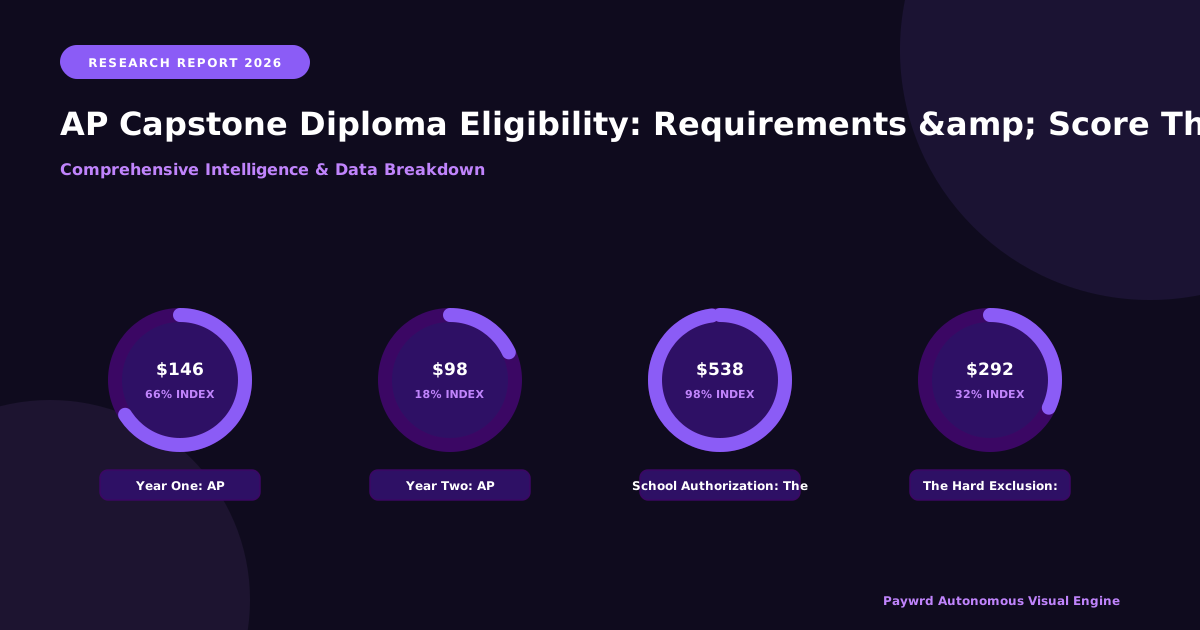
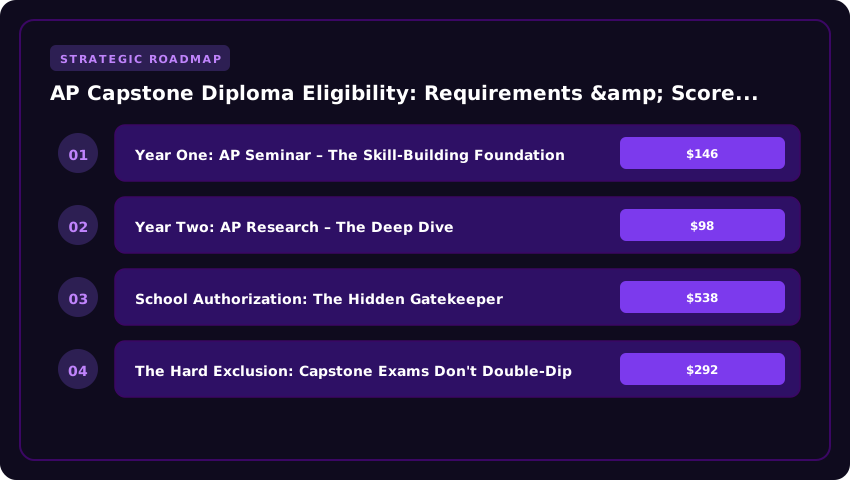
| Exam Fees (2024–25 USD) | $146 per Capstone exam (Seminar/Research) + $98 per standard AP Exam (≈$538+ total) | $146 per Capstone exam (Seminar/Research) = $292 total | $98 per exam (US/Canada/DoDEA); $128 international |
| College Recognition | Signals rigorous research readiness; credit/placement policies vary by institution | Recognizes research skill mastery; credit less common than Diploma | Widely established credit/placement policies for scores 3, 4, 5 |
| Self-Study / Homeschool Eligibility | Not permitted; requires authorized school enrollment & teacher authentication | Not permitted; requires authorized school enrollment & teacher authentication | Permitted for most exams (order via AP Coordinator); some restrictions apply (e.g., Capstone, Art) |
Frequently Asked Questions
What are the eligibility requirements for the AP Capstone Diploma?
To be eligible, you must attend a College Board–authorized high school, complete the two-year sequence (AP Seminar followed by AP Research), and earn scores of 3 or higher on both Capstone exams plus four additional AP Exams of your choosing. There are no age or grade waivers; the sequence is mandatory.
Can you self-study for AP Seminar or AP Research?
No. The College Board strictly prohibits self-study or homeschool enrollment for AP Seminar and AP Research. Both courses require in-school teacher authentication of performance tasks (team projects, academic papers, presentations) which must be submitted via the AP Digital Portfolio by a certified coordinator at an authorized school.
What is the difference between the AP Capstone Diploma and the AP Seminar and Research Certificate?
The Diploma requires passing scores (3+) on AP Seminar, AP Research, and four additional AP Exams. The Certificate is awarded for passing only AP Seminar and AP Research. The Diploma signals broader disciplinary mastery; the Certificate validates specific research and collaboration skills.
What scores do you need to earn the AP Capstone Diploma?
You need a score of 3 or higher on five specific exams: AP Seminar, AP Research, and any four other AP Exams. Scores of 1 or 2 on any of these six required exams disqualify you from the Diploma, though you may still earn the Certificate if Seminar and Research scores are 3+.
Do colleges give credit for AP Capstone courses?
Credit policies vary significantly by institution. Many universities grant elective credit or advanced placement for qualifying scores on AP Seminar and Research, but they rarely fulfill specific general education requirements. The Diploma is primarily valued as a rigorous credential demonstrating research readiness for admissions committees.
Strategic Final Takeaway
When evaluating Who Is Eligible To Receive The AP Capstone Diploma?, base your decisions on accredited institutional standards, measurable return on investment (ROI), and up-to-date official guidelines. Always verify specific dates and requirements through official regulatory portals.

