

Key Takeaway: The 2024 Student Loans (Access to Higher Education) Act removed the family income cap and guarantor requirements, but strict citizenship, NIN, and admission verification remain your primary gatekeepers for the 2026 cycle.
2026 NELFUND Eligibility: Who Qualifies Under the New Act
Let’s cut through the noise: if you are a Nigerian student eyeing the 2026 NELFUND cycle, the rules have shifted significantly from the 2023/2024 pilot phase. The repeal and re-enactment of the Student Loans Act in 2024 wasn’t just legislative housekeeping—it fundamentally rewrote who gets funded and who gets filtered out. Understanding these nuances now saves you the frustration of a rejected application later.

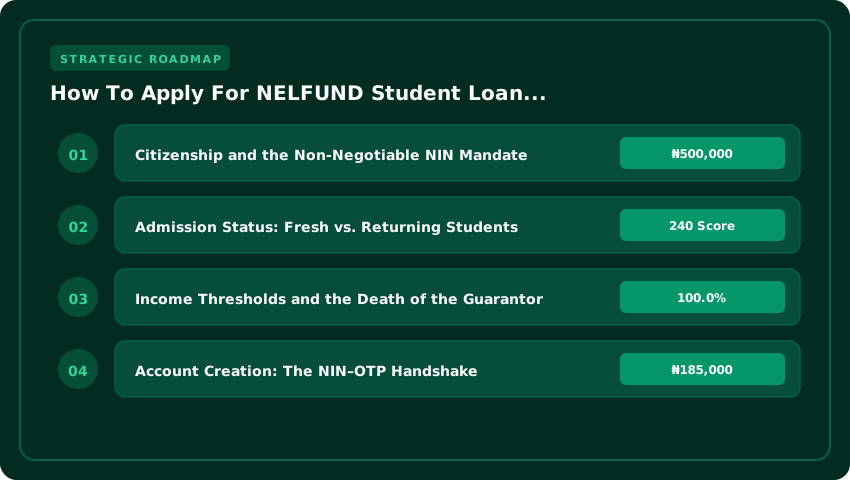
Citizenship and the Non-Negotiable NIN Mandate
This is your absolute baseline. You must be a citizen of Nigeria. Dual citizenship doesn’t disqualify you, but you must prove Nigerian nationality. The mechanism for this proof is the National Identification Number (NIN). There are no workarounds, no “awaiting NIN” grace periods, and no exceptions for international passport holders without a linked NIN. Before you even think about the portal, ensure your NIN is active, your biometrics are current, and the name on your NIN matches your JAMB and admission records exactly. A single character mismatch—like “Abdullahi” vs “Abdulahi”—will trigger an automatic verification failure on the NELFUND portal.
Admission Status: Fresh vs. Returning Students
The Act explicitly covers students in public tertiary institutions—Federal and State Universities, Polytechnics, and Colleges of Education. Private university students remain excluded from the loan component (though they may access the future Skills Development Fund). Here is how the split works for 2026:

- Fresh Students (100 Level / ND 1): You must have a verified admission letter on JAMB CAPS. “Provisional admission” on a school portal isn’t enough; it must reflect on CAPS. You also need a valid JAMB registration number used for that specific admission.
- Returning Students (200 Level+): You must have a valid Matriculation Number and be in good academic standing. Critically, you cannot be a beneficiary of the loan who has defaulted on a previous cycle or been expelled/rusticated. Your institution’s Bursary/Student Affairs unit must confirm your active status on the NELFUND Institutional Dashboard.
Income Thresholds and the Death of the Guarantor
This is the biggest win for applicants. Under the old 2023 Act, a family income ceiling of ₦500,000 per annum and two civil servant guarantors (Level 12+) were mandatory. That is gone. The 2024 Act removed the means-test entirely. There is no income threshold for 2026. Whether your parents earn ₦50,000 or ₦50 million monthly, you are eligible provided you meet the citizenship and admission criteria.
Equally critical: No guarantors are required. The loan is now strictly between you (the student), NELFUND, and your institution. This removes the historical bottleneck where applicants couldn’t secure signatures from high-ranking civil servants. However, the trade-off is stricter identity verification (NIN + BVN linking) and a robust repayment framework tied to your future earnings via the tax system (FIRS).
Bottom line? If you are a Nigerian citizen with a verified NIN, a confirmed spot on JAMB CAPS at a public tertiary institution, and a linked BVN, you are qualified. The barriers to entry have lowered; the burden of compliance has shifted to data accuracy.
Mandatory Documents Checklist for 2026 Portal Submission
Nothing kills a NELFUND application faster than a mismatched name on a BVN or a blurry JAMB admission letter. The portal is unforgiving; once you hit submit, you cannot swap files. I have seen too many students locked out of the 2024/2025 cycle because they rushed the upload phase. For 2026, treat this checklist as your pre-flight inspection. Get every single PDF verified before you log in.
1. Proof of Admission: JAMB Letter & Matriculation Number
This is your golden ticket. The system cross-references your JAMB registration number against the Central Admissions Processing System (CAPS) database in real-time. You need two distinct documents here:
- Original JAMB Admission Letter: Download the coloured version directly from your JAMB profile (efacility.jamb.gov.ng). Print-to-PDF is acceptable, but screenshots are rejected. Ensure the QR code and institution name are crystal clear.
- Matriculation Number Evidence: If you are a returning student, upload your current student ID card (front and back) or an official letter from your registry confirming your matric number. Freshers just admitted for the 2025/2026 session should upload the admission letter; the matric number field usually auto-populates once CAPS verification succeeds.
Pro Tip: If your name on the JAMB letter differs even slightly from your NIN (e.g., “Abdullahi” vs “Abdulahi”), do not upload yet. Head to a JAMB CBT centre for a data correction first. The portal’s name-matching algorithm is exact.
2. Identity & Payment Rails: NIN, BVN & Bank Account
The 2024 Act made the National Identification Number (NIN) the primary key. No NIN, no loan—period. Your Bank Verification Number (BVN) and the receiving account must align perfectly with that NIN.
- NIN Slip: Download the updated slip from the NIMC mobile app or portal (nimc.gov.ng). The old paper slip works if the QR code scans, but the digital PDF is safer.
- BVN & Bank Account: The account must be in your name. No parent accounts, no sibling accounts, no “trusted friend” accounts. The name on the BVN must match the NIN and JAMB records character-for-character. Provide a bank statement (stamped or downloaded from your app) showing the account number, name, and BVN linkage.
If you recently did a “Change of Name” at the bank or NIMC, wait 48 hours for the Nigeria Inter-Bank Settlement System (NIBSS) to sync before applying.
3. Cost Verification: Fee Schedule & HOD Attestation
NELFUND pays institutional charges directly to the school. They need proof of exactly what you owe.
- Official Fee Schedule: Download the current session’s fee breakdown from your school’s student portal or the bursary department’s website. It must show the programme, level, and total payable amount (Tuition, Acceptance, ICT, Medical, etc.). Handwritten lists or WhatsApp forwards will be flagged.
- Head of Department (HOD) Attestation Letter: This is a new strict requirement for 2026. The letter must be on the department’s letterhead, signed and stamped by the HOD, confirming you are a bona fide student of the department for the current session. It should reference your Matric Number and Programme. Some faculties delegate this to the Dean; check your faculty notice board for the correct signatory.
Final check: Name all files logically (Surname_FirstName_JAMBLetter.pdf, Surname_FirstName_NIN.pdf). Merge multi-page documents into single PDFs. The portal times out after 30 minutes of inactivity; you do not want to be renaming files while the clock ticks.
Step-by-Step: Navigating the NELFUND Portal Application Wizard
The portal at nelf.gov.ng is built on a single-page wizard logic—miss one validation check and you’re booted back to the dashboard. I’ve watched too many applicants lose weeks because they treated the “Next” button like a suggestion rather than a commitment. Here is the exact click-path for the 2026 cycle.
1. Account Creation: The NIN–OTP Handshake
Land on the homepage and hit “Apply Now”. You are immediately served the National Identification Number (NIN) field. Type it in—no spaces, no dashes. The system pings the NIMC database in real-time. If your NIN isn’t linked to a verified phone line, stop here; you cannot proceed without the OTP landing on that specific SIM.
- Enter the 6-digit OTP within 120 seconds. The timer is brutal; have your phone unlocked and ready.
- Create a password: minimum 8 characters, one uppercase, one number, one special character (
@#$%). Write it down; the “Forgot Password” flow routes back to NIN verification, adding 24 hours to your timeline. - Set your security question (Mother’s maiden name or First school). This is your only recovery path if the registered line is lost.
2. The Three-Tab Gauntlet: Bio-data, Academic, Bank
Once inside the dashboard, the wizard locks you into three sequential tabs. You cannot skip ahead.
Tab 1 – Bio-data: This auto-populates from NIMC (Name, DOB, Gender, State of Origin, LGA). Do not edit the Name or DOB fields—they are read-only. You must manually select Marital Status, Disability Status (if applicable), and upload a clear passport photograph (white background, 50KB–200KB, JPEG/PNG). A blurry selfie gets an instant “Document Rejected” flag.
Tab 2 – Academic Details: This is where most applications stall.
- Institution Type: Select “University,” “Polytechnic,” or “College of Education.” The dropdown only shows NUC/NBTE/NCCE-accredited schools.
- JAMB Registration Number: Enter your 10-digit 2026 UTME/DE reg number. The portal cross-references JAMB CAPS instantly. If CAPS shows “Admission in Progress” rather than “Admitted,” the Submit button stays greyed out.
- Matric Number: For returning students, enter your current matric number. Freshers leave this blank until matriculation; the portal allows a “Save as Draft” here.
- Course & Level: Select exactly as it appears on your admission letter. “Computer Science” ≠ “Computer Science Education.”
Tab 3 – Bank Details (GIFMIS-Ready): You need a Tier 3 BVN-linked account (Access, Zenith, UBA, GTB, First Bank, etc.). Enter Account Name (must match NIN name exactly), Account Number (NUBAN), and Bank Name. The system runs a BVN Name Enquiry via NIBSS. A mismatch—like “Chukwuemeka” vs “Chukwuma”—hard-stops the submission.
3. The Undertaking Form & Reference Number
After the Bank tab, the “Review & Submit” page renders a PDF Undertaking Form. Download it. Print two copies. Sign both with a ballpoint pen (digital signatures are rejected). You need two guarantors (Civil Servant Level 12+ or Lawyer/Doctor with practicing license) to sign and stamp. Scan the signed copies back into the portal (max 500KB each).
Hit “Final Submit.” The screen flashes your Application Reference Number (ARN)—format: NELF/2026/XXXXXX. Screenshot this immediately. The ARN is your only ticket for tracking status on the “Check Status” portal, raising tickets via the helpdesk, and eventual disbursement verification. Without it, you are a ghost in the system.
Understanding the 2026 Disbursement Timeline & Payment Schedule
Once your NELFUND application clears the initial eligibility checks, the real waiting game begins: verification by your institution, final approval by the Fund, and the actual flow of money. Knowing exactly how each step unfolds helps you budget for tuition, books, and living expenses without nasty surprises.
Institutional Verification vs. NELFUND Approval Processing Windows
The 2026 cycle splits the review into two distinct phases:
- Institutional verification (≈10‑15 working days) – Your university or polytechnic confirms your admission status, JAMB CAPS placement, NIN‑linked biodata, and that you meet the minimum course load (usually 12 credit units for undergraduates). This step pulls data directly from the JAMB CAPS portal and the WAEC e‑Registration system.
- NELFUND approval & fund allocation (≈7‑10 working days) – After the school’s verification uploads to the NELFUND portal, the Fund runs its final checks (citizenship, NIN validity, no existing loan defaults). Once cleared, the amount is earmarked for disbursement.
In practice, most applicants see the full cycle completed within 25‑35 working days from the date they submit all required documents. Peak periods (July‑September) can stretch this to 45 days, so applying early—ideally immediately after JAMB CAPS admission—is advisable.
Direct Tuition Payment to School vs. Upkeep Allowance to Student Wallet
NELFUND’s dual‑payment structure separates institutional fees from personal upkeep:
- Tuition component – Sent straight to the school’s designated bank account (usually the bursary office). For the 2026 academic year, the Fund covers up to ₦500,000 per annum** for undergraduate programmes in federal and state institutions; private universities receive a capped amount based on the NUC CCMAS‑approved tuition band.
- Upkeep allowance** – Deposited into the student’s NELFUND‑linked wallet (accessible via the NELFUND mobile app or USSD *389*123#). The standard semester stipend is ₦150,000** (₦300,000 per academic session), intended to cover accommodation, textbooks, meals, and modest transport.
Because tuition is paid directly, you will not see that portion in your wallet; only the upkeep tranche appears as a usable balance. Both tranches are released simultaneously once the Fund’s approval flag is set.
What to Do If Status Shows ‘Pending Verification’ Past 30 Days
A ‘Pending Verification’ tag beyond the typical 30‑day window usually signals one of three issues:
- Mismatched NIN/JAMB data – Ensure your NIN on the NELFUND portal exactly matches the NIN used for JAMB CAPS and WAEC. Even a typo in the middle name can trigger a hold.
- Institution lag** – Some schools batch‑upload verification files weekly. Contact your bursary or student affairs office and request they upload the Admission Verification Form (AVF) to the NELFUND portal.
- Missing documents** – The portal may be waiting for a signed loan agreement or a recent passport photograph. Log in, check the “Documents Required” tab, and upload any pending files.
If after contacting both your school and the NELFUND helpdesk (support@nelfund.gov.ng or 0700‑NELFUND) the status remains unchanged, escalate via the official complaints portal, providing your application reference number and screenshots of the pending status.
By keeping tabs on each verification stage, knowing exactly where the money goes, and acting swiftly on holds, you can turn the 2026 NELFUND disbursement process from a source of anxiety into a predictable part of your academic financing plan.
Common Portal Errors & How to Fix Rejected Applications
Nothing kills momentum faster than a red “Application Rejected” banner after you have painstakingly uploaded every document. In the 2026 cycle, the NELFUND portal is stricter on data integrity than ever before because the Student Loans (Access to Higher Education) Act 2024 ties disbursement directly to verified identity and admission records. Most rejections are not system glitches; they are data mismatches you can fix in minutes if you know where to look.
Resolving ‘BVN Name Mismatch’ and ‘Invalid Matric Number’ Flags
These are the top two rejection culprits. The portal cross-references your Bank Verification Number (BVN) against the National Identity Number (NIN) database and your institution’s nominal roll. If your BVN reads “Chukwuemeka John” but your JAMB admission letter says “John Chukwuemeka,” the system auto-rejects.
- BVN Fix: Do not edit the portal form. Walk into your bank branch with your NIN slip and a valid ID (Driver’s License or International Passport) and request a BVN Data Modification to align exactly with your NIN record. It takes 24–48 hours to propagate.
- Matric Number Fix: “Invalid Matric Number” usually means you typed the JAMB Registration Number instead of your Institutional Matric Number, or you included slashes/spaces (e.g., “UNN/2024/12345” instead of “UNN202412345”). Log into your school portal, copy the exact alphanumeric string from your admission profile, and paste it without special characters.
Re-uploading Rejected Documents: Size, Format & Naming Conventions
The parser is unforgiving on technical specs. A 2.1MB PDF fails if the limit is 2MB; a .png fails if only .pdf and .jpg are allowed. Follow this checklist before hitting “Resubmit”:
- File Size: Compress PDFs using Smallpdf or iLovePDF to stay under 2MB. For JPG/PNG (passport photos, signatures), keep it under 500KB.
- Format: Accepted: PDF (multi-page docs like admission letters, transcripts) and JPG/JPEG (passport, signature). Rejected: HEIC, PNG (sometimes), DOCX, ZIP.
- Naming Convention: Rename files to
Surname_FirstName_DocType(e.g.,Adebayo_Tunde_AdmissionLetter.pdf). Avoid dates, spaces, or special characters like(1)or&.
Contacting NELFUND Support: Ticket System vs. Physical Help Desks
If the error persists after correction, do not spam the portal. Use the Official Ticketing System at support.nelf.gov.ng (or the “Help” widget inside your dashboard). Select the correct category—BVN Issue, Document Upload, or Institutional Verification—attach a screenshot of the error code, and note your Application Reference Number. Response SLA is typically 48 hours.
For urgent matriculation or BVN sync issues, visit the NELFUND Physical Help Desk at your institution’s Student Affairs Division or ICT Centre. These desks are staffed by trained focal officers who can liaise directly with the NELFUND zonal office to force a manual verification override. Bring originals and photocopies of your NIN slip, BVN printout, Admission Letter, and a signed letter from your HOD/Dean confirming your active student status. Physical escalation often resolves “stuck” applications in 24 hours that tickets leave pending for weeks.
Repayment Terms: What Happens After Graduation in 2026?
Let’s talk about the elephant in the room: paying it back. The 2024 Student Loans Act didn’t just open the tap for funding; it built a structured, automated repayment engine designed to be far less predatory than commercial bank loans. If you accept this money, you are entering a legally binding contract with the Federal Government, and understanding the mechanics now saves you panic later.
The Two-Year Breathing Space: Post-NYSC Grace Period
Here is the most borrower-friendly clause in the Act: repayment does not start the day you throw your mortarboard in the air. It doesn’t even start the day you collect your NYSC discharge certificate. The law mandates a two-year grace period after the completion of your National Youth Service Corps (NYSC) programme.
This means if you graduate in 2026 and serve in the 2026/2027 batch, your first deduction won’t hit until 2029. This window is critical—it gives you time to secure stable employment, navigate the brutal Nigerian entry-level job market, and build a financial buffer before the deductions begin. Use this time wisely; it is not a payment holiday, it is a preparation window.
Income-Triggered Deductions: The ₦30,000 Threshold
Repayment is not a fixed monthly bill you pay regardless of income. It is income-contingent. The system only activates when your gross monthly salary hits ₦30,000 (the current national minimum wage benchmark). If you are earning below that—whether due to unemployment, underemployment, or running a startup that hasn’t broken even—you pay nothing. Zero. Zilch.
Once you cross that threshold, a flat 10% of your gross monthly income is deducted at source. No compound interest accrues during the grace period or while you are below the threshold. The loan is effectively interest-free for the borrower, indexed only to inflation adjustments applied to the principal balance annually by NELFUND.
Employer Obligations: The Payroll Integration System
You do not log into a portal to pay manually. The 2024 Act mandates a Payroll Integration System linking NELFUND directly with the Integrated Payroll and Personnel Information System (IPPIS) for federal workers and equivalent state payroll platforms (like Lagos State’s LASPEC) for state employees.
- Mandatory Remittance: Your employer (HR/Finance) is legally designated as a collection agent. They must deduct the 10% before your salary hits your account and remit it to NELFUND’s designated TSA account.
- Penalties for Employers: If an employer fails to deduct or remit, they face stiff fines—currently set at ₦500,000 per defaulting employee per month plus potential criminal liability for the accounting officer. This shifts the compliance burden off your shoulders.
- Private Sector & Self-Employed: If you work for a private firm not on IPPIS or are self-employed, you are required to self-assess and remit 10% of your monthly profit/income directly via the NELFUND portal (Remita/NEFT) by the 10th of the following month.
Default Penalties vs. Early Repayment Incentives
Ignoring the obligation is expensive. For self-employed borrowers or employers who fail to remit, the Act prescribes a 10% penalty on the overdue amount plus the prevailing Central Bank of Nigeria (CBN) monetary policy rate (MPR) on the outstanding balance until settled. Persistent default triggers BVN blacklisting, restriction from future government loans/grants, and potential legal action for recovery.
On the flip side, the system rewards discipline. Voluntary early repayment attracts zero prepayment penalties. If you land a high-paying gig, a contract windfall, or diaspora remittance, you can clear the principal balance early via the portal. This stops the annual inflation indexation on the remaining principal immediately, saving you real money in the long run.
Bottom line: This isn’t a grant. It is a social contract. The terms are generous—interest-free, income-triggered, with a multi-year grace period—but the enforcement mechanism (payroll integration) is automated and ruthless. Borrow with your eyes open.
| Criteria | 2023/2024 Pilot Phase (Old Act) | 2026 Cycle (2024 Repealed & Re-enacted Act) | Impact on Applicant |
|---|---|---|---|
| Family Income Cap | ₦500,000 per annum threshold | Removed entirely (No income ceiling) | All income brackets now eligible; means-testing abolished |
| Guarantor Requirement | Two civil servants (Level 12+) or Lawyer/Doctor | Eliminated (No guarantors needed) | Removes major administrative bottleneck; faster processing |
| Citizenship & NIN | Nigerian citizen + NIN mandatory | Nigerian citizen + Verified NIN mandatory | Non-negotiable gatekeeper; NIN must match BVN/JAMB data |
| Admission Status | Full-time undergraduate in public tertiary institutions | Full-time undergraduate in public & approved private institutions | Expanded coverage; verify institution is on NELFUND approved list |
| Repayment Trigger | 2 years post-NYSC or employment | 2 years post-NYSC or upon earning ₦30,000+/month | Income-contingent repayment; automatic PAYE deduction by employer |
| Application Portal | nelf.gov.ng (Pilot portal) | portal.nelf.gov.ng (Upgraded unified portal) | Single sign-on with NIN; real-time JAMB/Institution verification |
| Funding Scope | Tuition only (Institutional fees excluded) | Tuition + Institutional charges + Upkeep allowance | Comprehensive funding; upkeep paid directly to student bank account |
Frequently Asked Questions
What are the new requirements for NELFUND 2026 application?
For the 2026 cycle, you need Nigerian citizenship, a verified NIN linked to your BVN, admission into an approved public or private tertiary institution, and a valid JAMB registration number. The 2024 Act removed the ₦500k income cap and guarantor requirements, making eligibility strictly identity and admission-based.
Is there an income limit for NELFUND student loan 2026?
No. The 2024 Student Loans (Access to Higher Education) Act explicitly abolished the ₦500,000 family income ceiling that existed during the pilot phase. There is currently no means-testing or income threshold for the 2026 application cycle; all admitted Nigerian students in approved institutions qualify regardless of parental earnings.
When does NELFUND 2026 application portal open and close?
NELFUND has not officially announced fixed 2026 dates yet. Historically, the portal opens Q1 (January–March) for the academic session. Applicants must monitor portal.nelf.gov.ng and official NELFUND social handles. Deadlines typically close 6–8 weeks after opening; late submissions are not entertained due to budgetary allocation cycles.
Can private university students apply for NELFUND 2026?
Yes. Unlike the pilot phase which restricted funding to public universities, polytechnics, and colleges of education, the 2024 Act extends eligibility to students in <strong>approved private tertiary institutions</strong>. The institution must be accredited by NUC/NBTE and listed on the NELFUND portal as a participating institution at the time of application.
How is NELFUND loan repayment calculated for 2026 beneficiaries?
Repayment begins two years after NYSC completion or once the beneficiary earns ₦30,000 monthly, whichever comes first. It is an income-contingent model: 10% of gross monthly salary is deducted automatically via PAYE by the employer. Unemployed beneficiaries are not penalized; deductions only activate upon verified employment income.
Strategic Final Takeaway
When evaluating How To Apply For NELFUND Student Loan 2026 Portal Requirements, base your decisions on accredited institutional standards, measurable return on investment (ROI), and up-to-date official guidelines. Always verify specific dates and requirements through official regulatory portals.

