2026 Eligibility Matrix: Who Qualifies Under the New NELFUND Act
Before you scan a single document, run your profile against the amended Student Loans (Access to Higher Education) Act, 2024. The Federal Government replaced the old “family income below ₦500,000” blanket rule with a structured means test that distinguishes between tuition-only and upkeep components. If you miss one mandatory flag—like a lapsed NUC accreditation or a mismatched BVN—you will hit an automatic rejection on the NELFUND portal.
1. Income Threshold Verification: The ₦500,000 Benchmark
The Act defines “indigent” using the combined annual income of both parents or legal guardians. For the 2026 cycle, the ceiling remains ₦500,000 per annum. This is verified via:
- Tax Clearance Certificates (TCC) for parents in formal employment (Lagos State Internal Revenue, FIRS, etc.).
- Sworn Affidavits for parents in the informal sector, countersigned by a Notary Public or Commissioner for Oaths.
- Pension Remittance Slips for retired civil servants.
Pro Tip: If one parent is deceased or absent, submit a death certificate or court affidavit of sole custody; the surviving parent’s income is assessed singly.
2. Accredited Institution & Programme Validation (NUC CCMAS)
This is the silent killer of applications. Your course must appear on the NUC Core Curriculum Minimum Academic Standards (CCMAS) list with “Full Accreditation” status at the time of application. “Interim Accreditation” or “Denied Accreditation” disqualifies the programme instantly—even if the university itself is licensed.
- Check status via the NUC Official Website > Accreditation Status Search.
- Professional courses (Law, Medicine, Engineering) require additional Council of Legal Education, MDCN, or COREN accreditation proof.
3. JAMB Admission Letter & Matriculation Number Prerequisites
You cannot apply with a “provisional” or “awaiting result” status. The portal cross-references the JAMB Central Admissions Processing System (CAPS) in real-time. You need:
- Original JAMB Admission Letter (printed from CAPS, not the school portal).
- Valid Matriculation Number issued by the institution’s Senate—this confirms you have physically registered and paid acceptance fees.
- Current Session Registration Slip showing active student status (not rusticated, deferred, or graduated).
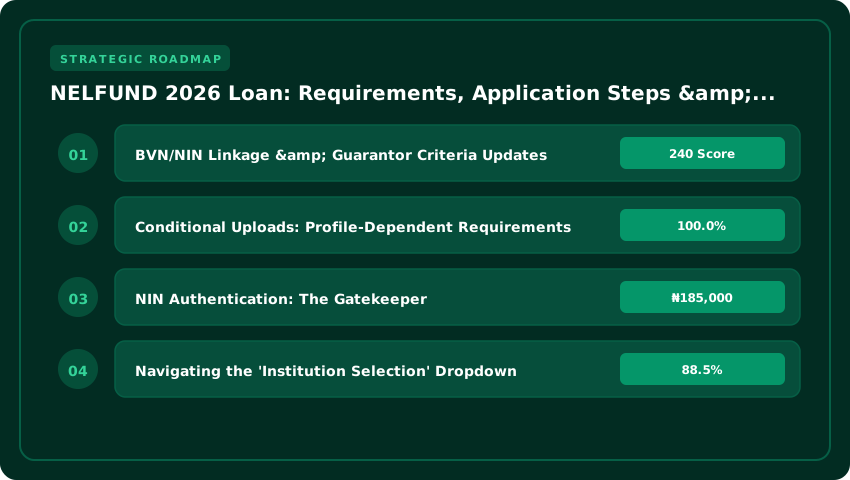
4. BVN/NIN Linkage & Guarantor Criteria Updates
The 2024 Act tightened identity verification to curb fraud. Every applicant must have:
- BVN linked to NIN (dial
*565*1#to confirm linkage status). - Active Bank Account in the applicant’s name (matching BVN details) for disbursement.
Guarantor Requirement: The Act mandates two guarantors who are Level 12 Civil Servants (or equivalent), Lawyers with 10+ years post-call, Medical Doctors, or Justice of Peace. They must sign the Guarantor’s Form uploaded to the portal, attaching valid means of ID (International Passport, Driver’s License, or Voter’s Card). NYSC members and Level 8 officers no longer qualify as guarantors under the 2026 guidelines.
Document Checklist: Mandatory vs. Conditional Uploads for 2026
Let’s be honest: the fastest way to kill your NELFUND application before a human ever sees it is uploading the wrong file format or a blurred scan. The 2026 portal runs on automated validation engines—optical character recognition (OCR) and API hooks into JAMB, NIBSS, and WAEC databases. If your document fails the machine readability test, you get an auto-rejection email, not a request for clarification. Below is the definitive checklist separating Hard Stops (mandatory, auto-reject if missing/invalid) from Conditional Uploads (required only for specific profiles). Print this. Tick it off. Do not hit “Submit” until every box is green.
Hard Stops: The Non-Negotiables (Auto-Rejection Triggers)
- JAMB Admission Letter (Original PDF from CAPS): Not a screenshot. Not a photo. Download the official PDF from JAMB CAPS. The portal validates the QR code and the unique admission number against the NUC-accredited course list. If your course lost accreditation last session, the system flags it instantly.
- WAEC/NECO Result (QR Code Verification Mandatory): The 2026 update requires live QR code scanning. Upload the original certificate PDF or a high-res scan (minimum 300 DPI) where the QR code on the bottom right is crisp. The system pings the WAEC/NECO verification API in real-time. “Result Checker” printouts or statement of results without the scannable QR code will hard-fail.
- Bank Verification Number (BVN) Linked to Active Student Account: This is the single biggest failure point. The BVN must match the name on your JAMB admission letter exactly (watch for “Mohammed” vs “Muhammad”). Crucially, the bank account tied to that BVN must be active, tier-3 KYC compliant, and in your name only. Joint accounts, parent’s accounts, or dormant wallets (Opay/PalmPay without full KYC upgrade) trigger an instant “Invalid Disbursement Channel” error.
- Valid School ID Card (Current Session): Upload the front and back in a single PDF. The expiry date or session sticker (e.g., 2025/2026) must be visible. Expired IDs are a hard stop.
Conditional Uploads: Profile-Dependent Requirements
These documents are not required for every applicant. Upload only if your eligibility profile triggers them. Uploading unnecessary documents clutters the manual review queue.
- Parent/Guardian Tax Clearance Certificate (TCC): Required only if your declared household income exceeds ₦500,000 per annum per parent/guardian. The portal uses this to calculate your “Income Tested” score. If you fall under the ₦500k threshold, skip this—uploading a zero-income TCC here actually complicates verification.
- Sworn Affidavit of Income (Alternative to TCC): Acceptable only for parents/guardians in the informal sector (traders, artisans, farmers) who cannot obtain a TCC. It must be sworn before a Commissioner for Oaths or Magistrate, stating the estimated annual income, and notarized within the last 3 months. Generic “I am poor” affidavits are rejected.
- Death Certificate / Divorce Decree: Required only if claiming single-parent or orphan status to adjust the household income calculation. Must be uploaded alongside the surviving parent’s income proof.
- Disability Certificate: Required only for applicants applying under the Special Needs quota. Issued by a Federal Medical Board or recognized teaching hospital.
Pro Tip: Rename your files before upload using the convention: SURNAME_FIRSTNAME_DOCUMENTTYPE.pdf (e.g., ADEBAYO_CHIDI_JAMB_ADMISSION.pdf). The manual verification officers love this, and it prevents “missing document” tickets when the OCR misreads a filename. Once this checklist is 100% green, you are cleared for the Application Workflow walkthrough next.
Step-by-Step Portal Walkthrough: From Registration to Submission
The 2026 NELFUND portal upgrade at nelf.gov.ng introduced a cleaner interface, but it also brought new friction points that trip up thousands of applicants every cycle. Let’s walk through the exact clicks so you don’t become a statistic.
1. NIN Authentication: The Gatekeeper
Everything starts and ends with your National Identification Number (NIN). Do not attempt to register with a borrowed or outdated NIN slip—the system now performs a real-time biometric handshake with the NIMC database. If your phone number isn’t the one linked to your NIN, the OTP will never arrive. Pro tip: Dial *346# beforehand to confirm the active line. If you’ve swapped SIMs, visit an NIMC enrollment centre for a data modification before you sit down to apply. The portal allows three OTP retries; after that, you’re locked out for 24 hours.
2. Navigating the ‘Institution Selection’ Dropdown
This is where most “portal abandonment” happens. The dropdown loads every NUC-accredited institution—Federal universities, State universities, Polytechnics, and Colleges of Education—in a single, unfiltered list of 270+ entries. Typing “Unilag” won’t auto-suggest; you must scroll or type the exact official name (e.g., “University of Lagos” not “UNILAG”).
- Federal vs. State Logic: The system tags your selection instantly. If you pick a State university, the next screen demands your State of Origin certificate upload—Federal schools skip this.
- Accreditation Check: If your course (e.g., Law at a specific campus) lost full NUC accreditation in the 2025 re-accreditation cycle, the portal greys out the “Next” button. No error message, just a dead button. Cross-check your course status on the NUC CCMAS portal first.
3. Document Uploads: Compression is Non-Negotiable
The 2026 platform enforces strict client-side validation. You will hit a hard wall if you ignore these specs:
- Passport Photo: Max 50 KB, JPEG only, white background. Most phone photos are 300 KB+. Use a free tool like CompressJPEG or TinyPNG before uploading.
- Admission Letter / ID Card / Birth Cert: Max 500 KB each, PDF or JPEG. Merge multi-page admission letters into a single PDF.
- Parent/Guardian Tax Clearance or Sworn Affidavit (Income Proof): Max 1 MB, PDF only. This is the new mandatory upload for the income-tested model.
Critical: File names cannot contain special characters (/, , #, %). Rename files to simple formats like Admission_Letter.pdf or Passport.jpg.
4. The Application Reference Number (ARN): Your Only Lifeline
Upon successful submission, the screen flashes your ARN (e.g., NELF/2026/XXXXXX) for exactly ten seconds before redirecting. Screenshot it immediately. The system does not email or SMS this number automatically anymore—a cost-cutting measure on the 2026 upgrade. You need the ARN to:
- Track status on the “Application Status” tab (updates every 72 hours).
- Raise a ticket via the “Help Desk” if your status stalls at “Document Verification” for >14 days.
- Match your disbursement schedule when the batch lists drop.
If you close that tab without the ARN, you have to log back in, navigate to “My Applications,” and hope the session hasn’t timed out. Treat that number like your JAMB registration number—write it in your notebook, save it in your notes app, and WhatsApp it to yourself.
The 2026 Disbursement Calendar: Key Dates & Processing Windows
Understanding when money will actually land in your student account is as crucial as meeting the eligibility criteria. The NELFUND 2026 loan cycle is tied to the Nigerian academic calendar, but several bureaucratic layers can stretch the timeline from “Submit” to “Alert.” Below is a month‑by‑month map that highlights the windows you control and the institutional checkpoints that often cause delays.
1. Application Windows per Academic Session
- First Semester (September – February): Applications open on the NELFUND portal on 1 July and close 31 August. This aligns with the JAMB CAPS admission release (usually mid‑July) and gives newly admitted students a full month to upload their admission letter, WAEC e‑Registration result, and NUC CCMAS‑accredited course proof.
- Second Semester (March – August): The portal re‑opens on 1 January and closes 28 February. Students who gain admission through direct entry or late JAMB regularisation can apply here.
Missing these hard deadlines means waiting until the next session—there is no rolling intake.
2. Institutional Verification Lag (Vice‑Chancellor/Dean Sign‑off)
Once NELFUND receives a completed application, it forwards the data to the student’s institution for verification. The law requires the Vice‑Chancellor (or designated Deputy) and the Dean of Students Affairs to sign off on:
- Admission status (JAMB CAPS confirmation)
- Course accreditation via the NUC CCMAS database
- Income‑test declaration (parent/guardian earnings ≤ ₦500,000 per annum)
In practice, most universities take 10‑15 working days to complete this step, but during peak periods (September‑October and February‑March) the average stretches to 20‑25 days due to committee meetings and limited administrative staff.
3. NELFUND Batch Processing Cycles & NIBSS Transfer
After institutional sign‑off, NELFUND groups approved loans into three monthly batches:
- Batch A: Processed 1‑5 business days after verification closes.
- Batch B: Processed 6‑10 business days.
- Batch C: Processed 11‑15 business days.
Each batch is transmitted via the Nigeria Inter‑Bank Settlement System (NIBSS) on the last business day of the week. NIBSS typically credits the beneficiary’s bank account within T+1 (one business day) after the file is sent.
4. Expected Credit Reflection in Student Accounts
Putting the pieces together, a student who submits a complete application on the first day of the window can expect the following timeline:
- Application submitted → Day 0
- Institutional verification (average) → +12 days
- NELFUND batch processing (Batch B typical) → +8 days
- NIBSS transfer & bank posting → +1 day
- Total ≈ 21 working days (about four calendar weeks) from submission to alert.
If verification slips into the 20‑day range or the application lands in Batch C, the total can creep to 30‑35 working days (six weeks).
5. Where Bottlenecks Live (and How to Mitigate Them)
NELFUND’s own processing is streamlined; the real delays sit at the institutional level:
- Missing or mismatched documents (e.g., WAEC result not uploaded via the official WAEC e‑Registration portal) trigger re‑submission loops.
- Late JAMB CAPS admission updates cause institutions to re‑run verification.
- Limited staff in the Bursar’s Office during registration peaks.
To stay ahead, applicants should:
- Upload all documents in PDF format, ≤ 2 MB, with clear filenames (e.g.,
WAEC_Result_JaneDoe.pdf). - Monitor the JAMB CAPS portal for admission status and promptly forward the admission letter to NELFUND.
- Check with their department’s student affairs unit weekly after submission to confirm that the Vice‑Chancellor/Dean sign‑off has been initiated.
By aligning your submission with the opening of the window and proactively clearing institutional hurdles, you can convert the theoretical 21‑day window into a realistic cash‑flow expectation—turning “Submit” into a timely “Alert.”
Funding Breakdown: Tuition vs. Upkeep Allocation & Limits
Let’s talk numbers—because that is what actually keeps the lights on in your hostel and the data on your phone. Under the 2026 NELFUND framework, the money moves on two completely separate rails, and confusing them is the fastest way to wreck your semester budget.
Tuition: The Institutional Rail
First, the tuition component never touches your palm. Zero. Zilch. Once your loan is approved, NELFUND wires the full approved course fee directly to your institution’s TSA (Treasury Single Account). You will see a credit on your student portal, but you cannot withdraw it, spend it, or negotiate it. The amount varies wildly by course tier. For high-cost professional programmes—think Medicine, Dentistry, Pharmacy, Engineering, and Law—the annual cap sits significantly higher, often ranging between ₦400,000 and ₦750,000 depending on the university’s approved fee schedule. Conversely, Arts, Social Sciences, Education, and Management Sciences typically fall in the ₦150,000 to ₦300,000 band. Always verify your department’s exact figure on the NUC CCMAS portal; NELFUND pays what the university gazettes, not a naira more.
Upkeep: Your Monthly Survival Wallet
This is the cash that actually hits your verified bank account (BVN-linked, of course). For the 2026/2027 session, the Federal Government has pegged the monthly upkeep stipend at ₦20,000. That translates to ₦240,000 annually, disbursed in monthly tranches—usually around the 28th of each month—provided you maintain satisfactory academic progress. Miss a semester registration or carry over a course? The tap turns off automatically until you regularize your status. Pro tip: Set up a standing order from this account to your “feeding & data” pot the day it lands; discipline here separates graduates from dropouts.
Course-Based Caps: The Hidden Ceiling
There is a hard aggregate limit per programme duration. You cannot borrow indefinitely. The current structure roughly approximates:
- Medicine/Surgery (6–7 years): Aggregate loan ceiling ~₦4.5M – ₦5.5M (Tuition + Upkeep).
- Engineering/Pharmacy/Law (5–6 years): Aggregate ceiling ~₦3.5M – ₦4.2M.
- Arts/Social Sciences/Management (4 years): Aggregate ceiling ~₦2.0M – ₦2.8M.
Once you hit that programme cap, the loan line closes. Plan your final year project costs accordingly.
Repayment Trigger: The ₦30,000 Threshold
Here is the mechanic that catches everyone off guard. Repayment does not start at graduation. It triggers the month your gross monthly income exceeds ₦30,000. Whether you are on NYSC allowance (currently ₦77,000), a junior analyst role paying ₦120k, or a freelance gig netting ₦50k—the moment your employer or platform reports earnings above that floor via the PAYE/Remita rails, a 10% automatic deduction kicks in at source. No invoices, no reminders, no “I’ll pay next month.” It is deducted pre-net, just like pension. If you fall below the threshold (job loss, hiatus), deductions pause automatically. The loan is interest-free, but time is the real cost—defaulting flags your BVN and blocks future credit access across the Nigerian financial system.
Top 5 Rejection Codes & How to Appeal a Declined Application
Seeing a red “Application Declined” banner on your NELFUND dashboard feels like a door slamming shut, but in 2026, most rejections are technical glitches—not eligibility verdicts. The portal now surfaces specific error codes that map directly to a fixable data point. Below are the five codes haunting applicants this cycle and the exact steps to flip the status to “Approved.”
Error Code 404: Institution Not Accredited
This is the most brutal code because it is not about you; it is about your school’s standing on the NUC CCMAS (Core Curriculum Minimum Academic Standards) register. If your programme lost full accreditation—or is running on “interim” status—the system hard-blocks disbursement. Resolution path: Log into your Student Affairs portal and download the current Accreditation Status Letter signed by the VC. If the course is fully accredited but the NUC database hasn’t synced, have your Dean of Student Affairs email accreditation@nelfund.gov.ng with the NUC reference number. Once NELFUND verifies the letter against the CCMAS API, the block lifts within 48 hours.
Error Code 502: BVN/NIN Mismatch
This triggers when the name, date of birth, or phone number on your Bank Verification Number (BVN) clashes with your National Identification Number (NIN) record. Even a missing middle name or a typo in the year (e.g., 2001 vs 2002) kills the match. Correction protocol: Visit your bank branch (not an agent) with your NIN slip and a valid ID to align the BVN bio-data. Simultaneously, dial *346# on your registered line to confirm your NIN details. If the NIN itself is wrong, book a NIMC enrolment centre appointment for data modification. After both records mirror each other, return to the portal and hit “Re-verify Identity.”
Error Code 601: Duplicate Application Detected
The logic here is strict: one JAMB Registration Number = one active loan cycle. If you applied last year, withdrew, and reapplied without formally closing the previous record, the system flags a duplicate. It also catches applicants who used a sibling’s JAMB number by mistake. Fix: Raise a ticket via the NELFUND Helpdesk (support@nelfund.gov.ng) with the subject “Duplicate Record Purge – [Your JAMB Reg No]”. Attach your admission letter and a sworn affidavit stating you have no other active application. The backend team manually archives the ghost record, usually within 72 hours.
Error Code 710: Income Threshold Breach & Code 808: Incomplete Guarantor Docs
Code 710 means the IRS/tax clearance data uploaded shows a household income above the ₦500,000 per annum per parent/guardian threshold. If your parents are in the informal sector, submit a notarized Affidavit of Means plus six months’ bank statements instead of a tax clearance. Code 808 is simpler: your guarantor (Level 12 civil servant or equivalent) missed the “Letter of Undertaking” upload or used an expired ID. Re-upload the signed undertaking on the guarantor’s letterhead and a valid means of ID (Voter’s Card, Driver’s Licence, or International Passport).
Formal Appeal Roadmap: Student Affairs Office → NELFUND Helpdesk
If the automated fixes fail, escalate formally. Step 1: Visit your institution’s Dean of Student Affairs (DSA) with a printed screenshot of the error code. The DSA logs an Institutional Appeal on the NELFUND Partner Portal—this carries more weight than a student ticket. Step 2: If the DSA cannot resolve it in 5 working days, email the NELFUND Helpdesk quoting the Institutional Appeal Reference Number. Attach: Admission Letter, JAMB Admission Letter, NIN Slip, BVN Printout, and the DSA’s signed cover letter. Step 3: Follow up via the NELFUND X (Twitter) handle @NELFUND_NG for visibility. Most escalated appeals resolve within 10 business days. Do not create a fresh application—it generates another Code 601.
Post-Disbursement Compliance: Maintaining Eligibility Year-on-Year
Securing the NELFUND loan for your first year is a victory, but keeping it is a discipline. Many students treat the approval letter as a finish line; in reality, it is the starting gun for a multi-year compliance marathon. The Student Loans (Access to Higher Education) Act, 2024 mandates continuous eligibility verification, and the Fund has zero tolerance for administrative drift. If you assume the money flows automatically until graduation, you are setting yourself up for a rude shock—usually right when fees are due.
The CGPA Floor: Know Your Institution’s Number
There is no single national CGPA cutoff for renewal. The Act empowers each institution’s Senate to set the minimum academic standard for “satisfactory academic progress,” typically aligning with the university’s own probation threshold. For most federal universities, this sits at a 1.50 (on a 5.0 scale) or 1.00 (on a 4.0 scale), but competitive faculties—Law, Medicine, Engineering—often enforce a stricter 2.50 or 3.00 internal benchmark. Action item: Do not guess. Visit your Dean of Student Affairs or the ICT/Student Records Unit before the re-validation window opens. If you are on probation, your loan pauses immediately; there is no “grace semester” to pull your grades up.
Annual Re-Validation: The Portal Does Not Chase You
Every academic session—usually between August and October—the NELFUND Student Portal opens for “Continuing Student Re-validation.” You must log in, confirm your current level, upload your current session’s admission letter or course registration form (Form 2A/2B), and re-confirm your BVN/NIN linkage. The portal typically stays open for 6 to 8 weeks. Miss this window, and your disbursement for that session is forfeited; it does not roll over. Set a calendar reminder for August 1st annually. Treat it like JAMB registration—miss the deadline, lose the year.
Change of Course or Institution: The “Fresh Application” Trap
Switching from Biochemistry to Nursing via JAMB Change of Course? Moving from a State University to a Federal University via Inter-University Transfer? Your existing loan contract terminates. You do not simply “update your profile.” You are legally required to initiate a fresh application as a new beneficiary for the new programme/institution. This means new credit checks, new guarantor verification, and a new disbursement schedule. The funds already disbursed for the old course remain a debt owed; they do not transfer. Plan transfers strictly around the application cycle to avoid a funding gap.
Withdrawal, Deferment, and the Repayment Trigger
This is the clause that catches everyone off guard. Repayment commences two years after completion of NYSC—unless you withdraw or defer voluntarily. The moment you submit a withdrawal letter or secure an approved leave of absence (deferment) exceeding one academic session, the “student” status evaporates. The two-year moratorium clock starts ticking immediately from the date on your clearance letter. If you defer for two years due to illness or finances, you could enter repayment while still unemployed and without a degree. Always exhaust the “Leave of Absence” options with your Dean—capped usually at one session—before formal withdrawal. Protect your moratorium; it is your most valuable financial buffer.
| Criteria | Old Act (2023) | New Act (2024/2026 Implementation) | Impact on Applicant |
|---|---|---|---|
| Eligibility Model | Indigent-only (Strict poverty indexing) | Income-tested (Means-tested) | Middle-income families (≤₦500k/yr/parent) now qualify. |
| Income Threshold | Family income < ₦500,000/yr (Household aggregate) | ₦500,000/yr per Parent/Guardian | Higher household ceiling; dual-income families assessed individually. |
| Loan Components | Tuition only | Tuition + Upkeep (Maintenance) | Two separate applications; Upkeep requires distinct means test. |
| Accreditation Requirement | NUC Accreditation (General) | Full NUC Accreditation (Mandatory Flag) | Provisional/Expired accreditation = Auto-rejection. |
| Identity Verification | BVN Optional | BVN + NIN Mandatory Match | Mismatched BVN/NIN details cause instant portal rejection. |
| Guarantor Requirement | Two Civil Servants (Level 12+) | Removed for Tuition; Simplified for Upkeep | Reduces barrier to entry for tuition funding. |
| Repayment Trigger | 2 years post-NYSC | Employment + ₦30,000+ Monthly Income | Income-contingent; pauses if unemployed/under-earning. |
Frequently Asked Questions
What is the income limit for NELFUND 2026 student loan eligibility?
For the 2026 cycle, the Student Loans Act 2024 sets the threshold at ₦500,000 annual income per parent or guardian. This means-tested model replaces the previous household aggregate limit, allowing students from middle-income homes to qualify for tuition and upkeep loans provided their course holds full NUC accreditation.
How do I apply for the NELFUND 2026 loan on the portal?
Visit the official NELFUND portal (nelf.gov.ng), create an account using your NIN and verified BVN, select 'Tuition' or 'Upkeep' application, upload admission letter, NUC-accredited course proof, and matriculation number. Submit for institutional verification; disbursement follows school confirmation of valid enrollment.
Which courses are eligible for NELFUND 2026 funding in Nigeria?
Only courses with full, current National Universities Commission (NUC) accreditation qualify. Programs with provisional, denied, or expired accreditation status are automatically rejected. Applicants must verify their department's accreditation status on the NUC website before applying to avoid the mandatory 'accreditation flag' rejection.
When will NELFUND 2026 loan disbursement dates begin?
Disbursement typically aligns with the academic session commencement (Q1 2026 for most federal universities). Tuition fees are paid directly to the institution upon verification; upkeep stipends are credited to the student's BVN-linked bank account monthly, contingent on the institution confirming continued attendance.
What is the difference between NELFUND Tuition and Upkeep loans?
The Tuition loan covers mandatory school fees paid directly to the university and requires no guarantor. The Upkeep loan provides monthly maintenance stipends to the student's bank account, requires a separate means test, and historically needed a guarantor, though the 2024 Act significantly relaxed guarantor requirements for both components.
Strategic Final Takeaway
When evaluating NELFUND Student Loan Application Requirements And Disbursement Timeline 2026, base your decisions on accredited institutional standards, measurable return on investment (ROI), and up-to-date official guidelines. Always verify specific dates and requirements through official regulatory portals.