
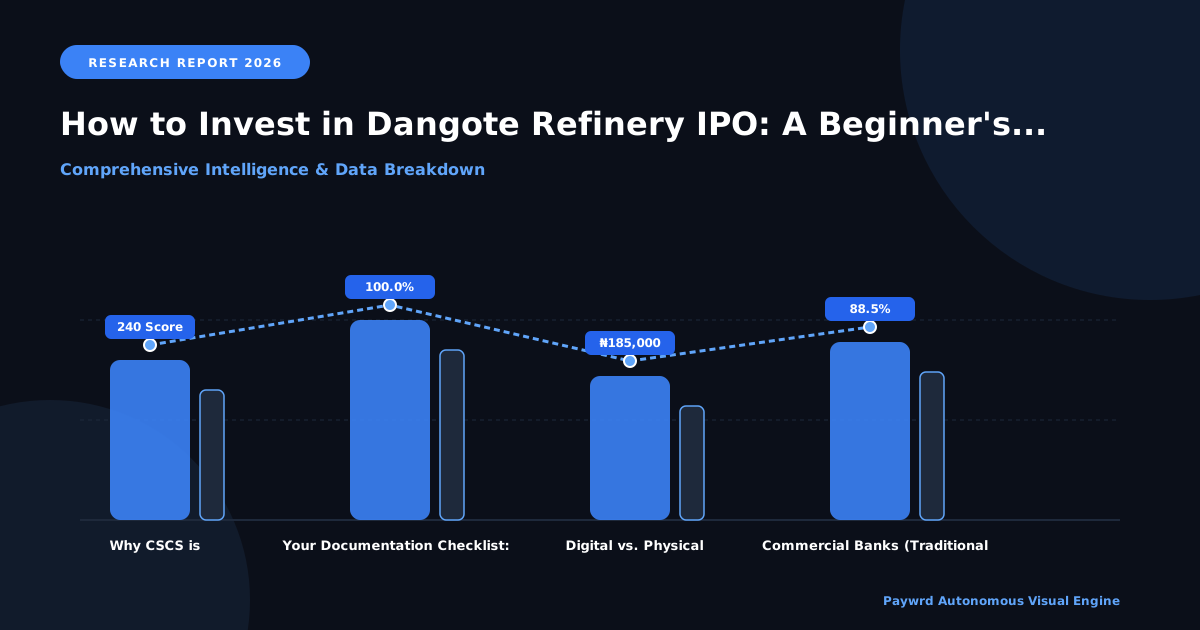
Key Takeaway: An IPO isn’t just “buying stock”—it’s your chance to buy directly from Dangote Refinery at the offer price before the shares hit the open market, locking in your entry point without the “premium” traders often pay on the NGX floor.
Demystifying the IPO: What Buying Dangote Refinery Shares Actually Means
Let’s cut through the noise. An Initial Public Offering (IPO) is simply a private company—like Dangote Petroleum Refinery—inviting the public to become part-owners for the first time. Think of it as the company selling slices of its future profits to raise capital for expansion, debt repayment, or working capital. For you, a student or young professional in Lagos, Abuja, or Port Harcourt, this is the ground floor. You aren’t buying from another investor; you are buying from the company via the issuing house (likely Stanbic IBTC Capital or Chapel Hill Denham) at a fixed offer price set by the Securities and Exchange Commission (SEC) and the Nigerian Exchange Group (NGX).

IPO vs. Secondary Market: Why Timing Changes Everything
This distinction saves you money. In the Primary Market (IPO), the price is fixed. If the offer price is ₦1,200 per share, you pay ₦1,200 (plus nominal fees). You apply via your stockbroker or a digital platform like Bamboo, Trove, or Meristem, fund your CSCS account, and wait for allotment.
In the Secondary Market (NGX Floor), you are buying from someone else who got in early. The price is dictated by supply and demand—often a “premium” above the IPO price if the stock is hot. If Dangote Refinery lists at ₦1,500 on Day 1, the secondary market buyer pays that premium. The IPO applicant? They already hold shares bought at ₦1,200. That immediate paper gain is the “IPO pop” everyone chases.

How Your Money Grows: Dividends & Capital Appreciation
Owning shares in the energy sector isn’t magic; it’s contractual. Here is how returns work in the Nigerian context:
- Capital Appreciation: As the refinery hits 650,000 bpd capacity, reduces Nigeria’s petrol import bill, and exports refined products, earnings per share (EPS) should rise. The market re-rates the stock upward. Your ₦1,200 share could trade at ₦2,500 in three years. That unrealized gain becomes real only when you sell.
- Dividends: This is your “salary” for being a shareholder. Once the board declares a profit after tax (PAT), they may propose a dividend—say ₦50 per share—approved at the Annual General Meeting (AGM). It hits your linked bank account (via e-dividend mandate) net of 10% Withholding Tax. For a 10,000-unit holding, that’s ₦450,000 cash annually, tax-free in your pocket.
- Bonus/Scrip Issues: Energy giants often capitalize reserves. You might wake up to extra shares credited to your CSCS account at zero cost, increasing your volume for future dividends.
Bottom line: The IPO lets you set your cost basis. The secondary market forces you to pay the market’s verdict. For a first-time investor building generational wealth on a NYSC allowance or entry-level salary, that difference is the entire game.
The Gateway to Ownership: Opening Your CSCS Account Step-by-Step
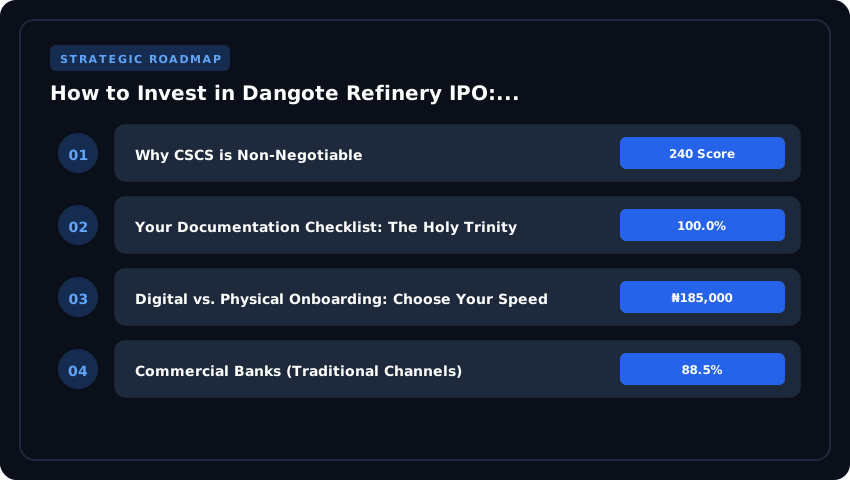
Before you can shout “I own Dangote Refinery,” you need a digital vault to hold those shares. In Nigeria, that vault is the Central Securities Clearing System (CSCS). Think of CSCS as the central depository—the official ledger that proves you legally own a slice of the company. Without a CSCS account, you cannot participate in any IPO on the Nigerian Exchange (NGX). It is non-negotiable, mandatory infrastructure, much like your BVN is for banking.
Why CSCS is Non-Negotiable
When the Dangote Refinery IPO opens, the allotment process credits shares directly to your CSCS account, not your bank app. This account assigns you a unique Clearing House Number (CHN)—your permanent identity on the NGX floor. It ensures seamless settlement (T+3), dividend processing, and corporate actions like bonus issues. If you’ve bought MTN or Airtel shares previously, you likely already have one; log into your stockbroker’s app to find your CHN.
Your Documentation Checklist: The Holy Trinity
Regulators (SEC and NGX) enforce strict Know Your Customer (KYC) rules. You cannot open a valid CSCS account without these three pillars:
- National Identification Number (NIN): This is now the primary identifier. Ensure your NIN is linked to your phone number and matches your name exactly.
- Bank Verification Number (BVN): Used for identity verification and linking your settlement bank account for dividend payments.
- Valid Government-Issued ID: International Passport, Driver’s License, or Voter’s Card. A utility bill (not older than 3 months) is usually required as proof of address.
Pro Tip: Ensure the name on your NIN, BVN, and ID are identical. A single typo—like “Abdullahi” vs “Abdulahi”—will freeze your onboarding and delay your IPO application.
Digital vs. Physical Onboarding: Choose Your Speed
Gone are the days of mandatory physical paperwork. Today, you have two paths:
- Digital (e-Onboarding): Most licensed stockbrokers (Meristem, Stanbic IBTC Stockbrokers, CardinalStone, etc.) offer full onboarding via their mobile apps or websites. You upload selfies, ID photos, and sign electronically. It takes 24 to 48 hours to get your CHN. This is the fastest route for the Dangote IPO window.
- Physical (Walk-in): Visiting a broker’s branch. Useful if you have complex name discrepancies or prefer hand-holding, but it adds travel time and manual processing delays (often 3–5 business days).
My advice? Download a top-tier broker’s app today, complete the e-KYC, and secure your CHN before the prospectus drops. When the Dangote Refinery offer opens, you want to be clicking “Subscribe,” not hunting for a utility bill.
Approved Channels: Where to Submit Your Dangote IPO Application
Let’s get straight to the brass tacks: you cannot walk into just any bank branch or download a random app to subscribe. The Securities and Exchange Commission (SEC) and the Nigerian Exchange Group (NGX) have strictly accredited 32 Receiving Agents for this offer. Using an unauthorized channel isn’t just a delay—it’s a direct risk to your capital. Below is the definitive list of institutions authorized to process your application, categorized for clarity.
Commercial Banks (Traditional Channels)
These are your Tier-1 and major Tier-2 banks. If you already hold a domiciliary or current account here, the KYC linkage is seamless.
- Access Bank Plc
- Citibank Nigeria Limited
- Coronation Merchant Bank
- Ecobank Nigeria Limited
- Fidelity Bank Plc
- First Bank of Nigeria Limited
- First City Monument Bank (FCMB) Limited
- Globus Bank Limited
- Guaranty Trust Bank (GTBank) Limited
- Heritage Bank Plc
- Jaiz Bank Plc
- Keystone Bank Limited
- Polaris Bank Limited
- Providus Bank Limited
- Stanbic IBTC Bank Plc
- Standard Chartered Bank Nigeria Limited
- Sterling Bank Plc
- SunTrust Bank Nigeria Limited
- Titan Trust Bank Limited
- Union Bank of Nigeria Plc
- United Bank for Africa (UBA) Plc
- Unity Bank Plc
- Wema Bank Plc
- Zenith Bank Plc
Merchant Banks & Fintech Platforms (Digital-First Channels)
For the digitally native investor, these platforms often offer faster UI/UX, real-time application tracking, and instant electronic allotment notifications.
- Chapel Hill Denham Securities Limited
- Cordros Capital Limited
- CSL Stockbrokers Limited
- EFG Hermes Nigeria Limited
- Meristem Stockbrokers Limited
- RMB Nigeria (Rand Merchant Bank)
- Vetiva Capital Management Limited
Bank Portals vs. Investment Apps: The Speed Verdict
Traditional bank portals (i-Bank, GTWorld, UBA Mobile, Zenith e-Azimo) are rock-solid for settlement finality because they sit directly on your settlement account. However, their IPO modules can feel clunky—think multi-page forms and mandatory OTPs for every click. Fintech apps like Meristem, Vetiva, or Cordros typically wrap the subscription in a modern wizard: pre-filled BVN data, instant CSCS clearing house number (CHN) validation, and push notifications the second your allotment hits. If speed and user experience matter, the fintech route wins; if you prefer keeping funds in your primary transaction account until the last minute, stick with your commercial bank app.
Verification Protocol: Don’t Get Scammed
Before you transfer a single kobo, run this three-step check:
- Cross-reference the NGX Issuer Portal: Visit the official NGX website (
ngxgroup.com) under “Current Offers” to see the live, updated list of Receiving Agents. If a platform isn’t on that PDF, it is not authorized. - Confirm the Settlement Account Name: The beneficiary for the transfer must read exactly: “Dangote Petroleum Refinery IPO Offer Proceeds Account” followed by the specific Receiving Agent’s name. Any variation—”Dangote Refinery Investment,” “Aliko Dangote Personal”—is a red flag.
- Validate the CSCS CHN: Ensure the platform asks for your Clearing House Number. If they don’t, they cannot warehouse the shares in your name at the Central Securities Clearing System (CSCS). No CHN = No legal ownership.
Pro tip: Screenshot the final confirmation page showing your Application Reference Number and the Receiving Agent’s stamp. That is your evidence if reconciliation issues arise during the allotment phase.
Protecting Your Naira: How to Spot and Avoid Dangote Investment Scams
Let’s be brutally honest: where there is hype, there are hyenas. The anticipation around the Dangote Refinery IPO has created a perfect hunting ground for fraudsters targeting eager Nigerians looking to build wealth. I have seen too many hardworking professionals lose life savings to “sure thing” schemes that vanish faster than fuel subsidy. If you want to keep your capital intact, you need to develop a radar for the red flags.
The “Guaranteed Returns” Lie
First rule of the Nigerian capital market: nobody—not Aliko Dangote himself, not the SEC, not your broker—can guarantee you a specific return on an equity investment. If a promoter, a WhatsApp “admin,” or a slick Instagram page promises you “30% ROI in 3 months” or “zero risk,” they are lying. Legitimate IPOs carry market risk; the share price can go up or down post-listing. Anyone selling you a risk-free ticket to wealth is selling you a scam. Run.
WhatsApp Groups and “Insider” Allocations
You know the drill: “Join this VIP group for pre-IPO allocation at a discount.” Stop. There is no “secret allocation” for retail investors via WhatsApp or Telegram. The official subscription process runs through the Central Securities Clearing System (CSCS) and registered Stockbroking firms. Scammers create fake groups mimicking legitimate firms like Meristem, Stanbic IBTC, or Chapel Hill Denham. They post doctored screenshots of “successful payments” to build social proof. Do not let FOMO (Fear Of Missing Out) override your due diligence.
The Private Account Trap
This is the single biggest giveaway. A legitimate IPO subscription will never—ever—ask you to transfer funds to a personal Opay, Palmpay, Kuda, or individual GTBank/Access Bank account. Never. Your subscription monies must go into a designated Issuing House Collection Account (e.g., Coronation Registrars, CardinalStone Registrars) or directly via your stockbroker’s client trust account. If the account name reads “Mr. Adebayo Johnson” or “Dangote Investment Team,” it is a 419 operation. Full stop.
Official Verification Channels: Your Shield
Before you part with a single kobo, verify the offer through these only official channels:
- The SEC Website (sec.gov.ng): Check the “Public Offers” register. If the offer isn’t listed there with a valid “No Objection” certificate, it does not exist legally.
- The NGX Website (ngxgroup.com): Look under “Listings > Upcoming Listings” for the official Prospectus and Abridged Prospectus.
- Your Registered Stockbroker: Call your broker directly using the number on your contract note or their official website—not a number from a WhatsApp forward.
- The Registrar’s Portal: For Dangote, confirm the appointed Registrar (likely Coronation or Veritas) and check their official site for the application portal link.
Protecting your naira isn’t about being cynical; it’s about being professional. Treat every unsolicited “opportunity” as guilty until proven innocent by the SEC and NGX. Your future self will thank you.
Budgeting for the IPO: Determining Your Investment Capacity
Before you log into your stockbroker’s app or fill out that e-offer form, let’s talk numbers—specifically, your numbers. The excitement around Dangote Refinery is palpable, but FOMO (Fear Of Missing Out) is a terrible investment strategy. You need a clear-eyed budget that protects your rent money while positioning you for potential upside.
Calculating the Minimum Subscription Cost
Every IPO in Nigeria has a “minimum subscription” threshold set by the issuer and the SEC. For context, recent major listings like MTN Nigeria or BUA Foods typically set a minimum bid—often around ₦10,000 to ₦50,000 worth of shares—though the exact figure for Dangote Refinery will be finalized in the prospectus.
Here is the practical math: if the offer price is set at ₦X per share and the minimum lot is Y shares, your floor cost is X × Y. Don’t forget to add the brokerage commission (usually 1.35%–1.5%), VAT on commission (7.5%), SEC fees (0.075%), and NGX fees (0.0125%). On a ₦50,000 subscription, transaction costs eat roughly ₦1,000–₦1,500 upfront. Ensure you fund your stockbroking wallet with the gross amount, not just the share value, or your order will fail validation.
The Golden Rule: Never Go “All In”
I cannot stress this enough: do not put your entire savings, emergency fund, or school fees into this IPO. Diversification isn’t just textbook theory; it is survival. As a beginner, your portfolio should look like a balanced diet, not a bet on a single horse.
- The 5–10% Rule: A common heuristic for retail investors is allocating no more than 5–10% of your total investable assets to a single IPO.
- Liquidity Buffer: Keep at least 3–6 months of living expenses in a high-yield savings account or Money Market Fund (like those offered by PiggyVest, Cowrywise, or your bank’s treasury bills). IPO shares can take weeks to list and settle; you cannot pay urgent bills with “shares pending allotment.”
- Sector Exposure: If you already hold heavy positions in Dangote Cement, Dangote Sugar, or NASCON, buying the Refinery increases your concentration risk to the “Dangote ecosystem.” Balance it with banking, telecoms, or consumer goods.
Managing Expectations: The Oversubscription Reality
Here is the hard truth: You might not get the shares you applied for. High-profile Nigerian IPOs are frequently oversubscribed by 200%, 300%, or even 1000% (remember MTN Nigeria?). When this happens, the registrars use a pro-rata allotment formula. If you applied for ₦1,000,000 worth of shares but the IPO is 5x oversubscribed, you might only receive ₦200,000 worth. The balance is refunded—usually within 5–10 working days post-allotment—but your capital is locked during the book-building and allotment period.
Plan for this. Budget an amount you are comfortable not having immediate access to for 2–3 weeks. If you get a full allotment, fantastic. If you get a partial fill, your financial plan remains intact. That is the mindset of a professional investor, not a gambler.
Post-Application Roadmap: What Happens After You Apply?
You’ve submitted your application, the funds have left your account, and now the waiting game begins. This is where many first-time investors get anxious, refreshing their banking apps or calling their stockbrokers daily. Let’s demystify the timeline so you can plan your next moves with clarity.
Understanding the Allotment Process and Refund Timelines
Once the offer closes, the registrars (likely First Registrars & Investor Services or CardinalStone Registrars, given the deal size) begin the “basis of allotment.” This is the SEC-approved formula determining who gets what. If the IPO is oversubscribed—which is highly probable for a Dangote asset—you won’t get your full requested volume. You’ll receive a pro-rata allocation based on the subscription level.
Here is the critical timeline to mark on your calendar:
- Allotment Date: Typically 10–14 business days after the offer closes. The SEC must approve the basis of allotment before funds are released.
- Refunds: If you applied for ₦5 million worth of shares but only got ₦1 million allocated, the balance (₦4 million) is refunded to your bank account. This usually hits within 5–7 business days post-allotment approval.
- Credit to CSCS Account: Your allotted shares are credited to your Central Securities Clearing System (CSCS) account via your stockbroker. This happens simultaneously with the refund process.
Pro Tip: Ensure your BVN-linked bank account matches the name on your CSCS account exactly. A mismatch is the number one reason for delayed refunds in Nigeria.
How to Track Your Shares Via Your Stockbroking App
Don’t wait for a physical certificate (those are effectively extinct). Log into your stockbroker’s mobile app or web portal—whether it’s Meristem, Chapel Hill Denham, ARM Securities, Stanbic IBTC Stockbrokers, or a fintech wrapper like Bamboo or Trove (if they offer primary market access).
Navigate to Portfolio or Holdings. You are looking for the ticker (likely DANGREF or similar). Once the shares hit your CSCS account, they appear here with the correct unit count and the current market valuation. If you see “Pending Allotment” or “Awaiting Credit,” the registrars are still processing. Patience is part of the asset class.
Long-Term Holding vs. Short-Term Flipping in the Nigerian Market
This is where your strategy meets reality. The “Listing Day Pop” is the stuff of legend—think MTN Nigeria or Airtel Africa—where early birds saw instant paper gains of 20–30% on day one. Flipping (selling immediately on listing) locks in that profit but exposes you to settlement risk (T+3 settlement cycle on the NGX) and brokerage fees (approx. 1.35%–1.86% total transaction cost including VAT, CSCS, and SEC fees).
Holding long-term aligns with the fundamental thesis: Dangote Refinery is a strategic infrastructure monopoly with 650,000 bpd capacity. You are betting on import substitution, FX savings for Nigeria, and dividend yield over 5–10 years. However, liquidity on the NGX can be thin. If you need emergency cash, selling large blocks quickly might move the price against you.
My take: If you applied with “rent money” or funds you need in 6 months, set a limit sell order for listing day. If this is “generational wealth” capital, ignore the daily ticker, opt into the Dividend Reinvestment Plan (DRIP) if offered, and let compounding do the heavy lifting.
Strategic Final Takeaway
When evaluating Guide To Investing In Dangote Refinery IPO For Nigerian Beginners, base your decisions on accredited institutional standards, measurable return on investment (ROI), and up-to-date official guidelines. Always verify specific dates and requirements through official regulatory portals.

