Mapping Nigeria’s AI-Auto Tech Skills Gap for 2026
Walk into any modern workshop in Lagos or Abuja today, and you’ll hear the hum of diagnostic scanners louder than the ring of spanners. The Nigerian automotive landscape is undergoing a silent revolution, driven by the influx of tokunbo vehicles packed with Advanced Driver Assistance Systems (ADAS), the gradual entry of Electric Vehicles (EVs) like the Hyundai Kona and Jetour models, and a regulatory push from the National Automotive Industry Development Plan (NAIDP) for local value addition. Yet, our tertiary institutions are playing catch-up.
The Curriculum Pivot: NUC CCMAS and the New Reality
The National Universities Commission (NUC) didn’t just tweak the syllabus; they rewrote the rules with the Core Curriculum Minimum Academic Standards (CCMAS). For Mechatronics and Computer Engineering departments, the 30% contextualization allowance is the golden ticket. Forward-thinking departments in UNILAG, FUTA, and Covenant University are already embedding Python for automotive data logging, MATLAB/Simulink for battery management system (BMS) modeling, and CAN bus protocol analysis into their 300 and 400-level coursework. If your department is still teaching only ladder logic and basic PLCs without a module on ISO 26262 functional safety or AUTOSAR architecture, your graduates are already obsolete before NYSC camp.
Where the Market Is Bleeding for Talent
Industry demand has crystallized around three high-value pillars that standard mechanical engineering degrees simply don’t cover:

- ADAS Calibration & Sensor Fusion: With OEMs like Toyota and Mercedes mandating post-collision radar/lidar recalibration, technicians who understand sensor fusion algorithms command premium rates—often ₦15,000–₦30,000 per calibration job in certified centers.
- Predictive Maintenance Analytics: Fleet operators (logistics, ride-hailing, haulage) are desperate for engineers who can deploy vibration analysis and OBD-II telematics data into Machine Learning models to predict injector failure or turbo degradation before breakdown. This saves fleets millions in downtime.
- EV Battery Optimization & Thermal Management: As the Energy Commission of Nigeria (ECN) pushes charging infrastructure, the bottleneck isn’t the charger—it’s the engineer who can manage State of Health (SoH) estimation, cell balancing algorithms, and thermal runaway prevention for our tropical climate.
The JAMB Signal: Students Are Moving Faster Than Schools
The clearest proof of the shift? The JAMB registration data. We are seeing a measurable pivot in subject combinations. The traditional Physics, Chemistry, Mathematics combo for Mechanical Engineering is losing ground to Physics, Mathematics, Data Processing/Computer Studies for Computer Engineering, Mechatronics, and the new “Robotics and AI” programs popping up in polytechnics like YABATECH and Federal Polytechnic Nekede. Prospective students are voting with their UTME slips: they want code, not just combustion.
For the 2026 graduate or the mid-career technician looking to upskill via NELFUND-backed professional certifications, the message is unambiguous. The “grease monkey” era is dead. The “data mechanic” era has arrived. Your next certification must speak the language of TensorFlow, ROS 2, and high-voltage safety standards—or you’re fixing yesterday’s cars.
Top Accredited AI Courses: Universities vs. Specialized Bootcamps
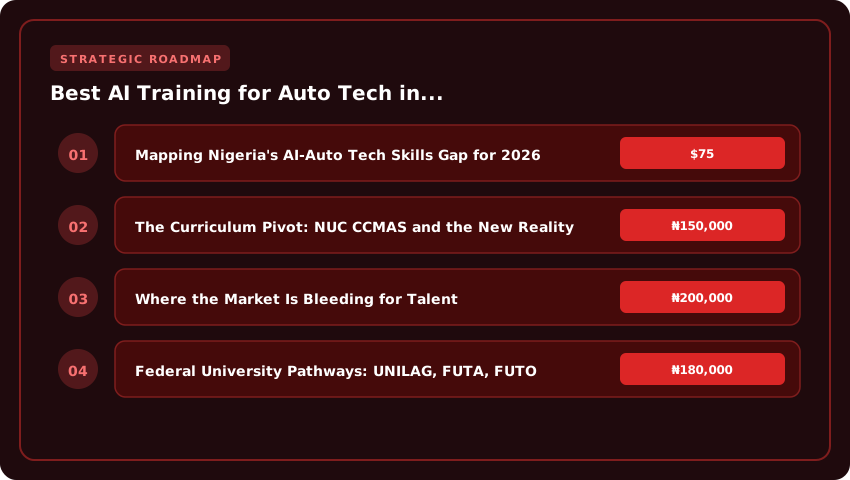
Choosing between a university postgraduate programme and an intensive bootcamp isn’t just about cost—it’s about your timeline, your NYSC status, and how deep you need the theoretical roots to go. For the auto-tech engineer targeting 2026, the decision usually boils down to the NUC-accredited academic rigour of federal universities versus the NITDA/NATEB-aligned speed of private academies.
Federal University Pathways: UNILAG, FUTA, FUTO
If you need the MSc or Postgraduate Diploma (PGD) stamp for lecturing roles, foreign scholarships, or senior R&D positions in OEMs like Innoson or Jet Motor Company, the federal route remains the gold standard. At the University of Lagos (UNILAG), the MSc Computer Science (AI/Machine Learning track) runs roughly ₦450,000 – ₦600,000 per session for new intakes, excluding acceptance fees. The curriculum leans heavy on mathematical foundations—convex optimization, probabilistic graphical models—which is critical if you’re building predictive maintenance models for EV fleets.
Federal University of Technology, Akure (FUTA) and FUTO offer stronger mechatronics integration thanks to the new CCMAS curriculum. FUTA’s PGD in Mechatronics & AI often costs ₦300,000 – ₦400,000 total. The catch? Duration. An MSc is 18–24 months; a PGD is 12 months plus a mandatory semester for project defence. If you haven’t served, you need NYSC discharge/exemption before* admission processing on JAMB CAPS.
NITDA/NATEB Certified Bootcamps: Speed & Stack Depth
For the practitioner who needs to deploy YOLOv8 for vehicle detection or TensorRT optimization for edge ECUs yesterday, bootcamps like Data Science Nigeria (DSN), Utiva, or AltSchool Africa (via NITDA’s 3MTT initiative) are purpose-built. Fees range from ₦250,000 – ₦800,000, but many are tuition-free via NITDA/3MTT scholarships if you pass the aptitude test.
- Curriculum: Project-heavy (CAN bus data logging, digital twin simulation, ADAS sensor fusion).
- NYSC Compatibility: Most run 3–6 months part-time/weekend, allowing serving corps members to upskill during service year.
- Certification: Look for NATEB (National Board for Technical Education) accreditation on the specific programme, not just the parent company.
The NELFUND Lever: Coursera, edX & Micro-Credentials
Here is the 2026 game-changer: NELFUND student loans now cover verified professional certificates on Coursera and edX from partners like DeepLearning.AI, Google, and IBM. You can finance the TensorFlow Developer Certificate or AI for Medicine/Automotive specializations (approx. ₦150k–₦300k total) via the NELFUND portal using your NIN and BVN.
Strategic Move: Enroll in a FUTA PGD for the degree credential, but use NELFUND to simultaneously knock out the DeepLearning.AI MLOps Specialization on Coursera. You get the NUC transcript and the GitHub-ready portfolio projects employers actually scan during interviews.
Curriculum Breakdown: Python, Computer Vision & CAN Bus Integration
This is where the rubber meets the road—or rather, where the tensor meets the tensor core. A world-class 2026 curriculum doesn’t just teach you model.fit(); it forces you to wrestle with the chaotic beauty of Nigerian mobility data. The syllabus typically splits into three brutal, high-value pillars: advanced perception, constrained deployment, and the messy reality of local data engineering.
Perception Engineering: Beyond COCO and ImageNet
Forget the standard COCO dataset. If your capstone project detects “car” and “person” on a clean highway, you have failed the Nigerian context. Top-tier programs—like the advanced tracks at Data Science Nigeria or the NITDA Blockchain/AI Scholarship practical modules—demand custom object detection pipelines built on PyTorch Lightning or TensorFlow/Keras. You will train YOLOv8/v9 or RT-DETR architectures specifically optimized for:
- Occlusion-heavy “Keke” (Tricycle) detection: Modeling the erratic, non-lane-following dynamics of three-wheelers in Yaba or Onitsha traffic.
- Articulated vehicle segmentation: Distinguishing a loaded “Danfo” bus chassis from its rooftop cargo (often passengers or goods) using instance segmentation (Mask R-CNN).
- Night-time domain adaptation: Handling the low-lux, high-glare conditions of Third Mainland Bridge at 2 AM using synthetic data augmentation (Albumentations) and test-time augmentation (TTA).
Embedded Deployment: The Jetson & Pi Crucible
Cloud inference is a luxury when you are building an ADAS retrofit for a 2005 Toyota Camry in Ibadan. The curriculum must cover TensorRT optimization, ONNX Runtime quantization (FP16/INT8), and memory management on NVIDIA Jetson Orin Nano/NX modules. You aren’t just running inference; you are profiling latency budgets (< 30ms end-to-end) on a 15W power envelope. Expect labs involving Raspberry Pi 5 clusters running K3s (lightweight Kubernetes) for fleet-edge orchestration—simulating how a logistics startup like Kobo360 or GIG Logistics might manage OTA (Over-The-Air) model updates across 500 trucks with spotty 4G connectivity.
The CAN Bus & Local Data Reality
This is the differentiator. You will write Python `python-can` scripts interfacing via SocketCAN on a Vector or Peak-System adapter to log live J1939/OBD-II frames from Nigerian-used vehicles (Tokunbo). The coursework forces you to correlate wheel speed sensor noise with your vision model’s velocity estimates for sensor fusion. Crucially, you will spend weeks on data annotation economics: building semi-automated labeling pipelines using CVAT or Label Studio to annotate Nigerian number plates (the new white-on-blue, the old yellow-on-black, and the diplomatic red-on-white) and unique classes like “Okada,” “Wheelbarrow,” and “Hawker.” If the program doesn’t make you clean a dataset where 40% of plates are obscured by dirt, tint, or missing entirely, it isn’t preparing you for Lagos.
Cost Analysis: Tuition, Hardware Kits & NELFUND Loan Coverage 2026
Let’s talk numbers, because ambition without a budget is just daydreaming. In 2026, the price tag for becoming an AI-literate auto tech professional in Nigeria spans a massive spectrum, and knowing where your money actually goes separates the prepared from the stranded.
The Tuition Landscape: Bootcamps vs. Degrees
If you want speed and industry relevance, specialized bootcamps (think Data Science Nigeria auto-track, Utiva, or Andela-adjacent partner programs) currently sit between ₦350,000 and ₦850,000. These are intensive, 3-to-6-month sprints focused on TensorFlow Lite for ECUs, CAN bus data logging, and computer vision for ADAS calibration. On the other end, a full MSc in Mechatronics/AI at universities like UNILAG, Covenant, or FUTA under the new CCMAS curriculum will run you ₦1.2M to ₦2.5M over 18–24 months. The university route buys you deep theoretical grounding and NUC recognition; the bootcamp buys you a GitHub portfolio and a faster entry ticket.
The “Hidden” Bill: Hardware, Cloud & Certifications
This is where most budgets break. Tuition rarely covers the physical tools of the trade. You need to factor in:
- Edge Compute Hardware: A decent Jetson Orin Nano or Xavier NX developer kit for running inference models on the vehicle edge costs ₦180,000–₦320,000 landed in Lagos.
- Sensor Kits: LiDAR (even solid-state units like Livox), IMUs, and OBD-II CAN loggers add another ₦150,000+.
- Cloud Compute Credits: Training YOLOv8 or transformer models locally is painful. Budget ₦50,000–₦120,000/year for AWS (Deep Learning AMIs) or Azure ML compute instances.
- Vendor Certifications: The AWS Certified Machine Learning – Specialty or Azure AI Engineer Associate exams cost roughly ₦110,000 (≈$75) each at current CBN rates, plus practice exam fees.
Unlocking NELFUND for “Emerging Tech” Programs
Here is the good news: The Nigerian Education Loan Fund (NELFUND) now explicitly covers “Emerging Technology” designated programs under the 2024 Act amendments. But you cannot just walk in; the portal (nelf.gov.ng) requires a specific workflow:
- Verify Institutional Accreditation: Confirm your chosen university or polytechnic has uploaded the program to the NUC CCMAS portal with the “Emerging Tech” tag. Private bootcamps are not currently eligible unless partnered with an accredited university for a diploma conversion.
- Create Your Profile: Use your NIN and BVN. Ensure your JAMB registration number matches your admission letter exactly—mismatches are the #1 rejection reason.
- Select “Tuition & Upkeep”: Apply for the Institutional Charge (paid directly to school) and the Upkeep Allowance (paid to your student account). Note: Hardware kits and cloud credits are not line items NELFUND pays directly; you must manage the upkeep disbursement to cover these.
- Guarantor Upload: You need two civil servants (Level 12+) or a recognized community/religious leader. Upload their signed forms and ID cards immediately to avoid the “Pending Verification” limbo.
- Track via Dashboard: Once submitted, monitor the “Application Status” tab. Disbursement to institutions typically hits within 30–45 days of approval.
Pro Tip: If you are doing a bootcamp, NELFUND won’t fund it directly. However, many bootcamps now offer Income Share Agreements (ISAs) or partner with Sterling/Access Bank for “Skill Loans” at 9–12% per annum. Crunch the ROI: a ₦600k bootcamp landing a ₦400k/month junior ADAS role pays for itself in 6 weeks. Do the math, then make the move.
Capstone Projects That Get You Hired by Innoson, Jet Motors & Startups
Let’s be blunt: Nigerian hiring managers at Innoson Vehicle Manufacturing (IVM), Jet Motors, and the mobility startups bubbling out of CcHub and Wennovation Hub do not care about your certificate grade. They care about your GitHub repo. They want to see code that survives a Lagos pothole, a harmonic generator hum, and a danfo driver’s erratic braking. Your capstone project is your probation period—make it count.
1. Autonomous Navigation for “Nigerian Reality” Roads
Forget the polished Stanford driving datasets. Build a perception stack trained on Nigerian road topology: unmarked lanes, missing drain covers, aggressive motorcycle (okada) swarms, and sudden flooding. A winning project fuses low-cost LiDAR (or stereo vision via OAK-D cameras) with YOLOv8 or RT-DETR models fine-tuned on local footage—think Apapa-Oshodi expressway at 7 PM. Bonus points if your path planner executes a “defensive swerve” around a pothole without crossing the double yellow line. That demo video on LinkedIn? That’s your offer letter from an OEM R&D unit.
2. Fleet Telematics Dashboards That Speak Pidgin (and Data)
Logistics firms like Kobo360 or GIG Logistics bleed money on fuel theft and unauthorized detours. Don’t just plot GPS dots. Build a full-stack IoT pipeline: ESP32 + CAN bus sniffers streaming J1939 data (RPM, fuel level, coolant temp) over MQTT to a TimescaleDB/Grafana backend. The killer feature? An anomaly detection model (Isolation Forest or LSTM Autoencoder) that flags “Engine idling > 15 mins in Berger traffic” vs. “Fuel siphoning at 2 AM in Ota.” Deploy the UI on a cheap Android head unit. If your dashboard saves one fleet manager ₦500k/month in diesel, you’ve just justified a ₦400k–₦600k entry-level salary band.
3. Co-Creation Cred: The CcHub & Wennovation Stamp
Solo projects are fine; hub-validated projects get fast-tracked. Apply for the CcHub Design Lab or Wennovation’s Hardware Accelerator with your capstone. These hubs pair you with OEM engineers from IVM’s Nnewi R&D center or Jet’s EV team for mentorship. A project stamped “Incubated at CcHub, validated by Jet Motors Chief Engineer” on your CV bypasses the HR filter entirely. Document the collaboration: pull requests reviewed by industry mentors, sprint retrospectives, and a signed MoU for IP sharing if the prototype scales.
4. Portfolio Hygiene: LinkedIn Nigeria & GitHub SEO
Recruiters in Victoria Island and Ikeja search LinkedIn with keywords: “Embedded Linux,” “CAN Bus,” “ROS2,” “TensorRT,” “EV Battery Management.” Optimize your headline: “AI/Embedded Engineer | Autonomous Systems & Fleet Telematics | IVM/Jet Motors Stack | Open to Work (Lagos/Abuja/Remote).” On GitHub, pin three repos max. Each README.md must have: Problem Statement (Nigerian Context), Architecture Diagram (Mermaid.js), Quantified Results (e.g., “Reduced inference latency to 22ms on Jetson Orin Nano”), and a 2-min demo video hosted on YouTube (embedded). Tag topics: nigeria-tech, automotive-ai, embedded-ml. That is how you get DM’d for an interview before you even apply.
Certification Validity: COREN Registration & International Recognition
Let’s be brutally honest: in Nigeria, a certificate without COREN (Council for the Regulation of Engineering in Nigeria) recognition is just expensive wallpaper. If you are gunning for that Professional Engineer (PEng) seal—or planning to sign off on structural EV charging infrastructure in Lagos—your AI training must translate into Continuing Professional Development (CPD) units. The Council typically mandates a minimum of 10 CPD units annually for license renewal. Before you drop ₦350,000 on a “Certified AI Automotive Specialist” badge, demand the provider’s COREN accreditation number and confirm the exact CPD unit allocation. No number? No deal.
Vendor Certs vs. Academic Transcripts: The Visa Reality Check
Here is where the rubber meets the runway for Japa aspirations. A NVIDIA Deep Learning Institute (DLI) certificate or a TensorFlow Developer Certificate carries immense weight with recruiters in Berlin, Toronto, or Dubai because they are vendor-verified, practical, and globally standardized. However, immigration officers processing Skilled Worker visas (like the UK Global Talent Visa or Canada Express Entry) often demand academic equivalence assessments (WES, ICAS, or NARIC). A 3-month bootcamp certificate rarely satisfies “Bachelor’s degree equivalence” requirements on its own. The winning combo? A NUC-accredited M.Eng in Mechatronics/AI transcript plus the vendor certs. The degree opens the immigration door; the NVIDIA/TensorFlow badges get you the interview.
Dodging the ‘Certificate Mills’: Your Due Diligence Checklist
The Nigerian ed-tech space is flooded with “institutes” selling diplomas printed in business centers. Protect your wallet and your career by running these three verification steps before payment:
- Check the NUC CCMAS Portal: Visit the National Universities Commission’s Course Accreditation Status database. If the university or polytechnic isn’t listed with “Full Accreditation” for Computer Engineering/Mechatronics under the new CCMAS curriculum, walk away.
- Verify NATEB/NBTE Codes: For polytechnics and monotechnics, demand the NBTE Accreditation Code and cross-reference it on the Board’s official website. Expired accreditation (common in many private polys) means your HND/ND is invalid for NYSC or COREN registration.
- Demand the COREN Training Provider List: COREN publishes an updated list of approved training providers for CPD. If the “Academy” isn’t on that PDF, your units won’t count toward your PEng.
Bottom line: In 2026, the Nigerian auto-tech pro who commands ₦1.2M/month or secures the UK Tech Nation visa isn’t the one with the most certificates—it’s the one with the right accredited paper trail. Verify first, pay later.
Roadmap: From NYSC Posting to Junior ML Engineer in Auto Sector
Your NYSC year isn’t a pause button on your career; it’s the most strategic 12-month runway you’ll ever get to pivot into Nigeria’s booming auto-tech space. The graduates landing ₦600k/month Junior Computer Vision roles in 2026 aren’t waiting for deployment letters to decide their fate—they are hacking the system from Orientation Camp.
Months 1–3: Strategic Posting & CDS Leverage
Don’t leave your Place of Primary Assignment (PPA) to chance. If you’re posted to Lagos or Abuja, target organizations with active R&D or automation units—think Jet Motor Company, Innoson Vehicle Manufacturing tech arms, or fintech-logistics hybrids like Kobo360 and GIG Logistics running fleet telematics. During documentation, network aggressively with the IT/Engineering heads.
Your Community Development Service (CDS) group is your free lab. Skip the generic “Education” or “Environmental” groups. Hunt down the AI/Robotics CDS in Lagos (often hosted at CcHub or Yaba tech hubs) or the Data Science Nigeria (DSN) clusters in Abuja. These aren’t social clubs; they are where you find mentors building ADAS prototypes for local EV conversions. Contribute code, document your GitHub commits, and treat every CDS Thursday like a sprint review.
Months 4–9: The “Portfolio Over Certificate” Sprint
While peers chase Corper allowances, you’re building a portfolio that screams “Auto-Tech Ready.”
- Project 1: Fine-tune a YOLOv8 model on Nigerian traffic data (okada, keke, danfo detection) using Roboflow. Deploy it on a Jetson Nano or Raspberry Pi 5—hardware you can afford on ₦33k allowance.
- Project 2: Simulate a ROS 2 (Humble/Iron) navigation stack for a differential drive robot mimicking an AGV in a factory floor. Document the URDF creation and Nav2 tuning on a technical blog.
- Certification: Knock out the ISO 26262 Functional Safety (ASIL-B awareness) course on Coursera or Udemy. It costs ~₦15k–₦25k on sale but signals to OEMs like Stallion or Dana Motors that you speak their regulatory language.
Months 10–12: Interview Ready & Salary Negotiation
By month 10, you should be applying to Junior ML/CV Engineer roles. The 2026 Nigerian market reality for entry-level auto-tech AI roles looks like this:
- ₦250k–₦350k/month: Generalist AI internships at non-auto tech firms (banks, telcos) doing generic CV.
- ₦400k–₦600k/month: Junior CV/Perception Engineer roles at mobility startups, EV retrofitting shops, or OEM R&D centers. This band requires proven ROS 2 fluency and a GitHub repo showing sensor fusion (LiDAR + Camera) work.
Negotiate using your NYSC discharge certificate as the “available immediately” leverage. Companies hate 3-month notice periods; you have zero.
Post-NYSC: The Senior Track (Year 2+)
Landing the job is step one. To breach the ₦1M/month ceiling within 24 months, specialize vertically. Master MLOps (Kubeflow/MLflow) to productionize models on edge devices in vehicles with intermittent connectivity—a uniquely Nigerian infrastructure problem. Deep-dive into AUTOSAR Adaptive platforms and advanced ISO 21448 (SOTIF) for autonomous safety validation. That is how you move from “coding models” to “engineering safety-critical systems” in the Nigerian auto sector.
| Training Pathway | Estimated Cost (₦) | Duration | Prerequisites | Core Focus (2026 Relevance) | Certification / Recognition | Avg. Entry Salary Potential (₦/mo) |
|---|---|---|---|---|---|---|
| University Mechatronics (CCMAS Curriculum) | ₦200,000 – ₦600,000 / session (Public) | 4–5 Years (B.Eng) | JAMB UTME + O’Level Credits (Maths, Physics, Chem) | Embedded Systems, Control Theory, EV Powertrain Modeling, ADAS Algorithms | NUC Accredited B.Eng / COREN Registration Eligible | ₦150,000 – ₦300,000 (Graduate Trainee) |
| Specialized Tech Bootcamps (e.g., Utiva, AltSchool, NIIT Auto-Tech Tracks) | ₦350,000 – ₦1,200,000 | 4–9 Months | Basic Coding (Python/C++) or Engineering Background preferred | Python for Automotive, CAN Bus/LIN Protocols, ADAS Calibration, EV Battery Management Systems (BMS) | Industry Certificate + Portfolio Projects | ₦200,000 – ₦450,000 (Junior AI/Auto Engineer) |
| OEM Certified Training (Coscharis, Stallion, Hyundai/Kia, Jetour Academies) | ₦150,000 – ₦500,000 (Often Subsidized) | 2 Weeks – 3 Months | Existing Mechanical/Diploma Cert; Employment/Dealership Affiliation | Brand-Specific Diagnostics, High-Voltage Safety (EV), ADAS Sensor Calibration, OTA Updates | OEM Certified Technician / Master Technician | ₦180,000 – ₦400,000 (Dealership Tech) |
| Global Online Certs (Coursera/edX: Google AI, Stanford ML, Tesla/Waymo Open Courses) | $50 – $300 (₦75,000 – ₦450,000) | Self-paced (3–6 Months) | Strong Math/CS Foundation; Reliable Internet/Power | Deep Learning for Vision, Sensor Fusion, Reinforcement Learning for Control, Functional Safety (ISO 26262) | Verified Certificates (University/Big Tech Branded) | ₦300,000 – ₦800,000+ (Remote/International Roles) |
| Workshop Apprenticeship + Upskilling (ITF/NASDC Accredited Centers) | ₦50,000 – ₦150,000 (Tooling/Levy) | 1–2 Years (On-the-Job) | Trade Test / City & Guilds / Basic Mechanical Aptitude | Scanner Diagnostics (Launch/Autel), EV Retrofitting Basics, ADAS Target Setup, Predictive Maintenance Data Logging | NABTEB / ITF Trade Test Cert / NASDC Competency | ₦80,000 – ₦200,000 (Master Technician) |
Frequently Asked Questions
Which AI auto tech course has the highest ROI in Nigeria for 2026?
Specialized bootcamps (₦350k–₦1.2M) offer the highest 2026 ROI. They bridge the NUC CCMAS theory gap with hands-on ADAS calibration, CAN bus hacking, and EV BMS projects in 6 months, yielding ₦200k–₦450k starting salaries versus 5-year degrees starting at ₦150k.
How much does OEM EV training cost for Hyundai Kona or Jetour technicians in Nigeria?
OEM training for Hyundai Kona, Jetour, or GAC EVs at Coscharis or Stallion academies costs ₦150,000–₦500,000, often subsidized by dealerships. Programs run 2–12 weeks covering high-voltage safety (Orange PPE), BMS diagnostics, and ADAS radar/lidar calibration using OEM tools.
Is a university mechatronics degree enough for ADAS engineering jobs in Nigeria?
No. The NUC CCMAS curriculum provides control theory foundations but lacks hands-on ADAS sensor fusion (radar/lidar/camera), ISO 26262 functional safety, and OTA update protocols. Graduates need a 3–6 month bootcamp or OEM cert to be job-ready for 2026 ADAS roles.
Can I get a remote AI automotive job from Nigeria with only online certificates?
Yes. Verified certificates from Coursera (Google AI, Stanford ML) or edX (MIT Autonomous Systems) plus a GitHub portfolio of sensor fusion/EV projects enable remote roles paying ₦300k–₦800k+. Employers prioritize proven PyTorch/TensorRT skills over local degrees for distributed teams.
What are the prerequisites for joining an automotive AI bootcamp in Lagos or Abuja?
Most Lagos/Abuja bootcamps (Utiva, AltSchool, NIIT) require basic Python/C++ proficiency or an engineering diploma. Non-coders must complete a 4-week pre-work module covering Linux, Git, and linear algebra before the core ADAS/EV curriculum begins.
Strategic Final Takeaway
When evaluating Artificial Intelligence Training Courses Nigeria Automotive Tech Applications 2026, base your decisions on accredited institutional standards, measurable return on investment (ROI), and up-to-date official guidelines. Always verify specific dates and requirements through official regulatory portals.