Navigating State Literacy Mandates Driving Middle School Adoption
The legislative landscape has shifted decisively. What began as a wave of early-literacy statutes targeting Kindergarten through third grade has migrated upstream. For middle school principals and curriculum directors, the “wait-and-see” approach is no longer viable; the legal triggers for Grades 6–8 intervention are active, funded, and enforced.
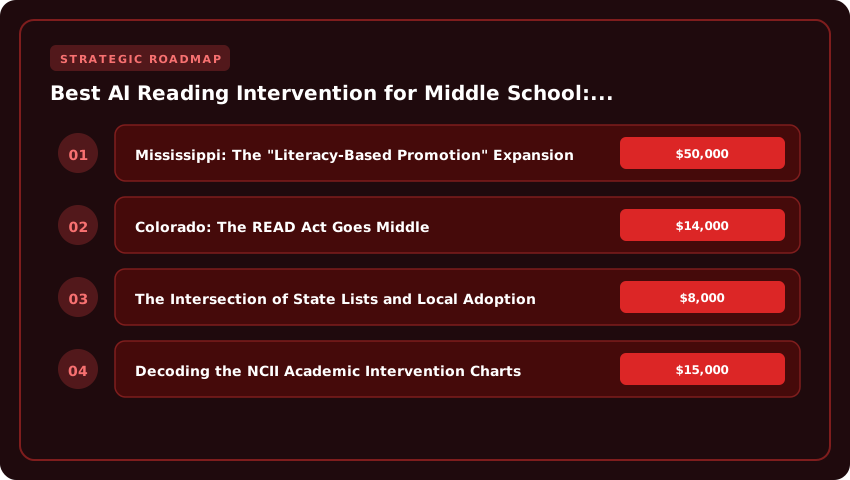
Mississippi: The “Literacy-Based Promotion” Expansion
Mississippi’s Literacy-Based Promotion Act (SB 2347/2023 amendments) is the national bellwether. While the original 2013 law focused on the third-grade gate, the 2023 revisions mandate that districts provide evidence-based reading intervention for any student in Grades 4–8 scoring below proficiency on the MAAP assessment. Critically, the law requires the Mississippi Department of Education (MDE) to publish a vetted list of approved high-quality instructional materials (HQIM) and intervention programs. Districts must select from this list or submit a rigorous local evidence package for approval. The deadline for full implementation aligned with the 2024–2025 school year, meaning procurement decisions for AI-driven intervention tools needed to be finalized by Spring 2024 to allow for summer professional development (PD).
Colorado: The READ Act Goes Middle
Colorado’s Reading to Ensure Academic Development (READ) Act (SB 19-199, updated SB 24-034) historically capped at Grade 3. The 2024 updates extend the requirement for Individual Reading Improvement Plans (IRIPs) through Grade 8 for students identified with a Significant Reading Deficiency (SRD). The Colorado Department of Education (CDE) now maintains an Advisory List of Instructional Programming specifically tagged for Grades 4–8. A crucial nuance: Colorado retains strong local control. Districts are not forced to buy from the state list, but they must prove their chosen curriculum meets the “Science of Reading” evidence standard defined in statute (phonology, orthography, morphology, syntax, semantics). If a district’s current middle school curriculum relies on three-cueing or balanced literacy models, it is legally non-compliant as of July 1, 2024. PD mandates require all 4–8 teachers serving students on IRIPs to complete 45 hours of SoR training by the 2025–26 deadline.
North Carolina: The “Excellent Public Schools Act” Enforcement
North Carolina’s Excellent Public Schools Act of 2021 (SB 387) mandated a statewide shift to the Science of Reading. While the initial splash was LETRS training for K-5, the legislation explicitly tasks the State Board of Education with developing standards for reading intervention in Grades 6–8. The NC Department of Public Instruction (NCDPI) released its Middle Grades Literacy Guidance in late 2023, requiring districts to implement “systematic, explicit” intervention for students not meeting benchmarks. The intersection of state-approved lists and local authority is tight here: the State Board approves the list of high-quality core and supplemental materials, but Local Education Agencies (LEAs) hold the purse strings. However, the 2024–2025 school year marked the hard deadline for districts to phase out non-aligned materials. Failure to align triggers corrective action plans monitored by NCDPI, potentially jeopardizing PRC 024 (Read to Achieve) funding streams.
The Intersection of State Lists and Local Adoption
This is where procurement gets sticky. In all three states, the state-approved list functions as a “safe harbor.” Buying off-list shifts the burden of proof to the district. For a middle school leader evaluating AI reading platforms, the immediate question is: Does this vendor appear on the MDE, CDE, or NCDPI approved lists for Grades 6–8 intervention? If not, your team must compile efficacy studies, alignment rubrics, and SoR crosswalks—a process that typically takes 6–9 months. With PD deadlines looming (Colorado’s 45-hour mandate, Mississippi’s required training on adopted materials), the evaluation window has effectively closed for the current cycle. The only compliant path forward for many districts is an emergency adoption or pilot of a pre-vetted, list-approved AI solution.
The Evaluation Rubric: NCII Tools Charts, WWC Evidence Tiers & SoR Non-Negotiables
Vendors love to slap “Science of Reading aligned” on landing pages, but procurement officers need a shield against marketing spin. That shield is a three-legged stool: the National Center on Intensive Intervention (NCII) Tools Charts, the What Works Clearinghouse (WWC) evidence tiers, and a non-negotiable checklist of instructional architecture. If a platform cannot clear all three, it does not belong in a Tier 2 or Tier 3 middle school block.
Decoding the NCII Academic Intervention Charts
The NCII charts are the gold standard for validity because they rate technical rigor, not just outcomes. Look at the “Study Quality” and “Effect Size” columns for the adolescent literacy tab. You want to see a bubble rating of “Convincing Evidence” or at minimum “Partially Convincing” for grades 6–8 specifically. A tool validated only for 2nd-grade phonics does not transfer to an 8th grader reading at a 3rd-grade level. Check the “Implementation” tab: does the dosage (minutes per week, group size) match your master schedule? If the study used 45 minutes daily in groups of three, but your resource room runs 20 minutes in groups of six, the validity evaporates.
Mapping WWC Tier 1 and Tier 2 to Middle School Effect Sizes
WWC standards protect you from cherry-picked case studies. Tier 1 (Meets Standards Without Reservations) requires a well-executed RCT; Tier 2 (Meets Standards With Reservations) covers quasi-experimental designs with baseline equivalence. For adolescent intervention, ignore anything below Tier 2. Now, translate the WWC “Improvement Index” into practical terms: an effect size of +0.25 is the floor for “positive effects” in secondary literacy, but you should demand +0.40 or higher to close gaps in a single academic year. Ask the vendor for the WWC Study Review Guide PDF. If they cannot produce it, the evidence does not exist.
The SoR Architecture Checklist: Non-Negotiables for Adolescents
Middle school intervention cannot look like elementary phonics with bigger fonts. The instructional architecture must integrate four strands simultaneously—explicit, systematic, and cumulative:
- Explicit Phonics & Advanced Decoding: Not just CVC words. The scope and sequence must cover multisyllabic word attack, schwa management, and morphological chunking (prefix/root/suffix) within the first 8 weeks.
- Morphology as the Bridge: Greek and Latin roots are not enrichment; they are the primary vocabulary engine for grades 6–8. The tool must teach morpheme meaning and spelling-meaning connections explicitly (e.g., struct → construct, destruct, structure).
- Vocabulary Depth, Not Breadth: Look for Tier 2 academic word instruction embedded in connected text—semantic mapping, multiple exposures (10+), and morphological relatives—not isolated flashcard drills.
- Comprehension Architecture: The platform must teach text structure (cause/effect, problem/solution, compare/contrast) and executive function strategies (summarization, inference monitoring) using grade-level complex text, not leveled readers below the student’s cognitive level.
Run every demo through this rubric. Score each pillar 0–2. A tool scoring below 7 out of 8 fails the procurement gate. This rigor protects your IDEA compliance, your state literacy funding, and the narrow window these students have left.
Critical AI Capabilities for Adolescent Literacy: Beyond Elementary Phonics
Procuring a K-5 foundational tool and expecting it to scale for eighth graders is a category error that wastes budget and instructional time. Adolescent literacy demands a fundamentally different architecture—one built for the cognitive leap from “learning to read” to “reading to learn” across disciplines. If your RFP does not explicitly require the three capabilities below, you are buying a phonics app disguised as an intervention platform.
Speech Recognition Tuned for Changing Voices and Dialects
Elementary engines are trained on high-pitched, relatively uniform child speech. Middle school introduces vocal fry, rapid pitch drops, and significant sociolinguistic variation. A compliant engine must maintain Word Error Rates (WER) below 15% across African American English, Southern American English, and Spanish-influenced English dialects without flagging grammatical features as “errors.” Look for vendors who publish confusion matrices by demographic subgroup, not just aggregate accuracy. If the system penalizes a student for pronouncing “ask” as “aks” or dropping a final consonant cluster, it is actively undermining the student’s linguistic identity and inflating risk scores for special education referrals.
Adaptive Branching for Morphology, Syntax, and Disciplinary Vocabulary
K-5 adaptivity branches on phoneme-grapheme correspondence. Grades 6-8 require branching on morphological awareness (prefix/root/suffix manipulation), syntactic parsing (embedding clauses, passive voice density), and disciplinary vocabulary networks (tier-2 words like “analyze” shifting meaning from ELA to Science). The logic must resemble a knowledge graph, not a linear scope-and-sequence. When a student misses “photosynthesis” in a science passage, the system should diagnose whether the gap is morphological (photo- + synthesis), syntactic (dense nominalization), or background knowledge—and serve a 90-second micro-lesson targeting that specific node before returning the student to grade-level text.
Automated Writing Analysis Aligned to State ELA Rubrics
Middle school intervention lives or dies by writing. The platform must score student responses against your state’s specific argumentative and informative rubrics (e.g., SBAC, PARCC, or state-specific variants) across four dimensions: evidence integration, organization, conventions, and academic language. Critically, the feedback loop must be formative: “Your claim lacks a counter-claim; insert a transition like ‘however’ after sentence two,” not a holistic “Score: 2/4.” Vendors should provide a crosswalk document mapping their algorithmic features to every descriptor on your state’s writing rubric. Without this, teachers cannot trust the data for IEP progress monitoring or MTSS tier movement decisions.
- Dialect-Aware ASR: Demand WER reports disaggregated by student demographic subgroups.
- Knowledge-Graph Adaptivity: Verify branching logic covers morphology, syntax, and cross-disciplinary vocab.
- Rubric Crosswalk: Require vendor documentation mapping auto-scores to state writing standards.
Automating IEP Compliance: Progress Monitoring, CBM Data & Goal Attainment
Ask any special education teacher what keeps them up at night, and it isn’t the instruction—it’s the paperwork. The Individuals with Disabilities Education Act (IDEA) mandates rigorous progress monitoring, but the reality of manually plotting Oral Reading Fluency (ORF) and MAZE Curriculum-Based Measurement (CBM) data points for a caseload of 15+ students is a recipe for burnout and compliance gaps. Modern AI-driven platforms are finally closing this gap by ingesting raw assessment data and instantly rendering real-time, IDEA-compliant graphs complete with aim lines, trend lines, and confidence intervals.
Instead of spending Sunday afternoons wrestling with spreadsheets, educators get a visual narrative of student growth that is instantly ready for the quarterly progress report sent home to parents. When a student’s trend line flattens below the aim line, the system flags the discrepancy immediately, triggering a data-based individualization (DBI) conversation weeks before the annual review. This shift from reactive graphing to proactive analysis is the single biggest lever for improving goal attainment rates in middle school intervention blocks.
From PLAAFP to Goals: Eliminating the “Blank Page” Paralysis
The Present Levels of Academic Achievement and Functional Performance (PLAAFP) statement is the legal backbone of the IEP, yet drafting a standards-aligned, data-rich narrative for every student consumes hours. Leading platforms now auto-generate draft PLAAFP statements by synthesizing the latest CBM scores, diagnostic decoding inventories, and classroom observation notes into coherent, legally defensible prose. The software maps specific skill deficits—say, “multisyllabic word decoding at the 4th-grade level”—directly to the corresponding Common Core or state standard (e.g., RF.6.3a).
This automation doesn’t replace professional judgment; it scaffolds it. The teacher reviews, edits, and personalizes the draft, ensuring the “parent-friendly language” requirement is met while maintaining the precise technical vocabulary needed for compliance. From there, the system suggests measurable, standards-based annual goals with built-in short-term objectives or benchmarks, calculating the required weekly rate of improvement (ROI) to close the gap by the IEP end date.
Audit-Ready Documentation: Your Shield in Due Process
When a state monitoring visit lands or a due process hearing looms, “I think I did that” doesn’t hold weight. Audit-ready documentation requires a pristine chain of custody: timestamped probe administrations, fidelity checklists for the intervention protocol, and a clear record of every instructional adjustment made in response to the data. Top-tier solutions create an immutable digital audit trail automatically.
- Time-Stamped Evidence: Every ORF/MAZE administration is logged with date, duration, administrator ID, and environmental conditions.
- Fidelity Logs: Built-in checklists ensure the intervention was delivered as prescribed (dosage, grouping, materials) before progress is evaluated.
- Decision History: A chronological log of every goal modification, group change, or intensity increase, linked to the specific data point that triggered it.
This level of granularity transforms the IEP from a static compliance artifact into a dynamic, legally defensible instructional plan. For districts, it mitigates the financial risk of compensatory education claims—which can easily exceed $50,000 per case—and protects the $14,000+ average per-pupil special education allocation by demonstrating faithful implementation of the Free Appropriate Public Education (FAPE) mandate.
Head-to-Head: Top-Rated Platforms for Grades 6–8 Intervention Blocks
Choosing a Tier 2 or Tier 3 intervention platform for middle school isn’t just about picking the shiniest dashboard; it’s about aligning the engine under the hood—explicit phonics, fluency protocols, and comprehension scaffolding—with your master schedule and your tech stack. Below is the shortlist I hand to curriculum directors when they need to move from RFP to pilot in 30 days.
Comparative Matrix: Core Pedagogy & Compliance Fit
- Amira Learning: The standout for automated oral reading fluency. It listens to a student read aloud, flags miscues in real time using speech recognition, and delivers micro-interventions grounded in the Science of Reading. Ideal for IEP progress monitoring because it generates norm-referenced fluency data (WCPM) weekly without teacher scoring time.
- Lexia PowerUp Literacy: Built explicitly for non-proficient readers in grades 6–12. It braids three strands—Word Study, Grammar, and Comprehension—into adaptive pathways. Its strength is offline instructional materials (Lexia Lessons, Skill Builders) that let paraprofessionals run evidence-based small groups while the software handles independent practice.
- Read 180 (HMH): The legacy heavyweight, now fully cloud-native. It remains the most comprehensive blended model: whole-group rotation, student app, independent reading library, and teacher-led small group. New “ReaL Book” modules align tightly with state ELA standards, but the lift for implementation fidelity is higher—plan for dedicated 90-minute blocks.
- MindPlay Virtual Reading Coach: A pure-play Orton-Gillingham engine. It diagnoses down to the phoneme level and prescribes a synthetic phonics sequence. The UI feels clinical compared to gamified peers, but for students with dyslexia markers on IEPs, the explicit, cumulative scope and sequence is hard to beat.
- LightSail Education: Differentiates via a massive adaptive e-library (6,000+ titles) with embedded cloze assessments every 2–3 pages. It shines when your intervention goal is volume reading and vocabulary acquisition rather than foundational decoding remediation.
Pricing Tiers: Campus vs. District Economics
Vendors rarely publish list prices, but recent procurement data from Texas, Florida, and California adoptions reveals consistent bands. Expect per-campus annual licenses to land between $8,000 and $15,000 for unlimited seats (Amira, MindPlay, LightSail typically sit at the lower end; Read 180 and PowerUp at the higher end due to print consumables). District-wide enterprise agreements usually unlock 15–25% volume discounts, pushing effective per-site costs to $6,500–$11,000. Critical nuance: Lexia and HMH often bundle required professional development days ($2,500–$4,000 per day) into the first-year contract—factor that into your Title I or ESSER III budget narrative.
Integration Depth: SSO, Rostering & Grade Passback
If your district runs Clever or ClassLink for SSO, all five platforms support automated rostering via OneRoster 1.1. Google Classroom integration is table stakes now; Amira, LightSail, and PowerUp push assignment links and scores bidirectionally. Canvas and Schoology LTI 1.3 advantage goes to Read 180 and PowerUp—they surface student dashboards inside the LMS iframe and write proficiency scores to the gradebook. MindPlay and LightSail currently offer “deep link” launch only; grade passback is on 2025 roadmaps. For IT directors, ask vendors for their Ed-Fi certification status and whether they support Clever Secure Sync 2.0 for nightly enrollment delta updates—this prevents the “ghost student” cleanup sprint every October.
Funding the Purchase: Leveraging ESSER, Title I & IDEA Part B Dollars
Securing a multi-year contract for an AI-driven reading platform requires more than finding line items—it demands a braided funding strategy that survives the ESSER cliff. Smart business officers are currently mapping software capabilities to specific federal statutes to ensure every dollar is defensible during an audit.
Aligning Capabilities to ESSA Title I, Part A
Title I, Part A is your broadest lever, but only if the intervention meets the “supplement, not supplant” test and addresses the needs identified in your Comprehensive Needs Assessment (CNA). To unlock these funds, the platform must demonstrate:
- Evidence-Based Tier 1 or 2 Rating: The software must carry a What Works Clearinghouse or Evidence for ESSA rating of “Strong” or “Moderate” for middle school literacy. Vendors should provide the study PDFs, not just marketing badges.
- Progress Monitoring for Accountability: The dashboard must export disaggregated growth data (by subgroup, grade, and IEP status) to satisfy the Schoolwide Program Plan reporting requirements under Section 1114.
- Parent & Family Engagement Modules: Built-in home-access reports and multilingual family portals tick the Section 1116 requirement, turning a software license into a compliance asset.
Utilizing IDEA Part B for Assistive Technology & Supplementary Aids
This is the most underutilized stream for middle school reading tech. Under 34 CFR §300.105, if a student’s IEP team determines that text-to-speech, dynamic scaffolding, or real-time fluency feedback is necessary for FAPE (Free Appropriate Public Education), the district must provide it at no cost to parents.
- Assistive Technology (AT) Line Items: Code the AI platform’s adaptive engine—specifically features like automatic lexical simplification or speech-recognition fluency scoring—as AT devices/services in the IEP.
- Supplementary Aids & Services: Use Part B funds for the professional development component. Training special educators and general ed co-teachers to interpret the AI’s diagnostic data is an allowable “service” under the statute.
- Maintenance of Effort (MOE) Safety: Because IDEA Part B funds are exempt from MOE calculations in many state plans, they protect your general fund from absorption risk.
Sustainability Planning: Budgeting for the Post-ESSER Renewal Cycle
The final tranche of ESSER III (ARP ESSER) obligates by September 30, 2024, with liquidation extensions pushing actual spend to early 2026. Do not build your renewal budget on these evaporating dollars. Instead, structure a three-year step-down model:
- Year 1 (Current): 60% ESSER III / 25% Title I / 15% IDEA Part B.
- Year 2: 10% ESSER Carryover / 45% Title I (increased allocation via consolidated app) / 30% IDEA / 15% State Literacy Grant (e.g., CLSD or state-specific SoR allocations).
- Year 3: 0% Federal Emergency / 60% Title I / 25% IDEA / 15% Local/State Formula.
Lock in multi-year pricing with a non-appropriation clause now. Vendors will discount 12–18% for a three-year commitment, and the clause protects the board if a future legislature zeroes out the literacy line item. Treat the contract as a recurring operational expense, not a one-time grant purchase, and you’ll avoid the “funding cliff” that strands students mid-intervention.
Ensuring Fidelity: Embedding Tools into MTSS/RTI Frameworks Without Drift
Procurement teams often treat software adoption as a finish line. In reality, the contract signature is just the starting gun. Without a deliberate plan for implementation fidelity, even the most research-aligned platform becomes an expensive digital worksheet. For middle schools operating under tight MTSS (Multi-Tiered System of Supports) and RTI (Response to Intervention) structures, the operational details—scheduling, staffing, and data routines—determine whether a tool accelerates growth or gathers dust.
Scheduling Models: Protecting the Dosage
The single biggest threat to fidelity in grades 6–8 is the master schedule. You cannot “fit in” a 45-minute evidence-based intervention block; you have to build the schedule around it. Three models dominate, but they are not created equal:
- Dedicated Intervention Block (Gold Standard): A standalone 45–50 minute period, separate from core ELA, scheduled daily. This guarantees the dosage vendors validate their efficacy studies on—typically 20–30 minutes of active student practice plus teacher-led small groups. It protects Tier 2 and Tier 3 students from missing grade-level content.
- Core Replacement (High Risk): Pulling students from grade-level ELA for intervention. While sometimes necessary for students reading three+ years below benchmark, it creates a “double jeopardy” gap: they miss the vocabulary and background knowledge their peers are building. If you choose this, you must ensure the intervention software explicitly covers grade-level standards, not just foundational gaps.
- Push-In / Co-Teaching (Supplemental Only): A specialist pushes into the ELA block to run a station rotation. This works for Tier 1 differentiation but rarely delivers the intensity required for Tier 3. Use this to reinforce, not replace, a dedicated block.
Professional Development: Differentiating for General vs. Special Education
Buying licenses without a PD plan is a compliance liability. General education teachers need training on data interpretation: how to read the dashboard, identify the specific phonics or fluency gap, and group students accordingly. They are the “first responders” in MTSS. Special education staff, however, require deeper instructional pedagogy training—specifically on the Science of Reading (SoR) scope and sequence, error correction procedures, and progress monitoring protocols aligned to IEP goals. If your SpEd teachers treat the software as “independent work time” while they prep IEPs, fidelity collapses. Budget for at least 12–15 hours of initial training plus monthly PLCs (Professional Learning Communities) focused on student work analysis, not just software navigation.
Leading Indicators: The Dashboard You Actually Need
Stop waiting for the end-of-year state assessment to judge ROI. Track these three leading indicators weekly to catch drift before it hardens into failure:
- Dosage Adherence: Are students hitting the vendor’s minimum minutes (e.g., 60–90 mins/week)? If average usage drops below 80% of target, the schedule or motivation structure is broken.
- Engagement Quality: Look beyond “time on task.” Monitor active response rates (keystrokes per minute, oral reading attempts). A student “logged in” for 30 minutes with 5 responses is disengaged.
- Mastery Velocity: Track the rate of skill mastery per week. If a student masters fewer than 1–2 discrete skills per week in a foundational program, the content is misaligned or the instruction isn’t sticking. This triggers an immediate instructional adjustment—re-teaching, group change, or tier movement—before the 6-week data review cycle.
Embedding these checks into your MTSS meeting agenda transforms the software from a “tool” into a lever for systemic literacy improvement.
| Decision Criteria | K-3 Literacy Mandates | Middle School (6-8) Intervention | Compliance Risk |
|---|---|---|---|
| Legislative Focus | Early Literacy/Phonics | Evidence-Based SoR Intervention | High (State Funding Loss) |
| Primary Goal | Reading Proficiency by Grade 3 | Closing the Gap/IEP Compliance | Critical (Student Aging Out) |
| Key States | National (30+ States) | MS, CO, NC (Explicit Mandates) | Legal Non-Compliance |
| Funding Source | General Literacy Grants | Targeted Intervention Funding | Budgetary Forfeiture |
| Implementation | Preventative/Foundational | Remedial/Intensive | Audit Findings |
Frequently Asked Questions
Which states require Science of Reading intervention for middle school?
While over 30 states have enacted Science of Reading (SoR) laws, Mississippi, Colorado, and North Carolina have specifically expanded mandates beyond K-3 to include evidence-based interventions for grades 6–8. District leaders in these states must implement SoR-aligned tools to maintain compliance and secure state literacy funding.
What are the risks of delaying AI reading intervention procurement in middle schools?
Delaying procurement risks non-compliance with state literacy mandates, potential loss of critical state funding, and negative audit findings. Most critically, students in grades 6–8 risk aging out of the primary intervention window, making it significantly harder to remediate reading deficits before entering high school.
How does the Science of Reading apply to middle school IEP compliance?
For middle schoolers, SoR compliance involves using evidence-based instructional methods—such as systematic phonics and morphology—within IEP goals. AI-driven interventions help track progress toward these specific benchmarks, ensuring that students with reading disabilities receive the legally mandated, data-driven support required by state and federal law.
Why is middle school literacy intervention different from K-3 mandates?
K-3 mandates focus on preventative foundational skills to ensure students can read by third grade. Middle school intervention is remedial and intensive, targeting students who have already fallen behind. It requires specialized SoR strategies tailored for older learners to bridge the gap without sacrificing age-appropriate content.
Strategic Final Takeaway
When evaluating Best AI Reading Intervention Software For Middle School Science Of Reading Alignment And IEP Compliance, base your decisions on accredited institutional standards, measurable return on investment (ROI), and up-to-date official guidelines. Always verify specific dates and requirements through official regulatory portals.