Why Generic Literacy Apps Fail MTSS Tier 2 & 3 Protocols
Let’s be blunt: the vast majority of literacy software sold to districts today is designed for volume, not velocity. They are built to keep a classroom of 25 students quietly engaged while the teacher runs small groups. That is a Tier 1 supplemental activity. But when a sixth-grader reads at a second-grade level, “engagement” is irrelevant—orthographic mapping is the only metric that matters.

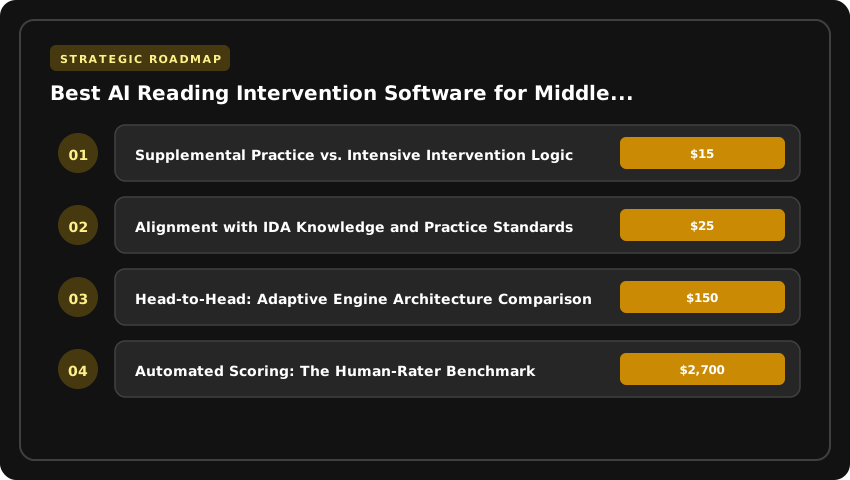
Supplemental Practice vs. Intensive Intervention Logic
The architectural difference is binary. Supplemental apps use adaptive branching: a student misses a question, the algorithm serves easier content. True intervention engines use mastery-based gating: the student cannot progress until they demonstrate automaticity at the sub-skill level—phoneme-grapheme correspondence, syllable division rules, morphological awareness. Under MTSS, Tier 2 requires standard protocol intervention (same evidence-based scope/sequence for a cohort), while Tier 3 demands diagnostic prescriptive logic (unique path per student). Generic apps rarely distinguish between these protocols; they simply flatten the difficulty curve.
Alignment with IDA Knowledge and Practice Standards
The International Dyslexia Association (IDA) Knowledge and Practice Standards for Teachers of Reading are the gold standard for Structured Literacy. Effective intervention software must operationalize these standards in code:

- Explicit Instruction: The software must model the skill (e.g., “This is a closed syllable; the vowel makes its short sound”) before asking the student to perform it. No discovery learning.
- Systematic & Cumulative: The scope and sequence must follow a logical linguistic hierarchy (simple to complex), reviewing previously taught concepts in every new lesson. Randomized “spiral review” widgets do not satisfy this.
- Diagnostic Teaching: The system must capture error types (visual similarity, phonological confusion, morphological blindness), not just error rates.
If a vendor cannot map their algorithm’s decision tree directly to these three pillars, the tool is pedagogically inert for Tier 2/3 populations.
The Danger of ‘Gamified’ Progress Masking Decoding Deficits
This is where Title I budgets evaporate. Gamification—streaks, badges, avatar upgrades—creates a powerful illusion of growth. A student can “level up” by guessing from context clues, memorizing whole words as logographs, or leveraging strong oral vocabulary to mask an inability to decode pseudowords. The dashboard shows green checkmarks; the NAEP data shows stagnation. True intervention software often feels “boring” by design: it strips away extraneous cognitive load (animations, narrative fluff) to force the brain to allocate 100% of working memory to the alphabetic principle. If your Tier 2 students are “crushing the app” but failing the DIBELS 8th Edition Nonsense Word Fluency probe, the software is teaching the game, not the code.
Head-to-Head: Adaptive Engine Architecture Comparison
Not all adaptive engines are built the same, and for a Director of Special Education or MTSS Coordinator, the difference between a diagnostic branching model and a curriculum pacing model determines whether a Tier 3 student actually closes the decoding gap or just spins wheels on grade-level exposure. We need to look under the hood at how Amira Learning, Lexia PowerUp, Read 180, and MindPlay Virtual Reading Coach process student errors in real time.
Diagnostic Granularity: Phonemic Awareness vs. Orthographic Mapping Depth
Amira and MindPlay operate on micro-skill diagnostic trees rooted in the Simple View of Reading. When a student misreads “blend” as “bend,” Amira’s ASR (Automatic Speech Recognition) isolates the phoneme omission (/l/) and instantly serves a targeted phonemic awareness drill—blending onset-rime—before returning to the text. It maps deficits to the IDA Knowledge and Practice Standards sub-skills: phoneme segmentation, deletion, substitution. MindPlay goes deeper on the orthographic mapping side; its diagnostic isolates whether the failure is visual memory for graphemes or a phonological working memory bottleneck, adjusting the visual-auditory-kineshetic (VAK) pathway weight dynamically.
Contrast this with Lexia PowerUp and Read 180. Lexia uses a scope-and-sequence gate: students place into a Zone (Word Study, Grammar, Comprehension) via an initial auto-placement, but the engine advances based on unit completion accuracy thresholds (typically 80-90%), not real-time phoneme-level error analysis. Read 180’s adaptive logic sits atop the FASTT algorithm (Fluency and Automaticity through Systematic Teaching with Technology), which prioritizes sight-word automaticity and passage fluency metrics (WCPM) over explicit phonemic manipulation. For a student with a core phonological deficit (Tier 3), Lexia and Read 180 often mask the hole by allowing context clues to carry comprehension scores.
Real-Time Scaffolding Logic: Immediate Corrective Feedback Loops vs. Delayed Reporting
This is the operational divide. Amira and MindPlay deploy immediate corrective feedback (ICF) loops. The AI interrupts the oral reading the millisecond an error occurs—modeling the correct articulation, highlighting the grapheme-phoneme correspondence, and forcing a re-attempt before the sentence continues. This mimics a 1:1 Orton-Gillingham practitioner. The data exhaust from these interactions feeds the teacher dashboard during the session, not after.
Lexia and Read 180 rely heavily on delayed reporting loops. A student works through a “unit” independently; the teacher sees the “struggle alert” or “skill builder” recommendation only after the session ends. While Lexia’s “Instructional Priority” report is excellent for grouping, it cannot prevent the student from practicing the error 15 times in a 20-minute block. For Tier 2 students with mild fluency gaps, this latency is manageable. For Tier 3 students fossilizing decoding errors, it is contraindicated.
Content Overlap Analysis: Scope & Sequence Alignment with Scarborough’s Rope
Mapping engine output to Scarborough’s Reading Rope reveals the strategic fit:
- Amira: Heavy lower rope (Word Recognition). Explicit alignment to phonological awareness, decoding, and sight recognition. Upper rope (Language Comprehension) is thin—limited vocabulary/background knowledge modules. Best for: Pure decoding deficits, Dyslexia profiles, Tier 3 Phonics.
- MindPlay: Full lower rope + synthetic phonics thread. Unique “Fluency” strand bridges to upper rope via prosody modeling. Best for: Severe dyslexia, ELLs needing articulatory feedback, Tier 3 Intensive.
- Lexia PowerUp: Balanced rope. Word Study (lower) + Grammar/Comprehension (upper). Strong on morphological awareness (prefix/root/suffix) bridging both strands. Best for: Tier 2 “bubble” kids, older students with gaps in morphology/syntax, not primary phonology.
- Read 180: Upper rope dominant (Comprehension, Vocabulary, Writing) with a fluency/decoding “bridge” (System 44 integration required for true lower rope). Best for: Tier 2 comprehension/fluency, students who decode but don’t understand.
Bottom line for procurement: If your universal screener flags Phonemic Awareness or Nonsense Word Fluency below the 20th percentile, you need Amira or MindPlay. If the flag is Oral Reading Fluency or Reading Comprehension with intact decoding, Lexia or Read 180 (with System 44) fits the profile. Do not force a comprehension engine to remediate a phonological core deficit—it violates the logic model and wastes Title I carryover.
Progress Monitoring That Satisfies IDEA & State Dyslexia Mandates
Here is the reality most vendors gloss over: a pretty dashboard does not equal legal defensibility. When a parent requests an Independent Educational Evaluation (IEE) or a state auditor pulls your Tier 3 files, you need technically adequate data—specifically, Curriculum-Based Measurement (CBM) scores with documented reliability coefficients (Cronbach’s alpha or split-half reliability ≥ .90) and criterion validity against measures like the DIBELS 8th Edition or Acadience Reading. If your AI scoring engine cannot produce a technical manual chapter citing these psychometrics, it fails the IDEA standard for “objective criteria” under 34 CFR §300.320(a)(3).
Automated Scoring: The Human-Rater Benchmark
Middle school schedules are tight; you cannot afford teachers hand-scoring Oral Reading Fluency (ORF) probes weekly. Modern AI engines—specifically those leveraging Automatic Speech Recognition (ASR) trained on diverse adolescent dialects—now hit Word Error Rates (WER) below 5% and Intraclass Correlation Coefficients (ICC) of .95+ against expert human raters. That is the compliance threshold. Demand the vendor’s Technical Adequacy Report. If they only offer “percentile ranks” without raw Words Correct Per Minute (WCPM) and error-type analysis (insertions, omissions, substitutions), the data is useless for instructional decision-making at Tier 3.
Building the “Audit-Proof” Data Trail
For IEP meetings and 504 reviews, you need an immutable chain of custody. The software must log: timestamp, device ID, examiner ID (even if “AI”), exact stimulus text version, raw audio file retention (minimum 7 years per FERPA/state retention schedules), and the specific algorithm version used to score it. This granularity transforms a progress monitoring chart into legally defensible evidence that the intervention was delivered with fidelity and the student’s response—or lack thereof—was measured validly. Without raw audio backup, a hearing officer can invalidate the entire trend line.
Interoperability: Ed-Fi, OneRoster, and SIS Reality
Manual CSV uploads are a compliance risk—version control errors and FERPA violations happen when staff email spreadsheets. Your RFP must require:
- Ed-Fi API Certification: Real-time push of assessment events (score, date, tier) into the state longitudinal data system (SLDS) for dyslexia screening mandates (e.g., Texas HB 3928, California SB 488).
- OneRoster 1.2+: Automated roster sync nightly so Tier 2 groups update the moment a counselor moves a student in PowerSchool or Skyward.
- SIS Grade Passback: Direct write-back to PowerSchool Unified Classroom, Skyward Student Management, or Infinite Campus so the intervention grade/indicator appears on the report card without dual entry.
If a vendor says “we integrate via SFTP,” walk away. That is 2010 architecture. You need RESTful APIs with OAuth 2.0 scopes limited to assessment.read and demographics.write to satisfy your district’s Cybersecurity Framework (NIST CSF) and student data privacy agreements (SDPA). The right platform turns progress monitoring from a paperwork exercise into a compliance asset that protects the district—and the student.
Implementation Fidelity: Scheduling, Dosage & Teacher Burden
Here is where the rubber meets the master schedule. Vendors love to cite “20 minutes a day, three times a week” because it slides easily into a bell schedule. But the What Works Clearinghouse (WWC) and ESSA Tier 1 studies underpinning actual intervention efficacy—think Reading Recovery derivatives or structured literacy platforms like Lexia PowerUp or MindPlay—typically validate 45 to 60 minutes per session, four to five days a week. If your MTSS block is a 25-minute “win period” twice a week, you are buying a placebo, not an intervention. You are spending Title I dollars on compliance theater.
The Rotational Reality Check
Middle schools run on two hardware models, and both wreck fidelity if unmanaged. In a 1:1 take-home model, the software competes with TikTok, Discord, and a dead battery. You need device management (MDM) profiles locking the device to the intervention app during the block, plus a $15–$25 per seat annual license for the MDM layer itself. In a station rotation model—still the norm for Tier 3 pull-out—you are constrained by the “slowest boot” problem. If three of 25 Chromebooks need OS updates or charger cables, your 45-minute block evaporates to 30 minutes of engaged time. That lost 15 minutes daily equals 45 hours of lost dosage per student per year—the difference between closing a gap and documenting one.
Professional Development: The Hidden Line Item
Vendors pitch “intuitive dashboards” to minimize PD. Do not believe it. Scripted fidelity programs (e.g., Wilson, SPIRE-adjacent digital tools) demand 30–40 hours of initial training plus monthly coaching cycles to prevent “drift”—teachers skipping the phonemic awareness warm-up because “the kids know this.” Adaptive platforms promising “teacher agency” require data literacy PD so staff can actually interpret the algorithm’s flags rather than just watching the green checkmarks.
Calculate the True Cost of Ownership (TCO) before signing:
- Substitute Coverage: 3 days of initial PD x $150/day/sub x 6 teachers = $2,700 per building.
- Coaching Days: 4 half-day cycles/year x $1,200/day consultant = $4,800.
- Hardware Refresh: 20% fleet replacement annually (Chromebooks @ $280/unit) = $5,600 per 100 licenses.
- License Fees: $40–$60/student/year for Tier 2/3 validated tools.
If your budget line only shows the per-seat license, you are underfunding the implementation by 40–60%. Fidelity isn’t a feature of the software; it is a function of the schedule, the hardware logistics, and the adult learning budget you protect.
Funding Alignment: Leveraging Title I, IDEA Part B, & ESSER
Securing budget approval for intervention software isn’t about finding money; it’s about speaking the precise compliance language that unlocks it. Business Officers and Grant Writers know that a purchase order dies on the vine if the justification doesn’t map perfectly to federal statutes. For Middle School MTSS Tiers 2 and 3, you are navigating three distinct funding streams—Title I, IDEA Part B, and the winding-down ESSER funds—each with its own evidence threshold and documentation burden.
Evidence Tiers: The Non-Negotiable Gatekeeper
You cannot pay for a Tier 2 intervention with Title I funds if the vendor only offers a logic model. The Every Student Succeeds Act (ESSA) evidence framework is the filter every federal program officer applies.
- ESSA Level 1 (Strong): Required for School Improvement Grants (SIG) and highly competitive for Title I schoolwide plans. The vendor must provide a well-designed, well-implemented experimental study (RCT) showing statistically significant positive effects on reading outcomes for middle school students.
- ESSA Level 2 (Moderate): The sweet spot for most Title I Targeted Assistance and IDEA Part B purchases. Requires a quasi-experimental design (QED) with matched comparison groups. Ask vendors for the What Works Clearinghouse (WWC) rating or an independent third-party evaluation (e.g., Johns Hopkins, WestEd).
- ESSA Level 3 (Promising): Correlational studies with statistical controls. Acceptable for some ESSER III “learning loss” allocations, but risky for Title I Supplement not Supplant justifications.
- ESSA Level 4 (Demonstrates a Rationale): Logic models only. Insufficient for Tier 2/3 intervention purchases under Title I or IDEA. Do not sign a contract relying solely on Level 4 evidence for federal funds.
Supplement Not Supplant: Cost-Per-Seat Accounting
The “Supplement not Supplant” test under Title I (Section 1118(b)) and IDEA (Section 613(a)(2)(A)) requires you to prove the software adds instructional capacity that wouldn’t exist with state/local funds alone. You must document the cost-per-seat against the specific instructional minutes added.
- Calculate the fully loaded cost-per-student: (Annual License + Professional Development + Hardware/Headsets + Implementation Support) / Number of Licensed Seats.
- Map this cost to the Master Schedule: Show that the software delivers 30–45 minutes of additional explicit, systematic instruction (Tier 2) or intensive individualized intervention (Tier 3) beyond the core ELA block.
- Maintain a Time-and-Effort log for the interventionist overseeing the software. If the software replaces a paraprofessional’s salary, you have a Supplanting violation. The software must augment the specialist, not replace them.
Contract Clauses: Protecting the District Asset
Multi-year contracts (3–5 years) lower the per-seat price but introduce liability. Never sign a vendor’s standard Master Services Agreement (MSA) without redlining these three clauses:
- Data Ownership & Portability: Explicitly state: “The District owns all student PII, usage metadata, and derived proficiency data. Upon termination, Vendor shall provide a complete, machine-readable export (CSV/JSON) within 30 days at no cost.” Require FERPA and COPPA compliance certifications (Student Data Privacy Consortium SDPC registry membership is a strong proxy).
- Sunset / Termination for Convenience: Include a clause allowing the District to terminate annually without penalty if federal appropriations lapse (e.g., ESSER cliff, Title I allocation drops). Language: “District may non-renew annually with 60 days’ written notice; Vendor shall prorate refund for unused license months.”
- Evidence Maintenance: Obligate the vendor to maintain ESSA Level 1 or 2 evidence validity for the contract term. If a WWC review downgrades the program, the District retains the right to renegotiate pricing or exit.
Bottom line: Your purchase order is a compliance artifact. Attach the ESSA evidence crosswalk, the cost-per-seat supplement worksheet, and the redlined MSA to the board packet. That is how you move a Tier 3 intervention from pilot to district-wide sustainability.
Decision Matrix: Matching Student Profiles to Platform Strengths
Stop buying site licenses hoping a single tool solves every deficit. Middle school MTSS fails when we treat a 7th grader reading at a 2nd-grade level the same as a long-term English Learner stuck at the 4th-grade comprehension ceiling. Your diagnostic data—specifically the PAST (Phonological Awareness Screening Test), ORF (Oral Reading Fluency) norms, and CBM-R maze comprehension scores—should dictate the software contract, not the vendor’s sales pitch. Below is the framework we use to align specific learner profiles to the only platforms engineered for Tier 2 and 3 intensity.
Profile A: Older Striving Readers with Severe Phonological Core Deficits
Diagnostic Markers: PAST scores below the 10th percentile; nonword decoding accuracy < 60%; significant gaps in advanced phonics patterns (vowel teams, r-controlled, multisyllabic segmentation). These students have memorized sight words but lack the orthographic mapping engine to attack unfamiliar text.
Platform Mandate: You need explicit, synthetic phonics scope and sequence that respects adolescent dignity—no cartoon bears. The software must enforce mastery-based gating (90%+ accuracy before unlocking the next module) and provide speech-recognition feedback on articulation/segmentation.
- Top Match: Lexia PowerUp Literacy (Word Study Strand). Its adaptive branching isolates specific phoneme-grapheme gaps and forces mastery of syllable types before advancing. The “Zone of Proximal Development” algorithm prevents the “swiss cheese” effect where kids advance with holes in foundational code knowledge.
- Runner-Up: Reading Horizons Elevate. Superior for explicit Orton-Gillingham alignment; the marking system teaches metacognitive decoding strategies transferable to content-area textbooks.
Profile B: Long-Term ELs with Comprehension/Vocabulary Gaps but Decoding Fluency
Diagnostic Markers: ORF at or near grade-level benchmark (Hasbrouck & Tindal norms); MAZE/CBM-R comprehension significantly below ORF; WIDA ACCESS Literacy composite 3.0–4.5. They “read” fluently but construct weak mental models. They need academic language, background knowledge, and inferencing scaffolding—not phonics drill.
Platform Mandate: Content-rich, discipline-specific texts with embedded vocabulary morphology (Greek/Latin roots) and strategic comprehension instruction (summarization, question generation, text structure analysis). Avoid “leveled libraries” that trap kids in low-Lexile silos.
- Top Match: Achieve3000 Literacy (Actively Learn). The proprietary LevelSet assessment places students precisely; the “stretch” articles differentiate the same grade-level topic across 12 Lexile levels, ensuring equitable access to Tier 1 science/social studies concepts while building academic vocabulary via the “Word Studio” morphology engine.
- Runner-Up: Newsela ELA. Excellent for engagement and text sets, but requires teacher curation to ensure systematic vocabulary recycling across weeks.
Profile C: Comorbid ADHD/Executive Function Needs Requiring High-Engagement UI
Diagnostic Markers: Diagnosed ADHD or EF deficits (BRIEF-2 clinical ranges); high variability in CBM probes (strong days/weak days); work avoidance behaviors triggered by dense text blocks or ambiguous navigation. These kids need externalized executive function baked into the UX: chunking, immediate feedback loops, and visible progress tracking.
Platform Mandate: Gamified microstructure (short sprints, 5–7 min modules), multimodal input (voice-to-text, drag-and-drop), and real-time dashboards for the interventionist to intervene during the session, not after.
- Top Match: Read 180 Universal (Stage B/C) on the HMH Ed platform. The “Student Application” (Student App) uses a “Explore, Learn, Practice, Succeed” loop with adaptive pacing. The “Mindset Scan” and explicit EF strategy lessons (goal setting, self-monitoring) address the comorbidity directly. Data exports integrate cleanly with Panorama or Branching Minds for MTSS documentation.
- Runner-Up: DreamBox Reading Plus. The “Guided Window” scaffolds silent reading fluency (fixation duration, regression control) which is often the hidden bottleneck for ADHD profiles. High agency in text choice drives persistence.
Implementation Reality Check: Assigning the right tool is step one. Step two is fidelity monitoring. If your Tier 3 student logs 12 minutes/week on PowerUp, the algorithm cannot work. Build the master schedule to protect 45-minute blocks, 4 days/week, with a certified interventionist circulating—not a paraprofessional monitoring headphones. That is how you move the needle on NAEP and state summative scores.
Strategic Final Takeaway
When evaluating Best AI Reading Intervention Software For Middle School MTSS Tier 2 And Tier 3 Students, base your decisions on accredited institutional standards, measurable return on investment (ROI), and up-to-date official guidelines. Always verify specific dates and requirements through official regulatory portals.