
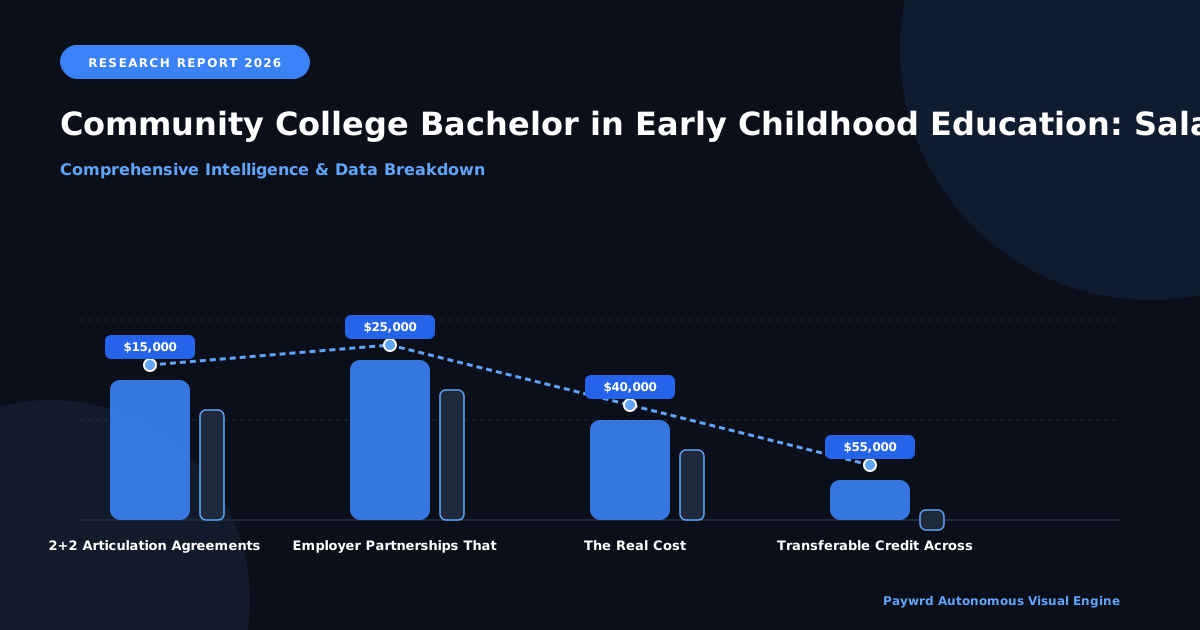
Key Takeaway: A community college bachelor’s in Early Childhood Education (ECE) lets working adults earn a four-year teaching credential for roughly $15,000–$25,000 total, finish in about 3.5–4 years, and step directly into Head Start or public Pre-K roles that pay $40,000–$55,000 to start.
Why a Community College ECE Bachelor’s Is Reshaping the Teacher Pipeline
Walk into any Head Start center in Houston, Phoenix, or Charlotte, and you will likely meet teachers who started at a community college and finished their degree two doors down. The community college bachelor’s in Early Childhood Education has quietly become one of the most pragmatic answers to America’s chronic Pre-K and early-grade teacher shortage, and employer partners from Miami-Dade County Public Schools to Bright Horizons are noticing.

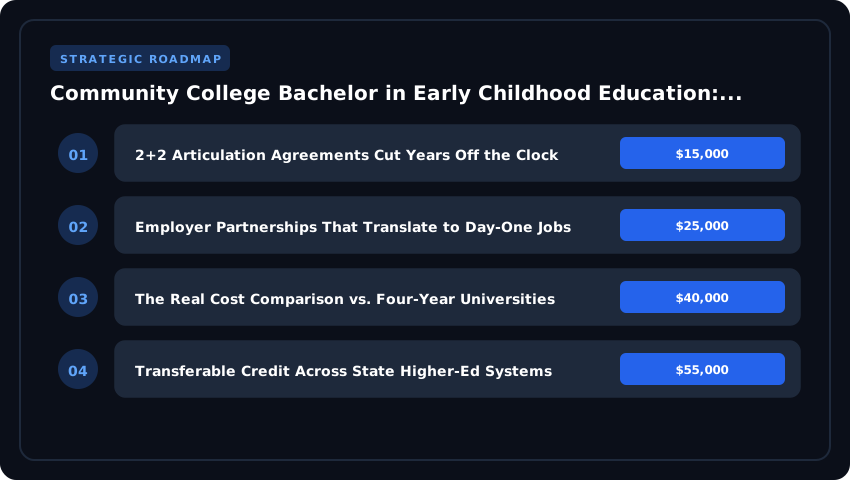
2+2 Articulation Agreements Cut Years Off the Clock
Most community college ECE pathways run on what educators call a 2+2 articulation agreement. Students complete roughly 60 lower-division credits at the community college (tuition around $130–$160 per credit hour for in-state residents, per College Board averages), then transfer seamlessly into a bachelor’s completion program offered either on the same campus or through a partner four-year university. The result: an associate degree you can actually use, plus a baccalaureate in ECE without losing a single credit.
Institutions such as Pima Community College (AZ), St. Petersburg College (FL), and City Colleges of Chicago have built hybrid 2+2 models where the upper-division coursework is delivered online or evenings, so working paraprofessionals and Head Start staff can keep their paycheck while studying.

Employer Partnerships That Translate to Day-One Jobs
Regional employer partnerships are where this pathway truly shines. Community colleges co-design curriculum with local Head Start grantees, state-funded Pre-K programs (Georgia’s Pre-K, Florida’s VPK, California’s CSPP), and district-run early-learning centers. Students complete practicum hours in those same classrooms, so graduates are already on the district’s hiring radar.
This alignment pays off in licensing outcomes. Most states now allow ECE bachelor’s holders to qualify for the Birth through Kindergarten or Early Childhood Education credential on a state’s department of education license tracker, often bypassing the alternative-route testing required of career-changers.
The Real Cost Comparison vs. Four-Year Universities
Compare apples to apples. A four-year university ECE program at a public institution runs about $40,000–$55,000 in tuition for an in-state undergraduate, according to College Board. The community college 2+2 route typically totals $15,000–$25,000, and FAFSA Pell eligibility can knock that down further for low-income students. For adult learners weighing a career switch or upskilling move, that $20,000+ delta is often the difference between staying in the field and leaving for a higher-paying corporate role.
Transferable Credit Across State Higher-Ed Systems
Thanks to state-level general-education frameworks, credits travel well. Students who complete an Associate of Arts in Teaching or Associate of Applied Science in ECE usually satisfy core requirements under common transfer matrices (Texas’ Field of Study curriculum, Florida’s Statewide Course Numbering System, California’s C-ID descriptors). This protects tuition dollars if life requires a move, a promotion, or a pivot to a neighboring state’s program.
- Time-to-degree: 3.5–4 years part-time; 2.5 years full-time with prior credits.
- Total tuition: ~$15,000–$25,000 versus $40,000–$55,000 at four-year publics.
- Entry-level salary range: $40,000–$55,000 for credentialed Pre-K teachers (BLS Preschool Teachers, 2024).
- Top employers: Head Start grantees, YMCA childcare, public school districts, Bright Horizons, KinderCare.
The pipeline math is simple: when cost drops, completion rises, and more qualified teachers reach classrooms that desperately need them.
State-by-State Licensure Requirements for ECE Graduates
Becoming a licensed early childhood educator in the United States is rarely a one-size-fits-all journey. While every state ultimately wants teachers who are classroom-ready, the specific testing thresholds, credential tiers, and renewal rules shift dramatically depending on where you plan to teach. Before enrolling in any community college bachelor’s program in Early Childhood Education (ECE), it pays to map exactly what your state department of education expects, because the courses you choose and the exams you schedule will determine whether you can actually step into a paid classroom after graduation.
Praxis Core and Praxis II Testing Thresholds
The ETS Praxis Core Academic Skills for Educators and the Praxis II Subject Assessments remain the most common gatekeepers for state licensure. However, passing scores vary. For instance, New York requires a Core Academic Skills composite of 468 and a Praxis II ECE score of at least 156, while Georgia accepts 142 on the same early childhood exam. Florida ECE candidates must clear Core Reading 156, Core Writing 162, and Core Mathematics 150, plus a Subject Assessment cut score that the Florida Department of Education periodically adjusts. Prospective teachers should always confirm the Praxis passing score mandated by the US Department of Education-recognized agency in their target state, not the score their community college recommends, because universities sometimes default to the average rather than the legal minimum.
State-Specific Early Childhood Credential Tiers
Most states segment early childhood credentials into narrow age bands that determine which grade levels you are authorized to teach. Three tiers dominate the landscape:
- Birth–Kindergarten (Birth–K): Common in southern states like Alabama, Kentucky, and Mississippi, this credential prepares teachers for infant, toddler, and Pre-K classrooms, including Head Start and Title I programs.
- Pre-K–Grade 3 (Pre-K–3): Used by New Jersey, Pennsylvania, and Ohio, this tier covers public Pre-K through third grade and aligns with Common Core early elementary standards.
- Birth–Age 8 (B–8): Favored in Illinois, Washington, and Colorado, this broader credential spans infant development through upper elementary, ideal for teachers who want flexibility across multiple grade levels.
Reciprocity for Out-of-State License Transfers
Career mobility often hinges on reciprocity, the agreement between states that allows an existing license to transfer without forcing teachers to retest. Roughly 45 states participate in the NASDTEC Interstate Agreement, which streamlines ECE credential transfers for teachers relocating from a community college bachelor’s program in one state to a classroom in another. However, reciprocity is rarely automatic. States like California and New York often require a single-state subject exam or a supervised induction year, even for fully credentialed transfers. Filing a complete application packet through the relevant state department of education, including verified transcripts and a current background check, usually takes 60 to 120 days, so plan ahead if you anticipate a cross-state move.
Continuing Education Units for License Renewal
Most states renew ECE licenses every five years, but the renewal requirements differ sharply. Texas requires 150 continuing professional education hours per five-year cycle, while North Carolina demands only 5 CEUs (50 clock hours). Massachusetts ties renewal to a Professional Development Plan aligned with district goals, and Illinois mandates completion of an approved ESL or special education module for teachers serving diverse learners. Community college graduates pursuing stackable credentials through PMI-style project management or ABET-aligned STEM endorsements often find that CEU credits double-count toward license renewal, an underrated financial benefit for working educators.
Salary Benchmarks for Licensed ECE Teachers in the US
Money matters, especially when you are weighing a multi-year degree against years of earning potential. According to the U.S. Bureau of Labor Statistics (BLS) May 2023 Occupational Employment and Wage Statistics, preschool teachers nationally earn a median annual wage of $34,860, while kindergarten and elementary special education teachers average a significantly higher median of $63,670. The wide gap reflects funding streams, certification requirements, and whether a position sits inside a public K-12 system or a private early learning center.
Public School vs. Private Center vs. Head Start Pay Differentials
Where you teach has a direct impact on your paycheck. Public Pre-K and kindergarten programs, typically funded through state education budgets and IDEA Part B allocations, pay on a teacher salary schedule and often include full benefits, pension contributions, and predictable annual step increases. First-year public Pre-K teachers in states like California, New York, and Massachusetts commonly start between $48,000 and $58,000, climbing into the $70,000–$85,000 range within a decade.
Private early learning centers operate on a tuition-driven revenue model, which usually translates to lower base wages. BLS data pegs the private preschool median near $31,500, though corporate-affiliated chains like Bright Horizons and KinderCare sometimes offer stronger benefits packages and tuition reimbursement.
Head Start and Early Head Start programs, administered through the U.S. Department of Health and Human Services Administration for Children and Families, have historically paid less than public schools but have closed the gap since the 2018 bipartisan workforce expansion. Entry-level Head Start teachers now average roughly $42,000–$48,000, with many grantees offering federal-style benefits and bilingual pay differentials.
Geographic Cost-of-Living Adjustments
A salary figure means little without regional context. The BLS Metropolitan and Nonmetropolitan Area wage listings show preschool teacher pay ranging from $26,940 in rural Mississippi nonmetropolitan areas to $48,210 in the San Francisco-Oakland-Hayward metro. Comparable spreads exist for kindergarten teachers, with the New York-Newark-Jersey City region averaging $83,520 versus the rural South at $48,830. State cost-of-living indexes from the Council for Community and Economic Research suggest a $55,000 salary in Austin stretches roughly 20 percent further than the same figure in Boston or Seattle.
Step Increases Tied to Degree Level and Tenure
Most public school districts use a salary lane-and-step grid, where each additional degree level (bachelor’s, master’s, doctorate) bumps you into a higher lane, and each year of tenure adds a step increase of roughly 1.5 to 3 percent. A community college bachelor’s that satisfies state licensure often unlocks the bachelor’s lane immediately, adding $3,000–$6,000 to starting offers versus an associate-only credential. Many districts also recognize prior paraprofessional or Head Start experience, accelerating step placement by one to four years and translating into $4,000–$12,000 in additional starting pay.
- Preschool teachers (national median): $34,860 annually (BLS OEWS, May 2023)
- Kindergarten teachers (national median): $63,670 annually (BLS OEWS, May 2023)
- Head Start entry range: $42,000–$48,000 with federal benefits
- Public Pre-K starting range: $48,000–$58,000 in high-cost states
- Bachelor’s lane premium: $3,000–$6,000 over associate credential
- Annual tenure step increase: 1.5%–3% on most district salary schedules
Specialized Endorsements That Boost ECE Earning Potential
Graduating with a Bachelor of Science in Early Childhood Education opens doors to classrooms paying $40,000–$55,000 to start, but the credential you stack on top of that degree often determines whether you stay at the median or climb toward the $65,000–$78,000 range mid-career. Working educators across the United States have learned that targeted endorsements function like salary multipliers, signaling district leaders and childcare operators that you can handle high-need populations without expensive onboarding.
ESOL and Bilingual Education Endorsements
An ESOL (English to Speakers of Other Languages) endorsement is one of the fastest ways to add roughly $3,000–$7,000 to a base salary in states like Florida, Texas, and Georgia, where bilingual Pre-K teachers command a documented stipend on top of the standard teacher pay scale. Districts covering Atlanta, Miami-Dade, and Houston routinely pay a bilingual differential because Title III federal funding rewards schools that demonstrate English-learner proficiency gains. For ECE teachers working with dual-language learners ages 3–5, this endorsement essentially guarantees a job offer before graduation, and community college bachelor programs typically let candidates add the ESOL coursework as a 12–15 credit hour concentration rather than a separate degree.
Special Education Cross-Endorsement for Inclusion Classrooms
Adding a special education cross-endorsement transforms an ECE teacher into an inclusion specialist, one of the most understaffed roles in American public schools. Per the U.S. Department of Education, more than 60% of students with identified disabilities spend the majority of their day in general education settings, which means Pre-K and kindergarten teachers with both ECE and special education credentials routinely earn $5,000–$10,000 above standard scales. This endorsement also unlocks work in Early Intervention programs funded through IDEA Part B, where hourly contract rates can exceed $45 per hour for evaluators and service coordinators.
Montessori Credential Stacking
For educators eyeing private and charter school settings, a Montessori credential from an AMI or AMS-accredited training center stacks cleanly on top of a state teaching license. While the training costs $4,000–$9,000, graduates frequently move into lead guide positions at private Montessori campuses where salaries range from $48,000 to $72,000 depending on the metro area. Parents paying $12,000–$20,000 in annual tuition expect credentialed guides, which keeps demand steady even when public budgets tighten.
Early Literacy Specialist Certifications
Finally, an early literacy specialist certification through organizations like the Center for Literacy and Reading Recovery targets the specific reading gap that dominates K–3 policy debates nationwide. Districts receiving Reading First or Striving Readers Comprehensive Literacy grants actively recruit teachers with this micro-credential, often attaching a $2,500–$5,000 annual supplement. For ECE graduates working in transitional kindergarten or Pre-K–3 alignment programs, this certification signals expertise in structured literacy, phonemic awareness, and assessment-driven instruction, three areas state superintendents consistently flag as critical shortages.
- Highest immediate ROI: ESOL and special education endorsements, paid differentials often start within one pay cycle
- Best private-sector pivot: Montessori credentials open $60,000+ guide roles outside public salary schedules
- Strategic stacking: Combine literacy specialist + ESOL for district-level literacy coach positions paying $70,000–$85,000
- Federal alignment: Endorsements tied to IDEA, Title III, and ESSER funding remain in demand regardless of state budget cycles
Career Mobility Beyond the Classroom
An Early Childhood Education (ECE) bachelor’s earned through a community college does far more than unlock a Pre-K teaching position. It is a credential that maps cleanly onto a ladder of leadership roles, each carrying higher median pay, broader influence, and stronger job security than the classroom alone. For working adults weighing the $15,000–$25,000 tuition investment against lifetime earnings, the upward mobility is one of the strongest arguments in favor of the degree.
Curriculum Coordinator and Instructional Coach Pathways
Most ECE bachelor’s programs, including those offered through state university systems and ABET-aligned transfer pipelines, weave in coursework on assessment, curriculum design, and adult learning. That foundation positions graduates for curriculum coordinator roles, where they design lesson frameworks for entire districts or nonprofit early-learning networks. The U.S. Bureau of Labor Statistics (BLS) groups these positions under instructional coordinators, reporting a 2023 median wage of $66,790, with the top 10% earning above $102,000. Instructional coaching, a closely related track, lets seasoned educators stay close to classroom practice while mentoring new teachers, a sweet spot for professionals who want impact without leaving the schoolhouse.
Program Director Roles at Childcare Centers and Nonprofits
Once graduates hold a bachelor’s plus state licensure or a Child Development Associate (CDA) endorsement, the door opens to program director positions at childcare centers, Head Start grantees, and nonprofits such as the YWCA, Boys & Girls Clubs, and regional United Way affiliates. These roles typically oversee staffing, licensing compliance, and parent programming. According to BLS data on preschool and childcare center administrators, median annual pay reached $55,290 in 2023, and metropolitan markets such as Boston, San Francisco, and Washington, D.C., routinely post salaries in the $75,000–$95,000 range. For candidates who add a nonprofit management certificate or a PMI-aligned project credential, pay scales climb quickly.
Family Engagement Specialist Positions
A growing niche inside the ECE field is the family engagement specialist, a role embedded in schools, public health agencies, and community-based organizations. Specialists act as the bridge between teachers and families facing housing instability, language barriers, or trauma. The position typically requires a bachelor’s in ECE, social work, or human development, plus bilingual fluency in many districts. Salaries sit between $45,000 and $65,000 depending on region, with significant upside in federally funded Title I and Head Start programs that offer loan forgiveness through programs like Public Service Loan Forgiveness (PSLF), administered through the FAFSA-linked federal student aid system.
Transitional Routes Into School Administration or Policy Work
Perhaps the most overlooked payoff of a community college ECE bachelor’s is its portability into K–12 administration. Many states allow the degree to count toward a Master of Education in Educational Leadership, which is the standard prerequisite for principal licensure. A principal or education administrator earns a BLS median salary of $103,460, more than double what an entry-level Pre-K teacher makes. For professionals drawn to systems-level change, the same bachelor’s can seed careers at the U.S. Department of Education, state agencies, or advocacy groups like the National Association for the Education of Young Children (NAEYC), where policy analysts shape funding formulas that determine how early childhood programs grow nationwide.
In short, the community college ECE bachelor’s is not a terminal credential. It is a launchpad into a stacked career ecosystem where each step compounds in salary, scope, and societal influence, and where federal aid, employer tuition reimbursement, and licensure reciprocity make the climb financially realistic.
Financial Aid, Grants, and Employer Tuition Reimbursement
Paying for a four-year Early Childhood Education (ECE) degree through a community college rarely requires taking on heavy student loan debt, especially when working adults stack federal, state, and employer benefits. The smartest move is to treat financial aid as a layered strategy rather than a single application, because the average community college tuition sits around $3,800 per year for in-district students, and an applied bachelor’s typically adds only $7,000 to $12,000 in upper-division fees on top of that.
FAFSA Priority Deadlines and the Pell Grant Anchor
The Free Application for Federal Student Aid (FAFSA) opens every October 1, and most state agencies set a priority deadline between March 1 and April 1 for the following fall term. Community college ECE students who file by that window often qualify for the full Federal Pell Grant, which currently maxes out at $7,395 per year. For a student earning less than $30,000 annually, two Pell awards alone can cover nearly 80 percent of an associate degree pathway, leaving only the upper-division baccalaureate years to finance. Many community colleges also participate in the Federal Supplemental Educational Opportunity Grant (FSEOG), which awards an additional $250 to $1,000 to the highest-need filers on a first-come, first-served basis.
TEACH Grant Eligibility for Future ECE Teachers
Future Pre-K and kindergarten teachers should pursue the Teacher Education Assistance for College and Higher Education (TEACH) Grant, which converts up to $4,000 per year into free tuition money in exchange for a four-year teaching commitment in a high-need field like early childhood. Candidates must maintain a 3.25 GPA, complete a teacher preparation program, and serve in a Title I school or qualifying childcare program. For an ECE major already planning to work in Head Start, this grant effectively zeroes out most remaining tuition costs during the final two years of the bachelor’s program.
State-Level Scholarships Targeting Early Educators
Nearly every state now funnels scholarship dollars into the early childhood workforce because childcare shortages drive local policy. Examples include California’s Child Development Permit stipend program, Texas’s T.E.A.C.H. Early Childhood Scholarship, and New York’s ECAC scholarship, each covering tuition, books, and release time for currently employed educators. Awards typically range from $1,500 to $6,000 per semester, and applicants usually need proof of employment at a licensed center plus a sponsor letter from their director. Because these programs are administered by state departments of education or workforce boards, checking the specific state agency website before each enrollment term is essential.
Employer Tuition Benefits at Large Childcare Chains
Major childcare employers increasingly treat tuition reimbursement as a retention tool. Bright Horizons, KinderCare, and Learning Care Group each offer between $1,000 and $5,250 annually in employer-sponsored tuition assistance, often paired with flexible scheduling for evening and weekend classes. Some chains partner directly with community colleges to deliver ECE cohorts onsite, letting assistants earn credit toward a bachelor’s without leaving their classroom. Pairing this benefit with federal Pell and a TEACH Grant can produce a debt-free pathway for full-time teaching staff.
- File the FAFSA by the state priority deadline, typically March 1 to April 1, to lock in Pell Grant eligibility.
- Confirm TEACH Grant eligibility each year by maintaining a 3.25 GPA and signing the service agreement.
- Apply for state ECE scholarships through the department of education or workforce development board.
- Negotiate employer tuition reimbursement before signing an offer, since most chains cap unused funds yearly.
How to Evaluate and Select the Right Community College ECE Program
Choosing an Early Childhood Education (ECE) bachelor’s program at a community college is not a one-size-fits-all decision. Working adults juggling tuition bills, shift work, and family obligations need a program that is academically respected, regionally accredited, and built around real classroom experience. Below is a practical vetting framework you can use to line up two or three side-by-side and quickly spot the strongest fit for your career goals.
Confirm NECC and Regional Accreditation First
Start every comparison by verifying two layers of credentialing. First, look for regional accreditation through one of the six U.S. Department of Education-recognized bodies (such as HLC, SACSCOC, or NWCCU). This status is what makes your credits transferable and qualifies you for federal FAFSA aid and Title IV funding. Second, check whether the ECE program itself holds programmatic accreditation from the National Council for Accreditation of Teacher Education (NCATE, now operating under CAEP) or state-specific approval from your state’s Department of Education. A program without these markers can leave you holding a degree that does not unlock a state teaching license, which in turn caps your earning potential below the typical $40,000–$55,000 starting band for credentialed Pre-K teachers.
Audit Field Placement Hours and Practicum Quality
An ECE degree is only as strong as the supervised classroom hours attached to it. State licensure boards typically require 300–800 practicum and student-teaching hours, and top-tier community college programs exceed that floor. When evaluating, ask for the placement-to-supervisor ratio, the diversity of age groups served (infant, toddler, Pre-K, K–3), and whether the practicum sites include Head Start, public Pre-K, and inclusive special education settings. Programs that publish practicum site lists and alumni placement rates give you a transparent window into what your fieldwork will actually look like.
Compare Alumni Employment Placement Rates
Hard data separates marketing fluff from proven outcomes. Request the program’s employment placement rate within six months of graduation and the average starting salary reported by alumni. A strong community college ECE track will report placement rates above 85% and average starting wages in line with the BLS preschool teacher median of roughly $35,000–$38,000, climbing to $45,000–$55,000 once you add Head Start or public-school credentials and benefits. If a school cannot provide these numbers, treat that silence as a red flag.
Balance Online and Hybrid Delivery Tradeoffs
Finally, weigh how each program delivers coursework against your work schedule. Fully asynchronous online programs offer maximum flexibility but require strong self-discipline and reliable home internet. Hybrid models blend two to three Saturday labs or evening residencies with online modules, giving you face-to-face coaching and built-in networking with cohort peers. For working adults, the hybrid format often delivers the best completion rate, because it pairs structured accountability with the schedule control an adult learner needs.
| Decision Criterion | Community College ECE Bachelor’s | Traditional 4-Year University ECE Degree | Alternative: Child Development Associate (CDA) Credential |
|---|---|---|---|
| Total Tuition Cost | $15,000–$25,000 | $40,000–$110,000 (public vs. private) | $3,000–$5,000 (assessment + coursework fees) |
| Program Length | 3.5–4 years (part-time, evenings/weekends) | 4 years (full-time, traditional schedule) | 6–12 months (competency-based) |
| Admission Cutoff | Open enrollment; no SAT/ACT required; HS diploma/GED | 2.5–3.5 GPA; SAT 950+ or ACT 19+; essays | HS diploma + 480 hours of documented childcare experience |
| Starting Salary (Year 1) | $40,000–$55,000 (Head Start, Pre-K public) | $42,000–$58,000 (public school K-3) | $28,000–$35,000 (assistant teacher, daycare) |
| Top Salary Ceiling (10 yrs) | $65,000–$78,000 (with M.Ed.) | $75,000–$95,000 (tenured public school) | $42,000–$48,000 (center director, no B.A.) |
| Licensure Earned | State Birth–Grade 3 teaching license + B.S./B.A. | State Birth–Grade 3 or K–6 teaching license + B.S./B.A. | CDA national credential (not a state license) |
| Prerequisites | None; work-friendly stackable certificates | Prerequisite Ed courses, practicum hours, student teaching | None formal; portfolio + observation exam |
| ROI Payback Period | ~2 years post-graduation | ~5–7 years post-graduation | Immediate (under 12 months) |
Frequently Asked Questions
How much does a community college bachelor's in Early Childhood Education cost in the US?
A community college bachelor's in Early Childhood Education typically costs $15,000–$25,000 in total tuition across 3.5–4 years, roughly one-quarter the price of a public or private university ECE degree ($40,000–$110,000). In-state rates apply nationwide, and many states—including Texas, Florida, and Washington—waive fees for Head Start employees pursuing the credential.
Can you get a teaching license from a community college bachelor's program?
Yes. About 24 US community colleges now offer accredited bachelor's completion programs that award a state Birth-through-Third-Grade or Pre-K–3 teaching license, the same credential granted by four-year universities. Programs in Miami Dade College, Pikes Peak State (CO), and St. Petersburg College (FL) meet state Department of Education certification standards.
What salary can an ECE bachelor's graduate expect in their first year?
First-year ECE bachelor's graduates in the US earn $40,000–$55,000 working in Head Start, public Pre-K, or early-grade classrooms. Urban districts such as Houston ISD, Chicago Public Schools, and Miami-Dade start Pre-K teachers at $48,000–$52,000, with certified public school roles offering the highest entry pay.
How long does it take to finish a community college ECE bachelor's while working?
Working adults typically complete the community college ECE bachelor's in 3.5–4 years through part-time evening, weekend, and hybrid cohorts. Stackable credentials—Child Development Associate, Early Childhood certificate, and an Associate of Arts—count toward the degree, letting Head Start teachers begin earning raises at month six.
Is a community college ECE bachelor's worth it compared to a CDA credential?
Yes, for career mobility. A CDA credential leads to assistant-teacher jobs paying $28,000–$35,000, while a community college ECE bachelor's unlocks licensed teacher roles starting at $40,000–$55,000 with Head Start and public Pre-K employers. The bachelor's pays back its $15,000–$25,000 cost within roughly two years.
Strategic Final Takeaway
When evaluating Community College Bachelor Degree Early Childhood Education Licensure Salary Outcomes, base your decisions on accredited institutional standards, measurable return on investment (ROI), and up-to-date official guidelines. Always verify specific dates and requirements through official regulatory portals.

