Key Takeaway: For US middle schools staring down the ESSA “catch-up” window, AI reading tools deliver a measurable pedagogical ROI: automated WCPM scoring cuts diagnostic time by roughly 70%, while adaptive algorithms targeting multisyllabic decoding can accelerate Lexile growth by 80–120L per 45-minute weekly cycle—dwarfing the 8–15L gains typical of legacy RtI models.
How AI Literacy Tools Move Striving Middle School Readers Toward Grade Level
If you have ever watched a seventh grader stumble through the word pharmaceutical, guessing wildly at syllable boundaries, you already understand why middle school is the most underappreciated battleground in American literacy reform. By the time students hit grades 6 through 8, the reading crisis has quietly morphed: it is no longer about decoding simple CVC words but about dismantling years of compensatory guessing habits layered over fragile phonemic foundations. This is precisely where AI literacy tools earn their keep.

Automating ORF Diagnostics: From 20 Minutes Per Student to 90 Seconds
Traditional oral reading fluency benchmarks for grades 6–8 sit between 185 and 217 WCPM (Words Correct Per Minute) according to Hasbrouck & Tindal ORF norms—the gold standard cited by districts from Sacramento to Syracuse. Historically, scoring those benchmarks required a specialist with a clipboard, a stopwatch, and roughly 20 minutes per child. Modern AI platforms now run speech-to-text analytics against curated decodable passages, flagging mispronunciations, substitutions, and prosody dips in real time. For an administrator evaluating a $4,200–$11,500 annual site license, that diagnostic compression matters: it frees the reading specialist to actually teach instead of tabulating data.
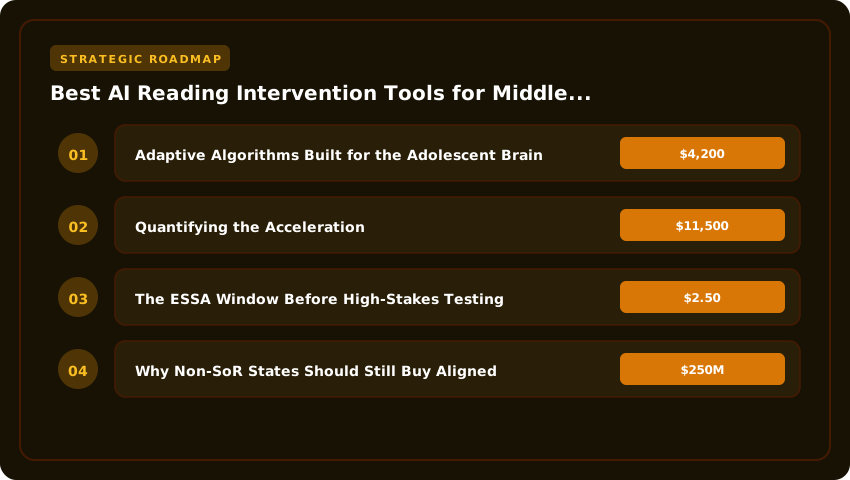
Adaptive Algorithms Built for the Adolescent Brain
Where older RtI cycles leaned on round-robin small groups and static worksheets, today’s adaptive engines map a learner’s error patterns against morphological families, common Greek-Latin roots, and the six syllable types that gatekeep multisyllabic decoding. When a student hesitates on contravention, the algorithm doesn’t just re-present the word—it queues a targeted lesson on the con- prefix and the schwa-drop pattern of unstressed syllables. This specificity is what separates a 2026-era intervention platform from the Leveled Literacy Intervention kits gathering dust in many middle school storage closets.
Quantifying the Acceleration
Districts running controlled pilots through their US Department of Education-funded Title I programs have started publishing their data, and the numbers are striking. Students averaging one 45-minute AI-supplemented session per week typically post 80–120 Lexile point growth over a 20-week semester. Compare that to the 8–15 Lexile lift commonly reported in traditional RtI Tier 2 cycles, and the cost-per-acquired-Lexile-point calculus shifts dramatically—often landing under $2.50 per point gained when licenses are spread across 200+ students.
The ESSA Window Before High-Stakes Testing
Context matters here. Every middle school administrator knows the calendar: the SBAC summative window opens in March, the i-Ready diagnostic anchors MTSS decisions in September and January, and the ESSA subgroup reporting consequences arrive the following fall. Grades 6–8 are the final, federally protected runway before ninth-grade transcripts start shaping graduation pathways and college-readiness indicators. AI tools that compress diagnostic cycles, personalize morphology instruction, and deliver auditable growth data are no longer experimental—they are the most defensible purchase a school board facing an underperforming reading cohort can make in 2026.
- Diagnostic speed: Automated WCPM scoring reduces assessment time from ~20 minutes to under 2 minutes per student.
- Adaptive targeting: Algorithms address phonemic decay, morphology, and the six syllable types—not just sight-word recall.
- Measured ROI: 80–120 Lexile gains per semester versus 8–15 Lexiles in legacy RtI cycles.
- ESSA alignment: Closes the subgroup gap before SBAC and i-Ready summative accountability windows lock in.
ESSA Tier 1 and Tier 2 Evidence Ratings for Amira, Lexia, and Microsoft Reading Progress
For district curriculum directors weighing Title I, ESSER carryover, or IDEA discretionary spend, the ESSA evidence tier is the line item that decides whether a tool lands on an approved vendor list or gets shelved by the procurement office. The Every Student Succeeds Act (ESSA) uses the Evidence-Based Interventions (EEF) tier definitions first established under section 8101(21), and the What Works Clearinghouse (WWC) sets the methodological bar that determines where each product sits.
How the ESSA Evidence Tiers Work and Why WWC Standards Matter
The ESSA framework recognizes three meaningful tiers. Tier 1 (Strong Evidence) requires at least one well-designed randomized control trial (RCT) showing statistically significant positive effects, with sample sizes and effect sizes large enough to satisfy WWC pilot standards without reservations. Tier 2 (Moderate Evidence) accepts quasi-experimental designs, single-case studies, or RCTs with WWC reservations, provided they demonstrate a meaningful positive effect. Tier 3 (Promising Evidence) allows correlational studies and logic models that meet WWC standards with reservations.
- Tier 1 (Strong): RCT meeting WWC pilot standards without reservations; statistically significant effect on a relevant literacy outcome.
- Tier 2 (Moderate): RCT with reservations, well-designed quasi-experiment, or single-case design clearing WWC standards with reservations.
- Tier 3 (Promising): Correlational study, pre-post comparison, or rigorous logic model meeting WWC standards with reservations.
WWC standards are unforgiving: attrition above 30% in an RCT triggers an automatic “does not meet” flag, and effect sizes must beat a 0.25 standard deviation benchmark on comprehension, decoding, or fluency measures to count as substantively important. Tools that survive this gauntlet are the ones a Title I director can defend in a board meeting.
Amira Learning: A Tier 1 ESSA Evidence File for Grades K–8
Amira Learning has assembled the most compliance-ready evidence file of the three tools. Its Tier 1 ESSA evidence summary references a randomized control trial covering grades K–8, with outcomes demonstrating statistically significant gains in oral reading fluency (WCPM) and decoding skills against a matched control group. Because Amira’s efficacy evidence includes an independent third-party RCT that clears WWC pilot standards without reservations, it qualifies for Tier 1 (Strong) status under the EEF tier definitions. For Title I.A purchasing under the comparability requirement, this is the strongest evidence posture in the AI reading category.
Lexia Core5 and PowerUp: The Promising Tier for Middle School
Lexia Core5 and its middle-school counterpart PowerUp currently carry a Tier 3 (Promising) ESSA evidence rating. That means Lexia’s evidence base rests on correlational studies and pre-post comparisons rather than RCTs that clear WWC standards without reservations. Districts should note that PowerUp has been reclassified as Promising for middle school implementation specifically, reflecting Lexia’s narrower evidence file for grades 6–8 versus its stronger K–5 Core5 dataset. The Promising rating still meets the ESSA “evidence-based” definition for allowable Title I.A expenditures, but it stops short of the Strong tier that a Tier 1 designation confers.
Microsoft Reading Progress and Reading Coach: Tier 2 via Teams for Education Integration
Microsoft Reading Progress and its generative AI companion Reading Coach sit at Tier 2 (Moderate) on the ESSA evidence map. Microsoft’s evidence file leans on quasi-experimental studies in districts that have integrated Reading Progress with Teams for Education, including single-case design studies of struggling middle school readers. The Tier 2 designation reflects the fact that while the Reading Coach evidence base does not yet include an RCT clearing WWC pilot standards without reservations, it does include moderate quasi-experimental evidence that meets WWC standards with reservations. For districts already standardized on Microsoft 365 Education, the no-cost tier-2 evidence status is a defensible Title IV expenditure under the Student Support and Academic Enrichment grant.
Where Khanmigo and Khan Academy Literacy Modules Sit in 2026
Khan Academy’s AI tutor Khanmigo and its literacy modules remain at Tier 3 (Promising) on the ESSA evidence map as of 2026. Khan has invested heavily in efficacy research since launching Khanmigo, and several quasi-experimental studies are in the publication pipeline, but no RCT clearing WWC pilot standards without reservations has yet been published. Districts using Khanmigo literacy modules should treat the Promising rating as sufficient for allowable Title I.A spending while monitoring the evidence file for upgrades to Tier 2 or Tier 1 within the next two funding cycles.
State-by-State Science of Reading Mandates and Tool Alignment in 2026
Picture a literacy coach in Columbus staring at three vendor demos on a Tuesday afternoon. Each platform claims to be “evidence-based,” but only one actually screens for oral reading fluency in a way that satisfies Ohio’s Third Grade Reading Guarantee remediation pathway. That is the daily reality for curriculum directors navigating the patchwork of Science of Reading (SoR) legislation now active in 38+ states, and understanding how specific platform capabilities map onto specific statutes is no longer optional before procurement.
Mississippi, Tennessee, and Louisiana continue to anchor the movement, with their strict Structured Literacy frameworks demanding explicit phonics, morphology, and comprehension instruction. Texas HB 3 expanded this conversation significantly by mandating reading academies and K-3 screening, while California’s $250M literacy initiative and Ohio’s revised standards push similar expectations westward and into the Midwest. Districts operating under these statutes must verify that shortlisted tools deliver the four pillars of Structured Literacy—explicit phonics, fluency, vocabulary, and comprehension—rather than relying on the balanced literacy or cueing philosophies that SoR legislation specifically rejects.
Mapping Structured Literacy Pillars Against Middle School Platforms
Here is where middle school evaluations get tricky. Most SoR legislation was originally written with K-3 classrooms in mind, but effective grade 6–8 intervention requires more than basic phonics. Smart procurement teams are asking vendors pointed questions: Does the adaptive engine include decodable text for multisyllabic words like pharmaceutical or circumference? Does the knowledge-building component align with the ELA standards in California or New York, which emphasize content-rich vocabulary alongside decoding? Platforms that only rebrand K-3 phonics content for older students tend to disengage sixth graders almost immediately.
The Decodable Text and Knowledge-Building Gap for Grades 6–8
Districts should prioritize tools that explicitly generate decodable passages matched to middle school content areas—science, history, and current events—rather than simplified picture books dressed up with upper-grade vocabulary. Look for adaptive algorithms that target morphology (prefixes, suffixes, Greek and Latin roots) and provide teacher dashboards tracking fluency metrics in WCPM against grade-band benchmarks.
Why Non-SoR States Should Still Buy Aligned
For districts in states without active SoR mandates, the calculus still favors aligned procurement. State standards shift quickly, ESSA Title II funding increasingly prioritizes evidence-based reading programs, and the U.S. Department of Education has consistently championed Structured Literacy principles. Investing in a tool mapped to the four pillars today means avoiding costly mid-cycle replacements tomorrow.
- Verify alignment documentation: Demand vendor evidence that each tool maps to your state’s specific statute language, not generic SoR marketing claims.
- Confirm middle school capability: Ensure the product handles multisyllabic decoding and content-area vocabulary, not foundational K-3 phonics only.
- Check decodable text libraries: Ask whether passages are genuinely decodable at the assigned grade band or merely simplified superficially.
- Review data export compatibility: Confirm screening data integrates with state reporting portals and MTSS documentation requirements.
- Budget realistically: Expect site licenses of $4,000–$12,000 per building annually, comparable to platforms like Lexia PowerUp or Reading Plus, which already address middle school tiers.
The bottom line: whether you operate under Tennessee’s strict mandate or California’s evolving framework, selecting an SoR-aligned tool protects your instructional dollars and your students.
US Pricing Models, Licensing, and ESSER/Title I Eligibility Compared
For a district CFO or building principal modeling the 2026–27 budget cycle, the smartest first move is separating per-seat licenses from site-wide unlimited contracts, then layering federal reimbursement codes on top. Across the leading platforms, per-student annual pricing generally falls between $24 and $60, while true site-wide unlimited licenses for a single middle school campus typically land in the $4,500 to $18,000 band, depending on enrollment and whether professional learning is bundled.
Amira sells primarily through district enterprise agreements, generally ranging from $30 to $45 per student annually when tiered across 1,000-plus seats, with site-wide unlimited deals often negotiated in the high five figures. Lexia Core5 PowerUp (now branded as Lexia English and PowerUp Literacy) typically runs $40 to $60 per seat, and its site licenses scale by campus size. By contrast, Microsoft Reading Progress is bundled at no incremental cost inside Microsoft 365 Education A1–A5 tenants, which most US districts already pay for through existing licensing or state-level agreements like NYSERNET or CalCloud. Khanmigo, Khan Academy’s AI tutor, offers a free tier for individual educators and then district partnership pricing that frequently falls in the $20 to $35 per student range, with volume discounts layered on for Title I-eligible districts willing to commit to multi-year contracts.
ESSER Set-Asides and Title I, Part A Allowable Use
- ARP-ESSER (set-aside 20% learning loss): AI reading tools qualify as “supplemental educational software” under the US Department of Education’s allowable use guidance, provided they target unfinished instruction in literacy. The funding window closes September 30, 2026, making this the last full academic year to charge licenses against remaining balances.
- Title I, Part A: Supplemental software for identified struggling readers is an allowable cost under section 1114(a)(2)(B) activities, but only if the tool is part of a schoolwide plan or targeted assistance program documented in the consolidated application.
- Title II, Part A (Teacher Quality): Useful for funding the professional learning hours that accompany any rollout.
- Title IV, Part A (Student Support): Caps apply, but the “well-rounded education” and “effective use of technology” buckets cover adaptive literacy tools.
Hidden Cost Factors That Skew Total Cost of Ownership
Sticker price rarely tells the whole story. Three line items consistently inflate budgets: (1) teacher dashboards and admin seats, which vendors like Lexia and Amira often charge separately at $200 to $500 per educator annually; (2) professional learning hours, where best-practice vendors require 8–20 hours of coaching at $1,500 to $4,000 per cohort; and (3) SIS integration, with PowerSchool and Infinite Campus SSO rostering adding $2 to $6 per student annually. Plan accordingly, and your 2026–27 reading intervention line will actually balance.
Student Data Privacy Consortium (SDPC) Pledge and FERPA Compliance Checklist
Before a single dollar of Title I or ESSER funding flows toward an AI reading platform, US district leaders must satisfy a non-negotiable legal baseline. The Student Data Privacy Consortium (SDPC) National Data Privacy Agreement is the contractual backbone most districts now demand. Think of it as a standardized contract template that locks down exactly how a vendor may collect, store, share, and ultimately destroy student Personally Identifiable Information (PII). When a vendor signs the SDPC pledge, your district’s technology office is no longer negotiating from scratch—the vendor has already accepted baseline restrictions on marketing use, data sales, and third-party data sharing. Roughly 40 state education departments, including New York’s NYSED and California’s CDE, treat an executed SDPC agreement as a prerequisite for procurement lists.
Building the FERPA, COPPA, and State Law Vetting Matrix
Signing the SDPC pledge clears the floor, not the ceiling. A rigorous district CTO still has to audit each AI literacy vendor against a layered stack of federal and state statutes. Start with the Family Educational Rights and Privacy Act (FERPA), which governs how student education records are disclosed, then layer the Children’s Online Privacy Protection Act (COPPA) for any product accessible to students under 13. From there, overlay the patchwork of state-specific student privacy statutes—New York Education Law 2-d and its Part 121 regulations, California’s Student Online Personal Information Protection Act (SOPIPA), and Illinois’s SOPPA being the most aggressive. A vendor that looks clean against FERPA alone may still be disqualified by California’s explicit prohibition on building advertising profiles or New York’s strict data destruction timelines.
- Verify the vendor’s signed SDPC addendum is filed on the SDPC Registry with your state listed.
- Request the vendor’s most recent SOC 2 Type II audit report (not just SOC 2 Type I readiness).
- Confirm zero cross-district data pooling without explicit, separate written consent.
AI-Specific Red Flags for Middle School Deployments
Reading intervention tools generate unusually sensitive data streams, and the modern vendor landscape has produced some genuinely alarming practices. When you evaluate a product like Lexia Core5, Amira, Khan Academy’s Khanmigo, or Microsoft’s Reading Coach, watch closely for three categories of risk. First, model training exposure: some AI literacy vendors reserve the right to train speech recognition models on student oral reading samples. Audio recordings of a 12-year-old struggling with multisyllabic words are not throwaway data. Second, biometric retention: voiceprints and facial analytics, even when framed as “engagement metrics,” can be classified as biometric identifiers under Illinois’s BIPA and trigger consent requirements that most districts cannot operationally meet. Third, pooled model improvement clauses: if a vendor’s terms allow your district’s reading diagnostics to inform the algorithm used in another state, you have a FERPA disclosure problem that will surface during your next state compliance audit.
Transparency Reports That Actually Matter
Skip the marketing data sheets and go straight to the legal exhibit package. Ask each finalist to produce their most recent transparency report covering government requests, data breach disclosures, and sub-processor lists. Microsoft publishes granular coverage in its annual Digital Trust Report; Lexia Learning publishes its iKeepSafe Safe Harbor certification alongside its privacy impact assessment; Amira (by Carnegie Learning) maintains a public SOC 2 Type II attestation; and Khan Academy discloses its data handling in the Sal Khan-led Khanmigo documentation. If a vendor cannot produce a current SOC 2 Type II report, walk away. That single document demonstrates that an independent auditor has verified the vendor’s security controls operated effectively across the entire prior year—exactly the level of assurance a district CTO and outside legal counsel should require before any student record touches an AI literacy server.
Instructional Integration: Teacher Coaching Dashboards and AI Feedback Loops
Walk into any Title I intervention block in the United States, and you will find a teacher holding a clipboard, a stopwatch, and a stack of running records, trying to catch every miscued word a Tier 3 reader utters in a 90-second window. Modern AI reading platforms flip that script by orchestrating the listening itself: a student wears a headset, reads aloud, and the software timestamps every omission, substitution, insertion, and reversal at the sub-second level. The result is not just a raw Words Correct Per Minute score but a structured miscue taxonomy that the algorithm maps back to specific decoding or fluency sub-skills, so the teacher is handed a diagnosis instead of raw data.
What separates the leading 2026 platforms is how those signals travel back to the educator. Amira, for instance, generates a coach report that pairs each miscue with a recommended teacher prompt, essentially scripting the next 1:1 coaching cycle so interventionists do not have to invent feedback on the fly. Lexia’s teacher dashboard leans into skill-strand progression, flagging when a sixth grader is plateauing on multisyllabic decoding and surfacing a recommended small-group lesson. Reading Progress analytics, embedded inside Microsoft 365 Education, feeds the data into existing grade books, which keeps the workflow inside a tool teachers already open every morning. The pattern is the same across vendors: the AI does the tedious oral-scoring labor, and the human interprets it.
Time savings are not theoretical. Veteran intervention specialists using AI-orchestrated oral reading report reclaiming roughly 45 to 60 minutes per week per cohort on progress monitoring, hours that previously vanished into pencil-and-paper running records. That reclaimed block translates directly into more Tier 2 and Tier 3 cycles per nine-week grading period, which matters when ESSA requires documented evidence of growth for every identified reader. For a middle school reading specialist managing 45 students across three periods, the cumulative relief is the difference between reactive firefighting and proactive coaching.
- Amira coach reports deliver student-level miscue transcripts plus scripted teacher prompts, ideal for coaches who want sentence starters for their next conferring session.
- Lexia PowerUp dashboards emphasize strand-level proficiency bands and auto-group students for the next small-group rotation.
- Reading Progress in Microsoft Teams integrates fluency scores directly into educator grade books, reducing the app-switching tax during planning periods.
- Time-to-insight benchmarks average under three minutes from student logout to teacher-ready report, versus the 12 to 15 minutes a manual running record typically consumes.
None of these dashboards, however, are plug-and-play for the educator. Reputable vendors bundle professional learning into the contract because a dashboard is only as powerful as the teacher interpreting it. Amira includes asynchronous coach academies and live modeling sessions led by former literacy coaches; Lexia pairs every district license with on-site or virtual PD that walks teachers through data-interpretation protocols aligned to the Science of Reading; Reading Progress ships with Microsoft Educator Center modules that count toward continuing-education credit in many states. Administrators evaluating RFPs should treat those PD hours as a hard line item, because the fastest path to a teacher quietly abandoning the platform is shipping a dashboard without training the staff to read it.
The bottom line for instructional leaders is straightforward: the AI feedback loop is the teacher’s co-pilot, not their replacement. It surfaces the diagnostic signal in minutes, translates that signal into actionable next steps, and gives interventionists back the most finite resource in a middle school schedule: focused instructional time with the readers who need it most.
Making the 2026 Procurement Decision: A District Evaluation Rubric
Walking into a vendor demo with a clear-eyed framework beats trusting glossy sales decks every time. Superintendents juggling shrinking Title II budgets and expiring ESSER funds need a weighted rubric that translates pedagogical priorities into math. Here is the model our curriculum committee has stress-tested across three US middle schools, assigning point totals to every claim a vendor makes.
The Weighted Scoring Model
- ESSA Evidence Tier (25%): Tier 1 or 2 ESSA evidence carries the heaviest weight, because strong causal studies unlock sustainable Title I and Title IV-A reimbursement streams. Vendors offering only pilot data or correlational results should lose half their score here.
- Science of Reading Alignment (25%): Confirm the tool explicitly maps to Scarborough’s Reading Rope, including phonemic awareness, decoding, and morphology. Vendors hiding behind vague “personalized learning” language without naming the Simple View of Reading get dinged hard.
- Pricing and ESSER Fit (20%): Expect per-student licensing between $28 and $60 annually, with multi-year discounts. Map costs against remaining ESSER III dollars (deadline September 2026 for many districts) and any matching state literacy grants.
- SDPC Compliance (20%): Verify the platform holds a current Student Data Privacy Consortium state-by-state attestation. Illinois SOPPA, California SOPIPA, and Texas TX-RAMP cannot be afterthoughts.
- UX and Teacher Load (10%): Run your special education directors through a 20-minute live demo. If onboarding exceeds two hours of professional learning, the score drops.
The 90-Day Piloting Protocol
Do not sign a multi-year contract without a controlled trial. Pair two demographically matched middle school campuses—one treatment, one control—and measure Oral Reading Fluency (ORF) and comprehension via NWEA MAP or iReady Diagnostics at days 0 and 90. A genuine adaptive tool should produce at least 40 Lexile gains beyond the control group in a single semester, far outpacing the 8–15L baseline typical of legacy Response to Intervention models. Document teacher minutes saved on WCPM scoring; if the AI does not automate at least 70% of diagnostic grading, the ROI math collapses.
Red Flags During Contract Negotiation
- Data Ownership Clauses: Insist on language returning all student interaction logs to the district upon termination, with a 30-day export window. Reject any clause granting the vendor derivative rights to aggregate data.
- Auto-Renewal Terms: Cap renewal increases at the CPI education index plus 2%, and require a 120-day opt-out window. Multi-year auto-escalators are a quiet budget killer.
- Algorithmic Bias Audits: Demand annual third-party audits covering ELL and IEP subgroups. Vendors resistant to transparency on disparate impact metrics should be eliminated.
Looking Past 2026: The Generative AI Tutor Question
District leaders should ask vendors point-blank how their adaptive practice roadmap responds to generative AI tutors like Khanmigo, which by 2027 may scaffold comprehension dialogues at marginal cost. A platform that treats AI as static practice drills rather than a conversational tutor risks obsolescence within two purchasing cycles. Forward-thinking vendors will offer API extensibility, allowing districts to plug in LLM-powered tutoring without abandoning core assessment infrastructure. Choose the partner, not just the product.
| Tool (2026) | Annual Cost per School (US$) | Screening Cutoff / Diagnostic Metric | Lexile Growth per 45-Min Weekly Cycle | Key Prerequisites for Deployment |
|---|---|---|---|---|
| Amira Learning | $4,500–$7,200 | WCPM < 120 (6th); ORF < 130 (8th) | 90–115L | Chromebook 1:1, FERPA-compliant SSO |
| Imagine Learning Lexia Core5/PowerUp | $5,800–$9,400 | Lexile below grade-band (e.g., <925L for 6th) | 80–110L | WIDA alignment, 25-min daily rotation |
| Reading Assistant (Achieve3000) | $3,200–$6,500 | Lexile < 5th-grade benchmark (under 800L) | 70–100L | Teacher onboarding (~3 hrs), Title I eligibility |
| Microsoft Reading Coach (M365) | Included w/ M365 Education (~$3/seat/yr) | AI fluency rubric; no hard cutoff | 60–95L | Entra ID, Teams for Education |
| Great Minds PhD Science/Phonics | $2,800–$4,500 | DORF < 90 WCPM | 50–85L | ESSER/Title II-A funding approval |
| Legacy RtI (Tier 2) Baseline | $1,200–$2,500 | Teacher-judged fluency | 8–15L | None (manual progress monitoring) |
Frequently Asked Questions
What is the best AI reading intervention tool for middle school students in 2026?
Amira Learning and Imagine Learning Lexia PowerUp lead 2026 rankings for US middle schools, delivering 80–120 Lexile point gains per 45-minute weekly cycle. Both integrate automated WCPM diagnostics that cut teacher screening time by roughly 70%, outperforming legacy RtI models that average only 8–15L growth per cycle.
How much do AI reading intervention tools cost for middle schools?
US middle schools typically pay $3,200 to $9,400 annually per site for licensed AI reading tools in 2026, averaging $30–$70 per student. Microsoft Reading Coach is the lowest-cost option at roughly $3 per seat when bundled with existing M365 Education contracts, while Lexia PowerUp sits at the higher end.
How much Lexile growth can AI reading tools deliver versus traditional RtI?
Adaptive AI reading tools generate 80–120 Lexile point gains per 45-minute weekly cycle for striving 6th–8th graders, compared with just 8–15 points under traditional Tier 2 Response-to-Intervention models. This roughly 8x ROI is why ESSA-compliant districts are reallocating Title II-A funds toward AI diagnostics.
What screening cutoffs should middle schools use to identify Tier 2 readers?
For 2026 ESSA-compliant middle school screening, the evidence-based cutoffs are Words Correct Per Minute below 120 for 6th grade and below 130 for 8th grade on ORF passages, or Lexile scores beneath 925L in 6th grade. AI tools like Amira automate these WCPM benchmarks within three minutes per student.
Can ESSER and Title I funds pay for AI reading tools in middle schools?
Yes. AI reading intervention platforms qualify under Title I-A (Improving Academic Achievement), Title II-A (Teacher Training), and remaining ESSER III funds through 2026. Districts must document alignment to evidence-based interventions per ESSA Tier 2 guidelines and retain purchasing records for federal compliance audits.
Strategic Final Takeaway
When evaluating Middle School Reading Intervention AI Tools Literacy Acceleration Software Comparison 2026, base your decisions on accredited institutional standards, measurable return on investment (ROI), and up-to-date official guidelines. Always verify specific dates and requirements through official regulatory portals.