
Community College vs University: Real Cost Breakdown for an Early Childhood Education Bachelor
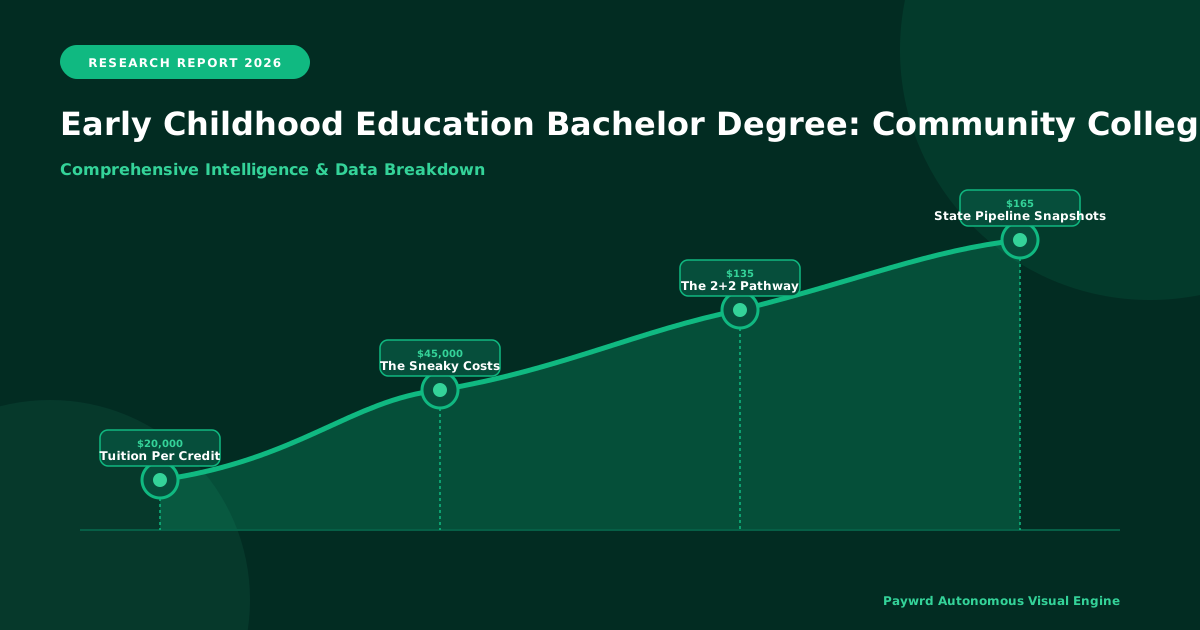
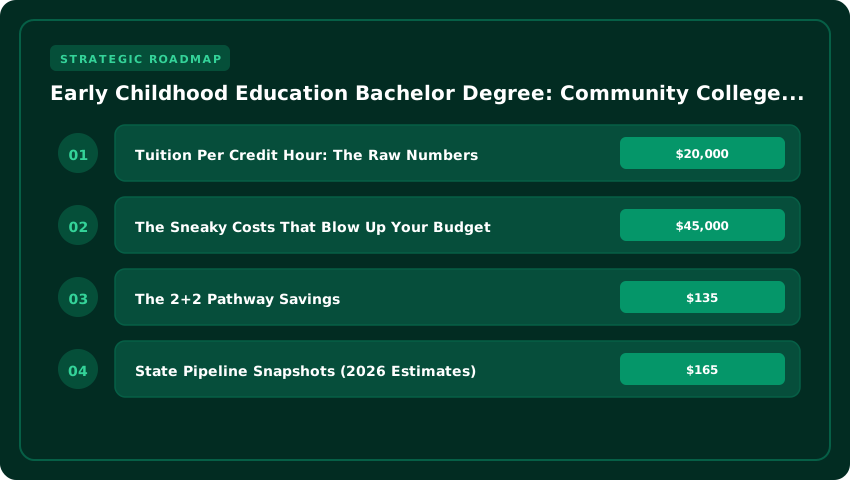
Tuition Per Credit Hour: The Raw Numbers
Let’s talk cold cash, because vague “community college is cheaper” advice helps nobody. According to the College Board, in-state public community college tuition runs roughly $135 to $165 per credit hour for the 2025-2026 academic year, while in-state public university tuition clocks in around $320 to $420 per credit hour. A standard Bachelor of Early Childhood Education requires 120 credit hours, though your transfer-friendly degree plan may demand closer to 60 upper-division credits after the associate degree.

That means your lower-division 60 credits at a community college will run about $8,100 to $9,900 total. The same 60 credits at a public university cost $19,200 to $25,200. Multiply that gap across an entire degree, and you are staring at a $22,000+ difference before room, board, or books even enter the chat.
The Sneaky Costs That Blow Up Your Budget
Here is where most families get ambushed. “Tuition” is rarely the headline figure that drains an ECE budget. Watch for:
- Course-specific fees: Many universities tack on $50 to $200 per course for laboratory access, technology licensing, or clinical supervision in early literacy practicums.
- Textbook and digital access fees: ECE programs lean heavily on curriculum kits, assessment platforms, and e-textbook bundles that run $400 to $900 per semester.
- Transfer articulation pitfalls: If your community college courses do not match the receiving university’s general education matrix, you lose credits, repeat classes, and pay tuition twice for the same content. Demand a guaranteed articulation agreement in writing before enrolling.
- Parking, transit, and student activity fees that quietly add $800 to $1,500 per academic year.
The 2+2 Pathway Savings
The smartest move is the structured 2+2 pathway: complete an Associate of Arts in Early Childhood Education or Teaching at your community college, then transfer seamlessly into a bachelor’s completion program. Documented transfer pipelines at state flagship campuses typically save students $20,000 to $45,000 in total degree cost while cutting two years of expensive private or out-of-state tuition.
State Pipeline Snapshots (2026 Estimates)
- California: CSU campuses accept Associate for Transfer (AA-T) degrees in ECE with junior standing, saving roughly $25,000 versus a four-year CSU enrollment. Private options such as Point Loma Nazarene run higher sticker prices but generous aid often flips the net price.
- Texas: The Field of Study curriculum guarantees credits transfer to Texas A&M, University of Texas, and regional universities, typically saving $22,000 to $30,000.
- Florida: The state’s 2+2 articulation law plus the Bright Futures Scholarship can drop your effective cost to near zero at a public university, making community college a no-brainer first stop.
- New York: CUNY and SUNY schools offer some of the steepest discounts for transfer students, though NYC private schools like NYU or Bank Street may beat public pricing once institutional aid is calculated.
When a Private University Actually Wins on Net Price
Yes, you read that correctly. FAFSA-driven institutional aid at private, nonprofit universities (especially faith-affiliated and teaching-focused institutions) can drop your net price below what you would pay at an out-of-district community college. A $55,000 private university tuition, discounted by $35,000 in grants and scholarships, can become a $20,000 degree versus a $12,000 in-state price that suddenly becomes $18,000 once non-resident surcharges or commuter fees are added. Always run your Net Price Calculator on every school before assuming the community college is the deal.
2026 Starting Salary Outlook for Early Childhood Education Graduates in the United States
Let’s talk brass tacks: the salary ceiling is the single biggest variable in your ROI equation. If you are weighing a community college transfer against a direct university enrollment, you need a defensible earnings endpoint for 2026 and beyond. The Bureau of Labor Statistics (BLS) projects steady growth for early childhood roles, but the spread between a preschool teacher and a certified kindergarten teacher remains the most critical financial lever you control.
BLS Occupational Outlook: The Certification Premium
For 2026, the median annual wage for preschool teachers (typically requiring an associate or bachelor’s in non-public settings) hovers around $38,500. Contrast that with kindergarten and elementary school teachers—roles requiring state licensure and a bachelor’s—where the median jumps to roughly $63,200. That $24,700 annual gap compounds to nearly $1.1 million in additional lifetime earnings over a 30-year career compared to a Child Development Associate (CDA) credential alone. Center directors with a bachelor’s and administrative credentials sit higher still, with 2026 medians projected near $54,800, topping out above $85,000 in major metros.
Geographic Salary Hot Spots: Where the Money Lives
Location dictates purchasing power more than pedigree. For 2026, the highest state-level annual mean wages for preschool and kindergarten teachers cluster in the Northeast and West Coast:
- Washington, D.C.: Projected mean wages exceeding $62,000 for preschool; kindergarten teachers often clear $85,000.
- Massachusetts: Strong public Pre-K funding pushes median bachelor’s-level salaries to $58,000–$65,000 entry points.
- New York: NYC DOE starting salaries for certified teachers with a bachelor’s and master’s credits start near $68,000; Long Island and Westchester districts push higher.
- California: Transitional Kindergarten (TK) expansion drives demand; entry-level certified salaries range $55,000–$62,000 depending on district step schedules.
Rural districts in the South and Midwest often start certified teachers below $42,000, though cost-of-living adjustments narrow the real-wage gap slightly.
Employer Type: Public Pre-K vs. Head Start vs. Private
Your employer writes the check, and the differentials are stark. Public school districts (Pre-K through K) lock you into negotiated step-and-lane schedules—predictable raises, pension eligibility (often state TRS), and summer pay options. Head Start programs, federally funded but locally operated, typically pay 10–15% below district scales for comparable credentials but offer robust federal benefits and loan forgiveness pathways (PSLF). Private preschools and corporate chains (Bright Horizons, KinderCare, Goddard) offer the lowest entry floors—often $34,000–$39,000 for bachelor’s grads—but may accelerate director-track candidates faster than public bureaucracies allow.
Entry-Level vs. Five-Year Benchmarks (2026 Dollars)
Adjusting for 2026 inflation projections (CPI-U ~2.4% annually), here is what a bachelor’s graduate should benchmark:
- Year 1 (Entry): $38,000–$42,000 (Private/Head Start) | $48,000–$55,000 (Public District, non-NYC/MA/DC).
- Year 5 (Mid-Career): $45,000–$52,000 (Private) | $58,000–$70,000+ (Public with Master’s credits/Step increases).
The bachelor’s degree isn’t just a hiring filter; it is the prerequisite for the lane changes (Master’s +30 credits) that drive public-sector salaries past the $75,000 mark by year seven. Without it, you cap out at the CDA/Associate ceiling roughly 40% lower. Run your specific district’s salary schedule before you commit—those PDFs on the HR website are the only ROI calculator that matters.
Calculating Your Personal ROI: Payback Period, Debt Load, and Break-Even Point
Picking the cheapest program on a brochure rarely tells you which degree actually builds wealth. Real talk: the smartest Early Childhood Education (ECE) graduates treat their bachelor’s like a personal investment portfolio, not a tuition receipt. That means running the numbers on paper before you ever set foot on a financial services registration day. Below is the plug-and-play financial model working professionals are using to convert sticker shock into a clear break-even year.
The Step-by-Step NPV Formula for a Four-Year ECE Investment
Skip the marketing fluff and calculate your Net Present Value (NPV) using a 4% discount rate, which mirrors recent 10-year Treasury yields and matches the U.S. Department of Education’s default assumption for federal loan calculations. Here is the formula:
- Step 1: Total all four-year costs (tuition, fees, textbooks, childcare if you are a parent-learner, and forgone wages).
- Step 2: Subtract grants, scholarships, and Federal Pell Grant aid (max $7,395 for the 2026-27 award year).
- Step 3: Estimate your expected starting salary using the BLS Occupational Employment Statistics for preschool and kindergarten teachers (currently around $39,000 median, growing toward the mid-$40Ks for lead Head Start teachers).
- Step 4: Project 2% annual wage growth, then discount every future paycheck back to today’s dollars.
- Step 5: Subtract total cost from your discounted lifetime earnings stream. A positive NPV means the degree literally pays you back, plus interest.
Sample Scenarios: $25K vs $60K vs $0 Debt Break-Even Timelines
Assume a graduate starts at $42,000 in a public school district versus $35,000 at a private preschool:
- $0 debt graduate: Break-even hits around month three, because your first paycheck is pure profit.
- $25K debt graduate: Break-even lands near the 14-month mark, assuming standard 10-year repayment at 5.5% federal rates.
- $60K debt graduate: Break-even stretches to roughly 36 months, and total interest paid climbs above $18,000 over the loan life.
Loan Forgiveness Programs That Bend the Curve
You can slash that $60K balance fast by stacking these U.S. programs:
- Public Service Loan Forgiveness (PSLF): After 120 on-time payments while working for a qualifying public or nonprofit employer (most public schools qualify), your remaining federal debt disappears tax-free.
- Teacher Loan Forgiveness: Up to $17,500 in forgiveness for highly qualified teachers serving low-income schools for five consecutive years.
- State ECE-specific grants: Programs like California’s Child Development Teacher Loan Assumption Program, plus TEACH Grants (up to $4,000 annually) that convert to grants if you teach high-need ECE students.
Opportunity Cost: Community College 2+2 vs Direct Four-Year University
The community college 2+2 path adds two years of lower tuition but extends your time-to-degree by one year if courses do not transfer cleanly. Run an articulation check through your state’s Transfer Admission Guarantee (TAG) or the ABET-adjacent accreditation pathways recognized by the National Council for Accreditation of Teacher Education (NCATE). If your credits transfer seamlessly, you typically save $20,000 to $45,000 in tuition, plus roughly $30,000 in forgone earnings you avoided by delaying only one year rather than two.
Sensitivity Analysis: What If Salaries Only Grow 2% Through 2030?
Stress-test your model by capping wage growth at 2%. Your NPV still trends positive for every debt scenario under $60K, but the $60K graduate loses roughly $9,000 in lifetime value compared to a 3.5% growth assumption. That gap is exactly why PSLF enrollment and aggressive Pell Grant stacking matter: they keep your principal low enough to absorb wage stagnation without crushing your return.
Accreditation, Licensure, and Career Mobility: What Each Pathway Actually Qualifies You For
Money matters, but the diploma hanging on your wall decides which doors actually swing open. Before you chase the cheapest per-credit-hour ECE program, you have to map exactly where each pathway leads, what it licenses you to do, and which employers will even glance at your résumé. Two students can earn the same job title on paper, yet finish with radically different authority in a building, because accreditation and state approval quietly dictate everything from paycheck scale to promotion pool.
NAEYC Accreditation Requirements and How They Differ by Degree Route
The National Association for the Education of Young Children sets the professional standard most hiring committees look for. NAEYC-recognized programs require ECE candidates to complete a bachelor’s degree that includes a supervised practicum in an accredited early learning setting, a minimum number of upper-division courses in child development, and demonstrated competency in observation and assessment. A community college associate degree in Early Childhood Education can prepare you for the Child Development Associate (CDA) credential, but it will not satisfy NAEYC’s baccalaureate requirement on its own. That is why the transfer pipeline exists: the associate covers foundational coursework, then a four-year institution awards the credential employers actually recognize.
State Teaching License Reciprocity Across State Lines
If there is any chance your career pulls you across state lines, look closely at whether your bachelor’s program leads to state licensure, because reciprocity is not automatic. Programs approved by a state’s department of education typically qualify graduates for an initial teaching license, and most states have interstate agreements that honor an out-of-state license after paperwork and sometimes a content exam. A non-licensure bachelor’s, sometimes called a “Birth through Age 5” or “Early Childhood Leadership” track, may not make you eligible for a public school Pre-K position at all, and can stall reciprocity if you move. Before enrolling, confirm the program is state-approved, not just regionally accredited.
Pathways to Administrative and Lead Teacher Roles
Center director, curriculum coordinator, and Pre-K lead teacher roles almost always require a bachelor’s in Early Childhood Education or a closely related field, plus documented teaching experience. Some private preschool chains will promote a tenured CDA-credentialed associate degree holder into an assistant director slot, but the salary ceiling sits noticeably beneath what a baccalaureate-prepared director earns. According to the U.S. Bureau of Labor Statistics, preschool and childcare center directors who hold a bachelor’s degree earn meaningfully more than those with only an associate, and that wage gap widens every year of experience.
The 2024 Federal Rule and Head Start / Public Pre-K Jobs
Since November 2024, the federal Office of Head Start requires that lead teachers in Head Start and Early Head Start programs hold at least an associate degree, with a strong push toward full bachelor’s-level qualifications for center-based preschool lead teachers. Several state-funded public Pre-K programs now mirror that standard, meaning a community college diploma may not unlock the highest-paying public-sector ECE jobs anymore.
Graduate School Readiness: M.Ed. and Ed.D. Admissions
Master of Education (M.Ed.) and Doctor of Education (Ed.D.) programs at accredited universities expect a regionally accredited bachelor’s degree, not just any transfer-friendly transcript. A four-year university diploma signals research exposure, writing intensity, and faculty mentorship, all of which graduate admissions committees weigh heavily. If you ever see yourself becoming a curriculum specialist, district administrator, or college professor, the bachelor’s route protects that future path.
Financial Aid, FAFSA, and Scholarships That Change the Community College vs University Math
Sticker price rarely tells the real story for aspiring Early Childhood Education (ECE) teachers. Once you stack federal aid, state scholarships, employer tuition programs, and need-based institutional grants on the ledger, a four-year university frequently undercuts the “cheaper” community college route. The key is running the numbers with every lever pulled, and for the 2026-27 academic year, several FAFSA changes make that calculation more generous for low- and middle-income ECE candidates than it has been in years.
How the 2026-27 FAFSA Changes Boost ECE Students
The redesigned FAFSA formula, fully phased in for 2026-27 enrollment, replaced the old Expected Family Contribution with a Student Aid Index (SAI) that shields more income from the calculation. For a future preschool teacher coming from a family earning under $60,000, the SAI often drops to $0 or below, unlocking the maximum Pell Grant of $7,395 for the 2026-27 award year. Pell is portable, meaning it travels with you from a community college like Pasadena City College into a transfer pathway at Cal State LA, or from a regional university like the University of North Texas. Always file the FAFSA by the priority deadline, even if you think your income disqualifies you, because many state and institutional grants use FAFSA data as the gating filter.
State-Funded ECE Scholarships and the TEACH Grant
If you commit to teaching high-need subjects, including early childhood special education, the federal TEACH Grant awards up to $4,000 per year and converts to a loan only if you fail to complete the four-year teaching service obligation. Layer that with state Promise programs like the Tennessee Promise, New York’s Excelsior Scholarship, Washington’s College Bound Scholarship, and California’s Middle-Class Scholarship, and community college tuition can effectively drop to zero for two full years. Several states, including Georgia (HOPE Scholarship) and Oklahoma (Future Teachers Scholarship), even offer targeted dollars specifically for ECE majors who agree to teach in public Pre-K classrooms after graduation.
Employer Tuition Reimbursement at Major Childcare Operators
Large employers treat tuition assistance as a retention weapon. Bright Horizons covers up to $5,250 annually in tuition for ECE staff pursuing a bachelor’s degree, and KinderCare partners with Purdue University Global and Southern New Hampshire University to deliver discounted, credit-bearing coursework. Public Pre-K districts in cities like Boston, San Antonio, and Cincinnati routinely pay 50% to 100% of remaining bachelor’s tuition for lead teachers who sign three-year commitments. If you are already working in a center, ask your human resources director about Section 127 educational assistance, which excludes up to $5,250 per year from federal income tax.
WIOA Workforce Funding for Aspiring Preschool Teachers
The Workforce Innovation and Opportunity Act (WIOA) channels federal dollars through local American Job Centers for high-demand occupations, and the U.S. Department of Labor has repeatedly flagged early childhood education as a shortage field. Approved candidates can receive tuition, textbooks, fees, and even childcare stipends while completing their degree. Contact your county’s workforce development board, list “Preschool Teacher” or “Kindergarten Teacher” on your application, and request an Individualized Training Plan that names an accredited ECE program.
When a University Matches the Community College Net Price
Elite private universities like Vanderbilt, NYU, and Boston College publish generous need-based institutional aid that can drop their published $60,000+ price tag to under $10,000 net for families below $85,000. State flagships such as the University of Florida and University of Virginia routinely match in-state community college totals for Pell-eligible transfer students through the ABET-adjacent accreditation and articulation guarantees. Run each school’s net price calculator, submit the FAFSA, and apply for every department scholarship before assuming the four-year path is out of reach.
Which Path Fits Your Life Situation: A Decision Framework for 2026 Enrollees
Choosing between a community college pipeline and a direct four-year university track is rarely a pure dollars-and-cents decision. Your stage of life, household responsibilities, and existing credits shape which path actually delivers ROI for your specific situation. Use the profiles below as a mirror, then run your own numbers using FAFSA data, your state’s community college tuition cap, and the net price calculators hosted on every accredited university’s website. The U.S. Department of Education’s College Scorecard remains the fastest way to confirm graduation rates and post-enrollment salaries for any program you are considering.
Profile A: The Working Adult With Family Obligations
If you are juggling a 30-to-40-hour workweek, childcare drop-offs, and possibly a partner’s unpredictable shift schedule, a community college 2+2 transfer pathway typically wins on flexibility and cash flow. You can complete lower-division coursework at roughly $130 to $200 per credit hour at most public community colleges, keeping your total two-year outlay near $5,000 to $8,000 before aid. Courses are often offered in evening, weekend, and hybrid formats that align with K-12 school calendars, which is a quiet advantage if your own children attend traditional schools. The catch is transfer friction: verify your state has a guided transfer pathway or articulation agreement for Early Childhood Education so your associate degree transfers as a junior, not a sophomore, at the receiving university.
Profile B: The Recent High School Graduate
Direct enrollment in a four-year Bachelor of Science in Early Childhood Education makes sense if you want the traditional residential experience, access to on-campus preschool labs, and a streamlined path to state teacher licensure in four years. Public university ECE programs charge in-state students between $11,000 and $16,000 annually for tuition and fees, while flagship flagships can exceed $18,000. Multiply that by four years and you are looking at $44,000 to $72,000 before room, board, and textbooks. If your family qualifies for the Pell Grant (up to $7,395 for 2025-2026) plus a state need-based grant, your net price can fall below $15,000 per year, which often beats the community college round trip once you factor in the extra two semesters of earning a preschool teacher’s median wage of roughly $35,000.
Profile C: The Career-Changer With an Existing Associate Degree
If you already hold an associate degree, your decision boils down to completion versus transfer. Some states now offer ECE bachelor completion programs specifically designed for working educators, including tuition discounts for Child Development Associate (CDA) credential holders and paraprofessionals already employed in Head Start or public Pre-K. Compare those discounted rates against losing credits on transfer. WGU, SNHU, and several state systems cap tuition near $4,000 to $5,000 per six-month term, which can deliver the degree for under $20,000 total if you accelerate.
Red Flags That a Community College ECE Program Will NOT Save You Money
- No statewide articulation agreement with your target four-year institution
- Required courses offered only once per academic year, delaying graduation
- Out-of-district tuition that pushes per-credit costs above $300
- Lack of CAEP or NAEYC accreditation, which blocks transfer credit at most universities
Red Flags That a University ECE Degree IS Worth the Premium Tuition
- Accreditation through CAEP, NAEYC, or a regional body recognized by the U.S. Department of Education
- Net price after grants falls within $4,000 of the community college pipeline total
- Embedded clinical placements in on-campus demonstration preschools
- Documented first-time licensure pass rates above 90 percent and median graduate salaries above $48,000 according to the College Scorecard
| Decision Criterion | Community College Pathway (2+2 Transfer) | State Public University (4-Year) | Private University (4-Year) |
|---|---|---|---|
| Tuition Per Credit Hour | $135 – $165 (in-state, per College Board) | $300 – $450 (in-state) | $850 – $1,400 |
| Estimated Total Tuition (120 Credits) | $16,200 – $19,800 (2 yrs) | $36,000 – $54,000 | $102,000 – $168,000 |
| Average Net Price (After FAFSA Aid) | $0 – $8,500 | $10,000 – $22,000 | $15,000 – $35,000 |
| Potential Savings (Gross) | Baseline | $16,000 – $34,000 more | $82,000 – $148,000 more |
| Program Length | 4 years (2+2 transfer) | 4 years | 4 years |
| Admission Cutoff (GPA) | Open enrollment / 2.0+ | 2.5 – 3.0+ (major-specific) | 3.0 – 3.7+ (competitive) |
| Prerequisites Required | High school diploma or GED | High school diploma + ACT/SAT (varies) | High school diploma + ACT/SAT + essays |
| Median Early Childhood Ed Salary (2026 Projected) | $36,000 – $42,000 (entry-level, per BLS) | $36,000 – $42,000 (entry-level) | $36,000 – $42,000 (entry-level) |
| 10-Year ROI (Net Price Basis) | High (lower debt, faster repayment) | Moderate | Low (highest debt burden) |
Frequently Asked Questions
Is it cheaper to get an Early Childhood Education degree at a community college or a university?
Community college is cheaper upfront, with in-state tuition averaging $135-$165 per credit hour compared to $300-$450 at state public universities and $850-$1,400 at private schools. However, after subtracting Pell Grants, state need-based aid, and institutional scholarships, some private universities deliver a lower net price than a community college transfer pipeline.
How much can I save by starting an Early Childhood Education bachelor's degree at community college?
Most future Early Childhood Education teachers save $20,000 to $45,000 by completing general education and lower-division ECE coursework at a community college, then transferring into a four-year bachelor's completion program. Savings depend on your state's transfer articulation agreements, residency status, and whether you qualify for federal financial aid.
What GPA do I need to transfer from a community college into an Early Childhood Education bachelor's program?
Most public universities require a minimum 2.5 to 3.0 GPA for admission into a competitive Early Childhood Education major after completing community college prerequisites. Some flagship state universities and private colleges demand a 3.0 to 3.7 GPA, particularly for guaranteed admission transfer programs with limited seats.
What is the projected 2026 starting salary for an Early Childhood Education bachelor's degree holder?
According to Bureau of Labor Statistics projections, Early Childhood Education teachers with a bachelor's degree earn a median salary of $36,000 to $42,000 annually as of 2026. Lead teachers in urban public school districts and Head Start program coordinators can earn $48,000 to $62,000 with experience and credentials.
Is an Early Childhood Education bachelor's degree worth the student loan debt?
ROI depends on your institution's net price rather than sticker tuition. Community college transfer graduates typically enter the workforce with $10,000-$25,000 in debt, while private university graduates often carry $80,000-$150,000. Public school teacher loan forgiveness programs can erase remaining federal balances after 120 qualifying payments.
Strategic Final Takeaway
When evaluating Early Childhood Education Bachelor Degree Community College Vs University ROI Salary 2026, base your decisions on accredited institutional standards, measurable return on investment (ROI), and up-to-date official guidelines. Always verify specific dates and requirements through official regulatory portals.

