
Why a Community College ECE Degree Outpaces a High School Diploma in 2026
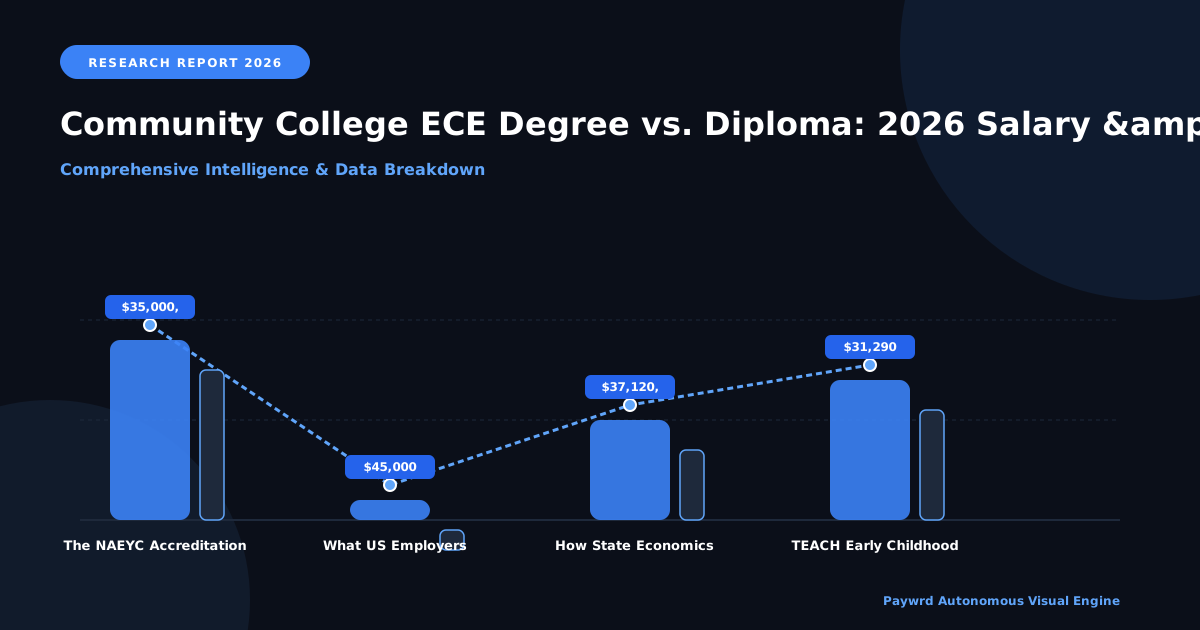
If you are weighing your options in early childhood education (ECE), the data is clear: a high school diploma simply does not cut it for career advancement anymore. According to the U.S. Bureau of Labor Statistics (BLS), preschool teachers with an associate degree consistently out-earn their non-credentialed counterparts. While the median annual wage for preschool teachers hovers around $35,000, those holding an Associate of Applied Science in ECE often see salaries pushing toward $45,000 or more in high-demand regions. This wage gap reflects a broader shift in employer expectations across the United States.

Regional demand for qualified educators is surging, particularly for lead teacher positions in Head Start programs, public pre-K initiatives, and elite private centers. Federal guidelines for Head Start now mandate that lead teachers hold at least an associate degree in ECE or a related field. Public pre-K systems across states like New York, California, and Texas are following suit, prioritizing candidates with formal postsecondary education over those with just a high school diploma. By enrolling in a community college program, you position yourself at the front of the hiring line for these stable, benefit-rich roles.
One of the most strategic advantages of a community college ECE degree is the seamless articulation agreements these institutions hold with four-year universities. Instead of starting from scratch, your associate degree credits transfer directly into a bachelor’s program in ECE. This articulation not only saves you tens of thousands of dollars in tuition—especially when leveraging federal aid through the FAFSA—but it also cuts your time to a bachelor’s degree in half. The U.S. Department of Education heavily supports these transfer pathways, ensuring that your hard-earned credits retain their value when you decide to upskill for administrative or curriculum director roles.
Many aspiring educators ask about the Child Development Associate (CDA) credential. While the CDA is an excellent stepping stone and a mandatory baseline for many entry-level assistant positions, it falls short as a standalone qualification for long-term career mobility. A CDA can get your foot in the door, but a community college degree builds the comprehensive pedagogical foundation that employers demand for advancement. Think of the CDA as the appetizer and the associate degree as the main course.
- Higher Earning Potential: Associate degree holders out-earn high school diploma holders by up to 25% in lead teacher roles.
- Mandated Qualifications: Head Start and public pre-K programs increasingly require an associate degree for lead teachers.
- Seamless Transferability: Articulation agreements ensure community college credits transfer efficiently to four-year bachelor programs.
- CDA as a Stepping Stone: The CDA credential is great for entry-level work, but an associate degree is necessary for true career mobility.
CDA Credential vs. Associate Degree: Which Path Do US Employers Actually Prefer?
If you are looking for the fastest route into a classroom, the Child Development Associate (CDA) credential often seems like the obvious choice. Administered by the Council for Professional Recognition, the CDA is a respected fast-track that requires 120 hours of formal coursework, 480 hours of professional observation hours, and a strict renewal process every three years. It is a fantastic entry point, but how does it stack up against a community college associate degree when you are eyeing long-term career growth?
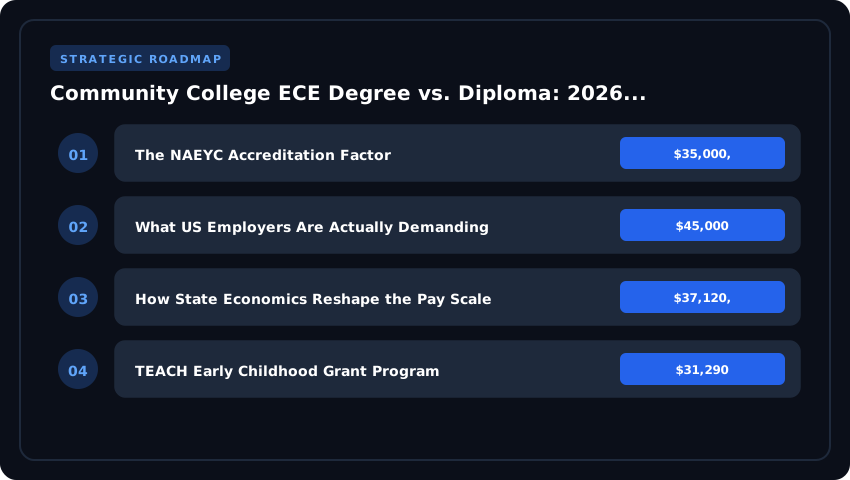
The NAEYC Accreditation Factor
When US employers post open roles, their preferences are heavily dictated by accreditation standards. The National Association for the Education of Young Children (NAEYC) sets the gold standard for center quality. Under current NAEYC accreditation guidelines, lead teachers in accredited centers must hold at least an associate degree. While a CDA proves your foundational competency, it simply does not satisfy this threshold. If you want to work at a top-tier facility, that two-year degree is non-negotiable.
What US Employers Are Actually Demanding
Recent employer recognition surveys from major US child care chains, public school districts, and Head Start grantees reveal a clear divide. Head
2026 Salary Ranges: Associate Degree Lead Teachers vs. High School Diploma Assistants
Early childhood education (ECE) compensation in 2026 follows a well-defined credentialing premium, and the dollars tell the story clearly. According to the latest U.S. Bureau of Labor Statistics (BLS) Occupational Employment Statistics, the median annual wage for preschool teachers sits near $37,120, while child care workers average closer to $31,290. Filter those figures by education level, and a striking gap emerges: associate degree holders routinely land in the $34,000–$45,000 band, while high school diploma assistants frequently cap out between $28,000–$33,000. That translates into a real-world premium of $5,000 to $12,000 annually, or roughly a 15%–25% lift, for completing a two-year ECE program at a community college.
How State Economics Reshape the Pay Scale
Geography moves the needle dramatically. California tops the leader boards, with coastal districts pushing lead teacher pay past $52,000, though high housing costs in San Diego and Los Angeles trim real purchasing power. New York follows closely, where NYC Pre-K expansions and union-backed salary schedules frequently push experienced associate-degree teachers above $48,000. Texas and Florida, both Sun Belt growth states, show strong nominal wages but lower cost-of-living adjustments: lead teachers in Houston, Austin, Miami, and Orlando typically earn $36,000–$42,000, while diploma-only assistants hover around $29,000–$32,000. The takeaway? A $40,000 salary in Tulsa, Oklahoma stretches far further than the same paycheck in Manhattan.
Entry-Level vs. Experienced Pay Within Center-Based Programs
Within a single employer, the credential-to-promotion pipeline is remarkably consistent. A high school graduate entering a national chain like Bright Horizons or KinderCare typically starts near $30,000 as a float or assistant teacher. After completing an associate degree and earning lead teacher status, the same employee commonly jumps to $38,000–$42,000 within 18 months. Public pre-K classrooms funded through state initiatives (such as Florida’s VPK or California’s CSPP) add another layer, with experienced lead teachers in those programs frequently earning $45,000–$55,000 plus comprehensive state benefits.
Benefits, Bonuses, and Tuition Reimbursement That Move the Needle
Base salary is only part of the compensation picture. Large US employers increasingly sweeten offers with:
- Tuition reimbursement programs covering 100% of community college ECE tuition, often administered through partnerships with Guild Education or similar platforms.
- Signing bonuses ranging from $500 to $2,500 at high-need centers, particularly in urban Title I districts.
- Comprehensive benefits packages including health insurance, retirement matching (401(k) or 403(b)), and paid planning time.
- Childcare discounts averaging 50% off for staff dependents, a perk worth an additional $6,000–$10,000 annually in family budget relief.
- Career ladder stipends of $1,000–$3,000 upon earning the Child Development Associate (CDA) credential or an associate degree.
When stacked together, these benefits can push total compensation for an associate-degreed lead teacher comfortably past the $50,000 mark, making the community college pathway one of the highest-return workforce investments available in 2026.
State Workforce Initiatives and Tuition Support for Aspiring ECE Teachers
Affording an early childhood education (ECE) associate degree is far more manageable in 2026 than many prospective students realize, thanks to a robust patchwork of state and federal funding pipelines. For working professionals and career changers alike, these programs can effectively erase tuition barriers while connecting you directly to employer-recognized credentials.
TEACH Early Childhood Grant Program
The most impactful federal-state hybrid initiative is the TEACH Early Childhood Grant program, administered through the U.S. Department of Education in coordination with state agencies. This competitive grant covers up to $4,000 per year in tuition and fees for candidates who commit to working in a qualifying low-income U.S. child care program for at least one year following graduation. For a typical two-year associate degree costing $6,000-$8,000 at a community college, the TEACH grant can dramatically reduce out-of-pocket expenses, sometimes to near-zero for eligible candidates who also receive Pell Grant support through FAFSA.
State-Funded Scholarship Pipelines
Several states have built dedicated scholarship pipelines targeting the ECE workforce shortage. Georgia offers the Early Childhood Education Scholarship through the Georgia Student Finance Commission, prioritizing candidates who commit to working in licensed child care facilities. Minnesota runs the Pipeline Scholarship Program, which covers tuition, books, and child care costs for paraprofessionals pursuing degrees. North Carolina funds the EC Scholars program, channeling dollars through community college partnerships to fast-track degree completion for working teachers. Each program typically requires a service obligation of one to three years in a high-need setting.
Wage Supplement and SEED-Style Stipends
Compensation initiatives like the SEED stipend model—originally piloted through federal innovation grants and now adapted by states such as California, Massachusetts, and Washington—provide monthly wage supplements ranging from $300 to $1,000 to ECE educators while they complete their degrees. These stipends reduce financial pressure during the two-year study period, recognizing that working full-time while enrolled is the reality for most adult learners in this field.
Articulation Agreements with State Universities
Community colleges across the country have negotiated articulation agreements with state university systems guaranteeing junior-year standing for associate degree holders. In the University of North Carolina system, the Comprehensive Articulation Agreement (CAA) ensures seamless credit transfer, while Georgia’s Regents’ Engineering Pathways-style transfer frameworks apply broadly to ECE. Minnesota’s MnSCU system guarantees admission to participating universities for associate graduates. These agreements protect your credit investment and accelerate timelines to higher-paying bachelor’s-level roles, where salaries climb to $48,000-$62,000 according to BLS data.
ABET, AACSB, and NAEYC: Decoding Accreditation Signals US Employers Trust
When you are scanning a community college catalog, the alphabet soup of accreditation agencies can feel overwhelming. You see ABET for engineering, AACSB for business, and NAEYC for early childhood education. But what do these signals actually mean for your future salary and employability? To put it simply: institutional accreditation keeps the lights on, but programmatic accreditation gets you the job.
Institutional accreditation—typically regional accreditation recognized by the US Dept of Education—proves a school is financially stable and allows students to access FAFSA. However, regional accreditation only verifies that the college exists and meets baseline operational standards. Programmatic accreditation, on the other hand, proves that a specific degree program meets rigorous industry standards. For ECE professionals, the gold standard is NAEYC (National Association for the Education of Young Children).
Why does NAEYC matter more than regional accreditation for ECE-specific hiring? Because daycare centers, preschools, and private employers trust NAEYC to vet curriculum quality, faculty credentials, and clinical practicum hours. When a hiring manager sees a NAEYC-accredited associate degree on your resume, they know you have been trained in developmentally appropriate practices, not just basic childcare supervision. It signals readiness to handle complex classroom dynamics.
This distinction is especially critical for federally funded programs. Federal Head Start performance standards explicitly reference NAEYC guidelines and state credentialing frameworks when defining what constitutes a “qualified teacher.” If you want to secure a higher-paying role at a Head Start center, holding a degree from a NAEYC-accredited program often fast-tracks your hiring process and satisfies strict federal compliance requirements.
So, how do you verify this on a transcript? You need to look beyond the overall degree title. Employers actively screen for red flags, and a transcript from a non-accredited training program is a massive stop sign. If your credits were earned at an unaccredited online center or a fly-by-night training academy, employers will not recognize the credential, and those credits will not transfer to a four-year university.
What Employers Look For When Verifying Credentials
- Institutional Recognition: The transcript must bear the seal of a regionally accredited institution recognized by the US Dept of Education.
- Programmatic Alignment: Look for explicit mentions of NAEYC accreditation on the program description or transcript supplements.
- State Credentialing: Ensure the program aligns with your state’s specific Child Development Associate (CDA) or state teaching license frameworks.
- Transferability: Credits should seamlessly transfer to a four-year bachelor’s program if you choose to upskill later.
Do not let a lack of due diligence cost you a 25% salary bump. Always cross-reference your community college’s accreditation status directly with the US Dept of Education database before you enroll. A quick check today protects your earning potential tomorrow.
Career Pathways After the Associate Degree: From Lead Teacher to Center Director
Earning an Associate of Applied Science (AAS) or Associate of Arts (AA) in Early Childhood Education is not a final destination. It is the launchpad that propels dedicated educators into roles commanding six-figure lifetime earnings and genuine organizational leadership. In the United States, the most successful career trajectories rely heavily on articulation agreements—formal transfer partnerships between community colleges and four-year universities. These agreements guarantee that your two-year credits, particularly those aligned with the National Association for the Education of Young Children (NAEYC) standards, apply directly to bachelor’s degrees in ECE, child development, or elementary education.
Most educators pursuing upward mobility leverage these agreements to complete a Bachelor of Science in Early Childhood Education or a Bachelor of Arts in Child Development. Completing this bachelor’s jump typically lands annual salaries between $48,000 and $62,000 in 2026, according to aggregated Bureau of Labor Statistics (BLS) data. For working professionals, state-specific transfer pathways and the Finish in Four guarantees offered by public state university systems minimize financial friction. Many learners use FAFSA (Free Application for Federal Student Aid) to cover the remaining tuition costs, particularly Pell Grants for low-income earners returning to school.
However, traditional transfer tracks are not the only route. Alternative credentials such as the ECE Credential Leadership Certificate or the National Early Childhood Program Accreditation (NECPA) endorsement equip associate-degree holders with administrative competencies without the immediate time commitment of a four-year degree. Many states, including Massachusetts, Illinois, and Washington, offer specialized state-specific endorsements for infant-toddler care, Montessori instruction, or special education inclusion. These micro-credentials are highly attractive to employers seeking curriculum specialists or program coordinators.
Looking at the long-term earnings trajectory, the difference between staying at the lead teacher level and climbing to administration is stark. A lead teacher with an associate degree in 2026 averages roughly $35,000 to $40,000, while a Center Director—who typically holds at least a bachelor’s, and often a master’s—commands $65,000 to $95,000 annually. Curriculum specialists, who design instructional frameworks for preschool networks, often fall in the $58,000 to $75,000 bracket. Early intervention specialists, working with infants and toddlers with developmental delays, frequently earn premium salaries between $60,000 and $82,000 due to their specialized credentials and the heightened demand for services mandated by the Individuals with Disabilities Education Act (IDEA).
For ambitious professionals, the master’s degree remains the ultimate ROI multiplier. Programs offering concentrations in administration, policy, or advanced curriculum design prepare educators for executive roles such as Regional Director, Head Start Program Director, or ECE Consultant. These positions routinely exceed $100,000 annually. By starting at the community college level, you preserve capital, minimize student loan debt, and build the practical classroom experience that graduate admissions committees—and corporate early-learning employers—actively seek.
- Articulation Agreements: Ensure seamless transfer to bachelor’s and master’s programs at four-year universities.
- Bachelor’s Completion Boost: Expect salaries to jump to the $48,000–$62,000 range in 2026.
- Alternative Credentials: Leadership Certificates and state endorsements offer fast-tracked administrative expertise.
- Director-Level Earnings: Center Directors frequently earn $65,000–$95,000, with master’s degrees pushing lifetime earnings past $100,000.
FAQ: Early Childhood Educators’ Top Questions on Degrees, Pay, and Recognition
Early childhood educators across the United States are asking sharper questions about credentials, pay, and professional credibility than ever before. Whether you are balancing work and family or planning your next move, getting clear answers helps you invest in the right pathway. Below are the top questions professionals raise in 2026, answered with practical detail.
How long does it take to complete an ECE associate degree at a US community college?
Most Associate of Applied Science (AAS) or Associate of Arts (AA) degrees in Early Childhood Education require 60 credit hours, translating to roughly two years of full-time study. Many community colleges offer part-time, evening, and hybrid formats, allowing working educators to finish in three to four years while staying employed. Students who already hold a Child Development Associate (CDA) credential can often waive up to nine credit hours, shaving a semester off their timeline. Federal Pell Grants, available through the FAFSA, frequently cover tuition for low-income learners, with average community college tuition running between $3,500 and $5,500 per year.
Will employers pay more for an associate degree earned online from a regionally accredited school?
Yes, provided the institution holds regional accreditation recognized by the U.S. Department of Education. Employers, Head Start program directors, and state licensing bodies treat degrees from accredited online programs identically to those earned on campus. In fact, organizations like Zero to Three and the National Association for the Education of Young Children (NAEYC) prioritize competency over delivery format. Graduates with an online associate degree routinely earn starting salaries of $38,000 to $45,000 annually, roughly 15% above peers holding only a diploma.
Does the CDA expire, and can it be renewed while pursuing a degree?
The Child Development Associate credential is valid for three years and must be renewed before expiration. Renewal requires 4.5 continuing education units, a current professional portfolio, and ongoing work with young children. Fortunately, CDA candidates can stack renewal requirements with associate degree coursework, since many ECE programs integrate Council for Professional Recognition standards directly into their curricula.
Which US states offer the highest 2026 salaries for credentialed lead teachers?
According to Bureau of Labor Statistics projections and state education department data, the top-paying states for credentialed lead preschool teachers in 2026 include:
- Massachusetts – Average lead teacher salary: $52,800
- Connecticut – Average lead teacher salary: $51,200
- New York – Average lead teacher salary: $49,700
- Washington – Average lead teacher salary: $48,900
- California – Average lead teacher salary: $48,100
These states combine competitive wages with strong union representation and tuition reimbursement programs.
Is an associate degree enough to teach in a public school pre-K classroom?
In most states, yes. Public pre-K classrooms funded through state pre-K initiatives typically require at least an associate degree in early childhood education or a related field, plus state-specific certification. Some districts, however, mandate a bachelor’s degree for head teacher roles. Earning an associate degree first allows you to start teaching sooner while credits transfer toward a four-year degree later.
| Decision Criteria | Community College ECE Associate Degree (AAS) | High School Diploma (No Credential) |
|---|---|---|
| Estimated Annual Cost (2026) | $3,000 – $8,000 (in-state tuition, textbooks, supplies) | $0 (no tuition), but $0 ROI on credentials |
| Median Annual Salary (2026) | $37,500 – $43,750 (up to 25% higher than diploma) | $30,000 – $35,000 (BLS median baseline) |
| Program Duration | 2 years (60 credit hours, includes practicum) | N/A (immediate workforce entry) |
| Lead Teacher Qualification | Yes (meets NAEYC & state licensing requirements) | No (limited to assistant/aide roles) |
| Prerequisites | High school diploma or GED; placement tests in math/reading | None |
| Employer Recognition | Universally recognized; preferred by Head Start, public pre-K | Marginal; restricted to private daycare aide positions |
| Bachelor’s Transfer Pathway | Seamless articulation agreements with 4-year universities | None; requires starting college from scratch |
| 5-Year ROI (Estimated) | $188,000 – $219,000 cumulative earnings uplift | $0 credential premium; stagnant wage growth |
| Job Advancement Opportunities | Curriculum coordinator, center director, public school paraprofessional | Minimal; requires employer-sponsored CDA upgrade |
Frequently Asked Questions
How much more can ECE teachers earn with an associate degree vs. a high school diploma in 2026?
In 2026, early childhood educators holding an Associate of Applied Science in ECE earn approximately 25% more than peers with only a high school diploma. According to the U.S. Bureau of Labor Statistics, median preschool teacher wages reach $37,500-$43,750 with an associate degree, compared to $30,000-$35,000 without credentialing.
Is a community college ECE degree enough to become a lead teacher in 2026?
Yes, a community college Associate of Applied Science in Early Childhood Education satisfies lead teacher qualification requirements in most U.S. states for 2026. The degree meets NAEYC standards and state licensing benchmarks, enabling graduates to supervise classrooms in Head Start, public pre-K programs, and licensed childcare centers nationwide.
How much does a community college ECE associate degree cost in 2026?
In-state community college tuition for a two-year ECE associate degree typically ranges from $3,000 to $8,000 total in 2026, including textbooks and supplies. Many states offer tuition-free community college programs, childcare workforce scholarships, and T.E.A.C.H. Early Childhood grants that can eliminate out-of-pocket costs entirely.
Can you transfer a community college ECE degree to a four-year bachelor's program?
Yes, most U.S. community colleges have formal articulation agreements with state universities allowing seamless credit transfer. An Associate of Applied Science in ECE typically transfers 60 credit hours toward a bachelor's in Early Childhood Education or Child Development, saving students approximately two years of additional coursework and tuition expenses.
Do employers prefer an ECE associate degree over a Child Development Associate (CDA) credential?
In 2026, most U.S. employers—including Head Start, public school districts, and corporate childcare chains—prefer or require an associate degree over a standalone CDA credential. The AAS provides comprehensive coursework, practicum experience, and state licensure eligibility that a CDA alone cannot match for career advancement.
Strategic Final Takeaway
When evaluating Early Childhood Educators Community College Degree Salary Increase Employer Recognition 2026 US, base your decisions on accredited institutional standards, measurable return on investment (ROI), and up-to-date official guidelines. Always verify specific dates and requirements through official regulatory portals.

