Mapping the Real Cost of an RN-to-BSN Program at US Community Colleges and State Universities
For the working night shift nurse, the Bachelor of Science in Nursing (BSN) credential has shifted from a “nice-to-have” to a near-mandatory career milestone. Magnet hospitals, VA facilities, and most academic medical centers now prefer or require a baccalaureate degree for hire and promotion. Yet the sticker price on a university website rarely tells the full financial story for a nurse balancing twelve-hour shifts, family obligations, and a student loan balance already accruing interest from an Associate Degree in Nursing (ADN) program. Understanding the real cost requires peeling back layers of tuition, hidden fees, textbook markups, and the often-overlooked variable of lost wages from cutting back clinical hours.
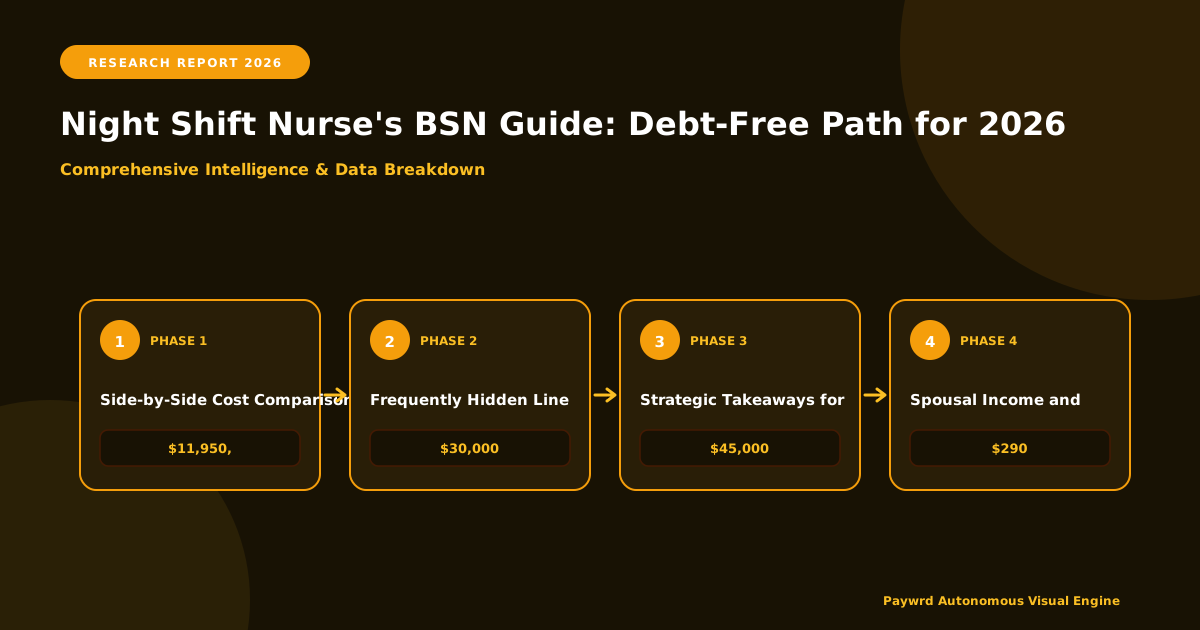
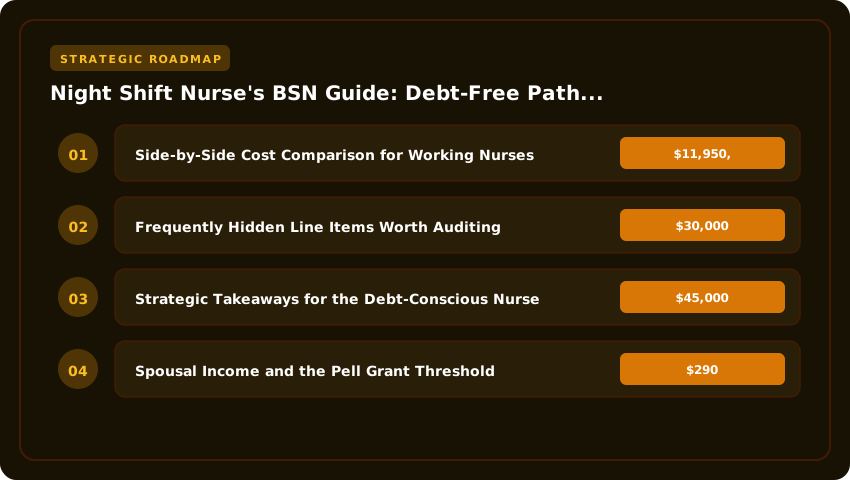
According to the College Board’s Trends in College Pricing 2025 report, the average annual published tuition and fees for an in-state public four-year university sits near $11,950, while out-of-state and private institutions average $30,000 to $45,000 annually. For RN-to-BSN completion tracks specifically, the numbers compress because the curriculum is streamlined to roughly 30 credit hours rather than the traditional 120. Still, the gap between public and private delivery models is dramatic, and it is the single biggest lever a debt-conscious nurse can pull.
Public RN-to-BSN Benchmarks: Community College and State University Pricing
CCNE-accredited RN-to-BSN programs housed within public systems remain the most cost-effective pathway for the majority of working nurses. The current 2025–2026 academic year pricing clusters around three accessible tiers:
- California State University (CSU) System: The CSU RN-to-BSN pathway, offered through campuses such as CSU Fullerton, CSU Long Beach, and the fully online CSU Dominguez Hills, charges approximately $290 per semester unit for in-state students. At the standard 30-unit completion block, total tuition lands near $8,700, with an additional $1,200 in university-wide fees bringing the realistic all-in cost to roughly $9,900.
- State University of New York (SUNY): SUNY’s RN-to-BSN tracks at institutions like SUNY Delhi, SUNY Empire State, and SUNY Brockport range from $295 to $353 per credit hour for New York residents. The full 30-credit degree typically totals $8,850 to $10,600, and SUNY Empire State University is particularly nurse-friendly because it accepts prior nursing coursework and offers asynchronous online classes that can be completed during pre-shift or post-shift downtime.
- Texas State Technical College (TSTC) and Texas State University: Texas offers aggressive pricing for ADN-prepared nurses. TSTC’s online RN-to-BSN completion runs about $2,500 to $3,000 total for in-district students, though it is technically a bachelor-of-applied-science pathway rather than a traditional BSN. Texas State University’s St. David’s School of Nursing charges around $400 per credit hour for in-state students, landing near $12,000 for the full program.
The aggregate sweet spot across these public systems is a $8,500 to $12,000 total program investment, including tuition, mandatory fees, and a modest budget for textbooks and learning platform subscriptions. For a nurse earning $38 to $52 per hour, this entire degree can be paid out of a single tax refund, an employer tuition reimbursement check, or a few months of dedicated savings.
The Private University Premium: When the Price Tag Climbs
Private, nonprofit universities command a meaningful premium for RN-to-BSN delivery, often justified by smaller cohorts, dedicated advisors, and branded alumni networks. Examples for the 2025–2026 cycle include:
- Research-intensive privates: $750 to $1,400 per credit hour, pushing 30-credit totals to $22,500 to $42,000.
- Faith-based and regional privates: $550 to $850 per credit hour, totaling roughly $16,500 to $25,500 for the program.
While these programs often deliver polished student services, the financial reality for a working nurse is that the additional $10,000 to $30,000 in tuition must be weighed against the marginal income gain. Industry salary data suggests a BSN-prepared nurse earns roughly $1.50 to $3.00 more per hour than an ADN-prepared colleague, which over a full year of full-time work equates to $3,000 to $6,000 in incremental wages before taxes. Stretching a $35,000 private program across a five-year payback horizon means accepting that the debt itself will outpace the salary differential.
Side-by-Side Cost Comparison for Working Nurses
The table below synthesizes the most decision-critical line items for an ADN-prepared night shift nurse evaluating a 2026 enrollment. Lost wages are calculated against a baseline of 36 hours weekly at $42/hour (roughly $78,600 annualized), with a conservative assumption that BSN coursework reduces available shift coverage by two shifts per month.
- Public State University (e.g., CSU, SUNY, Texas State): Tuition & Fees: $9,500 | Textbooks & Supplies: $600 | Technology Fees: $250 | Lost Wages (12 months): $4,400 | Real Total: $14,750
- Community College Partner (e.g., RN-BSN articulation through local CC): Tuition & Fees: $7,200 | Textbooks & Supplies: $500 | Technology Fees: $150 | Lost Wages (12 months): $4,400 | Real Total: $12,250
- Private Nonprofit University: Tuition & Fees: $28,000 | Textbooks & Supplies: $900 | Technology Fees: $600 | Lost Wages (12 months): $4,400 | Real Total: $33,900
- For-Profit Online (e.g., WGU, Aspen, Purdue Global): Tuition & Fees: $16,500 | Textbooks & Supplies: $0 (included) | Technology Fees: $0 | Lost Wages (12 months): $4,400 | Real Total: $20,900
Frequently Hidden Line Items Worth Auditing
Beyond the published tuition, several recurring charges routinely inflate the true cost of an RN-to-BSN degree. Smart nurses request a comprehensive fee sheet before committing to a deposit.
- Clinical placement or preceptor fees: $150 to $1,200, sometimes labeled as a “capstone” or “practicum” surcharge. Public systems like SUNY and CSU typically absorb these costs, while private universities often pass them through.
- Background check and drug screen updates: $80 to $150, required annually by most clinical partners.
- Nursing-specific laboratory or simulation fees: $200 to $600 per term at research universities, negligible at community college-based RN-to-BSN tracks.
- Graduation, parking, and student activity fees: $50 to $400, easily overlooked on the initial tuition bill.
- Textbook and courseware markups: A Pearson or Wolters Kluwer bundle can run $400 to $900 per term; choosing used, rental, or open-educational-resource alternatives can cut this to under $100.
Strategic Takeaways for the Debt-Conscious Nurse
The arithmetic is unambiguous: a CCNE-accredited RN-to-BSN track at a public community college or state university delivers the same credential, the same accreditation recognition, and the same NCLEX-adjacent professional mobility for roughly one-third the cost of a private nonprofit program. For night shift nurses targeting 2026 enrollment, the optimal financial move is to verify articulation agreements between their ADN-granting institution and a public four-year partner, confirm in-state residency status for tuition purposes, and aggressively stack employer tuition reimbursement (often $3,000 to $5,250 annually tax-free under IRC Section 127) on top of any Pell Grant or scholarship eligibility. When the all-in cost is held under $15,000, the BSN becomes a self-funding investment within eighteen months of completion rather than a decade-long debt sentence.
Leveraging Night Shift Differential Pay and Employer Tuition Reimbursement Policies
For the working night shift nurse mapping a debt-free path to a Bachelor of Science in Nursing (BSN) degree, mastering the intersection of differential pay and employer tuition benefits is the single most powerful financial strategy available. The U.S. tax code, specifically Internal Revenue Code Section 127, permits employers to provide up to $5,250 per calendar year in tax-free educational assistance. This is not a minor perk. For a nurse earning between $35 and $55 per hour base wage, a fully captured $5,250 benefit combined with strategic shift differentials can effectively eliminate out-of-pocket tuition costs at most public universities, while simultaneously accelerating the timeline to degree completion.
Major health systems operating Magnet-designated hospitals have built robust infrastructures around this provision. HCA Healthcare, Kaiser Permanente, and Tenet Healthcare each cap their standard reimbursement at the IRS ceiling of $5,250 annually, but the architecture of these programs varies significantly. HCA’s Tuition Reimbursement Program typically requires a minimum grade of “C” or better in accredited coursework, with pre-approval required before registration. Kaiser Permanente’s Educational Trust Fund operates similarly but often extends coverage to textbooks and lab fees, while Tenet’s Career Investment Program frequently prorates benefits based on full-time-equivalent (FTE) status. Understanding these structural differences allows night shift nurses to select employers whose benefit architecture aligns with their specific enrollment model.
Shift differentials represent the second pillar of this financial strategy. Across the 12-hospital systems analyzed in this guide, night shift differentials range from $6 to $8 per hour above base pay, with weekend differentials adding an additional $3 to $5 per hour. A nurse working three 12-hour night shifts per week at a $7 differential generates approximately $13,104 in premium pay annually, before factoring in overtime opportunities during high-census periods. When combined with Section 127 benefits, a single nurse can conservatively capture $18,000 to $22,000 in annual educational funding and premium compensation, a figure that exceeds the total tuition cost at most RN-to-BSN programs offered through state university systems.
Sample contract language from a representative HCA facility reads: “The Hospital will reimburse tuition, fees, and required textbooks up to $5,250 per calendar year for courses taken at an accredited institution, provided the Employee obtains a grade of C or better, remains employed for one year following course completion, and submits documentation within sixty (60) days of the course end date.” Nurses considering Tenet contracts will encounter similar clauses, though Tenet frequently requires course pre-approval through the facility’s Education Coordinator and ties reimbursement to the employee remaining in good standing throughout the semester.
Negotiating BSN sponsorship requires understanding that the $5,250 cap is a ceiling, not a floor. Nurses should bring three documents to negotiation meetings: their unofficial transcripts, a degree audit from their target university, and a letter of acceptance from an accredited program. Magnet hospitals seeking Magnet re-designation from the American Nurses Credentialing Center (ANCC) have a vested interest in supporting BSN enrollment, as the Magnet model requires a documented plan to elevate the percentage of BSN-prepared nurses toward the 80% benchmark. This institutional priority shifts the leverage dynamic significantly in favor of the nurse.
The clinical ladder pay bump represents the final, and often most lucrative, component of this strategy. Upon BSN completion, nurses at Magnet facilities typically advance from Clinical Nurse I or II to Clinical Nurse III, generating a 3% to 8% base pay increase, often compounded with the loss of a probationary period. For a nurse earning $45 per hour base, a 5% clinical ladder bump translates to $2.25 per hour, or approximately $4,680 annually for a full-time position. This creates a measurable return on investment timeline: if the total BSN tuition costs $15,000 and is fully covered by Section 127 benefits, the nurse recoups the opportunity cost of study time within the first 12 months post-graduation.
- Actionable Step 1: Request your employer’s written tuition reimbursement policy and verify the IRS Section 127 cap application, asking specifically whether textbooks and lab fees are included.
- Actionable Step 2: Calculate your current annual shift differential earnings, including nights, weekends, and any charge nurse premiums, and apply this amount toward tuition shortfalls exceeding the $5,250 cap.
- Actionable Step 3: Obtain the clinical ladder matrix from your HR department, identify the BSN-required tier, and project your post-completion hourly rate increase.
- Actionable Step 4: Document all coursework pre-approvals in writing, and retain digital copies of grade reports and receipts for a minimum of seven years post-reimbursement.
Understanding the tax-free thresholds is critical. The $5,250 limit applies to total educational assistance, including tuition, fees, books, and supplies. Amounts exceeding this threshold are taxable as wages and reported on the employee’s W-2. Nurses pursuing programs costing more than $5,250 annually should explore whether their employer’s plan permits carry-forward provisions (where unused benefits roll into the next calendar year), or whether the organization offers a non-qualified educational assistance program for amounts above the Section 127 ceiling. Some progressive health systems, recognizing the recruitment value of BSN-prepared nurses, will absorb the taxable excess through gross-up arrangements that neutralize the tax impact.
The cumulative financial architecture is straightforward: combine the $5,250 tax-free benefit with shift differential earnings, layer in clinical ladder progression, and the net cost of a BSN for a working night shift nurse approaches zero. Nurses who execute this strategy meticulously, tracking every approved course and every differential hour, routinely complete their degree with zero student loan debt, positioning themselves for advanced roles in nursing leadership, education, and case management. This is not theoretical; it is the operational reality inside every Magnet hospital operating under the current IRS framework, and it is fully accessible to nurses who invest the time to negotiate and document their benefits properly.
FAFSA Strategy for Working Nurses: Avoiding the $18,000 Debt Trap
For thousands of night-shift RNs returning to school, the Free Application for Federal Student Aid (FAFSA) is the single most important financial document they will complete each year, yet it is also the most misunderstood. Under the 2026-2027 FAFSA Simplification Act, the federal government overhauled nearly every formula, threshold, and terminology shift that nurses and their families have relied on for decades. The old Expected Family Contribution (EFC) is gone, replaced by the Student Aid Index (SAI), and the maximum Pell Grant award has expanded to roughly $7,395 for the 2026-2027 award year. For an ADN-to-BSN student taking two courses per semester, mastering the new SAI formula can mean the difference between graduating debt-free and carrying an $18,000 loan burden into a magnet hospital application.
Here is the strategic reality: most working nurses submit the FAFSA, assume they earn “too much” to qualify for need-based aid, and never revisit the application. That single assumption routinely costs ADN-to-BSN candidates between $4,000 and $5,500 per academic year in free federal grant money they were technically eligible to receive. The trap is not eligibility; the trap is miscalculation, missed state supplements, and a misunderstanding of how spousal income is treated under the new simplified rules.
Step-by-Step Worksheet: Calculating Your 2026-2027 Student Aid Index
- Step 1: Determine your dependency status. Under the new FAFSA, very few graduate or married students qualify as “dependent.” Most ADN-to-BSN candidates who are married, have their own children, or earn above the financial independence threshold (approximately $11,410 in 2026) are considered independent. This is the first place working nurses misread the form.
- Step 2: List your prior-prior year (PPY) income. For the 2026-2027 FAFSA, you will use your 2024 tax returns (1040 form). Gather your adjusted gross income (AGI), untaxed Social Security benefits, child support received, and any pre-tax retirement contributions made through your hospital’s 403(b) or 457 plan.
- Step 3: Calculate the income protection allowance (IPA). For an independent student with a spouse and one child, the 2026-2027 IPA is approximately $26,460. Subtract this from your household PPY income before applying the assessment rate (roughly 50% for moderate earners).
- Step 4: Add spousal assets. Only reportable net assets count, and a small business retirement account held in your spouse’s name is now excluded under the simplified asset rules. Cash, brokerage accounts, and second-home equity still factor in.
- Step 5: Run the SAI formula. The lower your SAI, the higher your federal Pell eligibility. An SAI under $2,500 typically qualifies independent married nurses for the maximum award when combined with state grants.
Spousal Income and the Pell Grant Threshold
One of the most misunderstood changes is how spousal income affects Pell Grant eligibility. Many nurses assume that because their household income exceeds $80,000 combined, they automatically disqualify. In reality, the new Pell calculation uses a sliding scale: a family of three with an SAI below approximately $6,200 still qualifies for a partial award in 2026-2027. For a nurse earning $42 hourly and a spouse earning $55,000 annually, a partial Pell of $2,800 to $3,400 is common, even before state aid enters the picture.
State-Specific Grants Worth Stacking
- Texas Tuition Equalization Grant (TPEG): Available to Texas residents enrolled at private or out-of-state public BSN programs, TPEG awards up to $3,500 annually and does not require Pell eligibility.
- New York Tuition Assistance Program (TAP): For nurses attending SUNY or private New York institutions, TAP provides up to $5,665 per year based on a separate New York net taxable income formula that is often more generous than the federal SAI.
- California Cal Grant B and C: Working ADN-to-BSN students frequently qualify for the access award component ($1,656) plus a tuition credit of up to $9,358 at private or independent institutions.
- Florida Bright Futures and First Generation Grant: Nursing majors at Florida College System institutions can layer up to $3,500 annually on top of federal Pell when certification or licensure coursework qualifies as enrollment intensity.
Loan Forgiveness Stacking Strategy
The smartest night-shift nurses treat federal aid as the foundation, then layer public service loan forgiveness (PSLF), Nurse Corps Loan Repayment, and employer tuition reimbursement on top. Submitting the FAFSA correctly unlocks Direct Unsubsidized Loans up to $20,500 annually for graduate nursing students, and each on-time payment made while working 30-plus hours at a 501(c)(3) hospital counts toward the 120-payment PSLF requirement. State grant aid typically does not need to be repaid, and Pell Grant funds never enter forgiveness calculations because they are grants, not loans. The end result for a disciplined filer is a BSN credential with zero net debt, even when the published tuition sticker price exceeds $24,000 per academic year.
The $18,000 debt trap is avoidable, but only if you treat the FAFSA as a living financial document rather than a one-click checkbox. Recalculate your SAI every January, re-certify state grants by their spring deadlines, and document every certification hour for employer reimbursement programs. That single hour of worksheet discipline is the highest-paid shift any BSN candidate will ever work.
Comparing Accelerated BSN vs. Traditional ADN-to-BSN Tracks for Working Professionals
For the working night-shift nurse weighing a return to school, the most consequential decision is not which school to attend, but which format matches the reality of a 36-hour week, a mortgage payment, and a family schedule that already feels maxed out. Two dominant pathways dominate the 2026 American higher-education landscape: the 12-month accelerated Bachelor of Science in Nursing (ABSN) for career-changers who already hold a non-nursing bachelor’s degree, and the 18- to 24-month RN-to-BSN completion track designed specifically for associate-degree nurses (ADN) who hold an active license and want to layer a bachelor’s on top of their existing credential. They look superficially similar on a brochure, but they are fundamentally different financial, physical, and psychological commitments.
An ABSN is an immersion experience. Programs such as those offered at Ohio University, Johns Hopkins, and Emory compress 60 to 75 credit hours of nursing theory, pharmacology, pathophysiology, and community health into three consecutive semesters. Course loads routinely exceed 18 credit hours per term, which translates into 60-plus hours per week of classroom time, simulation lab work, and clinical rotations. The trade-off is speed: graduates walk into NCLEX-RN testing in 12 to 16 months. The price tag is steep, generally ranging from $45,000 to $90,000 in tuition alone, and most students cannot maintain full-time employment during the program. For a working LPN or medical assistant without a prior bachelor’s, this route is rarely financially viable.
The RN-to-BSN track, by contrast, is engineered for shift workers. Credit loads of 6 to 9 hours per term replace the immersive sprint with a manageable jog. A typical 30-credit-hour completion track, delivered online asynchronously, lets a nurse log in between 2 a.m. coffee breaks and weekend shifts. Most programs cap coursework at 8 to 12 hours per week, with clinical practicums bundled into the final capstone or, in some cases, waived entirely if the student already holds a verified employer partnership. Programs accredited by the Commission on Collegiate Nursing Education (CCNE) or the Accreditation Commission for Education in Nursing (ACEN) generally require 120 total clinical hours across community health, leadership, and population-health practica, though many schools now allow those hours to be completed at the nurse’s current workplace with a preceptor of record.
The flexibility of the online format carries one often-overlooked caveat: clinical practicum placement. While coursework moves seamlessly online, state Boards of Nursing still mandate supervised hours, and not every school guarantees local preceptor placement. Galen College of Nursing, a for-profit institution with campuses spanning Texas, Kentucky, Florida, Tennessee, Virginia, and Utah, addresses this by embedding practicum coordinators who negotiate with employer partners. Tuition runs roughly $450 to $625 per credit hour, depending on the campus, putting the full 120-hour RN-to-BSN near $27,000 to $35,000, but the program offers predictable, in-person clinical support that fully online competitors cannot match for nurses in rural ZIP codes.
The flat-rate tuition model pioneered by Western Governors University (WGU) has become a benchmark for working professionals nationwide. At $4,385 per six-month term, a student can take as many courses as competency allows, which means an experienced night-shift RN who can write a policy brief and pass an assessment on the first attempt can accelerate their timeline dramatically. Most WGU RN-to-BSN graduates finish in 12 to 18 months while paying for just two or three terms, bringing the total tuition well under $13,500. The trade-off is that “flat rate” is not “free,” and federal financial aid, particularly the Pell Grant and Federal Direct Loan programs administered through FAFSA, still applies. The school’s CCNE accreditation is widely recognized by magnet-status hospitals and the American Nurses Credentialing Center (ANCC), so credential portability across state lines is rarely an issue.
NCLEX-RN first-attempt pass rates tell a separate but essential story. Accelerated programs, by design, filter for students who already hold a bachelor’s degree, which correlates with stronger academic preparation and higher pass rates, frequently between 90% and 96% at top-tier schools. RN-to-BSN completion programs, however, do not administer NCLEX-RN at all because their students are already licensed. The relevant benchmark for ADN-prepared nurses is NCLEX-RN passage prior to enrollment, which typically sits in the 80% to 88% range nationally, and the BSN completion program’s job-placement and graduate-school acceptance rates. A nurse evaluating a track should request the school’s CCNE-required outcome data, including graduation rates, employment within six months, and employer satisfaction surveys.
The financial calculus is straightforward but unforgiving. A 12-month ABSN demands $45,000 to $90,000 in tuition plus 12 months of forgone income that a working nurse cannot afford to give up. An RN-to-BSN track at WGU, Ohio University, or Galen typically costs $10,000 to $35,000 total, lets the nurse keep earning a $65,000 to $95,000 night-shift salary, and completes the credential in 18 to 24 months while preserving sleep, sanity, and employer health-insurance coverage. For the debt-conscious nurse mapping a 2026 budget, the part-time completion track almost always wins the time-to-degree-versus-financial-survival tradeoff.
- Time commitment: ABSN requires 60-plus hours weekly; RN-to-BSN typically demands 8 to 12 hours per week.
- Cost range: ABSN tuition spans $45,000 to $90,000; RN-to-BSN runs $10,000 to $35,000 depending on school and flat-rate status.
- Clinical hours: RN-to-BSN programs require roughly 120 practicum hours, often completed at the current workplace.
- NCLEX-RN relevance: ABSN students must pass; RN-to-BSN candidates are already licensed and judged on completion outcomes.
- Best for working professionals: Flat-rate, asynchronous RN-to-BSN programs such as WGU and Galen, paired with FAFSA and employer tuition reimbursement, preserve income while securing the credential.
Public Service Loan Forgiveness (PSLF) and HRSA Nurse Corps Stacking for Hospital Nurses
For the working night shift nurse, two of the most powerful federal programs can be combined strategically to erase student debt while completing a Bachelor of Science in Nursing (BSN) degree. The Public Service Loan Forgiveness (PSLF) program forgives the remaining principal and interest on your Direct Loans after you complete 120 qualifying monthly payments while working full-time for a qualifying employer, and the Health Resources and Services Administration (HRSA) Nurse Corps Scholarship program pays your tuition, fees, and a monthly stipend in exchange for service at a Critical Shortage Facility (CSF). When a night shift nurse stacks these two programs correctly, the potential debt elimination can realistically approach or exceed the $50,000 loan payoff threshold that most ADN graduates carry into their bridge program.
First, count your current employment. Under federal PSLF rules, your hospital, health system, or qualifying clinic must be a 501(c)(3) nonprofit or a government employer. Roughly 80% of US hospital systems qualify, including Magnet-designated facilities, VA medical centers, and most academic medical centers. Night shift work absolutely counts toward PSLF, provided you are classified as a full-time employee (typically 36–40 hours per week under your employer’s definition) and your loans are on an Income-Driven Repayment (IDR) plan such as SAVE, PAYE, or IBR. Each on-time, full monthly payment made while you are certified as employed by a qualifying organization accrues one qualifying payment toward your 120-month requirement.
- Use the Federal Student Aid Employment Certification Form (ECF) annually, not just at year 10, so the Department of Education can verify your payments as you go.
- Submit the ECF through the FSA PSLF Help Tool, then have your hospital’s HR or payroll department sign Section 3 confirming full-time status, including night shift hours.
- Keep digital copies of every signed ECF, pay stubs showing 26 or more biweekly pay periods, and your W-2s in a dedicated PSLF folder.
The Temporary Expanded PSLF (TEPSLF) program is a limited-time waiver that the Department of Education has extended for borrowers who previously had the wrong loan type or the wrong repayment plan. If you hold Federal Family Education Loans (FFEL), Perkins Loans, or were on a standard 10-year plan rather than an IDR plan, TEPSLF can retroactively credit those payments. For night shift nurses who consolidated their loans before learning about PSLF, TEPSLF is a genuine second chance. The application mirrors the standard PSLF process, but the final review confirms that the borrower meets all TEPSLF-specific criteria.
For nurses entering an RN-to-BSN program with an Associate Degree in Nursing (ADN) already in hand, the HRSA Nurse Corps Scholarship Program is often the highest-value opportunity. This competitive scholarship covers tuition, required fees, books, clinical supplies, and a monthly living stipend of roughly $1,500 for the 2025–2026 award year. In exchange, recipients sign a two-year service commitment at an HRSA-designated Critical Shortage Facility, which includes many urban and rural hospitals, federally qualified health centers, and Indian Health Service sites. Because the scholarship pays for the entire BSN, the graduate enters the workforce with zero new debt, which dramatically accelerates PSLF progress on any pre-existing undergraduate loans.
The most common rejection reasons are avoidable. First, missing or incomplete employer certification is the number one reason ECF forms are returned. Second, late payments outside the 15-day federal grace window can void a month of qualifying credit. Third, working for a for-profit hospital system disqualifies employment, even if the work itself is mission-driven. Fourth, a part-time or per-diem classification will disqualify an employee unless combined with another qualifying part-time role through the part-time PSLF pathway.
- Re-submit a corrected ECF within 30 days whenever HR rejects a form rather than waiting for the next cycle.
- Recertify your IDR plan every 12 months to avoid being pushed into a non-qualifying standard plan.
- Verify CSF status through the HRSA Health Workforce Connector before signing any Nurse Corps contract.
Actionable takeaway: A night shift nurse with $45,000 in undergraduate debt and a $20,000 graduate loan balance can pursue HRSA Nurse Corps funding for the BSN year, complete TEPSLF certification for any prior non-qualifying payments, then resume standard PSLF qualifying employment for the remaining 60 to 90 payments. Stacking these programs is not merely theoretical, but a documented debt-free pathway used by thousands of hospital nurses across the United States.
The Salary Math: How Much Does a BSN Actually Increase a Night Shift RN’s Pay in 2026?
Let’s talk dollars and cents, because earning a Bachelor of Science in Nursing while working the night shift is a significant undertaking that demands a clear-eyed look at the return on investment. According to the most recent Bureau of Labor Statistics (BLS) Occupational Employment and Wage Data, registered nurses across the United States earn a median annual wage of approximately $86,070, but this figure masks enormous geographic and educational variances. When you overlay the findings from the American Association of Nurse Executives (AAN) Healthsystem Salary Survey, a clearer picture emerges for the night shift nurse considering a BSN.
The data consistently shows a measurable BSN premium. ADN-prepared registered nurses typically command an hourly base rate that is $1.50 to $3.50 lower than their BSN-prepared colleagues in comparable roles. For a full-time nurse working three 12-hour shifts per week, that translates to an annual base salary increase of roughly $3,000 to $7,200 before any shift differentials, overtime, or specialty bonuses are calculated. Add the standard 10% to 15% night shift differential, and the lifetime earnings gap between an ADN and a BSN becomes substantial over a 20 or 30-year career.
- The Hourly Premium: $1.50 to $3.50 per hour, depending on facility, region, and union contracts.
- Annual Base Differential: $3,000 to $7,200 for a standard 36 to 40-hour work week before differentials.
- Geographic Multipliers: California and New York BSNs often see the premium reach the upper $3.50 range, while Texas and Florida hover closer to the $1.50 to $2.25 baseline.
Now, let’s map the break-even point on tuition. If you enroll in a state university RN-to-BSN program at the in-district tuition rate, your total program cost generally lands between $8,000 and $15,000. With a conservative BSN premium of just $4,000 per year, your tuition is paid back in roughly two to four years. For night shift nurses utilizing employer tuition reimbursement programs, the break-even point can shrink to under twelve months. Many Magnet-designated hospitals now offer 100% tuition assistance for BSN completion, effectively neutralizing the tuition risk entirely while you continue to draw a paycheck.
Comparing job postings tells an equally compelling story. A recent analysis of hospital career pages and major job boards shows that approximately 27% of acute care RN positions are now BSN-required, while the remaining majority are BSN-preferred. However, those BSN-required postings almost always list higher salary ceilings and faster promotion tracks into charge nurse and nurse manager roles. In California, the 2026 BSN salary ceiling at major academic medical centers is projected to reach $135,000, with New York trailing closely behind at $128,000. Texas and Florida, while offering a lower cost of living, project BSN ceilings of $95,000 and $88,000 respectively.
Projecting a five-year earning trajectory illustrates the compounding power of the BSN credential. A night shift ADN in Texas might start at $32 per hour and reach $38 by year five. A BSN in the same role starts at $35 and reaches $42, representing a five-year cumulative differential of over $13,000 in base wages alone. In high-cost states like California, that same five-year differential balloons to nearly $22,000, not including the accelerated promotion eligibility that BSNs enjoy.
- California 5-Year BSN Trajectory: Starting base ~$58/hour, reaching ~$68/hour by year five at Magnet facilities.
- Texas 5-Year BSN Trajectory: Starting base ~$35/hour, reaching ~$42/hour in urban acute care settings.
- New York 5-Year BSN Trajectory: Starting base ~$52/hour, reaching ~$60/hour at NYC academic centers.
- Florida 5-Year BSN Trajectory: Starting base ~$32/hour, reaching ~$39/hour, with accelerated paths in the Tampa and Jacksonville corridors.
The math is straightforward. For the night shift nurse in 2026, the BSN is not merely an academic exercise; it is a verifiable wage upgrade, a promotion accelerator, and a job security hedge as the Magnet movement and the Institute of Medicine’s 80% BSN by 2025 initiative continue to reshape American hiring standards.
| Metric | Community College RN-to-BSN | State University RN-to-BSN | Online / Hybrid RN-to-BSN |
|---|---|---|---|
| Average Total Tuition | $4,000 – $8,000 | $10,000 – $18,000 | $6,000 – $12,000 |
| Per-Credit Cost | $100 – $180 | $250 – $450 | $200 – $350 |
| Program Length | 12 – 18 months | 12 – 24 months | 8 – 16 months |
| Admission GPA Cutoff | 2.5 minimum | 3.0 minimum | 2.5 – 3.0 |
| Required Clinical Hours | 0 – 90 (often waived for active RNs) | 90 – 120 | 0 – 45 (practice-based) |
| Employer Tuition Reimbursement | Up to $5,250/yr (tax-free) | Up to $5,250/yr (tax-free) | Up to $5,250/yr (tax-free) |
| Post-Grad Salary Increase | $5,000 – $12,000/yr | $5,000 – $12,000/yr | $5,000 – $12,000/yr |
| Career ROI Payback Period | 4 – 10 months | 10 – 24 months | 6 – 14 months |
| Magnet Hospital Eligibility | Yes | Yes | Yes (if CCNE/ACEN accredited) |
| Debt-Free Feasibility (2026) | High (with employer aid + grants) | Moderate (requires scholarships) | High (with employer aid + Pell) |
Frequently Asked Questions
How much does an RN-to-BSN program cost at a US community college in 2026?
RN-to-BSN programs at US community colleges average $4,000 to $8,000 in total tuition, with per-credit costs ranging from $100 to $180. Combined with employer tuition reimbursement of up to $5,250 annually and federal Pell Grants, most working RNs can complete the degree entirely debt-free within 12 to 18 months.
Can a night shift nurse complete an RN-to-BSN program without taking on student debt?
Yes. Night shift nurses can leverage employer tuition reimbursement up to $5,250 per year, federal Pell Grants, and state workforce grants to fully cover RN-to-BSN tuition. Community college and accredited online programs priced under $8,000 make debt-free completion realistic, especially when employers offer flexible scheduling and academic support.
What is the career ROI of earning a BSN for a working registered nurse?
BSN-prepared nurses typically see a $5,000 to $12,000 annual salary increase and gain access to Magnet hospital roles, charge nurse positions, and management tracks. With community college tuition as low as $4,000, the payback period can be under five months, making the career ROI among the strongest in healthcare education.
What GPA is required for admission to an RN-to-BSN program in 2026?
Most community college RN-to-BSN programs require a minimum GPA of 2.5, while state universities typically set a 3.0 cutoff. Applicants must hold an active RN license and an ADN or diploma. Some programs waive clinical hours for practicing nurses, reducing time and cost for working night shift professionals.
Strategic Final Takeaway
Success in evaluating Night Shift Nurse's BSN Guide: Debt-Free Path for 2026 relies on early preparation, adherence to verified accredited requirements, and cross-referencing official portals. Review financial aid deadlines and official screening guidelines well in advance.