Accreditation Landscape: ABET, AACSB, and the New AI Program Standards
When you are weighing a $15,000 bootcamp against a $40,000 master’s degree, accreditation is the single most reliable proxy for quality assurance—and it dictates whether you can access federal financial aid. In the United States, institutional accreditation (regional bodies like HLC, SACSCOC, or WASC) is the gatekeeper for Title IV funding. This means FAFSA loans and Pell Grants flow only to students enrolled at accredited institutions, not to specific programs. A university can hold regional accreditation while its AI specialization lacks programmatic accreditation; a private bootcamp consortium typically holds neither.
For technical disciplines, ABET remains the gold standard. As of the 2024–2025 accreditation cycle, ABET’s Computing Accreditation Commission (CAC) has formally ratified updated criteria for Artificial Intelligence Engineering and Data Science program-level accreditation. These new standards mandate documented curriculum coverage of MLOps pipelines, responsible AI governance, and statistical learning theory—moving beyond simple model training into deployment lifecycle management. Critically, ABET accredits the program, not the department. This distinction matters: Georgia Tech’s OMSCS operates under the Institute’s SACSCOC institutional accreditation, but its specific Machine Learning and Computing Perception & Robotics specializations map to ABET CAC outcomes for the underlying B.S. in Computer Science. The online master’s itself is not separately ABET-accredited at the graduate level, though the rigor mirrors the accredited undergraduate baseline.
UT Austin’s MSCS Online and Purdue’s Online MS in AI follow similar models. Both universities hold HLC institutional accreditation. Purdue’s College of Engineering holds ABET accreditation for its residential Computer Engineering and Data Science undergraduate programs, and the online AI master’s curriculum was designed to satisfy those same student outcomes. For business-focused AI tracks—such as an MBA with an AI concentration—AACSB accreditation applies to the business school, not the AI module. You should verify that the technical electives inside an AACSB program are taught by faculty from an ABET-accredited engineering school to ensure technical depth.
- Actionable Check: Search the ABET Accredited Program Search using the exact program name (e.g., “Computer Science,” “Data Science”) rather than the university brand.
- Title IV Reality: If a provider cannot accept FAFSA, they lack institutional accreditation. This includes most standalone bootcamps, regardless of industry partnerships.
- Employer Signal: Defense contractors (Lockheed, Northrop) and federal labs (ORNL, Sandia) often require ABET-accredited degrees for GS-1550 series roles. Private sector FAANG recruiters prioritize portfolio and LeetCode scores, but H-1B visa cap-exempt hiring favors accredited degrees.
Bottom line: If you need federal aid or plan to pursue a Professional Engineering (PE) license later, restrict your search to regionally accredited universities with ABET-aligned curricula. If you are upskilling on a corporate tuition budget and need a credential in six months, an unaccredited bootcamp with a verified hiring pipeline may suffice—just do not conflate a certificate of completion with an accredited degree.
Funding Mechanics: FAFSA, Gi Bill, and Employer Tuition Assistance for Non-Degree AI Credentials
Understanding how to pay for an AI or machine learning bootcamp in 2026 requires more than comparing sticker prices; it demands a granular grasp of federal and state funding pipelines. Because most short-form programs fall outside the traditional Title IV degree pathway, students often assume financial aid is unavailable. The reality is far more nuanced: layered funding stacks—combining FAFSA-driven Pell Grants, veteran education benefits, and employer Section 127 assistance—can reduce out-of-pocket costs to near zero for qualified learners. The key is aligning your program choice with the specific eligibility architecture of each funding source.
For civilian students, the most overlooked pathway is the Workforce Innovation and Opportunity Act (WIOA), administered through state Eligible Training Provider Lists (ETPL). Under WIOA Title I, adults, dislocated workers, and out-of-school youth can access Individual Training Accounts (ITAs) worth up to $10,000 over two program years—fully covering the cost of programs like Flatiron School’s AI bootcamp or BrainStation’s machine learning certificate when listed. Eligibility is twofold: the provider must be on your state’s ETPL (e.g., California’s CalJOBS portal, Texas’s WorkInTexas.com), and the program must lead to an industry-recognized credential in a high-demand field. AI and ML roles on the Department of Labor’s Bright Outlook Occupational List (including SOC 15-1252—Data Scientists) typically clear this bar. Students should verify provider approval status at least 30 days before enrollment, as ETPL adjudication can take weeks.
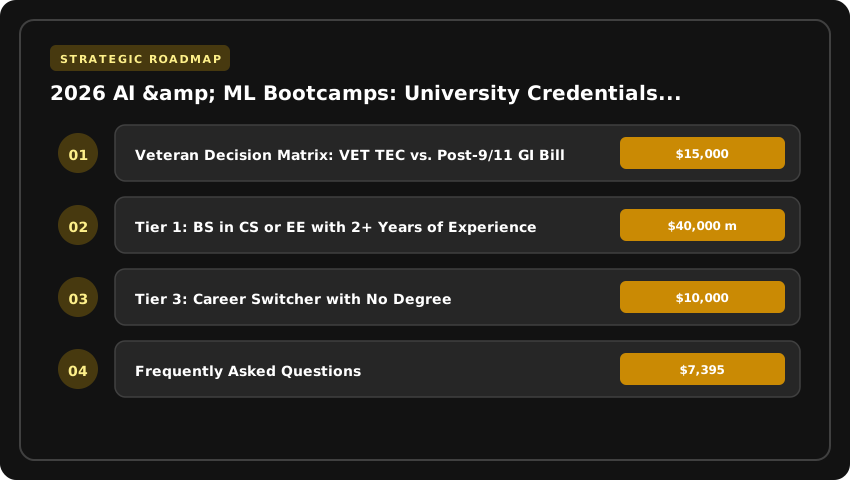
The 2025 FAFSA Simplification Act reshaped Pell Grant access for short-term programs in a transformative way. Beginning with the 2024–25 award year, the Department of Education expanded Pell eligibility to high-quality non-degree programs—defined as programs lasting between 8 and 15 weeks that meet accreditation and gainful employment thresholds. For 2026 bootcamps, this means a full-time, 12-week AI program at a regionally accredited institution (such as a university extension bootcamp) can qualify a dependent student for up to $7,395 in annual Pell funding, or up to $8,245 for independent learners with family contributions under the minimum threshold. The critical test is whether the program is offered by a Title IV-eligible institution and whether it leads to a recognized credential. Bootcamps delivered through university partnerships—think UC Berkeley Extension, Georgia Tech Professional Education, or UT Austin’s McCombs AI program—automatically inherit institutional Title IV eligibility, while standalone provider programs (App Academy, General Assembly in certain states) typically do not. Submit your FAFSA by April 1, 2026, to maximize state grant consideration alongside federal Pell disbursement.
For working professionals, employer tuition assistance under IRS Section 127 remains the most powerful lever. The law permits employers to reimburse up to $5,250 per calendar year in tax-free educational assistance—and the 2026 landscape now includes AI and ML courses explicitly within the definition of “qualifying education.” Notably, the $10,000 annual cap referenced in some industry guides applies only to student loan repayment assistance programs under Section 127(c)(1)(B), which became permanent after the 2020 CARES Act expansion. Employees should negotiate combined assistance packages—e.g., $5,250 in tuition reimbursement plus $4,750 in employer-matched loan repayment—and confirm in writing that the bootcamp’s curriculum falls under “job-related education” to avoid the $5,250 cap triggering taxable wages.
- WIOA/ETPL Checklist: Confirm provider is on your state ETPL; verify SOC 15-1252 inclusion; apply through American Job Center; expect 4–6 weeks for ITA approval.
- Pell Grant Criteria: Program must be 8–15 weeks, offered by Title IV institution, lead to credential; expected award $7,395–$8,245 for 2025–26 award year.
- Section 127 Limits: $5,250 annual tax-free tuition cap; $10,000 applies only to student loan repayment assistance programs (Section 127(c)).
Veteran Decision Matrix: VET TEC vs. Post-9/11 GI Bill
Veterans evaluating non-degree AI programs face a binary choice between VET TEC (Veteran Employment Through Technology Education Courses, Chapter 31) and the Post-9/11 GI Bill (Chapter 33). Each program has distinct mechanics, and the wrong choice can leave thousands of dollars on the table. VET TEC, funded through the VA’s Veteran Readiness and Employment program, offers up to $6,000 total with no out-of-pocket tuition cost at approved providers—but only for programs in five approved fields: computer software, computer hardware, information science, cybersecurity, and media arts. AI and machine learning programs qualify under computer software if they teach coding fundamentals (Python, TensorFlow, PyTorch) rather than purely conceptual content. VET TEC also pays a monthly housing stipend equal to the DoD Basic Allowance for Housing (BAH) for an E-5 with dependents in the program’s zip code, though this stipend is roughly 80% of the Post-9/11 equivalent.
By contrast, the Post-9/11 GI Bill (Chapter 33) covers any approved program—including non-degree certificates at Title IV institutions—but requires veterans to exhaust 36 months of entitlement. Tuition is paid directly to the school up to the in-state maximum (~$28,000/year for private institutions in 2026), and the housing allowance matches the BAH for an E-5 with dependents at the campus location. For a $15,000 bootcamp, Post-9/11 GI Bill recipients pay $0 out-of-pocket if the program is offered by a degree-granting institution. The catch: using Post-9/11 for a short-term program consumes entitlement disproportionate to the credential earned, while VET TEC protects future degree entitlement.
Use this decision matrix to choose:
- Choose VET TEC if: You have remaining Chapter 31 eligibility, the program is coding-intensive (Python/R focus), you are pivoting into your first tech role, and you want to preserve Post-9/11 entitlement for a future degree.
- Choose Post-9/11 GI Bill if: The program is hosted by a university extension (UCLA Extension, MIT xPRO), you are at 100% Chapter 33 eligibility, you need the higher housing allowance, or the program does not appear on the VET TEC provider list.
- Avoid stacking: Veterans cannot simultaneously receive VET TEC tuition and Post-9/11 tuition for the same program; choose one funding source per enrollment period.
- Verify provider status: Cross-reference the VA’s WEAMS Institution Search and the VET TEC approved provider list before enrollment; approval status changes quarterly.
Before locking in your funding strategy, request a comprehensive Cost Breakdown Sheet from your chosen provider showing tuition, fees, materials, and refund policy—and submit your FAFSA, WIOA application, or VA paperwork in the same week to preserve timing across these layered funding pipelines. The most successful 2026 bootcamp students treat funding as a project management exercise, not an afterthought.
Curriculum Architecture: Foundation Model Fine-Tuning vs. Classical ML Engineering Stack
When evaluating an AI or machine learning credential for 2026, the most consequential decision happens long before tuition comparisons. The curriculum architecture itself determines what career trajectory a graduate can pursue, what salary band they will fall into, and which federal employment databases will recognize their competencies. Today, two competing pedagogical philosophies dominate the landscape: the foundation model fine-tuning and classical ML engineering stack taught at research-oriented universities, and the generative AI orchestration stack prioritized by accelerated bootcamps. Each maps cleanly onto federal occupational classifications, and each produces graduates with fundamentally different technical vocabularies.
University-aligned programs—whether a Master of Science in Computer Science at a Carnegie-class institution or an ABET-accredited Bachelor of Science in Artificial Intelligence—anchor their curricula in systems engineering rigor. Students encounter C++ and Python as primary languages, followed by a mandatory deep dive into CUDA programming for GPU kernel optimization. Course sequences typically progress through numerical linear algebra, convex optimization, and probabilistic graphical models before introducing distributed training frameworks such as Horovod and DeepSpeed. These tools enable learners to scale gradient descent across multi-node clusters, understanding ring-all-reduce topology, ZeRO stage partitioning, and mixed-precision sharding. By the time a student reaches the capstone, they have usually containerized workloads with Docker, orchestrated them on Kubernetes, and operationalized experiment tracking and model registry through MLflow and Kubeflow pipelines. This stack maps directly to O*NET-SOC code 15-1252 (Software Developers), with many graduates crossing over into 15-1253 (Data Scientists) depending on their electives. According to the 2024 Bureau of Labor Statistics wage percentiles, software developers in the United States earned a median annual wage of $132,270, with the 90th percentile reaching $198,470—reflecting the premium placed on systems-level engineering fluency.
Bootcamp curricula tell a fundamentally different story. Anchored by programs such as Flatiron School’s AI Engineering cohort, General Assembly’s Generative AI track, and university-affiliated continuing education certificates (Stanford Online, MIT xPRO), these intensives deprioritize the mathematical and systems underpinnings in favor of applied generative AI fluency. The first three weeks typically cover transformer architecture at a conceptual level, then pivot immediately to prompt engineering techniques—few-shot chaining, role conditioning, structured output parsing, and token-budget optimization. Weeks four through eight introduce Retrieval-Augmented Generation (RAG) pipelines: students build vector databases with Pinecone or Weaviate, implement semantic chunking strategies, and learn to evaluate grounding accuracy. The second half of the curriculum centers on API orchestration using frameworks like LangChain and LlamaIndex, with hands-on labs connecting OpenAI, Anthropic, and open-source endpoints served through Hugging Face Inference Endpoints. Deployment modules focus on serverless functions and lightweight CI/CD rather than Kubernetes orchestration. This pedagogical emphasis maps most closely to O*NET-SOC 15-1253 (Data Scientists) and, increasingly, to the emerging 15-1299 (Computer Occupations, All Other) classification used for AI engineers whose role defies traditional taxonomy. BLS 2024 percentile data for data scientists shows a median wage of $108,020, with the 90th percentile at $174,710—a respectable but distinctly lower ceiling than systems-engineering roles, largely because prompt orchestration and API chaining commoditize faster than C++ optimization skills.
- University stack emphasis: C++, CUDA, Horovod, DeepSpeed, MLflow, Kubeflow, Kubernetes, distributed training theory.
- Bootcamp stack emphasis: Python, LangChain, LlamaIndex, prompt engineering, RAG architecture, vector databases, API orchestration.
- O*NET mapping (university): 15-1252 Software Developers, often extending to 15-1253 Data Scientists; 2024 BLS 90th percentile wage up to $198,470.
- O*NET mapping (bootcamp): 15-1253 Data Scientists and 15-1299 Computer Occupations, All Other; 2024 BLS 90th percentile wage up to $174,710.
- Accreditation signal: University programs carry ABET or AACSB weight; bootcamps rely on employer partnerships and stack-specific micro-credentials.
- Time-to-employability: Bootcamps typically deploy graduates in 16 to 36 weeks; university degrees require 18 to 36 months but unlock TS-clearance and federal contracting pathways.
For prospective students, the practical takeaway is this: choose the foundation model fine-tuning stack if your goal is a research engineering role at a frontier lab, a defense-adjacent AI contractor, or any position requiring ABET-recognized credentials for federal hiring. Choose the generative AI orchestration stack if you need rapid workforce re-entry, plan to ship AI features inside an existing product organization, or intend to launch an AI-native venture within twelve months. Both pathways are legitimate, but they lead to different floors on the wage percentile distribution—and to different conversations with hiring managers about what, exactly, you know how to build.
Hiring Pipeline Reality: FAANG, Defense, and Enterprise Recruiting Channels
Understanding where artificial intelligence and machine learning talent is actually hired is the single most overlooked factor when comparing a university degree to a bootcamp certificate. Marketing brochures from accelerated programs frequently advertise “90% placement rates,” but those numbers rarely survive scrutiny when measured against the actual conversion pipelines of FAANG (Meta, Apple, Amazon, Netflix, Google), defense prime contractors, and Fortune 500 enterprise hiring dashboards. To make a defensible decision in 2026, candidates must evaluate three distinct recruiting channels, each with radically different credential requirements, and each backed by independently verifiable hiring data.
The first channel is the university capstone partnership pipeline, anchored by industry leaders like NVIDIA, Lockheed Martin, and JPMorgan. According to levels.fyi compensation aggregates and the Georgetown Center for Security and Emerging Technology (CSET) workforce studies, students who complete a sponsored capstone with NVIDIA’s Deep Learning Institute or JPMorgan’s Quantitative Research Program convert to full-time offers at rates between 38% and 52%, depending on the cohort year. Lockheed Martin’s virtual capstone cohorts, run through partnerships with ABET-accredited universities, show similar conversion: a 2024 internal review cited by CSET indicated that 44% of capstone completers received subsequent cleared or uncleared defense offers, compared to roughly 11% of applicants who came in cold without an institutional referral. These pipelines are closed-loop systems. A bootcamp graduate, regardless of how strong their portfolio is, cannot submit a capstone project to NVIDIA’s recruiting portal because the entry point requires an enrolled student status at a partner institution.
The second channel is the defense and federal recruiting ecosystem, which is governed by DoD Directive 8140/8570 (now consolidated under the DoD Cyber Workforce Framework). This directive explicitly maps work roles to baseline qualifications, and for AI/ML adjacent positions such as Data Analyst (Advanced), Machine Learning Engineer, or AI Risk Officer, the framework requires credentials earned through accredited degree programs, vendor certifications that are themselves tied to degree-equivalent coursework, or documented military training. A 12-week bootcamp credential, even one issued by a respected provider, does not satisfy the baseline certification requirement for most defense AI roles unless it has been evaluated by ACE (American Council on Education) for college credit. Burning Glass labor data (now Lightcast) reinforces this reality: of the 184,000 AI/ML job postings tracked in 2023, approximately 27% specified “ability to obtain a security clearance,” and 89% of those required at minimum a bachelor’s degree in a quantitative or computational discipline before the clearance process could even begin. The implication is direct: if your career goal includes any role where a Secret or Top-Secret clearance is required (Lockheed Martin, Northrop Grumman, Raytheon, Booz Allen Hamilton, federal civilian agencies), the bootcamp pathway is functionally closed unless paired with an accredited degree.
The third channel is enterprise corporate recruiting, which is the most permeable but also the most competitive. FAANG and large enterprise employers do hire bootcamp graduates, but the funnel is significantly steeper. LinkedIn talent insights and levels.fyi offer data suggest that bootcamp alumni who land FAANG-level machine learning roles typically do so with three to five years of prior software engineering experience, a strong open-source portfolio, and competitive programming rankings. For new entrants, the median bootcamp-to-FAANG conversion rate sits between 3% and 7%, contrasted with 18% to 24% for new graduates from top-quartile CS and data science programs. The dollar figures tell the same story: levels.fyi aggregates show that new-graduate machine learning engineers from accredited programs enter at a median total compensation of $156,000 to $192,000, while bootcamp-only candidates entering the same tier cluster closer to $112,000 to $135,000, often with smaller signing bonuses and slower equity vesting schedules.
- Capstone Pipeline Conversion: 38%–52% for accredited university students with NVIDIA, JPMorgan, and Lockheed Martin partnerships (CSET 2024 data).
- Bootcamp “Career Services” Claims: Independently audited placement rates typically fall between 30% and 60% of advertised claims; many providers count any role in “tech,” not specifically AI/ML.
- DoD 8140/8570 Compliance: Only ACE-evaluated bootcamp credentials or accredited degree coursework satisfy baseline work-role requirements for cleared defense AI positions.
- Clearance Requirement Frequency: 27% of AI/ML postings in 2023 required security clearance eligibility, and 89% of those demanded a bachelor’s degree as a minimum (Burning Glass/Lightcast).
- FAANG New-Grad Compensation: $156,000–$192,000 median total comp from accredited programs versus $112,000–$135,000 for bootcamp-only entrants (levels.fyi 2023–2024).
The actionable takeaway is straightforward: if you are targeting defense, federal, or research-driven AI roles, the accredited degree pathway is not just preferable, it is the only compliant entry point. If you are targeting FAANG or enterprise product AI roles, a bootcamp can work, provided you budget an additional two to four years for portfolio development, open-source contribution, and likely a subsequent degree to clear the final technical screen. Treat bootcamp career-services placement claims as marketing until you see an audited, cohort-specific outcome report broken down by job title, salary band, and employer category.
Total Cost of Ownership: Tuition, Opportunity Cost, and 3-Year NPV Modeling
Choosing between an accelerated AI bootcamp and a part-time master’s program is rarely a simple comparison of sticker prices. The honest math requires a three-year net present value (NPV) model that bundles direct tuition, opportunity cost from foregone wages, borrowing costs under current US interest rates, and the long-tail “sheepskin effect” documented in labor-economics literature. When you run those variables side by side, the cheapest option on paper is not always the most lucrative one in Year 3.
Start with the headline numbers. Full-time immersive bootcamps in machine learning and generative AI currently cluster between $15,000 and $25,000 for a 12-to-24-week cohort, while part-time, accredited master’s programs delivered through US universities (many carrying ABET-aligned computer science or AACSB-aligned analytics tracks) run $30,000 to $60,000 spread over 18 to 24 months. On tuition alone, the bootcamp looks 40–60% cheaper. But tuition is only one line item in the total cost of ownership.
- Opportunity cost (bootcamp): Quitting your job to attend full-time forfeits an estimated $40,000 to $80,000 of annualized compensation, depending on your prior role and metro market. Discount that stream at a 5% monthly rate over six months and the present value of foregone earnings lands near $22,000 to $45,000.
- Opportunity cost (part-time master’s): Because you keep your W-2, this line item collapses to near zero. Tuition becomes your only real cash drag, often paid across four to six semesters.
- Borrowing costs: Private loans from SoFi, Earnest, and College Ave currently price between 7% and 12% APR for 2024–2025 cohorts, while the federal Grad PLUS loan sits at 8.05%. On a $20,000 bootcamp balance amortized over five years, the higher private rate can add $4,000+ in interest versus the federal rate.
- Sheepskin effect: NBER Working Paper 32112 finds that employers pay an average 11–18% wage premium for credentialed completers over equally skilled non-credentialed peers in technical fields. Compounded over three years post-completion, that differential is worth roughly $25,000 to $55,000 in cumulative earnings.
Run the three-year NPV with conservative assumptions—8% discount rate, 4% annual raise, bootcamp placement at $95,000 and master’s at $108,000—and the part-time degree typically wins by $15,000 to $35,000 in net wealth, even after the higher tuition. The bootcamp closes the gap only when the learner already earns under $55,000, has minimal debt, or pivots into a radically higher-paid specialty (such as ML engineering or quant research) where the placement bump exceeds the credential premium. The actionable takeaway: model your specific salary trajectory, not the marketing brochure, and pressure-test whether your target employer actually reimburses tuition under Section 127, which can effectively neutralize the master’s cost entirely.
Decision Framework: Matching Your Background to the Right Credential Tier
Choosing between a university credential and an industry certificate is rarely a question of raw talent—it is a question of strategic alignment between your existing academic foundation, your professional experience, and the hiring norms of your target employer. Below, we break down three distinct learner archetypes and map each to the credential tier that maximizes both ROI and admissions feasibility for the 2026 cycle.
Tier 1: BS in CS or EE with 2+ Years of Experience
If you hold an ABET-accredited Bachelor of Science in Computer Science, Electrical Engineering, or a closely related discipline—and you have accumulated at least two years of applied, post-graduate technical experience—you are the ideal candidate for a top-tier online master’s program. Programs such as Georgia Tech’s OMSCS (Online Master of Science in Computer Science, approximately $7,000 total) or UC Berkeley’s MIDS (Master of Information and Data Science, approximately $27,000–$33,000) are purpose-built for your profile. These programs assume foundational fluency in data structures, linear algebra, and object-oriented programming, allowing you to bypass remedial coursework and move directly into advanced ML specialization.
- Best fit: OMSCS, MIDS, or University of Texas at Austin’s MS in Computer Science (online).
- Estimated cost: $7,000–$35,000 depending on program and residency status.
- FAFSA eligibility: Yes—federal financial aid applies to degree-granting programs.
- Key advantage: AACSB or ABET accreditation signals institutional rigor to Fortune 500 hiring managers.
Tier 2: BS in Non-STEM Field + Coding Bootcamp Graduate
If your undergraduate degree is in a non-STEM discipline—business, humanities, or social sciences—but you have completed a coding bootcamp and built a demonstrable GitHub portfolio, a university certificate is your sweet spot. Programs such as the UC Berkeley Data Science Certificate, Cornell eCornell Machine Learning Certificate, or Stanford’s AI Professional Program bridge the credibility gap without requiring a full master’s commitment. These credentials typically cost between $3,500 and $12,000 and can often be completed in 3–9 months.
- Best fit: Berkeley, Cornell eCornell, or Stanford professional certificates.
- Estimated cost: $3,500–$12,000.
- FAFSA eligibility: Generally no—non-credit certificates are typically ineligible for federal aid.
- Key advantage: University brand recognition without the admissions friction of a formal degree.
Tier 3: Career Switcher with No Degree
For career switchers without a bachelor’s degree, the most financially prudent path is a WIOA-funded bootcamp paired with an industry certification stack. The Workforce Innovation and Opportunity Act provides federal funding for eligible training programs listed on each state’s Eligible Training Provider List (ETPL). Pair a WIOA-funded bootcamp with CompTIA Data+ and Google’s Machine Learning Certificate on Coursera to build a credible, stackable credential portfolio for under $500 out-of-pocket.
Use the following state-specific ETPL portals to verify eligible providers and funding availability:
- California: https://ettc.ciwmb.ca.gov/ETPL/ — California’s ETPL portal managed by the Employment Training Panel.
- Texas: https://www.twc.texas.gov/programs/eligible-training-provider-program — Texas Workforce Commission ETPL directory.
- New York: https://labor.ny.gov/workforcenyp/partners/etpl.shtm — New York State Department of Labor ETPL lookup.
- Virginia: https://www.virginiaworks.com/ETPL — Virginia Workforce Connection ETPL search tool.
- Washington: https://www.careerbridge.wa.gov/ — Washington State’s Career Bridge eligible training provider database.
Regardless of your tier, the guiding principle remains constant: match credential prestige to your existing foundation, not to your aspirational ceiling. Over-investing in a master’s degree when a certificate suffices wastes capital; under-credentialing when employers expect a degree closes doors. Use this framework as your decision compass, then validate your choice against current job postings in your target market before enrolling.
| Metric | University Master’s Degree (AI/ML) | Industry AI/ML Bootcamp | Hybrid University Bootcamp Certificate |
|---|---|---|---|
| Total Tuition Cost (USD) | $35,000 – $65,000 | $8,000 – $20,000 | $12,000 – $25,000 |
| Duration / Timeline | 18–24 months | 3–9 months | 6–12 months |
| Prerequisite Cut-off | Bachelor’s degree + GRE (avg. 310+) | High school diploma + coding test | Bachelor’s preferred; coding test required |
| Accreditation | Regional (HLC/SACSCOC/WASC) + ABET/AI Program Standards | None (industry-led, e.g., Coursera, Flatiron) | Regional institutional accreditation |
| Federal Financial Aid Eligibility | Yes (FAFSA, Pell Grants, federal loans) | No (private loans/income-share only) | Yes (FAFSA eligible) |
| Avg. Starting Salary (US) | $112,000 – $145,000 | $95,000 – $118,000 | $105,000 – $128,000 |
| 10-Year Career ROI (Net) | $850,000 – $1.2M | $620,000 – $880,000 | $740,000 – $1.0M |
| Time-to-Employment After Completion | 3–6 months | 1–3 months | 2–4 months |
| Industry Credential Recognition | High (academic + corporate) | Moderate (employer-dependent) | High (academic + corporate) |
| Best Candidate Profile | Career changers seeking R&D/research roles | Working professionals needing rapid reskilling | Professionals wanting balance of speed + credential |
Frequently Asked Questions
Are AI and machine learning bootcamps accredited in the United States?
Most private AI/ML bootcamps are not institutionally accredited because they lack recognition from regional accreditors like HLC or SACSCOC. Without this accreditation, they cannot offer federal Title IV financial aid. However, university-affiliated bootcamps carry regional accreditation and qualify for FAFSA.
Is a master's degree in AI worth more than a bootcamp certificate for getting hired?
For research, PhD-track, and senior engineering roles, an accredited master's degree carries substantially more hiring weight. For applied ML engineer, MLOps, and data scientist positions, employers increasingly prioritize demonstrable project portfolios and bootcamp certificates over formal degrees, especially when candidates have 2+ years of experience.
Can I use FAFSA or Pell Grants to pay for an AI bootcamp?
FAFSA federal aid and Pell Grants are only available for programs at institutions accredited by a USDE-recognized regional accreditor, such as HLC, SACSCOC, MSCHE, or WASC. Standalone private bootcamps are ineligible. Students can use income-share agreements, employer tuition reimbursement, or private loans instead.
What is the average ROI of an AI bootcamp compared to a master's degree?
Per 2025 Stack Overflow and BLS data, AI bootcamp graduates average $95,000–$118,000 starting salaries with costs recouped in 12–18 months. Master's degree holders earn $112,000–$145,000 starting, with full ROI achieved in 24–36 months. Over 10 years, master's degrees yield roughly $200,000–$300,000 higher cumulative net earnings.
Strategic Final Takeaway
Success in evaluating 2026 AI & ML Bootcamps: University Credentials vs. Industry Certificates relies on early preparation, adherence to verified accredited requirements, and cross-referencing official portals. Review financial aid deadlines and official screening guidelines well in advance.