How Career Connected Learning Is Redefining the High School-to-Career Pipeline
Walk into any forward-thinking US high school in 2026 and the guidance counselor’s office looks nothing like it did a decade ago. Bulletin boards promoting four-year universities still exist, but they now share wall space with apprenticeship flyers from Siemens, Tesla recruiter visit announcements, and Amazon’s AWS Cloud Practitioner certification bootcamps. This visual shift captures a structural transformation happening across American secondary education: Career Connected Learning, or CCL, has moved from a niche vocational experiment into the dominant framework for preparing young adults for the modern economy.
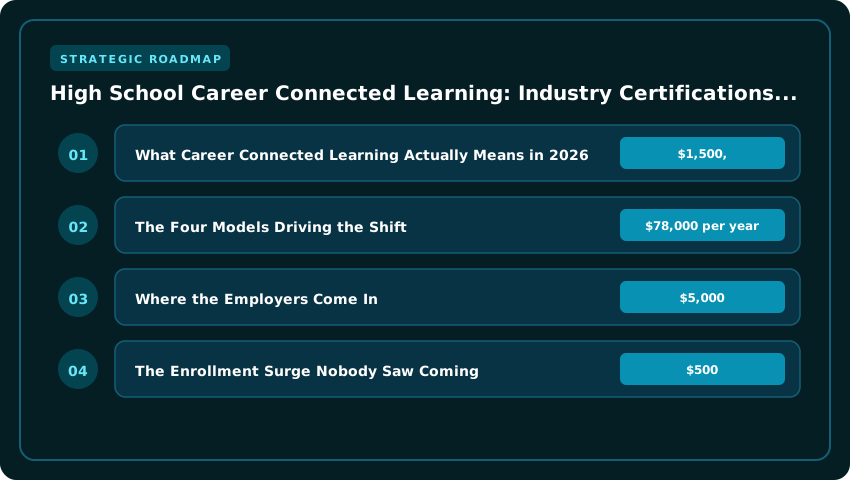
What Career Connected Learning Actually Means in 2026
Under the 2024 Strengthening Career and Technical Education for the 21st Century Act (commonly called Perkins V reauthorization), Career Connected Learning is defined as an integrated sequence of work-based learning experiences that begins in secondary education and extends through postsecondary training. The framework prioritizes three measurable outcomes: industry-recognized credentials earned before graduation, paid work experience tied to academic credit, and direct handoffs into high-demand careers. State CCL frameworks in Ohio, Kentucky, Tennessee, and Washington now formally require districts to track these outcomes, making the model a compliance priority rather than an optional enrichment program.
The Four Models Driving the Shift
- Registered Apprenticeships: Paid, multi-year programs combining classroom instruction with on-the-job training, increasingly sponsored by manufacturers, healthcare systems, and tech firms.
- Pre-Apprenticeships: Shorter bridge programs that prepare high schoolers for full apprenticeship entry, often funded through US Department of Education grants.
- Dual Enrollment: Courses that count for both high school and college credit, frequently stacked with industry certifications like CompTIA A+, OSHA 10, or Certified Nurse Assistant.
- Career Academies: Small learning communities organized around industry sectors such as healthcare, engineering, or information technology, typically operating as wall-to-wall programs within larger high schools.
Where the Employers Come In
Regional CTE centers serve as the operational backbone of this new pipeline, acting as intermediaries that broker relationships between school districts and major employers. Companies like Siemens have embedded technicians inside CTE machining labs, Tesla partners with high school automotive academies to certify students in high-voltage systems, and Amazon’s Career Choice program pre-pays tuition for in-demand certifications for both employees and, increasingly, their dependents. These partnerships are no longer philanthropic side projects; they are core talent acquisition strategies projected to fill millions of skilled trades and technology roles by 2030.
The Enrollment Surge Nobody Saw Coming
Data from the National Center for Education Statistics (NCES) confirms what career counselors are witnessing firsthand. High school students participating in CTE concentrators grew from approximately 3.7 million in 2018 to over 4.6 million by 2023, with dual enrollment participation climbing past 2.8 million students annually. Through 2026, NCES projections show continued double-digit growth, particularly in pathways aligned with information technology, advanced manufacturing, and healthcare. This surge signals a lasting structural change rather than a pandemic-era blip.
Industry Certifications That Outearn a Bachelor’s Degree in 2026
The 2026 US labor market is sending a clear signal to high school students and their families: the sticker price of a four-year degree no longer guarantees the highest return on investment. According to the US Bureau of Labor Statistics, the median weekly earnings for a bachelor’s degree holder aged 25 and over sits near $1,500, or roughly $78,000 per year. Yet a growing stack of industry certifications now routinely clear that bar in under 24 months of training, with cumulative tuition often landing below $5,000.
Technology Certifications Outpacing the BA Benchmark
Entry-level IT credentials have become the poster child for cert-first pathways. The CompTIA A+ certification, often completed for under $500 in exam fees plus a short prep course, positions candidates for help desk roles paying $48,000 to $55,000 within the first year. Stack an AWS Cloud Practitioner credential on top, and mid-level cloud support roles push past $80,000 by year two. The Google IT Support Professional Certificate, frequently covered by workforce Pell-equivalent grants, reports median earnings of $66,000 within six months of completion. Cisco’s CCNA remains the heavyweight, with network administrators clearing $95,000 to $110,000 annually, comfortably above the median BA earner, and zero student debt hanging over the paycheck.
Healthcare Certifications With Immediate Earning Power
Healthcare continues to absorb certification holders faster than colleges can graduate them. A Certified Medical Assistant (CMA) credential, achievable through a 9-to-12 month program, opens doors to $42,000 to $48,000 starting wages, with BLS projecting 14% job growth through 2034. Pharmacy Technicians certified through the PTCB route earn a median of $40,000, while Surgical Technologists, credentialed through the National Board of Surgical Technology, command $58,000 to $65,000 with overtime potential pushing totals past $80,000. For students weighing FAFSA loan caps against immediate wages, the math is straightforward.
Skilled Trades Stack and Apprenticeship Trajectories
The NCCER credentialing system anchors the construction trades stack, where apprentices routinely start at $22 to $28 per hour with automatic raises tied to competency milestones. HVAC Excellence certification elevates technicians into the $70,000 to $90,000 range after three years, particularly in regions experiencing heat pump retrofits. AWS D1.1 welding certifications unlock industrial pipelines, nuclear fabrication, and shipyard contracts where skilled welders consistently bill $90,000 to $130,000 annually.
These wages do not require a four-year detour. They require stackable credentials, registered apprenticeship hours, and a willingness to start earning while learning.
- 2024-2034 BLS Outlook: IT support roles projected at 6% growth, medical assistants at 14%, and HVAC technicians at 9%, all outpacing the 4% average across all occupations tracked by the US Department of Labor.
- Cost Comparison: Average public university in-state tuition now exceeds $11,000 per year, while a full CompTIA to CCNA stack runs under $3,500 total.
- Time-to-ROI: Most certification pathways reach positive ROI within 8 to 14 months, versus the typical 4 to 6 year payback window for a bachelor’s degree.
For the 2026 high school graduate, the credential-versus-degree debate has become an arithmetic problem, and certifications are winning the calculator.
When a College Degree Still Wins: ROI Analysis by Field
Let’s be honest: industry certifications are powerful, affordable, and undeniably the right call for many students heading into fields like IT support, welding, or medical billing. But there are specific career tracks where a four-year degree isn’t just preferred, it’s economically essential. If you’re weighing a certification stack against a bachelor’s program, the smartest move is to look at the actual return on investment (ROI) by field, factoring in tuition, accreditation, and long-term earnings.
Engineering, Nursing, and Computer Science: The Accreditation Advantage
In licensed and regulated professions, a degree from an accredited institution isn’t optional; it’s the price of entry. Engineering roles at major US firms routinely require an ABET-accredited bachelor’s degree. The same holds true in business, where AACSB accreditation signals to employers that a graduate has met rigorous global standards. These credentials directly translate to starting salaries that climb well past six figures within a few years, particularly in software engineering, petroleum engineering, and nurse practitioner roles. A certification simply cannot substitute for the structured curriculum, internship pipelines, and licensure pathways that these programs unlock.
- Engineering (ABET-accredited): Median starting salary of approximately $75,000 to $95,000, with mid-career earnings frequently surpassing $130,000.
- Nursing (BSN required by Magnet hospitals): Starting BSN nurses earn around $75,000 to $85,000, and the Bureau of Labor Statistics projects 6% job growth through 2032.
- Computer Science (ABET or AACSB-aligned programs): Entry-level software engineers average $110,000+ in tech hubs, with experienced architects clearing $160,000.
Cost-of-Degree Trajectory: Public vs Private Investment
Before calculating ROI, families need accurate tuition benchmarks. According to the College Board, average 2025–26 undergraduate tuition and fees at in-state public four-year universities run $11,260 annually, while out-of-state public averages $30,170. Private nonprofit four-year institutions now average $43,350 per year. Multiply that across four years, and you’re looking at a $45,000 public investment versus a $173,000 private one before financial aid or FAFSA support. Compare that to certification programs, which typically range from $500 to $3,000 total, and the upfront cost gap is enormous. The question becomes: how quickly does the degree recoup that difference?
Lifetime Earnings Premium and Break-Even Math
The Georgetown Center on Education and the Workforce consistently finds that bachelor’s degree holders earn roughly 75% more over their lifetimes than those with only a high school diploma. Engineering and computer science graduates see some of the steepest premiums, often $1 million to $1.5 million above non-degree earners across a 40-year career. That lifetime gap is what closes the break-even calculation. When you divide total degree debt (say, $40,000 after FAFSA and grants) by the annual earnings premium over a certification-track salary (roughly $10,000 to $20,000 more per year), most accredited degree pathways reach break-even within four to seven years. Certifications repay faster upfront, but they rarely compound at the same trajectory.
So when does the degree still win? When accreditation is non-negotiable, when the field is projected to grow, and when the lifetime earnings premium covers the tuition delta within a working career. For families mapping out a 2026 high school plan, that math is worth running before defaulting to the cheapest path.
State-by-State Funding: FAFSA, Pell Grants, and Workforce Innovation Dollars
Here is the part most families never hear about: the money to pay for a high-quality certification stack or a traditional four-year pathway already exists, and a huge slice of it does not come from student loans. When you map the US financial aid landscape honestly, the federal Pell Grant sits at the top of the pile as the single largest free-money resource for low and middle-income students. For the 2025-26 award year, the Maximum Federal Pell Grant sits at $7,395 per student, and the US Department of Education now allows these dollars to follow learners into short-term credential programs as long as the program is at least 600 clock hours over 15 weeks and leads to an industry-recognized certification. That single rule change quietly unlocked tuition coverage for thousands of welding, pharmacy tech, and IT support apprentices who would have been shut out of the old degree-only system.
WIOA Youth Dollars: The Hidden Workforce Pipeline
The Workforce Innovation and Opportunity Act (WIOA) routes dedicated funding through local American Job Centers for youth aged 16 to 24 who are pursuing industry-recognized certifications. These dollars can cover tuition, books, fees, required tools, and even supportive services like transportation and uniforms. For a high school junior or senior sitting in a CTE program, the WIOA Youth program is often the difference between finishing a certification and dropping out because the cost of a $200 pair of electrician boots shut them down. Schools and parents can start the conversation with the local workforce development board listed on the US Department of Labor website.
State-Level Catalysts Worth Knowing
State workforce boards are racing to keep up with employer demand, and three programs stand out as models worth copying:
- Indiana’s Next Level Jobs covers the full cost of tuition and required fees for high-demand certifications in fields like advanced manufacturing, IT, and health sciences, with no income cap for the Workforce Ready Grant.
- Texas’s Tri-Agency Workforce Initiative pools resources from the Texas Workforce Commission, Higher Education Coordinating Board, and TEA to fast-track dual credit and credential attainment for high school students.
- California’s Strong Workforce Program funnels $248 million annually into community college career education programs, with explicit K-12 dual enrollment carve-outs so high schoolers can stack credentials tuition-free.
The Scholarship Stacking Playbook
The real magic happens when families stop treating these dollars as either-or options. Smart stacking starts with filing the FAFSA to unlock Pell, then layers WIOA Youth funds, state grants, and employer sponsorships on top. Many apprenticeship sponsors like those registered with the US Department of Labor will cover the remaining tuition gap and pay the learner a wage during the classroom hours. Dual enrollment tuition waivers in 38 states mean a high schooler can earn 12 to 30 college credits at zero cost, compressing both the time and the price of the next step. The takeaway is simple: with the right sequence, a parent can fund a fully credentialed pathway into a $60,000-plus skilled trade career without ever signing a master promissory note.
Dual Enrollment and Career Connected Learning Credits Transferring to College
For decades, families operated under a false binary: either pursue a four-year degree or skip college entirely for an industry certification. In 2026, that binary is collapsing across the United States, largely because dual enrollment and Career Connected Learning (CCL) programs have matured into credit-bearing systems that actually travel. Students in California, Florida, Texas, and increasingly every Perkins V–funded state are stacking free community college credits, Advanced Placement (AP) exam scores, International Baccalaureate (IB) diplomas, and articulated Career and Technical Education (CTE) courses into a portable transcript that public and private universities must evaluate. The result is a hybrid pathway where a teen can leave high school holding both an AWS Academy Cloud Foundations certificate and 24 to 40 college credits, then finish a bachelor’s degree with two semesters of tuition savings averaging $12,000 to $24,000 in public flagships.
How AP, IB, and CTE Courses Articulate Into College Credit
Every regionally accredited US college publishes an Articulation Agreement or Transfer Credit Policy spelling out minimum AP exam scores (usually a 3, 4, or 5) that translate to credit. IB Higher Level exams at a 5 or higher commonly award 6 to 8 semester hours per subject at four-year institutions. Articulated CTE pathways are the real sleeper hit: a high school student who completes a state-approved Patient Care Technician or Mechatronics sequence with a B or better can walk into the partnering community college with 9 to 15 credits already on the books. The US Department of Education and FAFSA treat these as legitimate postsecondary credits, meaning they count toward Satisfactory Academic Progress (SAP) for future Pell Grant disbursements.
Reverse Transfer and the Hidden Associate Degree
Reverse transfer is the policy most families miss. If a student accumulates enough college credits before high school graduation to meet their community college’s associate degree requirements, the four-year university can send those credits back to the two-year school, which then awards an associate degree retroactively. Ten states have enacted mandatory reverse-transfer legislation, and another 20 maintain voluntary compacts through the Credit When It’s Due initiative. For first-generation college students, earning an associate degree alongside a high school diploma is a documented retention booster, translating to higher six-month earnings (BLS reports median $1,150 weekly for credentialed workers versus $985 for high school only) and stronger junior-year GPA outcomes.
Industry Certifications Meet University CS Programs
Articulation agreements between industry credentials and university programs are accelerating fastest in computing, healthcare, and skilled trades. AWS Academy, CompTIA, Cisco Networking Academy, and PMI-aligned project management sequences now map directly to lower-division computer science or IT management electives at schools like the Ivy League extension programs, Purdue Global, and various ABET-accredited regional universities. A student completing the AWS Solutions Architect Associate path can often satisfy 3 to 6 credits of a CS or Information Systems major. The catch is that credit is awarded only when the certification is earned through an authorized high school academy, not a self-study voucher.
Counselor Checklist: Verify Before You Enroll
- Confirm the dual enrollment college is regionally accredited (HLC, MSCHE, SACSCOC, NECHE, NWCCU, or WSCUC).
- Pull the written Articulation Agreement and confirm credit transfer guarantees by course number, not just by name.
- Check whether industry certifications come from authorized academies; otherwise, universities treat them as elective or non-transferable.
- Verify the high school program is Perkins V–funded and WIOA-aligned to safeguard future federal aid eligibility.
- Map the entire K–12 to bachelor’s pathway using the state’s published Career Pathways system, and screenshot the guaranteed transfer credit list for the student’s records.
Decision Framework: Matching Personality, Timeline, and Debt Tolerance to Your Pathway
Choosing between an industry certification stack and a bachelor’s degree in 2026 is rarely a simple coin flip. The smartest decision comes from pressure-testing your personality, your financial runway, and your local job market against three quantifiable benchmarks. Below is the framework I use when advising families who are staring at this exact fork in the road.
Step 1: The Kinesthetic vs. Theoretical Self-Assessment
Start with an honest learner profile. Kinesthetic learners thrive when they can touch, build, troubleshoot, and apprentice. If that sounds like you, a stack of industry certifications — CompTIA A+, AWS Cloud Practitioner, AWS Solutions Architect, ASE Automotive, or NCCER craft credentials — will likely outpace a lecture-hall degree in both engagement and early earnings. Theoretical learners who enjoy abstract analysis, research papers, and long-form problem-solving tend to extract more value from a four-year program, especially in fields where the credential itself (engineering, nursing, accounting) is a licensing gatekeeper. A useful 60-second rubric: ask whether your best high school class was the shop, the stage, or the seminar. Your answer is usually predictive.
Step 2: The Four-Year Earnings Timeline
Model the cumulative cash flow, not just the starting salary. A certification fast-tracker who earns a credential at 18 and steps into a $58,000-$72,000 skilled trade role (per current Bureau of Labor Statistics medians for electricians, HVAC technicians, and cloud support specialists) generates roughly $232,000-$288,000 in gross wages over four years. The bachelor’s completer, graduating at 22 with a starting salary near the $65,000-$75,000 national median for new grads, nets about $260,000-$300,000 in the same window. The trade-school graduate holds a 4-year earnings lead of roughly $30,000 plus zero tuition debt. After year five, however, the degree path typically accelerates if the graduate is in a high-ROI major.
Step 3: Debt-to-Income Risk Tolerance
Anchor the math to the median US household income of $80,610 (2024 Census baseline). A conservative rule: total education debt at repayment start should not exceed one year’s household income. So if your family sits near that median, anything above $80,000 in student loans is a red flag. Completing a certification stack for $2,000-$12,000 in total costs — often covered by Perkins V funding, employer sponsorships, or scholarships filed through FAFSA — keeps your debt-to-income ratio under 0.15. A private four-year degree averaging $55,000+ annually pushes many families past the 3.0 debt-to-income danger zone before the first paycheck arrives.
Step 4: The Integrated Decision Flowchart
Run the following gates in order before signing anything:
- FAFSA Eligibility Check: Submit the FAFSA regardless of choice — it unlocks Pell Grants, state aid, and registered apprenticeships that fund both pathways.
- Family Legacy Lens: If a parent holds an industry credential with strong union or corporate advancement, weigh the mentorship and network value against the tuition bill.
- Local Labor Market Demand: Cross-reference your state’s projected occupational openings (BLS Employment Projections 2024-2034) against your target credential. A welding certification in a Gulf Coast shipyard region beats a generic communications degree; the reverse is true in biotech corridors.
- Hybrid Optionality: Many high schoolers now stack an associate degree plus two certifications by 18, then convert credits toward a bachelor’s later through articulation agreements with ABET or AACSB-accredited programs.
The framework is intentionally numerical. Personality drives the qualitative fit, but the timeline, debt ratio, and labor market decide whether the choice actually pays off by age 30.
| Decision Criteria | Industry Certification Pathway | College Degree Pathway |
|---|---|---|
| Total Cost (USD) | $0 – $8,000 (often covered by Perkins V funding) | $40,000 – $120,000+ (tuition over 4 years) |
| Time to Employable Status | 6 – 24 months post-HS | 48 months post-HS |
| Earn While You Learn | Yes (paid apprenticeships $15 – $30/hour) | No (unpaid internships typical) |
| Entry-Level Salary (Year 1) | $45,000 – $65,000 | $55,000 – $75,000 |
| Mid-Career Salary (10 yrs) | $75,000 – $110,000 | $95,000 – $140,000 |
| Prerequisites | HS diploma, basic competency test | HS diploma, SAT/ACT, GPA cutoff (3.0+) |
| Admission Cutoff | Open enrollment / employer interview | Selective (top 50-90% acceptance) |
| ROI Timeline | Positive ROI within 1-2 years | Positive ROI within 6-10 years |
| Flexibility / Portability | High (stackable credentials across states) | Moderate (institution-specific credit transfer) |
| Employer Demand in 2026 | Critical shortage (IT, advanced manufacturing, healthcare) | Saturated in humanities; strong in STEM/business |
Frequently Asked Questions
What is Career Connected Learning (CCL) for high school students in 2026?
Career Connected Learning is a US education model integrating industry certifications, paid apprenticeships, and dual enrollment into the high school experience. By 2026, it is funded primarily through Perkins V grants and employer partnerships, allowing students to earn stackable credentials and wages before graduation.
Is an industry certification cheaper than a four-year college degree?
Yes, significantly. Industry certifications through CCL pathways typically cost between $0 and $8,000, frequently subsidized by Perkins V federal funding. In contrast, a four-year US college degree averages $40,000 to $120,000+, making certifications the lower-debt option for immediate career entry.
Can you earn a good salary with just a high school certification in 2026?
Yes. US workers with stacked industry certifications in IT, advanced manufacturing, or healthcare earn $45,000 to $65,000 in entry-level roles. By year ten, mid-career salaries typically reach $75,000 to $110,000, often without the student loan debt burden of traditional graduates.
How does a paid high school apprenticeship work in the US?
Paid high school apprenticeships combine classroom instruction with on-the-job training at partner employers like Siemens or Tesla. Students earn $15 to $30 per hour while completing industry credentials, gaining direct career placement advantages and immediate workforce experience before earning their diploma.
Which US states have the best Career Connected Learning programs?
States leading CCL adoption in 2026 include North Carolina, Indiana, Tennessee, Texas, and Wisconsin. These states effectively blend Perkins V funding with robust employer partnerships, creating the fastest-growing pipelines for registered apprenticeships and dual credit enrollment opportunities nationwide.
Strategic Final Takeaway
When evaluating Career Connected Learning High School Programs Industry Certifications Vs College Degree Pathways 2026, base your decisions on accredited institutional standards, measurable return on investment (ROI), and up-to-date official guidelines. Always verify specific dates and requirements through official regulatory portals.