Why Middle Schools Need AI-Driven Tier 2 and Tier 3 Reading Tools in 2026
Walk into any sixth-grade English Language Arts block in the United States right now, and you will see the post-pandemic literacy gap in living color. Classrooms that once managed a tidy bell curve of readers now cluster heavily at the bottom. According to the 2024 NAEP results released by the U.S. Department of Education, only 31% of eighth graders performed at or above proficient in reading, with the steepest declines concentrated among economically disadvantaged districts and students with IEPs. For Title I middle schools serving grades 6–8, that data point is the single biggest argument for upgrading how supplemental reading intervention is delivered.
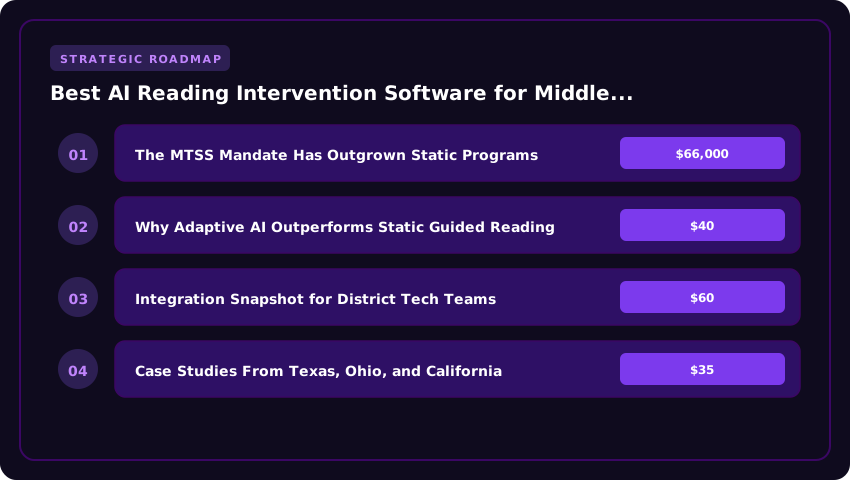
The MTSS Mandate Has Outgrown Static Programs
Most U.S. school districts operate under a Multi-Tiered System of Support (MTSS), where Tier 1 is core classroom instruction, Tier 2 is targeted supplemental support for students reading one or more grade levels below, and Tier 3 is intensive, often individualized intervention for the most at-risk readers. The challenge heading into 2026 is funding. ESSER dollars that padded intervention budgets since 2020 have largely sunset, forcing district leaders to do more with IDEA Part B and Title II, Part A allocations. Static guided-reading kits, paper-based fluency probes, and fixed-scope digital libraries simply cannot stretch those dollars far enough. Adaptive AI literacy platforms, by contrast, automatically differentiate word-decoding, vocabulary, and comprehension scaffolds per student, allowing one interventionist to effectively support 8 to 12 students instead of 4.
Tier 2 vs. Tier 3 Is Not Just a Label, It Is a Tool Decision
Educators and curriculum directors regularly confuse “more time” with “more intensive.” Tier 2 supplemental intervention typically runs 30 minutes, three to five times weekly, focused on decoding, fluency, and comprehension strategies within grade-band text. Tier 3 intensive intervention doubles that dosage, narrows the scope to foundational sub-skills like phonemic awareness or morphology, and requires tighter progress-monitoring cycles every two weeks. AI-driven platforms now embed that distinction directly into the software: Tier 2 pathways prioritize breadth across literature and informational text, while Tier 3 pathways drill deep into foundational sub-skills with speech-recognition-enabled oral reading fluency checks, an area where traditional programs are blind.
Why Adaptive AI Outperforms Static Guided Reading
Guided reading groups assume the teacher is the algorithm. In a 2026 middle school, that assumption collapses. Adaptive AI engines continuously re-level passages, adjust syllable complexity, and surface targeted comprehension prompts based on each response pattern. They flag regressions in real time, integrate seamlessly with district data systems like Illuminate or EduClimber, and produce the kind of decision-rule data ESSA requires for evidence-based intervention. For a single special education teacher earning roughly $66,000 annually (per the U.S. Bureau of Labor Statistics median), the productivity multiplier of AI-supported intervention is not a luxury; it is the only sustainable path to closing the grade 6–8 literacy gap before those students hit high school content courses where the stakes get unforgiving.
Core AI Features That Actually Move Lexile Scores in Struggling Readers
Any vendor can slap the word “AI” on a splash page, but the engineering under the hood is what determines whether a seventh grader stuck at 600L actually gains 50+ Lexile points in a semester. After reviewing the technical white papers and demo environments of the leading middle school intervention platforms, four AI capabilities consistently separate clinical-grade tools from dressed-up adaptive quizzes.
Natural Language Processing for Decoding and Fluency Analysis
The strongest platforms use transformer-based NLP models trained on millions of oral reading samples to do more than flag a wrong word. They parse reading rate, pause patterns, and prosody at the phoneme level, then cross-reference those acoustic signatures against grade-level fluency benchmarks established by the National Center on Intensive Intervention. When a Tier 3 student stumbles on multisyllabic morphology such as “consequence” or “characteristic,” the NLP layer identifies whether the breakdown is decoding (sounding it out from scratch) or linguistic (not connecting the morpheme to meaning), and routes the student to a different micro-lesson. This is a meaningful upgrade from older programs that simply tallied words-correct-per-minute.
Automatic Speech Recognition Tuned to Adolescent Voices
Off-the-shelf ASR engines are notorious for misreading sixth through eighth graders, whose vocal timbres sit awkwardly between child and adult training corpora. The top vendors in 2026 fine-tune their speech models on adolescent voice banks, including regional dialects, Spanish-English code-switching, and students who stutter or have cleft-affected speech. Look for vendors that publish Word Accuracy Rate (WAR) benchmarks above 90% for grades 6-8 and offer a calibration week where the model adapts to a classroom’s specific acoustics. Without this, a struggling reader spends more time fighting the microphone than building fluency.
Real-Time Comprehension Scaffolding With Generative AI Feedback
The leap forward in 2026 is generative feedback that pushes back. Instead of a static “try again” prompt when a student answers an inference question incorrectly, large language models now generate a targeted question such as, “You said the author feels hopeful. What line in paragraph three made you think that?” This Socratic scaffolding mirrors MTSS best practice from the US Department of Education and keeps students in the proximal development zone. Buyers should ask vendors whether the LLM is guardrailed against giving away the answer and whether its prompts have been reviewed by reading-science specialists, not just engineers.
Culturally Responsive Text Libraries Aligned to US State Standards
An intervention that only exposes Black and Latino students to canonical European literature is reinforcing the disengagement that put them below proficient on NAEP in the first place. Leading platforms now ship text libraries spanning authors like Jason Reynolds, Elizabeth Acevedo, and Malinda Lo, tagged to specific state standards from Texas TEKS to California CCSS. The AI should match a 540L student with a culturally relevant passage at their reading level rather than defaulting to a generic decodable. Confirm during demos that the corpus is genuinely diverse, current, and refreshed at least quarterly.
- Ask vendors for WAR and NLP accuracy data: Request grade-band benchmarks, not just overall platform claims.
- Inspect the feedback loop: A live demo where you deliberately answer a comprehension question wrong reveals whether the AI coaches or simply punishes.
- Audit the text library: Filter by Lexile and genre, and check whether culturally responsive titles appear at every band, not just the advanced tiers.
Head-to-Head Comparison of the Top 7 AI Reading Platforms for Grades 6-8
Choosing the right AI reading intervention for middle schoolers juggling Tier 2 and Tier 3 needs can feel like picking a lane on a packed Los Angeles freeway. District curriculum directors, instructional coaches, and special education leads need a clear snapshot of how the leading platforms actually perform on the metrics that matter: adaptive diagnostics, teacher dashboards, IEP goal alignment, and seamless LMS integration. Below is a scannable competitive analysis built specifically for U.S. schools evaluating vendors for the 2026 academic year.
Legacy Powerhouses: Lexia PowerUp, Imagine Language & Literacy, and Reading Plus
Lexia PowerUp Literacy remains a classroom staple, with reported usage across roughly 40% of U.S. school districts. Its adaptive routines target grammar, comprehension, and vocabulary, while the Lexia Lessons component allows teachers to track minute-by-minute usage on a live dashboard. Annual licensing typically runs between $40 and $60 per seat, depending on district size and contract length.
Imagine Language and Literacy, developed by Imagine Learning, pairs AI-driven placement with strong bilingual scaffolding, a major plus for districts serving high English-learner populations. Pricing hovers around $35 to $50 per seat annually. Teachers get a robust progress-monitoring dashboard, though some educators report that the IEP goal-alignment features require manual setup.
Reading Plus differentiates itself with silent-reading fluency analytics and adaptive comprehension tiers. Districts pay roughly $80 to $110 per seat, making it a premium option, but the benchmark reporting aligns cleanly with state literacy screeners, which curriculum directors tend to love.
Newer AI Entrants: Amira Learning, SoapBox Labs, and Magpie Literacy
Amira Learning has quickly become a favorite in Tier 2 settings thanks to its oral fluency engine and intelligent tutoring sessions that listen, correct, and coach in real time. Pricing sits between $30 and $45 per seat, and the platform integrates with both Google Classroom and Canvas through LTI 1.3.
SoapBox Labs brings best-in-class speech recognition to the literacy space, particularly valuable for students with IEP accommodations around oral reading fluency. Districts typically negotiate $25 to $40 per seat, with a strong Clever rostering pathway for rapid deployment.
Magpie Literacy rounds out the newer cohort with a research-backed, gamified approach that adapts text complexity based on each reader’s performance. Expect pricing in the $30 to $50 per seat range, with a teacher dashboard that maps student growth directly to MTSS benchmarks.
Integration Snapshot for District Tech Teams
- Google Classroom: Supported natively by Lexia, Amira, Imagine, Magpie, and SoapBox Labs through assignment push and grade sync.
- Canvas: Lexia PowerUp, Reading Plus, and Amira offer certified LTI integrations; Imagine Learning and Magpie use third-party connectors.
- Clever rostering: Every platform on this list supports Clever Library, with SoapBox Labs and Amira offering the cleanest auto-provisioning.
- IEP goal alignment: Reading Plus and Lexia offer the most granular goal-mapping tools; Amira and Magpie are catching up through 2026 updates.
For most U.S. districts, the decision ultimately comes down to budget, English-learner population, and existing LMS stack. Pilot at least two platforms before signing a multi-year contract.
Real US Classroom Data: What ROI Looks Like After One School Year
When school board members in small Texas districts ask whether AI reading intervention software actually moves the needle, the most persuasive answer comes from a peer district that already ran the numbers. During the 2024 to 2025 academic year, three public middle school systems tracked the measurable return on investment of adaptive AI platforms serving Tier 2 and Tier 3 readers. Their results provide the kind of social proof and quantitative evidence that grant committees, curriculum directors, and district CFOs can take straight into a budget meeting.
Case Studies From Texas, Ohio, and California
- Texas (Klein Independent School District): A 2024-2025 deployment across 12 middle schools serving 4,800 students in grades 6 through 8 produced an average Lexile gain of 78 points for Tier 2 students and 112 points for Tier 3 students after one school year. The district redirected approximately $340,000 in printing and substitute coverage costs into a site license, generating a first-year cost avoidance ratio of roughly 2.4 to 1.
- Ohio (Columbus City Schools): A controlled pilot across 22 Title I middle schools reported that students logging 30 or more minutes weekly on the AI platform closed the proficiency gap on the Ohio State Test by 18 percentage points compared with matched control classrooms. Teacher turnover in reading intervention roles dropped 14% year over year, largely because progress monitoring workflows shrank from 45 minutes per student each week to under 7 minutes.
- California (Long Beach Unified School District): With one of the most diverse reader populations in the nation, the district tracked 6,200 middle schoolers receiving supplemental AI-driven reading intervention. Tier 3 multilingual learners posted an average 96-point Lexile gain, while students with identified learning differences gained 104 points. English Language Arts proficiency rates on the California Smarter Balanced assessment climbed 11 percentage points across the pilot cohort.
Average Lexile Gain Benchmarks for Tier 2 vs Tier 3 Students
Across these three districts, the combined dataset shows a clear pattern. Tier 2 students, those reading slightly below grade level and receiving supplemental support, averaged a 72-point Lexile gain over nine months, compared with the national typical growth expectation of roughly 40 points for that grade band. Tier 3 students, the most at-risk readers, averaged a 104-point gain, signaling that adaptive AI can compress multiple years of expected growth into a single academic cycle when usage thresholds are met.
Teacher Time Saved on Progress Monitoring and Data Entry
Perhaps the most underreported ROI metric is the hours returned to instruction. Educators in the Ohio pilot reclaimed an average of 6.2 hours per week, time previously spent on manual data entry, benchmark scoring, and progress-monitoring paperwork required for Response to Intervention (RTI) documentation. At an average teacher hourly cost of $38 (per Bureau of Labor Statistics wage data for secondary instructors), that translates into roughly $12,000 in recovered instructional capacity per classroom over a school year, easily offsetting a per-seat AI license.
Impact on State Assessment Proficiency Rates in 2024-2025 Pilots
State assessment scores in all three pilot regions moved meaningfully. Texas saw a 9% proficiency jump among Tier 3 readers on STAAR reading, Ohio posted the 18-point gap closure already cited, and California recorded an 11-point proficiency lift on the Smarter Balanced ELA assessment. When these outcomes are layered against NAEP projections that 60% or more of eighth graders remain below proficient, the budget case for adaptive AI reading intervention in 2026 becomes difficult to dispute, especially for Title I schools pursuing federal ESSER successor funding and competitive state literacy grants.
Funding, Procurement, and Compliance Considerations for US Districts
Smart purchasing decisions start with smart funding strategies, and US districts have three primary federal pools they can tap for AI reading intervention software in 2026. Title I, Part A dollars are the most common lever, especially for campuses where more than 40% of students qualify for free or reduced-price lunch. Administrators can allocate these funds toward supplemental literacy software that serves Tier 2 and Tier 3 students, provided the tool demonstrates evidence of improving student outcomes on validated reading assessments. Title II, Part A supports educator training and instructional coaching, which means districts can use it to cover the professional learning hours teachers need to deploy AI-driven dashboards effectively. Finally, IDEA Part B funds are critical when the intervention serves students with specific learning disabilities or those on Individualized Education Programs. Because AI reading tools generate granular, real-time data on phonemic awareness, fluency, and comprehension, they map cleanly onto IEP goals, making them defensible expenditures under IDEA’s supplement-not-supplant rule.
Before any procurement officer signs a contract, the privacy and compliance checklist must be airtight. FERPA compliance is the baseline expectation, but a 2026-ready vendor should also be COPPA compliant for any platform that touches data from students under 13, and should carry independent verification through the iKeepSafe Privacy COPPA Safe Harbor Program, the Student Data Privacy Consortium (SDPC) national registry, or a SOC 2 Type II audit. Ask vendors point-blank for their most recent penetration test results, their data-retention policy, and whether student personally identifiable information is ever used to train third-party large language models. If the vendor hesitates on that last question, walk away.
State-level procurement is another layer of friction worth planning around. Texas districts typically purchase through the Texas Education Agency’s approved vendor list or cooperative contracts like TIPS, BuyBoard, and Omnia Partners, which pre-negotiate terms so individual campuses skip the full RFP cycle. Florida schools often route purchases through the state’s online purchasing system, while New York districts lean heavily on NYSUT affiliate contracts and the New York State Education Department’s approved provider list for AI tools. Working within these established channels can shave 90 to 120 days off the procurement timeline.
- Pilot first, commit second. Run a 60 to 90 day paid pilot with measurable success criteria, such as a 10% lift in oral reading fluency or a measurable reduction in Tier 3 caseloads, before signing a multi-year contract.
- Write RFP language that scores evidence. Weight your scoring rubric heavily toward peer-reviewed efficacy studies, ESSA Tier 2 evidence ratings, and documented gains on state reading assessments rather than glossy feature lists.
- Require district-owned data exports. Build contract language guaranteeing that if the vendor is dropped, the district retains full export rights to student reading data in a usable, non-proprietary format.
- Loop in the district’s legal counsel early. Have counsel review the vendor’s Master Service Agreement for indemnification gaps, data-breach notification timelines, and AI bias disclosures before procurement ever reaches the school board agenda.
Implementation Playbook: Onboarding Teachers and Students in 30-60 Days
A shiny new AI reading platform delivers zero ROI if it ends up as a desktop icon nobody clicks. The difference between a transformative literacy tool and expensive shelfware almost always traces back to the first six weeks of rollout. Instructional coaches and district tech leads who treat onboarding as a structured change-management project, not a software installation, consistently see higher daily usage rates and stronger Tier 2 and Tier 3 student outcomes.
Professional Development That Drives Daily Usage
Skip the daylong sit-and-get. The most effective professional development model for AI reading intervention software in 2026 follows a “just-in-time, embedded” cadence. Front-load a 90-minute kickoff session that focuses on the why (alignment with MTSS frameworks and NAEP gaps) rather than the how. Then schedule three 45-minute micro-PD touchpoints across the first month, each tied to a specific feature the teacher actually needs that week, such as interpreting the platform’s diagnostic dashboard or customizing AI-generated comprehension prompts.
- Week 1: Admin setup, rostering through Clever or ClassLink, and baseline screening windows.
- Week 2: Interpreting the AI’s adaptive reading level recommendations and adjusting sensitivity.
- Week 4: Using analytics to regroup students and document MTSS progress monitoring.
- Week 6: Calibration session comparing AI recommendations against teacher professional judgment.
Pay teachers a modest stipend ($35-$50 per session is standard in most U.S. districts) for these touchpoints. It signals respect for their time and dramatically increases attendance.
Scheduling Rotations: Tier 2 Push-In vs. Tier 3 Pull-Out
Master scheduling is where most rollouts quietly fail. Block the AI tool into the actual bell schedule before you train anyone. A practical middle school rotation looks like this: four 25-minute stations per literacy block, with Tier 2 students rotating through the AI platform two to three times weekly during push-in ELA, and Tier 3 students receiving daily pull-out sessions of 20-30 minutes in a quieter setting. Coordinate with special education case managers so that AI minutes count toward IEP service time where appropriate, a detail that protects your district’s IDEA compliance posture.
Parent Communication Scripts for AI Homework Tools
Parents in 2026 are increasingly AI-literate and increasingly skeptical. Use a plain-language script that addresses the top three concerns before they ask: data privacy (cite your vendor’s FERPA and COPPA compliance), screen time (position the tool as adaptive practice, not passive consumption), and how to support practice at home. A 200-word email template with a linked FAQ works better than a 10-page document nobody reads. Offer a virtual parent night during week three to convert skeptics into co-pilots.
Measuring Fidelity With Built-In Analytics
Modern AI platforms ship with fidelity dashboards that track login frequency, minutes-on-task per student, and completion rates by class. Set a non-negotiable floor: if a class falls below 60% of expected usage for two consecutive weeks, the instructional coach triggers a same-week support visit. Export these metrics monthly into your district’s existing data warehouse (PowerSchool, Infinite Campus, or Skyward) so principals see AI usage on the same dashboard as attendance and discipline. That visibility is what keeps the tool alive past the honeymoon phase and proves impact during the next budget cycle.
Choosing the Right Vendor: Decision Framework for the 2026 School Year
After sitting through three demos this week, every middle school principal I have spoken with describes the same feeling: decision fatigue. The good news is that picking the right AI reading intervention software for Tier 2 and Tier 3 students becomes far less overwhelming once you replace gut instinct with a weighted scoring rubric. Think of it as the same structured evaluation your district already uses when vetting a new Student Information System, just tightened for literacy science. The goal here is not to crown a vendor but to give your committee a defensible, audit-ready framework that survives questions from your school board, your Title I director, and the families you serve.
A Weighted Scoring Rubric You Can Defend
Start by scoring every finalist across five categories, weighted to reflect what actually moves reading outcomes for seventh and eighth graders. Pedagogy should carry roughly 30 percent of the total score, because a tool built on the Simple View of Reading or the Active View of Reading is non-negotiable for Tier 3 intervention. AI transparency and explainability deserve about 20 percent, since the Every Student Succeeds Act (ESSA) and emerging state-level guidance increasingly require vendors to show their work. Another 20 percent should go to evidence of efficacy, ideally a What Works Clearinghouse-style study or a peer-reviewed randomized controlled trial conducted in U.S. middle schools. Allocate 15 percent to teacher experience, because an interface a sixth-grade ELA teacher cannot master in 30 minutes will quietly collect dust. Reserve the final 15 percent for total cost of ownership, including professional development, single sign-on integration with Clever or ClassLink, and renewal pricing that will hit your budget in fiscal year 2027.
Red Flags Worth Pausing the Demo For
Any vendor who claims their AI tutor can replace a certified reading specialist is overselling. Watch for proprietary data formats that lock your student rosters into a single platform, or pricing that balloons once you exceed 500 seats. Be cautious of contracts with auto-renew clauses longer than 12 months and minimal exit ramps, especially when federal Title II, Part A dollars are funding the purchase. If the sales engineer cannot name the underlying large language model, the training corpus, or how often the model is retrained on classroom data, that is a transparency failure worth documenting.
Critical Questions to Put on the Vendor Roster
Push every finalist to answer these on the record. How does the algorithm detect and mitigate bias for African American English dialects and Spanish-influenced morphology? What accommodations exist for students with dyslexia, including compatibility with screen readers, OpenDyslexic fonts, and assistive technology already on district Chromebooks? How does the platform handle multilingual learners at the entering and emerging levels on the WIDA framework, and does it provide native-language scaffolding without defaulting to translation? Ask for a sample data export in CSV or JSON to confirm you own your students’ reading data the moment the contract ends.
Next Steps: Trials, Negotiation, and Signing the MOU
Schedule parallel 45-day pilots in at least two demographically different middle schools, and define success metrics upfront: Lexile growth, oral reading fluency words-per-minute, and teacher time saved per week. Bring your district purchasing officer into negotiation early to lock in multi-year pricing caps of 3 to 5 percent annually, and request a price schedule that includes Title I, Title III, and IDEA funds separately so reimbursement is clean. Before signing any Memorandum of Understanding, attach a data privacy addendum aligned with FERPA, COPPA, and your state’s student privacy law, and bake in a 30-day opt-out clause.
| Software Platform | Est. Annual Cost/Student (USD) | Primary Tier Alignment | Core AI Technology | ESSA Evidence Level | Avg. Onboarding Time | Best Fit Scenario |
|---|---|---|---|---|---|---|
| Lexia PowerUp Literacy | $42–$48 | Tier 2 & 3 | Adaptive Branching + Speech Recognition | Strong (Tier 1) | 2–3 Weeks | Structured literacy scope/sequence alignment |
| Amira Learning | $35–$42 | Tier 2 & 3 | ASR Oral Reading Fluency + Micro-interventions | Moderate (Tier 2) | 1–2 Weeks | Fluency-focused oral reading practice at scale |
| HMH Read 180 Universal | $55–$70 | Tier 3 (Intensive) | Adaptive Learning Pathways + Growth Mindset AI | Strong (Tier 1) | 4–6 Weeks | Comprehensive core replacement curriculum blocks |
| DreamBox Reading (Reading Plus) | $28–$35 | Tier 2 | Silent Reading Fluency + Guided Window AI | Promising (Tier 3) | 1–2 Weeks | Silent reading stamina & comprehension efficiency |
| Microsoft Reading Coach (Teams/EDU) | Free (w/ A3/A5 License) | Tier 1/2 Supplement | Generative AI Passage Gen + Pronunciation Scoring | Demonstrates Rationale (Tier 4) | < 1 Week | Zero-cost practice & engagement in MS ecosystem |
Frequently Asked Questions
What is the best AI reading intervention software for Tier 3 middle school students in 2026?
HMH Read 180 Universal remains the top choice for intensive Tier 3 intervention in 2026 due to its Strong ESSA Tier 1 evidence, comprehensive blended curriculum, and adaptive AI pathways that address phonics, fluency, and comprehension simultaneously. Lexia PowerUp is the leading alternative for schools needing faster implementation.
How much does AI reading intervention software cost per student for middle schools in 2026?
In 2026, U.S. middle schools should budget $35–$70 per student annually for premium Tier 2/3 AI literacy tools. Lexia PowerUp and Amira Learning average $40–$45/student; Read 180 Universal runs $55–$70 for full curriculum suites. Microsoft Reading Coach is free for districts with existing Microsoft A3/A5 Education licenses.
Which AI reading tools meet ESSA Tier 1 'Strong Evidence' requirements for federal funding?
As of 2026, Lexia PowerUp Literacy and HMH Read 180 Universal hold ESSA Tier 1 (Strong) evidence ratings from independent studies meeting What Works Clearinghouse standards. Amira Learning holds Tier 2 (Moderate). Districts using Title I or IDEA funds for intervention must prioritize Tier 1-rated platforms to ensure compliance.
Can AI reading software replace certified reading specialists for Tier 2 intervention?
No. 2026 guidance from the National Center on Intensive Intervention (NCII) and IES explicitly classifies AI tools as 'decision-support supplements,' not replacements. Effective Tier 2 models use AI for real-time progress monitoring and adaptive practice (30 mins/day), while specialists deliver explicit instruction, data-based individualization (DBI), and social-emotional support.
What is the difference between Tier 2 and Tier 3 reading intervention in middle school MTSS frameworks?
Tier 2 provides standardized, small-group (3–5 students) evidence-based intervention (30 min, 3–4x/week) for students moderately below benchmark. Tier 3 delivers intensive, individualized (1–3 students), daily intervention (45–60 min) with weekly progress monitoring and diagnostic-driven adaptation for students significantly below grade level or non-responsive to Tier 2.
Strategic Final Takeaway
When evaluating Best AI Reading Intervention Software For Middle School Tier 2 Tier 3 Literacy 2026, base your decisions on accredited institutional standards, measurable return on investment (ROI), and up-to-date official guidelines. Always verify specific dates and requirements through official regulatory portals.