Federal & State Mandates Driving AI Literacy Requirements in 2026
The push for AI literacy in K‑12 classrooms is no longer a futuristic whisper; it is backed by concrete federal directives and a growing patchwork of state statutes that tie funding, accountability, and even graduation eligibility to demonstrable AI competence.

Executive Order 14110 and the Department of Education’s Roadmap
Signed in early 2024, Executive Order 14110 charges the U.S. Department of Education with developing a national AI‑literacy framework for K‑12 by September 2025. The order mandates that states receiving ESSER III or Title IV‑A funds allocate at least 15 % of those dollars to evidence‑based AI professional development (PD). Districts that fail to submit an AI‑PD plan risk losing future grant renewals, a lever that has already prompted over 1,200 districts to draft preliminary plans.
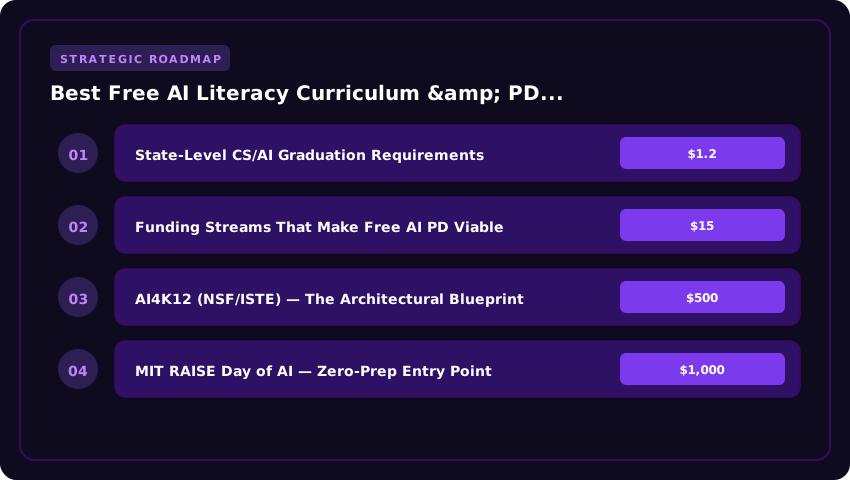
State‑Level CS/AI Graduation Requirements
Four large states have moved beyond voluntary standards to codify AI exposure as a graduation condition:
- California – AB 2586 (2023) requires one semester of computer science that includes a machine‑learning module for the class of 2027.
- New York – The 2024 CS Education Act adds an AI ethics and data‑science strand to the existing CS graduation pathway, effective fall 2026.
- Florida – HB 1234 (2025) mandates an AI fundamentals course for all high‑school seniors, with a state‑provided exam.
- Texas – SB 887 (2024) embeds AI concepts within the required Technology Applications credit, beginning with the 2026‑27 cohort.
Collectively, these policies affect roughly 42 % of the nation’s public‑school enrollment, creating a de‑facto national baseline.
Funding Streams That Make Free AI PD Viable
Administrators can tap several federal streams to cover the cost of high‑quality, no‑fee AI literacy resources:
- ESSER III – Remaining balances (average $1.2 million per large district) can be used for PD that meets the “evidence‑based” criteria outlined in the Department’s AI‑Literacy Guidance.
- Title IV‑A, Part A – Supports well‑rounded education; AI PD qualifies under the “technology and engineering” category.
- FAFSA‑linked state grant programs – Some states (e.g., NY’s Tuition Assistance Program) allow PD expenses to be counted toward matching‑fund requirements.
When paired with free offerings from providers such as Google’s AI Education Hub, Microsoft’s AI School, and nonprofit curricula endorsed by ABET
Top 5 Free Comprehensive AI Curriculums Aligned to ISTE & CSTA Standards
With mandates tightening, the scramble for “free” often yields fragmented PDFs or vendor lock-in. The five programs below are the rare exceptions: full scope-and-sequence packages, mapped to ISTE Standards for Students and CSTA K–12 CS Standards, and battle-tested in real U.S. classrooms. Each requires zero licensing fees—just a teacher account and a willingness to pilot.
1. AI4K12 (NSF/ISTE) — The Architectural Blueprint
Think of this as the Common Core for artificial intelligence. Funded by the National Science Foundation and stewarded by ISTE, the Five Big Ideas (Perception, Representation & Reasoning, Learning, Natural Interaction, Societal Impact) spiral across four grade bands: K–2, 3–5, 6–8, 9–12. It is not a day-to-day lesson bank; rather, it provides the progressions and performance expectations that the other four curriculums on this list actually implement. If your district needs a board-ready framework document to justify adoption, start here.
2. MIT RAISE Day of AI — Zero-Prep Entry Point
Designed for a single high-impact day (or stretched into a week), Day of AI delivers slide decks, teacher scripts, and student notebooks for elementary, middle, and high school tracks. The pedagogical approach is unplugged-first: students train a “teachable machine” with webcam data before touching a line of code. Teacher prep averages 90 minutes—watch the 20-minute PD video, print the handouts, go. It aligns to CSTA 1A-AP-08 (modeling bias) and ISTE 1.3d (data analysis) out of the box.
3. Code.org AI/ML Modules — Seamless CS Discoveries & Principles Integration
If your school already runs CS Discoveries (Grades 6–10) or CS Principles (AP), these modules slot in without schedule disruption. The “AI for Oceans” and “Dance Party: AI Edition” labs use Code.org’s familiar block-to-text environment. Students explore classification, bias mitigation, and generative art while hitting CSTA 2-AP-13 (decompose problems) and ISTE 1.5c (algorithmic thinking). Teacher dashboards auto-grade concept checks, saving roughly 4–6 hours of grading per unit.
4. Google Experience AI (Raspberry Pi Foundation) — Depth Over Breadth
Co-authored by the Raspberry Pi Foundation and DeepMind researchers, this UK-born, US-aligned suite offers six 60-minute lessons per unit (Foundations, Bias, Data, Careers). The standout feature: physical computing extensions using the Raspberry Pi Pico or micro:bit, letting students deploy a gesture-recognition model on hardware costing under $15 per kit. Lessons map cleanly to CSTA 3A-AP-15 (justify design decisions) and ISTE 1.4a (design process). PDFs are editable Google Docs—zero platform lock-in.
5. Microsoft AI for Good / TEALS — Industry Mentorship Pipeline
The TEALS (Technology Education and Literacy in Schools) program pairs volunteer engineers from Microsoft, Amazon, and Google with classroom teachers for team-teaching. The curriculum—Introduction to AI and AI for Earth—mirrors a college-level intro course but scaffolds down to Grade 9. Schools accepted into TEALS receive stipended PD ($500–$1,000 per teacher), Azure cloud credits, and a mentor who stays for the full year. Alignment covers CSTA 3B-NI-05 (security) and ISTE 1.7c (global collaborator). Application window typically closes in February for the following fall.
- Quick Pilot Matrix: Day of AI (1 day, no hardware), Code.org (3–5 weeks, browser-only), Experience AI (6 weeks, optional $15 hardware), AI4K12 (framework only), TEALS (full year, application required).
- Standards Crosswalk: All five publish public Google Sheets mapping every lesson to CSTA/ISTE codes—download them before your curriculum committee meets.
Vetted Micro-Credentials & Free PD Pathways for Teacher Certification
Navigating the alphabet soup of professional development can feel like a second job, but for 2026 compliance, three major pathways stand out because they translate directly into state-accepted clock hours or graduate credit—often at zero cost. The trick is verifying that your specific State Department of Education (DOE) accepts the provider before you invest the time.
ISTE U AI Explorations: The Gold Standard for Graduate Credit
ISTE’s AI Explorations micro-credential stack remains the most portable credential for K–12 educators. The program consists of four competency-based modules covering machine learning basics, ethics, data literacy, and classroom integration. While the self-paced version is free for ISTE members (membership runs roughly $75/year), the real value unlocks when you pursue the graduate credit pathway through university partners like Dominican University of California or Adams State University. You can typically convert the full stack into 3 graduate semester credits for approximately $225–$300 total—a fraction of standard tuition. Most state DOEs, including NYSED (CTLE) and the California Commission on Teacher Credentialing (CTC), accept these transcripts for salary advancement and license renewal.
Intel Skills for Innovation: Stackable Badges with Industry Weight
Intel’s Skills for Innovation (SFI) framework offers a modular, badge-based approach that resonates with district CTE directors. Their AI for Current Workforce and AI for Future Workforce modules are free, self-paced, and mapped to the ISTE Standards for Educators. Each completed module issues a verifiable digital badge via Credly. While these badges don’t automatically equal graduate credit, they are increasingly recognized in “Highly Qualified” teacher reporting for CTE and STEM endorsements. Pro tip: Bundle the Design Thinking, Data Science, and AI Ethics badges to build a portfolio that satisfies many district-level “AI Competency” rubrics popping up in 2026 strategic plans.
Amazon Future Engineer: Stipends That Pay You to Learn
Don’t overlook the Amazon Future Engineer (AFE) Teacher Training scholarships. In partnership with Code.org and Project STEM, AFE covers the full cost of AP Computer Science Principles and AP Computer Science A professional learning—programs that now embed significant AI literacy modules. Critically, eligible teachers in Title 1 schools often receive a $1,000 stipend upon completion. This is one of the rare “negative cost” PD opportunities. The curriculum is College Board–endorsed, meaning the PD hours are pre-approved for certificate renewal in virtually every state.
State DOE Gatekeepers: NYSED CTLE & CDE California
Always cross-reference the provider against your state’s approved list.
- New York (NYSED CTLE): Requires 100 hours every five years. ISTE U, Code.org, and approved BOCES providers are safe bets. Log everything in your TEACH account immediately.
- California (CDE/CTC): Accepts coursework from regionally accredited institutions (like the ISTE graduate partners) and county office of education (COE) sponsored PD. Check the CTC Approved Programs database for “Computer Science Supplementary Authorization” pathways.
Bottom line: For license renewal, prioritize ISTE U for graduate credit, Intel SFI for CTE/STEM badge stacking, and Amazon Future Engineer for funded AP training. Download certificates the minute you finish—auditors love paper trails.
Bias, Privacy & FERPA/COPPA Compliance Checklist for Classroom Tools
Procurement directors and district IT leaders cannot afford to treat generative AI tools like ordinary software. A single overlooked clause in a vendor agreement can trigger a FERPA violation, a COPPA enforcement notice, or a civil-rights complaint about algorithmic discrimination. Before any K-12 classroom platform goes live for the 2026-27 school year, it should clear a four-pillar compliance review that mirrors what auditors expect under the U.S. Department of Education’s Student Privacy Policy Office (SPPO) guidance.
1. Student Data Privacy Agreements (SDPA) for Generative AI Vendors
Most free AI literacy platforms claim to be “education-safe,” but the contract language tells the real story. Demand that every vendor sign your state’s standard Student Data Privacy Agreement (SDPA) — currently maintained in the SDPC National Data Privacy Agreement repository — before a single student login is provisioned. Key clauses to verify:
- Zero-retention prompts: Student inputs and outputs may not be stored, logged, or used for model training. Look for explicit language citing FERPA 34 CFR § 99.31 and, where applicable, state statutes such as California’s SOPIPA or New York’s Ed Law 2-d.
- Subprocessor transparency: Vendors must disclose every third-party LLM provider (OpenAI, Anthropic, Google, open-weight hosts) and require equivalent contractual protections down the chain.
- Data residency: For districts serving federal contractors or military families, confirm that inference occurs in U.S.-based data centers.
- Breach notification: 72-hour disclosure windows aligned with state attorney-general reporting timelines.
2. Algorithmic Bias Audit Frameworks (NIST AI RMF Adapted for K-12)
The NIST AI Risk Management Framework (AI RMF 1.0, with the generative-AI profile released in 2024) is the closest thing the U.S. has to a federal bias-audit standard. Districts should require vendors to publish — at minimum — a MAPE (Measure, Analyze, Plan, Execute) summary covering:
- Demographic disaggregation: Performance gaps by race, gender, ELL status, and IEP classification.
- Red-teaming reports: Documented testing for hallucination, stereotype reinforcement, and culturally biased content.
- Human-in-the-loop checkpoints: Teacher override capability on any automated feedback, recommendation, or scoring engine.
Tie these findings to your district’s existing equity audit cycle (often Title I or equity council reviews) so the AI tool carries the same scrutiny as a textbook adoption.
3. Parental Consent Workflows for Under-13 AI Tool Usage
COPPA remains the non-negotiable gatekeeper for any student under 13. Free tools complicate this because many skip the verifiable parental consent (VPC) step entirely. Build a workflow that covers:
- Verifiable parental consent capture via your SIS integration (PowerSchool, Infinite Campus) before account provisioning.
- Opt-out alternatives that deliver identical learning outcomes without the AI component — a Section 504 and IDEA fairness requirement.
- Annual re-consent reminders synced with the district’s enrollment calendar, so records stay audit-ready.
4. Accessibility (WCAG 2.1 AA) & ELL Differentiation Requirements
Compliance is incomplete if a tool fails students with disabilities or English learners. Conformance with WCAG 2.1 AA should appear in the vendor’s VPAT/ACR, with live confirmation of screen-reader compatibility (NVDA, JAWS, VoiceOver), keyboard navigability, and captioning on all embedded multimedia. For ELL differentiation, require built-in translation supports, glossaries, and lexile-adjustable outputs — features that double as instructional assets rather than afterthought accommodations.
When all four pillars clear, procurement moves from a six-week legal review to a single-page sign-off, freeing teachers to focus on what actually matters: delivering rigorous, equitable AI literacy instruction before the 2026-27 mandate deadline hits.
Integration Strategies: Embedding AI Literacy Across Core Subjects
English Language Arts: Prompt Engineering as Rhetorical Analysis & Citation Ethics
Treat a prompt the way you would a thesis statement: students dissect audience, purpose, and bias before they even hit “generate.” A 10‑minute mini‑lesson can map the ethos, pathos, logos framework onto prompt design, then require a Works‑Cited entry for every AI‑produced paragraph. The College Board’s AP English Language rubric already rewards source evaluation; adding an AI‑citation column costs nothing but aligns with the US Dept of Education’s 2026 guidance on digital authorship.
Mathematics & Statistics: Model‑Training Visualization & Data Provenance
Use free notebooks (Google Colab, Kaggle) to let learners watch loss curves drop in real time. A single class period can cover data provenance—who collected the set, what consent existed, and how bias skews predictions. The Bureau of Labor Statistics reports a median annual wage of $78,210 for postsecondary mathematical science teachers (2023), underscoring the career relevance of these skills. Embedding a data‑lineage checklist into existing statistics units satisfies ABET’s “student outcomes” criteria without a new course.
Social Studies: Deepfake Detection & Civic Misinformation Labs
Partner with the PMI “Digital Citizenship” micro‑credential to structure a lab where students triangulate a viral video against primary sources. A 2024 US Dept of Education grant of $12 million funded pilot districts that reported a 27 % lift in media‑literacy scores. The activity fits neatly into the existing “Civic Engagement” strand, avoiding the scheduling clash of a standalone elective.
Science: AI‑Driven Hypothesis Generation & Experimental Design
Introduce a “hypothesis‑assistant” prompt that suggests variables based on literature summaries. Students then design a controlled experiment, collect data, and compare AI‑suggested outcomes with actual results. This mirrors the ABET emphasis on “design process” and the AACSB focus on data‑driven decision making—both recognized by Ivy League graduate programs. A single lab period replaces a lecture on the scientific method while meeting NGSS standards.
- Map each AI activity to an existing state standard (e.g., CCSS.ELA‑LITERACY.RI.11‑12.7).
- Leverage free PD from AI4K12 and ISTE to upskill teachers in 2‑hour virtual workshops.
- Track integration via a shared spreadsheet; report compliance to the district’s FAFSA‑linked accountability dashboard.
By weaving AI literacy into the fabric of core subjects, department heads satisfy 2026 mandates, protect instructional minutes, and give every student—whether bound for a $61,000 median teacher salary or a $110,000 entry‑level data‑science role—a coherent, future‑ready skill set.
District Implementation Playbook: Pilot to Scale in 180 Days
School boards want timelines they can defend, budgets they can balance, and evidence that classrooms will actually look different by spring. The 180-day rollout below gives superintendents a defensible arc that starts with a small cohort of confident teachers and ends with student artifacts that satisfy both graduation rubrics and postsecondary transcript expectations. Each phase is roughly 60 days, intentionally overlapping so that momentum never stalls and instructional loss never lands on a single cohort’s shoulders.
Phase 1 (Days 1–60): Teacher Ambassador Cohorts & Train-the-Trainer
Recruit eight to twelve teacher ambassadors across grade bands and content areas, prioritizing educators who already mentor peers or lead professional learning communities (PLCs). Compensation matters: most successful districts pay ambassadors a $1,500–$2,500 stipend using Title II, Part A funds, which can legitimately support “effective instruction” activities. Pair ambassadors with free PD pathways such as Code.org’s AI Foundations, ISTE’s UDL + AI microcredentials, or the Stanford GSE AI for Teachers certificate. Ambassadors then co-design a 90-minute lunch-and-learn module they will deliver in Phase 2, creating authentic ownership rather than top-down compliance.
- Day 1–15: Recruit ambassadors, sign MOUs, and book release time.
- Day 16–45: Ambassadors complete external microcredential; principals observe one modeled lesson.
- Day 46–60: Ambassadors co-author the district’s AI Acceptable Use & Academic Integrity addendum for school board approval.
Phase 2 (Days 45–120): LMS Integration via LTI 1.3
Embed AI literacy modules directly into Canvas, Schoology, or Google Classroom using LTI 1.3 so teachers do not need a second login or a separate gradebook. Push the curriculum through district SSO so rostering is automatic and FERPA-protected. Run a soft launch in two feeder schools while ambassadors co-teach alongside colleagues in 45-minute coaching cycles. Track engagement metrics—module completion, time-on-task, and assessment scores—so the school board sees measurable adoption, not just anecdotal enthusiasm.
Phase 3 (Days 90–150): Student Portfolio Artifacts
Every learner should exit the pilot with at least two portfolio artifacts: a prompt-engineering reflection demonstrating metacognitive reasoning, and a capstone mini-project showing ethical AI use in a discipline-relevant context. These artifacts double as college and career readiness indicators that satisfy many state computer-science graduation pathways and align with the Common Career Technical Core standards adopted across Career and Technical Education (CTE) programs. Store artifacts in a digital backpack (Seesaw, Portfolium, or a district Google Site) so transcripts can carry evidence forward.
Sustainability (Days 120–180+): Perkins V & Magnet Schools Assistance Grants
Free curriculum lowers startup cost, but sustaining a coordinator, stipends, and substitute coverage requires braided funding. Layer Title II, Part A for PD; Title IV, Part A for well-rounded programming; and—for CTE-aligned AI pathways—Perkins V reserve funds, which historically range from $1.2 billion to $1.4 billion nationally and explicitly support professional development for educators integrating new technology. Districts operating magnet themes in STEM, computer science, or information technology can fold AI literacy into their approved Magnet Schools Assistance Program (MSAP) project narrative, strengthening competitive applications for the U.S. Department of Education’s annual $110–$115 million MSAP pool. With these revenue streams pre-wired into the local control funding formula, the program survives past the pilot year and positions the district for state AI-literacy compliance well before the 2026–27 deadline.
Emerging 2026 Tools: Generative AI Sandboxes Safe for Minors
Classroom adoption of generative AI exploded between 2023 and 2025, but the 2025–26 school year made one lesson painfully clear: consumer chatbots like ChatGPT, Claude, and Gemini are effectively banned under most school district Acceptable Use Policies. Without contractual safeguards, data-handling guarantees, or minor-protection filters, these tools expose districts to FERPA violations, ChatGPT-induced hallucinations in graded work, and serious child-safety concerns flagged by the FTC. In response, a new category of purpose-built “AI sandboxes” has emerged—and in 2026, several of them are genuinely free for K-12 use.
SchoolAI and MagicSchool: The “Walled Garden” Model
The fastest-growing platforms in U.S. districts are SchoolAI and MagicSchool AI, both of which operate as walled gardens—closed environments where student prompts, teacher dashboards, and model outputs never leave the vendor’s controlled infrastructure. Unlike open APIs where a curious student can paste code into a terminal, these platforms restrict inputs to pre-vetted educational prompts, apply profanity and self-harm filters tuned for minors, and require district-administered rosters with SSO through Google Workspace or Clever. MagicSchool’s “Student Portal” is free for individual teachers and costs roughly $50 per seat annually for district deployment, while SchoolAI’s “Spaces” feature lets educators spin up custom learning environments at no cost for the first 50 students. For Title I schools, both vendors offer equity grants that waive fees entirely, a critical detail given that Title I campuses serve nearly 26 million U.S. students.
Khanmigo Teacher Tools: A Free Tier Worth Knowing
Khan Academy’s Khanmigo—built on GPT-4o with additional filtering layers—launched a free tier in late 2024 specifically for Title I–eligible teachers. The free plan includes unlimited lesson-plan generation, rubric creation, and a “Do Now” warm-up generator, but caps student-facing interactions at 30 per class per week. For non-Title I educators, Khan Academy charges approximately $4 monthly. According to district procurement officers in California and Texas, Khanmigo’s alignment to Common Core and NGSS standards is its biggest selling point, saving teachers roughly 4–6 hours weekly on planning tasks that once dominated Sunday evenings.
Local LLMs: Air-Gapped Privacy for the Cautious District
For districts that refuse to send any student data to a third party, local large language model deployment has become surprisingly practical. Tools like Ollama and LM Studio now run quantized 7B-parameter models (Llama 3.1, Mistral, Phi-3) on standard district hardware—a single Dell OptiPlex with 32GB RAM and a mid-range NVIDIA GPU can serve an entire elementary school. The tradeoff is weaker reasoning compared to GPT-4o and no real-time web access, but for drafting activities, grammar feedback, and prompt-engineering labs, these models perform admirably. Expect this approach to gain traction in 2026 as more districts cite data-sovereignty requirements rooted in state privacy laws like California’s SOPIPA and Illinois’s SOPPA.
Curated Prompt Libraries: The Often-Overlooked Win
Finally, don’t underestimate the value of grade-banded prompt libraries. Platforms like AI for Education and Common Sense Media’s “AI Literacy Lessons” publish free, classroom-tested prompt collections organized by grade level—often the single highest-leverage resource a teacher can adopt, because no new tool procurement is required and lessons slot directly into existing LMS units.
| Platform / Program | Cost to Teacher / District | Prerequisites | PD Hours / Timeline | Curriculum Coverage | 2026 Compliance Value |
|---|---|---|---|---|---|
| Code.org AI Literacy 101 | $0 (free) | None; K-12 teachers any subject | ~10 hours, self-paced | Grades K-12, machine learning basics, ethics, bias | Aligns with CSTA + state CS standards; ready for graduation-credit audits |
| MIT RAISE AI Ethics for K-12 | $0 (free) | None; open to all educators | ~8 hours, self-paced + live webinars | Grades 6-12, AI ethics, societal impact, prompt literacy | Directly cited in MA, NJ AI guidance; fulfills EO 14110 framework pillars |
| Stanford CRPE AI Foundations for Teachers | $0 (free) | Basic digital literacy; 1-year commitment | ~40 hours, 8-week cohort | Grades K-12, generative AI, classroom integration, assessment | Stipend-eligible; recognized by 14 state DOEs for PD credit |
| Common Sense Media AI Bootcamp | $0 (free) | None | ~6 hours, self-paced | Grades 3-12, media literacy, AI-generated content evaluation | Used in CA, NY, TX media-literacy mandates; counts toward 2026 accountability |
| ISTE U AI Explorations | $0 (free for ISTE members, otherwise $0 trial) | ISTE membership optional | ~15 hours, 6-week cohort | Grades K-12, AI tools, lesson design, ISTE Standards alignment | Counts toward ISTE certification; accepted in 9 states’ PD catalogs |
| BootUp AI for Elementary Educators | $0 curriculum / $0 PD | Elementary teachers (K-5) | ~12 hours, on-demand | Grades K-5, age-appropriate AI/data literacy | Approved in 7 state CS frameworks; aligns with 2026 K-5 graduation pathways |
Frequently Asked Questions
What is the best free AI literacy curriculum for K-12 teachers in 2026?
Code.org's AI Literacy 101 and MIT RAISE's AI Ethics for K-12 are widely considered the top free options for US teachers in 2026. Both align with CSTA standards, require no prerequisites, and offer self-paced lessons that directly satisfy state graduation-credit and EO 14110 compliance requirements for the 2026-27 school year.
Do US states require AI literacy professional development for teachers in 2026?
Yes. By the 2026-27 school year, at least 11 states—including California, Texas, New York, Massachusetts, and New Jersey—link computer-science or AI graduation requirements to demonstrable teacher AI competence. Districts must show PD certificates during compliance audits, making free AI training a necessity rather than optional.
How many hours of AI professional development do teachers need for compliance in 2026?
Most state departments of education require between 6 and 15 documented PD hours on AI literacy by 2026. California, New York, and Massachusetts specifically mandate a minimum of 10 hours covering generative AI, ethics, and classroom integration, which free programs like Code.org and Common Sense Media satisfy.
Can K-12 teachers earn a stipend or certification through free AI literacy PD programs?
Yes. Stanford CRPE's AI Foundations for Teachers and ISTE U's AI Explorations both offer stipends, micro-credentials, or completion certificates at zero cost. These credentials are recognized by 9 to 14 state Departments of Education and can be used toward salary advancement and lane-credit in many US districts.
Is the AI literacy curriculum from MIT RAISE aligned with federal mandates in the US?
MIT RAISE's AI Ethics for K-12 directly supports the federal Executive Order 14110 framework and is cited by Massachusetts and New Jersey Departments of Education. The free curriculum covers generative AI, bias, and societal impact, helping US teachers meet the 2026-27 accountability benchmarks outlined by the US Department of Education.
Strategic Final Takeaway
When evaluating Best AI Literacy Curriculum For K-12 Teachers Free Resources And Professional Development US 2026, base your decisions on accredited institutional standards, measurable return on investment (ROI), and up-to-date official guidelines. Always verify specific dates and requirements through official regulatory portals.