
Who Qualifies for the 2026 NELFUND Loan Under the Student Loan Act 2024
The Student Loan (Access to Higher Education) Act, signed into law in 2024 and now fully operational through the Nigerian Education Loan Fund, has quietly become the single most consequential piece of education legislation for low- and middle-income families in over a decade. But the portal does not ask for vibes — it asks for verifiable eligibility. And thousands of hopeful applicants every cycle get rejected at the verification stage for skipping the basics.

So let’s break down, in plain terms, what the law actually demands of you before that first loan disbursement can be processed.
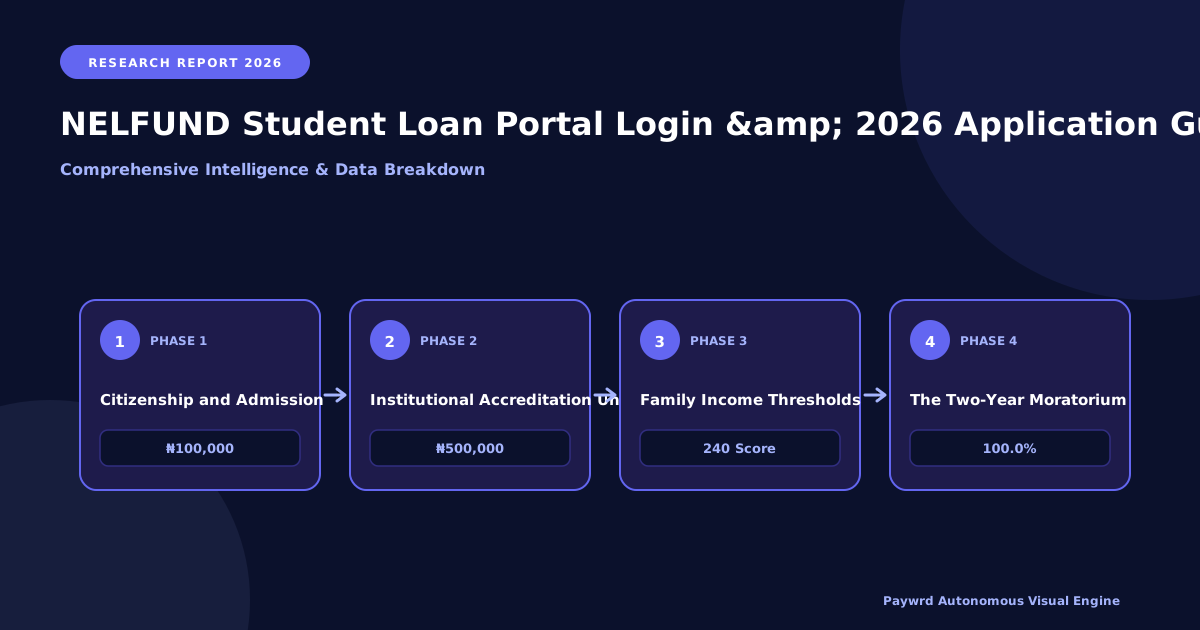
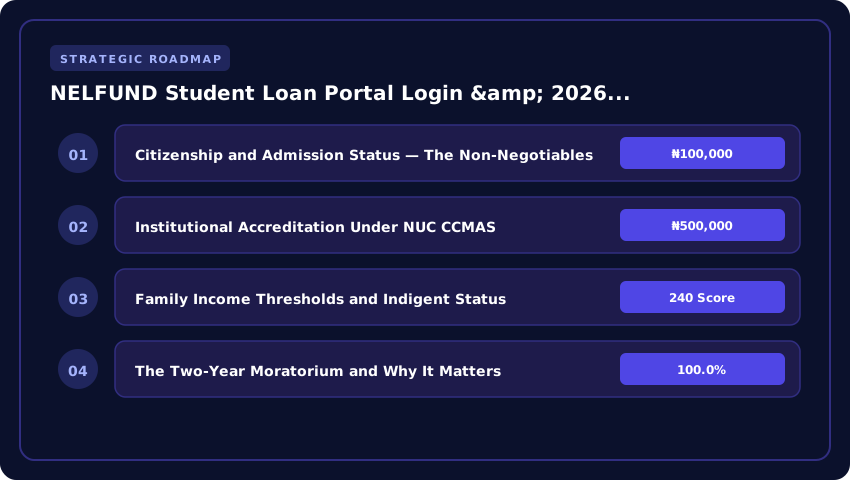
Citizenship and Admission Status — The Non-Negotiables
First, you must be a Nigerian citizen. The Act deliberately excludes foreign nationals, and the portal will cross-check your NIN against the National Identity Management Commission (NIMC) database during registration. Dual citizenship alone will not bar you, but you must present a valid Nigerian passport or NIN as the primary identity document.
Second, your admission must be legitimate. We are talking about a valid admission letter obtained through the Joint Admissions and Matriculation Board (JAMB) process and accepted on the JAMB CAPS portal. Random admissions from unrecognised institutions — no matter how convincing the letterhead looks — will fail the institutional verification step. Your course of study must also lead to a recognised undergraduate or higher National Innovation Diploma (NID) qualification.
Institutional Accreditation Under NUC CCMAS
Here is where many students misread the rules. NELFUND does not fund every Nigerian tertiary institution. Your school must be accredited by the National Universities Commission (NUC) under the new Core Curriculum Minimum Academic Standards (CCMAS) framework, or recognised by NBTE for polytechnics and innovation enterprise institutions, or NCCE for colleges of education. Private universities are not automatically excluded, but funding for them is currently limited and varies per cycle — so verify on the NELFUND portal before applying.
Family Income Thresholds and Indigent Status
This is the heart of the loan. The Act defines “indigent” as a household earning ₦500,000 or less per annum at the point of application. You will be asked to upload supporting documents — typically a sworn affidavit, salary slips, or a letter from your local government area. If your family’s combined income comfortably exceeds this threshold, the system will flag your application during the income verification phase.
The Two-Year Moratorium and Why It Matters
Repayment does not begin immediately after graduation. The Act grants every beneficiary a two-year moratorium — a grace window that starts after your National Youth Service Corps (NYSC) programme ends. During this period, no interest accrues and no repayment is required. After two years, you begin a 10% income-based deduction through your employer or remittance platform.
Who Is Excluded — Read This Before You Apply
- Part-time students: Whether at a conventional university or the National Open University of Nigeria (NOUN), part-time enrollees are categorically barred from accessing the loan.
- Pre-degree and JUPEB candidates: Foundation, remedial, and pre-degree programmes do not qualify, even if your host institution is otherwise accredited.
- Defaulters from previous cycles: Any prior NELFUND loan default automatically disqualifies future applications.
In short, the 2026 application is designed for full-time undergraduates in accredited public institutions from financially constrained households. Confirm those four boxes, and you are officially eligible to proceed to portal registration.
Documents and Data You Must Have Ready Before Opening the NELFUND Portal
Let’s be honest — the single biggest reason NELFUND applications stall is not the portal itself; it is the scramble that happens at 11 p.m. when a student finally sits down to fill the form and realises their BVN is linked to a phone number they no longer use. If you want a frictionless login and a successful upload, you have to treat this stage like packing for a flight. Lay everything out on the table the night before. Here is exactly what the NELFUND portal will demand from you, and the silent pitfalls that catch most first-time applicants off guard.
1. NIN, BVN, and the NIN-BVN Linkage That Trips Up 70% of Applicants
Your National Identification Number (NIN) and Bank Verification Number (BVN) are the twin gateways into the portal. The NELFUND system cross-references both against the National Identity Management Commission (NIMC) database and the Nigeria Inter-Bank Settlement System (NIBSS). If they do not match — and this is where the majority of rejections originate — your application will simply bounce back. Before you even type nelfund.ng into your browser, dial *346# to confirm your BVN is active, then visit the NIMC self-service portal to verify that your NIN is the exact same number linked to your bank account. If you have changed SIM cards since opening your bank account, walk into any branch of your bank with a valid ID and request a BVN update before logging in.
2. JAMB UTME or DE Registration Number
NELFUND does not run its own admission screening; it leans entirely on JAMB records. Your UTME or Direct Entry registration number — the ten-digit code printed on your JAMB slip — must correspond to an active admission on the JAMB CAPS portal. Log in to caps.jamb.gov.ng first and confirm that your admission status reads “Approved” rather than “Pending” or “Provisional.” Without this green light on CAPS, NELFUND will not process your upkeep stipend.
3. Admission Letter and Matriculation Confirmation
Whether you are heading into UNILAG, UNIBEN, OAU, UNILORIN, or any federal polytechnic, you will need a clear scanned copy of your admission letter — typically a soft copy is fine if it is under 2 MB. Matriculation confirmation is a separate step: your institution’s Student Affairs division or the academic registrar must have formally confirmed your matriculation number on the NUC CCMAS database. This confirmation is what tells NELFUND you are truly a bonafide student, not just an offer holder.
4. Bank Account Details and Fee Schedule
Open only a savings or current account held in your own name — joint accounts are automatically disqualified. Your account must be domiciled in a Nigerian commercial bank, and the name on it must match your NIN exactly. Alongside this, request an official school fee schedule from your bursary department, broken down by session. NELFUND pays tuition and a separate upkeep allowance, and the portal requires you to input both figures.
5. Next-of-Kin Information for the Upkeep Disbursement
Finally, prepare full details of your next of kin — full name, residential address, valid phone number, and occupation. The upkeep allowance of roughly ₦20,000 monthly is disbursed through verified channels, and NELFUND uses next-of-kin data strictly for identity recovery and emergency communication. Get this detail wrong, and your stipend may be delayed by weeks.
Step-by-Step NELFUND Portal Registration and Login Walkthrough for Fresh Applicants
Now that you have confirmed your eligibility under the Student Loan Act 2024, it is time to tackle the digital heavy lifting. The Nigerian Education Loan Fund (NELFUND) portal is designed to be intuitive, but a single mismatched detail can stall your application for weeks. Here is your friction-free, screenshot-ready guide to navigating the 2026 registration and login process without breaking a sweat.
1. Creating Your NELFUND Account
Head straight to the official portal at www.nelfund.gov.ng. Do not use third-party agents or unverified links. Click on the “Apply Now” or “Register” tab to begin. You will be prompted to enter an email address and a phone number. Crucial tip: Ensure the phone number you provide is the exact one linked to your National Identification Number (NIN). If your NIN profile shows a different number, update it at a NIMC enrollment center before proceeding, as the portal cross-references this data to verify your Nigerian citizenship.
2. BVN Verification and Biometric Consent
Next, you will input your Bank Verification Number (BVN). The portal securely connects with the Nigerian Inter-Bank Settlement System (NIBSS) to pull your biometric data and personal records. You must explicitly grant biometric consent on the screen for this handshake to occur. Once initiated, an OTP will be sent to your BVN-linked phone number. Enter this OTP promptly to confirm your identity. This step locks your profile, ensuring no one else can apply for a loan using your credentials.
3. Uploading Admission Documents and Signing the Indemnity Form
With your identity verified, the portal will prompt you to upload your academic credentials. You will need clear, scanned copies of the following:
- Your official JAMB admission letter (easily downloaded from the JAMB CAPS portal).
- Your institutional admission letter from your current NUC-accredited public university, polytechnic, or college of education.
After uploading, you must review and sign the digital indemnity form. This legally binds you to the loan terms, acknowledging your commitment to repayment once you secure employment and cross the federal minimum wage threshold. Read the terms carefully before appending your e-signature.
4. Final Submission for Institutional Vetting
Before hitting the final submit button, double-check every field. Ensure your names match exactly across your JAMB, NIN, and BVN records. Once you submit, your application status changes to “Pending Institutional Vetting.” Your school’s student affairs office will now verify your active studentship and academic standing. You can log back into the NELFUND portal at any time using your registered email and password to track your application status as it moves from institutional approval to final disbursement.
Understanding the 2026 NELFUND Upkeep Loan Amount and Two-Cycle Disbursement Structure
Money sitting in your NELFUND dashboard is good news, but it only helps if you know exactly what is hitting your account, when it is hitting, and what it is legally allowed to pay for. The upkeep component of the 2026 NELFUND loan is designed to cushion the everyday cost of being a student, not to fund a lifestyle upgrade. Let us break down the confirmed Naira values, the two-cycle academic year disbursement structure, and the spending guardrails the Student Loan Act 2024 places on every beneficiary.
Confirmed Naira Value Per Cycle for Nigerian Students
For the 2025/2026 academic session, the Nigerian Education Loan Fund has maintained the upkeep allowance at ₦20,000 per month for undergraduate students enrolled in NUC-accredited universities, polytechnics (HND programmes), and Colleges of Education (NCE programmes). Because the academic year is structured around two semesters, each disbursement cycle covers a defined window of institutional activity, meaning an undergraduate should reasonably expect up to ₦120,000 across an eight-month active session if both cycles are honoured without delay.
It is important to note that NELFUND does not currently differentiate the upkeep figure between university undergraduates, HND students, and NCE candidates. The ₦20,000 monthly figure is uniform across the three categories, which removes any ambiguity when you are budgeting on the portal. What does vary is the institution’s session calendar, and that is where the two-cycle disbursement structure becomes critical.
How the Two-Cycle Disbursement Ties into Your Session Calendar
- First Cycle (Semester Alpha): This typically aligns with the resumption and first semester window of your institution, usually spanning roughly four to five months depending on whether your school runs a conventional two-semester system, a sandwich calendar, or a trimester structure.
- Second Cycle (Semester Beta): This kicks in after examinations, vacation, and the second semester resumption. Your NELFUND dashboard should reflect a refreshed allowance window without you needing to re-apply, provided your institution has uploaded fresh course registration and matriculation data onto the NELFUND portal.
- Continuous Profiling: NELFUND uses your institutional academic session calendar as the disbursement trigger. If your school’s Senate approves a delayed resumption, your upkeep cycle will shift accordingly; there is no need to panic if the first alert arrives a week or two after you have resumed lectures.
What the Upkeep Loan Covers — and What It Does NOT Cover
The upkeep allowance is ring-fenced for the daily realities of student life. You are expected to channel it toward feeding, intra-city and inter-city transport, textbooks and learning materials, and ICT expenses such as data subscriptions and device repairs. Think of it as the allowance your guardian would have handed you if one existed.
What the upkeep loan explicitly does not cover is your tuition, accommodation, or any institutional levy. Those are handled by the separate tuition and fee component, which NELFUND pays directly to your institution’s TSA-compatible account and never to your personal wallet. You also cannot lawfully redirect upkeep funds into a POSITIVE account for trading, partying, or non-academic side hustles without risking the compliance flag that can pause your future cycles. Budget the ₦20,000 monthly figure honestly, plan hostel and feeding costs across both semesters, and your 2026 session becomes far less financially stressful.
Fixing Common NELFUND Login Errors, BVN-NIN Mismatches, and Institutional Verification Delays
Nothing kills momentum faster than getting stuck at the NELFUND login screen or seeing your application sit at “Pending Institutional Verification” for weeks. These are the three most common pain points Nigerian students face on the portal, and honestly, most of them have nothing to do with the NELFUND platform itself — the problems usually start at your bank or NIMC long before you ever click “Apply.” Let me walk you through exactly how to untangle each one.
Resetting Forgotten Passwords, Locked Accounts, and Missing OTPs
If you cannot log into the NELFUND student loan portal, the first thing to check is your email spam folder. NELFUND OTPs and password-reset links are dispatched automatically and frequently get swallowed by Gmail’s Promotions tab or Yahoo’s Bulk folder. Still locked out? Use the “Forgot Password” link on the login page and request a fresh reset — but wait at least 15 minutes between attempts. Hammering the reset button is the fastest way to trigger a temporary account lock.
- OTP not received: Confirm the phone number on your NELFUND profile matches the SIM currently in your phone. OTPs cannot route to a line you no longer use.
- Account locked: Wait 24 hours, then try again with the correct NIN-linked email. Persistent locks require a helpdesk ticket.
- Browser issues: Clear cache and cookies, or switch to Chrome on a desktop. Many portal glitches trace back to stale session data on mobile browsers.
Resolving the BVN-NIN Mismatch Before You Reapply
The single biggest reason NELFUND applications stall is a BVN-NIN mismatch at the point of identity verification. NELFUND cross-references your Bank Verification Number against your National Identification Number through NIBSS and NIMC, and if the names, dates of birth, or phone numbers differ by even a comma, the system rejects you silently. Do not just reapply — fix the root cause first.
- Visit any branch of your BVN-linked bank and request a BVN update to match your NIN exactly as printed on your slip.
- Head to a NIMC enrolment centre (or use the NIMC mobile app) to correct any spelling errors on your NIN record. The ₦500 token fee covers field corrections.
- Wait 48 to 72 hours for the updates to sync across both databases, then reattempt your NELFUND application.
Escalating Verification Delays at UNIBEN, OAU, UNILAG, UNILORIN, and Federal Polytechnics
Once your application reaches the “Pending Institutional Verification” stage, the ball moves to your school’s bursary and NELFUND liaison officer. At high-volume institutions like UNIBEN, OAU, UNILAG, UNILORIN, and the federal polytechnics, this step can stretch two to six weeks during peak admission season. If you are past the four-week mark, escalate — politely but firmly.
- Email the NELFUND helpdesk at support@nelfund.ng with your application ID, JAMB number, and a screenshot of the pending status.
- CC your institution’s Student Affairs Dean and the NELFUND Liaison Officer. Public universities have designated desk officers who can push your file manually.
- For federal polytechnics like Yaba Tech, Federal Polytechnic Ilaro, or Auchi, also reach out to the registrar — their admissions office controls the BVN-linked payroll data NELFUND validates against.
The pattern is clear: students who combine NIN accuracy, clean BVN records, and proactive institutional follow-through get disbursed first. Treat your application like a job application — keep records of every email and reference number, and never assume silence means rejection.
NELFUND Repayment Timeline, Interest Rate, and Naira Deduction Mechanics for Federal Workers
The moment your NYSC discharge certificate lands in your hand, the repayment clock quietly starts ticking. Under the Student Loan Act 2024, every beneficiary enjoys a two-year grace period, officially called a moratorium, before any money leaves their pocket. That window covers your full youth service year plus one additional twelve months of cushion. During this grace period, NELFUND does not chase you, does not deduct from your salary, and does not compound penalties. You are technically using a deferred-payment facility.
Once the moratorium expires, repayment kicks in automatically for anyone in paid employment. The headline number every borrower should memorise is that NELFUND deducts exactly 10% of your monthly gross salary until the loan is fully settled. For a fresh graduate earning the federal ₦70,000 minimum wage, that translates to roughly ₦7,000 monthly, an amount that fits comfortably inside one lunch outing in Lagos. For an entry-level lecturer on CONMESS or CONTISS Grade Level 08 earning about ₦180,000, expect roughly ₦18,000 to leave your Integrated Payroll and Personnel Information System (IPPIS) payslip each cycle.
How Interest Actually Works on Your Loan
Forget the commercial bank model where 9% APR bleeds your balance dry every quarter. NELFUND operates a radically borrower-friendly interest structure that has surprised even financial analysts. The interest rate is fixed at 3% per annum, and this rate is only applied to the principal if and when repayment formally begins. In simpler terms, your loan does not balloon during the moratorium, and your balance does not silently multiply while you serve. Each 10% deduction is split between principal reduction and accrued interest until the latter is wiped out, after which 100% of every deduction chops down what you actually borrowed.
IPPIS Deductions, Private Sector Workers, and the Missing-Deduction Recovery Protocol
Federal and state public servants repay automatically through IPPIS, the Federal Government payroll backbone, which means your employer never gets to “forget” the deduction. Private sector employees and self-employed professionals are equally bound by the Act. NELFUND partners with the Federal Inland Revenue Service (FIRS), Joint Tax Board, and pension fund administrators to track income streams. Private employers who fail to deduct and remit face penalties under Section 17 of the Student Loan Act, and individual borrowers who ignore their remittance obligations risk having their BVN flagged, their loan account flagged in the Credit Bureau, and their records frozen for future federal interventions.
If a deduction fails to pull through in a given month, perhaps because you transitioned jobs or your employer processed payroll unusually, the system does not erase that debt. NELFUND simply stacks the missed amount onto your next repayment cycle. Voluntary lump-sum payments are accepted and encouraged through the same portal, and requesting a payoff statement takes roughly three working days.
Loan Forgiveness and the Moral Case for NELFUND
The Act contains a striking provision that makes the loan more generous than most commercial alternatives. Loan forgiveness applies automatically to borrowers who become permanently disabled, to families of deceased borrowers, and to any graduate who earns below the federal minimum wage threshold for two consecutive years after the moratorium. The Board of Trustees also holds discretionary power to write off loans in cases of national emergency or severe economic hardship.
The bottom line is this: NELFUND is designed to chase your success, not your struggle. Plan around the ₦7,000 to ₦18,000 monthly figure, verify your IPPIS deduction the moment it appears, and remember that the loan vanishes if genuine hardship ever visits your household.
NELFUND 2026 FAQ: BVN Issues, Application Deadlines, and What to Do After Approval
Navigating the NELFUND portal can feel like decoding a new dialect, especially when BVN verification keeps stalling or you cannot tell whether the 2026 application window is officially live. Below is a straight-talking FAQ built around the questions flooding Nigerian student forums, Twitter support threads, and WhatsApp study groups right now. Bookmark this section — it answers the genuine pain points that delay loan disbursement every cycle.
Can You Reapply If Rejected, and How Many Times Per Session?
Yes, a rejection is not a permanent black mark. NELFUND allows candidates to reapply once any flagged issue is resolved. However, only one fresh application per application session is permitted. That means if the 2026 cycle opens in January and closes in March, you get a single submission attempt; if denied, you must wait for the next officially declared session — typically announced on nelfund.gov.ng and the verified NELFUND Twitter handle. Submitting multiple times using different email addresses or slight name variations is treated as a duplicate and can permanently disqualify you. Always fix the root cause (BVN-to-bank mismatch, missing JAMB number on CAPS, or incorrect household income declaration) before retrying.
When Does the 2026 Portal Open for Returning Students and Fresh Intakes?
Based on the precedent set by the 2024 and 2025 rollout cycles, the 2026 application window is expected to open in the first quarter of the year (January–February 2026). Returning students — those already in NUC-accredited public tertiary institutions — are usually given a 2–3 week priority window before fresh intakes (admitted via 2025/2026 JAMB UTME) are cleared. To avoid missing the announcement, enable notifications on the NELFUND Twitter account, subscribe to your school’s Student Affairs Office email list, and check the News & Updates tab on the portal weekly. Late applications are not entertained.
Authoritative Resources and Cross-Check Steps You Must Use
- nelfund.gov.ng — the only legitimate portal. Beware of cloned sites mimicking the URL.
- NELFUND Twitter/X Support (@nelfund) — fastest route for BVN mismatch complaints and login troubleshooting.
- JAMB CAPS (caps.jamb.gov.ng) — cross-check your admission status, JAMB number, and programme type (full-time only) before applying.
- NUC CCMAS — confirm your institution and programme are accredited; private universities, part-time, and pre-degree students are ineligible.
What to Do Immediately After Your Application Is Approved
Approval on NELFUND is not the same as disbursement. Once you receive an approval email or SMS, log into the portal and verify your account details, then expect a 2–6 week processing window before funds are credited to your institution’s tuition account. Keep your student ID, current course form, and NELFUND approval letter handy — your bursary department will request them before releasing your fee balance. If the funds do not reflect within six weeks, escalate via the NELFUND support portal and copy your school’s Student Affairs Director.
| Eligibility Criteria | NELFUND Requirement | Alternative: TETFund Bursary | Alternative: Private Bank Loan |
|---|---|---|---|
| Citizenship | Nigerian citizen only | Nigerian citizen | Nigerian citizen or resident |
| Institution Type | NUC-accredited public institution | Public tertiary institutions | Any accredited university |
| Admission Status | Valid JAMB admission letter | Current student (full-time) | Admission letter + guarantor |
| Household Income Limit | Below federal indigence threshold (₦500,000/yr est.) | No strict threshold | Minimum ₦100,000/month |
| Programme Type | Full-time undergraduates only | Full-time undergraduates | Full-time & part-time accepted |
| Loan Range (Annual) | Up to ₦500,000 tuition + upkeep | ₦100,000–₦200,000 grant | ₦500,000–₦5,000,000 |
| Interest Rate | 0% (government subsidized) | 0% (non-repayable) | 18%–28% annually |
| Repayment Start | 2 years after NYSC completion | No repayment required | Immediately after disbursement |
| Application Timeline | Annual cycle (Jan–March est.) | Closed (replaced by NELFUND) | Rolling applications |
| Processing Duration | 4–8 weeks verification | Not applicable | 2–6 weeks approval |
| Co-signer/Guarantor Required | No (for indigent students) | No | Yes (2 guarantors minimum) |
| Credit History Check | Not required | Not required | CIBIL-style check mandatory |
| Application Portal | nelfund.gov.ng | No active portal | Bank-specific portals |
Frequently Asked Questions
How do I log in to the NELFUND student loan portal in 2026?
Visit nelfund.gov.ng and click 'Student Login.' Enter your registered email address and password created during account registration. New applicants must first click 'Apply Now' to create a profile using their JAMB registration number, NIN, and BVN. Reset forgotten passwords via the 'Forgot Password' link using your registered phone number.
What are the requirements to qualify for a NELFUND loan in 2026?
You must be a Nigerian citizen with a valid JAMB admission into a NUC-accredited public tertiary institution. Your household income must fall below the federal indigence threshold (estimated ₦500,000 annually). Part-time, postgraduate, and pre-degree students are ineligible. You also need a valid NIN, BVN, and active bank account linked to your phone number for verification.
How much money can I receive from NELFUND per academic session?
NELFUND covers tuition fees up to ₦500,000 annually and provides a monthly upkeep allowance of ₦20,000 for each beneficiary. The exact amount depends on your institution's approved charges. Loans are disbursed directly to your school's account for fees, while upkeep stipends are paid via bank transfer to verified accounts.
When does NELFUND loan repayment start in Nigeria?
Repayment begins two years after completing your National Youth Service Corps (NYSC) programme. If you secure employment within 24 months post-NYSC, monthly deductions of 10% of your salary commence automatically through your employer. Loan default occurs if you fail to begin repayment within five years after service completion.
Can part-time students or private university students apply for NELFUND loans?
No. The NELFUND loan scheme strictly covers full-time undergraduate students enrolled in NUC-accredited public federal, state, and local government universities, polytechnics, and colleges of education. Part-time students, pre-degree candidates, postgraduate students, and those attending privately-owned institutions are explicitly excluded from the 2026 application cycle under the Student Loan Act 2024.
Strategic Final Takeaway
When evaluating NELFUND Student Loan Application Portal Login And Registration 2026, base your decisions on accredited institutional standards, measurable return on investment (ROI), and up-to-date official guidelines. Always verify specific dates and requirements through official regulatory portals.

