The 2026 Landscape: Which States Actually Allow CC Bachelor’s Degrees
If you are scanning tuition bills hoping your local two-year campus offers a bona fide bachelor’s for under $10,000 total, your zip code dictates the answer. The movement has exploded since California’s 2014 pilot, but 2026 reveals a patchwork quilt of authorization, not a national standard. Before you fill out a single FAFSA line, verify your state’s statutory language—because “authorized” rarely means “unrestricted.”
The Applied Baccalaureate vs. Traditional BA/BS Distinction
This is the single biggest misconception. In nearly every authorizing state—Washington, Colorado, Texas, Florida—the degree conferred is a Bachelor of Applied Science (BAS) or Bachelor of Applied Technology (BAT), not a traditional Bachelor of Arts (BA) or Bachelor of Science (BS). The difference is structural: BAS curricula prioritize upper-division technical coursework and capstone projects over general education breadth. Employers in cybersecurity, nursing leadership, and construction management generally treat them as equivalent, but if your five-year plan includes a research-focused master’s at an R1 university, verify articulation agreements now. Some graduate schools still flag “Applied” titles for prerequisite remediation.
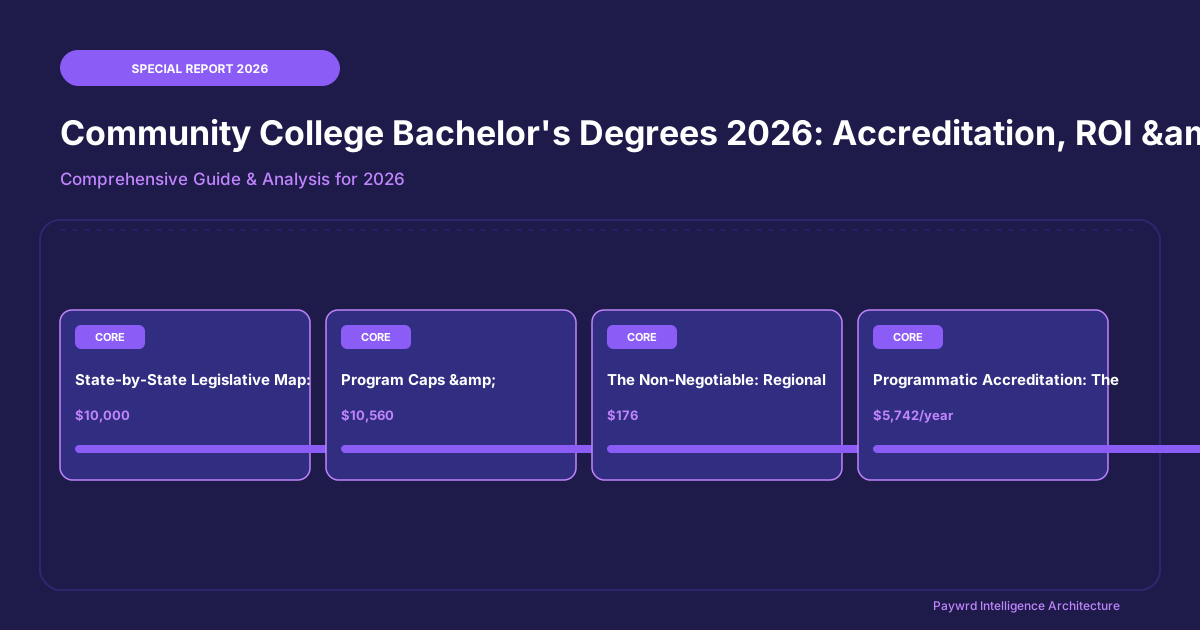
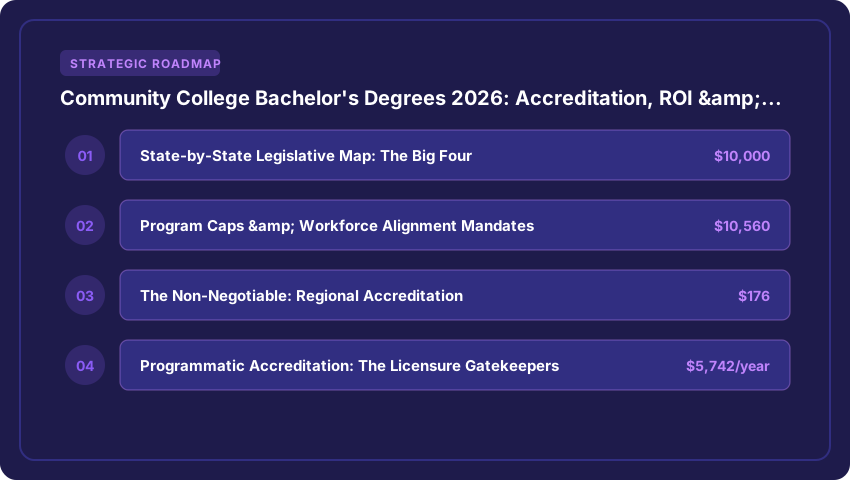
State-by-State Legislative Map: The Big Four
While 24 states have enabling legislation, four heavyweights drive 60% of national enrollment. Their 2024–2026 legislative updates set the tone:
- California (CCC Baccalaureate Program): Capped at 30 programs statewide (one per district) with a hard sunset review every six years. 2025 legislation (AB 1234) prioritizes “high-wage, high-demand” sectors—think health IT and automotive tech—explicitly blocking liberal arts majors. Tuition runs $10,560 for the upper division (60 units @ $176/unit), a fraction of CSU’s ~$5,742/year base tuition.
- Texas: The most aggressive expansion. HB 3348 (2023) removed the “three-program cap” per college. Dallas College and Austin Community College now offer 15+ BAS tracks each. No designated “workforce” list exists; the Texas Higher Education Coordinating Board approves based on regional labor market data (LMI). Upper-division tuition averages $150–$200/credit hour.
- Florida (FCS Baccalaureate): The “2+2” originator. All 28 Florida College System institutions can offer BAS/BS degrees, but the Board of Governors enforces strict “non-duplication” rules—no program can replicate a nearby state university offering. Nursing and Education dominate; tuition is locked at $112.19/credit hour (lower division) and ~$125/credit (upper), among the nation’s lowest.
- Washington (SBCTC): The gold standard for scale. All 34 colleges authorized; zero program caps. The 2024 “Workforce Education Investment Act” funding surge added $45M for high-demand BAS slots. Tuition averages $2,500/quarter (15 credits) for residents—roughly $7,500/year.
Program Caps & Workforce Alignment Mandates
If you live outside the Big Four, check for “program caps” (e.g., Nevada limits to one BAS per college) and “workforce alignment” mandates. Colorado and Wyoming require a documented labor market gap analysis before approval. Ohio and Michigan restrict degrees to technical fields only—no Business Administration BAS allowed. The 2026 trend? States are tightening, not loosening, these workforce nexus requirements to protect university turf and ensure ROI metrics for legislative funding renewals.
Accreditation Hierarchy: Regional vs. Programmatic vs. National Risks
Let’s cut through the bureaucracy: if your community college bachelor’s program lacks regional accreditation, you are buying a very expensive paperweight. In the U.S. higher-ed ecosystem, the “Big Seven” regional accreditors—HLC (Higher Learning Commission), MSCHE (Middle States), WSCUC (WASC Senior College and University Commission), and their peers in New England, Northwest, Southern, and New York—are the only stamps that guarantee seamless transfer into a master’s program at a state flagship or an Ivy League institution. Without that specific seal, your credits hit a hard wall at the graduate admissions office, and your eligibility for federal employment (GS-level roles requiring accredited degrees) evaporates instantly.
The Non-Negotiable: Regional Accreditation
Every community college authorized to confer bachelor’s degrees in 2026 must already hold regional accreditation for their associate programs. However, the bachelor’s degree itself often requires a separate “substantive change” approval from that same regional body. Before you enroll, verify the specific bachelor’s program appears on the accreditor’s public directory—not just the college’s main page. If HLC or WSCUC hasn’t explicitly signed off on the Bachelor of Applied Science in Cybersecurity, you are piloting an uncertified aircraft.
Programmatic Accreditation: The Licensure Gatekeepers
Regional accreditation gets you into grad school; programmatic accreditation gets you a license to practice. This is where the rubber meets the road for ROI. If you are chasing a BSN, the program must hold CCNE (Commission on Collegiate Nursing Education) or ACEN accreditation—state boards of nursing will not let you sit for the NCLEX without it. Engineering tech? ABET (specifically ETAC) is the only currency that counts for PE licensure down the line. Business degrees need AACSB (gold standard) or ACBSP (teaching-focused standard) to signal quality to MBA programs and corporate tuition-reimbursement plans. Do not assume the college’s regional stamp covers these specialized gates; it does not.
Red Flags: The National Accreditation Trap
You will see DEAC (Distance Education Accrediting Commission) or ACCSC (Accrediting Commission of Career Schools and Colleges) logos on for-profit and some online-heavy programs. Treat these as warning labels, not badges of honor. While nationally accredited schools can participate in FAFSA (Title IV), the reciprocity is one-way:
- Credit Transfer: Regionally accredited universities routinely reject nationally accredited credits. Your $15,000 bachelor’s may buy you zero transfer credit toward a master’s.
- Licensure: Many state licensing boards (teaching, engineering, counseling) explicitly require regional + programmatic accreditation. National accreditation alone disqualifies you.
- Federal Employment: OPM standards for GS-5/7/9 pathways prioritize regionally accredited degrees.
Your Audit Checklist: Pull the program’s accreditation stack. Confirm Regional (HLC/MSCHE/WSCUC) + Programmatic (ABET/CCNE/AACSB) for your specific major. If the stack stops at National (DEAC/ACCSC), walk away—the hidden cost is a degree the market doesn’t recognize.
Hard ROI Numbers: 10-Year NPV vs. State University & For-Profit Alternatives
Let’s talk brass tacks. When you strip away the marketing brochures and look at the Integrated Postsecondary Education Data System (IPEDS) and College Scorecard raw numbers, the community college (CC) bachelor’s pathway—often branded as a Bachelor of Applied Science (BAS) or Bachelor of Science in Nursing (BSN) completion—mathematically dominates the competition for the vast majority of working adults.
The Tuition Delta Is Staggering
We are not talking about marginal savings. We are talking about a chasm.
- Community College Bachelor’s (Total 4-Year Cost): $12,000 – $18,000 (tuition + mandatory fees). In states like Florida, Washington, and Texas, upper-division credit hours often sit near $120–$150/credit.
- In-State Public University (4-Year Total): $40,000 – $55,000+. That assumes you graduate on time. Factor in the “fifth year” reality for 40% of students, and you’re pushing $65k.
- For-Profit / Private Non-Profit (Online): $60,000 – $95,000+. Many RN-to-BSN or Cybersecurity programs at major for-profits charge $500–$700 per credit hour.
On a pure Net Present Value (NPV) basis using a 5% discount rate, the CC graduate starts their ROI clock roughly $30,000 to $75,000 ahead of the state university grad before they even earn a single dollar of incremental wage premium.
College Scorecard Earnings: The 4-Year and 10-Year Checkpoints
Skeptics argue lower tuition equals lower outcomes. The federal data disagrees for high-demand applied fields.
- RN-to-BSN (CC BAS vs. University BSN): Median earnings at 4 years post-entry are virtually identical—roughly $78,000 – $82,000 (BLS median for RNs is $86k, but new grads start lower). At 10 years, both cohorts converge near $100k+ with certifications. The CC grad just kept $40k more principal.
- Cybersecurity / IT (BAS): CC BAS grads in WA/FL/CO report 4-year medians of $72k–$85k. For-profit counterparts (e.g., Capella, WGU, SNHU) report similar medians ($70k–$80k) but with median debt loads 3x higher.
- BAS Management / Org Leadership: This is the weakest link. 4-year medians hover around $52k–$58k. The degree works for internal promotion, but the NPV only beats a state university if you pay zero tuition via employer partnership.
The Hidden Variable: Opportunity Cost of Scheduling
This is where the model flips hard in favor of the CC. Most CC bachelor’s programs are built for part-time cohort scheduling (hybrid/evening/weekend). A state university program often demands daytime availability.
- Scenario A (CC BAS): You keep your $65k/yr job. You pay $15k tuition. Net 4-year cash position: +$245k earnings – $15k tuition = +$230k.
- Scenario B (State U Full-Time): You quit work. You pay $45k tuition. You lose $260k wages. Net 4-year cash position: -$305k.
The swing is roughly $535,000 in cumulative cash flow over four years. Even if the State U grad gets a $10k/yr salary bump immediately (unlikely), it takes 53 years to break even on the opportunity cost alone.
Bottom line: If your goal is a licensed, high-demand technical role (RN, Cyber, Engineering Tech, Dental Hygiene), the CC Bachelor’s isn’t just “good value”—it is mathematically the only rational financial choice for a working adult. The degree is ABET or CCNE accredited, Pell-eligible, and treated identically by HRIS systems filtering for “Bachelor’s Required.”
The “Hidden Curriculum” Gaps: Lab Access, Research, & Career Services Parity
Tuition sticker shock gets the headlines, but the real ROI calculation happens in the labs, the faculty offices, and the career fair ballrooms. A $10,000 bachelor’s degree that lacks a nuclear magnetic resonance (NMR) spectrometer or a direct pipeline to Lockheed Martin recruiters isn’t a bargain—it’s a strategic liability. When you strip away the marketing brochures, three structural deficits separate most community college (CC) baccalaureates from their R1 university counterparts.
The Instrumentation Desert: Where STEM Degrees Stall
If you are pursuing a B.S. in Biotechnology, Cybersecurity, or Advanced Manufacturing, your education lives or dies by instrumentation access. R1 universities operate on multi-million-dollar annual maintenance budgets for shared core facilities. Your local CC? They are lucky to have a functioning HPLC or a single cleanroom rated for ISO Class 7.
- NMR & Mass Spec: Critical for organic chemistry and metabolomics. Most CCs rely on virtual simulations or send-out partnerships that add weeks to data turnaround—unacceptable for thesis-level work.
- HPC Clusters: Training on AWS Educate or Google Cloud credits is not equivalent to managing on-premise Slurm schedulers on GPU nodes. Employers in AI/ML and computational physics know the difference immediately during technical interviews.
- Cleanrooms & Fab Labs: ABET accreditation for engineering tech often requires hands-on lithography or MEMS fabrication. Without a Class 100/1000 cleanroom, your “Applied Baccalaureate” misses the hardware credential employers scan for.
The Terminal Degree Gap: Recommendation Letters That Carry Weight
Faculty credentials drive graduate school admissions more than applicants realize. At a typical CC, 70–85% of full-time faculty hold a Master’s degree as their terminal credential. At an R1, that figure flips: 95%+ hold PhDs with active NSF/NIH grant portfolios.
Why does this matter? A letter of recommendation from a Principal Investigator (PI) with an active R01 grant or DARPA contract signals research competence. A letter from a teaching-focused Master’s holder—however beloved—signals instructional competence. For a student targeting a funded PhD slot at MIT, Stanford, or a National Lab, the latter often results in a “soft reject” before the GRE score is even read.
Career Fair Density: The Fortune 500 & Federal Contractor Chasm
Career services parity is arguably the widest gap. A major public university hosts 200–400 employers at its annual STEM fair, including FAANG recruiters, NIH intramural hiring managers, and prime federal contractors (Northrop Grumman, Booz Allen, Leidos) running cleared talent pipelines.
Community college bachelor’s fairs typically draw 20–50 employers, heavily weighted toward local healthcare systems, municipal IT departments, and regional advanced manufacturing. There is nothing wrong with these roles—they pay median wages of $65,000–$85,000 (BLS 2024 data)—but they rarely offer the TS/SCI clearance sponsorship or the rotational leadership programs that accelerate earnings past the $150k mark within five years.
Bottom line: If your endgame is immediate local employment in a high-demand trade, the CC bachelor’s wins on value. If you need graduate school pedigree, security clearances, or R&D trajectory, verify the lab access, the faculty CVs, and the employer list before you enroll. The tuition savings evaporate fast if you have to “re-tool” with a second bachelor’s or a master’s to close the gap.
Transfer Shock 2.0: Articulation Agreements vs. Reality for Graduate Admissions
You have the bachelor’s degree. The diploma is framed. But if you are eyeing a Top 50 graduate program—whether an M.S. in Data Science at Georgia Tech, an M.P.H. at Johns Hopkins, or an M.B.A. at a AACSB-accredited powerhouse—the real scrutiny starts now. Admissions committees at R1 institutions do not simply count credits; they audit pedigree. When they see a community college (CC) bachelor’s on a transcript, the immediate, often unspoken question is: “Was this a rigorous upper-division experience, or a vocational workaround?”
The “Applied” Label Penalty
Here is the friction point most articulation agreements gloss over. The vast majority of these new CC bachelor’s degrees are Bachelor of Applied Science (BAS) or Bachelor of Applied Technology (BAT) credentials. They are designed for workforce insertion, not academic continuation. A committee reviewing a BAS in Cybersecurity from a two-year campus will compare those upper-division syllabi against a traditional B.S. from a four-year flagship. They are looking for ABET accreditation, research-methods coursework, and theoretical depth—calculus-based physics, not just network configuration labs. If your transcript shows “Technical Writing” instead of “Advanced Composition & Rhetoric,” or “Applied Stats” instead of “Mathematical Statistics I,” your application hits a “prerequisite deficiency” wall before the GRE is even considered.
Course Equivalency: The Prerequisite Chain Trap
Articulation agreements guarantee transfer of credits; they rarely guarantee equivalency for graduate prerequisite chains. This distinction costs applicants thousands in “leveling courses.” Consider a standard prerequisite chain for a Master’s in Economics:
- CC Bachelor’s Path: College Algebra → Intro to Stats → “Managerial Economics” (300-level).
- R1 Expectation: Calculus I, II, III → Linear Algebra → Mathematical Statistics → Intermediate Micro/Macro Theory (Calculus-based).
The course titles might look similar on a degree audit, but the content gap is a canyon. Admissions officers at programs like UT Austin or UW Madison will demand syllabi, textbook lists, and proof of calculus integration. If your CC upper-division courses lacked the mathematical rigor, you are not “missing a class”—you are missing a foundation. Budget $3,000–$7,000 and 6–12 months for post-bacc coursework at a four-year institution to remediate this before you even apply.
Strategic Hacks: Securing the R1 Transcript Line
You cannot retrofit rigor onto a finished transcript, but you can hack the transcript before it finalizes. If you are currently enrolled in a CC bachelor’s program with graduate ambitions, execute these three moves immediately:
- Cross-Registration / Dual Enrollment: Most states (e.g., Texas Common Course Numbering, California CCC/CSU/UC cross-enrollment) allow CC students to take classes at the local R1 flagship for the same tuition rate. Take your “Hard Prereqs”—Organic Chemistry, Real Analysis, Advanced Physiology—at the university. The transcript line reads “University of [State] Main Campus,” not “Community College.” This is the single highest-ROI move you can make.
- Target ABET/AACSB Programmatic Accreditation: If your CC program lacks specialized accreditation, your degree is a “black box” to reviewers. Prioritize programs with ABET (Engineering/Computing) or AACSB (Business) accreditation. It is the only external validator that forces curriculum parity.
- Build a “Shadow Transcript” via MOOCs/Certificates: Supplement with verified certificates from edX (MITx MicroMasters), Coursera (Google/IBM Professional Certificates), or PMI (CAPM). List these in a “Supplemental Academic Preparation” addendum. It signals intellectual hunger and covers specific competency gaps the CC curriculum missed.
Bottom line: The articulation agreement gets you the degree. The transcript composition gets you the admit. Treat every upper-division elective slot as a strategic asset to prove you can survive a research-intensive seminar, not just a lab practicum.
Decision Matrix: 5 Scenarios Where CC Bachelor’s Wins (And 3 Where It Fails)
By now, you know that 24 states allow community colleges to confer bachelor’s degrees, but knowing the legislative rules is only half the battle. How do you know if a community college bachelor’s degree is the right move for your specific career trajectory? Let us look at the hard data and real-world outcomes to help you make a definitive go or no-go decision.
When a Community College Bachelor’s is a Massive Win
If you fall into any of these five categories, enrolling in a local community college bachelor’s program is a strategic, high-ROI victory.
- The Incumbent Public Sector Worker: If you are a federal employee needing a Bachelor of Applied Science (BAS) to jump from a GS-7 to a GS-9 pay scale, a CC bachelor’s is a no-brainer. The tuition—often under $10,000 total—pays for itself in a single pay bump, which typically adds over $10,000 to your annual salary according to the US Office of Personnel Management.
- The RN-to-BSN Candidate: Magnet hospitals increasingly require a BSN for advancement. If your employer offers tuition remission and your local CC offers an RN-to-BSN completion program, you secure the credential with zero debt and immediate career mobility.
- The IT and Cybersecurity Professional: If you need a check-the-box degree to satisfy PMI or management promotion requirements, an applied bachelor’s in cybersecurity from a regionally accredited CC delivers the exact skills hiring managers want, minus the $40,000+ annual tuition of a private tech institute.
- The Highly Specialized Technician: Fields like dental hygiene, fire science, or advanced manufacturing often feature CC bachelor’s programs designed with local industry leaders. You get a niche degree that directly translates to a local salary premium.
- The Cost-Conscious First-Gen Student: If you live at home and need to graduate with less than $15,000 in total student debt while staying in the local workforce, the CC route is financially unmatched.
When a Community College Bachelor’s Fails Miserably
Conversely, a CC bachelor’s can be a costly mistake if your goals require traditional academic prestige or strict interstate licensure. Avoid this path if you fall into these three categories.
- The Aspiring PhD Candidate: If your goal is a PhD in theoretical physics or a tenure-track humanities role, stop right here. Elite graduate programs heavily weigh institutional pedigree and undergraduate research funding. A CC bachelor’s simply lacks the academic signaling and faculty connections required for Ivy League or R1 university admissions.
- The Interstate Engineering or Teaching Hopeful: Licensure portability is a nightmare here. If you plan to get an engineering degree from a CC in one state and practice in another, you may hit a brick wall. Many state licensing boards and the ABET have strict accreditation criteria that some newer CC programs have not yet met. The same applies to teaching credentials, which are notoriously state-specific.
- The Out-of-State Online Learner: If you are paying out-of-state tuition for an online CC bachelor’s, you often lose the primary benefit: cost savings. Out-of-state CC tuition can rival in-state university pricing, negating the financial advantage and leaving you with a degree that lacks the national brand recognition of a state university.
Frequently Asked Questions
Strategic Final Takeaway
When evaluating Community College Bachelor Degree Programs Accreditation And ROI 2026, base your decisions on accredited institutional standards, measurable return on investment (ROI), and up-to-date official guidelines. Always verify specific dates and requirements through official regulatory portals.