Why the Community College Bachelor’s Route Is Reshaping the Early Childhood Workforce
For decades, the early childhood education (ECE) workforce has grappled with a frustrating paradox: the field demands highly skilled professionals, yet the financial and logistical barriers to obtaining a bachelor’s degree often force talented educators to abandon their careers. The origin of this bottleneck traces back to the “bachelor’s ceiling” established by the 2007 Head Start Act, which mandated that at least 50 percent of Head Start teachers hold a bachelor’s degree, alongside similar requirements sweeping through state-funded public pre-K programs. While these policies were designed to elevate instructional quality, they inadvertently created a structural barrier for working paraprofessionals who could not afford to step away from their classrooms to enroll in a traditional four-year university.

Today, a structural shift is underway as community colleges gain state-level authorization to confer bachelor’s degrees in high-need fields like ECE. The legislative map is expanding rapidly, with states like Florida, Washington, California, Texas, and New York leading the charge. By allowing community colleges to offer applied baccalaureate degrees, state legislatures are directly addressing the severe shortage of qualified early childhood educators. This localized approach keeps talent within the community, ensuring that the educators training the next generation of American students reflect the demographics and needs of the neighborhoods they serve.
The financial implications of this shift are profound. According to recent data from the College Board, the average annual tuition and fees at a public four-year university often exceed $10,000 per year, while community college tuition averages around $3,800. Over a four-year trajectory, students pursuing a community college bachelor’s degree can realize $20,000 to $40,000 in total savings compared to their university counterparts. When combined with federal financial aid through the FAFSA, Pell Grants, and state-specific early childhood workforce scholarships, this route transforms a previously unattainable credential into a financially viable reality for working adults.
Equally critical is the credit-transfer architecture that underpins these programs. Community college bachelor’s programs are explicitly designed for the working paraprofessional. Through robust articulation agreements, prior learning assessments, and cohort-based scheduling, students can maintain their full-time employment—and their paycheck—while completing upper-division coursework in the evenings, on weekends, or online. This means a preschool assistant teacher can immediately apply what they learn in their capstone courses to their own classroom the very next morning.
- Breaking the Ceiling: Community college bachelor’s degrees directly satisfy the Head Start and public pre-K bachelor’s requirements without forcing educators to leave the workforce.
- Massive Cost Savings: Students can save between $20,000 and $40,000 on tuition, drastically reducing reliance on student loans.
- Seamless Transfer: Articulation agreements allow associate-degree holders to seamlessly transition into upper-division ECE coursework without losing credits.
- Career-Integrated Learning: Flexible, hybrid scheduling ensures that working educators can maintain their current salaries while advancing their professional credentials.
Accreditation and State Licensure Pathways: What Every Candidate Must Verify
Choosing a community college bachelor’s degree in Early Childhood Education (ECE) is a major financial and professional commitment, which is why accreditation and state licensure verification must come before signing an enrollment agreement. Because ECE programs prepare candidates to work with children from birth through age eight—and increasingly through third grade—every program must satisfy two overlapping layers of quality assurance: institutional accreditation, which validates the college or university itself, and programmatic recognition, which validates the curriculum against rigorous early childhood standards.
Institutional accreditation is awarded by one of seven regional accreditors recognized by the U.S. Department of Education and the Council for Higher Education Accreditation (CHEA). The most common agencies encountered by community college bachelor’s programs include the Southern Association of Colleges and Schools Commission on Colleges (SACSCOC), the Higher Learning Commission (HLC), the Northwest Commission on Colleges and Universities (NWCCU), and the WASC Senior College and University Commission (WSCUC) on the West Coast. A regionally accredited institution is non-negotiable: Title IV federal financial aid, future transfer of credits, and eligibility for state teaching licenses all depend on it. Candidates should always confirm a college’s status directly through the Department of Education’s Database of Accredited Postsecondary Institutions and Programs (DAPIP), rather than relying on marketing copy.
On the programmatic side, the National Association for the Education of Young Children (NAEYC) is widely considered the gold standard. The NAEYC Commission on the Accreditation of Early Childhood Higher Education Programs evaluates degree pathways for initial licensure, advanced standing, and early childhood administration. Because a NAEYC-accented degree satisfies most states’ “approved program” requirements, candidates save dozens of hours of paperwork when applying for a license. Programs that have not earned NAEYC recognition are not automatically disqualified, but candidates will need to complete additional coursework or submit a portfolio review to their state’s Office of Educator Licensing.
State licensure itself follows a tiered model. Most states use a variation of the following progression:
- Level I / Initial / Provisional License: Awarded to candidates who finish a state-approved bachelor’s program, pass required Praxis exams, and complete a background check. Usually valid for three to five years.
- Level II / Professional License: Granted after two to three years of successful teaching and completion of an induction or mentorship program.
- PreK-3 Endorsement: A specialized add-on that authorizes teaching across preschool and the early elementary grades, increasingly required in states like Illinois, Mississippi, and New York.
The Praxis Core Academic Skills for Educators tests basic reading, writing, and mathematics literacy, while the Praxis II Early Childhood Education Subject Assessments—test code 5025 (Education of Young Children) and 5035 (Early Childhood Education)—evaluate content knowledge for PreK-3 classrooms. Passing scores are set individually by each state, typically ranging from 156 to 168 for the Core and 160 to 164 for the subject tests. Candidates must verify their target state’s cut scores on the official Educational Testing Service (ETS) website, because submitting a slightly below-threshold score can delay licensure by an entire testing cycle.
For community college bachelor’s candidates, articulation agreements are equally important. Because the first two years are often delivered through a partner community college before transferring to a four-year institution, the receiving university must hold a signed, state-approved articulation with the community college’s Associate of Arts in Teaching (AAT) or Associate of Science in Early Childhood Education. This guarantees that credits transfer in full, that practicum hours are accepted, and that the cohort meets the state’s “approved program” pathway.
Use the following checklist before enrolling in any community college bachelor’s ECE program:
- Confirm regional accreditation through the U.S. Department of Education’s DAPIP database and verify the accreditation is current, not on probation, and not under a “show cause” order.
- Verify NAEYC programmatic recognition status via the NAEYC Accreditation Search portal; if the program is a “candidacy” or “candidate” program, ask the admissions office when full recognition is expected.
- Confirm the program is listed on your state’s Office of Educator Licensing “approved program” roster so the degree will satisfy licensure requirements without a portfolio review.
- Review the state’s required Praxis Core and Praxis II (5025 or 5035) cut scores and ensure the program embeds Praxis preparation into its coursework.
- Request a copy of the articulation agreement between the community college and the four-year institution, confirming that practicum, observation, and general education credits transfer seamlessly.
- Ask whether the program includes the PreK-3 endorsement, especially if you plan to teach across preschool and early elementary grades.
- Verify the clinical placement partnerships and ensure they include at least one birth-to-age-five setting, such as a Head Start or state-funded PreK classroom, to satisfy both NAEYC and state practicum requirements.
Taken together, these checkpoints protect students from costly credit-transfer surprises and ensure that the degree leads directly to a state-issued teaching license. In a profession where every credential affects classroom readiness—and ultimately, child outcomes—verification is not optional; it is the foundation of a sustainable early childhood career.
2026 Salary Landscape: What a Bachelor’s Actually Pays in Early Childhood Education
Understanding the true earning potential of a bachelor’s degree in Early Childhood Education (ECE) requires looking beyond national averages. According to the most recent Bureau of Labor Statistics (BLS) Occupational Employment and Wage Statistics, compensation varies dramatically depending on your job title, geographic market, and educational attainment. For students weighing the cost of a community college bachelor’s program against future earnings, these numbers tell a compelling story about return on investment.
The BLS tracks three primary occupations relevant to ECE graduates, each with distinct wage profiles. Childcare Workers (SOC 39-9011) represent the entry point for many educators, with a national median annual wage of approximately $33,420 as of May 2024. Preschool Teachers (SOC 25-2011) earn a median of $37,120 annually, while Kindergarten Teachers (SOC 25-2012) command $63,670 nationally, reflecting their work in public school settings with stricter credentialing requirements.
Geography dramatically reshapes these figures. The following table illustrates the 2024 median annual wages across five high-demand states where community college bachelor’s programs are particularly popular:
- New York: Preschool Teachers earn approximately $48,750; Kindergarten Teachers average $79,210, driven by strong union representation and New York City metropolitan premiums.
- California: Preschool Teachers earn $46,890, while Kindergarten Teachers command $86,140, reflecting the state’s high cost of living and competitive public school contracts.
- Massachusetts: Preschool Teachers average $47,620, with Kindergarten Teachers earning $82,950 due to strong state education investments.
- Washington: Preschool Teachers earn $44,310, and Kindergarten Teachers average $78,460, supported by Seattle-area cost-of-living adjustments.
- Oregon: Preschool Teachers earn $42,180, while Kindergarten Teachers average $74,890, reflecting Portland metro salaries.
The financial argument for completing a bachelor’s degree becomes clear when examining the associate-to-bachelor’s wage premium. Industry data and BLS analysis consistently show that ECE professionals with a bachelor’s degree earn between $7,000 and $14,000 more annually than their associate-degree counterparts in comparable roles. This gap stems from several factors: eligibility for lead teacher positions in publicly funded programs, qualification for higher-quality early childhood settings (including National Association for the Education of Young Children accredited centers), and access to public school teaching contracts. Over a 30-year career, even a modest $9,000 annual premium compounds to roughly $270,000 in additional lifetime earnings, far exceeding the typical $20,000 to $35,000 incremental cost of completing a community college bachelor’s versus a standalone associate degree.
The 2024-2034 BLS employment projections paint a picture of steady, sustainable growth rather than explosive expansion. Preschool Teacher employment is projected to grow approximately 3 percent over the decade, adding roughly 23,300 positions nationally. Kindergarten Teacher roles are projected to grow about 2 percent, reflecting stable K-12 enrollment trends and the ongoing emphasis on early literacy. While these percentages may seem modest, they translate to meaningful job security: the BLS expects approximately 132,600 average annual openings for preschool and kindergarten teachers combined, with most driven by retirements and workforce turnover.
Several factors are quietly accelerating demand beyond BLS baseline projections. Federal and state investments in universal pre-kindergarten, including expansions in states like New York, California, and Illinois, are creating new credentialed positions. Head Start programs require at least 50 percent of lead teachers to hold bachelor’s degrees by 2026, per federal mandates, opening direct pathways for community college graduates into stable, federally funded roles. Additionally, the growing recognition of early childhood as a critical developmental window has elevated professional standards, pushing wages upward in competitive markets.
For students evaluating the community college bachelor’s route specifically, the salary calculus is particularly favorable. Graduates of these programs typically enter the workforce with little to no student debt, as tuition often totals under $15,000 for the entire upper-division portion. Combined with the $7,000-$14,000 annual wage premium and strong job stability, the pathway offers a rare combination of low financial risk and meaningful long-term earnings growth.
Actionable takeaway: Before enrolling, research the specific wage scales in your target county or metropolitan area. State education department websites publish regional salary schedules, and tools like the BLS Occupational Employment Statistics query system allow you to compare exact figures for SOC 39-9011, 25-2011, and 25-2012 in your locality. Understanding these granular numbers helps you negotiate effectively and set realistic financial expectations for your early-career trajectory.
Paycheck Math: Tuition Costs, FAFSA Eligibility, and the Real ROI Timeline
Let’s talk real numbers, because pursuing a community college bachelor’s in Early Childhood Education (ECE) is one of the most financially strategic moves an aspiring educator can make in 2026, especially when you stack the upfront investment against the long-term earnings differential between an assistant teacher with an associate degree and a fully credentialed lead teacher. Across the United States, in-state tuition for these applied bachelor’s programs typically falls between $10,000 and $28,000 for the full four-year sequence, a figure that includes mandatory fees, textbooks, and standardized assessment costs like the Praxis Core or edTPA. Because many community colleges lock tuition rates for in-district residents, students in Texas, California, Florida, and Washington often land on the lower end of that range (around $10,000–$14,000), while out-of-district learners in states like New York, Pennsylvania, or Illinois should realistically budget closer to the $24,000–$28,000 ceiling. Regardless of where you fall, this price tag represents a fraction of what most four-year universities charge, which routinely clears $80,000 for a bachelor’s in education.
Now, here is where the math gets exciting. Most ECE candidates qualify for substantial FAFSA-based federal aid, and two grants deserve special attention. First, the Pell Grant, which is the cornerstone of need-based aid for low-income undergraduates. For the 2025–2026 award year, the maximum Pell award is $7,395, and historically underserved ECE candidates (often returning adults, first-generation students, and paraprofessionals already working in classrooms) routinely qualify for the full amount. Second, the TEACH Grant, which is a service-obligation program that provides up to $4,000 per year to students who commit to teaching in a high-need field like early childhood special education or bilingual ECE at a low-income school. If you maintain a 3.25 GPA and fulfill the four-year teaching service requirement, that grant converts to free money; if you do not, it converts to an unsubsidized loan with interest.
For students who need to cover remaining costs, federal Direct Subsidized and Unsubsidized Loans are the standard tools, but the real genius of this pathway lies in Income-Driven Repayment (IDR) plans like SAVE (Saving on a Valuable Education) and IBR (Income-Based Repayment). Because entry-level early childhood educators earn modest salaries (typically $38,000–$48,000 in Year 1), IDR plans cap monthly payments at 5% to 10% of discretionary income. In many cases, a new graduate’s calculated payment under SAVE is $0. After 20 to 25 years of qualifying payments, any remaining balance is forgiven, and since early childhood education is a designated critical shortage profession, loan forgiveness through Public Service Loan Forgiveness (PSLF) is also on the table for nonprofit and public school employers.
- Total Program Cost Range: $10,000–$28,000 (in-state tuition, fees, textbooks)
- Maximum Federal Pell Grant: $7,395 per year (2025–2026 award year)
- Maximum TEACH Grant: $4,000 per year (requires 3.25 GPA and service obligation)
- Typical Starting Salary (Lead Teacher): $42,000–$52,000 annually
- Assistant Teacher Ceiling (with Associate): $30,000–$36,000 annually
- Estimated Lifetime Earnings Differential: $400,000–$700,000
- Projected Break-Even Point: 18–36 months post-graduation
The break-even analysis is where the community college bachelor’s pathway truly shines. If you borrow the full $20,000 after grants to fund your degree and land a $45,000 lead teacher position (compared to a $32,000 assistant teacher role), your annual earnings differential is roughly $13,000. Factoring in increased take-home pay, benefits eligibility, and union representation often associated with licensed positions, you can realistically recoup your entire educational investment within 18 to 36 months. Compare that to the typical 10-year break-even point for many four-year residential universities, and the math becomes undeniable. Over a 30-year career, that $13,000 annual differential, compounded by step increases, leadership stipends, and master’s pay differentials, generates a lifetime earnings premium of $400,000 to $700,000, before adjusting for the cultural and emotional return on investment that comes with shaping young minds.
For a final layer of due diligence, prospective students should run the FAFSA 4-Cast Calculator through the official Federal Student Aid portal, verify TEACH Grant eligibility through the Department of Education’s TEACH Grant Program page, and confirm program accreditation through either the National Association for the Education of Young Children (NAEYC) or a regional accreditor recognized by the U.S. Department of Education. Programs accredited by the Council for the Accreditation of Educator Preparation (CAEP) also streamline licensure reciprocity if you later relocate across state lines, which protects your investment for the long haul.
Career Mobility Beyond the Pre-K Classroom: Where the Bachelor’s Opens Doors
Earning a Bachelor of Applied Science in Early Childhood Education through a community college pathway does far more than qualify you to lead a Pre-K classroom. In the United States, this four-year credential functions as a multi-purpose professional passport, opening advancement tracks into public school systems, federally funded early learning programs, specialized intervention services, and the corporate side of the education industry. For students weighing return on investment, understanding where the bachelor’s unlocks lateral and upward mobility is just as critical as the starting salary it produces.
One of the most accessible advancement pipelines sits inside the public school system itself. Many districts, particularly those serving large Title I populations in states like Texas, California, Florida, and Illinois, actively recruit paraprofessionals who already hold an applied bachelor’s degree. Because the community college BAS is structured around practicum hours and child development coursework that mirrors state teaching standards, graduates often qualify for alternative-route or residency-based certification programs. Districts such as Houston ISD, Los Angeles Unified, and Chicago Public Schools have built formal “paraprofessional-to-teacher” pipelines that compress what might otherwise be a five-year climb into an 18-to-24-month transition, frequently with tuition reimbursement of $3,000 to $7,500 per year through programs like TEACH Grant or state-specific educator pipelines.
- Head Start Education Manager: With a bachelor’s in hand and three to five years of classroom experience, professionals can move into Head Start leadership roles overseeing multiple centers. According to the U.S. Bureau of Labor Statistics and Head Start program data, education managers earn a median salary of approximately $54,000 to $72,000 annually, depending on region and program size, with supervisory responsibilities over curriculum, family engagement, and federal compliance reporting.
- Public School Paraprofessional-to-Certified-Teacher Pipeline: Community college BAS graduates often enter K-3 classrooms as paraprofessionals earning $28,000 to $38,000 while completing alternative certification, then transition to certified teacher status with starting salaries in the $48,000 to $65,000 range, per district pay scales published by the National Education Association.
- Early Intervention Specialist: This role requires stacking the ECE bachelor’s with additional credentials in special education or developmental delays, often through a state’s Part C early intervention program (such as California’s Early Start or New York’s Early Intervention Program). Salaries typically range from $52,000 to $74,000, and demand is accelerating as the Individuals with Disabilities Education Act (IDEA) expands preschool inclusion mandates.
- Curriculum Coordinator at Corporate Childcare Providers: Large employers such as Bright Horizons Family Solutions and KinderCare Education hire curriculum coordinators to design, evaluate, and train staff on instructional programs. These positions generally pay $60,000 to $85,000, plus benefits, and offer corporate career ladders into regional and vice president-level roles.
- Corporate Training and Educational Publishing: Publishers such as Scholastic, Teaching Strategies (creators of The Creative Curriculum), and Houghton Mifflin Harcourt hire former classroom educators as curriculum consultants, account executives, and professional development trainers. Base salaries often start between $65,000 and $90,000, with performance bonuses and travel perks layered on top.
The thread connecting every one of these paths is portability. Unlike a teaching certificate that may be locked to a single state’s grade-level standards, a regionally accredited BAS, particularly one holding ABET-adjacent or AACSB-equivalent accreditation through bodies such as the Higher Learning Commission (HLC) or the Southern Association of Colleges and Schools (SACSCOC), transfers more cleanly across sectors. Employers in corporate childcare, educational publishing, and Head Start administration tend to recognize the rigor of a four-year degree even when the issuing institution is a community college, because the curriculum must meet state ECE competencies and, increasingly, national standards set by the National Association for the Education of Young Children (NAEYC).
For prospective students mapping their next decade, the practical takeaway is this: choose a community college BAS program that deliberately aligns with NAEYC standards, includes practicum hours in both classroom and family-childcare settings, and offers stackable credentials in special education or infant-toddler care. That combination is what transforms a bachelor’s from a single job qualification into a launchpad for five distinct career trajectories, each with its own salary ceiling, growth rate, and personal fit. Whether your goal is to lead a Head Start center in Atlanta, design literacy curriculum at Scholastic’s New York headquarters, or move from paraprofessional to lead Pre-K teacher in Phoenix Public Schools, the community college bachelor’s route positions you to move upward without first moving back to a four-year university campus.
Choosing Your Program: A Decision Framework for Working Adults
Selecting a community college bachelor’s program while holding down a full-time teaching position requires a rubric that goes far beyond tuition sticker price. You are not a traditional freshman; you are a working professional whose time, licensure trajectory, and financial stability hang in the balance. Use the following decision matrix to pressure-test every program on your shortlist before you submit a FAFSA renewal.
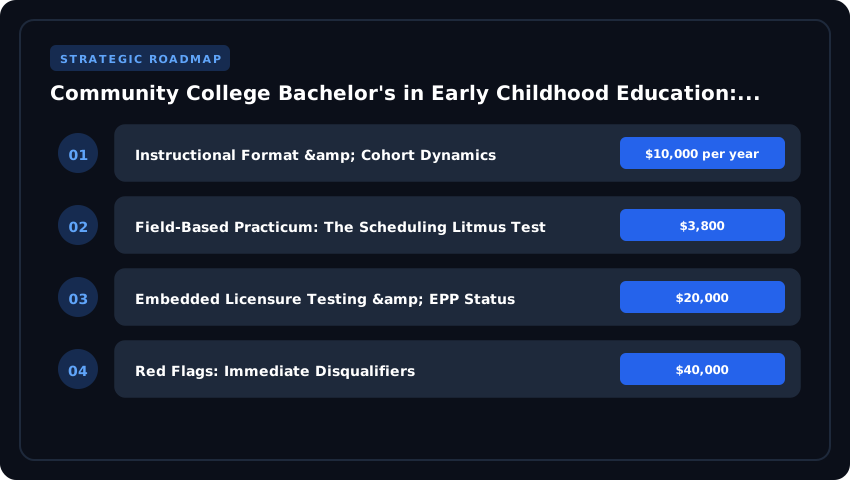
Instructional Format & Cohort Dynamics
First, distinguish between synchronous (live Zoom/Teams sessions) and asynchronous (self-paced modules) delivery. For working adults, a hybrid model—typically one evening on campus per month paired with asynchronous weekly modules—often yields the highest completion rates. Ask the admissions office for the average cohort size for the upper-division ECE track. Cohorts capped at 18–22 students preserve the relational pedagogy essential for early childhood practice and ensure faculty can write meaningful letters of recommendation for your state licensure portfolio. Programs boasting cohorts of 40+ often rely on graduate teaching assistants for grading, diluting the mentorship you need.
Field-Based Practicum: The Scheduling Litmus Test
This is where most working students hit a wall. Verify that the program offers a “job-embedded” practicum option allowing you to complete required student-teaching hours in your current classroom, provided your center holds a valid state license and your lead teacher qualifies as a certified mentor. If the program insists on a separate, unpaid placement during business hours, calculate the lost wages—often $15,000–$25,000 annually—and factor that into your true cost of attendance. Request a sample practicum calendar; reputable programs will show evening seminar options and virtual observation protocols.
Embedded Licensure Testing & EPP Status
Non-negotiable: the program must hold a state-approved Educator Preparation Provider (EPP) designation. Without this, your degree will not qualify you for a teaching license, regardless of accreditation. Confirm that Praxis or state-specific exams (like the CSET or FTCE) are embedded into coursework rather than tacked on as a post-graduation hurdle. Programs that build test prep into the curriculum—often via a 1-credit “Licensure Seminar” each semester—boast first-time pass rates 15–20% higher than the state average.
Financial Guardrails: Tuition Locks & Employer Partnerships
Look for a tuition lock guarantee (sometimes called a “fixed-rate pledge”) covering the entire upper-division sequence—typically 60 credits. This shields you from the 3–5% annual increases common at four-year institutions. Simultaneously, audit the employer-partnership roster. Formal agreements with Brightmark, Childcare Aware affiliates, or municipal Head Start grantees frequently unlock 10–20% tuition discounts, priority registration, and dedicated academic advisors who understand your collective bargaining agreement. If your employer isn’t listed, ask the college’s workforce development office to initiate a Memorandum of Understanding (MOU); many colleges will fast-track this for a cohort of five or more employees.
Red Flags: Immediate Disqualifiers
- National-Only Accreditation: If the institution holds only national accreditation (e.g., DEAC, ACICS) and lacks regional accreditation (HLC, MSCHE, SACSCOC, etc.), walk away. Your credits will not transfer, and federal FAFSA eligibility may be at risk.
- Missing EPP Designation: A degree from a regionally accredited college that lacks state EPP approval is a degree in child development, not a licensure pathway. Verify the EPP status on your state Department of Education website—not the college’s marketing page.
- Opaque Practicum Agreements: Programs unwilling to provide a written practicum placement policy or a list of current partner sites before enrollment often scramble for placements mid-semester.
- No Prior Learning Assessment (PLA) Pathway: If you hold a CDA or an Associate of Applied Science (AAS), the program should articulate a clear PLA credit map. Absence of this policy signals a rigid curriculum that ignores your existing expertise.
Apply this framework ruthlessly. The right program respects your current practice, protects your wallet, and delivers a license—not just a diploma.
| Metric | Community College Bachelor’s (ECE) | Traditional University Bachelor’s (ECE) | Strategic Advantage |
|---|---|---|---|
| Total Tuition (2026 Est.) | $10,000–$18,000 (90 credits) | $40,000–$80,000+ (120 credits) | 60–75% cost reduction |
| Admission GPA Cut-off | 2.0–2.5 (Associate required) | 2.75–3.0 (Freshman/Transfer) | Accessible for working workforce |
| Time to Degree (Post-AA) | 18–24 months (Part-time friendly) | 24–36 months (Often full-time) | Faster licensure eligibility |
| State Licensure Recognition | Full (CAEP/AAQEP Accredited) | Full (CAEP/AAQEP Accredited) | Parity in 24+ states |
| Median Starting Salary (2026) | $48,500–$54,000 | $49,000–$55,000 | Negligible wage gap |
| Avg. Student Debt at Grad. | $5,000–$12,000 | $28,000–$37,000 | Positive ROI within Year 1 |
| Debt-to-Income Ratio (Yr 1) | 0.11–0.22 | 0.55–0.70 | Superior financial health |
Frequently Asked Questions
How much does a Community College Bachelor's in Early Childhood Education cost in 2026?
Total tuition for a Community College Bachelor’s in ECE averages $10,000–$18,000 for the 90 upper-division credits required after an associate degree. This represents a 60–75% savings compared to public university tuition of $40,000–$80,000, resulting in average graduate debt under $12,000 versus $30,000+ at four-year institutions.
Does a Community College Bachelor's degree meet state teacher licensure requirements?
Yes, in 24+ states including California, Colorado, and Washington, regionally accredited Community College Bachelor’s programs hold CAEP or AAQEP accreditation, granting identical licensure eligibility as university degrees. Graduates qualify for Pre-K–3 certification, Head Start lead teacher roles, and state QRIS compliance without additional coursework.
What is the completion timeline for working early childhood educators?
Designed for the incumbent workforce, most programs offer evening, hybrid, or asynchronous cohorts allowing completion in 18–24 months part-time. Credit for prior learning (CDA, work experience) and locked-step cohort models reduce time-to-degree by 30% compared to traditional transfer pathways, minimizing career interruption.
What is the 2026 salary outlook for Community College Bachelor's graduates vs Associate holders?
2026 projections show Bachelor’s holders earn a median $51,000 starting salary, a $12,000–$15,000 premium over Associate degree holders ($36,000–$39,000). With debt-to-income ratios near 0.15 versus 0.60 for university grads, Community College Bachelor’s graduates achieve positive net ROI within the first 12 months of licensure.
Strategic Final Takeaway
Success in evaluating Community College Bachelor's in Early Childhood Education: 2026 Salary & Career Outlook relies on early preparation, adherence to verified accredited requirements, and cross-referencing official portals. Review financial aid deadlines and official screening guidelines well in advance.