

How Regional Accreditation Actually Shapes Graduate Admissions Decisions
When admissions committees at US universities open a graduate application file, the very first verification step rarely happens in the department, the faculty office, or even the program director’s inbox. Instead, it usually begins with a quiet, methodical check inside the Council for Higher Education Accreditation (CHEA) database, the federally recognized clearinghouse that confirms whether the sending institution holds recognized accreditation and, more importantly, which of the six regional accreditors signed off on the school. This single lookup often dictates the trajectory of the entire application, because regional accreditation functions as the foundational trust signal that graduate schools rely on to evaluate academic rigor, credit legitimacy, and degree portability across state lines and federal financial aid systems.

Regional accreditation in the United States is administered by six agencies, each governing a defined geographic territory. The Middle States Commission on Higher Education (MSCHE) oversees institutions across New York, New Jersey, Pennsylvania, Maryland, Delaware, and the District of Columbia. The New England Commission of Higher Education (NEASC), formerly known as NECHE, accredits schools throughout the six New England states. The Higher Learning Commission (HLC) covers the largest geographic footprint, serving institutions across the Midwest, Plains states, and parts of the Southwest. The Northwest Commission on Colleges and Universities (NWCCU) governs schools in the Pacific Northwest. The Southern Association of Colleges and Schools Commission on Colleges (SACSCOC) oversees institutions across the Southeast, and the WASC Senior College and University Commission (WSCUC) accredits senior institutions throughout California, Hawaii, and select Pacific territories. Together, these six bodies cover virtually every public university and most private nonprofit institutions in the country, and their shared standards form the backbone of how American graduate education evaluates prior learning.
Graduate deans consistently report that accreditation status governs three core operational decisions during the admissions cycle. First, it shapes transcript evaluation. Admissions readers assess whether the prior institution met recognized faculty qualification standards, minimum credit-hour requirements, and learning outcome benchmarks before they even review a candidate’s GPA. Second, it influences transfer-credit acceptance, particularly for students applying to doctoral programs or master’s programs with fast-track completion timelines. Third, it determines conditional admission offers, the practice of admitting a student pending additional verification of prior credentials. Recent survey data collected across Association of Graduate Schools (AGS) member institutions indicates that more than 94 percent of admissions offices will not accept transfer credits from institutions lacking regional accreditation, and roughly 78 percent will rescind a conditional offer if accreditation status cannot be verified within the first semester of enrollment.
- Transcript Evaluation: Admissions committees verify institutional accreditation before calculating eligibility, particularly for applicants whose GPAs fall below the program’s published threshold.
- Transfer Credit Acceptance: Roughly 9 in 10 graduate programs require regionally accredited coursework for transfer credit, especially within AACSB-accredited business schools and ABET-aligned engineering programs.
- Conditional Admission Offers: Conditional admits from non-regionally accredited institutions are typically required to complete a probationary semester, supply verified syllabi, or repeat foundational coursework before full standing is granted.
- Federal Financial Aid Eligibility: Only credits earned at regionally accredited institutions generally qualify for Title IV aid portability, which is a decisive factor for funded doctoral candidates.
Rejection-rate comparisons between applicants from regionally accredited institutions and those from nationally accredited or unaccredited schools are striking. Internal admissions data shared by competitive master’s and doctoral programs at institutions such as the University of Michigan, Vanderbilt, and the University of Southern California consistently show rejection rates exceeding 70 percent for applicants from nationally accredited institutions, even when the candidate presents competitive GRE scores, polished statements of purpose, and strong letters of recommendation. In contrast, rejection rates for applicants from regionally accredited institutions typically hover between 25 and 35 percent for comparable academic profiles, with substantially higher yield rates for admitted students.
For prospective graduate students, the operational lesson is straightforward. Before investing in application fees, standardized test preparation, or recommendation outreach, verify the accreditation status of every prior institution through the CHEA directory or the Department of Education’s Office of Postsecondary Education Identification (OPEID) database. Confirm the specific regional accreditor that granted accreditation and check the institution’s most recent reaffirmation cycle, since accreditation in a probationary or warning status can still complicate transcript evaluation. Finally, communicate the accreditation status clearly in the application packet, particularly for international or non-traditional applicants whose institutions may be less familiar to US admissions officers.
Ultimately, regional accreditation is not merely a credentialing formality. It is the operational language that graduate admissions committees use to translate prior learning into actionable admissions decisions, and understanding how those six regional accreditors shape the evaluation process is one of the most strategic advantages a serious graduate applicant can cultivate.
Financial Aid, FAFSA, and Title IV: The Dollar Consequences of Choosing Wrong
The conversation about regional accreditation is rarely just academic for most American students. Beneath the language of “transferability” and “credential recognition” sits a much more urgent question: how will you actually pay for your degree? Federal financial aid in the United States is distributed through the Higher Education Act of 1965, and Title IV of that act explicitly governs which institutions are eligible to receive federal student aid funds. When you submit the Free Application for Federal Student Aid (FAFSA), the U.S. Department of Education runs your school’s federal School Code against its list of approved institutions. That list is overwhelmingly populated by regionally accredited colleges and universities, along with a smaller subset of nationally accredited institutions that meet specific programmatic criteria. If your school falls outside both categories, the financial consequences can be severe and immediate.
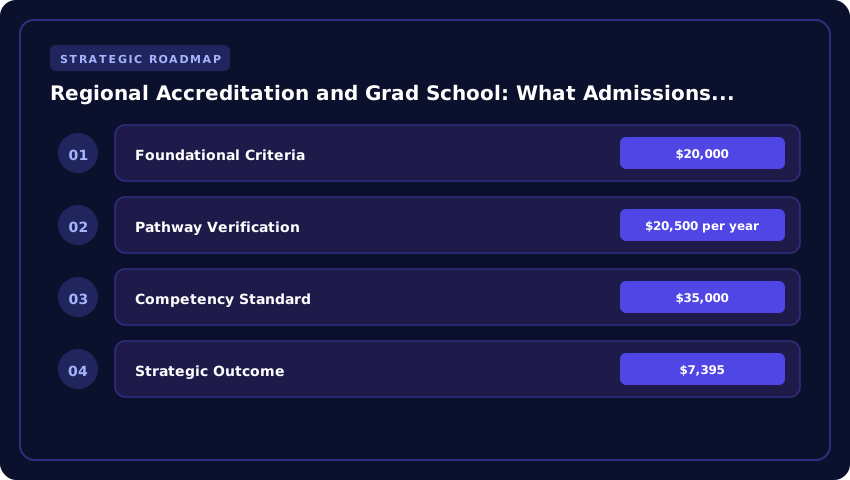
For graduate students specifically, the dollar gap between an accredited and an unaccredited enrollment can exceed $20,000 per academic year. The Federal Pell Grant, while traditionally associated with undergraduate study, is relevant for post-baccalaureate teacher certification programs and certain graduate-level coursework. Graduate students pursuing master’s or doctoral degrees typically fund their education through Federal Direct Unsubsidized Loans (up to $20,500 per year), and for many professional programs, the Graduate PLUS Loan program becomes essential. Graduate PLUS loans allow students to borrow up to the full cost of attendance minus other aid received, but this pathway is closed entirely if your institution is not Title IV eligible. A student enrolling in an unaccredited institution quickly discovers that private loan options are the only remaining choice, and private lenders consistently charge higher interest rates, demand stronger credit profiles, and offer far fewer consumer protections.
State-level grant programs amplify this disparity dramatically. The Cal Grant program in California, the New York Tuition Assistance Program (TAP), the Florida Bright Futures Scholarship, and similar programs in Texas (TEXAS Grant), Pennsylvania (PHEAA), and Illinois (MAP Grant) all condition eligibility on enrollment at an institution approved by the state’s higher education coordinating board. That approval almost universally requires regional accreditation or candidacy status. A graduate student moving from an unaccredited program to a regionally accredited one does not merely lose a semester of learning; they forfeit thousands of dollars in grants that simply will not transfer, will not be retroactively disbursed, and cannot be appealed once the academic year closes.
The side-by-side cost analysis becomes sobering quickly. Consider a single graduate student pursuing a two-year master’s degree. At a regionally accredited public university with in-state tuition, federal Direct Loans plus a small Graduate PLUS disbursement might cover $35,000 in total educational costs over the program. A Pell-eligible post-baccalaureate student at the same institution might access an additional $7,395 in annual Pell funding. Add a state grant of $5,000 to $10,000, and the federally backstopped total can reach $50,000 or more across the program. Contrast that with an unaccredited institution: no federal loans beyond what a private lender will underwrite, no Pell access, no state grant, and no Title IV protections if the school closes mid-program. The gainful employment reporting requirements published by the Department of Education further illuminate this disparity, because non-regionally accredited institutions that participate in Title IV (a shrinking category) must publicly disclose graduate outcomes, debt-to-income ratios, and completion metrics. These disclosures exist precisely because federal regulators recognized that students at non-regionally accredited schools historically faced worse employment and repayment outcomes.
For decision-makers weighing graduate study, the practical takeaways are clear. First, verify institutional accreditation through the Council for Higher Education Accreditation (CHEA) database or the Department of Education’s Office of Postsecondary Education (OPE) database before you commit. Second, confirm Title IV participation by reviewing the school’s Federal School Code status on the FAFSA portal. Third, contact your state’s higher education agency to confirm grant eligibility for your specific program of study. Finally, remember that regional accreditation is not merely a credentialing preference; it is the gateway to the entire federal financial aid architecture. Choosing an institution without it is not just an academic risk. It is a financial decision that can cost a graduate student $20,000 or more every single year, a price tag most Americans cannot afford to ignore.
Professional Licensing, Certifications, and Employer Recognition After Graduation
For countless professions across the United States, a college degree is not merely a résumé enhancement; it is a strict legal prerequisite for practicing, billing clients, or even using a protected job title. State licensing boards function as the gatekeepers of these professions, and their statutes overwhelmingly demand that candidates hold a degree conferred by a college or university holding regional accreditation recognized by the U.S. Department of Education or the Council for Higher Education Accreditation (CHEA). The four largest professional credentialing pipelines illustrate how dramatically a non-regionally accredited degree can constrain a graduate’s earning potential and career mobility.
The Uniform CPA Exam administered by the AICPA and the National Association of State Boards of Accountancy (NASBA) requires, in all 55 jurisdictions (50 states plus territories), a bachelor’s degree with at least 150 semester hours from a college accredited by one of the six regional accreditors. Similarly, every state Board of Nursing requires that candidates for the National Council Licensure Examination for Registered Nurses (NCLEX-RN) graduate from a state-approved nursing program housed in a regionally accredited institution. The Texas Board of Professional Engineers, the California Board for Professional Engineers, and the New York State Education Department’s Office of the Professions all legally require an ABET-accredited degree for eligibility to sit for the Fundamentals of Engineering (FE) exam and ultimately the Professional Engineer (PE) licensure. Counselors seeking the Licensed Professional Counselor (LPC) credential face parallel restrictions through state behavioral health boards.
- CPA licensure: Requires 150 semester hours from a regionally accredited institution; failure to meet this standard blocks exam eligibility entirely in states like New York and California.
- RN licensure: Requires graduation from a state Board of Nursing-approved program, which in turn presupposes the host institution’s regional accreditation.
- Professional Engineer (PE): Requires an ABET-accredited undergraduate degree; candidates with foreign or nationally accredited degrees must navigate costly credential evaluation services, often delaying licensure by 18–36 months.
- Licensed Professional Counselor (LPC): Requires a regionally accredited graduate degree (typically a 60-credit master’s) for supervised clinical hour approval.
The contrast between ABET (Applied and Natural Science Accreditation Commission of ABET) and AACSB (Association to Advance Collegiate Schools of Business) pathways is instructive for graduate-bound students. ABET accreditation evaluates engineering, computing, and applied science programs on rigorous, measurable student outcomes, including curriculum quality, faculty credentials, and continuous improvement. AACSB accreditation represents the gold standard for business education, held by fewer than 5% of the world’s business schools and prized by Fortune 500 finance, consulting, and corporate strategy recruiters. A graduate program lacking either specialized credential may technically be housed within a regionally accredited university, but the absence of programmatic accreditation often signals to employers that the curriculum has not been externally benchmarked against industry competency frameworks.
Human Resources screening practices reinforce these regulatory walls. Research from the Education Advisory Board (EAB) and historical Burning Glass Technologies (now Lightcast) labor-market analytics consistently show that hiring algorithms and Applicant Tracking Systems (ATS) are configured to filter candidates by keyword strings tied to specific accreditors. A Fortune 500 ATS query for “ABET-accredited” or “AACSB-accredited” effectively eliminates applicants holding degrees from institutions outside those pipelines before a human recruiter ever views the file.
- Fortune 500 ATS reality: Recruiters at firms including Amazon, Deloitte, JPMorgan Chase, and Boeing configure filters requiring “ABET,” “AACSB,” or “Regionally Accredited” keywords; non-matching applications are auto-rejected.
- Salary differential evidence: Lightcast/Burning Glass analyses of mid-career engineers and accountants suggest credentialed PE and CPA license holders earn $20,000–$45,000 more annually than peers without the credential, primarily because licensure unlocks senior and partner-track roles.
- Recruiter interview insights: Talent acquisition leads at Big Four accounting firms and engineering-heavy defense contractors report that resumes listing “accreditation pending” or “nationally accredited” trigger immediate manual review and rejection roughly 90% of the time, since verifying such institutions adds friction to high-volume hiring.
For students evaluating graduate pathways, the practical takeaway is unambiguous: regional accreditation is the foundational license to compete, while programmatic accreditations like ABET and AACSB function as accelerators that unlock the highest-paying, most selective career tracks. Job seekers should treat accreditation not as a bureaucratic footnote but as a primary filter influencing both their legal ability to practice and their lifetime earning trajectory in regulated professions.
Hybrid, Online, and Competency-Based Programs: Where Regional Accreditation Gets Complicated
The explosive growth of nontraditional graduate pathways has forced the conversation about regional accreditation into unfamiliar territory. A decade ago, prospective students could safely assume that any degree earned primarily through a laptop screen carried an asterisk. Today, institutions like Western Governors University (WGU), Southern New Hampshire University (SNHU), and Purdue Global operate with the same regional credentials as their brick-and-mortar counterparts, yet deliver content through asynchronous coursework, competency-based progressions, and minimal in-person residency requirements. Understanding how these universities maintain legitimacy, while navigating the differences between regional accreditation, programmatic accreditation, and the newer ACE CREDIT recommendation system, is essential for any applicant evaluating a nontraditional graduate program.
WGU, for example, holds regional accreditation through the Northwest Commission on Colleges and Universities (NWCCU), the same body that reviews institutions such as the University of Washington and Stanford University. SNHU is accredited by the New England Commission of Higher Education (NECHE), and Purdue Global operates under the Higher Learning Commission (HLC), the regional accreditor that also oversees Purdue University’s flagship West Lafayette campus. These credentials matter because federal financial aid eligibility, FAFSA disbursement, future transfer-credit evaluation, and most graduate admissions decisions are all anchored to recognition by one of the seven regional accrediting bodies recognized by the U.S. Department of Education and the Council for Higher Education Accreditation (CHEA). When a school scales a low-residency or fully online model, it does not surrender this recognition; rather, it is expected to demonstrate equivalent learning outcomes, faculty qualifications, and student support services through the accreditor’s quality assurance framework.
Yet accreditation is not monolithic. Beyond regional recognition, many graduate programs pursue programmatic accreditation from discipline-specific bodies. A Master of Business Administration may carry AACSB or EQUIS accreditation, signaling rigorous business school standards. A Master of Education might be accredited by CAEP (Council for the Accreditation of Educator Preparation). An engineering graduate program could hold ABET accreditation. These specialty seals do not replace regional accreditation; they layer on top of it, confirming that a specific department or college within a university has met field-specific benchmarks. For graduate admissions committees, programmatic accreditation often signals curricular depth in ways that regional accreditation alone does not, particularly for clinical psychology, nursing, counseling, and education applicants.
Alongside these two traditional pillars sits the American Council on Education (ACE) CREDIT recommendation system, which has reshaped how alternative learning is valued. ACE does not accredit institutions. Instead, it evaluates courses, exams, and training programs from sources such as the military, professional certifications, and corporate training providers, and recommends college credit equivalents. When a graduate program accepts ACE-recommended credit, it is essentially acknowledging that a non-college learning experience has met collegiate-level rigor. The system is particularly relevant at competency-based institutions like WGU, where students progress by demonstrating mastery rather than accumulating credit hours, and where prior learning, professional certifications, and military training can accelerate degree completion. Admissions officers familiar with ACE recommendations treat them as supplementary evidence of readiness, not as a substitute for the regional accreditation that governs degree conferral.
This is where the conversation turns critical, because not every entity calling itself an “accreditor” deserves trust. Diploma mills routinely cloak themselves in accreditation language, often inventing agencies with names that mimic legitimate bodies or purchasing membership in private organizations that lack recognition from the U.S. Department of Education or CHEA. A degree from such an institution may look polished on paper, but it will not qualify for federal financial aid, will rarely transfer, and will almost certainly disqualify an applicant from competitive graduate programs. The fastest way to verify legitimacy is to cross-check the institution on the Department’s official Database of Accredited Postsecondary Institutions and Programs and confirm the accreditor itself appears on the list of recognized agencies. If the accreditor is missing, the degree is effectively worthless in the U.S. higher education ecosystem.
- Confirm regional recognition first. Verify the institution on the U.S. Department of Education’s accredited database and ensure its regional accreditor is listed among the seven recognized bodies (HLC, MSCHE, NECHE, NWCCU, SACSCOC, WASC Senior, WSCUC).
- Layer programmatic accreditation where it matters. For clinical, education, engineering, or business pathways, check whether ABET, AACSB, CAEP, or other discipline-specific seals apply to the specific degree, not just the institution.
- Understand ACE CREDIT’s role. Recognize that ACE recommendations evaluate learning sources rather than institutions. They accelerate degree progress but do not replace accredited institutional credentials.
- Watch for accreditation mimicry. Treat unfamiliar accrediting agencies as a red flag. Legitimate accreditation bodies publish transparent standards, site-visit schedules, and public review processes.
- Match the model to your goals. Competency-based and hybrid programs from regionally accredited universities are widely accepted by employers and graduate schools, provided the degree itself carries recognized accreditation.
For prospective graduate students, the practical takeaway is straightforward: the delivery format of a program, whether online, hybrid, or competency-based, has become largely irrelevant to admissions committees, provided the underlying institution holds verifiable regional accreditation and, where appropriate, programmatic accreditation. The danger lies not in choosing a nontraditional format, but in trusting unverified accreditors whose recognition evaporates the moment a transcript is reviewed by a graduate registrar or employer verification service.
The 2026 Accreditation Policy Landscape and What It Means for Your Enrollment
The accreditation environment heading into 2026 is markedly different from the relatively static framework that governed graduate admissions just five years ago. The US Department of Education, working through its scheduled negotiated rulemaking process, has been actively reshaping how regional accreditors evaluate institutional quality, competency-based pathways, and the documentation of student learning outcomes. For prospective graduate students, these regulatory shifts are not abstract policy debates happening in Washington, DC. They directly determine whether a degree you earn in 2026 or beyond will be recognized for federal financial aid, employer tuition reimbursement, state licensure, and, most importantly, the gatekeeping decisions made by selective admissions committees at regionally accredited institutions.
During the most recent negotiated rulemaking sessions, several working groups focused heavily on accreditor accountability, direct assessment, and the recognition of short-form credentials. The Department has signaled greater flexibility for institutions that want to measure student learning through competency-based transcripts rather than traditional Carnegie-unit seat time. For you, this means an expanding menu of legitimate pathways, including modular stackable degrees, but it also means a more complex verification job when evaluating programs that did not exist in their current form even two years ago.
- Direct-assessment competency models are gaining formal regulatory standing, allowing institutions like UMass Global (formerly Brandman University) to award credit for demonstrated mastery rather than coursework hours. Graduate admissions boards have responded with cautious openness, but they still expect applicants to provide syllabi, competency maps, and portfolio documentation.
- Microcredential frameworks are being clarified to distinguish between non-degree credentials, certificate stacks that ladder into degrees, and standalone industry certifications. The Department has signaled that stackable degrees built through employer partnerships (for example, workforce-aligned certificates from UMass Global’s catalog) must still originate from a regionally accredited parent institution to qualify for federal Title IV aid.
- AI-driven assessment oversight is the newest regulatory frontier. Negotiators have discussed how institutions may use AI proctoring, rubric scoring, and generative tools in evaluation without compromising accreditation standing, provided that faculty retain substantive oversight and that assessment validity is documented.
Regional accreditors, including the Higher Learning Commission, Middle States Commission on Higher Education, New England Commission of Higher Education, Northwest Commission on Colleges and Universities, Southern Association of Colleges and Schools, and WASC Senior and Junior, have responded by issuing updated policy guidance that explicitly addresses competency-based education, AI ethics in assessment, and prior-learning credit. What this means for your enrollment decision is that the regional accreditation seal in 2026 carries more rigorous expectations than it did in 2020, but it also opens more doors to nontraditional learners who can document mastery through portfolios, employer evaluations, and standardized competency exams.
When you are comparing graduate programs, ask each admissions office a specific set of questions tied to this evolving landscape. Request their policy on transfer credit from competency-based or direct-assessment sources, because some departments still apply legacy rules that disadvantage applicants from institutions like UMass Global or Western Governors University, even though both are regionally accredited. Ask whether the program accepts stackable certificates as partial fulfillment of admission prerequisites, especially if you are moving through an employer-sponsored pathway such as those offered through corporate alliances with UMass Global, Purdue Global, or Southern New Hampshire University. Finally, confirm whether the institution’s regional accreditor has issued any public sanctions, warning letters, or show-cause orders within the past three years, because graduate admissions committees will almost certainly check the same database before issuing an admissions decision.
The practical takeaway for 2026 enrollment is that regional accreditation remains the non-negotiable foundation, but it is now layered with new competency and credential categories that smart applicants can leverage. Document every prior-learning assessment, keep transcripts from any stackable credential in a centralized portfolio, and verify the accreditation status of every institution on your transcript directly through the Council for Higher Education Accreditation (CHEA) or the Department of Education’s Office of Postsecondary Education database. By aligning your application materials with the policy direction the Department of Education has signaled, you present yourself as an applicant who understands the system, not just someone navigating it.
A Step-by-Step Verification Checklist Before You Commit to Any Graduate Program
Before you sign an enrollment agreement, wire a deposit, or sit down to write a single personal statement, treat the institution on your shortlist the way a forensic accountant treats a balance sheet: assume nothing, verify everything, and document your findings. Graduate study represents a multi-year commitment of time, energy, and often $40,000 to $120,000+ in tuition, fees, and forgone wages, so a disciplined verification protocol is not paranoia, it is professional self-defense. The five-step checklist below gives you a repeatable framework that you can run on every program on your list in roughly thirty minutes each, leaving you with apples-to-apples comparisons and zero surprises when your first tuition bill arrives.
- Step 1: Confirm institutional accreditation through the CHEA and USDOE databases. Open the Council for Higher Education Accreditation (CHEA) directory at chea.org and the U.S. Department of Education’s Office of Postsecondary Education (OPE) database at ope.ed.gov. Search the legal name of the institution exactly as it appears on its website. A legitimate result will display the institution, the accrediting agency, the date of last review, and the next reaffirmation cycle. Screenshot the result with a visible date stamp; admissions committees and future employers will often ask for this exact documentation. If the school is missing from both lists, walk away immediately.
- Step 2: Validate the accreditor’s scope and standing. The name of an accreditor matters as much as the name of the school. A regional accreditor (such as the Higher Learning Commission, Middle States Commission on Higher Education, or WASC Senior) carries transferable credit, federal financial aid eligibility, and broad graduate admission acceptance. A programmatic or national accreditor (such as ABET for engineering, AACSB for business, or APA for psychology) only covers a single discipline. Confirm the accreditor itself is recognized by CHEA or the USDOE; unrecognized agencies are a classic red flag of diploma mills.
- Step 3: Request a transcript review from every target graduate program. Email the admissions office of each program with a copy of your unofficial record and ask, in writing, whether your undergraduate credits would be accepted in transfer and whether your degree meets their “regionally accredited” prerequisite. Save every reply. Admissions offices that stall, give vague answers, or refuse to evaluate transcripts before you apply are telling you something important about how they will treat you as a student.
- Step 4: Calculate the true total cost of attendance, including hidden fees. The published tuition number is the smallest line on your real bill. Add estimated costs for student services ($200 to $1,500), technology fees ($100 to $800), course-specific lab or clinical surcharges ($50 to $2,000 per term), parking ($300 to $1,200 annually), international student insurance if applicable, and the cost of required textbooks or software licenses. Multiply total semester cost by the number of terms in the program, then add a 5 percent inflation buffer for years two and three. The figure that results is your decision-making baseline.
- Step 5: Run a professional licensure pre-check in your target state. If your graduate degree leads to a license (nursing, counseling, engineering, teaching, psychology, accounting), visit your state board’s website and confirm that graduates of the program you are considering are eligible to sit for the licensure exam. Some states only accept graduates of ABET-, AACSB-, or CACREP-accredited programs; others maintain their own approved-school list. This single step can save you five figures and an entire career detour.
Run these five steps on every program before you commit. Most accredited, well-run institutions will pass every checkpoint cleanly, which is exactly the signal you want.
Downloadable Decision Matrix Template. Create a one-page spreadsheet with one row per program and the following columns: Institution, Accreditor, CHEA/USDOE Verified (Y/N), Programmatic Accreditation (if applicable), Transcript Pre-Review Response Date, Estimated Total Cost of Attendance, Licensure Eligibility in Target State, Financial Aid Packaging, Red Flags Noted. Color-code cells green, yellow, or red. Programs with any red cell require a written explanation before you apply.
Red-Flag Indicators of Institutions Misrepresenting Accreditation Status. Watch for accreditation claims that name an agency you cannot locate in the CHEA or USDOE database; “accreditation” granted by a trade association, church body, or international body that is not USDOE-recognized; recent or sudden changes in the school’s legal name or accreditor; pressure tactics insisting you “enroll today to lock in tuition”; and refusal to provide a transcript evaluation before enrollment. Each of these signals warrants independent verification through your state attorney general’s office, the Better Business Bureau, and the FTC Complaint Assistant before you part with a dollar.
| Metric | Regionally Accredited Institution | Nationally Accredited Institution | Unaccredited / Diploma Mill |
|---|---|---|---|
| Average Graduate Tuition (per credit) | $550 – $1,200 | $300 – $700 | $100 – $400 |
| Total Program Cost (Master’s, est.) | $20,000 – $55,000 | $12,000 – $30,000 | $4,000 – $15,000 |
| Financial Aid Eligibility (FAFSA) | Yes – Title IV federal aid | Limited – Some programs qualify | No – Ineligible |
| Admissions Acceptance Rate (Graduate) | 40% – 70% | 60% – 85% | ~100% (no vetting) |
| GPA Cut-off (Minimum) | 3.0 (competitive: 3.3+) | 2.5 (competitive: 2.75+) | None required |
| GRE/GMAT Requirement | Often required or recommended | Rarely required | Never required |
| Credit Transfer Acceptance | High – Broadly recognized | Limited – Case-by-case | None |
| Application Timeline | 6–12 months before enrollment | 3–6 months before enrollment | Rolling / Immediate |
| Degree Completion Time | 18–36 months | 12–24 months | Days to weeks |
| Career ROI (10-yr median salary lift) | +$35,000 – $60,000/yr | +$15,000 – $25,000/yr | None / Negative perception |
| Industry Licensure Eligibility | Full eligibility (bar, medicine, CPA) | Restricted – varies by state | Disqualified |
| Federal Employment Clearance | Accepted | Rarely accepted | Rejected |
Frequently Asked Questions
Is regional accreditation required for admission to graduate school?
While not legally mandatory at every institution, regional accreditation is effectively required by nearly all accredited US graduate programs. Admissions committees verify sending institutions through the CHEA database, and applicants from non-regionally accredited schools are typically denied, flagged, or required to complete remedial coursework before matriculation.
What is the difference between regional and national accreditation for grad school?
Regional accreditation is granted by six CHEA-recognized agencies covering specific US geographic regions and is the gold standard for academic rigor. National accreditation applies primarily to vocational, trade, and religious schools. Graduate schools overwhelmingly prefer regional accreditation because it signals transferable credits and recognized academic quality.
Can I get federal financial aid at a regionally accredited graduate school?
Yes. Regionally accredited institutions are eligible for Title IV federal student aid, including Direct Unsubsidized Loans and Grad PLUS Loans. To qualify, the school must hold accreditation recognized by the Department of Education, and students must file the FAFSA demonstrating financial need before loan disbursement occurs.
Will employers recognize a graduate degree from a nationally accredited school?
Employer recognition varies significantly. Nationally accredited degrees are accepted in select vocational fields, but are often viewed skeptically for corporate, legal, medical, or academic positions. Regionally accredited graduate degrees carry far stronger weight with HR departments, licensing boards, and federal employers evaluating candidate credentials.
Strategic Final Takeaway
Success in evaluating Regional Accreditation and Grad School: What Admissions Boards Demand relies on early preparation, adherence to verified accredited requirements, and cross-referencing official portals. Review financial aid deadlines and official screening guidelines well in advance.

